


 SHARE:
When I want to escape traditional social media and the intense feed of news events, I usually head to my Pinterest profile, where I’ve been curating the platform to mostly show me home decor inspiration, cooking recipes, plants and knitting patterns.
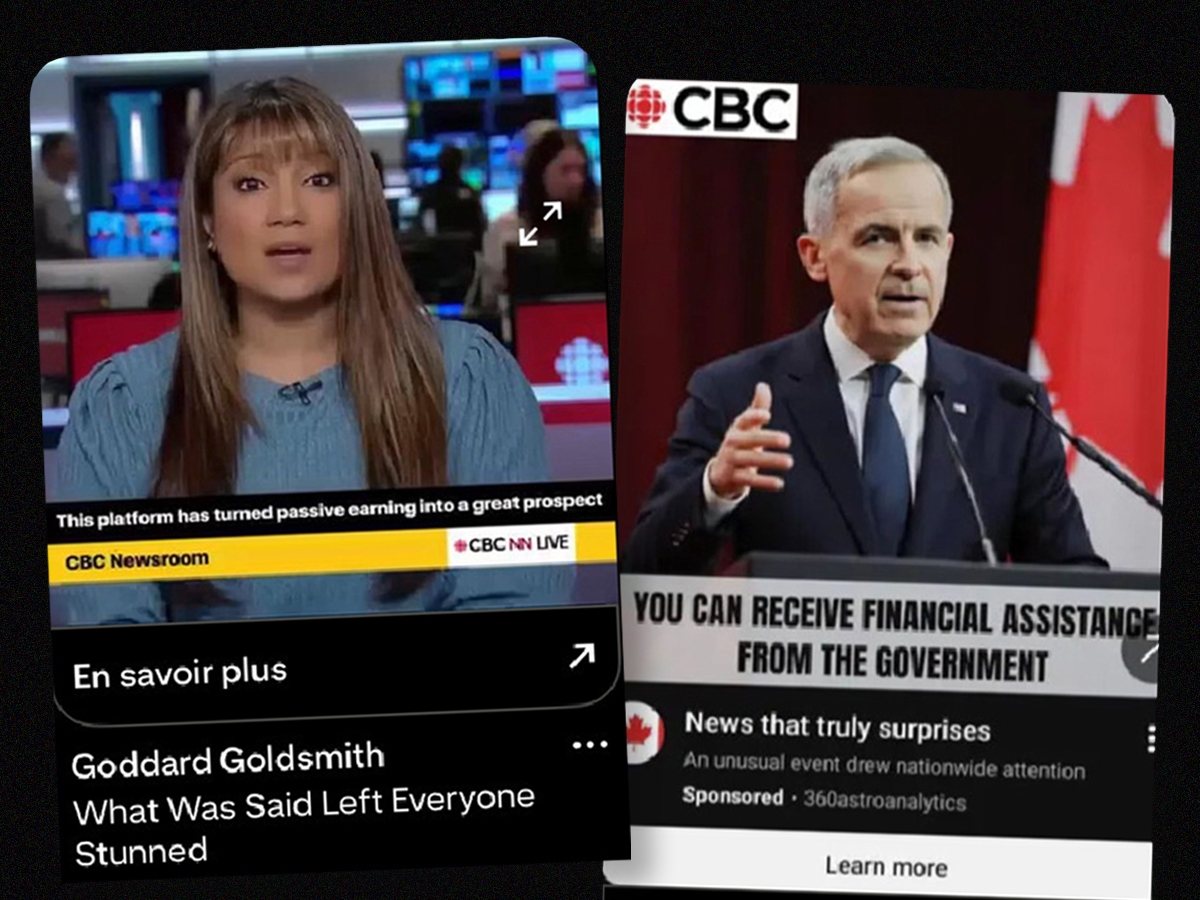
I’ve gotten used to the increased flow of ads and AI-generated content there over the years. But when a fake ad showing Mark Carney popped up, telling me that the government can provide me with financial assistance, that cheery digital sanctuary was ruined for me.
For two days in January, ads on Pinterest promoting financial scams using visuals of Canadian politicians targeted users in Canada. This campaign was likely an extension of previously documented scams targeting Canada and other countries on Facebook and X, sharing similar names, visuals and tactics.
The Tyee reached out to Pinterest for comment for this story. While The Tyee had initial discussions with Pinterest employees about providing a response, the company ultimately declined to provide an on-the-record comment. Company representatives did tell The Tyee the platform has since deactivated two accounts associated with the ads featured in this story.
The operation followed a three-stage format that relied on short-lived click-bait social media ads that feature politicians and media personalities, directing users to spoofed news articles and then to fraudulent pages to collect their data. The new campaign mostly relied on visuals showing Canadian Prime Minister Mark Carney and former prime minister Justin Trudeau, including a deepfake video of Carney promoting a fake program.
During and after Canada’s 2025 federal election, research by CBC and the Media Ecosystem Observatory documented ad campaigns on Facebook and X that targeted Canadians with fake and AI-generated political content to promote fraudulent financial schemes.
Ads used altered and possibly AI-generated images of politicians and media personalities, along with false political scandals to deceive users.
A report by the Canadian Anti-Fraud Centre in 2024 showed “an increase in cryptocurrency payments and the associated dollar loss,” because of investment, job and romance scams. In fact, cryptocurrency represented “the highest number of payments” and “most amount of money.” The report also showed that, based on all fraud reports received, those aged 60 and above make up almost 27.9 per cent “of the overall dollar loss.”
With the rapid development of generative AI, it is now easier and cheaper to produce synthetic content and deepfakes that are difficult to distinguish from authentic media to support these fraudulent activities. Canadians have already lost thousands of dollars if not more to scams that used deepfakes of politicians where seniors were tricked by videos depicting Doug Ford and Mark Carney; others saw a video showing Justin Trudeau and business figures like Elon Musk.
On Jan. 23, the Vancouver Police Department warned about cryptocurrency scams that stole a total of $1.3 million from two victims over several months in 2025. One of the victims, an 82-year-old man, lost $800,000 after responding to an online ad that he saw on the Google web browser. The ad showed a photo of Carney and encouraged investment in cryptocurrency.
Pinterest and AI content
In 2026, scammers have used the same approach but on Pinterest, a platform that operates as a visual search engine with about 10.7 million users in Canada. The platform is especially popular with women and gen-Z users, according to its latest third-quarter report.
A story by Wired on the surge of AI-generated content on Pinterest also notes the platform’s decision in 2022 to increase tailored ads, and an AI-assistant tool for advertisers launched in 2024.
Pinterest provides a label for AI-generated content, but the label does not appear on ads unless users click on the ad details provided by Pinterest.
Real politicians, fake headlines
I encountered a total of 10 ads during two days on Jan. 6 and 7, 2026. Six of the ads showed pictures and depictions of Carney, showing him presenting programs providing financial assistance to Canadians in addition to images of him along with sensational text. Some of the ads showed signs of low-quality production, with poor designs and typos. These ads were promoted by entities named Byte Fusion, Forfaith One, 360astroanalytics and Goddard Goldsmith.
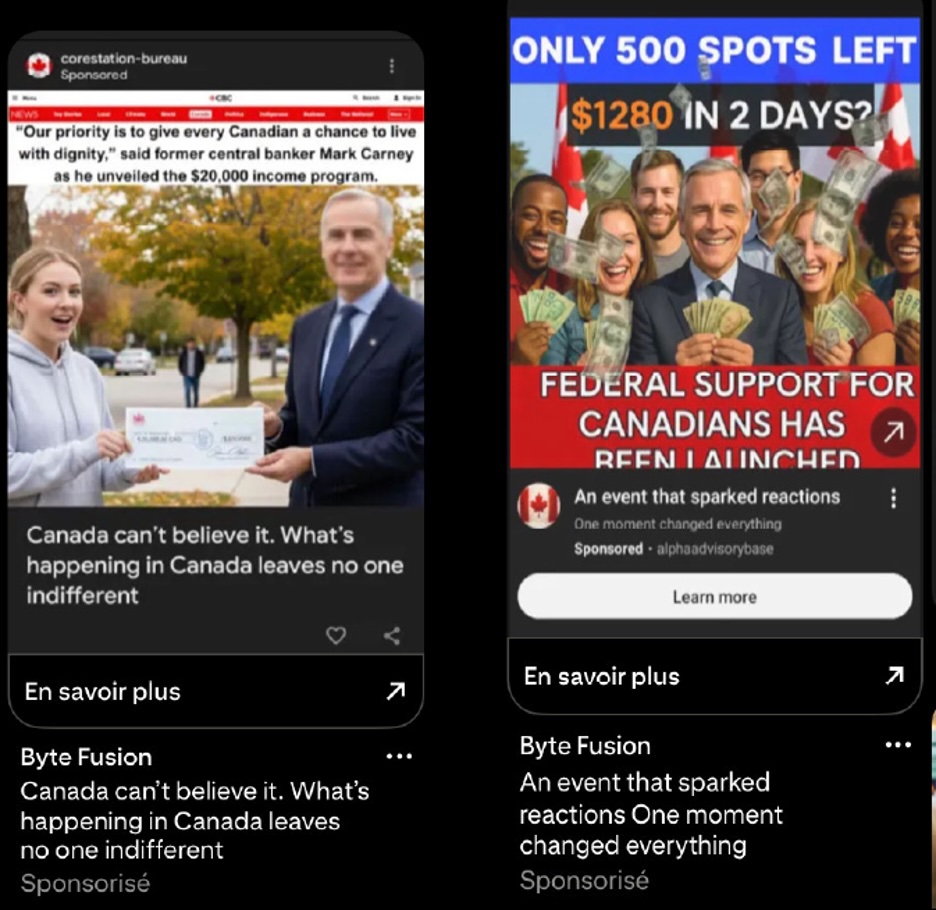
Other ads focused on impersonating the CBC, with two showing journalist Aarti Pole making an announcement related to a financial platform. The two ads were advertised by two different entities, Goddard Goldsmith and Byte Fusion, with two different click-bait titles.
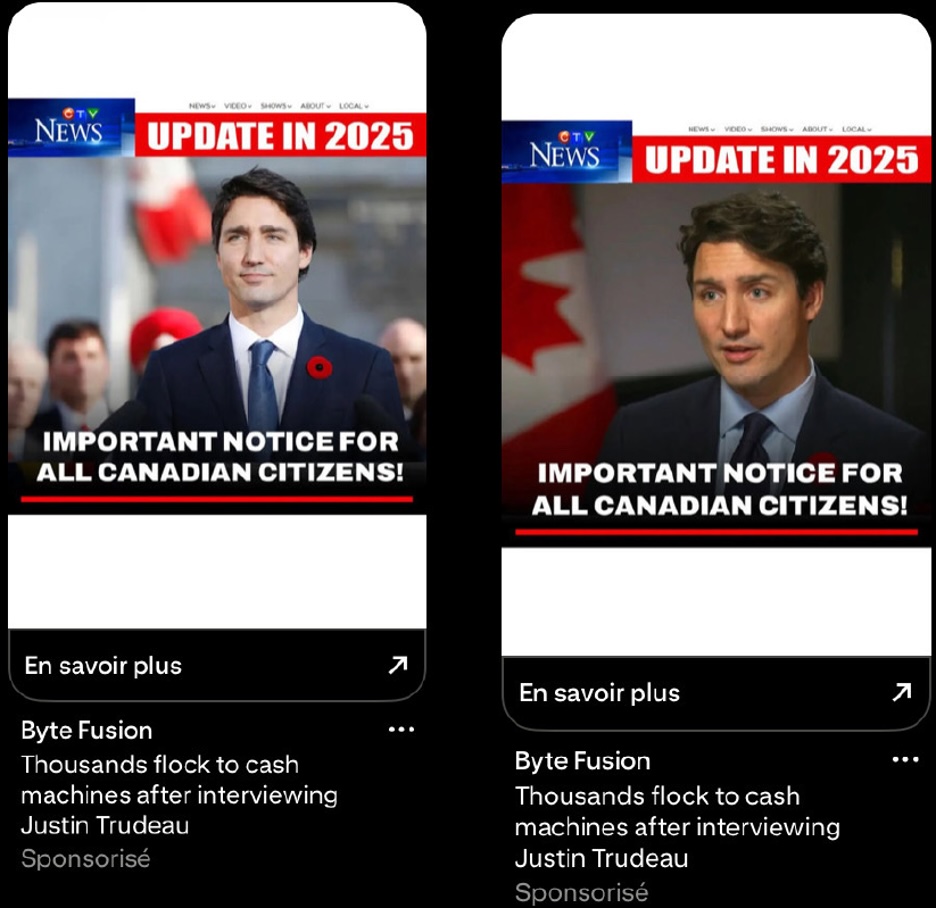
Others used publicly available images of former prime minister Justin Trudeau. The ads used the logo of news channel CTV News and in-text images announcing “Update in 2025.” These ads reused the title in one of the ads showing journalist Pole.
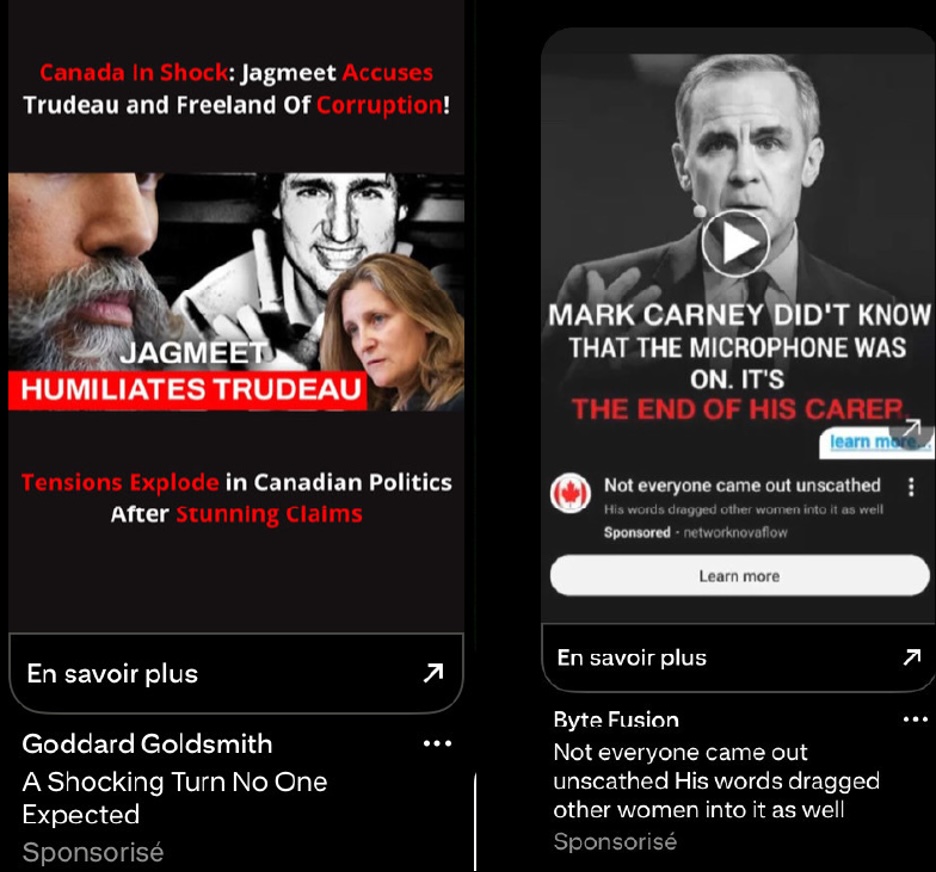
Other ads also mirrored the use of provocative click-bait titles about fake political scandals to drive users to their pages. In one example showing Carney, the on-image text used a narrative suggesting the prime minister had a “hot-mic” moment, though it included obvious typos.
This mirrors previous campaigns where similar layout and hot-mic narratives were used when discussing former NDP leader Jagmeet Singh. (Singh’s image was also used for a disturbing fake ad campaign that erroneously claimed he’d died.)
What happens when you click on the ads?
Ads redirected users to three pages that are currently unavailable. Two sent users to the website canada-times.firstnewsworld.life and one to the website newscoverage24.news. Publicly available Whois data shows that the first was newly registered on Jan. 4, 2026, just before the campaign started appearing on Pinterest, while the second was created on Jan. 15, 2025.
Testing access to these pages confirmed the use of geofencing and IP filtering, tools that are used to limit access to users in Canada. When accessed from another country or using a virtual private network set to a non-Canadian server, the links fail to load.
The first page showed a mock-up of a fake BBC article claiming that a man earned hundreds of thousands of dollars using “Mark Carney’s new initiative, Ont 365.” The article is presented as an investigation into the platform by a journalist who eventually proves that the financial scheme is legitimate. There are even fake comments on the article, which are sharing stories from people who supposedly earned money from investing in the platform.
The second page showed a fake CBC news article focused on promoting trading platform Bitechchain, describing it as a successful government program created by the Trudeau government.
The page on newscoverage24.news showed a mock CBC article falsely attributed to journalist Rosemary Barton, announcing the launch of the “Quantum AI” platform. Quantum AI has been previously identified as a scam after being promoted in previous ad campaigns on Facebook and X.
This fake article praised the platform and listed its features, promoting a “minimum entry point of $350 Canadian dollars.” The same message was promoted in a deepfake video of Mark Carney included in the article, promising that money invested will grow within a few weeks to thousands of dollars.
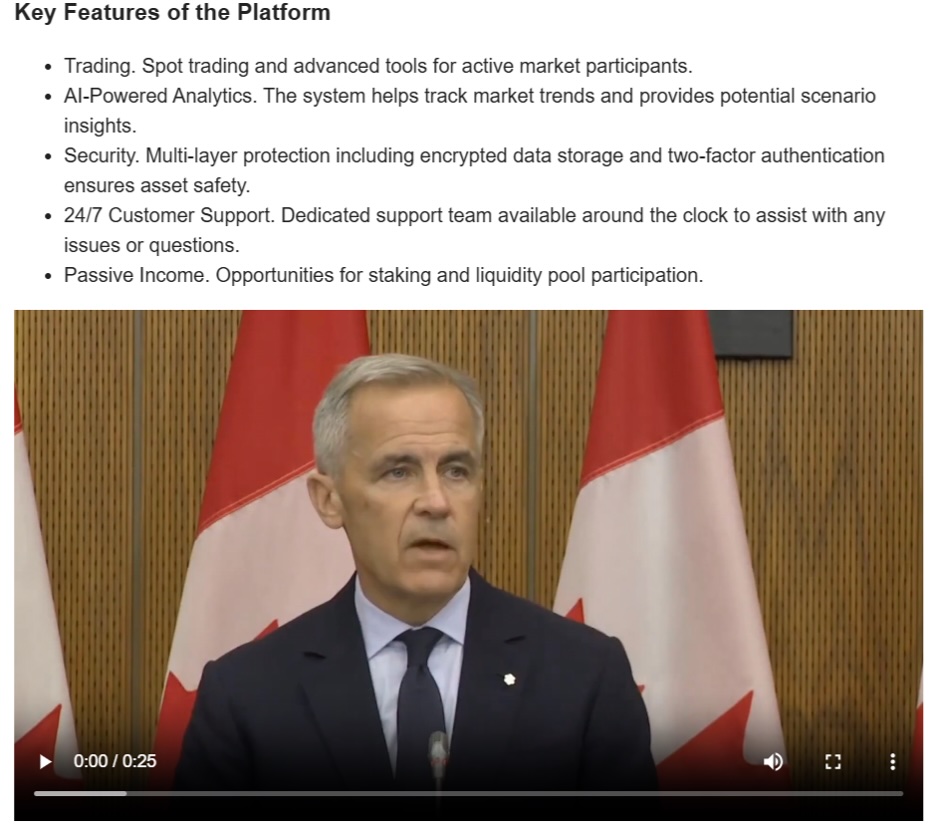
The last destination of the scam
After users click on the links in the fake news articles promoting these platforms, they are sent to the kinds of web pages often used for such fraudulent schemes. These landing pages are similar in design but presented under different names, using fake testimonials from celebrities and well-known business figures. They function as lead-generation funnels asking users for their contact information, and the scammers collect their data using an account setup form.

Two of the landing pages were hosted on the subdomain b.bytefusion.blog, sharing the same name of one of the advertisers identified on Pinterest. The domain bytefusion.blog shows a suspicious, yet more professional-looking, website presenting articles about various topics such as tech and lifestyle, possibly AI-generated, and all written by someone going by the name James Edward Harrison.
The first two articles published on the website during the period I did my research are about Carney’s and Trudeau’s leaderships and politics. When reviewing the two articles using a Canadian IP address, the articles about Carney and Trudeau directed users to the spoofed BBC and CBC articles. When accessed from a non-Canadian IP address, users are directed to the actual articles published by Byte Fusion.
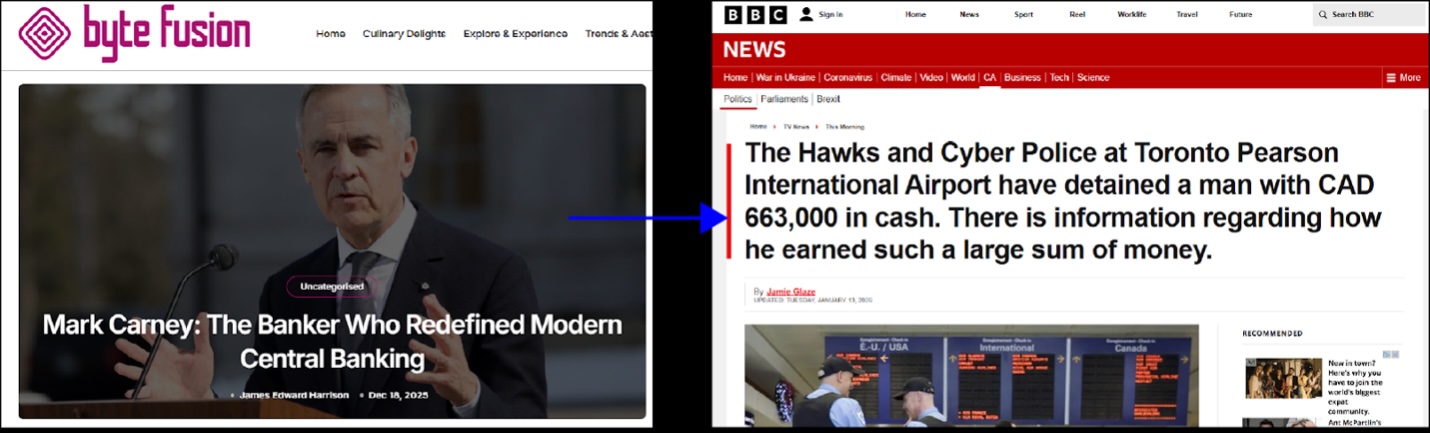
This primary domain appears to be functioning as a “filler” front that can be used to create subdomains that host financial scam pages.
The policy gap
This case demonstrates an important evolution in online scam campaigns, as scammers use flash campaigns with short lifespans on other platforms instead of relying on mainstream social media platforms.
The persistent targeting of Canadians highlights a growing trend and a critical vulnerability in the digital landscape. The European Union’s Digital Services Act can force “very large online platforms” to provide transparency about ads shown on their platforms and store ad information in a publicly accessible ads repository. But Canada doesn’t have the same legislation, so it’s currently not possible to review the ads that are shown to Canadians.
This regulatory vacuum prevents oversight and attempts to track and prevent malicious activities. Platforms with significant reach operating in Canada should be required to show necessary information about their ads in a publicly searchable database. And the database should include information about who paid for the ad, the time period it was displayed, the target audience, the visuals and text used, and whom it reached.
Without access to such information, similar malicious campaigns can reach users, scam them and disappear before regulators or the public can take notice.
How to protect yourself and vulnerable family members
It is important to protect yourself and family members from these fraudulent campaigns, especially campaigns using sophisticated technology.
The Canadian Anti-Fraud Centre recommends looking for warning signs when it comes to videos showing a public figure advertising investments, questioning videos that seem too good to be true, and being aware of signs of video editing. If it feels suspicious, use the centre’s list of fraud types, review tips on how to protect yourself, and call official numbers to confirm before making any financial decisions.
The Canadian Anti-Fraud Centre has tips about what to look for when it comes to these scam ads, starting with assuming that all ads featuring public figures selling something are fake unless you can prove otherwise.
The centre also suggests looking out for hints of video editing, unnatural movements, mismatched audio and odd shadows and lighting. When it comes to ads promoting cryptocurrency or other investments, you can check whether the investment company is registered with a provincial securities regulator. In B.C., that regulator is the BC Securities Commission.
Even though people of all ages can fall for these scams, especially as generative AI evolves, people who are over the age of 60 continue to lose the most amount of money. Family members can help prevent loved ones from falling for this kind of fraud by improving their own digital literacy and by taking steps like creating a verbal password to prevent family AI voice clone scams.
This article is part of The Tyee’s reader-funded Reality Check project exposing and explaining the rise of digital disinformation. ![[Tyee]](/design-article.thetyee.ca/ui/img/yellowblob.png)
Read more: Media, Science + Tech












Notice about commenting changes
The Tyee’s commenting system will be moving to a new platform on Nov. 12. If you’re already a Tyee commenter you must register with the new system on or after Nov. 12 with your preferred username.More information can be found here.