

 SHARE:
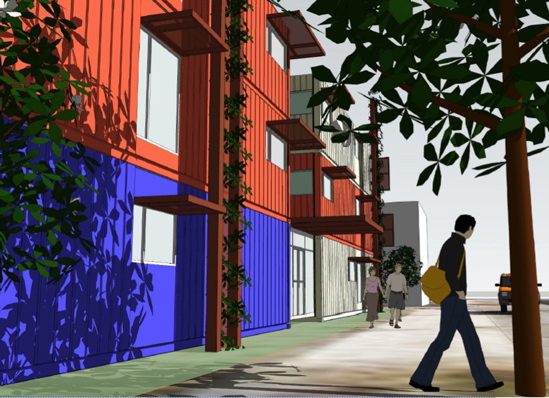
1/7 Container housing manufacturer MC Quarters offered to build this 43-suite supportive housing complex on a city-owned site at the corner of Princess Avenue and Powell Street. The Vancouver-based company offered to donate the cost of the container-based housing units, and help raise the estimated $1.6 million required for on-site construction.
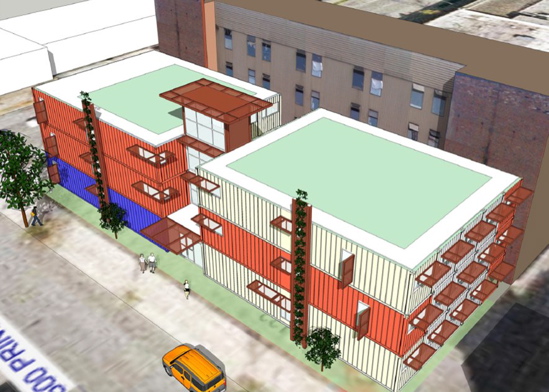
2/7 MC Quarters partnered with Coast Mental Health and architect Gordon MacKenzie to plan the project, which would include 43 small suites, as well as offices, a kitchen, common area, and laundry room. The proposal pegged construction cost at $3.1 million. That's $72,000 per suite. BC Housing is spending in the range of $350,000 per suite on the new homeless housing is its building in Vancouver.
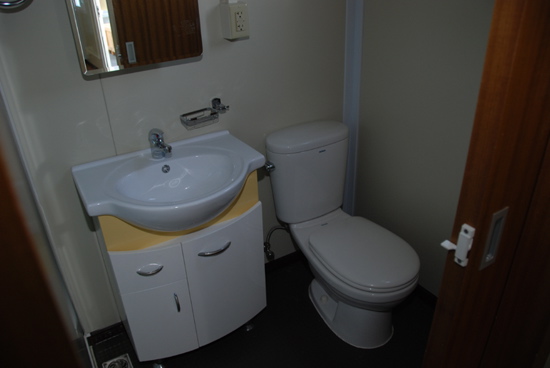
3/7 MC Quarters built a prototype unit to demonstrate the fit and finish of its container-based modules, which are manufactured in China.
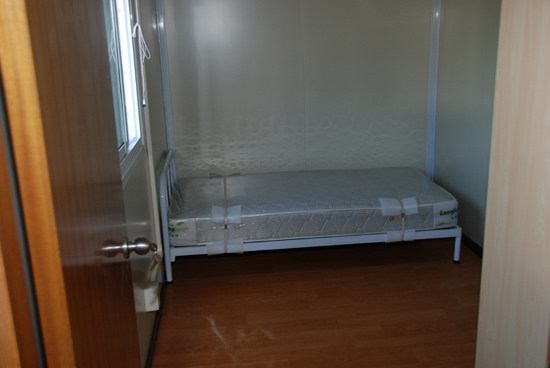
4/7 Here's another shot of the MC Quarters demonstration unit. While home architects such as Keith Dewey tend to take advantage of shipping containers' long beams to create wide-open floor plans, construction camp manufacturers such as MC Quarters utilize the containers' existing eight-foot-wide form to create smaller spaces for less.
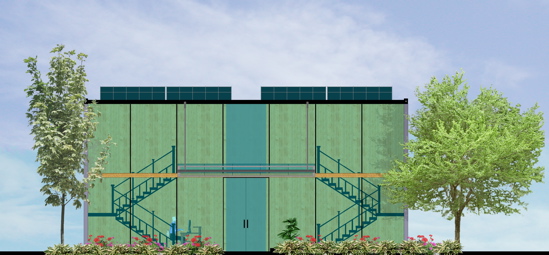
5/7 C-Bourne Structures prepared a conceptual proposal for dormitory-style housing to be built on the same Downtown Eastside site. The C-Bourne proposal included a glass curtain wall around the building, and use of beetle-damaged wood throughout the units. Some C-Bourne buildings also include features such as LED lighting, on-demand hot water, incinerator toilets and insulation rated at R-35 or higher.
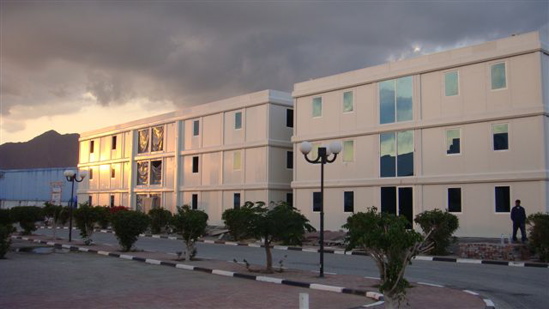
6/7 Isopod is a Canadian-owned company that has built thousands of units of container-housing in places as far-flung as Afghanistan, Russia and Saudi Arabia. Pictured is a project in Dubai. Vancouver-based distributor C-Bourne offered to lease the City of Vancouver a building somewhat similar to this for $350 per dorm room per month.
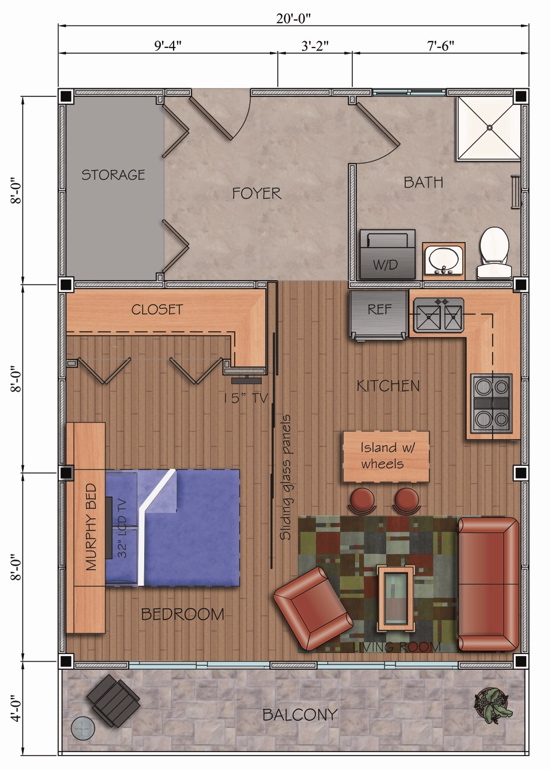
7/7 C-Bourne is also working with developers in Saskatchewan who plan to erect prefabricated apartment buildings, then rent the suites for $550 to $700 a month. The apartments could include 480-square-foot bachelor suites such as the one pictured above. Each 20- by 24-foot unit would feature a large glass wall overlooking a 20-foot-long balcony.
[Editor's note: Read previous stories in this series here.You can also click here to download a copy of the entire series in PDF.]
Last summer, Vancouver City Council invited several B.C.-based companies to submit ideas about how modular housing might be employed to house the homeless.
Three container-based proposals were among the five submitted. One firm offered to build a 43-suite supportive housing complex at no cost to taxpayers. Another offered to lease dormitory-style rooms for only $350 a month. Yet another offered to build a similar project from scratch using local labour at its Coquitlam factory.
But the Vancouver council's enthusiasm for the project was dampened by a distinct lack of interest from the province. Vancouver councilor Kerry Jang said, "This initiative just sort of stalled at the province."
This installment of The Tyee's overview of container-based housing takes a look at the three proposals.
MC Quarters offered free housing
"Basically, we are asking the city to identify a site where we could do a pilot project. And we will provide the funding to develop that pilot project."
That's the extraordinary offer MC Quarters president Frank Lo told The Tyee that he made to the city.
MC Quarters is a new company that is building pre-fabricated worker housing in China for export worldwide. It was founded by Lo, a longtime Vancouver resident and former shipping container broker. Lo figures he sold more than a quarter of a million shipping containers before launching MC Quarters.
Lo's concept involves adapting technology developed for refrigerated containers -- which are basically one steel box inside another, with foam insulation sandwiched between the walls -- for use as a structure in which super-insulated housing can be built.
MC Quarters sells construction camps to mining and oil companies. His company claims its container-based work camps are both more durable and more easily transported than the wood-frame modular structures sold by competitors such as Atco, Britco or Williams Scotsman. The B.C. company's first order is for a mining camp in the Yukon.
Lo's fledgling company also prepared by far the most detailed of all the container-based homeless housing plans submitted to the city.
MC Quarters hired architect Gordon MacKenzie to plan 43 units of supportive housing in a three-storey structure to be erected on a city-owned parking lot at the southwest corner of Princess Avenue and Powell Street. (See slide show at top of this page.)
In addition to 43 very small but fully self-contained suites, the proposed 13,755-square-foot building would include offices as well as a kitchen, common area and laundry room.
MC Quarters' proposal pegged the construction cost at $3.1 million. That's $72,000 per suite. Lo said he can deliver those units six months from the date he receives an order.
BC Housing recently started construction on six of 14 promised new homeless housing buildings in Vancouver. The suites planned for those mid-rise buildings are almost twice as large as the room-sized units in the MC Quarters proposal. But the BC Housing suites are expected to cost taxpayers more than $350,000 per unit.
About $1.6 million of the projected construction costs for the MC Quarters building is for on-site construction by local trades, with the other half allotted for the purchase of 30 prefabricated container modules. Lo -- who has already hired and architect and built a prototype with his own money -- said he has offered to put up the cost of the containers, and help raise the cost of the local trade work.
"This is basically a semi-commercial project as far as we're concerned," Lo said. "We want to do something for the community."
C-Bourne offered to lease rooms for $350 a month
Vancouver-based C-Bourne Structures is among MC Quarters' competitors.
Though C-Bourne's container housing proposal was neither as elaborate nor ultimately as generous as MC Quarters', it did include one particularly intriguing element: C-Bourne offered to lease the city however many units it needs for $350 per month per unit.
"We lease these units all over the world," said C-Bourne partner Grant Powell, who joked that mining juniors "never actually buy anything."
C-Bourne is the Canadian distributor for Isopod modular housing. Isopod is a Canadian-owned company that has built thousands of units of container housing in places as far flung as Afghanistan, Dubai, Russia and Saudi Arabia. Isopod owns one-third interest in a proprietary factory near Shanghai.
C-Bourne submitted a conceptual proposal for dormitory-style housing that could be quickly erected on any city-owned lot, and then just as quickly disassembled when the real estate was needed for some other purpose.
"I basically said to the city, 'Tell us what type of units you want, how many you need, and where you want to put them. We'll engage engineers and architects and bring you a proposal,'" Powell told The Tyee.
Powell offered to lease the city as many dormitory-style rooms -- with a shared bathroom down the hall -- as the city wanted for $350 a month per room. That's $25 less than the $375-a-month housing allowance the province provides welfare recipients.
After seven years, the city would be eligible to buy the rooms for $10 each.
"These units are virtually indestructible. There's no drywall to mildew or wood to rot," Powell said. "If the city didn't want to keep them, we would happily take them back."
C-Bourne is also working with developers in Saskatchewan who hope to erect pre-fabricated apartment buildings in communities near the tar sands.
"It's nuts out there," Powell said. "Some of those towns are facing an even worse housing shortage than Vancouver."
Plans for the prairie apartment buildings call for sprawling three-story walkups surrounded by parking lots. Most of the apartments would be 480-square-foot bachelor suites with full kitchens, bathrooms, Murphy beds and in-suite laundry facilities. Each 20- by 24-foot unit would feature a large glass wall overlooking a 20-foot-long balcony. (See a plan in the slide show at top of this page.)
Powell said C-Bourne can deliver and construct these instant apartment buildings in six months or less at a cost of about $100 per square foot (excluding land). He said the developer aims to rent these apartments for between $550 and $700 a month.
"We can do two-bedrooms, three-bedrooms, anything," Powell said. "This is just the tip of the iceberg."
Mogil offered to build in Coquitlam
While less detailed than either of its competitors, the third proposal offered the prospect of bolstering the B.C. economy by building its entire complex in Coquitlam.
Mogil Modular Structures was founded by Phil Wang and is run by his son Nam Wang. The family is from Korea, where shipping containers are more frequently used as offices and small shops.
"Japan manufactured shipping containers to start off. But the cost was just too high, so it shifted to Korea," the younger Wang noted. "Then the same cycle happened again, and the production shifted to China."
Mogil builds 10-foot-wide containers that better lend themselves for use as construction components. Because Mogil is focused on the North American market, its super-sized containers do not have to fit on container ships.
"That extra two feet makes a lot of difference," Wang said. "Shipping containers are nice. But the width is eight foot. It's just too narrow. By the time you do the walls, you put in a desk, and all you have is a little space as a corridor."
Mogil invested in all the tooling to make shipping containers from scratch, including massive metal-bending machines, precision plasma-cutting tables and a giant painting booth.
"We are pretty much self-contained," Wang said. "We bring in raw materials. We stamp, we bend, we produce our own components. We don't source out any work."
Mogil's camp business has slowed down considerably during the past couple years. "We had a good deal with the oilfields," Wang said, "but when that slowed down there just weren't any more orders."
So the family leapt at Vancouver's invitation to propose homeless housing. Mogil built a table-sized mockup intended to show off both its design and its local fabrication abilities.
"We built this miniature model just to show that we were really into it 100 per cent," Wang said. "We think these structures are ideal for housing. We would very much like to find a way to build some housing."
New vs. used containers
All three firms told The Tyee that the benefits of purpose-build containers outweigh the advantages of reusing end-of-life shipping containers.
"I am biased against used containers," said Lo. "I was in the shipping business. These containers go all over the world. You don't know what kind of freight they carry. And then you expect people to live in them?"
Lo added that new containers come from the factory with certificates that civil engineers can use to assess the load-bearing ability of the steel frame.
"You can't even tell them what kind of steel an old container was made of," Lo said. "If you have volume, your price difference on a per-unit basis is not large."
Nam Wang agreed. He said that even without the volume discounts available to larger firms, the cost of cutting, re-flooring and repainting a used container can wind up costing as much a new container.
"It's like you converting your hatchback into a pickup," Wang said. "A lot more effort is going to go into it to convert it, and it's not really made for that."
Both the MC Quarters and C-Bourne units come fitted out with fixtures that would seem familiar to any North American.
"Remember that nearly everything we install in our homes is already made in China," Powell observed. He said C-Bourne installs the same American Standard sinks and Bosch appliances available at the local Home Depot or Future Shop.
Powell added that the next generation of urban apartment buildings could just as easily include larger windows, LED lighting, bamboo floors, solar hot water heating or other green features.
'We are still doing this'
Another thing all three firms agreed upon was a sense of confusion about whether or not either the city or province will ever follow up on their proposals.
"Several months went by. We heard nothing. And then one day I got a call saying, 'You've got to come pick up your stuff.'" Powell said.
In response to his questions, Powell said the city told him only that, "BC Housing was not going to give them any money for this."
Wang recounted a similar experience.
"The whole idea with this was that we were going to give them a sweet deal so that we could help promote our product, right?" Powell said. "But if they don't see it, they don't see it."
City Councilor Kerry Jang, whose Vision Vancouver party has promised to end street homelessness by 2015, acknowledged that the process was dropped.
"We welcomed these proposals in order to raise awareness about this type of housing," Jang told The Tyee. "And then we referred them to BC Housing for consideration, because at the end of the day it's BC Housing that has to decide whether or not these units would fit their needs," Jang added.
"Nothing came of it after that. It just sort of stalled in provincial hands," he said.
On his own initiative, Lo recently met with Housing Minister Rich Coleman.
"It's a chicken and egg situation," Lo said. The city won't grant a site without some signal that the province will help fund the support services. And the province won't commit to a project that doesn’t have a site.
Lo said he is neither discouraged nor dissuaded.
"We are still doing this. I think the key is to have patience. Because the whole idea is for the community to benefit." Lo said. "I believe that it will work."
Representatives from all three firms have been invited to participate in this week's Quick Homes Superchallenge, organized by Architecture For Humanity Vancouver in association with the Design Foundation of British Columbia and The Tyee Solutions Society. ![[Tyee]](/ui/img/ico_fishie.png)
Read more: Rights + Justice, Housing


Tyee Commenting Guidelines
Do not:
Do: