
Books

America, Bad to the Bone?

Laxer and Wright portray US as empire, hardwired for evil. Too harsh?

By Peter Seixas, 16 Jan 2009, TheTyee.ca

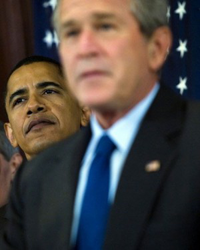
Barack Obama and George Bush

Imperialist in waiting?

The Perils of Empire: America and its Imperial Predecessors
James Laxer
Viking Canada (2008)

What is America? A Short History of the New World Order
Ronald Wright
Alfred A. Knopf Canada (2008)

Historians have long recognized a conundrum involving the past and the present. In order to write about history in a way that is significant for us today, they ask questions and frame issues that arise from contemporary life.

On one level, our present-day conceptual lenses (like nation, gender, power) are what enable us to think about the past; on the other hand, in the words of L.P. Hartley, "the past is a foreign country: they do things differently there."

If history is oversimplified, if historical characters and situations are simply flattened into earlier versions of ourselves and our problems, then history loses its power to show us anything new.

In the final months of the Bush administration, two mature left-wing Canadian thinkers, neither a historian by training but both well known for their ability to address a broad public, focus their gazes on the United States. Both express the horror and rage felt by most Canadians at "extravagant misrule," as James Laxer puts it, south of the border over the past eight years. Both are thus products of a particular moment in time.

Over a long career, Laxer has straddled academia, politics and public broadcasting, and has written a dozen books on themes of political economy and globalization, and on Canada and the United States through those themes.

Ronald Wright is the author of nine books, among them the 2004 Massey Lectures, published as A Short History of Progress and Stolen Continents: 500 Years of Conquest and Resistance in the Americas. Both have now written books that purport to use history to shed light on the present, with mixed results.

Touring empires

In 1836, American painter Thomas Cole completed his magisterial series of five landscapes entitled, "The Course of Empire," to show stages in the development and dissolution of empire. He combined allusions to Europe and North America to fashion a dire warning about the hubris of Jacksonian America: the seeds of destruction are present at the height of imperial power.

Cole wrote, "We see that nations have sprung from obscurity, risen to glory, and decayed. Their rise has in general been marked by virtue; their decadence by vice, vanity, and licentiousness. Let us beware!" American concern with the dangers associated with expansion and empire is thus nothing new, but writing about it has become a minor cottage industry since the ramifications of Bush's Iraq disaster have become widely recognized.

Laxer sets his stage with George Bush on the deck of the U.S.S. Abraham Lincoln, landing under the banner, "Mission Accomplished." The combination of unprecedented concentration of military power and cultural influence on the one hand, with a debt crisis and the nadir of America's international reputation on the other promises a dramatic plotline. "One of the greatest challenges for people in any epoch," Laxer writes, "is to imagine vast changes to the political and societal order in which they live."

Laxer's definition of empire is broad and open: "an empire exists when one people or state conquers, subjugates, or dominates another people for an extended period of time." He notes the reluctance of American politicians to speak in terms of empire, given the obvious incompatibility between an ideology founded on popular sovereignty and respect for human rights, and the domination of one people by another.

Laxer sees two possible futures: that the U.S. will give up its founding democratic ideals and pursue a course of unbridled power or, alternatively, that it will give up its empire.

Ignatieff as empire seeker

He further defines the scholarly debate among imperialists as divided between "unilateralists" (i.e. Niall Ferguson and the neo-conservative "Project for the New American Century") and "multilateralists" (Zbigniew Brzezinski, Francis Fukuyama and Michael Ignatieff). These are two strategies, he asserts, with the same imperial ends in sight.

Two problems surface immediately. First, Laxer's sketch of the scholarly debate serves his dichotomous scheme (unilateralists vs. multilateralists), but hardly does justice to the outpouring of literature on the topic. The authors listed above comprise the entire reference list. One would think that Laxer's attempt to draw lessons from the history of empires and apply them to the United States today was a new project, not one that had been undertaken very recently by eminent American scholars like Charles Maier (Among Empires: American Ascendency and its Predecessors) or the team of Craig Calhoun, Frederick Cooper and Kevin W. Moore (Lessons of Empire: Imperial Histories and American Power) or a multitude of others. Though the book is intended for a broad audience, one does need to ask just how little intellectual context a serious writer can get away with.

Second, if "multilateralists" seek to promote an orderly world through multi-state cooperation, and if those states do remain sovereign, then the appropriateness of the term "empire" becomes questionable at best.

Writing in Foreign Affairs, Alexander Motyl has gone further, suggesting that the ubiquity of "empire" talk may be quite a specific response to the Bush administration's reckless unilateralism: "The United States and its institutions, political and cultural, certainly have an overbearing influence on the world today, but why should that influence be termed 'imperial,' as opposed to 'hegemonic' or just 'exceptionally powerful'?"

By the end of the book, Laxer himself backs away from the idea that multilateralists are just another variant of imperialist: "If a more multilateralist tendency prevails," he concludes, "the world can look forward... to a long-term shift away from empire toward an international regime in which a myriad of voices, tendencies, peoples, and ideas have their place in shaping the world." This is surely not an outcome we need to fear.

Beware of hubris

The second section of the book lays out a typology of empire: slave, mercantile, capitalist, and the post-Soviet "global" empire, with individual chapters on Egypt, Athens, China, Rome, Spain and Britain. A book that promises to mine "the lessons" of empire, however cautiously, probably needs to be based on what scholars already know about historical empires. Laxer's "Egypt" is based entirely on the Oxford History of Ancient Egypt; his "Athens" entirely on J.B. Bury's history, published in 1913. Is this good enough?

Each of the chapters in this section yields a small nugget that Laxer suggests might apply to the 21st century world. Thus, Egypt created an aura of metaphysical permanence, demonstrated in the connection between the physical monuments of the pyramids, the lives of the pharaohs, and the order of the universe. Athens suggests, "that the American Empire will either have to be short-lived or... have to pass through a period of intense political and cultural crisis and emerge as an imperial state that has banished the anti-imperial ideals on which it was originally based."

The Spanish, Laxer observes, learned few other languages and relied on financial resources of capitalists in other parts of Europe. "Like Americans in our time, the Spanish became famous for their arrogance and their narrowness of culture." For their part, the pre-World War I British "failed to see that the globalizing regime [mistaken for the human condition] was, in fact, the product of a particular power arrangement in which one imperial power dominated the globe."

These are the components of a morality tale much like Cole's series of paintings or Shelley's "Ozymandias": Beware imperial overstretch. Nothing lasts forever. They set up the final section, which surveys "four strategic challenges" faced by the United States today: the relationship with the Islamic world; China; Latin America; and petroleum supplies and "the emerging global environmental crisis." The tour of imperial history helps very little in the specifics of this analysis; Laxer's important lesson is that, given enough time, everything changes.

A final chapter fails to put the Bush policies of the last eight years into a larger context. Despite what Laxer has said about the twin approaches to empire (unilateralist vs. multilateralist), as the book draws to a conclusion, the American Empire is the Bush disaster. Approaching the present, The Perils of Empire descends into cable news discourse, with little distance or analytical clout, but rather, a somewhat breathless set of possibilities, sure to be revised in the light of the unfolding of tomorrow's events -- an election, for example, or a meltdown of global finance.

The profundity of the change that could be coming is surely the highlight of the book. Laxer's treatment of the current situation convincingly demonstrates how precarious it is, while the historical vignettes underscore the historical fact of cataclysmic disruption facing powers that have dominated the globe in what seemed like eternal power arrangements.

Born evil

Laxer's work acknowledges the change and the contradiction between the democratic promise of the Declaration of Independence and the swashbuckling imperial arrogance of the Bush administration. For Ronald Wright, America was born evil and has been evil ever since: not much has changed at all.

Wright sets his thesis at the outset:

...recent difficulties run much deeper than a stolen election and an overreaction to a terrorist assault. The political culture and identity crisis of the United States are best understood as products of the country's past ...[T]he frontier became a breeding ground for militarism and religious extremism ... The nation did not wake up one morning and find that it was suddenly imperial; it always has been so.

Wright arrives at this view by reading all of American history, from the Columbian encounter to today, through the narrow lens of the Bush-dominated present. Moreover, he provides no footnotes or references to show where his interpretation fits within 30 years of critical American historiography, making his book appear (to non-specialists) more original than it is. In 1975, when Francis Jennings upset the traditional dichotomy of "savage" vs. "civilized" in The Invasion of America, it represented a breakthrough, but this is hardly innovative today. Wright has taken the work of Jennings, along with Howard Zinn, Alfred Crosby and William Appleman Williams -- all writing in the '60s and '70s -- and worked them into a sweeping synthesis, with none of the nuance or complexity that has been built upon their early trailblazing.

The result is a series of startling leaps backward from today to two, three or four hundred years ago, accompanied by sweeping (but evocative) moral judgments. Thus, the Spanish were "uncouth and violent strangers"; the British immigrants behaved "with all the desperation, superstition and showy violence of early post-medieval Europe." The materialist analysis of the first substantive chapter, "Loot, Labour and Land," degenerates quickly into character assassinations of the bad Europeans.

Ahistorical history writing

This is curiously ahistorical history. In Wright's interpretation, European explorers and settlers started out as murderers and rapists, Native Americans as impotent resisters and victims; and that is pretty much how things ended up. The chapter on colonial America provides almost nothing on the colonial economy (notwithstanding the previous chapter's promise of a materialist analysis). The American Revolution passes by in a blink, within the space of a couple of pages.

Noted historians such as Joyce Appleby, Bernard Bailyn and Gordon Wood might as well have put elsewhere the energies they devoted to untangling the complex of ideologies that surrounded the upheavals of the late 18th and early 19th centuries. The chapter entitled "White Savages" has no reference to the writings of historians Richard White or Gary Nash (among many others), whose crucial contributions led to the re-thinking of relations among "red, white and black" (as Nash's earliest work framed it), none of whom was merely a passive victim in their struggles.

Indeed, despite a superficially impressive 18-page bibliography in Wright's book, most of the historical writing dates from the 1970s and '80s, with more recent references dominated by the work of journalists and pundits.

Working backwards

In Wright's reading backwards from the present, history appears to offer "foretastes" of the future. McKinley wanted the Philippines "just as George W. Bush wanted Iraq," while his secretary of war, Elihu Root, presages Donald Rumsfeld. Wright's most brazen mining of the present comes, however, through reading back from the presidential elections of 2000 and 2004 and their "red" and "blue" states. All U.S. history is thus a war "between the sophisticated internationalism of the seaboard and the parochial extremism of the inland 'backwoods.'" By 1812 "the United States was splitting into the two cultures that still contend within it: educated, establishment Easterners and illiterate, isolated, hard men of the hinterland..."

This simplistic projection of the election of 2000 works very poorly in explaining the gathering storm over slavery that led to the Civil War: where would log-cabin-born Abraham Lincoln fit in such a scheme? The red/blue dichotomy offers little help, either, in understanding pivotal battles over Reconstruction, the accomplishments of progressive women in the early 20th century, workers' activism in Depression-era conflicts or the Civil Rights movement more recently.

In the penultimate chapter on the Cold War, Wright recapitulates the ironically unchanging dynamic in the soul of America: a widespread fear without end, of "…heathen Indians in the seventeenth century or an 'axis of evil' in the twenty first." And so, "isolated, unschooled, messianic in their thinking... the frontier folk came to see themselves as victims... During the Cold War, they became, as it were, Afrikaners with atomic weapons."

History at its best aims to show how things developed, with the future in some sense up for grabs at each moment in time, subject to the decisions, wise or foolish, of those in power, the resistance or capitulation of those who are not, the interplay of unintended consequences, and above all, the possibility, reality, indeed the inevitability of change, which Laxer makes so central in The Perils of Empire. Wright's narrative starts from the fixed and over-determined present, from which it reaches back, to find essences and foreshadows. Such a method can never yield a satisfactory historical explanation, since it is clear from the beginning that the outcome has already been set.

Fetch us a better frame

Public intellectuals are always faced with the question: how much can the public handle?

Books like The Perils of Empire and What is America? offer big interpretive frames that might help to shape the public perception of the past. At their best, they could provide a conduit that helps to mobilize recent scholarship to shift the terms of debate about American power, continentally and globally, by providing links between recent academic history and public discussion of policy issues.

Moreover, a Canadian perspective on the United States could offer something distinctive, not only at home, but to an American readership as well. But what should the public demand in the way of scholarly rigour and disciplinary integrity? Laxer and Wright have set the bar disappointingly low. When the lens of the present is too narrowly focused, our perspective on the past is distorted rather than clarified, our horizons constricted rather than broadened. Present-ist history copes poorly with the passage of time and the inevitable change it brings.

With the impending inauguration of Barack Obama, Wright's answer to the question of "what is America?" can be tossed into the remainder bins -- with a huge sigh of relief.

Related Tyee stories:

 [Tyee]

29  Comments:

Login or register to post comments

  • robertjb2

    3 years ago

    America, Bad to the Bone?

    Writers, reviewers,and scholars can disagree until hell freezes over but this does not negate the stark reality that the USA today is one very f---ed up country. This is not just the view of two Canadian leftist writers but also the view of many of America's own best and brightest.

    The biggest difference between America of the past and the America we now know is that it can take us all down with it.

    We can no longer consider ourselves disinterested observers. Their fate will very much be our fate and we cannot afford silent compliance in the face of this tyranny.

  • mcwar

    3 years ago

    America, Bad to the Bone?

    "if "multilateralists" seek to promote an orderly world through multi-state cooperation, and if those states do remain sovereign, then the appropriateness of the term "empire" becomes questionable at best"

    However, if the governments of these supposedly sovereign states are either blatantly (Iraq, Pinochet's Chile, etc.)or clandestinely (Orange Revolution Ukraine, Suharto's Indonesia) chosen by the U.S., any term but "empire" is not only questionable, it's inaccurate. The U.S. is an empire and consent to its "hegemony" is manufactured - just as it was by all previous empires.

  • James Burns

    3 years ago

    "Multilateral" on a state

    "Multilateral" on a state level perhaps, but unilateral culturally, and to a lesser extent racially.

    States that differ significantly culturally from Anglo-Saxon norms and/or where the population is largely of non-western European origin, exist to be exploited, but with a patina of foreign "aid" and with self-deceptive notions of civilizing the savages.

    It's British style-empire as opposed to say Darth Vader's or W's style. It doesn't result in less murder, it just does it without "shock and awe".

  • Jeffrey J.

    3 years ago

    Not so harsh

    Some scholars write to analyze nuances between academic subjects. Others seek to speak out about clear and present dangers facing society. While the academic world of ivory tower fact sifting has a role, speaking out like Laxer and Wright have done takes courage and vision.

    Many authors have written in precisely this fashion, starting with Suetonius: The Lives of the Twelve Caesars, which features the overwhelming ethical failures of Roman emperors. In the 19th-20th century such writers included Karl Marx, William James, Bertrand Russell, Noam Chomsky and Naomi Klein.

    Prof. Seixas observations may work as an academic parsing of these two excellent books, but the same arguments could be made about the ethical outrage expressed by Marx, James, Russell, Chomsky and Klein.

    Unfortunately, academia has mostly failed to stand up to the tiny minority of elites who are responsible for dismantling society as we know it. I say, bring on more Laxers and Wrights! Great to see this discussion.

  • Rod Smelser

    3 years ago

    TWO I DON'T NEED TO BOTHER WITH

    My thanks to reviewer Peter Seixas for allowing me to add two additional titles to the DO NOT READ list. If his description of Wright's book is accurate, it appears that the Wright tome can be placed on the same part of the imaginary DO NOT READ shelf as those of Murray Dobbin:

    Quote:
    Indeed, despite a superficially impressive 18-page bibliography in Wright's book, most of the historical writing dates from the 1970s and '80s, with more recent references dominated by the work of journalists and pundits.

    I wonder if Laxer or Wright, in treating Bush as the typical rather than the atypical US President, have decided to rush these books out the door prior to next Tuesday, when President-elect Obama is inaugurated? There's going to be more than cartoonists who will mourn that day.

  • PatrickMcEvoyHalston

    3 years ago

    Writing for the broad (and presumably rather simple) populace?

    Seixas chides the simplistic and flattening, and looks for nuances and complexities, but offers, with his "Present-ist history copes poorly with the passage of time and the inevitable change it brings," the kind of foggy, near mystical (and non-specialist) overall sense of historical causes, of history, that materialist historians (for one) have long seen as, at best, pointless parlour sport.

    (Also, Jeffrey J: Assuming Seixas fairly summarizes the books he is reviewing, it would seem both Laxer and Wright are more directing our attention to American heritage/ American culture than to a "tiny minority of elites," to understand America's current fix and likely future.)

  • G West

    3 years ago

    Rod

    In my view, the review is wrong, and wrong-headed - especially on the Wright book - which I have read.

    The Laxer one I haven't so I shan't comment on it.

    I'll post a review of Wright's book on the weekend...in the interim, suffice to say I think it's well worth the cost and the effort.

  • Booker

    3 years ago

    Confirmation bias

    This is one of the most thoughtful book reviews I've read on the Tyee. While I have enjoyed Laxer's and Wright's books in the past, there is no excuse for gross simplification. When progressive writers analyze the U.S. they are sometimes guilty of only looking at the data that confirms their argument and not at the data that muddies the picture or makes it too complex. Hence the Mountain-west, the Midwest "red states" become the home of crazy fundamentalist uber-patriotic militarists. While those people do exist, the real picture is much more complicated, as the elections of 2006 and 2008 showed.

    Yes, Palin and her ilk number in the millions, but probably several million Republicans voted in 2008 for a liberal black Democrat. Add that to the data.

  • rangergord

    3 years ago

    born evil

    Yes the US was born evil. From its beginnings the illuminati worked behind the scenes in concert with the founding fathers. The conspiracy continues to this day and it does not matter whether the republicans or the democrats are in power. Barack Obama is much better than George Bush but Obama's closest advisors include Z. Brzezinsky and other insiders affilitated with the Council on Foreign Relations and the Trilateral Commission. And these only include the people we have been officially told about. Democracy is a sham.

  • RickW

    3 years ago

  • G West

    3 years ago

    But hardly a surprise

    But hardly a surprise that someone with degrees from Swarthmore (BA) and UCLA(PhD) and a teaching qualification from Temple (as well as an MA from UBC) might not want to think of his home and natal land as an 'evil empire'...

    After all, I think we can be pretty certain that Peter Seixas doesn't see himself as one of Wright's "...illiterate, isolated, hard men of the hinterland."

    On the other hand, the good professor seems to have left the United States at a particularly appropriate time for someone not so interested in America's 'foreign adventures and 'quasi-imperialist' tendencies....interestingly enough a time when the President(s) of the United States were 'liberal' Democrats as well.

    We are, after all, products of our past and our historiography ought to take that too into account.

    And, personally, I’d sooner see a lot more members of the academy coming from Canada and writing from a Canadian perspective – people like Wright and Laxer funnily enough.

  • Dungeness_Crab

    3 years ago

    "natal?"

    http://en.wikipedia.org/wiki/Natal

    I'm pretty sure you mean "native," Mr. West. Correct me if I'm wrong.

  • SharingIsGood

    3 years ago

    Dungeness_Crab: Natal is correct

    Mr. West used natal quite correctly. I can see why you may have been confused and Googled the word to find the link you gave.

    However,Natal:
    http://www.merriam-webster.com/dictionary/natal

  • Dungeness_Crab

    3 years ago

    SIG

    I stand corrected, sir. Thank you!

  • ME2

    3 years ago

    ethics

    Throughut recorded history the role of politics and gov't has always devolved into profiting the rich at the expense of the poor, and Lewis Lapham's essay which Rick W has linked should be proof enough for anyone that nothing has changed.

    And so Peter Seixas' analysis leaves me with "So what? What else did you expect?", for all we've gotten from him is yet more discusssion about the politics with which we are already too distressingly familiar, and not an exploration of of the ethical dilemma which is implicit in the meaning of "Bad to the Bone".

    Clearly there are no ethical guidelines to which either the public at large - the consumer society - or the parasitical ruling elites feel bound to. Theoretically, our Christian religions provide such guidelines, but they have long abandoned promoting them, preferring instead to focus upon guilt tripping the sexual peccadillos of their followers.

    This is particularly evident with the Fundie's Moral Majority, with its millionaire televangelists and its obsession with materialism and militarism - all in the name of "God". That is not to excuse the more traditional churches, either, for they are not willing to offend wealthy parishioners with sermons about their misplaced belief in The Market and its abhorrence of ethical practices.

    I am one of those who think Bertrand Russel said it best when he wrote "Civilisation has progressed not because of Christianity, but in spite of it"

    This is not to dispute the fact that athiesm and non-religion are on rapid increase. Rather, it is beyond dispute that if our preachers focused upon ethical practices in the marketplace, and publicly shamed the abusers, considerable change would happen, and very likely the politicians, ever on the lookout for votes, would get on board too.

    What IS clear is that if we do not abandon our present ways and adopt some ethics we can all follow, there's no way out of the mess we're in.

  • G West

    3 years ago

    Another perspective on Ronald Wright

    What is America? A Short History of the New World Order

    Ronald Wright’s book is short – 176 pages of text and an extensive section of notes and references – though none of the kinds of footnotes Seixas seems to prefer. A curious complaint from a man who has, given his current occupation, been more concerned about ways to get young people to engage in the activity of becoming aware of history as a process with meaning to everyman. As a piece of historical scholarship it won’t compete with Niall Ferguson or Paul Johnson but then, it wasn’t meant to.

    Wright, in some ways, has defined his non-fiction work fairly narrowly; in some ways, he keeps writing the same book again and again – circling the same question and approaching it from different directions. He is, at bottom, an anthropologist who has dedicated his life to exploring the effects of the invention of the New World – that is, 1492 and its aftermath – upon world and especially ‘western’ culture with a primary focus on the indigenous peoples of North and South America.

    Furthermore, he finds his sources, whenever possible, from the narrative record – the recorded words of real people – for example in “Stolen Continents” from the actual words of Amherst, the British officer who first adopted the stratagem of eliminating native populations with smallpox ‘blankets’.

    Far from dismissing the United States as ‘bad to the bone’ he constantly sets up a parallel between what the new republic ‘said’ it represented and what it actually did. This may be discomfiting for an ‘American’ like Prof. Seixas, but it is exactly the kind of thing that many Americans and Canadians need to hear about their colonial past. A set of 'facts' which is both inconvenient and troublesome and an attitude of mind which has certainly coloured the 'idea' America has of its own inheritance.

    And, as Wright himself says:

    “America, which helped set the Europeans on their new path half a century ago, must now examine its own record – the facts, not the myths – and free itself from the potent yet potentially fatal mix of forces that created its nation, its empire, and the modern world.”

    I wonder, seriously, if Seixas actually read the book.

  • Okanagan Orchardist

    3 years ago

    Susan Jacoby

    Thank goodness I read Jacoby's "The Age of American Unreason" before the good professor ripped apart what I thought was an interesting, well documented book. Or has he?

  • Peter Evanchuck

    3 years ago

    Americas route of destruction and mayhem greed & power

    As long as America deems itself god of the universe, the world is in trouble since it unilaterally picks and choses what's good and what's evil. When u get on that no fly list it don't matter if your a saint or a sinner in their eyes you ain't no good. It don't matter if the people elected you (Palestinians elections) if you're deemed a terrorist you are without trial, without hope and like a Canadian child Khadr, you are sent away, tortured randomly by barbarians and thrown to the wolves to be eaten like warm toast. God help us.

  • realisticman

    3 years ago

    A Short History, that's for sure

    With this new mini-book Ronald Wright has reduced the value of his previous works. His premise could really be applied to virtually any country on earth. What tribe or country does not have skeletons in its closet? Now we see that Wright has put his name on this collection of rather boring repetitive highlighting of attitudes and the supposedly consequential results, we understand what Wright's understandings and musings have been all along.

    The inspiring allure of the concept of the United States is diminished to irrelevance by the constant negativity; as though it was a conspiracy by design of its DNA.

    That he would publish such a thin collation and present it as an historical overview, rather than what it is - a rambling stream of consciousness, further diminishes it.

    There are so many references it's as though the book is an introduction to what one really should be reading instead - as long as one has bought the bias.

    A more balanced postulation can be found, and more contemplation stimulated, by picking up a few dusty old editions of any number of decent magazines.

  • G West

    3 years ago

    Constant negativity?

    Sounds to me as though you picked it up at the bookstore and flipped through the pages.

    I think you should take the time to actually read it....

    I take it you read the title at least. For your information, in case you didn't, here it is again:
    What is America? A Short History of the New World Order

    Please also take note of the pun in the title....

  • G West

    3 years ago

    As for the 'allure' of the US

    If you'd read the book, you'd realize what that allure is based on: a stolen continent and the legacy of more that 200 years of real and implicit slavery.

    That, my friend, is more than a 'skeleton' in the closet.

  • G West

    3 years ago

    erratum

    should be "...legacy of more than 200 years of real and implicit slavery."

    One only hopes that, with Obama's accession to the 'throne' of the 'city on the hill' that it may actually have a chance of becoming something with an air of 'allure' about it again....

    But, don't hold your breath.

  • realisticman

    3 years ago

    Mr West

    I received the book last year and I have read it. Sorry to disappoint and prove you to be wrong, again! Your sweeping condemnation is entirely predictable. It's perfectly clear that you and your clique yearn for disaster so as to be able to shriek, "We told you!". It is also a manifestation of a somewhat trendy, thank god only in one small circle, chronically morose mentality. Fortunately, particularly today, the wind is not in your sails.

    It's a pity the book was around $20 because as the writer says, it will soon be in the Diatribes Bin for $2.99.

  • G West

    3 years ago

    Well

    Then you should read it again - and spend a bit more time on the notes - they're almost as interesting as the text.

    By the way, did you actually 'read' what I wrote?

    In case you missed it, I'll post it again, for emphasis:
    One only hopes that, with Obama's accession to the 'throne' of the 'city on the hill' that it may actually have a chance of becoming something with an air of 'allure' about it again....

    One wouldn't have to mention that Wright's book was actually written and published long before Obama was even a candidate for US President, would one?

    Sorry you didn't like the book - I expect it made you uncomfortable.

    I think that's a good thing.

    Cheers.

    By the way, 'diatribes' is YOUR construction, not Seixas's.

  • G West

    3 years ago

    I am glad to hear

    I am glad to hear that someone (a 'friend' presumably) gave you the book - assuming that's what you mean by 'received'.

    The fact that someone else in the 'real' world sensed you might 'learn' something by reading it gives one hope that you and your attitudes are not irremediable.

  • realisticman

    3 years ago

    Lots of traffic

    You'd be surprised at the volume of scribbles that come across the threshold.

    I wasn't at all uncomfortable about reading this unorganized and frequently tedious book. Somewhat bored though. As you said, "in some ways, he keeps writing the same book again and again – ".

  • G West

    3 years ago

    Let's leave it at then

    We disagree.

    Not much about that that's news. You might find me a little less inclined to spit at you if you didn't make the kinds of personal comments about me that you seem disinclined to forego.

    There are lots of examples - as you know.

    There's a difference between questioning an ideology and attacking a person.

    An important difference.

    As Ronald Wright puts it: “My school days taught me that the world is run by fools and knaves. So I set out to be free to run my own life. Writing has been a way of doing that. No doubt I am sometimes a fool and knave, too, but at least I answer only to myself.”

  • G West

    3 years ago

  • G West

    3 years ago

    For those who click on the above link after Thursday 21 Jan

    It's a notice of a lecture Wright is giving at the University that night...

    • The discussion for this story is closed. No more comments can be added.