Books

As China's 'Concrete Dragon' Devours Nature

Enviro efforts in BC are dwarfed by growth after Mao.

By Geoff Meggs, 26 Dec 2008, TheTyee.ca

beijing.png

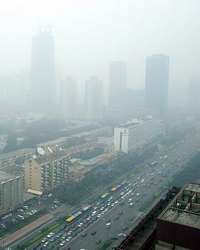
Beijing shrouded in smog.

  • The Concrete Dragon: China's Urban Revolution and What It Means for the World
  • Thomas Campanella
  • Princeton Architectural Press (2008)

Grim economic news from China: growth is expected to slump below 10 per cent a year for the first time in three years. Will this mean only one new million-person city next year, rather than two? A coal-fired plant every seven days, rather than 10?

Given B.C. growth forecasts of less than one per cent, China's plight may seem tolerable, but it serves to heighten the contrast between two starkly different paths to the cities of the future.

As urban planner Thomas Campanella declares in this compelling book, "When it comes to the environment, China and the West are moving in opposite directions, and at blinding speed."

Stop Gateway? A bicycle lane on Vancouver's Burrard Bridge? These initiatives seem rather beside the point in the face of China's inferno of urbanization.

In Vancouver, new construction is stopping in its tracks. The focus is on homelessness, fewer cars, more bicycles, modest densification, affordable housing.

In China, it's the reverse. Massive urbanization continues, automobile use is skyrocketing, bicycle use is falling and smog-shrouded new suburbs thick with 30-story towers prove that sprawl can happen at any density. McMansions and golf courses have swallowed so much agricultural land that China is no longer self-sufficient in food.

Moving mountains

The global downturn is unlikely to blunt the gung-ho attitude of Chinese developers like Zhu Qihua, who removed 900-foot Big Green Mountain from Shanghai's outskirts, ostensibly so fresh breezes could blow unfettered across the city's polluted skyline. He replaced the mountain with an industrial park.

Zhu's enterprise is symbolic of the unprecedented changes that are literally re-engineering the Chinese landscape in the greatest and most destructive construction boom in the history of the planet.

Campanella's The Concrete Dragon: China's Urban Revolution and What it Means for the World is an engaging, disturbing and ultimately somewhat hopeful look at China's exploding cities, where a new type of society is being born from a bizarre amalgam of command-and-control politics and unfettered capitalist economics. They call it "socialism with Chinese characteristics."

Since the 1980s, China has mobilized a construction force as large as the entire population of California. These workers have trebled the number of Chinese cities to 700, more than 100 of which have populations of greater than one million.

(This does not include the dozen cities drowned by the Three Gorges Dam on the Yangtze River, where more than one million people were displaced.)

China is consuming half of the planet's concrete and steel production annually to remake itself as a world economic power, reproducing much of what is most deplorable about modern cities in the process.

Tinkering towards catastrophe?

In the face of the Chinese urban maelstrom, Vancouver's interest in sustainability initiatives like allotment gardens, cycle paths and streetcars seems laughably effete.

Once Shanghai's party leaders had agreed in 1984 on Pudong, across the Huangpu River from the original city, as the location of a new metropolis, an international design contest quickly followed to ensure that the massive development attracted global attention and investment.

This was just two years before Expo '86, which marked the beginning of the still-incomplete transformation of Yaletown and north False Creek. We've been taking our time. The Chinese? Not so much.

By 1992, bulldozers were scraping away the farms and homes of more than one million Pudong residents, and construction had begun on the Pearl of the Orient. This tripod-mounted, 1500-foot behemoth, whose twin globes and skyscraping needle look like a Buck Rogers syringe, is now at the centre of countless pictures of Shanghai's iconic skyline.

The new city required elevated ring roads driven through dense neighbourhoods and two, count 'em, two cable-stayed bridges across the Huangpu, one a direct copy of our own Alex Fraser Bridge. It was completed in 1991, two years ahead of schedule.

Cult of development

These engineering marvels, which were more expensive than tunnels but more attractive to city officials, are celebrated in rhapsodic coffee table books that include photos of the three (three!) bridges built since, including the world's longest arch bridge and a double-decked span that opened this year. (Anyone planning a coffee table book on the Port Mann?)

These were in addition to a series of new tunnels. Like the bridges, they are now all at capacity. Car use has quadrupled and as for bicycles, well, don't ask. Given pollution, traffic and the low-class feel of Chinese cycles, bicycle use is so yesterday and declining everywhere.

The Chinese urban explosion started on a base of Maoist urban planning, organized around economic and work units that included work places, schools and homes. During the Cultural Revolution, from 1966 to 1976, the economy stood still. Cities were surrounded by agricultural land, bicycles were the dominant form of private transportation and inter-city travel and trade was based on railways.

It was a blank slate on which a sustainable development process could have been drawn. It was not to be. New development happened on the cities' edges and spread quickly, like water spilling on a table.

Despite the eye-watering densities of new cities, with massive tower blocks jammed in tight rows, China's new cities sprawl in every direction.

Development zones on the outskirts of cities accounted for an area equal to New Jersey and Connecticut combined in 2003. New housing estates, far from most services, entice customers with memorable English-language names like Latte Town, Yuppie International Garden and Wonderful Jungle.

No time to feel smug

It would be easy to conclude that Vancouver's sustainability measures are futile in the face of China's whirlwind of urban development. But as Campanella points out, inaction is not an option. Chinese cities are not sustainable, nor are ours.

The difference may lie in how long it takes to get things done. In Vancouver, change takes time; democracy must have its due. In China, children of the Cultural Revolution are now running a modern capitalist economy with a one-party system. They have seen dramatic changes and may be ready to make more.

Notwithstanding their overall pollution, Chinese cities are committed recyclers. Demolition sites become massive recycling operations. Rapid transit construction is continuing apace. The same central government that opens a new coal-fired power plant every 10 days is also committed to generate 12 percent of all power from renewable sources by 2020.

Vancouver and its Chinese counterparts may be following two very different paths, but as Campanella points out, they must soon converge.

 [Tyee]

14  Comments:

Login or register to post comments

  • Peter Dimitrov

    3 years ago

    Two paths diverged..lets take the path less travelled

    A very interesting article, I thank the author and the Tyee for posting. Cowboy capitalism threaded with minimalist regulation & considerable corruption, coupled with 'command & control" Communist Party direction - is leading China down this very unsustainable path. While not commented upon, I understand that there is a great deal of ground-water pollution in China and that fresh-water aquifers for the mega-cities are rapidly depleting, beyond their resiliency point. The Implication for China's adoption of this growth model on other national economies and the global environment is immense. Looking at Canada one notes considerable Chinese investment in the mining/oil & gas sectors, and according to an associate with ties to Chinese National Investment institutions and factories a frantic search is on globally for new sources of iron ore, sulphur, concrete, copper concentrate, oil, rare minerals, potash. As an example, within the BC/Yukon region there are hundreds of millions of dollars invested in the mining sectors, from junior companies, to producting companies, to purchase of mineral properties. Not only does that bring employment and multiplier effects, the cumulative environmental impacts are substantial, provincially and for Metro Vancouver. Decisions need to be made by British Columbians and Greater Vancouverites respecting the extent to which we will be the raw 'commodity' basket for China, and their Gateway transportation hub. That economic model, also adopted by Campbell & the BC Liberals is not sustainable at home or in China...and the more fuel we add to China's ability to continue - the worse it will be for all. Somehow, the juggenaut must be diverted off its destructive path - to genuine progress...and not just sustainability 'lite' of bike paths, bike bridges, more recycling. Essentially, the throughput of natural captial must be slowed and measures put in place to restore. I have confidence in Geoff and Vision members to provide balanced advice at City Hall to advance 'greener' initiatives, including green collar jobs, and greater localization, perhaps even a Genuine Progress Index and annual GPI assessmentts for the City of Vancouver to ensure 'genuine wealtth or genuine progress' with smart regulations & initiatives. Two paths diverged in the woods, lets take the one less travelled, lets forge our own destiny and not let political-economic policy formulated in China (and India) completely dictate our path, nationally, provincially, or in the Greater Vancouver Region.

  • ME2

    3 years ago

    Unfortunately,

    "Cowboy Capitalism" is where it's at, Peter, and there is not much we can do about it, esp since our homegrown cowboys rule the roost here too, employing their less obvious (to most people) versions of "command and control" gov't.

    We haven't diverted an inch off of our long-followed path of exploiting our resources til they're exhausted. And so just as China and India's day will come when there's no more resources left to buy, ours will come at roughly the same time, when we've none left to sell.

    Sustainability? Why that must be just for the people, since it doesn't compute at all for the get-rich-quick boys.

    And while the developing world is tooling up to produce CO2 by the gigaton, we diddle around with illusions like carbon taxes and carbon trades, Judas-goats designed to divert us away from government investment in low-profit but genuinely sustainable and environmentally sound energy projects like solar, tidal, and geothermml.

    "Run 'er 'til she breaks" boys" is what they're selling us, and it appears most of us are still buying in.

  • realisticman

    3 years ago

    Probably already out of date

    Dongtan.

    Ever heard of it?

    http://www.arup.com/eastasia/project.cfm?pageid=7047

    China moves ahead; quickly.

    This is true:
    "The difference may lie in how long it takes to get things done. In Vancouver, change takes time; democracy must have its due.".

    Meanwhile, in Vancouver, one of the biggest studies next year will be the question of a bike lane on a bridge.

  • Bobby Peru

    3 years ago

    Two different worlds

    It's almost impossible to compare the economic and urban developments of any Chinese city to Vancouver. The priorities, culture and historical contexts are so vastly different that's it's like passing through a looking glass.

    Shanghai builds the equivalent of Vancouver's Skytrain line and all of Vancouver's buildings including the Olympics in an average year. Urban development is ceaseless because a high rate of urbanization- moving peasants from the countryside into the city is a key part of their economic plan. Over the last 15 years, China's development has simply been incredible lifting many out of poverty, creating a middle class which has altered the political landscape and world economics. While Vancouver city council wastes time debating about bike lanes on a bridge, Chinese officials are building a nation and rush towards what they believe is their global destiny.

    Yes, there is a democracy of sorts in China when it comes to urban development. The PRC govt is not a monolith, but comprised of competing interests from developers, govt officials and local residents. Vancouver has the intellectual luxury of wasting time on petty special interest groups whose narrow interests are largely irrelevant and parochial- like bicyclers on the Burrard Bridge. That everyone must and can be accommodated is conceited and foolhardy. But, that's part of the thinly veiled arrogance of Vancouver culture.

  • G West

    3 years ago

    Oh Really!

    http://www.gwu.edu/~econ270/Taejoon.html

    Perhaps a little more reading might be useful

  • realisticman

    3 years ago

    Say What?

    Your reference, GWest, is over ten years old! This is a study published when Hong Kong and Macao were still run by Britain and Portugal! This is ancient history! Get real.

  • G West

    3 years ago

    Just a starting point for Bobby Peru

    You have to start by understanding the ground the current monster walks on. Bobby doesn’t even seem to understand the role of the Party in the mess that is modern China – he only sees the cranes.

    I wasn't even 'talking' to you.

    Furthermore, If you'd been paying attention you would already have read the long series on China from the New York Times: Links for which I provided months ago. Which since you could find nothing ad hominem to say about me in reference you clearly chose to ignore.

    Here's something else for you:
    http://en.epochtimes.com/news/7-10-5/60453.html
    There are plenty more things available.

    And there is and will be, as the Depression spreads, a lot more evidence about how 'bad' things are for rural Chinese.

    The point is that - just as here in the West - globalization and the worship of the market only helps the very few parishioners at the front of the church.

    In any case, have a wonderful new year. And maybe make a resolution to actually 'read' in 2009 and work for a little understanding and empathy.

  • anarcho

    3 years ago

    It is called freedom, B. Peru

    "That everyone must and can be accommodated is conceited and foolhardy."

    This is what freedom is all about. The right not to be steamrollered by powerful minorities. If you want the sort of fascism they have in China, move there!

  • anarcho

    3 years ago

    China Is a Paper Tiger

    China could blow apart and its "miracle" disintegrate, should the economic crisis prove to be as major as many think. The collapse of China would be a very good thing for the rest of us, as we could restore our industrial bases and get rid of this ghastly Walmart mentality. China in crisis could see a resurgence of the left in a Third Revolution and that would sure shake up the megalomaniacs and psychopaths controlling the corporate system, wouldn't it?.

  • Susan

    3 years ago

    Democracy must have its due....

    The heart and soul of most communities - the very centre of a green sustainable life - are our small businesses.

    The powers that be, in their race to pave over our entire region, have paved over our rights as citizens as well.

    What was democratic about the Canada Line snow job that has burried the life savings of hundreds of family run small businesses?

    Some have gone for good - some are still struggling to survive with no financial aid of any kind, all the while contributing more to our economy than any other sector.

    Gosh - we didn't even get one of those Gold Medals.....

    Our own government has turned the same blind eye to the victims of Canada Line, that the relentless builders in China did, and there is no excuse for this negligence.

    All parties have heard from us for four years this January - four years since we were all sucker-punched and left to die by the roadside.
    We seek a fair resolution to this crisis.
    The government and all their partners massed a legal army to fight us in court, instead of doing the right thing.

    It's May Day for this Liberal Cabal.

    Perhaps someone will recognize that the only win is to settle this out of court -
    IMMEDIATELY.

  • bikerbill

    3 years ago

    Sprawl?

    I have to take issue with some of the things in this article.

    Why is massive urbanization a bad thing? Housing large numbers of people in dense urban developments is surely better than sprawl.

    I'm not sure I understand his definition of sprawl. "new suburbs thick with 30-story towers prove that sprawl can happen at any density". Is there a better way of housing millions of people? Is he saying that they should be 60 stories high?

    I'm not saying China is developing in a sustainable way I am just questioning some of the arguments used here.

  • tacet

    3 years ago

    Wrong comparison

    I wouldn't compare the forecast for China's economic growth with that for BC. Yes, less than 10% seems spectacular compared with less than 1%. But given the international financial meltdown, that's like the difference between hitting a brick wall at 100 kph and hitting it at 10 kph.

    China depends on a steadily growing stream of exports, especially to the US, and as that stream dries up, factories close, and workers are thrown out on the street, their capitalist fling could turn very ugly. In the short term, their economic unsustainability might well trump their environmental unsustainability.

  • Okanagan Orchardist

    3 years ago

    China's concrete dragon

    One of the things that hasn't been directly commented on in this article, is that, because of the continous loss of agriculture, China is now looking abroad to produce its own food. Rather than depending on its own production and out-of-country imports, China is now leasing or buying up land in other countries. A recent article from the Chicago Tribune gives us this tidbit:

    "... China, which already farms more than 100 thousand acres of farmland in Australia, is buying or leasing huge swaths of farmland in the Philippines, Laos, Cameroon, Uganda and other countries."

    As an aside, you may be interested to know that all of the Middle East countries, particularly those rich in oil resources, are doing the same thing.

  • VancouverPointGreen

    3 years ago

    Pink flamingos

    Nearly 1.4 billion in China -- the most populated nation on the planet. Yet, on a per capita basis, their consumption falls well short of Canadians and Americans. They are catching up to our level of development rapidly using many of the same means of getting to where we are today (beginning with the start of the Industrial Rev).
    Taking into account that much of the energy that is required to produce OUR consumption habits (like pink flamingos and the like), their per capita consumption is WAY lower. It takes power to fuel our manufacturing abroad!
    Instead of continuously pointing the finger at China, we have to set the example as global leaders (despite our tiny 33 million pop) with concrete policies and regulations that promote smarter and less wasteful consumption at home. Eating local is great! Consuming local is the next step. Hopefully, the likes of Geoff Meggs, a pro-development (?) Vancouver Councillor, will focus on Vancouver's devourings.

    • The discussion for this story is closed. No more comments can be added.