- Mary Carlisle is a Tyee Builder. You can be, too.
- Prem Gill is a Tyee Builder. You can be, too.
- Nancy Flight is a Tyee Builder. You can be, too.
- Justin Everett is a Tyee Builder. You can be, too.
- John Westover is a Tyee Builder. You can be, too.
- Nora Etches is a Tyee Builder. You can be, too.
- Edward Henderson is a Tyee Builder. You can be, too.
- Bharadwaj Chandramouli is a Tyee Builder. You can be, too.
- Dean Chatterson is a Tyee Builder. You can be, too.
- Marius Scurtescu is a Tyee Builder. You can be, too.
- Robert Parkes is a Tyee Builder. You can be, too.
- James Murton is a Tyee Builder. You can be, too.
- Susan Doyle is a Tyee Builder. You can be, too.
- Vincent Strgar is a Tyee Builder. You can be, too.
- Helen Spiegelman is a Tyee Builder. You can be, too.
- Subir Guin is a Tyee Builder. You can be, too.
- Kimball Finigan is a Tyee Builder. You can be, too.
- Joanne Manley is a Tyee Builder. You can be, too.
- David Leach is a Tyee Builder. You can be, too.
- Joel Berger is a Tyee Builder. You can be, too.
He'd Rather Be Alone
Author Bob Kull lived a long time in solitude on a remote island. Here's what he learned.
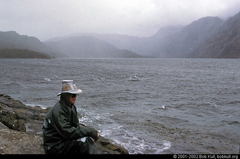
Kull took this photo of himself weathering the wind and mist.
- Solitude: Seeking Wisdom in Extremes
- New World Library (2008)
In March 2001, Bob Kull packed up tents, tools, boats, clothing, food and 40 rolls of toilet paper to do what many of us think we would like to do: escape society to live alone on a deserted island.
The Vancouver resident and UBC graduate student had been spending time alone in nature since childhood, and was at last following up on a life-long dream to commit to the experience for a full year. When he returned, The Tyee shared some of his reflections in an article. Now, five years later, in his new book Solitude: Seeking Wisdom in Extremes, Kull records the transformations he underwent on a remote island off the coast of Chile.
Solitude is the daily journal that documents Kull's survival and moments of philosophical clarity in the Patagonian wild. The entries are punctuated every few months with essays regarding solitude and its effects on human spirit and psychology.
In contrast to the fast-paced story structure of the typical adventure memoir, Solitude rises slowly, unexpectedly and organically from Kull's plodding journal entries. Over time, the daily routine of living and being becomes fascinating and exquisitely beautiful.
Kull finds joy and vitality in ordinary moments and ordinary things. He begins to devote careful thought to the lives most live without regard for emotional experience, or interactions with nature and people.
In a political season when environmental policy is the stuff of candidate debates, Kull offers a different take. According to his observations in Solitude, no environmental ills can be cured until we first remedy ourselves.
On his lonely island, Kull finds that we in this society strongly desire to satiate and confirm ourselves through consumption and production. Our identities have come to depend on it. But in the process, we sacrifice our critical awareness, and become ignorant of the fact that our excessive reaching out for a feeling of being important and being alive actually does very little to achieve the experience of vitality.
"My goal in the wilderness was not to conquer either the external world or my own inner nature," Kull writes in Solitude, "but to give up the illusion of ownership and control and to experience myself as part of the ebb and flow of something greater than individual ego."
A practiced Buddhist, Kull advocates "mindful awareness" in everyday life that is similar to the awareness that a still mind achieves in meditation. Solitude has helped him get there. "With few distractions," he writes, "my mind naturally slows and deepens even without strong self-discipline" -- and this leads to looking at the world in a whole new way.
"Meditation is not an intellectual activity grounded in thinking," writes Kull. "The source of understanding is insight arising from a still mind rather than from discursive analysis." When we depend more on intuition and insight than scientific logic, "our truth is discovered in our own embodied existence in this moment, and this, and this."
In a conversation with The Tyee, here is what Kull had to say...
On getting past the panic of loneliness
"We have an idea of who we are. An identity. And we hold that in place. We actively hold it in place. It's also held passively in place by our culture. We are constantly, in our relationships, putting out signals asking for affirmation of who we are. Out there, [in solitude], this active mirroring process of humans is gone, unless we imagine it. We can use the imagination to imagine the past or the future. But if we're actively trying to let go of that, and come into the present moment, that stuff starts dissolving. And it can feel like literal death.
"The ego creates the illusion of actual physical risk. If you don't understand that's what is happening, then it leaves you panicked out and terrified. If you do realize it's happening, then you can just be with it and dissolve into that. The world opens out into wonder."
On learning a new relationship with nature
"Typically, I -- and I think this is a 'we' -- don't really experience nature. It's sort of a backdrop to human activity. So even when we go into nature, it's in a context when we go hiking or canoeing, we do this or do that, but it remains a backdrop to our activity.
"In my younger years, especially before I went into solitude, but even after that, I was always reaching out, grabbing for life. I wanted to feel alive. I wanted to do exciting things. I've learned that I feel most alive when I'm still. That what I'm searching for, this experience of aliveness, that I am alive. We are alive.
"In solitude, in coming into stillness without the distractions of appointments and telephones, and just settling into the natural rhythms of the natural world, there's a deepening and an integration that happens for me, in the sense of truly belonging to the world, the biological and spiritual world [and] accepting more and more of myself as being natural."
On why writing about solitude is really impossible
"One of the things that is really fascinating is that you can't really write about solitude, because as soon as you write about it, you're not in solitude anymore -- you're with an imagined reader, whether or not that reader is a future you.
"What was writing doing to me? It was keeping me at the level of language in some ways. It wasn't the actual writing [that did that], because the writing took between half an hour to an hour a day in the journal. It was experiencing something, and solidifying it conceptually, internally, in words, that I would write in the journal later in the day. There was a fracture in the nowness of the world, just being in each moment and letting it go. On the other hand, that practice helps me to notice things. I would say, 'Oh, I want to remember this,' and it would help me to pay attention in a detailed way because I wanted to describe it. It was a bit of a mixed blessing."
On finding true luxury in a spacious moment
"In our culture, we're really confused between necessity and luxury. We're so caught up in thinking that we need all of the things in our lives, especially technology. We don't really need it. It's nice, but it has more to do with our self-image, who we think we are, and the kind of life we want to live.
"It's useful to spend some time and really look at what we're doing and the franticness of our lives, and question, where am I trying to go? Why? What am I trying to get? Because it seems to me what we're trying to get, we already have. We are already alive. This frantic grabbing pulls us further and further away from a quiet experience of joy.
"In some ways, it's really easy to imagine being on a deserted island somewhere in the wilderness -- for me and other people. The real challenge is to realize that if [solitude] is sacred, then this must be sacred, too, because it's all a part of the same world. For me, when I'm able to relax into the moment, and relax my desires and aversions, there's a kind of spaciousness that's really comfortable. I think we could use that."


11
Login or register to post comments
ME2
3 years ago
On denial of "comforts"
The mind is a truly amazing thing. Using it properly, we can create a sense of serenity in virtually any situation we might find ourselves.
People write of having found it the solitary confines of a prison cell, and others even when enduring the horrors of the Death Camps.
Many of the great mystics of the past did their "desert solitudes", fasting, etc, not to display or prove that living in their culture involved "sinning", but rather to prove to themselves that they were not wired on the pleasures their cultures had to offer.
No person is truly free nor are they "their own person" if they lack the self-mastery to deny themseles any form of pleasure when such should be done.
When Christ fasted in the desert, it wasn't meant as a denial of the "sin" of drinking, for example, but rather the sin of excess, since he drank - and supplied - wine at festivities.
Today, the best examples of this is seen with those people who have gone over their heads in debt to buy creature comforts and toys. They have made themselves into the modern equivalent of indentured slaves, and slavery, in it's multifarious forms, is what is to be feared.
snert
3 years ago
Perception
ME2
If people don't feel like slaves are they?
joelguy
3 years ago
Beautiful
Wow. What a beautifully written article.
"With few distractions," he writes, "my mind naturally slows and deepens even without strong self-discipline" -- and this leads to looking at the world in a whole new way.
I remember living in the countryside for a short time, in a small village, and I completely recall this happening to me. It was not at all true isolation, but I rarely had email or phone access, and my days were structured, so little planning was required. The result was an automatic "slowing and deepening" of the mind, in contrast to my usual frantic state.
So, is it possible for a resident of Vancouver to cultivate stillness, or is a change of location in order?
Kull's questions are well-asked: "Where am I trying to go? Why? What am I trying to get?"
Michael
3 years ago
But what are his politics?
Given the recent federal election in B.C., it seems that the remoter the region, the more right-leaning the persuasion. Since Kull is now thinking more clearly than us city dwellers, I wish the writer had asked Kull about his views on the carbon tax, lowering the GST and arts funding.
James Burns
3 years ago
Awareness
There are a number of things dealt with here that are important, but the most important is understanding the need to cultivate awareness, particularly mindful awareness.
While I fully agree that simplicity and stillness facilitate the cultivation of mindful awareness, they aren't a priori necessities. It's a good thing they're not, because otherwise, particularly in our current cultural context, mindful awareness would be unattainable. The kinds and number of distractions we face in modern society certainly hinder the process, but they don't make it impossible.
In fact, I would argue that an immersion in that sea of distraction is, in part, necessary in order to come to an awareness of how to maintain mindfulness in our current cultural context. Even more than that, I suspect that state is vital to understanding how to affect positive change, even if that change is limited to your own awarness.
I find there is often an alarming tendency among many cultivating mindfulness, particularly in their early stages, to advocate that withdrawal. That's not a workable path, particularly at this point in the human context.
Mindful awareness has no prescription, beyond paying attention right here, right now; because that's all there ever is.
Fii
3 years ago
It sure is
"So, is it possible for a resident of Vancouver to cultivate stillness, or is a change of location in order?"
Sure, just toss out the distractions (other than the fridge). I have to do it to stay sane in the city. I have no tv, rarely play music, absolutely love quiet. I can read for hours on end alone in my apartment (with my dog) and not feel bored or lonely (an emotion I have a hard time understanding, actually.) I've gone camping alone to the Sunshine coast and to Vancouver Island, with nothing more than a book and my dog to chat to. It's bizarre to me that many people would never even consider doing something like this (though a year is pushing it, I'd have to work up to that). I find I get rather addicted to the need for solitariness and if I have a "busy" weekend, which involves hanging out with friends all day for two days straight or something, it's common knowledge among my friends that at some point I'm going to suddenly stand up and declare "Got to go now- I need some alone time", and I'm gonzo.
ME2
3 years ago
Snert
You're right, Snert, but why is a whole 'nother question.
snert
3 years ago
There is only one answer, ME2
Why not?
ME2
3 years ago
There is more than one answer, Snert
You asked and then quoted me:
If people don't feel like slaves are they?
Quote:
The mind is a truly amazing thing
In his book Indians Of The Americas, John Collier notes that the early American settlers didn't take aboriginals as slaves, for no matter what was done to them, they refused to work. They believed that a life as a slave wasn't worth living.
Putting a person into solitary confinement is an attempt to force a person to think like a slave.
Getting hooked on drugs, a religion, a feelgood ideology, food or sex, is making yourself a slave to pleasure.
Being a "wage slave" is slavery only if one thinks he / she deserves it, and does not seek to escape it. "Acceptance", however, might hinge upon having to feed others. So physical slavery can be purely attiudinal.
Since we can BS ourselves into believing or accepting almost anything, ("The mind is a truly amazing thing") the trick then becomes mastery of the Ego, that little child within that says "Gimme, gimme", but is never satisfied.
Thus, true freedom demands the ability for self denial when necessary in making a decision, and self denial is also necessary to overcome fear.
Among many of the American Indian tribes, ritual torture was practised. For warriors, being tortured, even to death, was considered an honour. This offered the warrior an opportunity to demonstrate his bravery, since neither slavery nor release was an option. Imagine the mental mastery required to participate in one's own death !!!!
As I understand it, the great religions are founded upon the premise that one serves God by doing service to others. Such self denial thus makes a stronger person, while enriching the group, and of course this is what Socialism is all about.
Having written all this lovely nonsense (I just can't help myself) I'm left - as always - with that pesky nostrum....."Physician, first heal thyself"
snert
3 years ago
Interesting
When one comes to the realization that fear can be self defeating and chooses to not yield to it's pressures does that make it self denial or self preservation?
Even more interesting, one could become a slave to religion......but I guess that's OK. Isn't it?
sherrysmith
3 years ago
perceptions
For many years I ran around to different churches and religious organizations looking for "God".
I have since found that spirituality involving "acceptance" "gratitude" for my life is most important while honouring the beliefs of my friends and family, even though I may not agree with their perception of something.
Service to others no matter what the situation always makes me feel good about myself and is like taking medicine for my usual self seeking agenda.
Many years ago I studied the effects of Meditation and finally took a course. On the humourous note my mantra is probably the only secret I have ever kept and I find whenever I want to get away from the confusing situations around me, I go to a quiet place and meditate. It help immensly and leaves me calm and at peace for a while. I really enjoyed reading all the above intelligent perceptions and it made me remember one of my favorite oldies from Bob Dylan. "We all serve somebody sometime"