
Books

Mothers of a Native Hell

Meet two founders of BC's residential schools for aboriginal children.

By Crawford Kilian, 8 Aug 2007, TheTyee.ca

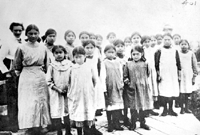
Residential school photo (200px)

Residents of the Crosby Home.

  • Good Intentions Gone Awry: Emma Crosby and the Methodist Mission on the Northwest Coast
  • Jan Hare and Jean Barman
  • UBC Press (2006)

Like an unwelcome memory of youthful stupidity, the residential-schools scandal keeps coming back to haunt us. But what do we really know about how the residential schools came to be? For most of us, only that First Nations kids were stuffed into them for generations and once inside were sexually, physically and culturally abused.

Two recent books throw some light on the origins and development of the schools. Good Intentions Gone Awry, by Jan Hare and Jean Barman, gives us the letters and life of Emma Crosby, the wife of Port Simpson's first missionary, Thomas Crosby, from the 1870s to the turn of the century. The Letters of Margaret Butcher, edited by Mary-Ellen Kelm, picks up the story from 1916-1919 in the village of Kitamaat.

Apart from chronicling an almost forgotten era in B.C. history, these books introduce us to two remarkable women. Both were highly intelligent, immensely competent, and profoundly toxic to the people they were trying to save.

In discussing these women and their worlds, I am keenly aware of the sin of "presentism"-- judging our ancestors by our own values. Emma Crosby and Margaret Butcher grew up and grew old in a very different culture from ours, and were doing the best they could. But it wasn't utterly different, and the two women were clearly smart enough to have known that what they were doing -- right or wrong -- simply wasn't working.

'A proper Christian family'

Emma Douse grew up in an Ontario Methodist family and became a teacher at her alma mater, Hamilton's Wesleyan Female College. In 1874, at the age of 25, she met Thomas Crosby, who had spent some years as a missionary in B.C. Crosby was both raising money and looking for a wife who could help him show the natives how a proper Christian family should function.

Emma willingly took on an immense task, and performed it well for decades: giving the Tsimshian of Port Simpson a model of the ideal Christian wife and helpmeet. Emma had a political role as well: to inform the Methodists back home in Ontario of the mission's progress, and to keep the money coming that would support it. (She also had to help propagandize against the charismatic Anglican missionary William Duncan, who considered the Crosbys too near his own little theocracy, Metlakatla.)

So Emma's letters home to her mother were intended for a much wider readership, and naturally presented the mission's work as a series of hard-won successes against great difficulties.

For modern readers, however, it's striking to see that Emma expressed zero interest in the people the Crosbys were trying to convert. She never discusses the Tsimshians' culture or history. (One photograph, from 1876, shows Thomas Crosby in Tsimshian regalia; he looks painfully embarrassed.) She refers in passing to the dirt and disease of the natives, but doesn't even mention the catastrophic smallpox pandemic that a decade earlier had killed a third of the native population on the B.C. coast.

Problems, not people

The natives existed, for the Crosbys, as problems to be solved by conversion, and only when converted did they become worthy of discussion. Even then, acceptance was conditional. Some of their finest converts, who went on to convert others and to support the mission, never achieved real equality with them or other whites.

Almost as an afterthought, Emma began to take young girls into her home. Her purpose was to protect them from the men of the community, both native and white, and to train them to become Christian wives and mothers. By a kind of Victorian social engineering, the girls were supposed to grow up into women like Emma herself, transforming and stabilizing their people.

As years went by, the number of girls grew. They helped her run the household and to look after her children.

Eventually, however, Emma saw that her own daughters were learning the Tsimshian language and values. This predictable but threatening development led her to physically segregate the native girls in their own building, and make their education a matter separate from the Crosby household. To maintain order she established rigid rules, rigidly enforced. Eventually, as Hare and Barman say, the girls were not so much educated as incarcerated.

The Crosbys' mission achieved pyrrhic victories. Spread too thin by his constant travels along the coast, Thomas Crosby was promoted into an administrative job that removed him from Port Simpson. By then Emma must have been glad to go: she left four of her seven children in the church's graveyard.

Despite the doubtful success of her efforts, Emma Crosby's residential school rapidly became the model up and down the coast. By the time Margaret Butcher arrived in Kitamaat in 1916, the Women's Missionary Service was a major organization providing staff and support for many such schools.

'Astoundingly pig-headed'

Emma Crosby clearly felt a vocation to evangelize in Port Simpson. For Maggie Butcher, a 46-year-old nurse and midwife, the school in Kitamaat was just another job. She'd spent three years as a missionary among the Japanese in Steveston, and a job in Kitamaat turned up. So she went off to teach Haisla girls how to sew. ("Education" was always for domestic or menial labour.)

Butcher was in many ways a far more attractive person than Crosby. The letters she wrote to her sisters and friends are gossipy, full of details, and generally good-humoured. She rhapsodizes about the scenery of the Kitamaat Valley, and provides extraordinary reportage on a logging operation. She can laugh at herself, and prayer is for her just another chore in a day full of them.

These traits make her all the more maddening to modern readers, because for an intelligent and observant woman she was astoundingly pig-headed. She might like her "kids" as individuals, but she despised them as a race.

"They are a slow, indolent, dirty people," she writes, "bound very strongly by custom and superstition. Matron says the young folk who have been educated in this school and at Coqualeetza will have more chance when some half dozen of the old folks of the Village, who still hold fast to their ancient customs, are dead and one hopes that it is so. In all our bunch of 37 children there are only two who appear cunning and they are half-breeds."

It wasn't worth learning Haisla since so few spoke it, and she casually remarks, "I suppose in a few years time Kitamaat speech will be extinct for the young folks learn to speak Eng. in the schools & one of our senior girls told me they cannot understand all the Kitamaat of the old folk."

Butcher clearly considered this progress. She happily described her children "going to church to sing Christmas carols in a village where 30 yrs ago the people were savages, & the medicine man ran naked through the village in a frenzy" -- this at a time when Europeans, with far greater savagery, were slaughtering one another in the trenches.

A trained nurse and midwife, Butcher spent much time and concern on the health of her students and their families. We can't blame her for applying mustard poultices to children with tuberculosis -- this was long before antibiotics. But she was convinced that the school was a safer place for the children than their own homes, despite the children's chronic TB, plus outbreaks of whooping cough and 10 fatal days with the Spanish flu.

From sexual "protection" to sexual abuse

Emma Crosby and Margaret Butcher shared an unquestioned assumption that white Christians had the right and duty to tear native families apart, to deprive children of their own cultures, and to impose Victorian sexual values on them.

"Protecting" the girls was implicitly to protect them from their own sexuality, if necessary by strapping them, overworking them, and malnourishing them. Margaret Butcher routinely kept track of the girls' periods, and woe betide the girl suspected of being pregnant. In hindsight, we can see the foundations being laid for decades of sexual abuse.

This arrogation of control over their converts' lives seems to have blinded the missionaries to the harm they were doing, so they could shrug off the natives' death and suffering as just the price to be paid for progress.

We don't have equivalent accounts of residential schooling by the Tsimshian, Haisla, and other nations, at least until much later. But in a sense we don't need them. Emma Crosby and Margaret Butcher inadvertently wrote their own self-damning confessions.

They also raise a disturbing question: When future generations read our accounts about all the good we're doing in the world, will they regard us too as toxic and self-deluded fools?

 [Tyee]

14  Comments:

Login or register to post comments

  • HawkEyes

    4 years ago

    Not Yet Almost Forgotten

    Oh the superiority of Our Father...
    Sexual abuse is better measured in generations to reveal the beast.
    Is it ironic that healing is needed if "conversion" was successful?
    And many of today's generation know we are toxic and self-deluded...
    Sadly, excellent points.

  • G West

    4 years ago

    Bears repeating

    Quote:
    Emma Crosby and Margaret Butcher shared an unquestioned assumption that white Christians had the right and duty to tear native families apart, to deprive children of their own cultures,

    With just a few substitutions, this same phrase may be as true of the corporate/governance model that has recently produced the Tsawwassen Treaty.

    Let's try.

    Gordon Campbell and Stephen Harper shared an unquestioned assumption that corporate capitalist structures were the right and proper thing to substitute for FIRST NATIONS governance and real self-determination. Did they realize they were, in all probability, tearing this nation and its culture apart and ensuring its inevitable destruction?

    Did they care? Or were they simply serving, as their Christian forebears did a few generations previously, a false god and their own selfish interests?

  • G West

    4 years ago

    Let's remember what a lot of First Nations' people are saying.

    From Rod Mickleburgh

    Quote:
    Specifically, they want governments to end their insistence that all treaties must include the ceding of further aboriginal rights and land claims, an agreement to pay government taxes and a switch of native land
    ownership to the provincial system of fee simple.

    For a growing number of native bands, these factors are non-starters, says Robert Morales, lead organizer of the unity protocol and chief negotiator for the Hul'qumi'num Treaty Group on Vancouver Island.

    "The Crown still wants to control the agenda, while our resources disappear," Mr. Morales said. "They continue to deny that aboriginal title and rights exist."

  • Booker

    4 years ago

    The new religion

    G West wtore:

    Quote:
    Did they care? Or were they simply serving, as their Christian forebears did a few generations previously, a false god and their own selfish interests?

    A very good point, G West. This is the current missionary cause -- to bring the miracle of the marketplace to the "savages", whether they be in Iraq, the Amazon, or BC. It is the one true religion now, and it's proselytizers are organizations like CanWest and the News Corp.

  • BC Dude

    4 years ago

    FN people have always been

    FN people have always been screwed by our polititons and our system just look at the reserves in BC and all across Canada, a great shame and despicable and cowardly acts!
    I agree 100% Booker especially about the CanWest Global media as they own about 90% of all media in Western Canada. Google CanWest holdings. Where is the part about the SPP's, TILMA and Atlantica a major Conspiracy against US the taxpayers, I'd say heads should roll right across this "OUR HOME AND NATIVE LAND"
    I'd say that anyone who uses AT&T, Verizon,
    Bell etc Telus and do what I've done, cancel my cell phone and my kids are trying to give it up!
    "I remember learning to count using "One little two little three little Indian boys". As we were being programmed to this kind of hateful thinking.
    "Patriotism in its simplest, clearest and most indubitable signification is nothing else but a means of obtaining for the rulers their ambitions and covetous desires, and for the ruled the abdication of human dignity, reason, conscience, and a slavish enthrallment to those in power". : Leo Toystoy

  • GJW

    4 years ago

    Missing the point

    This review only scratches the surface of the topic and the writer spends too much time looking for things she can admire/detest about the books' subjects. It's history -- it is what it is. You don't have to admire or dislike a source to get some insight into history through the window they provide.
    The writer also admits it's hard to avoid the "sin" of "presentism" and jumps whole-heartedly into committing it.
    And, as usual for the Tyee, discussion degrades into a general anti-conservative, anti-big-media rant with little relation to TFA (The eFfing Article, in case you don't speak Slashdot).
    That's too bad, because there's a lot to talk about when it comes to B.C.'s residential schools. Why did people like Emma Crosby and Margaret Butcher believe that what they were doing was right? Their reasons were a lot more complex than a Victorian mindset and cultural superiority. Let's also consider that at the time, no one expected natives would survive longer than a few more decades. Death and disease were taking a huge toll, villages were disappearing and by starting these schools people like Crosby and Butcher actually believed they were saving lives by helping them assimilate into the "civilized" world.
    There's lots more to say but I'll end by saying that with an issue this huge, a surface glance that once again encourages the natives-as-victims, whites-as-evil-oppressors mindset doesn't do the history justice.

  • Skywalker

    4 years ago

    What was the cause?

    "This is the current missionary cause -- to bring the miracle of the marketplace to the "savages", whether they be in Iraq, the Amazon, or BC. It is the one true religion now, and it's proselytizers are organizations like CanWest and the News Corp."

    That may be what the missionary cause has degenerated into throughout history by the "money changers in the temple" but I really doubt that IS the missionary cause. Throughout history the missionaries came with good intentions, a spiritual calling, but as so often happens the search for wealth seems to take hold and things start to go wrong. The first thing that escapes those behind the cause is any sensitivity to the cultures and that leads to a misguided sense superiority. The world has been made poorer because people are never willing to treat others as equals and learn from them.

  • G West

    4 years ago

    The road to Hell

    IS paved with 'good intentions'. Of course the natives weren't 'meant to survive' and they almost didn't. As far as giving the 'churches' a 'pass' because of their religious convictions, there were plenty of government schools operating and doing the same thing - on their own or as partners with the churches through this same period.

    Mistreatment is NEVER benevolence and our First Nations brothers and sisters are and have been paying the price. The dominant culture has been, and still is, just cashing the cheques.

    The point ought to be that one 'learns' from the past. I don't think that's happening and making excuses for our forebears is just another dodge, in my view.

  • weasel

    4 years ago

    Crawford Kilian expects too much

    ... of a 19th century missionary, and too little of us today. You don't have to scrape very far to find modern parallels to the good intentions of Emma Crosby. What about rich white parents who fire their Philipino nannies when the kiddies start speaking Tagalog? Or Madonna, who saves the world by removing one baby from his home? If only it were that simple. Good Intentions should be read as metaphor, not fact.

  • anarcho

    4 years ago

    Good intentions, my foot!

    I wonder how anyone can consider cultural genocide "good intentions." Missionaries never have good intentions. Their intentions are to destroy the religion and culture of the people they have selected and replace it with their own religion and culture. This is monstrous. And in the remaining areas of the world where "primitive people" still exist, they are still at it. It should be considered a crime.

  • Chris H

    4 years ago

    Missionaries.

    "Missionaries never have good intentions. Their intentions are to destroy the religion and culture of the people they have selected and replace it with their own religion and culture."

    That's a good point. What is the core purpose of a missionary? Taking a very subjective view, the missionary has very good intentions because they are trying to save people's souls from hell. That is their intention, and that is what they believe. Looking at the matter objectively gives us another perspective entirely.

    I dearly hope that all the Korean missionaries that are hostage in Afghanistan are freed, home safe and sound, as soon as possible, but I really wonder how they are viewed by the largely Muslim population in that country. Could you compare the Taliban's actions in the same subjective light of "good intentions" as those early residential school missionaries? Aren't they trying to save the souls of their countrymen?

    In my opinion, it is interesting how religion screws up all good intentions. I don't think the Methodist church that bankrolled those missionaries work can go without some of the blame.

  • dorothy

    4 years ago

    white, eh?

    How is it, that 'white' and 'christians' are always put together? The recent crusade by a group of African clerics to prohibit 'gay influence' in their own church should make it clear, that skin colour and high-handed zeal do not go together. There are some of us smarting even today about how a bunch of zealots sanctioned and commissioned by the Goth Kaiser to the south butchered thousands of our countrymen to spread their 'good intentions'. This place (Earth)is crawling with people intching to manage others and get a little soul-butter or gold into the bargain. May the jotnar get them all!

    It isn't a question of color, of specific religion, but of the fundamental attitudes behind our actions. If the beliefs lead to overreaching of our mandate in this life, those beliefs will have to go. It's that simple. A wise man said: If the ends justify the means, what, then, do we look to to justify the end? This isn't rocket science. It is my considered opinion that the freedom of religion only stretches to what you do with your own person, it does not include your stepping as much as one millimeter onto ground on which other people are standing. And, fianlly, let me remind that the most dangerous version of the human species is the well-meaning idiot.

    I am not buying attempts at handing sympathy to the people who lent themselves to this. Each and every step of the way, they witnessed the hurting and did not go tell it on the mountain. I do not understand the notion that what they did was 'not so bad', because back then the thinking was different. Is the idea, then, that we should forego the progress we have supposedly made in humanity, just so these people can still look respectable? Not judging is a Christian notion. Same story over again. There is no old and new model of human suffering and crime against humanity. These people did what they did, because they could.

  • mikev

    4 years ago

    Quote:When future

    Quote:
    When future generations read our accounts about all the good we're doing in the world, will they regard us too as toxic and self-deluded fools?

    Most definitely :-(

  • dorothy

    4 years ago

    could you run that by me again?

    "When future generations read our accounts about all the good we're doing in the world..."

    First off, we're going to have to give them something to read about, so when do we get started, eh? So far, we can talk eloquently about the wrongs, but on every single parameter that is really going to make a difference to future generations, we as a community haven't even had the rubber hit the road yet. We barely even clean up the worst messes, until we make more, and as for progress - don't get me started...

    • The discussion for this story is closed. No more comments can be added.