- Mary Carlisle is a Tyee Builder. You can be, too.
- Prem Gill is a Tyee Builder. You can be, too.
- Nancy Flight is a Tyee Builder. You can be, too.
- Justin Everett is a Tyee Builder. You can be, too.
- John Westover is a Tyee Builder. You can be, too.
- Nora Etches is a Tyee Builder. You can be, too.
- Edward Henderson is a Tyee Builder. You can be, too.
- Bharadwaj Chandramouli is a Tyee Builder. You can be, too.
- Dean Chatterson is a Tyee Builder. You can be, too.
- Marius Scurtescu is a Tyee Builder. You can be, too.
- Robert Parkes is a Tyee Builder. You can be, too.
- James Murton is a Tyee Builder. You can be, too.
- Susan Doyle is a Tyee Builder. You can be, too.
- Vincent Strgar is a Tyee Builder. You can be, too.
- Helen Spiegelman is a Tyee Builder. You can be, too.
- Subir Guin is a Tyee Builder. You can be, too.
- Kimball Finigan is a Tyee Builder. You can be, too.
- Joanne Manley is a Tyee Builder. You can be, too.
- David Leach is a Tyee Builder. You can be, too.
- Joel Berger is a Tyee Builder. You can be, too.
An Army Betrayed
'Fiasco' is the story of US armed forces done in by civilian masters.
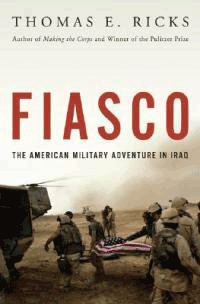
- Fiasco: The American Military Adventure in Iraq
- Penguin (2006)
I have very mixed feelings about the American military.
A pair of my black army boots, 44 years old, still sits in my closet. As a draftee I lucked out with good duty at Fort Ord, California, typing the orders that sent my fellow-draftees to Vietnam. I got to meet and respect people I'd never have met outside the service.
But when I watch the news and the Iraq documentaries, and when I read the war blogs, I usually see an army I don't know and don't like. This army's uniforms are strange. Its weapons look like props from Star Wars. Its enlisted men and women are even more ignorant of the world than we were. The major link to its past is that its spokespersons, like those of the Vietnam era, are supreme bullshit artists.
Yet I have a deep respect for the people who serve in any country's military, especially a country that considers itself democratic. They are their country's people in arms. Wise or foolish, they are not to be trifled with, and still less to be betrayed.
In his book Fiasco: The American Military Adventure in Iraq, Thomas E. Ricks demonstrates that the United States armed forces, and especially the army, have been trifled with and betrayed by their civilian masters. What he says about American soldiers has implications for our own.
The Iraq Book as news coverage
Since the Iraq War began, books about it have become a genre of their own. Such books are so easily written and published that they're actually preferable to the news stories that appear on paper and online. They appear when events are still fresh in memory, and they offer coherent narratives in place of the sound bites and fragmentary stories offered on TV and in the papers.
Thomas E. Ricks published Fiasco last summer. Yet it's not dated at all. Many of the characters in his book, like General David Petraeus, are still actively engaged in the war. Today's car bombings are much like those of two years ago.
More importantly, Ricks gives us a useful perspective on the war -- that of the soldiers and Marines actually fighting it. While civilians certainly play an important role in the book, it's the officers and enlisted personnel who dominate the story -- especially the generals.
The U.S. military is a culture Ricks clearly likes and understands, without becoming a war groupie like so many embedded reporters. He knows the military's history and sociology. He knows it includes good ole boys who love bass fishing, and warrior-scholars whom Sun Tzu and von Clausewitz would have respected.
Winning the war only to lose it
But Ricks maintains some detachment from the remarkable people who fight America's wars, and this makes his book all the more devastating an indictment of their moral failures and strategic incompetence. The American military won the Iraq War, and then set about losing it.
It's a truism that armies always want to fight the last war and get it right the next time. As a basic trainee in 1963, I learned how to fight Korea again.
Not now. Ricks shows that after Vietnam, the U.S. military deliberately forgot everything it had painfully learned about counterinsurgency warfare. Instead it focused on big, set-piece battles in which overwhelming force would smash any conceivable enemy...and then provide the victors with a great meal and email access to the folks back home.
The Gulf War of 1991 seemed to vindicate that doctrine, but it failed abysmally in Iraq. Bizarrely, it failed in part because Donald Rumsfeld thought the modern U.S. military too conservative, too concerned about the number of boots on the ground. He wanted to teach the generals a lesson: You can win a war cheaply, with a small force.
The generals who disagreed were soon gone, notably Eric Shinseki. When other generals saw that the chairman of the Joint Chiefs of Staff could be hung out to dry, they fell into line.
Triumph of incompetence
What followed was a triumph of incompetence. The neoconservative promoters of the Iraq War deliberately crowded out the professionals who were planning for the postwar Iraq. They chose a tactician, Tommy Franks, to run the war, rather than a strategist who could think beyond the day the tanks rolled into Baghdad on a "thunder run."
Ricks documents in depressing detail the disastrous year that followed that day. Scholar-warriors like David Petraeus ran their patches of Iraq with intelligence and civility. Bullies like Raymond Odierno served as recruiters for the insurgents, alienating ordinary Iraqis. Meanwhile Paul Bremer as head of the Coalition Provisional Authority committed one folly after another, including the disbanding of the Iraqi army and the blacklisting of all Baath Party members. Most U.S. generals hated him more than they hated the insurgents.
Here and there, officers like Petraeus and Marine general James Mattis made real but temporary progress. Colonel H. R. McMaster planned and executed a brilliant campaign to regain control of the town of Tall Afar without needless carnage.
But it says something that he did so by drilling his troops in what should have been self-evident: "Every time you treat an Iraqi disrespectfully, you are working for the enemy." That was in June 2004, when the war was effectively lost already.
How lost? According to the Saudi agency Arab News, on March 27 some 85 people were killed in Tall Afar when a suicide truck bomb exploded in a Shiite part of town. That led to a revenge massacre of Sunni men.
Ricks is a fine writer and a perceptive observer of military politics. He lays blame where it is clearly deserved: on Bush, on Rumsfeld, on Wolfowitz and the other neocons who stampeded their country into disaster. He writes sympathetically of the officers who knew better, and who tried within the system to mitigate the disaster. He argues plausibly that a hurried U.S. withdrawal would indeed lead to a still greater bloodbath.
Wars of necessity and wars of choice
Yet he never really questions the U.S.'s right to throw its weight around as it has. Afghanistan, he says, was a war of necessity; Iraq, a war of choice. The problem with Iraq, in his view, is that it drew resources away from the first fight and was badly planned-not that it was legally and morally wrong. Like Tacitus, Ricks sees the errors that empires commit. And like Tacitus, he doesn't see that empires are errors by definition; they will always make a desert and call it peace.
It's easy to root for Ricks's heroes, the scholar-warriors who have thought deeply about counter-insurgency. But they too have not thought about why people rebel against empires. Petraeus is now running the American "surge" in Baghdad, while the truck bombs keep exploding.
Meanwhile, our own troops in Afghanistan are doing a slow-motion reprise of Iraq 2004: trying to rebuild a shattered country while fighting the Taliban insurgency. Our prime minister promises not to cut and run. CBC runs a stupid radio soap opera called Afghanada. Various Canadian academics are pimping the war as a good reason to get more money into our military.
Ricks shows that the Americans really didn't know what they were doing, and their professional soldiers couldn't educate their political masters. From what we see of our own efforts in Afghanistan, the same is true of our politicians and our soldiers.
This makes me sad. I would have thought that in the 44 years since I first laced on my army boots, the politicians and professional soldiers would have seen the folly of such wars. The politicians have yet again betrayed the soldiers, and the soldiers have yet again betrayed themselves.
Related Tyee stories:


15
Login or register to post comments
nightbloom
5 years ago
Great Review
Great review - an indepth and insightful examination of the civil-military relations behind this debacle is very much needed. I wonder if Ricks puts forward any recommendations for structural/institutional changes to this relationship. It's a fine balance between insulating military leadership from opportunistic and undue politic pressures, and ensuring they remain responsive and accountable to civil government. Surely it's possible to make it less easy to summarily sack military leaders who advise against civilian policies.
Booker
5 years ago
Incompetance dodge
The liberal hawks love to use this argument because it allows them to take the moral high ground (at least in their own imaginations), and they can place the blame for the failure of the war on Bush, the incompetent. The war violated international legal norms that had evolved for a reason, to help avoid fiascoes like Iraq and to dampen the hubris of the great powers.
It is, of course, moral to free subjugated peoples like those in Iraq. But Bush did not go into Iraq to free people. He lied in obvious ways, hugely exaggerated the threat Iraq posed, and slimed people who dared question his statements, yet the liberal hawks went along with him. Is that what the moral high ground looks like? The war libs have learned nothing if they think the war was lost only due to Bush's incompetence.
G West
5 years ago
Further problems
Pretty hard to give the military any real independence when the practical ethos in the States has calcified into a three-cornered dance between government, the military and the 'defence' contracting industry.
These are, for the most part the same people, just caught at different stages of their serial passage through the room wearing different hats. What degree of independence there actually is, in the event, is really quite extraordinary.
The betrayal is, for many of these characters, simply a self-inflicted wound.
skeptikool
5 years ago
A concerted mental bludgeoning
After the monumental, concerted mental bludgeoning Canadians have just been subjected to, to even ask whether the thousands of young Canadians' lives were wasted, who died in the Vimy Ridge slaughter, will brand one treasonous in the eyes of many.
In justification, that sacrifice, it seems, suddenly made Canada a world class nation.
It was neccessary to cross an ocean and to participate in an horrendous butchery to gain recognition? The whole idea sickens.
G West
5 years ago
skeptikool
It would have been interesting if someone, just once, had spent some time on the iconography of Walter Allward's Vimy Memorial.
Or if someone else had pointed out that Arthur Currie had stated to the Canadian Battlefield's Memorial Commission that - "I do not want to have the impression left...that Vimy was our greatest battlefield." He went on, and this material was referenced in the original souvenir booklet when the monument on Hill 145 was originally unveiled: Vimy was not 'the greatest achievement of the Canadian Corps either in strategic importance or results obtained,' but simply that 'there it was that the Canadian Corps first fought as a unit and, as its components were drawn from all parts of the country, Vimy may be considered as the first appearance of our young nation in arms.'
A little less concentration on the spin cycle would have been appreciated - no question.
clo3
5 years ago
That's a tough one...
This book looks like a really interesting read! It does create some problems when military policy is set by a political body. I think that wavering public opinion often does not allow top Generals to do what makes the most sense militarily, and most politicians seem to pay more attention to polls than military advisors.
At the same time, in a democratic country the military needs to be controlled by elected officials in order to ensure that it serves the people. The alternative to having elected politicians set military policy does not seem very attractive, as evidenced in many dictatorships.
Definitely a tough issue…
I am currently reading a good book about the Canadian Forces and it's post 9/11 reality. It is called Whose War is it? by J.L. Granatstein. Not finished it yet, but so far it has made some really enlightening points about our armed forces. Highly recommended!
granthams
5 years ago
Canada's Identity
It seems to me that Canada’s identity was created at home by men and women who fought for equal rights, fair wages, decent healthcare and education and so forth. Not by armies fighting wars in foreign lands for dubious reasons.
G West
5 years ago
granthams
I think you're right and that's why I look upon the eruption of rampant nationalism and jingoistic self-righteousness at the weekend relative to Vimy as almost all 'spin'.
The idea that Canada somehow came of age and became an actor on the world stage in 1918 is nonsense. It also ignores the constitutional crisis that conscription and a 'conscription election' during the war engendered. The effects of which - in terms of the French/English, Quebec/Rest of Canada dichotomy are still echoing today.
Whereas Borden might have found a way to heal the wounds inflicted by MacDonald after 1885, he chose instead to exacerbate them in a vainglorious attempt to make a nation which had already suffered many losses suffer still more.
Agonizing over the fact that Quebecers felt differently (though not all that differently from their Canadian-born fellow citizens - the make up of the CEF having been, for much of the first 3 years of the war, of citizen soldiers who weren't born in Canada either) he stumbled his way into the dynamic of two solitudes with both feet and we have been tripping over his errors ever since.
At least the war and the conscription crisis it created brought with it universal suffrage. However, even that, if one reads the history, was a put-up job designed to put French Canadians in their place. Appalling stuff none of which was aired honestly in the nonsense televised all this past weekend.
Excellent point granthams, and you too skeptitool
murdock
5 years ago
Always someone else to fight ...
It was neccessary to cross an ocean and to participate in an horrendous butchery to gain recognition? The whole idea sickens.
Wrote skeptikool.
It is the very 'martial spirit', that once drove the members of nations to make war one upon another, which is becoming increasingly abhorent and irrelevant in the 'flat' earth.
The use of a nations' youthful lifeblood to destroy parts of another nations' has become as ancient as Feudalism, the only problem is that not enough of the 'modern' world recognizes this.
Really ask yourself, what is there to gain in todays world from military adventure?
The neuclear aircraft carrier is as much a museum piece as is a suit of lorica segmentata.
Crawford
5 years ago
Another side of Ricks
I didn't read any reviews of Fiasco before writing my own, but by coincidence I've just discovered an interesting angle on Ricks by the economist-blogger Brad Delong, who in January pointed out that Ricks must have known from the start how badly things were going...but his Washington Post stories didn't say so.
The URL of Delong's comments is here:
http://delong.typepad.com/sdj/2007/01/why_oh_why_cant_1.html
jrb
5 years ago
back to peacekeeping and homeland defense
i've said it before and i'll say it again:
- canadian troops should only be overseas if they are wearing the UN's blue helmets/berets.
- defense spending should be vastly increased. with the focus being on border security.
- canada's constitution should be amended to include a passage similar to japan's article 9, which renounces war and forbids their self-defense force from deploying overseas.
bpither1
5 years ago
Frontline/The World
A bit late but last night PBS ran a 20 minute British documentary mostly about the Canadian presence in Kandahar. Anyone who saw it would get a better grip on the futility of fighting a counter insurgency war.
murdock
5 years ago
The Clock runs forwards only ...
The notion that Canada should only use military force for UN actions is a throwback to the 1960's, yes 1960's.
The 'peace-keepers' were in decline from 1971 onwards, once they were used in Vietnam the decline was accelerated, though the 'hype' about their actions was increased in Canada. Leading to the national misconception that we are a nation of peacekeepers. Canada barely rates as a peacekeeping nation, and has been on the bottom 1/3rd of the UN lists for more than 2 decades!
In NATO circles we are the 'Taxi Squad'; akin to an 1870's Mexican bandito group that needs someone else to carry them to and from the battle zone.
Like it or lump it there are Canadian troops in Afghanistan, they are going to be facing greater and greater odds in the coming months.
I still see no way to get them out alive, though a thought occurs:
Since I think we should not want these troops to come home anyway (their PTSD and other complications will be coming on just as the 'medical system' will be going into complete overload from the boomers flooding it), why not create the CAST brigade as something more akin to the Foreign Legion? This way we can leave these men out there as mercenaries for hire (something we are essentially doing anyway, only getting very, very little in return for our expenditures {I do not count the happy feelings from the Bush Cabal as of any value whatsoever}).
In any event the use of military force is going to continue to gain less and less advantage to those whom employ it ... for once the CVBG is seen approaching over the horizon anything of real value will either be hidden, leave or be transmitted away at the speed of light.
clo3
5 years ago
Peacekeeping is not all it's cracked up to be
Thanks Murdock for the reminder that Canada is not actually that big on UN Peacekeeping. In actuality, many of the peacekeeping missions we participated in during the 1950s and 60s were motivated as much by self-interest as a commitment to peace. For example, had a UN force not been sent into Suez in the 1950s, Canada would’ve found itself forced to pick between either the US or Britain and France (because the US condemned the proposed intervention by France and Britain). Sending an international UN force allowed us to please all our allies, instead of making enemies. Our intervention in Cyprus was also self-serving in that it largely served to hold NATO together at the height of the Cold War. Though humanitarian concerns have played a role in the past, our peacekeeping has not been as selfless and many believe.
Also, I have to disagree with you Jrb. I think that many parts of the UN are dysfunctional, including the Security Council. Since some of the nations that hold veto power do not see eye-to-eye with us on human rights (mainly Russia and China), I think it is a bad idea to limit our international actions to only those missions approved by the Security Council. I think we do have an obligation to use our military internationally to protect the defenceless whenever we can and the UN has failed too many times in that regard. There is a big difference between invading a country for expansion sake and intervening in a country to stop human rights abuses (like what is happening in the Sudan). We shouldn’t limit ourselves to only what the UN approves.
Frank
5 years ago
War ain't what it used to be
Damn, "Fiasco" is the title I was going to use for my own book which was going to be about all the usual right-wingnut brigade devouring their own in the wake of military defeat.
My opening chapter was going to be full of quotes about why attacking Iraq was a great thing. And the last chapter would be quoting the same people pointing fingers at each other and yelling "incompetent".
But I have to admit, as much as I enjoy the political theatre of it all I know that like the Bourbons, the Right-wingers remember nothing and forget nothing.
So I'm looking forward to the cheers of "On to Tehran" and more Fiasco books a few years later.