
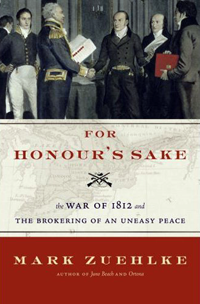
- For Honour's Sake: The War of 1812 and the Brokering of an Uneasy Peace
- Knopf Canada (2006)
- Bookstore Finder
Ask most Canadians about the War of 1812, and they'll say it's the war the Americans lost. But they probably won't know much more than that.
They should. Mark Zuehlke has now given us a concise and readable history in For Honour's Sake: The War of 1812 and the Brokering of an Uneasy Peace. It does more than fill in a gap in our collective memory; it uncomfortably foreshadows the wars of the 21st century.
The United States in the early 1800s was a seaboard nation of eight million. It was also a seafaring nation, and many of its sailors had been born English subjects. As naturalized Americans, they were still prey to the British Navy, which was desperate for men to help fight Napoleon. Britain claimed the right to stop and search any American vessel on the high seas and to kidnap any seaman considered a British subject.
This was a severe irritant, just as in our own time Canadian citizens have been abused (and killed) by the governments of Iran and China, which don't recognize dual citizenship.
The U.S. was also expanding westward into Indian country -- what are now the states of Ohio, Indiana and Illinois. They were running into trouble with tribes allied to and trading with Britain, and the boundary between the U.S. and British North America was far from clear. Britain took its treaties with the Indians far more seriously than the Americans did, so the threat of new wars loomed on the frontier.
Hawks drove US to war and taxes
Even so, the War of 1812 could have been avoided. Britain was fighting Napoleon. The U.S. depended heavily on trade with Britain, and had no army or navy to speak of.
So this was a war of choice, and the man who chose it was Senator Henry Clay of Kentucky. He attracted a number of other young politicos who became the "War Hawks," and who eventually forced the administration of James Madison to declare war.
The sheer cost of it nearly killed the War Hawks' plans. Albert Gallatin, the Swiss-born secretary of the treasury, estimated the war would require imposing high new taxes on a population that didn't want to be taxed at all. Lacking a serious standing army, the U.S. would have to use the state militias -- which by law couldn't be deployed outside the US.
Clay and the War Hawks somehow surmounted these financial and legal obstacles, and the war was on. One U.S. goal was the conquest of Upper and Lower Canada -- modern Ontario and Quebec. But invasion forces were run by incompetents left over from the Revolution, and manned by poorly trained militias. The Americans' chief advantage was arguably Sir George Prevost, the commander of British and Canadian forces. Prevost's caution resulted in many missed opportunities.
Even so, the battles fought were startlingly bloody affairs, a mix of European and guerrilla tactics. The battle of Crysler's Farm cost the victorious British 22 dead and 148 wounded. The Americans lost 102 dead, 237 wounded, and 100 captured. Lundy's Lane was another British victory, though a Pyrrhic one: 171 dead Americans, 572 wounded, and 110 missing versus 84 British and Canadians killed, with 559 wounded and 193 missing.
Brits burned Washington...and Indian allies
The Americans looted and burned York (now Toronto), but their worst atrocity was the burning, in December 1813, of Niagara. Almost 400 civilian residents were left homeless and destitute.
The atrocity outraged the British into their famous attack on Washington. But they were careful to burn only government buildings, and they were aided by the gross incompetence and cowardice of the Americans defending their capital. (The follow-up attack on Baltimore was less successful, and inspired Francis Scott Key to write "The Star-Spangled Banner.")
While these battles were going on, London and Washington were trying to end the war. After months of slow, long-distance negotiations, both sides agreed to meet in the Flemish city of Ghent to find agreement on a peace treaty. The American side included the war's chief architect, Henry Clay. The British included some capable people, but not a single Canadian.
Zuehlke spends almost as much time on the negotiations as on the battles and political intrigue, and it's time well spent. We learn a great deal about the two cultures, as well as the negotiators themselves.
The talks started badly, with the Americans amazed that the British wanted protection for the Indian allies. John Quincy Adams and Clay quarrelled violently over U.S. fishing rights in British waters. Clay saw no value in those rights; Adams feared New England would secede from the union without them.
The talks depended largely on reports from the battlefields, weeks or months old but valuable as bargaining tools. The American failure to take Canada was balanced by Prevost's failure to counterattack deep into New York. As it turned out, the war was really settled by Waterloo: Britain was now absorbed in building a post-Napoleonic Europe, and wanted to get out of the North American war as quickly as possible.
The British negotiators therefore cut loose their Indian allies, knowing that the Americans were determined to "extirpate" them and take their land. Britain also gave up free access to the Mississippi River and restored U.S. fishing rights. In return the British settled the boundary at the 49th parallel, established a balance of naval power on the Great Lakes and kept a firm grip on their North American colonies that would become Canada.
Zuehlke is excellent at bringing his soldiers and diplomats to life. The battlefield narratives are too much like those of regimental histories, full of names of units and their commanders. Even so, the battles are vivid and horrifying. I would have liked more of the social background of colonial Canada and post-Revolution America: why did men join the militias on both sides, and how did both sides fund the war?
Disturbing parallels with today
The book is good at evoking a forgotten war; it's even better at drawing unspoken parallels with our own time. Henry Clay and his warmongering contemporaries were as scurrilous and dishonest as Bush and his supporters. The War Hawks thought they could get away with a cheap and easy victory. American expansionism was taken for granted, and national security meant destroying all possible enemies -- especially the Indians who were fighting for their homes.
In settling the War of 1812, the Americans achieved essentially none of their aims. It had all been a wretched waste of money and lives, and Clay could claim nothing but "honour preserved."
We're often chided for not knowing our own history, and it's too true. This book is a good place to start learning it.
![[Tyee]](/ui/img/ico_fishie.png)