

 SHARE:
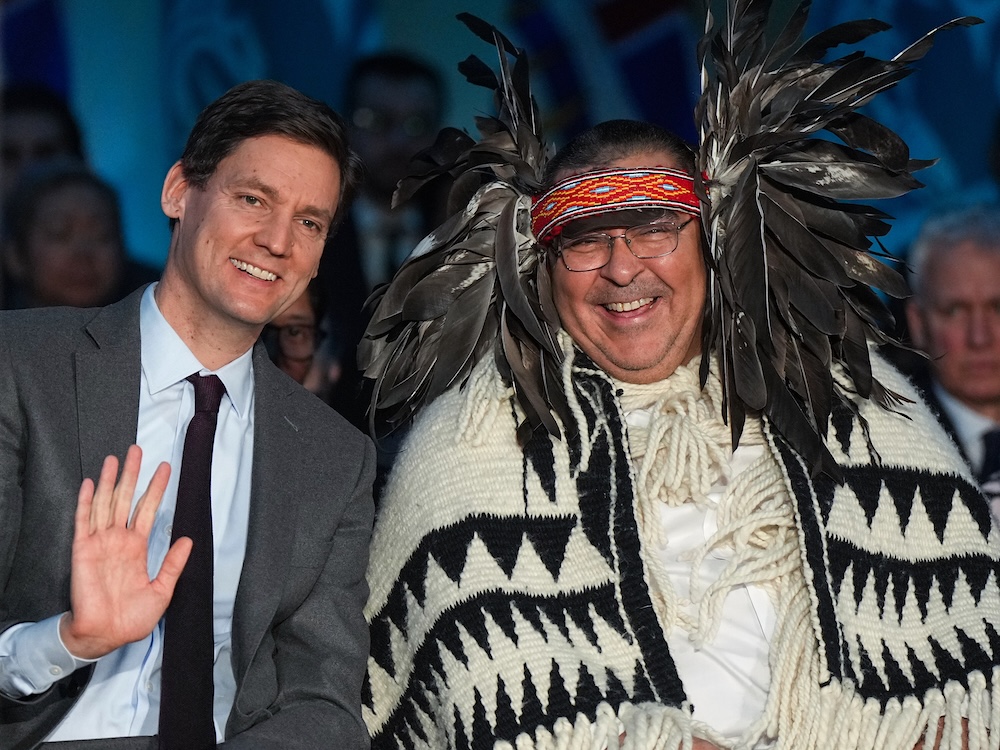
When Premier David Eby announced March 2 that B.C. was about to “spring forward” into permanent daylight time, he felt so upbeat about the news that he danced along to Daft Punk’s “One More Time” with assembled school kids to celebrate.
But within minutes, the government’s agenda fell back into acrimonious controversy over the Cowichan decision, the Declaration on the Rights of Indigenous Peoples Act, Aboriginal title and the alleged threat to fee simple private property posed by all three.
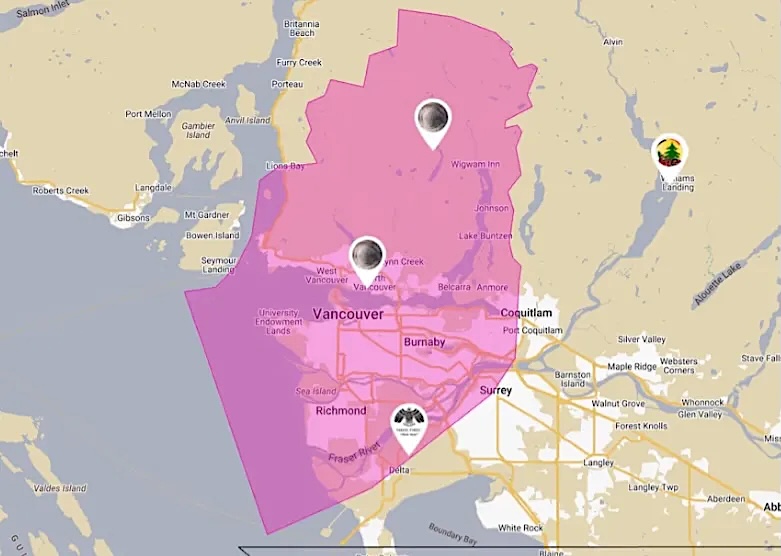
The trigger for panic this time was Eby’s denial that he had any insight into a Feb. 20 agreement signed between Ottawa and the Musqueam Indian Band acknowledging Musqueam title within a large swath of the Lower Mainland. (A helpful map purportedly showing the broad scope of the agreement was widely shared.)
When word broke the next day that he had actually been present for the signing, the stage was set for one of the worst, very bad weeks the premier has had in some time.
Lost in the storm: the fact that three major First Nations with traditional territories in the Lower Mainland, including the Musqueam, are among the largest fee simple private property landowners in the province, driving tens of billions of dollars’ worth of development.
They, along with the Cowichan and every other First Nation in the province, have repeatedly denied any interest in threatening private property, and they face significant costs from uncertainty on that score along with everyone else.
Do these sound like the kind of people who want to rock the boat of fee simple private property?
While the Conservative Party of BC condemned Eby for “silence on major title recognition,” party leadership front-runner Caroline Elliott declared that “Metro Vancouver homeowners’ private property rights are under threat thanks to David Eby’s NDP. A million homes and businesses are at risk.”
In Elliott’s fevered imagination, all Metro Vancouver residents may soon find themselves paying rent to First Nations in the wake of Eby’s “land back” activism.
It was enough to send real estate agents rushing to their websites to reassure panicky homeowners.
Musqueam leaders did what they could to tame the wildfire. Chief Wayne Sparrow repeated the statement he issued in the wake of the Cowichan decision — which the Musqueam are appealing alongside B.C. — that “Musqueam is not coming for anyone’s private property.”
“Our approach to traditional, unceded territory is one of partnership and relationship with our neighbours, not trying to take away our neighbours’ private property.”
Musqueam chief negotiator Wendy Grant-John went further, telling CBC interviewer Stephen Quinn, “We are not going after anyone’s private land.”
The map that set off such anxiety had been drafted in the 1970s, she explained, to demonstrate during the treaty process the broad territories the Musqueam had historically utilized.
Equally relevant, but lost in the debate, was any reference to the major mixed-use developments now underway in Metro Vancouver under the direction of the for-profit MST Development Corp., a joint venture that makes the Musqueam, Squamish and Tsleil-Waututh among the largest players in the Metro housing development business. MST owns 160 acres on six different sites that will support at least $5 billion in development.
In 2024, Vancouver Magazine ranked the MST leadership second only to Eby himself for clout in the city, with 16,000 homes planned for the Jericho Lands and 4,200 more on the Heather Lands near Queen Elizabeth Park.
All these sites were former federal lands transferred to First Nations as part of Canada’s effort to maximize revenue-generating opportunities for Indigenous communities where heavy urbanization makes treaty-making more complex, precisely because of the presence of thousands of fee simple properties.
The transfers were de facto acknowledgment of Musqueam title, as were similar transfers made from provincial Crown lands by the BC Liberal government of Premier Gordon Campbell, where Caroline Elliott once worked as a political aide.
The MST member nations have their own direct investments, as well, including the Squamish Nation’s Sen̓áḵw project at the south end of the Burrard Bridge, where three of 11 planned towers are already getting ready to welcome residents to 1,400 completed units.
This $3-billion project is located on the Squamish Nation’s former Indian Reserve No. 6, a busy village on what is now Kitsilano Point that originally stretched east to what is now Granville Island. Late in the 19th century, the Canadian Pacific Railway, viewing the entire site as ideal for a port and rail terminal, expropriated a portion of the reserve for a rail right-of-way.
In 1913, Premier Richard McBride gave orders to clear out the Squamish to make way for development. Through a combination of bribery and coercion, the residents were driven onto barges and forcibly removed to a North Vancouver reserve as their homes were burned to the ground behind them.
As Kerry Banks reported last month in the Globe and Mail, Canadian law made it illegal for the Squamish even to hire a lawyer to pursue their claims until 1951. In 1977, the Squamish began decades of litigation to force Canadian Pacific to relinquish the rail right-of-way, already abandoned by the railway, and to win compensation from Canada for the destruction of the reserve.
In 2000, after spending $6 million to fight the Squamish, Canada paid a settlement of $92 million to resolve more than 30 outstanding claims under the Indian Act.
The Squamish surrendered their interest in certain properties and their claim to public lands from the former reserve, including Vanier Park, the Seaforth Armouries, Fishermen’s Wharf and the Burrard Bridge. They then set their sights on the Canadian Pacific right-of-way, winning a decisive court decision on that matter in 2003. Sen̓áḵw now stands on this land.
The Squamish legal saga, up until then the longest trial in Canadian history, bears a strong resemblance to the Cowichan issue, which began with the fraudulent conveyance of reserve lands, set aside for the Cowichan, to the province’s land commissioner and his friends for their private profit. The Cowichan case lasted nearly six years, or twice as long as the Squamish litigation.
Far from posing a threat to private property, the cases arose from First Nations’ demands for restoration of property illegally taken from them by federal and provincial officials. The Cowichan challenge, as with the Squamish case, is expected to end with a negotiated settlement that sees senior levels of government compensate the Cowichan while leaving private landowners untouched.
The same day Eby did his happy dance with schoolchildren, Indigenous Relations and Reconciliation Minister Spencer Chandra Herbert put out a joint statement with the Cowichan (Quw’utsun) Chiefs in the wake of negotiations arising from the Cowichan court victory last year.
“The Cowichan Nation respectfully did not seek to invalidate any privately held fee simple titles,” the statement said. “Instead, the Cowichan Nation sought and received a court declaration that the British Columbia government has a duty to the Cowichan Nation to negotiate in good faith the reconciliation of these continuing Crown granted fee simple interests with the pre-existing Cowichan Nation Aboriginal title, in a manner consistent with the honour of the Crown.
“Both parties are also proceeding with their appeals to the British Columbia Court of Appeal.
“For transparency, neither the Cowichan Nation nor British Columbia are seeking to invalidate any privately held fee simple titles on the Cowichan Title Lands through the negotiation or appeal processes.”
In normal times, that simple declaration should have been enough to settle everyone down. These are not normal times.
Tom Isaac, a widely respected lawyer with long experience in Indigenous law, insisted that the Musqueam agreements with Canada do not provide private landowners with assurance their titles are secure, “because the agreement doesn’t set out where within the Musqueam-asserted territory that the Musqueam hold title.”
The repeated declarations of the Musqueam, the Cowichan and even the entire First Nations Leadership Council that there is no threat to private property have proved futile. Eby has repeated his determination to amend the Declaration on the Rights of Indigenous Peoples Act over the strong objections of B.C.’s First Nations.
Conservative leadership candidates are vying with one another to attack the act and to roll back the clock on reconciliation.
The province seems to be heading toward an election fought over B.C.’s relationship with First Nations. If so, it will be a vote with truly historic consequences. ![[Tyee]](/design-article.thetyee.ca/ui/img/yellowblob.png)
Read more: Indigenous, BC Politics


Tyee Commenting Guidelines
Please note that email notifications for replies are not currently working due to a software issue which may be resolved in a future update.
Comments that violate guidelines risk being deleted, and violations may result in a temporary or permanent user ban. Maintain the spirit of good conversation to stay in the discussion and be patient with moderators. Comments are reviewed regularly but not in real time.
Do:
Do not: