


 SHARE:
In August of this year, a beaming Mélanie Joly stood alongside Swedish and Canadian executives as they posed for a photo.
The Swedish steel producer Swebor and the Canadian armoured vehicle manufacturer Roshel had just signed a strategic partnership agreement that would establish Canada’s “first facility dedicated to production of ballistic-grade steel,” an accompanying press release from Roshel explained.
Canada had nothing to do with that deal, despite what the photo op might have implied. Joly’s office confirmed to The Tyee that the partnership is entirely private.
In fact, the only contract the government has granted to Roshel was in 2019, when the Department of National Defence sourced trailers from Roshel to the tune of just over $324,000 — though Roshel appears motivated to change that.
Fast-forward to this week. It turns out Roshel found a higher-paying government customer to grant it a contract. The Canadian company is selling more than $10 million worth of armoured vehicles that can stop .50-calibre rounds and protect its passengers from bomb blasts.
The buyer? U.S. Immigration and Customs Enforcement, or ICE.
The news was first reported by the Independent, a British publication.
But as ICE ramps up its harassment of U.S. communities while implementing President Donald Trump’s mass deportation agenda, Roshel has also been stepping up its lobbying efforts to get Canadian federal government contracts.
Joly, meanwhile, has hinted the government is looking for opportunities to play ball with domestic defence companies.
Speaking before the Greater Vancouver Board of Trade in March, Joly noted Canada has to up its spending to fulfil its NATO targets and she wants Canadian companies to take advantage of that.
“All of these business community members should think, ‘How can I be part of that supply chain? How can I be part of the investment the government will be making?’” Joly said.
All of this raises a sticky question about government procurement in the Trump era: Where do they draw the line in working with Canadian companies who are also profiting off of the more egregious aspects of Trump’s regime?
The Tyee sent an email to the Department of National Defence to ask them that question. They referred us to Foreign Affairs Minister Anita Anand’s department, which did not answer by publication time.
Roshel registers to lobby the Canadian government
To date, Roshel had only ever been granted one government contract, the aforementioned 2019 purchase of $324,000 worth of trailers.
In the spring of this year, however, Roshel decided to step up its game.
Shortly after its CEO called on the government to buy Canadian (out of patriotic duty and nothing else, I’m sure), the Investigative Journalism Foundation reported that the Brampton-based armoured vehicle manufacturer registered to lobby the federal government.
While the company wanted Canada to buy local armoured vehicles, Roshel had no qualms about selling to the “America First” Trump administration. According to the U.S. federal procurement website, Roshel was awarded a sole-sourced contract on Nov. 28.
“These vehicles are peculiar to one manufacturer, Roshel, LLC., and are required to support the agents in the field,” a partially redacted procurement document read. “Roshel is uniquely positioned to fulfill this requirement within the necessary timeframe, having confirmed immediate availability of vehicles that fully meet ICE’s specifications.”
The document went on to note that other sources were consulted, but none could meet ICE’s immediate needs.
“Given the critical need to support the agents in the field, proceeding with Roshel as the sole source vendor is both justified and in the best interest of the Government, ensuring continuity of operations, mission readiness, and timely deployment of needed assets,” it read.
ICE is violating human rights across the US
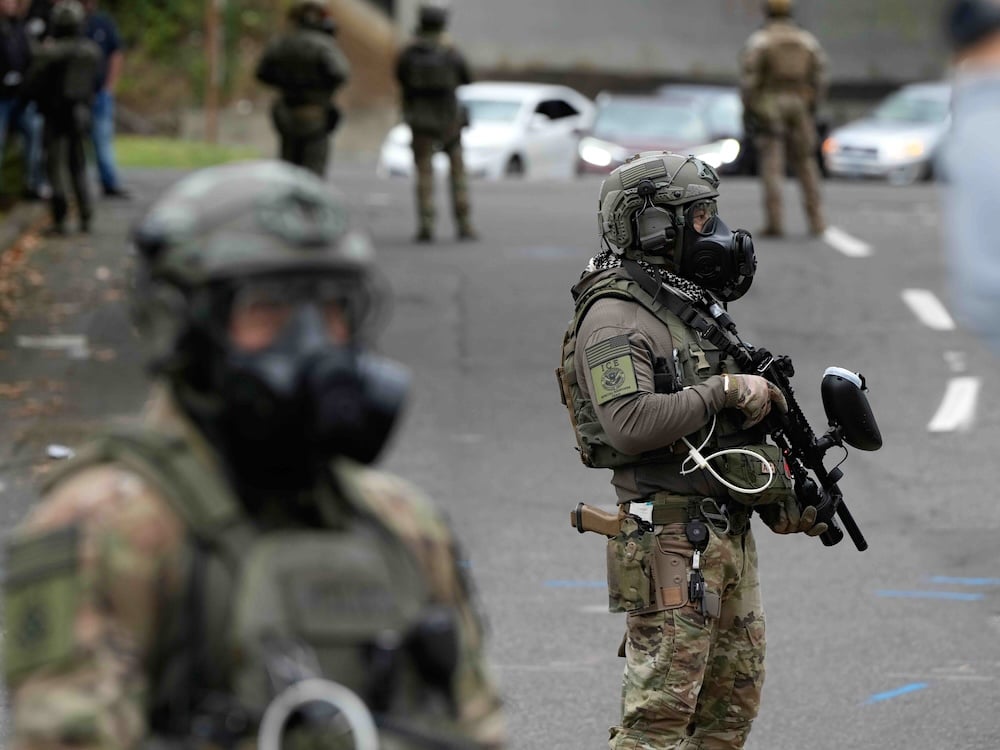
The ICE agents the Canadian company’s armoured vehicle will be carrying have faced mounting accusations of human rights abuses and violent acts.
A ProPublica investigation published in October found more than 170 cases this year where citizens “were detained at raids and protests,” with some held for more than a day without permission to contact a lawyer or loved ones.
The article also detailed aggressive violence, including Americans being “dragged, tackled, beaten, tased and shot by immigration agents.”
In just one viral incident among many, ICE agents shot a pastor in the head with a pepper ball.
This moment calls for moral clarity
The government can’t stop Canadian companies from working with and profiting off of the more inhumane elements of the U.S. administration.
But after an election campaign that Mark Carney’s Liberals won on a promise that Canada would keep its elbows up, the government should establish moral red lines for the companies it’s willing to partner with here at home.
Instead, Carney’s government continues to place profit over morals.
When it became apparent the Canadian company GardaWorld would be staffing the Florida detention centre known as Alligator Alcatraz, the government refused to comment on whether it would continue working with the security giant.
Since that article was published in mid-August, the government has granted GardaWorld nearly $2 million in additional contracts.
Now, we’re again watching a Canadian company profit from Trump’s mass deportation agenda. Again, the Canadian government is refusing to say whether this is a red line for granting future contracts to the armoured vehicle manufacturer — even as Roshel ramps up its lobbying efforts.
Moments like these call for moral clarity.
Carney’s government, however, refuses to provide it.
Is this what “elbows up” looks like? ![[Tyee]](/design-article.thetyee.ca/ui/img/yellowblob.png)
Read more: Politics




Notice about commenting changes
The Tyee’s commenting system will be moving to a new platform on Nov. 12. If you’re already a Tyee commenter you must register with the new system on or after Nov. 12 with your preferred username.More information can be found here.