


 SHARE:
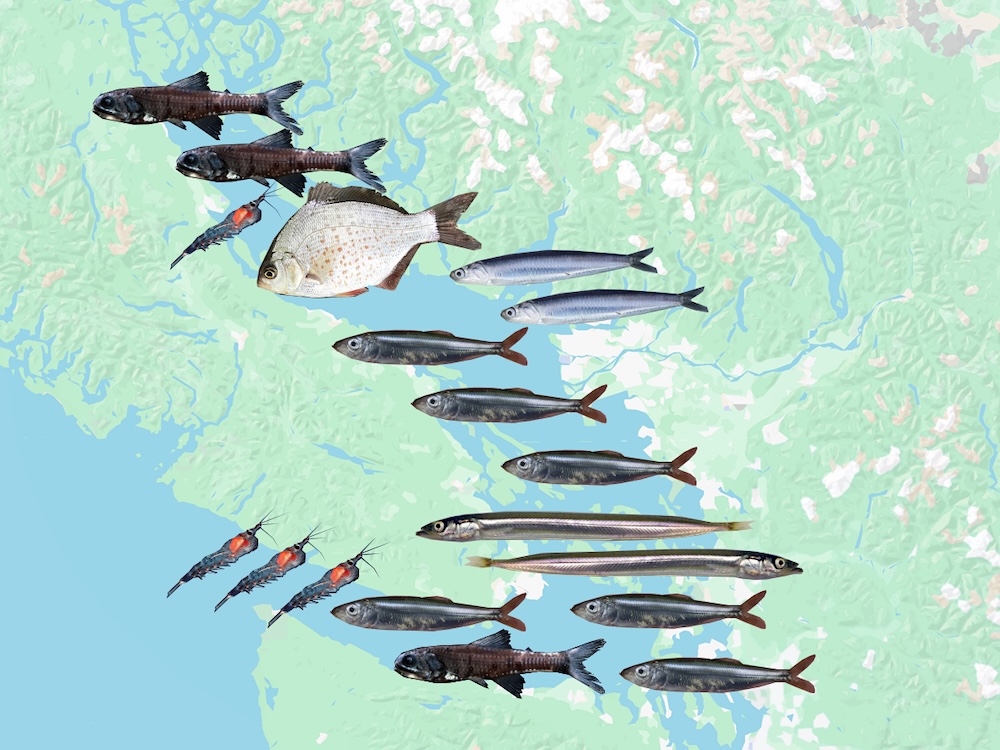
Scientists have figured out how to use the voracious appetites of salmon to map the availability of forage fish in the Salish Sea.
How voracious? A juvenile salmon digesting a herring almost one-third its size, with the herring’s tail still sticking out of its mouth, will still bite at a fishing lure in search of more grub, says Rick Hackinen, who owns Brightfish Charters in Campbell River and has been fishing salmon for 45 years.
Instead of scientists trawling to try to catch small and agile forage fish themselves, they’ve partnered with local anglers like Hackinen who are catching the salmon that are eating the small fish.
The Salish Sea is the inland sea between Vancouver Island, mainland British Columbia and Washington state. Its forage fish include Pacific herring, Pacific sand lance, northern anchovy, lantern fish and tiny shrimp and crustaceans.
To support the study, known as the Adult Salmon Diet Program, local anglers recorded data about their daily chinook and coho catches before sending scientists the fish’s guts.
Researchers such as Wesley Greentree, a PhD student with the University of Victoria and the Pacific Salmon Foundation, then received the guts and took a closer look to analyze the semi-digested creatures inside.
Researchers can also further “digest” the stomach contents in a dish soap mixture for six weeks. This allows them to fish out the remains of tiny identifiable bone structures, which also inform researchers about what the salmon was eating before it died.
The work is “incredibly stinky” and “not glamorous,” Greentree told The Tyee.
People visiting the lab have worried that the smell is rancid enough to be a safety issue, he added. But Greentree said his team have tough stomachs.
“We’ve done more smelly projects,” he said. “We had one student who was looking at whale feces. Now that was quite something.”
While the work may not be glamorous, it helps fill a knowledge gap about local forage fish, he said.
Greentree’s team has mapped out the availability and distribution of chinook salmon prey during the hotter, brighter half of the year and the cooler, darker half of the year.
They recently published their findings in the Fisheries Oceanography journal.
Since launching in 2015, the Adult Salmon Diet Program has been sent more than 7,600 chinook and coho salmon stomachs from more than 250 recreational anglers.
Stomachs for the study were also collected by the Pacheedaht First Nation creel surveyors in Port Renfrew, the Raincoast Education Society in Ucluelet and Tofino and the Sidney Anglers Association in Sidney.
Greentree’s study analyzed 2,500 chinook stomachs caught in summer and winter from April 2017 to March 2022. They focused on chinook instead of coho because chinook can be recreationally caught year-round.
Herring feed chinook; chinook feed orcas
Chinook salmon spend their first summers foraging in the Salish Sea. Some never leave, while others return to the region to eat their final meals before heading into fresh water to spawn, the study said.
Chinook are the main food source for endangered southern resident killer whales.
And, as it turns out, Pacific herring are the main food source for chinook salmon.
Will Duguid, who founded the Adult Salmon Diet Program, explained in a 2021 webinar that it’s important to study forage fish because they play such a major role in marine food webs, transferring nutrients up the food chain when they eat tiny zooplankton and then are eaten by larger seabirds, fish and mammals. Small impacts to forage fish populations can have huge implications further up the food web, he added.
The Salish Sea is divided into five regions: the northern Strait of Georgia, central Strait of Georgia, southern Strait of Georgia, Haro Strait and Juan de Fuca Strait. For the purposes of this study, researchers further divided the sea into a grid of 625 squares.
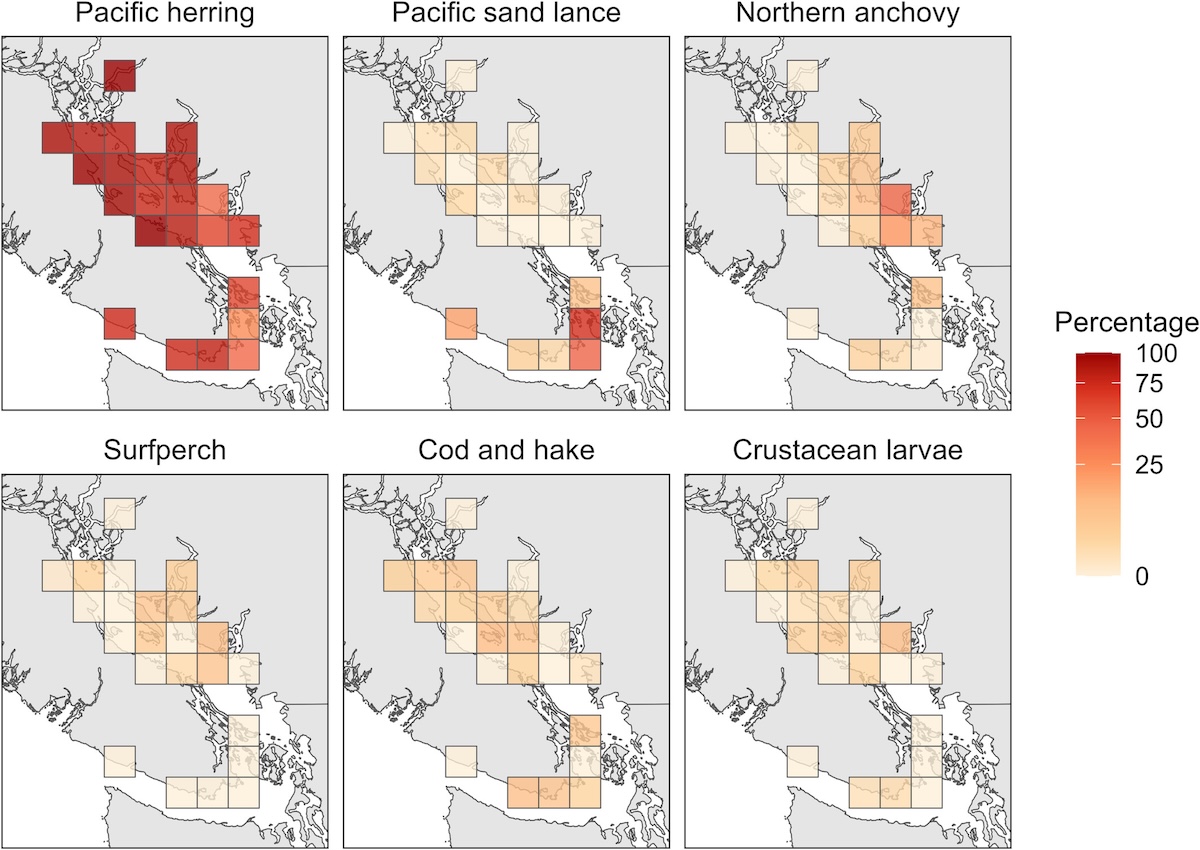
In the warm season, which ran from April to September, chinook were frequently eating herring, especially in the Strait of Georgia and Juan de Fuca Strait.
They also ate sand lance in Haro Strait and anchovy and surfperch along the mainland shore of the Strait of Georgia. Occasionally they also snacked on juvenile cod and hake throughout the Salish Sea.
Chinook’s diets were more diverse during the cool season, which ran from October to March.
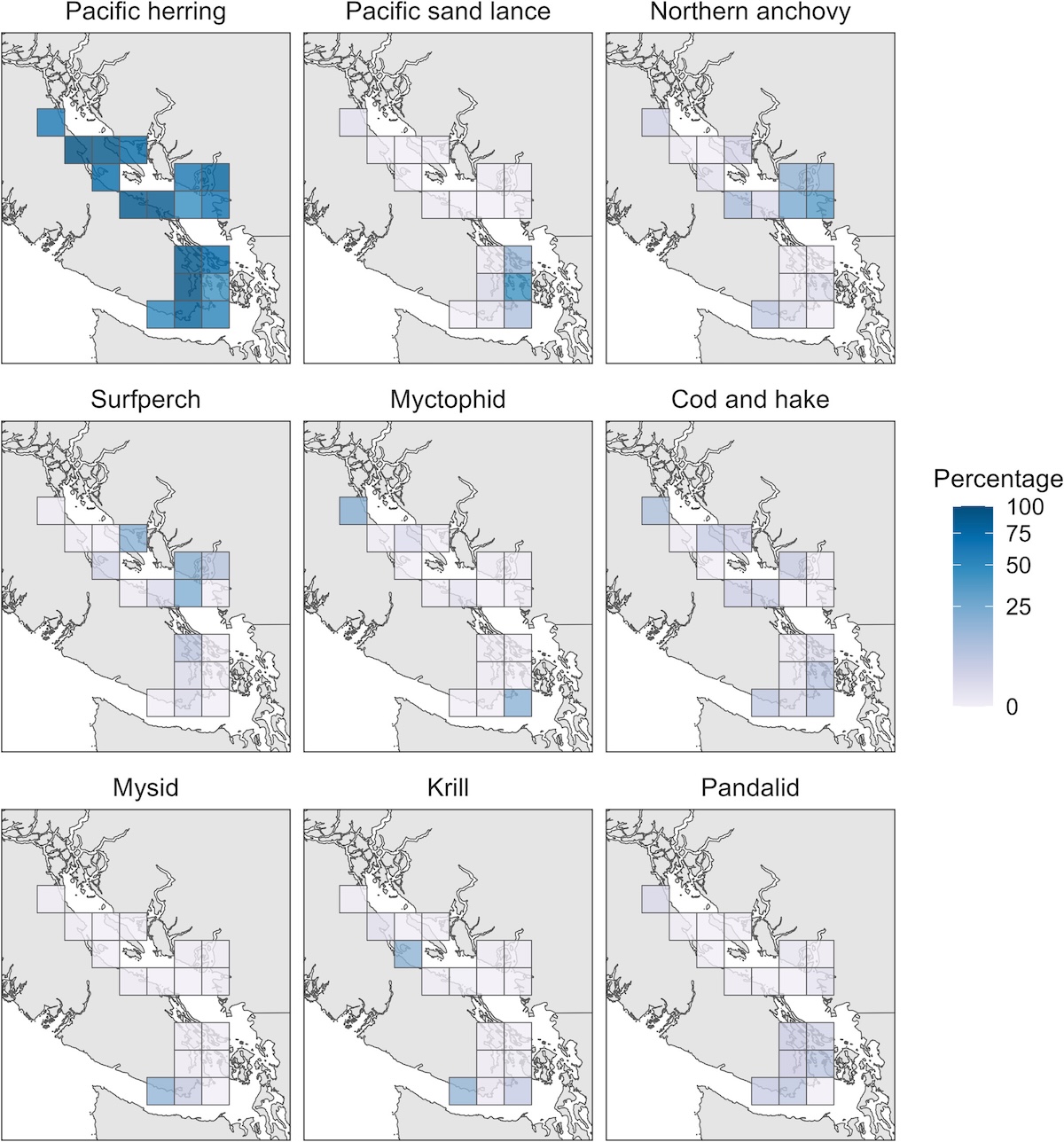
Herring were still important prey throughout the Salish Sea, and sand lance were commonly eaten in Haro Strait but not really anywhere else.
Anchovy were eaten only at the entrance to Howe Sound. Surfperch were popular at that same spot, and well as in the Malaspina Strait.
Northern lampfish were important prey in the northernmost part of the Strait of Georgia and the eastern part of the Juan de Fuca Strait.
In the winter, chinook also feasted on crustaceans. Krill and other small shrimp made up 31 per cent of salmon diets in the western Juan de Fuca Strait.
Certain forage fish have habitat preference, which might explain why they are found only in certain areas, researchers said.
For example, sand lance thrive in the cold waters of Haro Strait, which happens to be one of the few areas in the Salish Sea that are home to the coarse sand they like to bury themselves in, the study said. Anchovy were mostly eaten near where the Fraser River dumps into the Salish Sea; they’re known to spawn in coastal areas influenced by freshwater input.
The last time local chinook salmon’s diets were studied was in the 1960s. There have been “major changes” in local forage fish communities over the last eight decades, the study said.
Some big shifts include how Pacific sardines were abundant in these waters in the 1940s but disappeared a decade later. (They re-emerged in the 1990s and disappeared again in the 2010s.)
In 2014, anchovies arrived on the scene, a development thought to be connected to warming local waters.
How anglers can connect with the study
Local anglers who are interested in participating can continue to help scientists track changes to salmon diets.
After a lifetime of benefiting from salmon, Hackinen told The Tyee he’s happy to be able to give back. He spends a lot of his time contributing to community science initiatives — including trolling for juvenile salmon on cold winter days so he can weigh them, tag them and release them.
When he takes people out on tours with Brightfish Charters, people “feel like they’re contributing to the scientific base and most people are keen about that,” Hackinen said.
“It’s a selling feature in my boat,” he added.
Anyone interested in contributing salmon guts to community science can contact the Adult Salmon Diet Program by email or check in with their local tackle shop — many shops let anglers drop off stomach samples, which are held in a freezer for collection. ![[Tyee]](/design-article.thetyee.ca/ui/img/yellowblob.png)
Read more: Science + Tech, Environment













Tyee Commenting Guidelines
Please note that email notifications for replies are not currently working due to a software issue which may be resolved in a future update.
Comments that violate guidelines risk being deleted, and violations may result in a temporary or permanent user ban. Maintain the spirit of good conversation to stay in the discussion and be patient with moderators. Comments are reviewed regularly but not in real time.
Do:
Do not: