


 SHARE:
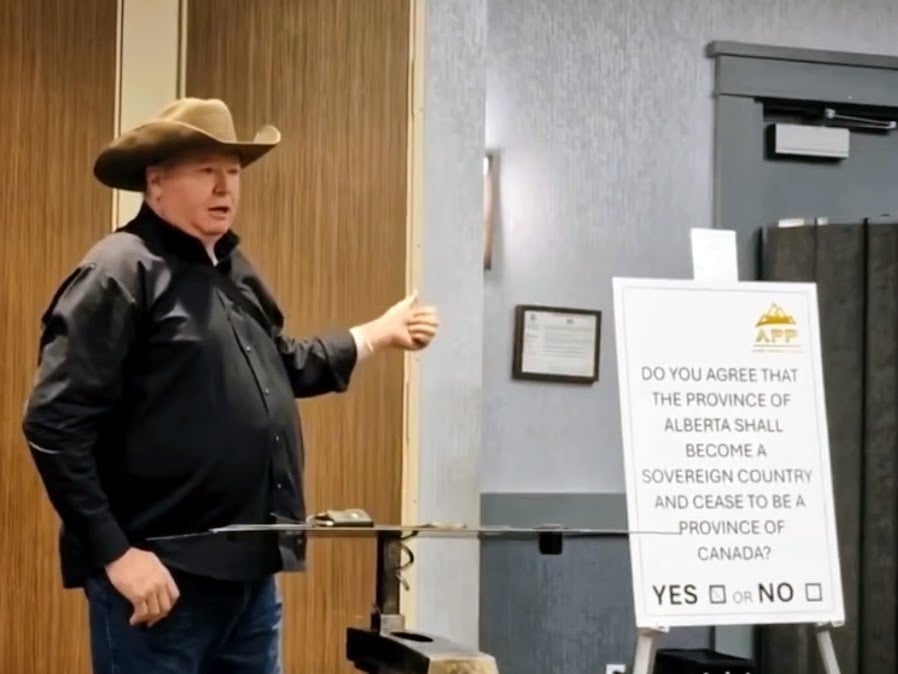
A network of 20 inauthentic YouTube accounts has racked up nearly 40 million views by peddling lies, grievance, division and narratives normalizing the prospect of Alberta’s secession and annexation by the United States.
“Because these channels offer no identifying information to real humans or organizations, nor ties to the secession movement in Alberta, we are flagging this phenomenon as a potential covert influence operation produced by unknown actors pursuing unclear objectives,” states a report released today by the Canadian Digital Media Research Network.
“These videos contain frequent and obvious lies, drawing on real news stories to reach exaggerated conclusions designed to exploit political divisions,” the report states, adding that the news is discussed “from a perspective of a highly aggrieved, anti-federal government perspective.”
Researchers could not determine which countries the videos originated from, where the people who are consuming the videos live or the intent.
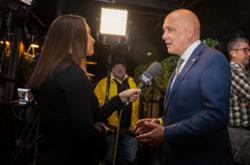
Chris Ross is the senior analyst at the Media Ecosystem Observatory at McGill University in Montreal, which co-ordinates work by media researchers across Canada.
Ross, a Calgary native, said separatism is obviously a major topic in Alberta and these YouTube videos are getting a lot of views.
“So we can't rule out that the purpose may be clickbait and engagement farming for profit.
“But because of the political content and the very extreme grievance-oriented language, there also is a potential political angle. So it’s difficult to tell when you don't know who the origins of the channels are or their target audience.”
The Tyee asked Patrick Lennox, a former criminal intelligence manager for the RCMP’s federal policing program in Alberta, to review the report. His interpretation of the quantitative evidence collected by the researchers, which he called “extraordinary,” is much more direct.
Lennox said that while academic researchers are not going to draw a straight line to U.S. financiers or MAGA influencers, “any common-sense reading of that report would understand it to be for an influence job.”
“I think if you just look at it more broadly, it suggests that there is very clearly an American-led attempt to normalize and amplify the idea of Alberta becoming the 51st state of the U.S. annexation. And the co-ordination effort is so obvious.”
The genesis for the digital media research network report was a November Canadian Press report that revealed the potential for an Alberta sovereignty referendum had launched a tsunami of clickbait stories on video-sharing sites earlier in 2025.
The story detailed how content farms, which usually use AI to narrate videos, had circumvented a ban on “AI slop” — mass-produced, misleading content — by using real people to narrate and appear in videos.
The videos studied by researchers for this network report use AI-generated deepfakes of politicians — often Alberta Premier Danielle Smith or Prime Minister Mark Carney — with maps in the background showing some combination of western provinces as part of the United States.
The videos’ content is often a voice-over of clipped news sources, ranging from traditional media news snippets to clips from the YouTube accounts of authentic separatists.
Because so many use similar clips it appears a template is being employed, the report states. And while the content is likely disseminated among many channels using an automated process, a significant amount of work would be required to source and edit the clips into video segments.
The videos contain frequent blatant lies. For example, the Canadian Reporter channel opens with the following quote in its most popular video, which drew 710,000 views.
“The western provinces just dropped a political bombshell that is shaking Ottawa to its core, declaring moves towards the 51st through 56th statehoods with shocking authority.”
Fifty seconds later, the narrator declares: “I am witnessing decades of ignored comments, dismissed warnings and brushed-off facts finally exploding in Ottawa’s face.
“And here comes the punch, 65 per cent of Albertans, 61 per cent of Saskatchewan residents and 58 per cent of Manitobans openly supporting separation or even U.S. statehood.
“At this point, anyone who is still calling this fringe is either blind, they’re lying, or they’re desperately hoping that everyone else stays clueless.”
None of the polling statistics stated in the video are true.
The study also found that the secession-related content produced by these YouTube channels significantly focused on “grievance framing alongside pro-U.S. annexation narratives.”
Researchers classify three types of grievances: political, economic and cultural.
“On the inauthentic channels, grievance framing is overwhelmingly political and economic. On average, 65 per cent of video segments in Alberta-mentioning videos contain such framing, while approximately seven per cent are favourable toward U.S. annexation.”
Researchers found that compared with the YouTube accounts of real Alberta separatists, the inauthentic channels featured about 60 per cent more grievance framing and about 12 times more video segments discussing U.S. annexation favourably.
“While authentic Albertan secessionists discuss their politics with high amounts of grievance and low favourability towards U.S. annexation, the inauthentic channels not only amplify grievance framing but also skew the discourse toward favourable characterizations of U.S. annexation,” the report states.
The report says its finding of 40 million views of propaganda in 12 months raises serious concerns about the integrity of the Canadian media ecosystem, particularly given the 2024 revelation that the Tenet Media YouTube channel was a Russian-funded influence operation. It accumulated 15 million views in one year.
With a referendum on separation scheduled to be held in Alberta in October, the report says it hopes this information helps the public, governments and social media platforms to respond accordingly.
The Canadian Digital Media Research Network is calling on YouTube to share information about the account creation and ownership history of channels identified as part of co-ordinated inauthentic networks and whether paid promotion or ad targeting was used to direct content toward specific regions.
They also want YouTube to disclose data so that researchers can determine who is actually watching this content and expand community notes so that viewers can directly flag misleading content.
This article is part of The Tyee’s reader-funded Reality Check project exposing and explaining the rise of digital disinformation. ![[Tyee]](/design-article.thetyee.ca/ui/img/yellowblob.png)




Tyee Commenting Guidelines
Please note that email notifications for replies are not currently working due to a software issue which may be resolved in a future update.
Comments that violate guidelines risk being deleted, and violations may result in a temporary or permanent user ban. Maintain the spirit of good conversation to stay in the discussion and be patient with moderators. Comments are reviewed regularly but not in real time.
Do:
Do not: