


 SHARE:
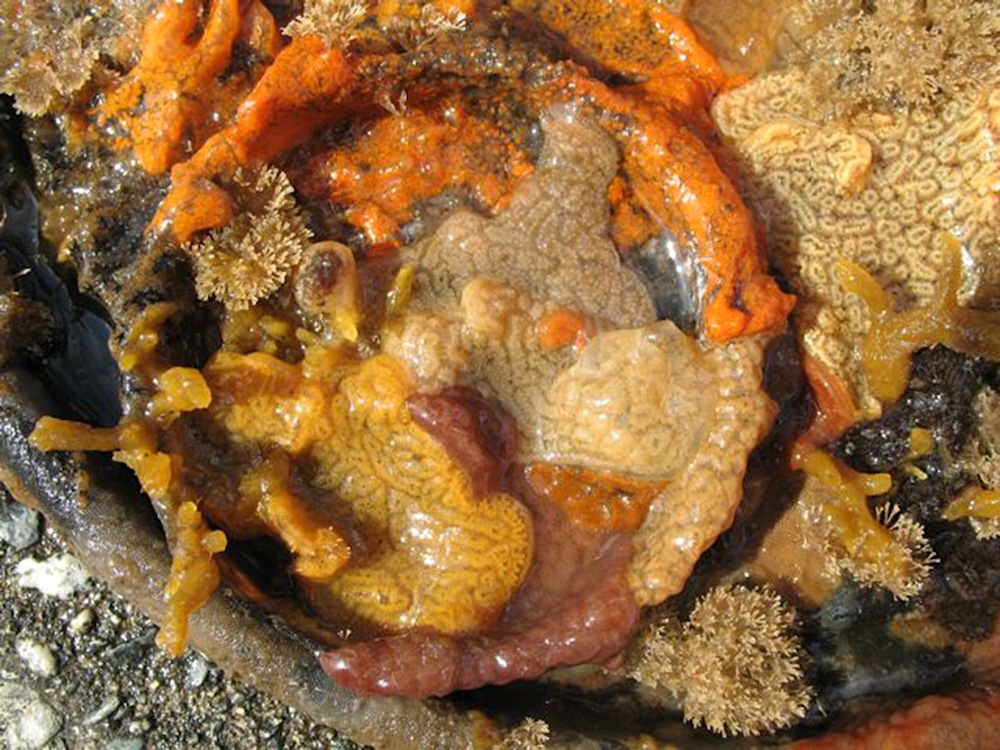
It didn’t arrive on a meteorite, crashing into a suburban town to feast on human flesh. But an alien blob has been circulating in British Columbian waters, spreading its colonies in marinas and oyster farms.
It arrived from the west, likely as a stowaway on ships from Japan or Korea, or as a hitchhiker on the backs of oysters.
Once it arrived, it thrived. Now, it is found across the eastern Pacific, from California to Alaska.
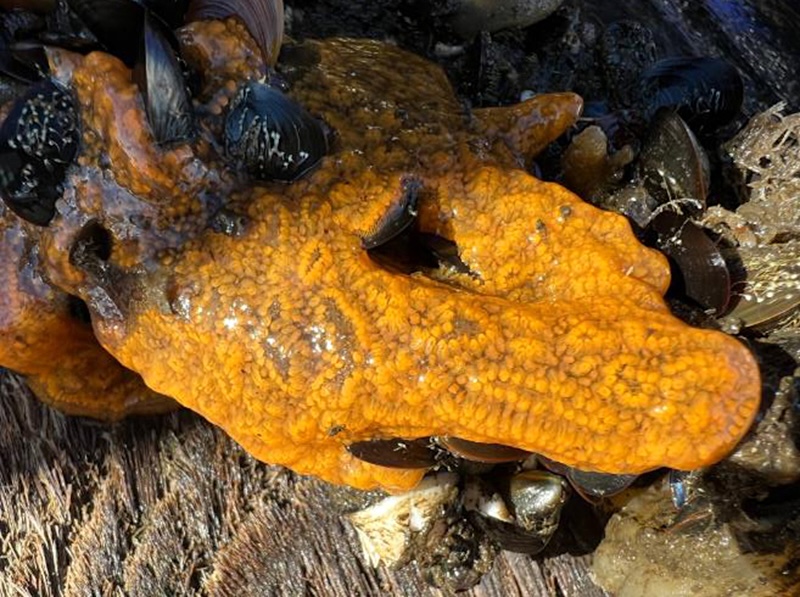
It is the violet tunicate, Botrylloides violaceus: a colonial sea squirt that looks surprisingly similar to a blob of slime. Made of hundreds of individual animals called zooids, the violet tunicate spends its adult life attached to hard surfaces such as docks, ships, rocks or mollusks.
Its life history sounds like something out of science fiction. The colony feeds together, with the zooids arranged in a chain pattern around a shared tubular structure called a siphon. The zooids share a blood supply, spread throughout the surface tissue, called a “tunic,” which helps protect the colony.
The violet tunicate uses a chemical to prevent other species from adhering to surfaces near it and can increase the size of its colony through asexual budding.
It also reproduces through hermaphroditic sex.
Each zooid is both male and female. When it is time to reproduce, one zooid releases an egg into the membrane of the colony’s tunic. The egg grows in that pouch for one month and then bursts from the colony as a tadpole about as wide as a strand of spaghetti. The tadpole swims for a few hours before settling on a nearby rock or dock. Within two weeks in the summer — or four in the slower winter months — the new violet tunicate colony will be made of more than 100 individual zooids.
Not a lot is known about violet tunicates in their native range, although a study from the 1970s found it was one of the most common biofouling creatures on Japanese cultured pearl oysters. Some of those oysters were imported to Ladysmith Harbour in 1912 to supplement depleted stocks of native oysters. Most arrived uncleaned, and many different invasive hitchhiker species spread along the B.C. coast.
The government takes a closer look
Thomas Therriault, a scientist with Fisheries and Oceans Canada, commonly known as DFO, was called in the early 2000s to take a closer look at the violet tunicate and other invasive sea squirts like it after mussel farmers in Prince Edward Island expressed concern about new kinds of species infiltrating their farms.
“It was the very early days of our science program on aquatic invasive species at DFO,” Therriault told The Tyee. Industry partners wanted to get a better handle on what these sea blobs were, where they were coming from and what they were doing in Canadian waters.
“They’re basically the precursor to vertebrate life,” Therriault said, describing the tunicates.
Therriault began a national risk assessment on tunicates, published in 2007. He assessed the violet tunicate, alongside the Mediterranean golden star tunicate, the solitary club tunicate from the northwest Pacific, the cold-water vase tunicate and the taxonomically complex Didemnum tunicate.
While his initial assessment was focused on aquaculture in the Atlantic provinces, Therriault soon found that tunicates were spreading in the Pacific, too. But shellfish farmers out west weren’t too put out dealing with the blobs. “‘They’re not really causing us as much of a problem,’” Therriault remembers being told.
And that’s still true — for the most part.
Therriault’s 2007 assessment labelled violet tunicates as high risk for aquaculture, and a recent DFO report reaffirmed the designation.
But B.C.’s nearly 500 shellfish farms have found successful methods for dealing with the invaders. Pressure washing effectively removes the tunicates from shellfish and gear — so long as it is done on land, where the fragments can’t make their way back into the water to colonize new areas.
“It’s not quite the same story as, say, a higher-risk invader like European green crab where you have predation and competition and displacement,” Therriault said.
But, he noted, there is still a lot we don’t know about violet tunicates and other tunicate invaders off B.C.’s coast.
That is why Fisheries and Oceans Canada continues to have a “see it, report it” policy for violet tunicates and other invasive sea squirts. Though they’re not B.C.’s worst invader, they can be problematic in certain areas, and we need to gather data, refine future assessments and consider further mitigation tactics.
There aren’t any native tunicate species, Therriault added, so if you see a slimy mat affixed to a dock, rock or boat, chances are it’s an invasive tunicate. They’re actually quite pretty underwater, Therriault said.
If you see a violet tunicate, or any tunicate species, in your area, you can take a picture and send it to Fisheries and Oceans Canada with the GPS co-ordinates of where it was found. ![[Tyee]](/design-article.thetyee.ca/ui/img/yellowblob.png)
Read more: Environment











Tyee Commenting Guidelines
Please note that email notifications for replies are not currently working due to a software issue which may be resolved in a future update.
Comments that violate guidelines risk being deleted, and violations may result in a temporary or permanent user ban. Maintain the spirit of good conversation to stay in the discussion and be patient with moderators. Comments are reviewed regularly but not in real time.
Do:
Do not: