


 SHARE:
Last year, the Wall Street Journal won a Pulitzer for an investigation that used artificial intelligence. To map out the transformation of Elon Musk’s politics, the Journal used machine learning to analyze 41,000 of his interactions on X, reported Andrew Deck in NiemanLab.
That’s a powerful use case for AI in journalism.
But it’s also an example of machine learning — not generative AI, the tool that no one has been able to stop talking about since the launch of OpenAI’s ChatGPT in November 2022.
Not only is generative AI prone to inaccuracies, but experiments conducted by The Tyee while developing our own AI policy revealed that text ChatGPT generated was also vague and bland — much weaker than what a human journalist could write.
The use of generative AI in journalism has also produced some embarrassing mistakes.
Last May, the Chicago Sun-Times and the Philadelphia Inquirer published a book recommendation list that included non-existent books.
This past August, Wired and Business Insider removed numerous features that had appeared under the byline “Margaux Blanchard” after concerns that they were likely AI generated. Many other U.S.- and U.K.-based outlets had published content under the same name.
Even newsrooms that profess they intend on sticking to human-made journalism have had close brushes with AI scams. In November, the Local’s executive editor Nicholas Hune-Brown recounted the tale of how a suspicious pitch from a “freelancer” led him to investigate the byline and ultimately expose the “journalist,” whose works had already been published in the Cut, the Guardian and Architectural Digest.
In a profession that emphasizes accuracy, ethics, accountability to the public and engaging writing, those are serious drawbacks.
So, is AI useful in newsrooms? Should you be worried? Or is everyone blowing this out of proportion? In short: yes.
Here’s what you need to know about how Canadian media are navigating this technological game-changer.
What kinds of AI are newsrooms and journalists using?
“Artificial intelligence” is an umbrella term that applies to many kinds of technology.
Global technology and consulting giant IBM defines AI as “technology that enables computers and machines to simulate human learning, comprehension, problem solving, decision making, creativity and autonomy.”
Machine learning is a dominating subset of AI. It’s “focused on algorithms that can ‘learn’ the patterns of training data and, subsequently, make accurate inferences about new data,” allowing models to make predictions without hard-coded instructions, explains Dave Bergmann, an AI models writer for IBM Think.
Machine learning “provides the backbone of most modern AI systems, from forecasting models to autonomous vehicles to large-language models and other generative AI tools,” Bergmann writes.
Machine learning also uses “deep learning,” which consists of “multilayered neural networks” — a design inspired by the structure of the human brain.
These are not new tools.
The more recent hype around AI is centred on generative AI, which uses machine learning to generate original text, images, video, audio or software code in response to a user prompt.
Proponents of AI say it will revolutionize everything from content creation to software engineering or even writing an email to your boss.
But because it’s trained on data it scrapes from the internet, it has also been the subject of copyright lawsuits. In 2023, the New York Times sued OpenAI, the parent company of ChatGPT, and Microsoft, which owns the chatbot Microsoft Copilot, for using its articles for training and competing with the outlet as a source for reliable information.
ChatGPT and Copilot are considered large-language models, or LLMs — another term you’ve likely come across.
LLMs use generative AI to parse and generate human-like language. Critics have called attention to their worsening “hallucinations,” referring to when a chatbot confidently supplies seemingly plausible information that is actually misleading or inaccurate.
There is still little understanding of how to use AI tools ethically in the journalism industry, according to a study published in Digital Journalism in April of last year.
“You have a few big newsrooms with funding that are doing it in the correct ways, out loud in sandboxes and sharing knowledge,” Angela Misri, an assistant professor of journalism at Toronto Metropolitan University, who led the study, told The Tyee. “Like the Washington Post or the Atlantic or BBC.”
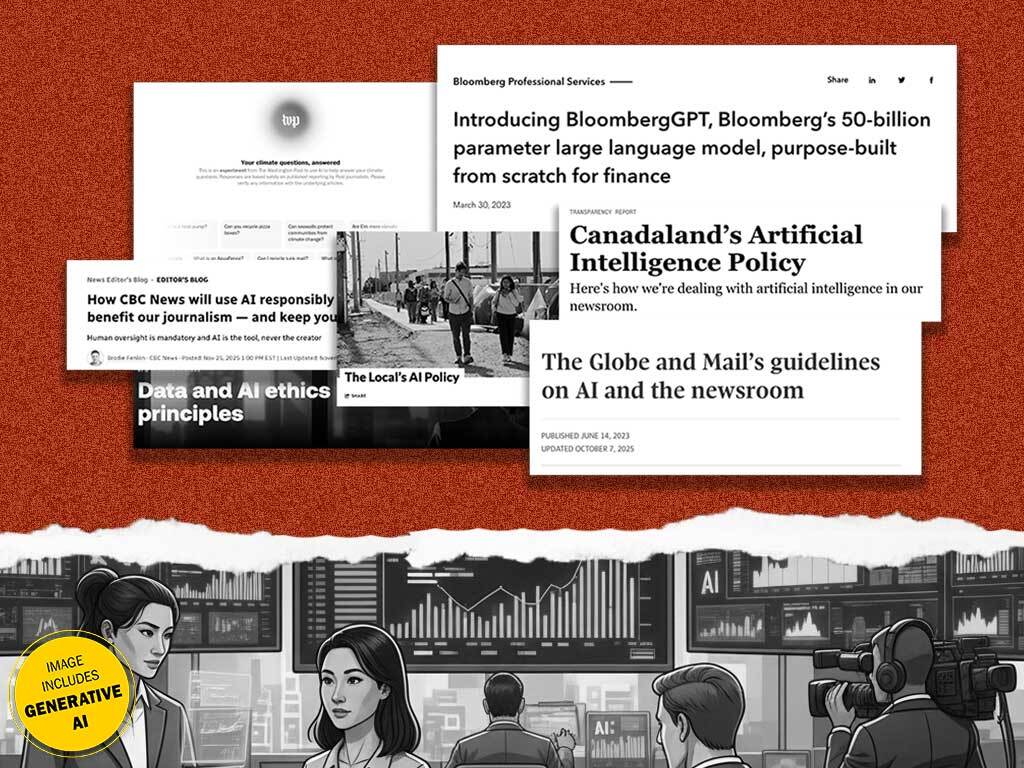
The Post, for example, just launched an AI-powered, “pick-your-own-format” podcast to attract younger audiences. Last year, it launched an experimental chatbot that uses its own reporting to generate responses to users’ climate-related queries. The Financial Times also made a chatbot for financial queries, as did Bloomberg.
On the other hand, “you’ve got newsrooms where people are literally working on it on the side of their desk,” Misri added. “The other guy next to them has no idea.”
Should I be worried about the future of journalism?
Google now automatically provides AI-generated responses to anything you enter in the search bar using its own chatbot, Gemini, which means users don’t have to click through to news websites to find answers to their queries.
That threatens news outlets’ traffic and business models.
“So far the trend is small, but everyone expects it to increase,” wrote Margaret Simons in the Guardian.
“Fewer eyeballs on a media organization’s website or app means fewer subscribers and fewer advertisers willing to pay to reach the diminishing audience.”
It’s easy to fearmonger, but “we need to be less scared,” said Misri. “How will we confront the fact that we have fewer journalists in the field — could AI help us with that? We have local news deserts — couldn’t AI help us with that? There are so many ways that we could be using this as a problem-solver.”
“A year ago, I was really worried we [were] still not seeing any of this in the journalistic policies,” Misri said. “But we’re starting to see at least line items.”
How will AI affect reader trust in journalism?
Journalism operates on a system of audience trust and credibility. Canadian newsrooms often share ethics guidelines or standards and practices they promise to follow on their websites, including principles such as serving the public interest and avoiding conflict of interest. Journalism students are taught these principles as early as the first few weeks of post-secondary journalism programs.
As Misri’s study points out, these standards fall within larger industry-accepted standards across the world. But the “gut instinct” approach journalists have taken around their personal use of generative AI is insufficient, Misri told The Tyee.
According to a survey conducted for the Canadian Journalism Foundation by Maru Public Opinion, 92 per cent of Canadians believe newsrooms should have AI policies.
How are Canadian newsrooms ethically using AI?
In discussing AI in the newsroom, often one of the first tools that comes to mind is Otter.ai, which is widely used to transcribe interviews.
Back in June 2023, Brodie Fenlon, chief editor of CBC News, posted in an editor’s blog that AI has long been “baked into much of our daily work and tools,” citing auto-complete, translation tools and voice assistants.
Some longtime use cases for AI in the newsroom happen outside the newsroom too, as noted by Sandra Martin, standards editor for the Globe and Mail. Machine learning can be used to personalize a user’s news home page or identify what stories readers consume in the morning or after work to suggest more of those kinds of stories around that time of day.
The Globe and CBC — which both published their first AI guidelines or memos in June 2023, then updated them late last year — commit to human-made journalism and, in the rare cases AI is used, commit to disclosing it. CBC makes note of avoiding AI-powered identification tools in their investigative journalism, such as facial recognition or voice matching, “without advance permission of our standards office.”
Fenlon noted in November CBC’s use of AI to analyze “a number of town council meetings to identify contentious stories that had not yet been told by community media.”
Both newsrooms also acknowledge the flaws and dangers of overreliance on AI. The Globe cautions that generative AI has “fundamental flaws” and a “sycophantic” nature and that even something as “benign” as getting rid of typos in an interview can change the meaning of a source’s quote.
Misri said no newsroom she spoke with for her study had a number on how much of their budget was being spent on AI development. “I’m hoping the newsrooms themselves know how much they’re using, because that is something the journalists in the newsroom have a right to know. Somewhere like the CBC, the public has a right to know.”
Smaller newsrooms are also acknowledging the AI wave. PressProgress includes in its journalistic standards that it does not use generative AI to create any editorial content, using AI solely in assistive features that exist within other tools. The Local also recently released an AI policy acknowledging the use of AI-assistive tools and committing overall to human-verified, fact-checked journalism.
Meanwhile, other independent newsrooms are full-on embracing AI — or at least not turning their noses up at it.
“AI integrates with my very human-centred community engagement-driven model,” said Anita Li, founding editor of the Green Line, on a panel about AI in the newsroom in June 2024. “It supports smaller, independent newsrooms that are low-capacity, low-resourced.”
For example, Li, who has a team of about 10 part-time staff or freelancers, has found ChatGPT immensely useful as a “headline-brainstorming partner.” She also highlights the Canadian-made tool OneCliq, which takes video transcripts and churns out descriptive text. But her best use case was the creation of a grant application that ended up getting her news outlet $50,000. “It would’ve normally taken me 40 hours to do this. These are things CBC has an entire team for, and I don’t.”
Experimenting with generative AI — and receiving some backlash for it — was what led Canadaland to adopt the AI policy it released in October. In spring 2024, the news podcast used generative AI without disclosure for the artwork and music of its hit show Pretendians. Director of growth Tony Wang, who co-wrote the policy, said the use of the AI-generated art was discussed in the newsroom, but the ultimate reason for using it came down to the fact that it had “some thematic bearing on the show.”
“I remember being quite disappointed with that decision,” said Sam Konnert, host of Canadaland’s supporters-only show Off the Record, on an episode about AI use in the newsroom.
Konnert acknowledged in the episode that an Indigenous artist was commissioned and paid to create art for the show, but it was ultimately not selected. In a recent Instagram post, the commissioned artist, Sonny Assu, shared what he had created for the show, writing, “An image I made for the Canadaland podcast on Pretendians, which they ultimately used an AI image for... ironic.”
“That’s an example I think we’ve learned from,” Wang told The Tyee in September. “Even if we had been like, ‘Hey, this is AI-generated’... our golden rule is that generative AI should only be used to augment or expedite skilled work, and it never should be used in place of human labour where that’s applicable.”
“We should all be talking to each other about this,” Wang added. “How we’re using it and how we shouldn’t be using it. We should be critical of each other, but we shouldn’t be shooting people down, like, ‘They used it once in a way that was problematic, therefore we can’t trust them anymore.’ I think that’s unproductive.”
Another AI Adobe tool Canadaland has used is Enhance Speech, which uses machine learning to regenerate a cleaner version of low-quality audio files, Wang explained on the Off the Record episode.
AI voice cloning can also be useful when something needs re-recording or clarifying. Few of the newsroom’s hosts have consented to this kind of technology, Wang told The Tyee: “Off the top of my head, only [publisher and host] Jesse Brown. It’s like, the tiniest thing, where he’s having dinner with his family and the episode’s coming out tomorrow [and] he needs to change the way he pronounced one word.”
Post-policy, the use of a voice clone would be disclosed in the show notes, Wang confirmed to The Tyee.
OK, so it’s evolving. What’s the best way forward?
In Wired’s “AI issue,” published in October, chief editor Katie Drummond wrote: “Generative AI is genuinely useful in some contexts, profoundly useless in others and decidedly unproven in most. It is situationally dependent. It is not a monolith.”
The current era of AI is focused on using vast amounts of data for training, notes Drummond. “It might seem technically intimidating. But it is, truly, not that profound.”
Misri recalled a time when she was excited by a still-new, seemingly game-changing tool for journalists: Photoshop.
In her first couple of years out of school at CBC, a foreign correspondent didn’t manage to get a photo of themselves in the field. Misri told her senior producer she could take a picture of the reporter and Photoshop it into the recently bombed area, “no problem.”
“The senior producer was horrified,” recounted Misri. “He was like, ‘That’s not a thing.’”
Misri said she’d been coming at the situation from the perspective of excitement for the tool and its potential rather than “the critical thinking of ‘Wow, that’s not journalism. That’s just faking stuff.’ That same approach can still happen,” she said.
Journalists need to discuss where AI can help and where to draw the line when something is no longer real and nobody verifies it, she added.
“Ask yourself, why are you using the tool to do this? Do I have nine other things to do, and this will make my life faster? Or am I trying not to pay a journalist?” ![[Tyee]](/design-article.thetyee.ca/ui/img/yellowblob.png)
Read more: Media, Science + Tech












Tyee Commenting Guidelines
Please note that email notifications for replies are not currently working due to a software issue which may be resolved in a future update.
Comments that violate guidelines risk being deleted, and violations may result in a temporary or permanent user ban. Maintain the spirit of good conversation to stay in the discussion and be patient with moderators. Comments are reviewed regularly but not in real time.
Do:
Do not: