

 SHARE:

“On my third day in Canada,” recalls Abdul Hassan, “I felt lost and scared on East Hastings, where I sought shelter.” He looked for a place where he might learn and contribute to his new home. A stately stone building with columns, topped by a dome, caught his eye. “I didn’t know if it was a mosque or a church. It looked like both. I just wanted a connection.”
Hassan was from Ethiopia, and had spent several years in Dubai before climbing the steps of Carnegie Community Centre and passing through its glass doors. Inside, he encountered one of the two part-time teachers at the Carnegie Learning Centre, or CLC, funded through a long-standing partnership with Capilano University in North Vancouver.
“Emily Hunter welcomed me,” says Hassan of that day three years ago. “And I became a volunteer computer tutor. Because of the CLC, I met people and got a full-time job.”
Over the span of nearly three decades, the Carnegie Learning Centre has demonstrated what’s possible when a university reaches beyond its campus borders to partner with community service providers — and sticks to its commitment. Capilano University funds one instructor position at the centre. The City of Vancouver and the Carnegie Community Centre Association provide infrastructure and administrative support. The community offers volunteers and other support.
Hassan’s story is one among many we’ve heard as university professors who have taught and volunteered at the centre.
Another belongs to Nahida Osman, who migrated from Jordan. She credits Namorsh Reddy, one of two part-time Capilano instructors, with transforming her horizons. “I improved my self-esteem and my English,” Osman says. After years of juggling multiple responsibilities, she’s earning an Adult Dogwood Diploma and works as a cook in the Carnegie kitchen. “I volunteer too. The CLC changes lives.”
Universities are cutting budgets, and community programs are often the first to go. But disengaging from people outside the university's walls will only worsen the town-gown gap. University students will have fewer chances to connect what they learn in the classroom to different contexts, and the quality of research will be undermined. Community members will be deprived of learning opportunities.
If universities become more disconnected from wider communities, they may find it harder to justify their missions and claims on tax dollars.
Rather than simply abandoning community programs and the substantial benefits they provide, a better way for universities to deal with tightening budgets would be to adopt models of resource-sharing collaboration.
A prime example is the Carnegie Learning Centre, where educators and researchers learn alongside Downtown Eastside residents and university students — all developing their capacities.
The cost to post-secondary institutions is small, but the impact is not. Students from various institutions describe their placements at the Carnegie as transformative.

Stephen Lytton is a member of the Nicomen Indian Band within the Nlaka’pamux First Nation, an artist, a disability rights activist and an active member of the CLC since 2003. He says practicum students have now become lifelong friends, educators and community members.
This reciprocity extends to Downtown Eastside residents who gain confidence through the CLC to finish high school and pursue further education. Some become writers and actors in plays written by Downtown Eastside residents. The program contributes talent and energy to the Downtown Eastside Writers Festival, the Heart of the City Festival and theatrical productions like The Mayor of Oz — community-led initiatives that create tangible benefits and learning opportunities for all involved.
As Lytton says, the CLC “is a bridge to education that means we all benefit.”
Wendy Pedersen, executive director of the DTES SRO Collaborative, which works to improve the habitability, safety and security of single-room ocupancy homes, gives credit to the CLC for her innovative approach to organizing and supporting community.
“The CLC was where I learned how to learn and help others in the early ’90s. I got plugged in as a community leader who went on to make things happen,” she says.
One of the unique elements of the DTES SRO Collaborative approach is the SRO Degree, a tenant education program that builds on the innovative approach to education Pedersen learned at the CLC.
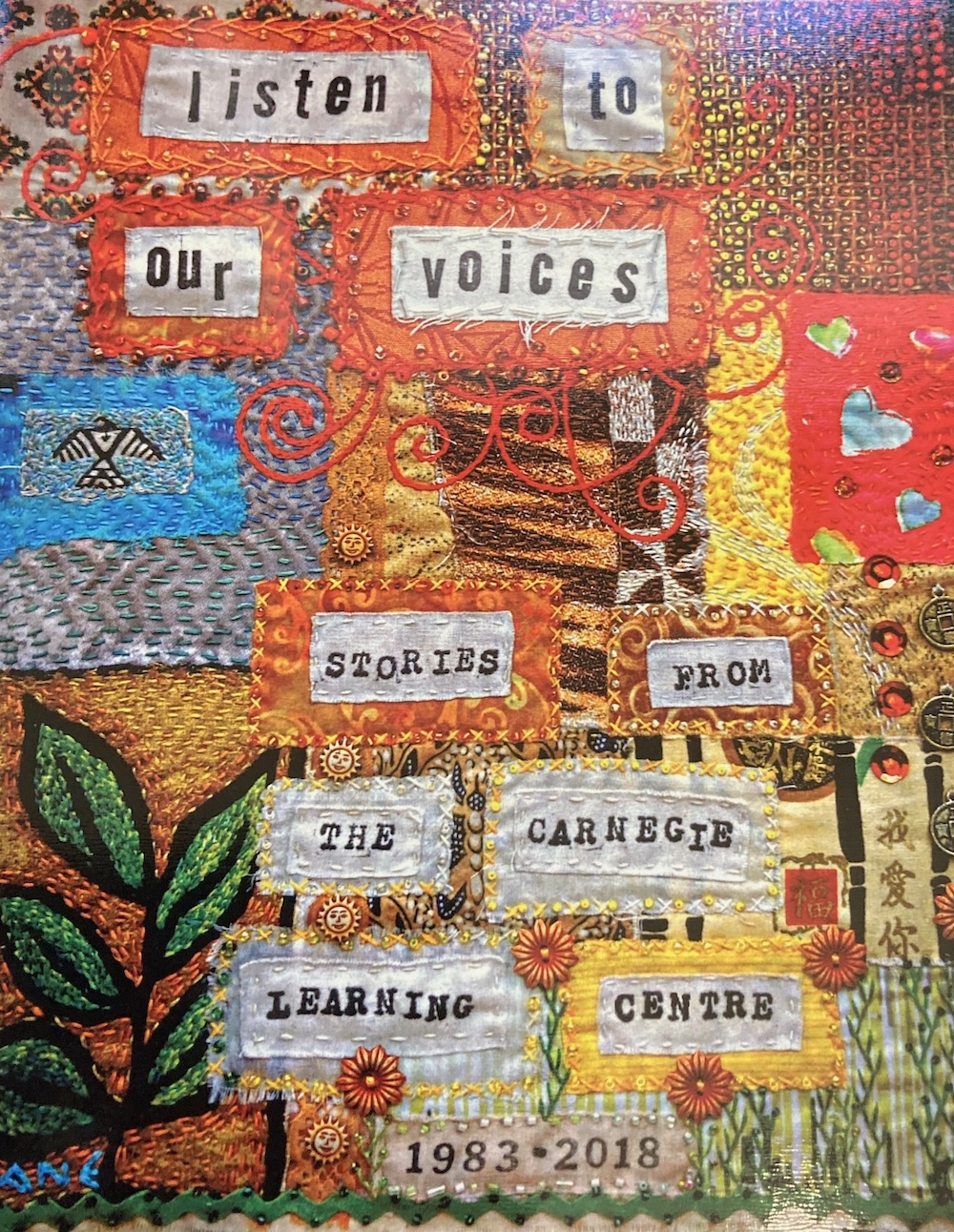
CLC participants teach and learn across the community, participating in multiple learning spaces that take place at the Carnegie, including the University of British Columbia’s Humanities 101.
Gilles Cyrenne has played roles in the Carnegie Learning Centre for over a decade. “My involvement has led me to teaching English grammar for UBC’s Writing 101 and connected me to the Carnegie Community Centre Association, which I served as president of for five years, activities that have transformed my senior years.”
The CLC is grounded in research-based approaches that emphasize participatory decision-making and aim to have a positive effect on community engagement. Anything done in the space is decided at weekly meetings. When women expressed safety concerns, participants created a self-identified women’s space on Fridays.
When Kevin Conrod suggested creating a Speakers Café, he and fellow CLC participants designed the format: academics present for 15 minutes, followed by discussion.
One recent chilly afternoon Carrie Jenkins, a UBC philosophy professor, joined the Speakers Café to give a talk about love and connection. The experience “was wonderfully energizing” to her research project, she reflected afterwards. “There were so many creative and inspiring questions and conversations! I’ll be thinking about them for a long time.”
Universities have a responsibility to communities that have trained generations of students and served as research partners for decades. We face multiple crises — climate change, housing insecurity and rising inequality. We need places that demonstrate how to work together across differences, not institutions withdrawing into silos. The Carnegie Learning Centre provides one such model. ![[Tyee]](/design-article.thetyee.ca/ui/img/yellowblob.png)
Read more: Education








Notice about commenting changes
The Tyee’s commenting system will be moving to a new platform on Nov. 12. If you’re already a Tyee commenter you must register with the new system on or after Nov. 12 with your preferred username.More information can be found here.