

 SHARE:
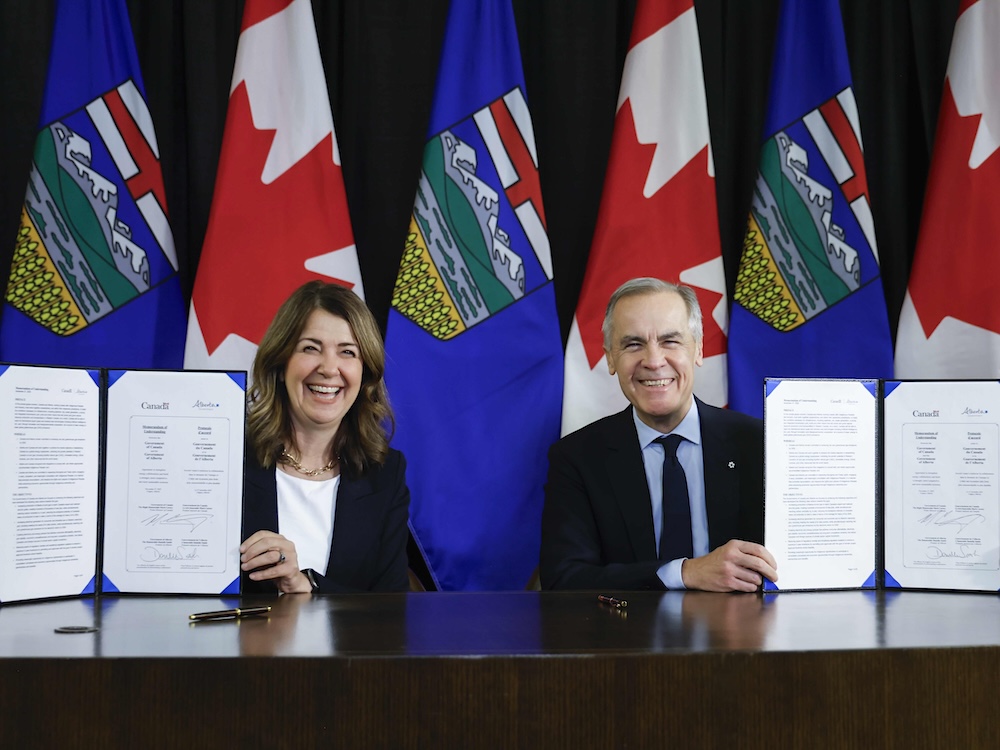
The famous memorandum of understanding signed last week by Prime Minister Mark Carney and Alberta Premier Danielle Smith has been praised and damned. Canadians with climate concerns have felt seduced and abandoned by what looks like a Liberal U-turn.
Amid all the confusion, I should point out that this MOU has not been studied as literature. If we read it closely, as we would a poem or short story, we can hope to learn what is going on beneath the surface of words.
Canada’s greatest literary scholar, Northrop Frye, offers a useful approach to such a study. But I’m afraid that analysis shows neither Carney nor Smith understands the implications of climate change.
The first thing we need to resolve is the genre. An MOU is indeed a genre, which includes two sub-genres: binding and non-binding. In the first, the parties explicitly enter into a contract that can be litigated if any party fails to live up to its terms. A non-binding MOU is, in effect, simply a joint aspiration to achieve some desirable future condition. The parties to it may change their minds without consequence.
The Carney-Smith MOU is non-binding, making it a kind of fiction. Frye tells us that fiction depicts the world as we wish it to be, or a demonic one as we hope it will not be. Comic fiction describes an outsider who is eventually united into a society, often symbolized as a wedding. Tragic fiction, by contrast, shows an insider, often of high rank, who becomes isolated from society; after loss of rank, death is the ultimate form of isolation.
When we look at the Carney-Smith MOU in this light, we can see it as offering a world that Carney and Smith say would be highly desirable, a veritable utopia. Achieving this world would make the MOU a comedy, a story of Alberta’s happy reintegration into Canada through a symbolic wedding of Carney and Smith. Failure to achieve it would bring about a tragic, demonic world.
The people who are more than they seem
But Carney is not an ordinary literary hero; he is what the Greeks (and Northrop Frye) called an eiron, a man who is more than he seems. The same can be said of Danielle Smith, who may or may not rejoice in being Canadian.
From eiron we get “irony,” when words convey more — or less — than in normal discourse. And the Carney-Smith MOU is a brilliantly ironic document.
The desirable world it describes is one in which Canada has achieved net-zero carbon dioxide emissions by 2050, while also:
- building a new oil pipeline to the B.C. coast;
- exporting bitumen and liquefied natural gas to Asian markets;
- establishing “the world’s largest carbon capture, utilization, and storage (CCUS) project”;
- building at least one data centre to support artificial intelligence; and
- creating “interties” in western provincial electrical systems, permitting them to deliver enormous amounts of electricity to one another to power these projects.
These goals make the MOU a kind of fantasy, in which magic or other supernatural forces influence human action. We know that the MOU’s goals are comparable to casting the One Ring into the lava of Mount Doom — dramatically satisfying but impossible, because the One Ring does not exist and neither does Mount Doom.
But some of the MOU’s goals are fairly plausible. For example, a new pipeline is certainly feasible, given time, and Asian markets for fossil fuels are likely to persist for decades. A recent Financial Post article estimated that in September 2025, 64 per cent of exports from the Trans Mountain terminal in Burnaby were destined for China. Any increase in export volume will likely go to China as well.
These facts place the MOU in a sub-sub-genre called science fantasy. In most fantasy genres, we simply play “Let’s pretend that magic and dragons exist.” In science fantasy, we play “Let’s pretend that science does not exist.”
This puts the MOU’s 2050 goals squarely in the realm of make-believe. All the goals assume no change in the status quo of 2025, even though the world has seen dramatic changes since the year 2000 and is likely to see still more change for the foreseeable future.
Dwindling demand for fossil fuels?
For example, China and other Asian countries may be demanding a lot of Canadian oil at the moment, but that could change almost overnight.
In 2024, according to a report from Climate Energy Finance, China added 429 gigawatts of new capacity to its electrical grid; wind and solar power made up 83 per cent of this capacity.
Thermal power, which generally means power derived from fossil fuels, saw just 13 per cent new growth in China, a seven per cent drop from 2023.
According to the website Carbon Brief, China’s policy is to achieve “peak carbon dioxide emissions before 2030” and “carbon neutrality before 2060.” The rapid fall in the cost of renewables like solar energy suggests Canadian oil exports to China would fall as well, perhaps below the cost of extracting and processing them.
Similarly, the MOU’s vision of energy sources to support data centres for AI imagines an infinite supply of water, not to mention an infinite demand for AI products. The World Economic Forum estimates that “a medium-sized data centre (15 megawatts) consumes as much water as the yearly consumption of either three average-sized hospitals or more than two 18-hole golf courses.”
As well, part of that water evaporates, and the rest is wastewater that can’t be recycled. So Alberta farmers and cattle ranchers are likely to be competing with data centres for access to fresh water.
$12 million per megawatt
According to a recent CNBC article, a “hyperscale” data centre of 150 to 300 megawatts would cost about $12 million in U.S. dollars per megawatt, or $1.8 billion to $3.6 billion. The same report says demand for AI and cloud services will drive data-centre spending to about $1.8 trillion between 2024 and 2030. Simply to accumulate our share of capital for data centres would mean depriving other Canadian projects of capital spending.
The MOU says nothing about protecting data centres from climate disasters likes fires, storms and floods. Alberta has already seen catastrophic losses to fire in Fort McMurray and Jasper, and is likely to see many more. Operating and insurance costs are therefore likely to soar in the coming decade.
Science fiction or science fantasy?
Some might argue that the Carney-Smith MOU is science fiction, but that genre assumes some future scientific discovery will provide a plausible basis for the story’s characters and actions. The MOU assumes current scientific knowledge is irrelevant to its goals; this makes it unquestionably science fantasy.
As science fantasy, however, the entire document is an exercise in irony. Its authors know discerning readers will recognize the amusing gap between its goals and objective reality. Readers who fail to see the gap make themselves the object of its satire.
In literary theory, if the reader knows more about a story’s character than the character knows himself (like Winston Smith in Orwell’s 1984), that character is ironic. We have established that Carney is an eiron, like Odysseus or any number of classic heroes. But the eiron eventually reveals his true nature, as Odysseus does when he comes home, strings his bow and slaughters his wife’s suitors.
So has Carney revealed himself? Or has he simply expressed a typical deception, as Odysseus does when he designs the Trojan Horse? For that matter, is Smith also an ironic character, sincerely believing that the MOU is achievable, or is she actually another eiron, intent on fooling her supporters with an impossible vision of utopia arising from the oilsands?
Further research is clearly necessary to resolve these conflicting interpretations, but the brilliant ambiguity of the MOU suggests it will resist critical analysis for a long time — or at least until the fast-approaching year of 2050. ![[Tyee]](/design-article.thetyee.ca/ui/img/yellowblob.png)






Notice about commenting changes
The Tyee’s commenting system will be moving to a new platform on Nov. 12. If you’re already a Tyee commenter you must register with the new system on or after Nov. 12 with your preferred username.More information can be found here.