

 SHARE:
After a decade of wandering in the political wilderness, the Conservative Party of Canada has some reason to be optimistic as the 45th Parliament gets back to work.
Mark Carney seems to have misplaced the rabbit’s foot that has brought him such good luck since his election last April as a political rookie.
Just to keep things in perspective, the Liberals are still the party to beat, according to the latest Abacus polls. But their grip on power is weakening. Just over a third of Canadians, 35 per cent, believe that the country is headed in the right direction, while 48 per cent say the country is on the wrong track.
That pessimism also shows up in Prime Minister Carney’s favourability rating. The poll found that 48 per cent of Canadians had a favourable view of Carney, while 35 per cent viewed him unfavourably.
“His net rating now stands at +13, down from +18 two weeks ago and +21 in mid-July. The erosion is subtle but sustained, and notably, his ratings have declined across most regions and demographic groups,” the poll stated.
In fact, the Conservatives briefly topped the Liberals in an August Abacus poll, albeit by only a two per cent margin. As pollster David Coletto put it at the time, the shift was modest but meaningful. “The political weather hasn’t turned,” he said, “but the wind may be shifting.”
The August Abacus poll found that two-thirds of Canadians think it is time for a change. But only 36 per cent said they thought there was a viable alternative. Why have Carney and his party arrived in this odd spot?
Blame and hype
At one level, it’s just politics as usual. The governing party gets blamed for everything that isn’t working, whether it is canola sales to China or the price of hamburger.
But it is also a case of the government overhyping public expectations. The PM sold himself to Canadians as the best candidate to wrangle a new trade and security deal with the irascible and vengeful Donald Trump. By comparison, Conservative Leader Pierre Poilievre is a rank amateur on the economy.
Carney also pledged that he would create a one-Canada trading zone. That was a key part of his strategy to combat Trump’s punitive tariffs. We could, the PM told the country, give ourselves more than the Americans could take away from us. And he wasn’t just whistling Dixie. Interprovincial trade barriers cost the country an estimated $200 billion per year.
As big as Carney’s commitments were, the rookie politician put them on a tight timetable — July 1 for knocking down interprovincial trade barriers, and mid-August for a new trade deal with the United States. Both of those deadlines have come and gone without either promise being completely fulfilled.
In fairness to Carney, it should be noted that Ottawa has largely done its part in doing away with federal impediments to interprovincial trade. The provinces, with most of the authority in such matters, have moved at a slower pace. The bottom line is that the country still has a distance to go to realize internal free trade.
Cracks in Carney’s caucus
And the PM has another potential problem. At the partisan level, Carney has created a degree of unrest in his own caucus and portions of his base. He has done that with his steady retreat from signature policies from the Justin Trudeau administration. There has been such an obvious shift to the political right that Carney is routinely described as a “conservative.”
Climate change is a case in point. Carney is in the process of dramatically repositioning the party’s environmental policies. The most striking example was the PM’s decision to drop the consumer carbon tax, which Trudeau as prime minister had doggedly defended, despite public disapproval and withering attacks from the opposition.
Then there is Bill C-5, the part known as the Building Canada Act in particular. This legislation allows the government to fast-track major projects such as pipelines and mines without the usual, rigorous review process.
Carney’s goal is to make Canada an energy “superpower” by building our way out of Trump’s tariff war and finding new trading partners. But critics of C-5 worry that it could trample Indigenous rights and endanger the environment.
There is more ominous news on that front. Carney recently paused the government’s mandate on electric vehicles. In 2023, Trudeau’s ambitious plan called for 20 per cent of new cars in Canada to be electric by 2026, 60 per cent by 2030 and 100 per cent by 2035.
Carney is “pausing” that plan for a year. He is also launching a 60-day review to determine “future flexibilities and ways to reduce costs” on this file. That no doubt will please corporate interests.
The big automakers have been pressing Ottawa to dump the EV mandate altogether. At the very least, they wanted Carney to come up with what they called a “more consumer-focused” policy. Decoded? Don’t be in a rush to dump gasoline-powered cars. It appears the PM was listening.
And that had Liberal MPs Eric St-Pierre and Shannon Miedema sufficiently worried that they decided to create a special caucus to discuss the environment within the Liberal party. The new caucus appeals to those Liberals who worry that Carney is pushing green initiatives off centre stage and into the background.
Some of them found that to be strange behaviour coming from the man who was once the United Nations special envoy on climate action and finance, and a one-time supporter of the carbon tax.
Without attribution, here’s how one of the caucus members put it to CBC: “People don’t understand how someone who has championed climate issues for 15 years can suddenly become prime minister of a G7 country and stop talking about climate change. Not a word about it. What’s going on?”
A PM of two minds
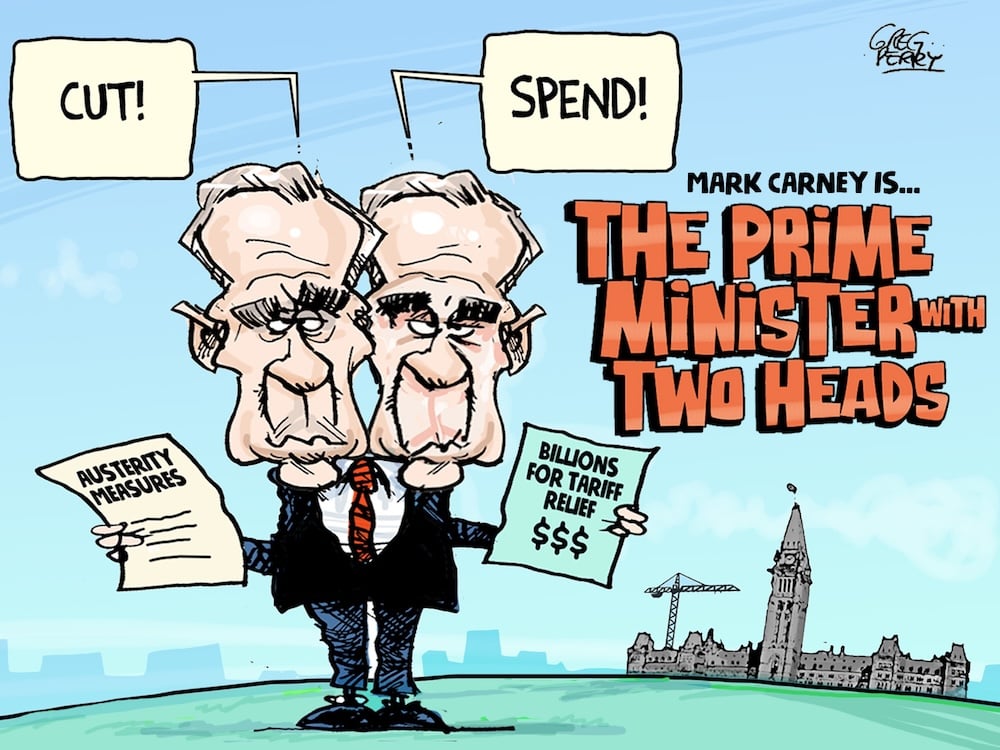
Carney’s shift to the right is also apparent from his musings about the October budget, which he says will feature the odd bedfellows of “austerity” and “investment.”
Carney’s plans for the public service are a complete rejection of the policies of the former Trudeau government. Trudeau added 100,000 public service jobs during his tenure. Carney has asked most federal departments to find cuts of 15 per cent to their budgets.
What does all of this mean? Carney has handed the Conservative party a ready-made playbook for the return of Parliament. The game of “perception is reality” will go something like this.
Despite his lofty promises, Mark Carney has failed to deliver. He is the politician who said he had the best credentials to go to the mat with America’s “Lyin’ King.”
But so far, he has failed to get any movement on the president’s punitive and painful tariffs. Instead, Carney now offers the thin gruel of some smaller deals, where tariffs may come down on specific sectors.
The Conservatives are sure to argue that it is not just that Carney didn’t deliver on getting tariffs removed — but that he in fact bungled the negotiations with Trump and wimped out.
Despite the PM’s rhetoric, the Conservatives will argue that it was elbows and pants down. Carney dropped the digital services tax, as well as most retaliatory tariffs on U.S. products covered under the Canada-United States-Mexico free-trade deal. What did he get for these concessions? The square root of bugger all, or so the opposition will argue.
Will Conservatives affirm Poilievre?
But as favourable as the political landscape may look for the Conservatives, the Abacus poll identified an enormous dark cloud over the party’s prospects. It’s all in the numbers. While 66 per cent of Canadians in the August Abacus poll were in favour of change, only 36 per cent believe there is a viable alternative. What does that suggest? Canadians are willing to vote for Conservatives, but not willing to make Pierre Poilievre prime minister.
And it’s not just Abacus. At one point in July, Nanos Research reported that Carney had a 30-point lead on Poilievre as preferred minister. Then in August, Angus Reid found that 50 per cent of respondents would be “ashamed” to call Poilievre PM, while 52 per cent found him to be “insincere.”
Poilievre’s net favourability rating has remained at minus two in the last two Abacus polls. In September federal vote intention was at 43 per cent for the Liberals, up four points. The Conservatives dropped a point to 40 per cent.
And that is despite the fact that the Conservatives have a lead on the Liberals on several top-of-mind issues for Canadians, including cost of living, the economy, immigration and crime and public safety.
How different the atonal political landscape might look if a Doug Ford or a Tim Houston were the face and personality of the Conservative Party of Canada.
Ahead of their January leadership review in Calgary, that is a prospect Conservatives should ponder long and hard before again endorsing a leader whose specialty is losing. ![[Tyee]](/design-article.thetyee.ca/ui/img/yellowblob.png)
Read more: Federal Politics







Tyee Commenting Guidelines
Please note that email notifications for replies are not currently working due to a software issue which may be resolved in a future update.
Comments that violate guidelines risk being deleted, and violations may result in a temporary or permanent user ban. Maintain the spirit of good conversation to stay in the discussion and be patient with moderators. Comments are reviewed regularly but not in real time.
Do:
Do not: