


 SHARE:
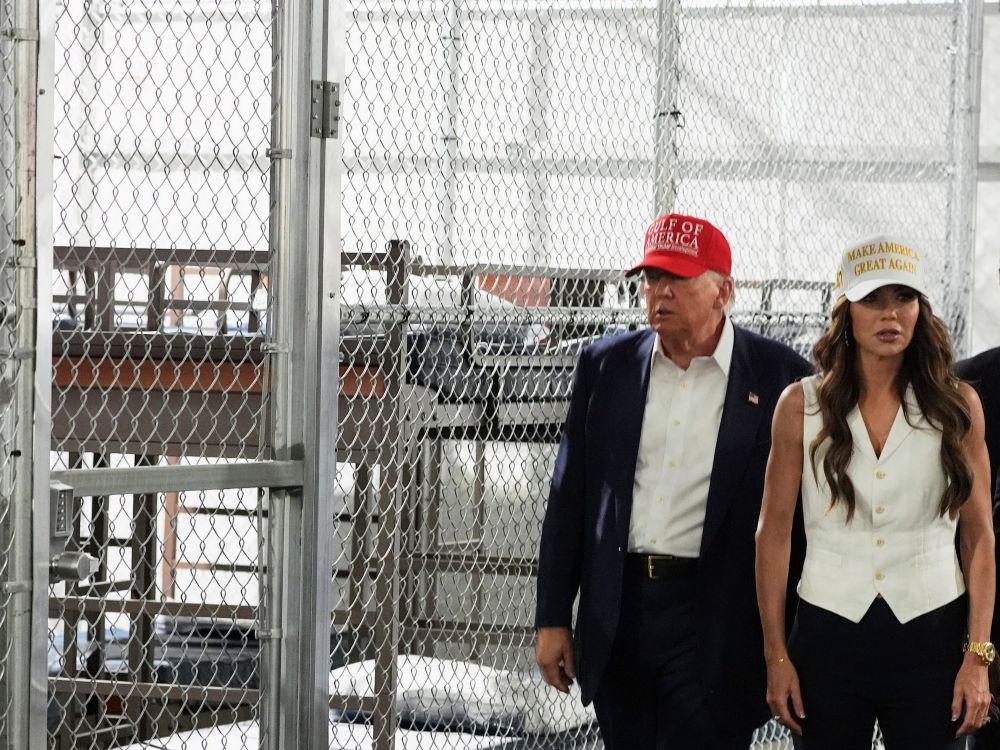
The United States government recently opened a massive immigrant detention facility built deep within the Florida Everglades that’s been dubbed “Alligator Alcatraz.” White House Press Secretary Karoline Leavitt said during a media briefing that “there is only one road leading in… and the only way out is a one-way flight.”
For some taking in her remarks, the moment felt dystopian.
According to Florida Gov. Ron DeSantis, the facility is surrounded by swamps and alligators and is equipped with more than 200 security cameras, 8,500 metres of barbed wire and a security force of 400 personnel.
Accounts from some of the first detainees at the facility have shed light on the inhumane conditions. They’ve described limited access to water and fresh air, saying they received only one meal a day and that the lights are on 24-7.
Apparently designed to be an immigration deterrence and a display of cruelty, Alligator Alcatraz is much more than infrastructure. It is visual policy aimed to stage terror as a message while making Trump’s authoritarian and fascist politics a material reality.
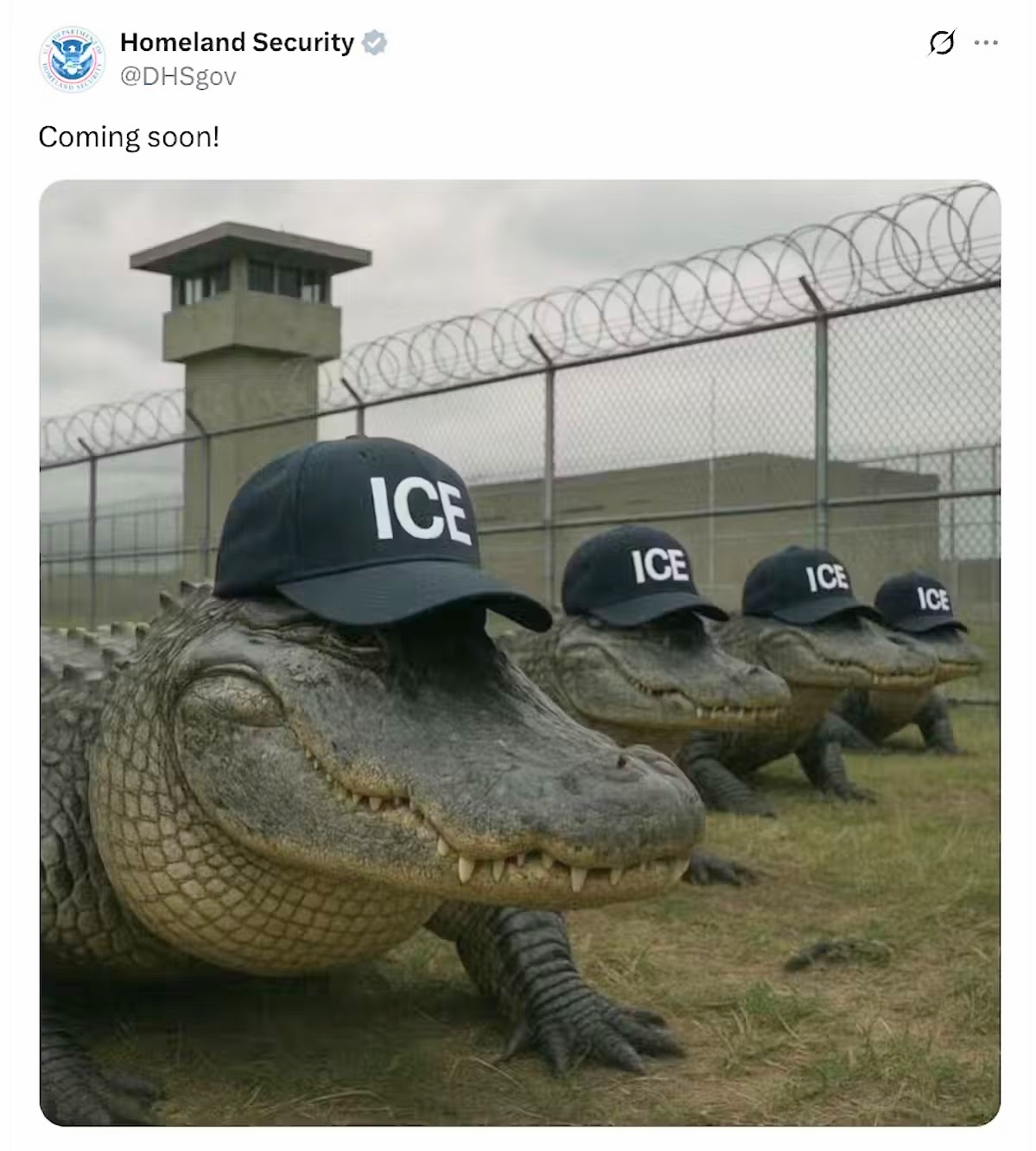
Contributing to this fascist visual apparatus, AI-generated images of alligators wearing Immigration and Customs Enforcement hats have circulated widely on social media. Some have questioned whether these images were satire or state propaganda.
Surveillance, migration, debilitation
In a moment of growing right-wing rhetoric and support for anti-immigrant violence, understanding how visual regimes operate, and what they attempt to normalize, is important.
Surveillance and deterrence technologies used along the U.S.–Mexico border for decades were intentionally designed to restrict the movement of undocumented migrants. According to Human Rights Watch, this has resulted in more than 10,000 deaths.
Since 1994, U.S. Border Patrol has been accused of directing migrants away from urban crossings along the southern border, intentionally funnelling them into harsh and inhospitable terrain like the Sonora Desert.
The desert serves as a deterrent to prevent immigrants from reaching their destiny. American theorist Jasbir Puar’s concept of debility is useful in making sense of the strategic process whereby the state works not to kill, but to weaken, as a form of slow violence that wears people down over time. The desired outcome is deterrence.
On the southern U.S. border, severe dehydration and kidney failure can be outcomes of this debilitating process, potentially resulting in disability or death.
Infrastructures of violence
Sarah Lopez, a built environment historian and migration scholar in the U.S., describes the architecture of migrant immobilization as existing on a continuum with prison design. She’s highlighted the increasingly punitive conditions of immigration detention facilities, such as small dark cells or the absence of natural light.
French architect and writer Léopold Lambert explains that architecture isn’t just about buildings, but about how space is used to organize and control people. He coined and developed the term weaponized architecture to describe how spaces are designed to serve the political goals of those in power.
Colonialism, capitalism and modernity are closely connected, and architecture has played a key role in making them possible. Alligator Alcatraz sits at the intersection of all three, intentionally created to invoke danger and isolation. In other words, it’s cruel by design.
As Leavitt put it, the facility is “isolated and surrounded by dangerous wildlife and unforgiving terrain.” The Trump administration has essentially transformed land into infrastructure and migrants into disposable threats.
Terrorizing the marginalized
State-sanctioned “unforgiving terrains” are not new, and the use of alligators to terrorize people of colour isn’t new either.
The grotesque history of Black children being used as “alligator bait” in Jim Crow-era imagery is well-documented.
So when Trump publicly fantasized about alligators eating immigrants trying to escape the new detention centre, it came as no surprise to those familiar with the long racist visual history linking alligators to representations of Black people.
This logic is redeployed in the form of a racial terror that is made visible, marketable and even humorous in mainstream political discourse.
Visuality and migration
“Visuality” is a key term in the field of visual and cultural studies, originally coined by Scottish historian Thomas Carlyle and reintroduced in the early 2000s by American cultural theorist Nicholas Mirzoeff. It can be understood as the socially, historically and culturally constructed ways of seeing and understanding the visual world.
Visual systems have historically been used to justify Western imperial and colonial rule by controlling how people see and understand the world.
While Alligator Alcatraz is a brand-new detention facility, it draws from a longer visual and spatial history of domination.
The AI-generated images of alligators wearing ICE hats can be seen as part of a broader visual system that makes racialized violence seem normal, justified and even funny. In this absurd transformation, the alligator is reimagined as a legitimate symbol of border enforcement.
Migrant death by water
The spectacle of Alligator Alcatraz, with its swampy inhospitable landscape, cannot be divorced from the long visual history of migrant death by water that’s relied on the circulation of images to provoke outrage — and sometimes state action.
Examples include the iconic image of Alan Kurdi, the Syrian child whose lifeless body washed ashore in Turkey in 2015, and the devastating photo of Oscar Alberto Martínez Ramírez and his two-year-old daughter who both drowned crossing the Rio Grande in 2019.
These images sparked global concern, but they also reinforced the idea that migrant lives only matter when they end in death — as if borders only become visible when they cause deaths.
Alligator Alcatraz was built in eight days. The fact that a detention camp — or what some have called a concentration camp — can be assembled almost overnight, while basic human needs like clean drinking water or emergency warning systems go unmet for years, speaks volumes about where political will and government priorities lie.
![[Tyee]](/design-article.thetyee.ca/ui/img/yellowblob.png)
Read more: Rights + Justice, Politics





Tyee Commenting Guidelines
Please note that email notifications for replies are not currently working due to a software issue which may be resolved in a future update.
Comments that violate guidelines risk being deleted, and violations may result in a temporary or permanent user ban. Maintain the spirit of good conversation to stay in the discussion and be patient with moderators. Comments are reviewed regularly but not in real time.
Do:
Do not: