Charting the Votes for a Rural Showdown
NDP and Tories duke it out in BC Southern Interior riding.
Charting the Votes: Canada's Federal Election '08
- Charting the Votes for Gary Lunn
- Charting the Vote for Grits in BC
- Charting When NDP Votes Rise
- Charting the Votes where Tories are Strongest
- Charting the Vote for Incumbents
- Charting the Votes for Hedy Fry
- Charting the Votes of Visible Minority Members
- Charting May's Chances against MacKay
- Charting the Votes for a Rural Showdown
- Charting the Votes in Nanaimo-Cowichan
[Editor's note: This is the latest of a new feature on The Tyee through election day: Charting the Votes. In charts and prose, veteran political analyst Will McMartin breaks down the important factors in key B.C. races.]
The best predictor of future elections, it's been said, are past elections. It's true, usually. Indeed, in the federal general election now underway, recent election results (along with demographics and public opinion polls) make it fairly easy to forecast the outcomes in a large majority of B.C.'s 36 ridings.
A notable exception is the sprawling electoral district of British Columbia Southern Interior.
In part this is due to frequent boundary changes and the region's historical topsy-turvy electoral results, with further complications caused by controversy surrounding the Conservative candidate in 2006.
The easiest way to appreciate the riding's geographical and electoral history is to think of a trio of West Kootenay cities -- Nelson, Castlegar and Trail. Having a combined population of about 25,000, the three are home to roughly one-quarter of all district residents.
From 1972 until 1984, Nelson, Castlegar and Trail were at the heart of a federal electoral district known, not surprisingly, as Kootenay West.
Revelstoke then was added to the district, which became Kootenay West-Revelstoke. It was known by that moniker in the 1988 and 1993 general elections.
After the latter contest, Revelstoke was removed (to Kootenay-Columbia), and replaced by three towns from the Boundary-South Okanagan region -- Grand Forks, Oliver and Osoyoos. The riding's name was altered to West Kootenay-Okanagan.
That was the name it carried into the 1997 federal general election. The appellation was altered once again, prior to the 2000 tilt, when it became known as Kootenay-Boundary-Okanagan. All in all, from the 1970s through to the turn of the century, the riding's name was accurately descriptive of its geographical components.
At that point further changes occurred, notably expansion westward to bring in Princeton. Inexplicably, at that time all reference to the West Kootenays, the Boundary region, or the South Okanagan was eliminated. For the 2004 federal general election, the new district was called Southern Interior.
It later was amended to British Columbia Southern Interior in anticipation of the 2006 contest.
Topsy-turvy history
The riding's topsy-turvy electoral history can be seen from the political career of Bob Brisco, a former Progressive Conservative MP. Brisco ran unsuccessfully in 1972 against the NDP incumbent, Randolph Harding, but he beat the same opponent in 1974. He was victorious again in 1979, this time over New Democrat Lyle Kristiansen.
Kristiansen prevailed over the incumbent in 1980, but Brisco took it back in 1984, and then Kristiansen won it again in 1988.
In six tilts between 1972 and 1988, Brisco was a winner in three, and a loser in three more. The Tories and New Democrats clearly were closely divided in terms of electoral support.
Prior to the 1993 federal general election, which in British Columbia saw the collapse of both the Progressive Conservatives and the New Democrats, both Brisco and Kristiansen wisely retired from politics. Neither likely would have been successful in West Kootenay-Revelstoke, which was captured by a newcomer, Jim Gouk, representing the nascent Reform Party.
Gouk held the seat from 1993 through the 2004 federal general election, even as the riding boundaries and name changed to West Kootenay-Okanagan, then Kootenay-Boundary-Okanagan, and finally Southern Interior.
Not only did the district's name undergo near-continuous alterations; Gouk himself won re-election under the Reform banner in 1997, then with the Canadian Alliance in 2000, and for the recreated Conservative party in 2004.
After the latter contest -- in which he defeated the NDP candidate, Alex Atamanenko, by a mere 680 votes -- Gouk retired from politics.
Zeisman's doomed run
Atamanenko again represented the New Democrats in 2006, and it was expected that his main opponent would be Derek Zeisman, a Conservative, As the campaign got underway, however, it was revealed that Zeisman faced criminal charges for attempting to smuggle large quantities of alcohol across the Canada-U.S. border.
Conservative leader Stephen Harper subsequently announced that, although it was too late to drop Zeisman's name from the ballot, he was being kicked out of the Tory party. If elected, Harper said, Zeisman would not be welcome in the Conservative caucus.
What once was thought to be a close contest ended as a blow-out, with Atamanenko winning the seat by a margin of nearly 13,400 votes. Zeisman finished a distant third, more than 400 votes behind the Liberal candidate.
Too tough to call
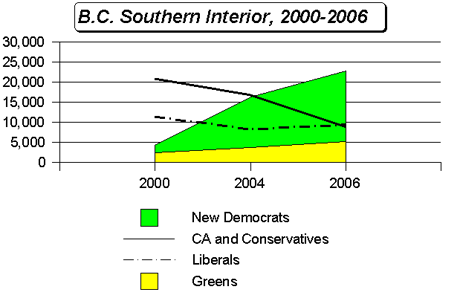
The chart above shows British Columbia Southern Interior over the past three federal general elections. (Although the riding did not exist in 2000, Elections Canada transposed the results from Kootenay-Boundary-Okanagan and Okanagan-Coquihalla to reflect redistribution.)
In the 2000 contest, Gouk and the Canadian Alliance captured nearly half of the riding's votes -- 48.0 per cent.
Four years later -- and three years after the provincial New Democratic Party albatross had been removed from the federal party's neck -- Atamanenko and the NDP climbed into a virtual tie with Gouk and the Conservatives.
In 2006, with Tory Zeisman's character and candidacy an open question, the Conservative vote plummeted while New Democrat Atamanenko soared to 49.0 per cent of the vote.
So, what kind of contest may we expect in 2008? Will Atamanenko's personal popularity help him retain the seat, even as province-wide polls show the Tories with support from 40 per cent and more of the electorate? What impact will a sinking Liberal vote, and rising Green support, have in the riding?
We'll find out only after the votes have been counted, because past results are of minimal utility in this hotly-contested riding. British Columbia Southern Interior will be one of the most interesting battles to watch on October 14. ![]()


9
Login or register to post comments
Luke Skywalker
3 years ago
BCSI...
Funnily enough, the booted Tory candidate Zeisman topped most of the polls in Oliver and Osoyoos in the South Okanagan Valley, Keremeos in the Similkameen Valley, as well as the small neighbouring towns in Olalla, Bridesville, Beaverdell, and Westbridge.
I would never have anticipated that result with the Con Zeisman thrown out of the party.
And that's why I think the NDP in Saanich Gulf islands may also top the polls in the NDP strongholds in that riding resulting in the Lib, Briony Penn, falling short.
As for BCSI itself, the Similkameen Valley, and South Okanagan Valley (the fastest growing in terms of population) are Tory blue.
But the demographics of Boundary country and the West Kootenays are decidedly populist left and enviro and have been trending that way for some time.
The only reason that Gouk was able to stave off defeat in 2004 was the incumbancy factor as well as some remaining resonance from the "populist" Reform/ Canadian Alliance.
With the those demographic trends and NDP incumbancy...
Prediction: NDP slam dunk.
politico
3 years ago
Imagine that eh?
Conservative support collapsing in key ridings: poll
Updated Wed. Oct. 8 2008 10:01 PM ET
CTV.ca News
In the last week of campaigning before the Canadians go to the polls,
Conservatives are rapidly shedding support in the battleground ridings
that could determine the outcome of the election.
The drop in support coincides with a sharp decline in Conservative
Leader Stephen Harper's favourable ratings, particularly in Quebec.
"He has gone from hero to zero in just a matter of weeks," pollster
Peter Donolo of The Strategic Counsel told CTV.ca. "(The
Conservatives) were going build their majority in Quebec -- now they
are fighting for their political lives there to hold on to the very
modest inroads they made in the last election."
In the 15 tight ridings in Quebec, only 40 per cent of those polled
had a favourable impression of Harper, a drop of 18 percentage points
from those polled a month earlier.
The new Battleground 2008 poll of 45 close races in British Columbia,
Ontario and Quebec, conducted by The Strategic Counsel for CTV and the
Globe and Mail, comes less than a week before Canadians head to the
ballot boxes on Oct. 14.
In polling conducted Oct.5-7, the Conservatives lost ground in all
three provincial battlegrounds over the past week. In Ontario and
British Columbia, the Liberals have almost pulled even with the
Tories.
"The Conservatives should be happy the election is only six days
away," Donolo said. "They've had a very difficult week."
In Quebec, the Conservatives are now sitting third, behind the Bloc
Quebecois and the Liberals, in the battleground ridings.
The Conservatives dwindling numbers coincide with a period of global
economic uncertainty, even as Harper had repeatedly said that Canada's
economy remains strong.
Donolo said that some gaffes made by Harper have hurt his party in the
polls.
"That's the problem when you put the entire campaign on the shoulders
of the leader . . . if the leader stumbles then there's not a lot to
cushion to party," he said.
In Quebec, Harper's comment that "ordinary Canadians" don't care about
the arts have really hurt his numbers.
On Tuesday, the last day of Oct. 5-7 polling, Harper said the economic
downturn has created "buying opportunities" on the stock market --
which has led to opposition cries that he is "out of touch."
Ontario polling
According to polling conducted Oct. 5-7 in Ontario's 20 battleground
ridings, the Conservatives held 35 per cent support, a loss of five
per cent from polling done from Oct.1-4.
The new numbers are down a full 10 points from the Tories' highest
mark of 45 per cent in those same ridings in late September. The
Liberals are closing quickly, a trend that could be an election game
changer: (Brackets show percentage-point change from Oct. 1-4 poll):
Conservative: 35 per cent (-5)
Liberals: 31 per cent (+3)
NDP: 24 per cent (+3)
Bloc Quebecois: n/a
Green Party: 10 per cent (-2)
Another sobering finding for Harper in these battleground ridings is
that 53 per cent of those polled said they thought it was time for a
change in government, compared to only 36 per cent who thought it the
wrong time for a change.
The Conservatives are losing support in the all-important 905
battlegrounds of Ontario, down to 39 per cent support. That is a 10-
point decline from their September high.
"The silver lining (for the Tories) is that their loss is not directly
the Liberals gain," Donolo said.
He said that the NDP and the Greens could draw support away the
Liberals in close races, allowing the Conservatives beat the split.
But a higher percentage of Green and NDP voters in this poll say they
are willing to change their vote. Of NDP voters, 31 per cent say they
might change their vote, and 35 per cent of Green voters say the
same.
If those voters decide to move to the Liberals to counter the
Conservatives, next Tuesday could be very close in Ontario.
Quebec polling
The Conservatives hoped to make major inroads in Quebec, but their
support in the battleground ridings is dwindling, putting a majority
all but out of reach.
The Bloc Quebecois, which was floundering before the election call,
has been given new life over the campaign :(Brackets show percentage-
point change from Oct. 1-4 poll)
Bloc Quebecois: 37 per cent (-3)
Liberal: 24 per cent (+2)
Conservative: 20 per cent (-1)
NDP: 13 per cent (same)
Green Party: 6 per cent (+2)
British Columbia polling
In British Columbia's 10 battlegrounds, the Tories are rapidly
bleeding support and the race is now a statistical tie as the Liberals
are within the margin of error.
Here are the parties' results in B.C. (Brackets show percentage-point
change from Oct. 1-4 poll):
Conservative: 32 per cent (-6)
Liberal: 30 per cent (+3)
NDP: 24 per cent (+2)
Bloc: n/a
Green Party: 14 per cent (+1)
The Conservatives had as much as 46 per cent support in September
polling in B.C. battlegrounds.
Harper's favourable ratings lower
Harper's personal stock has taken a solid hit in the Oct. 5-7 poll
compared to polling a month ago.
In British Columbia battlegrounds, those who as favourable impression
of Harper dropped to 52 per cent, compared to 61 per cent a month
earlier.
In Ontario, 52 per cent of respondents thought favourably of Harper, a
drop of ten percentage points from early September.
In Quebec, Harper is sitting at 40 per cent favourable, well down from
58 per cent in September.
"The Quebec loss is monumental, it's very rare to see a complete
reversal inside a few weeks in a political campaign," Donolo said.
But Harper's loss isn't necessarily the Liberals gain.
Liberal Leader Stephane Dion's favourable ratings have improved
modestly over the campaign in B.C. and Ontario battlegrounds but still
only sit at 43 per cent and 41 per cent, respectively.
"In a sense, if (Dion) was better perceived in B.C. and Ontario, his
party would be picking up more of that Conservative vote," Donolo
said.
However in Quebec, Dion has improved remarkably in his favourable
ratings, in part spurred by a strong showing in the French leaders'
debates.
His favourable rating sat at 51 per cent, compared to 36 per cent a
month earlier.
NDP Leader Jack Layton had the best favourable ratings by far in this
poll. In B.C., it was 62 per cent, with an impressive 70 per cent in
Ontario and 71 per cent in Quebec.
Technical notes:
The poll was conducted from Oct. 5-7 by The Strategic Counsel for CTV
and The Globe and Mail.
The B.C. battleground ridings have a sample size of 390 people and the
margin of error is plus or minus 5.0 percentage points.
The Ontario battleground ridings have a sample size of 420 people and
the margin of error is plus or minus 4.8 percentage points.
The Quebec battleground ridings have a sample size of 405 people and
the margin of error is plus or minus 4.9 percentage points.
Results are based on random samples of adults 18 years of age or older
in each of the 45 battleground ridings. Results were weighted by age
to be proportionate to the provincial population sampled.
Luke Skywalker
3 years ago
So What Does This Mean???
Strategically vote Liberal to defeat the Con?
Frank
3 years ago
Strategic voting
This guy thinks the Cons and Libs should form a grand coalition.
"The world is heading towards a deep recession (even though Canada has weathered it so far, our time will come, soon). Harper can say that for the sake of the economy the Liberals and Conservatives should join forces, throwing aside the crazy NDP and the increasingly annoying Bloc Quebecois."
http://michael-cc.blogspot.com/2008/10/grand-coalition_08.html
ME2
3 years ago
Frank
Interesting site. One of the posters moaned about the poor ReformaTories being "demonized". Made my heart bleed,it did.
Budd Campbell
3 years ago
Luke? Did HQ see this before you posted it?
With the those demographic trends and NDP incumbancy...
Prediction: NDP slam dunk.
You're kind of getting off message here. Must be a reaction to all those ABC meals.
BTW, did you see the CBC TV environment debate last night? The Greens and Liberals packed the hall, and Michael Byers came in fourth! Why wasn't Hedy Fry there, why was Ujjal Dosanjh substituted for her, given that all other parties had their Vancouver Centre candidates in attendance?
I think the best one liner of the evening came from Liberal/Conservative Lorne Mayencourt. He called Dion's carbon tax a "GST in a green skirt".
Frank
3 years ago
Budd
I watched that, you'd think the Greens would be getting 45% of the vote in that seat if that CBC audience was honest.
Suffice to say, they weren't.
Luke Skywalker
3 years ago
Budd...
Political debates are usually attended by political hacks. Rarely anybody attending same is undecided and they usually have small turnouts.
I've never attended one and would never waste my time.
As for carbon taxes/ cap and trade and all of that enviro nonsense these "ideas" are all conjured up by enviro profs situate in ivory towers in conjunction with their enviro ngo buddies.
BC's bigest greenhouse gas problem right now? The pine beetle.
http://www.cbc.ca/technology/story/2008/04/23/tech-beetle-carbon.html
jimmy_laroux
3 years ago
Luke
Luke Skywalker:
Ironic. Is this meant to be a joke?
Yeah! Stupid scientists! What do they know, anyway? Except for that researcher in the cbc article you quote. He's alright.
Ivory towers... how original.