
Rev up resource sell-offs, demonize dissenters as 'foreign' threats. Did Stephen Harper study Alan García?
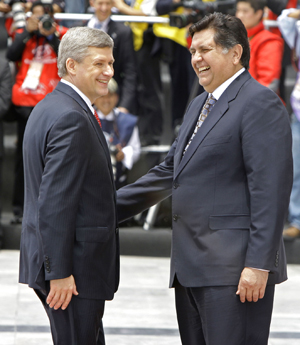
PM Stephen Harper greeted by Peru's President Alan Garcia at APEC summit in Lima, Nov. 22, 2008. Photo: AP/Martin Mejia.

-
For Nisga'a and Amazonian aboriginals alike, the private ownership message of economist Hernando de Soto is stirring controversy. A special report.
-
Energy firms eager to build bonds with Canada's First Nations.
-
Journalists across the country spent last week gorging on the low-hanging fruit offered by Stephen Harper and Natural Resources Minister Joe Oliver, whose pre-emptive verbal assault on the public hearings into the Northern Gateway pipeline proposal set a new benchmark for unintended irony. "Growing concern has been expressed to me about the use of foreign money to really overload the public-consultation phase," Harper told journalists on Friday, Jan. 6, four days before the Review Panel opened its doors in Kitimat; the following Monday, 24 hours before citizens were allowed to opine, Oliver wrote off their potential concerns in an open letter deriding "environmental and other radical groups that would seek to block this opportunity to diversify our trade. Their goal is to stop any major project no matter what the cost to Canadian families in lost jobs and economic growth."
Political interference aside, the piles of foreign money in Enbridge's account ledger are so high, and the industrial projects supported by First Nations groups who oppose the Northern Gateway so major, that it seems impossible for Harper and Oliver not to have foreseen the media using their logic against them; as the communications coordinator of one radical group told me with a head-scratch, "They're just not that stupid." Who knows? Perhaps they calculated that the average Canadian is that stupid, or that voters would change the channel and flip the page before the obvious retorts came flooding in.
Either way, the episode provoked a powerful sense of déjà vu -- or rather, ya visto, for it was in Peru that I first watched this script unfold.
The other letter
In Oct. 2007, Peru's then-president Alan García penned an open letter to his country that would set the tone of political discourse for the rest of his four years in office. Published under the title "The Syndrome of the Dog in the Manger," García adapted Aesop's fable to his own Amazonian predicament: a jungle full of untapped treasures, blocked by "second-class" citizens who stubbornly resisted industrial development in their back yard. "Many resources aren't being traded, invested in, or generating employment," García wrote. "And all this because of the taboo of outdated ideologies, because of idleness and indolence, or the law of the dog in the manger who says, 'If I don't eat, no one else eats either.'"
García avoided using the words "indigenous" or "native" in his article, but he left no doubt over whom he was comparing to dogs or labelling outright as "second-class citizens." The timing of his polemic was hardly accidental: Canada and the U.S. were on the verge of finalizing free trade agreements with Peru, and our resource extraction companies (the TSX alone hosts 60 per cent of the world's mining companies) promised tens of billions of dollars in foreign investment -- if only the right laws were in place to protect their interests.
It turned out the Dog-in-the-Manger article was simply preparing the ground for those laws. Soon after it came out, García won congressional approval to impose a series of presidential decrees; among other things, these undebated decrees gutted Peru's environmental regulations and reduced from two thirds to one half the proportion of a native community's approval required for multinationals to operate on their land.
The thinking in Lima's presidential palace and corporate boardrooms at the time was clearly that the best way to deal with fractious natives was to trample over them. This had worked for the past five centuries, after all. That logic remained undeterred in April 2009, when every single tribe in the Peruvian Amazon joined a historic uprising to shut down highways, river ports and oil facilities in over half the country to protest the decrees. On June 5, 2009, after two months of half-hearted negotiations, the army descended on the uprising's most troublesome blockade and sprayed bullets into a crowd of 2,000 Awajun protestors. Amazingly, only three died, but another 82 wound up in the hospital with bullet wounds in their backs.
Peru's foreign influences
I flew to Peru soon after that and was astonished at how unapologetic García remained, in large part because the protesters had defended themselves to the tune of 24 dead soldiers -- "a genocide of the police" was how García saw it. He did, however, shift the blame somewhat. Instead of dogs and second-class citizens, it was now "foreign agents" who were responsible for putting Peru's development on hold.
"Who does it suit for Peru not to use its gas, not to find more oil, to be unable to better exploit its minerals?" he asked. "International communists," that was who -- a thinly veiled reference to García's Bolivian neighbour Evo Morales and Venezuela's Hugo Chavez, both of whom eschew free trade with North America. The natives, for their part, wasted no time in explaining who they saw as the foreign agents: Canada, the U.S., and all those multinationals whose industrial leases now cover three quarters of the Peruvian Amazon.
Over the next year, I went from Lima to the desolate stretch of highway in northwestern Peru where the army opened fire, and then on to the riverside communities where the protesters live. One of the men who welcomed me, Joel Shimpukat, still has an arrest warrant against him for helping to organize the blockade; at one point, local authorities had published his photo in the newspaper and labeled him as one of the foreign agents, because unlike most Amazon natives Shimpukat has a thick moustache. But despite a few drops of Spanish blood somewhere in his bloodline, Shimpukat was a respected Awajun leader who grew up on the banks of the Marañon river.
"We are not against all development," he told me more than once in quiet frustration. "But we cannot allow the land and water we depend on to be contaminated or destroyed. Why can't the government talk to us before allowing these projects to go ahead?"
His comments echoed those of Alejandra Alayza, the fiery researcher for a Peruvian NGO called Network for Globalization with Equity (REDGE by its Spanish acronym), whom I met in Lima. "Every time we talk about regulating foreign investment," she told me, "the government calls us radicals. It's as though the most rational way to trade with other countries is to prostitute ourselves and let them take whatever they want."
Another Amazonian leader I met, Zebelio Kayap, took me on a tour of the Cenepa river, a remote and stunning tributary of the Marañon that eventually merges with the Amazon River itself. Gesturing at the dense emerald foliage surrounding the river, he asked, "If the Awajun weren't here, how long do you think it would take our government to mow all this down?" A few hundred kilometres upstream, the Vancouver-based gold mining company Dorato was already busy exploring for gold with the help of helicopters loaned from the Peruvian military. It was Dorato's unwelcome activities, Kayap explained, that had provoked the tribes of Cenepa into joining the doomed blockade
There were also many Awajun who welcomed the prospect of cash payments from the multinationals. The intensely rancorous community debates that arose on this subject were a spectacle to behold, often coming close to blows; at other times, in quiet corners and empty rooms up and down the Amazon, I would be accosted by men with sick wives or uneducated children who whispered that, much as they hated to admit it, they'd be willing to accept the presence of companies like Dorato if it meant an end to their suffering. This tension went all the way to the top, with several prominent native leaders signing declarations of solidarity with corporations and the government alike. Invariably, these signatures were trotted out in press releases, which were quickly followed by more press releases from a different group of chiefs who angrily insisted: "You don't represent our people, we do!"
The descent from dissent
Two years later, it's déjà vu all over again. There's Enbridge posting full-page adverts in The Globe and Mail to announce all the native friends they've made; there's Gitxan hereditary chief Elmer Derrick, locked out of his office for signing on with Enbridge; there's Stephen Harper, speaking for all the world as though Alan García had moved to Ottawa and started whispering in his ear.
Given our substantial role in Peru's recent drama, it seems morbidly fitting that Canada should now be staging a third world show of its own. Now it is our own beleaguered Indians, living in a part of the country most Canadians will never see, who have become the last obstacle in the path of oil barons who, as Oscar Wilde put it, know the price of everything and the value of nothing. Instead of civilized discourse, our news reports deliver all-or-nothing rhetoric from both sides of the table. The possibility that there might be another route by which Enbridge could get its oil to China is nowhere to be heard. More alarming still, dissent is smeared as illegitimate at best and possibly criminal -- it isn't far from "radical" to "terrorist," especially considering that at least eight First Nations have already promised widespread civil disobedience should construction ever begin on the Northern Gateway.
How much lower can we sink? The communications coordinator I mentioned earlier, the one who Joe Oliver would say works for a "radical group," asked me not to mention any names because the group's director (who has decades of experience fighting Big Oil) recently warned all employees to start preparing for the vicious smear campaign that comes next -- hacked email accounts, bugged phone lines, spies posing as volunteers, cars following them at night, all this and more could very well lie around the corner.
Come on. That kind of stuff would never happen here. ![[Tyee]](http://thetyee.cachefly.net/ui/img/ico_fishie.png)
Freelance journalist Arno Kopecky has a Global Fellowship with the Walter and Duncan Gordon Foundation to investigate Canadian ties with Latin America. Kopecky's first book, The Devil's Curve, will be published by Douglas & McIntyre in the fall of 2012. Find his previous articles for The Tyee here.
49
Login or register to post comments
moodyguy
1 year ago
why a surprise?
Stephens Harpers's dislike for what this country has become over the last 100 years has been clear for 20 years, his religious alegiance to monetarist economics coupled with libertarian political views have also been clear. I am not surprised at how fast he has moved, effectively ending the Canada Health act (no enforcement), gutting environmental regulation (he & Oliver say they will make the decision on Enbridge after the hearings, clearly not what the legislation allows), Slashing of government spending which is being loudly floated for anyone listening to hear, sadly no one in this country seems to be listening or to comprehend what is happening. Mr. Harper himself said that we would not know Canada when he is done with it. What is the next step? The only surprise for me is that he has recently developed a liking for state controled enterprises, particular those owned by China, almost like South American governments used to love the American companies that kept them.
Sad what we have become!!
Fiat lux
1 year ago
Any way to export Harper to
Any way to export Harper to Peru ?
We could start a fund to pay anybody who would take him.
Ed Deak.
Hal K from BC
1 year ago
Canadian Corporate Fascism
A Cornell University Global Labor Institute study found that for every 400,000 Barrels of BITUMEN shipped from Canada , costs Canadian workers 18,000 jobs.
Obviously our "trained economist PM " missed out on that course which would have helped him understand " economics".
The only other excuse is that the man and his cronies are " fascists " trying to bankrupt this nation.
oceanmtngoat
1 year ago
Interesting connection
Interesting connection you have made between Peru and Canada. I was actually in the Peruvian Amazon in May and June of 2009 during all of these protests studying the 'environment versus development' situation taking place there and have to agree that your comparison is spot on. Feeling beyond frustrated abut Harper's recent ramblings...
wiley
1 year ago
neocons rely on short memories
The comparison with Peru might seem like a stretch to some because we don't see blood running in the streets yet. But remember the dynamics of Gustafsen Lake as we chafe under the neo-colonialism of a strident petro state leadership who are wishing this was more like China.
toquer
1 year ago
Grain of truth
Sure, it's entirely accurate to point out the hypocrisy inherent in foreign corporations and governments (in the case of China) being welcomed, and foreign-funded dissenters being labelled meddlesome outsiders. But it remains true that large, primarily American funded enviro. orgs. direct campaigns against projects they dislike, and often wage a public relations war replete with overheated rhetoric, charismatic US politicos and celebrities, and the use of well-worn strategies such as stacking public hearings with activists 'parachuted' in, and direct management of local storefront groups. Now, these are often issues of global, or at least international, concern, and it might be suggested that concern for the environment should know no borders, and this makes a fiar bit of sense. Doesn't take away from the truth in the Minister's statements, though. To suggest otherwise is to be wilfully ignorant. One cannot spend their time pointing out every 'thin edge of the foreign wedge' when it comes to matters of trade and corporate ownership, but remain in constant denial when the same is pointed out the other way. Whatever your take, the spectacle of American and Chinese companies duking it out with American environmental organizations fronted by American celebrities and politicians on Canadian soil is distasteful to anyone with a kernel of national pride.
judycross
1 year ago
Harper is no "libertarian"
In the words of Judi Falardeau who ran in Toronto for the Libertarian Party of Canada:
“Clearly someone who has increased spending, even allowing for growth in the economy, by 25 percent, who has passed draconian mandatory sentencing requirements to expand the war on drugs and who is bent on increasing the military to support more adventurism in other countries is not a supporter of small government. The rhetoric about having reduced taxes is just empty words, that extra spending will have to be paid from more taxes.”
He wants more liberty for rapacious corporations, not for citizens.
Fiat lux
1 year ago
If we have a kernel of
If we have a kernel of national pride left, what are we doing in NAFTA and the coming CETA, implemented without public vote, not only destroying our manufacturing sector and hundreds of thousands of well paying jobs, but also denying democratic decision making powers to the municipal level.
What benefit has the public received from these treaties, apart from having to sell the country to "foreign investment" to survive, while calling it GDP ?
Ed Deak.
brunssd
1 year ago
Judi Falardeau sez: "He
Judi Falardeau sez: "He wants more liberty for rapacious corporations, not for citizens."
Which is, of course, the natural result of libertarian "small-state" governance. The state is the only power capable of countervailing corporations. While a corrupted state aids and abets corporate rule, dismantling the state when it is the statesmen not the state that are corrupt is the equivalent of throwing the baby out with the bath water.
jimorsheryl
1 year ago
Here's an idea
Let's leave our natural resources in the ground, sell them to no one, and just borrow money from all the rich union pension funds to fund our education and health care etc. etc.
Better yet, let's just all get the government to send us a check each month for which we do nothing.
The only thing that back stops our economy is our natural resources......so how else do we get them to market???
happy (not verified)
1 year ago
Good idea jimorsheryl but it can't work
Simply because those rich union pension funds are heavily invested in natural resource extraction so if you leave them in the ground.....
moodyguy
1 year ago
Re: Heres an idea
Sorry, can't agree with you even as I know your statement is fascious. Rather, I take your comment as in the spirit of a lead article in the Globe and Mail today. As a realist and an environmentalist, I am actually in favour of development much like as a hockey fan, I like to see a great game. But much like the hockey fan who sees a great game when the officials do their job in an apprpropriate way, and where teams are well matched and play within the rules, I believe that we should be developing our resources for the long term benefit of Canada, including all of BC, all of Alberta and the rest of the country. This article speaks to recent promoition by the government of Northern Gateway. Having lived on the Northwestern BC coast, I see this as a huge environmental risk with virtually no benefits to the region or BC. Having lived in the Alberta oil patch, I see this as having limited benefit and huge opportunity cost as it entails shipping Bitumen, not crude oil (not the same thing!) and having that processed in China rather than in Alberta with a huge loss of both potential hjobs and potential revenue. I have heard repeatedly by people pushing for the export of Bitumen that no refinery has been built in many decades in North America. Bunk! Numerous upgraders (refineries that take bitumen or heavy oil and turn it into crude) have been built (Lloydminster, Edmonton & Ft.Mc). If the stuff is dug up in Canada, process it here by Canadians, with appropriate regulation and then sell it as a valuable commodity. Perhaps the financial backer of this project, who seem to be state controlled foreign companies, do not want to process their Canadian bitumen in Canada under appropriate regulation and would rather process in their state owned refineries, and appropriate regulation be damned. If this is the case, and I think it is, the stance of the federal government against the best interests of Canadians is terrible
Fiat lux
1 year ago
The reason we have to sell
The reason we have to sell resources, which is the sale of capital and not an income, is because of the free trade fraud that ruined our economy, killed hundreds of thousands of jobs and tens of thousands of businesses.
We could "create" an endless number of jobs, as we have done before, if we could have products "Made in Canada"
By the way, if we had economists who knew simple business accounting, they could show that products imported from China are not "cheaper" , but far more expensive, but the present bunch and their "conservative" bosses are covering up the real facts.
Ed Deak.
OwlRol
1 year ago
The first long term goal of
The first long term goal of fossil fuel extraction needs to be to develop the tools and infrastructure for sustainable energy production.
Even the Tar Sands will diminish over time, especially as extraction continues to be ramped up, never mind regional and global environmental degradation.
Of course that implies that the oil patch would work to gradually put itself out of business, a "sunset industry", something capitalist economists, politicians and CEOs can't fathom or would shrink back from in horror.
Although I prefer a global approach with an environmental priority, Canadian resources should first satisfy Canadian needs before considering major export. As such, pipelines need to go east to Ontario and beyond.
This would serve Canada as a whole in the mid to long term.
Minister Oliver's statement about such a pipeline, likewise Alberta refinery development, for private companies to take on, being far too expensive given returns on investment, and that we know the objections against government investment in such a project (reference to Trudeau's National Energy Policy), essentially make such projects unreasonable.
This only highlights the narrow fiscal view and privatizing, small oversight ideology of the Harper government. They are not looking at what's best for all of Canada, only the corporate vision.
Value added is surely the way to go. Why is it that Sweden's IKEA can do this and Canada, with its vast forests, can't?
Likewise oil based products. As to jobs, this type of diversification would provide far more of these than simple extraction and transport. The Harper government is misfocused if that were truly the agenda that they spin.
Export of raw materials always reduces job creation, compared to value added production.
And if they were concerned about efficient export energy production, that goo would go to the new Gulf coast refineries, rather than the expensive and hazzardous route to Asia, mostly China, to be refined there with little environmental or worker safety oversight.
This Conservative government is not working for Canada's or the world' improvement, only corporate profits in the Tar Patch.
OwlRol
1 year ago
jimorsheryl, the solution
jimorsheryl, the solution to your question is to get those resources to export markets AFTER they've been processed, value added, and AFTER domestic market orders are filled, then and only then exported.
How does Canada really gain revenue from oil export if the eastern half of the country has to import even more oil and oil based products than exported out of the west?
Value added and domestic delivery would produce more jobs and revenue in Canada for infrastucture, health care, etc. Export is only the icing on the cake,...for some.
OwlRol
1 year ago
Internet eating away at colonialism
Canada, like so many of the Americas, including Peru, has always been a colony, first to France and Britain, then after WW1, to the U.S.A., and most recently, to the big trans national corporations.
It should be no surprise that the tactics used by the colonists to extract resources would be nearly identical, including the displacement and degradation of the original inhabitants, as well as anyone who objects to their profiteering plans.
Mercantilism is not dead, it only morphed into more insidious global corporitism.
Marshall Mcluhan's "Global Village" transportation component is what allows this import-export shell game, but its the communications component that irritates the big corporations and their political lap dogs, as global citizens collect to demand better conditions and treatment by the exploiters, or even to expel them.
And indigenous people all over the world are taking the risks leading this shift away from corporate colonialism to a more egalitarian form of development.
How often have the mainstream media reported on these struggles with any real insight into the motives and desperation of the struggle, rather than just the photo op violence?
Ah, but there's the internet, be it the Zapatistas of Chiapas in Mexico on the day of the NAFTA agreement, the plight of E. Timor and more recently the Penan of Borneo or the Yanomani, Guarani or Awa people of the Amazon, amongst many others.
All treated very poorly by the powers that be, but their now public causes are being heard and the worst abuses are slowly being reduced.
No wonder governments and corporations want more control over the internet. Think China, Iran, Egypt, Wikileaks, etc. Its all about publicizing that transparency creating and democratizing "Truth to Power".
Skywalker
1 year ago
Ed Deak is right!
After we have sold/traded our natural resources to every country that want us to by their cheap-labor goods, and all our manufacturing jobs that once paid decent wages are gone, what happens then? We won't be able to afford to buy those same goods because only the exporters of our resources will have jobs. We the majority will then become a source for cheap labor or sweat shop labor. Our resources no longer in our control and the whole place exists as a place for a few to make money. We become the exploited and the colonizers are the rich 1% what then? Revolution!.
It is hard to understand the short-sightedness of politicians. Their vision, I swear, only extends to their immediate term of office. Free-trade agreements are a complete abrogation of their responsibility. They are a cop out. Trade agreements for specific commodities and for a specific purpose yes, but not these sellout free trade deals where we sell our resources to countries that compete with our citizens for labor.
It has one clear purpose. To break any union strength and reduce everyone to mere serfs for the elite rich class.
Sockeye
1 year ago
Hey Ed
Could I contact you by email? I have something I'd like to run by you.
Fiat lux
1 year ago
OK Sockeye my address is
Cheers, Ed.
Tankenka
1 year ago
Thanks, Tyee!
Hey Tyee,
I know yer focus is BC, and then Canada, mainly, but I sure do like to find out about news from around the world in the style that you offer.
I know the cons are selling us down the river already, so it's nice (rather bitter-sweet) to find out critical news from other parts of the globe.
So thanks for this.
RickW
1 year ago
Hal K from BC
You speak as though Harper actually gives a damn about creating jobs.....
RickW
1 year ago
brunssd
The state is the only power capable of creating and nurturing corporations. Corporations could not physically exist and flourish without the protection of the state. A libertarian regime would remove that crutch, making the whole notion of the corporation (especially in the context of the corporation as an entity) moot.
realisticman
1 year ago
All Very Exciting - but
...Yawning. Another Freelance journalist from a Trust-Fund Foundation Charity.
The 2009 incident, Arno, just to bring you up to date since it was you that mentioned it, and, we like the guilty to be named, has since been proved, however, that members of the main opposition (nationalist) party, were behind these protests. Maybe Alan Garcia's protests were not so surprising.
Garcia is out now but the new administration is moving to the centre.
LIMA—2012-01-21
wsj.com
A top adviser to Peruvian President Ollanta Humala resigned this week, the latest in a string of high-level departures since the president signaled a policy shift to the center.
The latest to go is Félix Jiménez, a left-leaning economist with a doctorate from New York's New School for Social Research who helped to formulate Mr. Humala's governing proposals before the 2011 presidential campaign.
Mr. Jiménez was also Mr. Humala's economic adviser in his unsuccessful 2006 run for office.
Oscar Dancourt, a left-of-center economic adviser to Mr. Humala, resigned earlier in the week.
By campaigning as a centrist, the 49-year-old former military officer drew a line under his failed 2006 run for office, in which he received the overt support of Venezuela's firebrand socialist leader, Hugo Chávez.
The change in tack worked. Promising to maintain market-friendly policies to sustain foreign investment and Peru's robust growth, Mr. Humala won a second-round runoff vote against the center-right candidate Keiko Fujimori.
Since taking office in July, Mr. Humala's policies have been welcoming to foreign investors.
But those policies have alienated some of his left-leaning supporters, who saw his late-stage campaign vows of economic pragmatism as mere electoral politics.
"The policies that we are seeing now are showing clear movement away from the left and toward the center," said Luis Benavente, a political scientist with the University of Lima. "
realisticman
1 year ago
You can Dig It
Lima, Jan. 20 (ANDINA). Peruvian Minister of Foreign Affairs Rafael Roncagliolo said that he will start visiting Arab countries to promote their participation in the Third Summit of South American-Arab Countries (ASPA) to take place from September 26 to 28 in Lima.
“There are many European and Arab capitals which are thinking that it is better to invest in Latin America than in their own regions; therefore, we want to organize the summit in September and I will start flying to their countries to invite them,” said Minister Roncagliolo.
The minister said that the opportunities to invest in Peru are focused on mining activities. However, Peru also wants to involve technology transfer and development possibilities for national products. "
kootenay
1 year ago
Prosperity is just around the corner
You've gotta love the right-wingers, they would have us believe that the pursuit of money trumps all moral, ethical, environmental and humanitarian needs.
So Lefties, get the hell out of the way so we can ship our raw logs, unrefined oil and coal to China; the faster we do it, the better off we'll all be, right?
anne cameron
1 year ago
thank you
Thank you for this insightful comparison. And thank you Ed Deak, you seem able to bring into clear focus the b.s. inherent in "economics" and make things understandable even to an old fool like myself.
Be very nice if Tyee could get Ed to do a weekly article on any subject he chooses....
jimmmmy
1 year ago
b.c.= peru
wonderful article! but too late the facists [ think mussilini] have already taken over be careful the para-military secret police [ think rcmp ] are watching
Fiat lux
1 year ago
Sorry Anne, but I already am
Sorry Anne, but I already am writing a biweekly column for the God River Record, and with all the things I have to do, wouldn't have time to write another.
It is nice, and good fun, to sit down some time for a few minutes to torpedo the rulers of the world, but to write a column is too much.
Right now my wife and I are working on a major exhibit for next Sept. in the Williams Lake Station House Gallery, when all our paintings will be donated for fund raising to save the artist owned gallery, after major government cuts.
It is more important to send the money to China than to keep it for the benefit of BC
Thanks for the thought and cheers, Ed.
pwlg
1 year ago
realisticman, on the contrary
First, the beginning comment from realisticman attacks the journalist not for the content but for his alleged source of payment.
Then, he uses a government owned "news" source as his source of information. Andina is owned by the government and if any readers can find any opposition to government initiatives or policies you win the prize. Andina seems more interested in juicing its information to attract foreign investment to Peru.
For a more realistic view readers may want to read the following from a notorist left-leaning rag (not), The Economist:
Protests in Peru
Honeymoon over
Ollanta Humala struggles to contain opposition to mining projects Nov 2011
http://www.economist.com/node/21538788
As well, Humala ordered a state of emergency recently because the indigenous peoples of an area of Peru where Newmont Mines wants to open a second gold mine, Cajamarca, is doing so without adequate consultation which is contrary to Peruvian law. Cconsultation with indigenous peoples in Peru was a major campaign promise by Humala to the indigenous people which provided him his narrow second round win. Humala is now surrounding himself with the military just as the jailed former President Fujimoro did when Peruvians protested. Humala has jailed the oppositions main leader as a terrorist.
Also to note, something "realisticman" failed to tell readers, was the area where Newmont wants to site its new mine, Cajamarca, elected a leftist Governor. Upon his election mining companies signaled their dismay and alarm. The mining company candidate was disqualified from running for Governor 4 weeks before the election because he had failed to serve his 4 years in jail for corruption when he was part of Fujimoro's government.
Stay tuned for more real news.
RickW
1 year ago
Oo la la, pwlg!
Yet another instance where "realisticman" has been "hoist with his own petard!?
OwlRol
1 year ago
Rman, I'm sure that
Rman, I'm sure that Hugo Chavez is biting his tongue for that support back in 2006, but things have changed considerably in South America between the time of his election and subsequent abduction, through to 2006, and the 5 years since. Just look at how our leaders have changed their tunes during that time period.
“There are many European and Arab capitals which are thinking that it is better to invest in Latin America than in their own regions;..."
Ouch, understandible in the monetary sense of globalised capitalism, but when looking after your own, this is a sort of financial treason. No wonder so many labelled "lefties" have quit the Humala government.
The trickle down theory has surely been debunked, although many spinners hang onto it.
"...However, Peru also wants to involve technology transfer and development possibilities for national products."
Our own government should take the hint and focus on what this quote suggests, far greater value added production, rather than raw resource export. It's key to our mid to long term national well being, especially the manufacturing and processing sectors, rather than this resources, fire sale, rush.
Fiat lux
1 year ago
Citizens arrest of Cargill
And it is about time to arrest and break up this obscene conglomerate, with a directorship waiting for Harper.
Ed Deak.
http://understory.ran.org/2012/01/21/breaking-%E2%80%9Coccupy-cargill%E2%80%9D-activists-stage-citizen%E2%80%99s-arrest-on-cargill-inc/
OwlRol
1 year ago
Thanks +
pwlg. thanks for the update in Peru, I suspected as much.
Might be interesting to see how much of this mining activity/repression is driven by the big Canadian corporate mining sector, active throughout Latin America. Surely Harper's FTA agreement with Columbia is part of it.
Skywalker, don't give up on all politicians, at least not yet.
You and I would surely be tempted by certain perks, such as a full, rich, pension plan after 2 terms (at the federal level, not so at the municipal or even provincial political levels, let alone government employees).
Perhaps the best known Canadian politician to use that end of his resources is Stephen Lewis with his poverty & HIV reduction work in Africa, a far greater problem than here, even considering our First Nations impoverishment.
There are quite a number of honest politicians, despite the selfish or ideologically blind members. Like any identified group, they are not all the same.
It is at the level of the "uber elite", the top rank in the cabinets and corporate boardrooms, the "old boys club" that the problem really exists.
Don't blame em' all, even as some, but not all, betray their constituents and their own principles to brown nose their way up, it really is a systemic problem in all capitalist and other power organizations. (Won't mention names here.)
Hey Anne, I too would like to see Ed, perhaps edit as much as write a weekly, but I'm sure it would not be the "GOD River Record", somehow gold and god are marginally, 180* opposites. :-) (it's OK to make fun of our aging and diminished eyesights, when not malicious).
Thanks Ed, for your eMail address. I don't give mine out so easily to all commenters and more, call me paranoid, but I've been down that road before. I have one or two questions...
Rick W., don't pooh pooh Rman too hard, he has many valuable ideas, information sources and insights worth considering, even though I can only sometimes agree with his analyses.
We have numerous other commenters with a narrower, blinded and unsubstantiated spin. Even these we need to invite, then debate, to be a wholesome democratic media.
Yet it often is different world views that seem to make sense to some, while utterly ridiculous to others.
Let's not attack people who comment, rather some of their poorly thought out ideas, then again, its OK to demolish such, including with some sarcasm.
OwlRol
1 year ago
Good stuff Ed
Wonderful documented adjunct to corporate feudal domimation on the global scale. These folks' protests are not even mentioned in our mainstream media, hardly worth opposing viewpoints in their minds.
It's great to see them publicizing this unjust corporate agricultural domination.
Most people have no idea how pervasive Cargill is, from breakfast cereals to OJ to beer and much more.
And being a fully private (not traded on any stock market) company, they have no obligation to accountability, financial or otherwise, beyond certain laws and regulations in various parts of their domains, that they can then choose to avoid. (At least publicly traded shares involve some minimal accountability.)
Recall the Adbusters diagram of oxymoronic trade, N. America exports cookies, potatoes, beans ect. to other parts of the world at a relatively similar level of their inports. Somehow energy costs are omitted.
Even 15 years ago I saw 45% cheaper cauliflower inports and other veggies from California than local produce (August, not January). Recall the lettuce producers protest on the Victoria legislature lawn, that it would cost more to produce these than it could possibly be sold for, given "foreign competition" imports.
The documentary, "Food Inc." surely investigates many of these non-export issues in the USA.
One of my heroes, a bain to corporate agriculture worldwide, Vandana Shiva, definitely describes and explains this folly of monocultural farming, food supply and distribution systems. She provides numerous local and sustainable solutios, plus a better way of thinking about food.
I was deeply saddened by the 2011 death of Kenyan women's leader, Wangara Matthai, the much persecuted founder of Africa's "Green Belt Movement", an advocate of local food, self and environmental sustainability, but much opposed to corporate agricultural domination.
Of course we need similar outings of companies like AD Midland, Maple Leaf and McCain hear in Canada, and on a different, yet more insidious thread, DOW and Monsanto's GM aspirations.
Finally, fresh water usage for domestic and small agricultural use vs. big monoculture and fossil fuel extraction usage is only starting to be noted at a wider public scale.
Crucial to all our well being, few others beside Maude Barlow and the Council of Canadians seem to get even a limited bit of media attention. This must change. Can't drink toxic bitumen or frackin' gas "residuals" (often labelled as corporate "externalities", to avoid costs that might reduce profits).
Fiat lux
1 year ago
Owl....There's such thing as
Owl....There's such thing as "cheaper".
What monetary economics are about is to change the dimensions of trade goods with artificial monetary figures,legalizing theft. That's all.
Our cost of living has been inflated by over 1,000 % since the neoclassical theory was forced on us 35-40 years ago. At the same time, in some parts of the world people can survive under slave labour conditions, on a couple of bucks a day, or less.
Their physical survival needs are basically the same, but phony monetary figures change the dimensions of the needs on both sides.
When products are imported from such areas, as from China, the reactions to the increased energy inputs also increase dramatically with unnecessary transport.
In the case of Canada, with the transport of raw materials overseas, then bringing back the finished products, causing energy waste all over, unemployment and poverty in our inflated areas, slave labour conditions in the other parts, then having the overseas bosses bring back our own money to buy the country up from under our feet, preventing our people to own homes, etc.
Yet, our politicians and economists are calling this racket "wealth creation", while it causes, with the help of mega corporations controlling the food supply, again through the changing of physical realities with forced on monetary figures, some 30 million starvation deaths per year.
This is not economics, but a crime wave, forced on the world with faith based fraud, with the use of imaginary monetary figures .
The worldwide Occupy movements are a small sign of the beginning of a wakeup call and of the coming of major changes, when we may see our dear capitalism follow its idiot twin, communism, to the grave.
The sooner the better.
Ed Deak.
Fiat lux
1 year ago
Correction...The first line
Correction...The first line should read "There's no such thing as "cheaper".
Ed Deak.
RickW
1 year ago
Owk
Energy costs are omitted because global civilization literally could not exist without energy in anything approaching it's present form. So energy becomes like air and water - and this threesome is never factored into survival and prosperity.
realisticman
1 year ago
Realistically
Nobody wants mines developed in a criminal manner, such as with leaching tailing ponds, and there are laws that should be enforced to prevent this.
Fortunately, Canada has other things to offer:
Canada announces US$7.09 mln support to improve living conditions for Peruvians.
Lima, Dec. 28-2011(ANDINA). The Canadian government has announced a US$7.09 million cooperation in five years to improve living conditions for more than 87,000 people who are members of cooperative and mutual/membership organizations in Peru, Bolivia and Vietnam.
The 2012-2017 Cooperative and Mutual Partnership Program will be run by Société de coopération pour le développement international (Socodevi), which is member of the Canadian International Development Agency (Cida).
The merits of the project are consistent with two major development issues: poverty reduction through sustainable economic growth, and increased food security through stimulation of sustainable agricultural development.
The Peruvian support is part of an assistance program which totals up to US$ 109.49 million in projects from the "Over US$1.96 million" category and up to US$30.09 million in projects from the "Under US$1.96 million" category.
Minister of International Cooperation, Beverley J. Oda, said the Canadian government aims to support further progress to reduce poverty and help the world's vulnerable peoples effectively. ..."
Peru is where the potato originates. They have been cultivated there for 7,000 years. Like bananas, we only eat one or two varieties, although there are over 5,000 and many with interesting flavors and high nutritional values. Don't tell Cargill.
Skywalker
1 year ago
Sounds like another government P.R. justification...
...for Canada to support regimes that are corrupt and dictatorial. Harper seems to adopt some of the tactics of the very regimes that he publicly criticizes when it suits him. As long as there are corporate interests involved, Canada will provide "living assistance" propping up any despot in the world.
RickW
1 year ago
R/M old man....
Don't you mean Canadian MINING COMPANIES? Why should Canada fork over (especially when the Harper government is enacting cutbacks to our own natives, elderly, poor, etc)?
RickW
1 year ago
R/M old man....(continued)
http://corpethics.org/article.php?id=2659
Almost all the dikes in the tar sands are leaking, but the Alberta government does not report the volume of seepage. For more than 40 years, Suncor’s Tar Island dike directly spewed or leaked bitumen and chemicals into the Athabasca River.
realisticman
1 year ago
Rick the Younger
You'd better find an extremist party to vote for if you want less foreign aid. Do you have one in mind?
G West
1 year ago
Nobody wants mines developed improperly???
Except, it seems, Canada and Canadian mining companies....
“In Peru,” says McGill professor Daviken Stuenicki Gizbert, “40 percent of conflicts involving local communities are over mining. The majority of the mining sector in Peru is Canadian.”
During 2008 Canadian resource companies in Peru were responsible for numerous 'wonderful' events: — an oil and gas company entered an area inhabited by a nomadic tribe that refused contact with the outside world; — a mine destroyed pre-Columbian carvings; — the government declared a state of emergency over fears that arsenic, lead and cadmium from a mine near Lima could pollute the capital’s main water supply.
In October 2008, Zuniga, the president of the Achuar indigenous group FENAP, told a local radio: “We, as indigenous people, reject the Canadian company Talisman. We do not want them working in our territory. We want the Peruvian state to respect us and the armed forces to stop helping the company.” The following spring, Achuar leaders traveled to Calgary to tell Talisman to stop drilling in their territory, because it caused ecological harm and social conflict.
Barrick Gold's Tierina mine in North Central Peru has been embroiled in a number of conflicts in Peru - some involving deaths.
Reuters has reported... “thousands of protesters angry at a court decision to waive a $141 million tax payment levied on Canadian miner Barrick Gold Inc clashed with riot police in Peru’s central Andes on Monday, the latest in a run of anti-mining protests in the mineral-rich nation.”
And I haven't even mentioned Vancouver-based Manhattan Minerals’ Tambogrande open pit gold mine which would have forced half of the town’s 16,000 residents to relocate while creating only a few hundred jobs.
RickW
1 year ago
R/M old man....
And you have a problem with the mining companies providing these paltry benefits where they are giving the peasant the business?
As for your question, the Green Party.
Boreal
1 year ago
That kind of stuff would never happen here.
While this Peruvian analogy is suggestive, there are other examples which can teach us something about Harper's bigger plan. The unfolding slow-motion right-wing coup in Hungary has been going almost unreported in the North American media, except for detailed coverage by Paul Krugman's blog, for example:
http://krugman.blogs.nytimes.com/2012/01/21/hungary-misunderstood/ and http://krugman.blogs.nytimes.com/2012/01/12/somewhere-in-europe/
jnewcomb
1 year ago
Peru centre-hinterlands complicated history
Note: the live-link to the Garcia Perez statement is now at: http://elcomercio.pe/edicionimpresa/html/2007-10-28/el_sindrome_del_perro_del_hort.html
Hard to summarize the depth of historical conflict in Peru, as it cuts many ways: racially, geographically, class. The Amazon region big European exploitation was the murderous slavery of rubber empire more than a hundred years ago. For the Andes, the white hacienda system enslaved many natives. Unlike Canada, Peru doesn't have the luxury of wealth, and the notion of being beggars sitting on a gold bench rankles a lot of Peruvians of all races. Post-Garcia Perez, the new Peruvian president Ollanta Humala is trying to find an approach that works for both the native peoples, the colonists in the regions, and the masses of urban ultra-poor. Very difficult - but his continuing high popularity poll standing suggests that Peruvians are willing to have him lead them towards a resolution of this resources-versus-natives issue (http://www.elperuano.pe/edicion/noticia.aspx?key=k712H1xmRy0=)
ron wilton
1 year ago
http://www.scribd.com/doc/792
http://www.scribd.com/doc/79228736/Whistleblower-s-Open-Letter-to-Canadians
wiley
1 year ago
Justifying despotic fascism
In a Sun article yesterday, Joe Oliver is saying if First Nations remain unconvinced that the Northern Gateway pipeline is environmentally sound and an economic advantage to them, then the government is ready to "justify" that it has met its constitutional obligations to them.
“We have a moral and constitutional obligation to consult and to accommodate and if that doesn’t work, to justify,” he said.
In a later interview, he said he was referring to Supreme Court rulings that require the government to consult and accommodate first nations interests.
“Only if accommodation breaks down, does one get into the next stage,” he said.
The "next stage" of course means ramming through the pipeline that BC First Nations and most coastal residents do not want. Sounds like Ottawa is getting pumped for the kind of civil war we read about in many third world countries.
That's pretty radical!
anarcho
1 year ago
Don't complaim, K, do somethging about it
Kredit, if you find that the people who do the work in this country are too well paid,have too many benefits, for you to invest, why not leave? In fact, please leave. And take all the other far-right types with you.