
News

Indigenous Capitalists, from BC to Peru

For Nisga'a and Amazonian aboriginals alike, the private ownership message of economist Hernando de Soto is stirring controversy. A special report.

By Arno Kopecky, 5 Jan 2010, TheTyee.ca

PeruvianKids

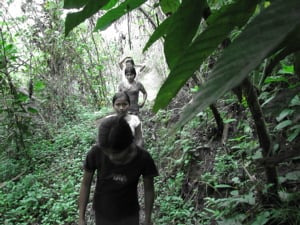
Awajun children hike through their territory in the endangered Peruvian Amazon. Photo A. Kopecky.

Related

Eleven years after the Nisga'a became the first tribe in B.C. to sign a treaty, gaining self-government over 2000 square kilometers on the northwest coast, the nation went a step further and decided to let its citizens own the homes they live in. The news that private ownership would be legal on Nisga'a land rippled out of the Nass River valley in November, reminding those who heard it of how things work for the rest of Canada's First Nations. If you live on a reserve in this country, your home belongs to the Crown, effectively barring you from the single most important economic tool in Western society: credit.

The impact of that state of affairs was recently summed up by Manny Jules, the Shuswap chief who was a key architect of the Nisga'a Final Agreement. Addressing the House of Commons in September, Jules asked his audience to consider the damage wrought by the global economic crisis as a result of collapsing credit systems. "If a credit crisis can do this to your economy in one year," he said, "think of what a 130-year credit crisis would feel like. That is precisely what we have faced since the 1876 Indian Act."

Two weeks after he gave that speech, I met Jules over breakfast at a restaurant in downtown Vancouver. It wasn't the Nisga'a I wanted to talk about, but the natives of the Peruvian Amazon.

Oil, gas and bullets

Jules, who has silver hair that flows from his crown to the middle of his back, had flown to South America in July to spread his message. "When I saw their temples," he said, "it was very powerful for me, because it spoke to the contribution our peoples have made to humanity over the course of history. Here are incredible works of architecture, seamlessly constructed and aligned with the stars. The same societies came up with the value of zero. They bred corn and tomatoes and turkeys, and trade flourished from the top to the bottom of the Americas."

While Jules' primary focus is on plugging Canadian First Nations into the Canadian economy, he also believes in a broader project known as the Eagle and the Condor -- linking up North and South American native populations, whose struggles are all too similar.

In Peru, however, those struggles took a bloody turn when government troops opened fire on a crowd of native protesters at the Amazon's edge last spring; 82 people were sent to hospital with bullet wounds and another 34 straight to the morgue.

Jules' trip was a direct response to that disaster; he'd been invited to appear in a documentary promoting a peaceful solution to the oil-and-gas-driven conflicts now tearing through the rainforest.

Hernando de Soto's prescription

The documentary was produced by Hernando de Soto, a hugely popular Peruvian economist whose accolades include an endorsement from Time magazine as one of the world's 100 most influential people and a close brush with the Nobel Prize. De Soto, who has advised dozens of presidents around the world, earned his fame with The Mystery of Capital, a book about getting the world's poorest citizens involved in the formal economy. In it, he argues that the first step for developing countries is to give slum residents legal title to the shacks they inhabit (most of the world's governments view these citizens as illegal squatters). De Soto's recommendations have been applied to roughly half his own country, but the other half -- the side carpeted by rainforest -- remains mired in indigenous land disputes strikingly similar to those in Canada.

When last June's crackdown provoked domestic and international outrage, de Soto turned his attention to the problem of indigenous rights.

"When I heard what de Soto was doing, I recognized the same arguments that I've been making all these years," Jules told me. "He comes at it from education, I learned it from experience, but we're talking about the same thing. And then I got to Peru and heard all these stories from the natives - that they are living on land they're restricted from exploiting; that in order to gain legal access to that land, they must renounce their identity as indigenous peoples; and meanwhile foreign companies that make private deals with the government have greater legal right to the land than they do. These are stories I instantly recognized, having heard them time and again here in Canada."

De Soto's documentary, The Mystery of Capital among the Indigenous People of the Amazon, plays like an exotic epilogue to his book. Speaking to a crowd of be-feathered Indians in their jungle lodge, de Soto introduces Jules and a few other North American chiefs: "What we would like to do today," he announces, "is see how they went from being tribes to become powerful organizations that can deal with the market. How they have adapted to the 21st century, nevertheless preserving their identity and keeping their traditions."

Manny Jules comes on next, uttering a few words that, like the grass skirts in the audience, seem largely ceremonial: "My dream is to unite the Eagle and the Condor so that one day all of our peoples of the Americas will be able to work together for a better future."

The camera then fades to a scene where de Soto is walking through a forest trail with a local chief. "The world has an impression that private property doesn't exist here," de Soto says, "nor business enterprise, but I've seen various enterprises in your community. We have a mistaken image of you. . . am I wrong?"

No, replies his companion, you are not. "We are collective in the form of organization," he says, "but beyond that collectivity, whatever we have is individual."

That phrase echoed something Jules told me in Vancouver, when I asked him if private ownership didn't go against the holistic world view of indigenous people.

"Just walk into any chief's house uninvited," he replied, "and you'll get your answer."

On the ground in the Amazon

A few days after I met Jules, I boarded a plane to meet the Awajun natives who took part in the highway blockade so violently disrupted last June. The clash took place in a region of northern Peru known as the "eyebrows of the jungle," where the dry Andes give way to florid foothills marking the beginning of a rainforest that reaches all the way to the Atlantic. Peru hosts the biggest stretch of Amazon outside Brazil, the third largest rainforest on earth, and until the price of oil stretched towards $100/barrel, it had been one of the most pristine as well.

That appears set to change now. Three quarters of the Peruvian Amazon has been leased to oil and gas companies in the past few years. As soon as the price rebounds from its current slump, it's a safe bet the drilling will too.

And while Manny Jules wasn't a household name in that region yet, Hernando de Soto certainly was.

"I believe he is a man of integrity," Luis Kunchikui, an Awajun leader, told me, "but I don't like his politics." Kunchikui, a vigorous man in his mid-forties, looked nothing like the natives in de Soto's video - he wore khaki shorts and a polo t-shirt buttoned halfway down in the heat. I met him at a meeting of regional chiefs -- all similarly attired -- in Bagua Grande, a dusty town that hardly merits a sentence in the Lonely Planet. Today, Bagua Grande has gained some in-country notoriety for its role in last spring's violence; when residents heard native blood was being spilled a few kilometers down the highway, thousands rioted and burned down a good portion of their central avenida.

"Picture this," Kunchikui told me. "A herd of sheep can protect itself from the wolf better than any one of them alone. But De Soto is saying, 'you sheep living together in your herd aren't eating very well. Why doesn't this one go there and graze in that space, and that one go there, and you'll all have more to eat.' But if we do that, it becomes very easy for the wolf to eat us all up one by one."

'Globalization is coming': De Soto

There was a powerful irony in the fact that Kunchikui felt de Soto was trying to throw his people to the wolves, while de Soto insists that's exactly who he wants to protect them from.

"Globalization is coming," de Soto told me when I visited his leafy estate behind the University of Lima. "You can't just ignore it, and if you don't have some kind of economic power you will be destroyed by it. If you take the kind of laws that protect Peruvian indigenous people, or indigenous people anywhere, they're sort of like a legal ghetto; it's a small world with very few legal contraptions in it that make reference to ancestral and traditional customs. They're absolutely useless if you want to face that monster called globalization."

De Soto insisted that his solution emphasized locking down collective title first, as the Nisga'a have done in British Columbia.

"The first thing I said [in the film] is that government had promised the Indians land title," he said. "We should give them what has already been promised them, which is communal title, because only 14 per cent of that is done. Let's get one hundred per cent of it in so that everyone feels as secure as they possibly can. Then, let's ask another question, which is: Is this title really what you want? Because if it's really what you want, then why are you organized differently than what this title says?"

That is precisely the route taken by the Nisga'a, who spent a century and a half fighting for communal title, then added the private option a decade after winning it. But the indigenous citizens of the Amazon haven't yet made that first step. They interpreted de Soto's video as inverting the proper sequence, and they were anything but grateful. The National Association of Amazonian Indigenous Peoples of Peru (AIDESEP by its Spanish acronym) officially declared him "persona non grata," in a communique that described Jules and the other North American chiefs as "traitors."

De Soto 'betrayed us': Awajun president

At the meeting of regional chiefs in Bagua Grande, de Soto's name came up repeatedly, always in a tone of scorn.

"He invited me three times to meet with him," recalled Ambrosio Uwak Taijie, president of the Awajun council. "So on the third time, I went. He told me he felt our fight was just and that he wanted to help us, but our tactics were wrong. He said what we needed to do was stop blockading highways and get proper title to our lands. But this is precisely why we were blockading highways in the first place! Negotiating with the government gets us nowhere. We rejected his argument, but he kept looking until he found someone to agree with him, and then he went and made this video that he's shown to the world, making it look as though all the natives of the Amazon agree that we need private title. He betrayed us and divided our communities in the process."

When I asked de Soto how he felt about being declared persona non grata for his efforts, he said that only a fringe group of Amazon Indians had done so. "AIDESEP is made up of about ten or twelve organizations," he said, "one of which purports to have called me persona non grata. It has eight signatures, of which only two correspond to chieftains. So it really is of no significance whatsoever."

Yet that minority happens to include AIDESEP's elected president, Alberto Pizango, a man who was exiled by the Peruvian government after June's uprising and has taken asylum Nicaragua. And whoever controls AIDESEP's website is also publishing virulent anti-de Soto literature in that organization's name.

Meanwhile, the Peruvian government has tried to dissolve AIDESEP itself, describing it as a seditious organization, an accusation rapidly becoming a self-fulfilling prophecy.

'We're not a museum artifact': Jules

Amidst all the confusion, de Soto postponed a forum he'd been planning for December, in which Manny Jules and others were to have returned to Peru to meet with AIDESEP’s representatives and the Peruvian government to try hammering out some kind of way forward in the Amazon.

"We're not a museum artifact," Manny Jules says towards the end of de Soto's documentary. "Our cultures are dynamic, we accept new technologies, we have evolved over many millenia and that's going to continue into the future."

Indeed, the need for development is the one thing everyone seems to agree on. And in the struggle over who gets to dictate the terms - and reap the rewards - what's striking is how the adversaries describe each other in almost exactly the same terms. Both de Soto and members of AIDESEP, for instance, asked me who I think is funding the other; the Presidents of Peru and AIDESEP have accused one another of genocide; and everyone likes to picture their adversary as a small group of radicals who claim the whole jungle for themselves.

A few days after I got home in November, I called Manny Jules and described this phenomenon to him.

He chuckled a moment before answering. "Yep," he said, "sounds exactly like Canada."  [Tyee]

29  Comments:

Login or register to post comments

  • Frank

    2 years ago

    De Soto

    "In it, he argues that the first step for developing countries is to give slum residents legal title to the shacks they inhabit "

    Okay, sure. let's do that. Will they also have to pay a mortgage or will they get it all for free?

    Then what's the next step? Will they be forced to sell their shacks for food?

  • roady

    2 years ago

    were lucky

    they have knifes instead of M16S OR WED ALL BE DEAD

  • frank2

    2 years ago

    Excellent article. But...

    Excellent article. BUT it doesn't highlight sufficiently (in my view) the major lacuna in applying de Soto's views to indigenous communities. For many years I helped finance and implement schemes to give slum-squatters title, and the benefits (for many) were outstanding. Official recognition of the right to be there (end of police raids on slums). Ability to borrow (the "beneficiaries" paid even for their land over time at highly subsidised rates) to construct permanent housing (slum dwellers couldn't, because of government/developer bulldozing). Also, ability to get hooked up to government services (water, improved roads, sanitation -- again, repayment of these was built into the payment scheme). The results were quick and apparent. Densities rose (mor storeys), businesses flourished, health improved, and there were also benefits from project components for womens education, micro credit, etc.). I daresay some initial slum dwellers didn't make it, but many did. The important point is that these slums, which housed the mirgrant masses from the countryside, disappeared "constructively" rather than via the bulldozer. The schemes were highly progressive, and operated within the capitalist framework. Attractive as such schemes were to "enlightened" outsiders, and some residents, they were usually resisted by local power structures, which meant many of them were almost tokenism.De Soto was one of the first in Latin America to champion them there. More power to his elbow.

    BUT, the situation of populations living in more remote areas (the Amazon rainfores, the BC rainforest), still with vestiges of their traditional ways of life, is very different. The bull-dozers are coming to gain access to resources of value to "outsiders." The problem is not (necessarily) about giving hope to marginal people without rights who are mired in suffering. Though that exists. If de Soto is correctly quoted that the first step should be to define communal rights, allowing the community to decide whether to move on to some form of private property, this would be progressive. But the danger is that folks will be lured into jumping immediately into private property and rapid alienation of the land -- and destruction of the environment.

    Sorry to go on at such length.

  • soleprobe

    2 years ago

    Indigenous Capitalists?

    Why should indigenous people require land title from the thieves who stole it? Land ownership, which naturally includes “private title,” is a basic human right. All indigenous peoples of the Americas want their lands back. It’s not up to the thieves to decide whether the land that they stole from the rightful owners should be private.

    And capitalism has nothing to do with private land ownership since private land ownership existed long before capitalism. Only land robbing hordes equate capitalism with private property in an attempt to politicize a basic human right for the purpose of plunder.

  • Glen Murtz

    2 years ago

    Nice Racket

    Awesome.
    So we're going to recognize the right of indigenous people to their home while thousands of "Canadians" are homeless.
    Whoa.
    Pass me the bong.

  • Ksimlaxgibuu

    2 years ago

    This article is false

    As a critic of the Nisga'a Treaty for 9 years, this article says 11 years after the Nisga'a.......the Final Agreement was signed May 2000. Don't forget, we gave u[p 93% of our ancetral lands for this sellout treaty. In 2012, we don't have Indian Status, we pay income taxes and property taxes on fee simple lands, etc. etc.

    No one gave me the right to own my home, I went to the Scotia Bank in Terrace to pay for it and show me papers where the government paid for my home. This is ludicrous. No one decides for me, I always have represented myself, no leader needs to tell me what I may or may not own. Who is is Jules character anyway? He should not be given credit for our sellout Treaty. If we played a role, he is another person to blame for all the flaws..long, very long story.

    I don't even think we should be compared to the other tribe down South America..my ancestors looked after this land for hundreds of years, settled close to fishing and hunting grounds and no leader these days should be mentioned, read our Nisga'a history. I received my BA in First Nations Studies from UNBC, a Minor Degree in Political Science and 4 Certificates...believe me, we are a distinct nation and even though Nisga'a Government is not accountable, we still occupy this beautiful God's country and food we get from it. We look forward to men catching oolichans next month, fishing in the summer and picking tons of berries in my beautiful garden..we are truly blessed from above....Cheers!!

  • zalm

    2 years ago

    glen

    "So we're going to recognize the right of indigenous people to their home while thousands of "Canadians" are homeless."

    Just like a pig is not a pigeon, having title to a homeland is nothing like individuals being homeless. Don't get hung out to dry on the words. On the other hand, if you want to talk about self-determination....

  • roady

    2 years ago

    not hundreds of years

    but thousands of years, long before there ever was a word canada. the white people should be forced to
    live on reserves while the indigenous people gaze over the valley and rivers from which they hunted and fished for there food..thanks

  • ME2

    2 years ago

    David Beers

    My comment, prepared on Word, and checked by Word Count on that program; shows:

    480 words
    2500 characters, and
    2981 chracters with spaces, yet

    Your Preview rejects the text for being over 3000 characters

    Why ??

  • ME2

    2 years ago

    David Beers

    My comment, prepared on Word, and checked by Word Count on that program; shows:

    480 words
    2500 characters, and
    2981 chracters with spaces, yet

    Your Preview rejects the text for being over 3000 characters

    Why ??

  • David Beers

    2 years ago

    Administrator

    Good morning ME2

    I don't know why that happened. Can you break your comment into two parts and publish them in sequence?

  • alive

    2 years ago

    2 standards

    Let us not forget that our governemnt(s) bend over backwards to help natives set up business.
    They have free consultations and help with preparing business plans, then financing is expedited for them.
    The ony thing we fail to do, is to oversee that they conduct themselves in a way that make their business viable!
    I know of a few examples that have been bailed out and re-started several times, while ordinary citizens are left to their own devices should they want to have a go at being self-employed.

  • KWD

    2 years ago

    globalization is here

    “But if we do that, it becomes very easy for the wolf to eat us [sheep] all up one by one."

    True enough if you believe people are sheep, which, unless I’m being a bit naieve, Kunchikui still believes. And, if that’s the case, in the greater scheme of things, the wolf will determine the Indigenous South American herd’s quality of life. Just as it is determining the quality of life for Nisga’a and the rest of the capitalist world.

    If “the need for development is the one thing everyone seems to agree on”, then having a say in what defines “development”, and whether or not development is synonomous with an improvement in the quality of life, is criitical.

  • Chris Keam

    2 years ago

    access to self-employment resources

    "I know of a few examples that have been bailed out and re-started several times, while ordinary citizens are left to their own devices should they want to have a go at being self-employed."

    I'll forego the obvious bail-out comment re: automakers and banks (none of which AFAIK are owned by indigenous peoples) and instead move on to the second (erroneous) statement alive made:

    Self-employment assistance for people on EI
    http://www.servicecanada.gc.ca/eng/epb/sid/cia/grants/self-emp/desc_self-emp.shtml#apply

    BC college and other self-employment programs
    http://www.beyourownboss.org/programs.htm

    I'm sure there's more, but 30 seconds of Googling is all I'm prepared to spend on the subject.

  • Glen Murtz

    2 years ago

    Property as a "Right" = tired, stupid and wrong.

    Property as a "right"?
    I call BS.

    Lets consider how property becomes "yours", pre-law. You make claim to it. You have to defend a geographic area against other people who might want it. They will use violence if necessary to take it - so you require violence to defend against it. So you get a bunch of people together and say "this is ours" and anyone who wants it either has to join your little group of thieves or hook up with a bigger, badder crew than yours and cave in every last one of your heads in.
    That's how "property" worked pre-law.

    LAW and this ridiculous notion of RIGHTS came a LONG LONG time after cracking open heads did the trick.
    Get your shit straight pal. You're living in some weird dream world in which everything is ass-backwards.

    Land is never "yours" anymore than a "right" is. One was stolen and retained through violence and brutality, the second was a conveniently individualized "legalization" that diminished the use of an individuals or groups use of force necessary to retain the former. That use of force now resides with the state instead of a bunch of Haida, Frenchmen, Punjabi, etc etc etc.

    None of which negates the fact that property is theft.

  • analu

    2 years ago

    Interesting article, but two clarifications are needed

    First of all, our message for the development of the Indigenous Peoples of the Amazon goes beyond suggesting private or communal property. It is summarized in 6 points:

    1)Deficient territorial control: The peoples of the Amazon lack three legal instruments to obtain economic control over their territory: a.Effective property rights (collective and individual) that will enable them to extract from their resources the most surplus value possible; b.business organizations and contracts through which they can control their assets and make deals with other indigenous people or investors; and c.clearly defined mechanisms to be consulted about and help create the laws that regulate their property and businesses.

    2)No voice in their own future: Traditional legal instruments, that call for indigenous peoples to be consulted on matters concerning their interests, do not specify the mechanisms to make that happen. There are Peruvian and international laws and initiatives that can provide the missing pieces – if properly adapted to the indigenous context.

    3)Unprepared for the flow of investment to the jungle: We need to design strategies to help the indigenous peoples benefit from the flight of international investors toward Third World commodities and land as a result of the debasement of the world’s main currencies and financial instruments.

    4)Unaware of recent successes outside Peru: Indigenous leaders from other parts of the world will share their experiences making the transition to the 21st Century globalized economy, without losing their traditions or cultural identity.

    5)Marginalization: We need to end the isolation of indigenous communities by creating efficient institutions that connect them to the rest of Peru and the world, without depending only on “cultural brokers” that systematically undermine the opportunities for Peruvians to share information and collaborate economically.

    6)The indigenous peoples’ problem is everybody’s problem: We must all understand that the outcome of the crisis in the Amazon will affect the future of the entire country. The decision to tackle these fundamental problems – or postpone their solutions – is likely to determine the course of informality and hundreds of social, environmental, oil, and mining disputes throughout Peru.

    Second, to date leaders representing more than 700 of the 1,500 indigenous communities in the Amazon, have publicly manifested that they will participate in the forum being convened by the ILD, because they believe it is essential to find a peaceful solution to the 6 fundamental problems affecting them.

    One of these leaders is precisely the Native Chief Ambrocio Uwak Taijin, who stated “De Soto betrayed us” in the article above. Therefore, De Soto´s proposals have made great advances among the native leaders.

    ILD Legal Director

  • Ksimlaxgibuu

    2 years ago

    Chill!!

    I cannot understand how people talk like they know what the real score is, read our history books.

    Some writers don't know what they are talking about, I say, In Your Dreams.....thoughts?

  • soleprobe

    2 years ago

    Lets consider how property becomes "yours", pre-law.

    "You make claim to it."

    By what means? Peacefully because you were the first to lay claim to unoccupied land? Then it's rightfully yours.

    "You're living in some weird dream world."

    You are correct, a bad "weird dream world" because it's run by a bunch of "ass-backwards" weird people like you.

  • Glen Murtz

    2 years ago

    Blinded.

    "By what means? Peacefully because you were the first to lay claim to unoccupied land? Then it's rightfully yours."

    LOL.

    Yeh - it was all peace and love. Like when First Nations bands were taking slaves back after a raid.
    Please - by all means - correct me if I'm wrong.

    And on that whole dreamy "peaceably taking land blah blah blah"... I guess that meant "tough sh*t" for those nomadic types though, huh?

    Property is theft.

  • ME2

    2 years ago

    A little different view

    A very interesting story, one which should bring out some facts about which discussion has been deliberately suppressed on the false grounds that doing so would be "racist". I'll deal here only with the issue of individual and tribal fee-simple ownership of Reserve Lands, which lies at the very base of historical and current FN problems.

    All FN peoples, along with many "white" peoples who had lived millennia in isolation, such those in the Balkans, had learned that individual ownership of other than purely personal items, along with aspirations to personal political power, was anathema to peaceful relationships and solidarity within the group. These ills were unknown to Canadian FNs, if not other FNs. Thus, power - via inheritance – along with wealth was held for the tribe by Clans, and their power was mediated through tribal councils.

    These situations can be successful only when the groups are completely isolated from incoming new ideas and technologies. Witness our Western and Eastern cultures which have been under continuous change, driven by innovations such as the watermill, Capitalism, and The Pill..

    Hence Canadian FN's long-standing charge that our Western cultures are driven by "greed" and their equally long-standing aversion to comprehending the usefulness of accumulated personal Capital. (Capitalism0 Their inheritance of a culture in which day-to-day rather than year-to-year subsistence was / is a practical strategy has led to the recurrent failure of hundreds of millions of dollars worth of Federal monies which have been “loaned” to finance commercial ventures such as wild-rice harvesting, cattle-ranching, sawmilling, and canneries, to mention only a few. The White Man's patronising Reserve system and Indian Act has served to perpetuate that culturally derived syndrome. Despite their Crocodile tears, FNs have fought to retain both.

    It is a deep-seated belief among pro-native sympathisers that the Reserve system was set up to "force" FNs off the land. Not so. First of all, there was no way - then or even today - that a "communistic" system can freely co-exist within a private enterprise majority. The only way the tribal and cultural systems could be preserved was through the Reserves, the Indian Act, and the laying on of benefits. Had Canadian FNs been given fee simple ownership of land – in any amount – and then left to fend for themselves, with no knowledge of financial matters they would have soon been cheated out of it, or squandered it away, tribal unity lost, and Canadian aboriginals scattered to the winds.
    .
    continued below.

  • ME2

    2 years ago

    A little different view - continued

    Next time you place the blame for FN problems squarely upon the.European’s shoulders, folks, remember that of ALL the colonising nations, the first to treaty with aboriginal peoples were the British, and have been the ONLY ones to honour them - unlike the US, for example. If you want to cherry-pick events out of history about which to get riled up about, I can offer you a few documented ones about aboriginals.

  • Taqulik

    2 years ago

    The saga continues...

    It's interesting to see how history can be manipulated and turned to one's advantage. Just one example: before the British, the French made treaties with Aboriginal peoples and those treaties were honored. That being said, all colonizers share the same burden as they are the ones that pushed Aboriginal peoples into reserves, for whatever motive it was. Today we are dealing with those consequences. This is a legal issue, one of human fundamental rights, no less.

    This article shows the tension between private and communal ownership of land. But one thing that needs to be remembered is the fact that there is a difference between families living in the slums of Lima and the Indigenous peoples of the Amazon. They are the ones to decide their future, not De Soto, Canadian Chiefs or the Peruvian government.

    Peru is now ruled by a government that is open to capitalism and quite opposed to Indigenous rights. Its neighbour, Bolivia, that also shares the Amazon, has a very different approach and Original peoples are now having their own territories called Tierras Originarias de Origen (TCO) and are forging ahead in the autonomy process. Together, on their land, they feel they are stronger than isolated in a world where the capitalist free for all dominates. No wonder that the actual president, Evo Morales, was reelected with a strong majority as the majority of Bolivians are Indigenous.

    So, whatever outsiders think about the situation, that doesn't change the fact that it will be those people that will decide their future or the conflicts with governments are likely to escalate. What they need is international support for their fundamental rights, not gurus that will tell them what to do.

    From La Paz, Bolivia.

  • Taqulik

    2 years ago

    TCO

    Sorry for the mistake: They are Tierras Comunitarias de Origen - Original Communal Lands.

  • Ahni

    2 years ago

    Laugh out Loud

    Some great comments here. Really nice to see.

    First, I wish to say how surprised I was to see an article like this on the Tyee. Honestly, this is what I'd expect to see in the Winnipeg Sun.

    Hernado de Soto is a muse for the pro-assimilation, anti-indigenous rights movement---which, for the past couple years, has been floating around between Canada, Peru, Ecuador, India and a few other places.

    They love referring to him, even in Winnipeg Sun, because he so effectively re-frames indigenous knowledge to reinforce his personal vision of how things should be...

    While it's true that "some" indigenous people historically practiced variations of capitalism, they were far from being "Capitalists" in the modern sense.

    I mean, it's like saying all Indigenous People speak English because in the past they had "language". LOL. It's non-sense, just like "Property being a right" as Glenn points out. And that shallow argument by Joseph Quesnel and various others that we need a "revolution in individual rights" --- and model ourselves after colonial society so that we, too, can live "the good life".

    All our problems with float away like magic, they argue. We just have to do what they tell us to do.

    That sounds very familiar to me.

    Last but not least, in case readers don't realize it, the Awajun and Wampis were the ones in Bagua, Peru, where, on June 5, 2009, police opened fire after the People (who had gathered by the thousands) agreed to take down a series of blockades they had erected to defend their collective rights. Recently, the Awajun and Wampis also arrested five employees from a Canadian mining company for trespassing on their territory without their consent.

    In other words, the "need for development" by which I mean the vulgar colonial model, is not something that everyone agrees on. And those who are opposed to it are not a simple minority. This pro-captial fringe is the minority. And rightly so, since their propositions are incompatible with the needs, rights, and histories, and perspectives of Indigenous people. One or two examples isolated from the rest of the world does not prove otherwise.

  • soleprobe

    2 years ago

    "LOL".

    Doesn't take too much to make you laugh does it.

    "Property is theft."

    Go get some help.

  • soleprobe

    2 years ago

    "...incoming new ideas and technologies."

    "...incoming new ideas..."

    Infest with disease, starve and slaughter over 90% of them and shove the remnant on reserves and slaughter 50% of that remnant through the Residential School System while obliterating their cultures and languages at the same time."

    "...new...technologies."

    Superior weaponry to facilitate the implementation of the "...incoming new ideas..."

  • jnewcomb

    2 years ago

    De Soto: indigenous peoples and landless migrants

    Hernando de Soto's main points about property rights are something that he has been working on for about 30 years now. I first read El Otro Sendero (The Other Path) in Lima 20 years ago - and was so amazed by De Soto's perception and prescription for insuring property rights for the poor and for the underground economy. Surviving the terrorists' bomb attacks, De Soto has been feted by the elder President Bush and the Fraser Institute, but now with his focus on property rights for indigenous peoples, he has really been moving in another important direction. Best wishes to him and to his ILD crew for their important work!

  • RickW

    2 years ago

    Glen Murtz

    Quote:
    Property is theft

    Exactly!
    It is my understanding that FN held land in the community, rather than individual ownership. So "allowing" natives to own their onw houses is just another proverbial 'nail in the coffin' of removing native peoples from their history and culture.

  • soleprobe

    2 years ago

    "allowing" natives to own their onw houses

    Excuse me but please allow me to speak openly my sincere thoughts:

    Who the hell are you creeps to say that natives or anybody else can't own their own houses without permission?

    First they get all but exterminated through genocide, then the tiny remnant get shoved onto reservations for further bodily and cultural extermination as their children are starved to death, raped and the resulting offspring burned alive in ovens, froze to death, beaten to death, and used as Ginny pigs in covert medical experiments... and then some pompous, arrogant puff faced jerks come around and say to those who have somehow miraculously survived, "I don't think it would be a good idea to allow you poor folks to own your own homes.”

    I just hope that this sick stuff is coming from a few foreign psychos with many usernames because this is not Canadian. This is not what Canadian soldiers have fought and died for in past and current wars: to have a bunch of sick tyrants telling them that they are not allowed to own their own homes and property.

    • The discussion for this story is closed. No more comments can be added.