
News

A Tyee Series

Low-Energy Homes Mean Thousands of New Jobs

In Europe, that is, where Passivhaus principles are going into building codes. Could B.C. do it?

By Monte Paulsen, 27 Jan 2011, TheTyee.ca

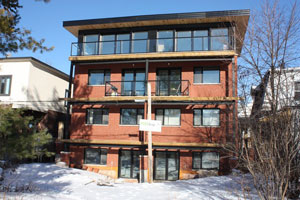
OttawaPassivhaus2-300.jpg

Related

Thirty-two years elapsed between the invention of the Saskatchewan Conservation House and the erection of Austria House in Whistler (structures this series profiled in the previous two stories).

Canada's second certified Passivhaus was completed just a year later. And a dozen more Canadian Passivhaus projects are underway.

Passivhaus buildings -- which include schools, offices, apartments as well as a growing number of renovated structures -- use 90 per cent less energy for heating and cooling than conventionally built buildings. Since buildings consume up to half of all energy in North America, the prospect of a 90 per cent reduction poses what green building advocates believe is the most affordable way to reduce energy costs and slash the emission of greenhouse gasses.

Europe has embraced the idea. The continent already has more than 25,000 Passivhaus certified buildings. And by 2020, every new building in the European Union must be a "near zero energy building." With that shift has come a steep rise in new green construction jobs.

Given that both the City of Vancouver and the Province of British Columbia have committed to cutting greenhouse gas emissions by 33 per cent by 2020, it's worth asking: Is B.C. ready for Passivhaus building codes?

On the Rideau, a Passivhaus duplex

Canada's second Passivhaus was certified last November. It's a three-storey duplex overlooking the Rideau River in Ottawa. The building sports a green roof (with 12 inches of soil for gardening), a heat recovery ventilator, a geo-thermal system and a rainwater cistern.

Chris Straka designed the building, and lives on one of the two 1,650 square foot residences.

"I focused my attention on the building's envelope, using triple-glazed windows, a combination of foam insulations, and I sealed the house carefully to avoid thermal bridges that would transfer energy across the outer walls. All of this plus a south-facing rear wall of windows overlooking the Rideau River, keeps the cold out while inviting heat inside," he said. (Photos here.)

Straka built his duplex, which is also seeking platinum certification under the LEED for Homes program, without importing high-tech windows from Europe.

"I knew that a very high performing building could be created using Canadian materials and mechanical systems," he said.

Stratka said his house cost about 10 per cent more (per square foot) than a conventional house. He estimates that expense will be recovered through energy savings within six to 10 years.

"Any custom home in Ottawa will cost about $225 a square foot to build," Stratka said. "For $250 a square foot, you can have the ultimate in energy efficiency."

Stratka is already at work on another Passivhaus/LEED Platinum design, which he said will be built for the same construction cost as a conventional custom home.

At least a dozen more Passivhaus building projects are underway across Canada. In British Columbia, the list of projects on the boards includes two multifamily homes in Vancouver, a winery in the Okanagan, and a warehouse on Vancouver Island.

In Whistler, an affordable Passivhaus

Matheo Duerfeld, the veteran Whistler contractor who helped build Austria House, is also planning a Passivhaus duplex.

"So you get a project like this [Austria House]. Part of it is construction. Part of it is, you make some friends. And part of it is you look at new technology," he said.

Duerfeld had been investigating BuiltGreen and the R-2000 standard, but was discouraged by what he described as the heavy use of foam and other chemical-laden building products in many of those homes. The Austrian emphasis on wood products changed his mind about energy-efficient building.

"So we looked at this [Austria House], and we said, 'You can actually build an airtight house that is a wood-based house. You don't have to build a petrochemical-based box.'"

Duerfeld's company bought a lot through the Whistler Housing Authority in a new subdivision called Rainbow, where he expects to break ground in April on a Passivhaus duplex. The side-by-side duplex was designed by Alex Maurer of Marken Design. The housing authority expects the Passivhaus homes to be affordable (by Whistler standards).

"That is really going to be the challenge," Duerfeld said. "If I build a custom house for someone in Whistler, and I have a $2 million budget, I know I can build that person a Passivhaus. Here, our challenge is going to be to build an affordable envelope."

Duerfeld isn't yet certain what the homes will cost. He plans to invest in insulation and airtightness, while eschewing expensive alternative energy systems. And, like Straka, Duerfeld plans to build using local materials.

"That means made in B.C.," Duerfeld said. "We're going to try to do it so that almost everything can be locally based."

In Williams Lake, hope for new jobs

"The other thing we are looking at is doing this in modules," Duerfeld continued.

"If I was only ever thinking of doing one house, I wouldn't think of doing it in modules. But we're thinking that this is a new little business we might get into. We have a shop up north. We have space where we could actually build walls," he said.

Thus the Whistler duplex will serve as a pilot project where Duerfeld plans to showcase the walls he will prefabricate in Williams Lake.

"Ultimately, our goal is we will get to the point that we would become a subcontractor for a developer or a builder. We would build the envelope. We would test the envelope. And then we're out of there," Duerfeld smiled. "We'd provide a quick build at a fixed price."

Duerfeld's plan is to prefabricate a wall system that would combine a two-by-four inch service wall inside a two-by-ten insulation wall.

The exterior (2x10) wall would be insulated with rockwool, and sheathed with oriented strand board. The inside sheet of OSB will double as an all-wood vapour barrier. "This is our insulating and structural wall," he said. "We won't penetrate it. No plumbing, no electricity there."

WhistlerDuplex-300.jpg

The interior (2x4) wall would contain all the mechanical systems. "We won't pre-insulate this. We can run all our plumbing, our wiring, anything else," Duerfeld said. "When we finish the wall, just before we put the drywall on, we'll insulate that as well."

Though it won't include the sold-wood interior that makes the Lost Lake Passivhaus (nee Austria House) so visually attractive, Duerfeld's affordable wall system will provide more insulation.

"We have more R-value in this wall than the Austrians have in that wall," Duerfeld said. "Our philosophy is: We are going to show that you can do this using Canadian products and Canadian labour."

In Germany, jobs grew quickly

In the European Union, all new buildings must be "nearly zero energy" by 2020.

"They're headed toward a Passivhaus-equivalent building code. Your thermal envelope is going to have to be this good," Duerfeld said. "I think that will slowly follow here, too."

Guido Wimmers is a Dutch architect who now works as a designer in Vancouver. He wrote the city's Passive Design Toolkit for homes, and he trains Canadian architects, builders and engineers through the Canadian Passive House Institute.

"Quite a few European cities are already doing [Passivhaus or near-zero building codes]," Wimmers said. "By 2020. A lot, actually."

Wimmers shares Duerfeld's view that Canada is ready for Passivhaus.

"The time is right. LEED has sensitized the market over the last few years. They did an awesome job in educating people. My personal opinion is just that they have not focused correctly on energy, but it doesn't matter. Overall, they have changed the building industry," he said. "Now, the market is open for the next big leap, for something more. And they've seen that Passivhaus is fairly successful."

Wimmers, who consults on numerous Passivhaus projects, expects to see between five and 10 more Passivhaus buildings in B.C. this year. "I could imagine that a year later we are already at 50. And double that the following year."

He watched it happen in Europe.

"These ideas transformed the industry in a relatively short period of time," he said, adding that the rate of job creation in Germany was staggering.

"The automobile industry in Germany is huge, as everybody knows. We're talking about Mercedes, BMW, Audi, Porsche, Opal, Toyota, Volkswagen," he said. "By 2008, there were more jobs in energy-saving technologies and the renewable energy sector than in the whole German automobile industry."

Slouching toward Passivhaus

Wimmers sits on a committee that advises the City of Vancouver on its plan to become the Greenest City in the world by 2020.

He paused when asked whether he believed the city should adopt Passivhaus-like standards for its building code.

"Over time, yes," he replied. "But I think the industry is not set up to accept this as a general rule by 2020. We cannot implement it over nine years. That's too much."

In Europe, he noted, "They've been working on this for 20 years."

Asked what he thought Vancouver should do to meet the green building component of its promise to reduce community greenhouse gas emissions by 33 per cent (from 2007 levels) by 2020, Wimmers replied promptly and in detail.

"First of all, push the code. Make it more challenging. So that legally allowed worst-case scenario? Just push it a little bit higher. Raise the bar," he began.

"Then educate. Because without education, it's not gonna happen," Wimmers continued.

"Then, it is a money issue. As long as we get electricity more or less for free, where is the motivation to save energy?" he asked. "The city could come up with a very provocative model, and put some tax on our electricity ... is not a very popular tool. But it is an extremely efficient one," he said.

"And finally, make it simple. For every new bylaw, throw away 10 existing ones. Just get rid of all this jungle of bylaws and make them clear and performance-based," like the Passivhaus standard. "Nothing proscriptive, only performance-based."

Wimmers added that, based on the feedback he receives at his Passivhaus training seminars, he believes the green building market is ready.

"I think the time is right," he said. "I'm convinced that Passivhaus is about to take off in Canada."  [Tyee]

12  Comments:

Login or register to post comments

  • P. Markunas

    2 years ago

    Headline drew me in, but...

    Interesting series. The headline to this article suggests thousands of new jobs, but perhaps that's a bit of an oversell. Thousands of jobs involving more sustainable practices than in the past, quite possibly, but electricians are still electricians even if they are now involved in installing solar panels. It is largely the currently employed skilled and knowledgable trades people who will take on the challenge of new materials, technologies and architectures. The possibility of employing more workers does increase if we assume increased rate of replacement of existing housing stock above business as usual or an increase in new housing starts for other reasons, for example, but I don't think I hear the author advocating for that. A greater demand for workers would also result from increased activity in retro-fitting existing housing with new technologies, as has occurred in Germany, but again, don't see the author arguing for that in this article.

  • Homesol

    2 years ago

    First Passive House house in Canada

    Monte, you've really done a great job on this and other stories about the growing Passive House movement in Canada, it really is capturing the imaginations of many who can no longer believe in houses that suck energy. I like to make the analogy that if one car maker was selling cars that went 100 kms. on less than one litre of gas, while the competition continued selling basically the same cars that used 10 litres, which one would everyone buy? On top of that, a Passive House is more comfortable, is "future-proofed" against rising energy costs, and provides "passive survivability" in that it would probably never freeze inside even if the power was off all winter. Although Passive House might not be possible for all locations and designs, it's certainly an ideal worth striving towards.

    One clarification to your story: although the Austrian ski chalet in Whistler was certified by the Passive House Institute as a "Leisure Facility" (and I'm not knocking that accomplishment, it's a very innovative design, I toured the building at last spring's Passive House conference), Chris Straka's house in Ottawa, which our company Homesol certified, is the first Certified Passive House residence in Canada.

    Regardless of firsts, the really exciting news about Passive House is that by this time next year we may see dozens of Certified Passive House buildings of all kinds all over the country, and I look forward to more green building news from Tyee!

  • JSoet

    2 years ago

    More jobs?

    P. Markunas, I think the author's point is that it could create more jobs by creating the materials and things that are needed to create these passivehauses. Although in this article Duerfeld says he can do it using all canadian parts and labour, they do mention that there is not really that many options in terms of highly energy efficient windows, etc. so fabricating that could create jobs?

  • ergodesk

    2 years ago

    Green Jobs From Where?

    Government need to get on board first. Their Red Tape also needs to turn Green if any movement towards allowing industry to even start thinking about Energy Efficient projects, then add 10 years for us to see any fruit develope.

  • Bytesmiths

    2 years ago

    Let's talk "sustainability" building codes

    "Passivhaus principles are going into building codes. Could BC do it?"

    I agree completely that BC building codes stand in the way of anything more innovative than stick-frame and drywall. You need to spend five-figures worth of engineering fees to do anything different.

    But at a much more basic level, BC building codes are anti-subsistance and anti-democracy.

    We wanted to do better than fossil fuel and electricity for heating, and we had a woodlot that could sustainably support our needs. All we needed was storage. So we did some scrounging, and came up with nearly all the materials -- hand-charred cedar posts, old fencing boards, and concrete rubble for the post's foundation. We wanted to share this with a second house, and needed room for aging green wood, and so came up with a requirement and a design for a 16 cord woodshed, in four sections of four cords each. Each section would have a footprint of 64 square feet.

    We laid it out in a row, broadside south for best solar aspect. As soon as we got the frame up, we got "red tagged" for a building code violation. I guess someone thought we'd soon be renting it out for $800 a month, and so it needed to be built to code.

    So I inquired about building "to code." It would require digging up the rubble foundation and putting in a poured concrete foundation, and getting rid of our nail-laminated 2"x6" headers and putting in either solid or engineered beams. It would mean thousands of dollars worth of new materials, versus the zero dollars worth of recycled and reused materials we had planned to use -- all for a wood shed!

    (continued below)

  • Bytesmiths

    2 years ago

    Let's talk "sustainability" building codes

    (continued)

    Luckily, Uli Temmel, our local building inspector, was quite sympathetic, and helped us explore how to make it "below regulatory concern" by chopping it up so that no individual section would be more than 107 sqft. The "in between" sections are now covered with plastic, and the remaining 64 sqft sections are a bit wobbly, because we had to cut out the header beams.

    Last I checked, building codes were for the purpose of public health and safety. Now we have a woodshed that is certainly LESS safe than the original design, because we could not use the recycled materials we had planned!

    So let's not change the code to allow Passivehaus or any other single non-standard design -- let's change it to make sense!

    My second point: that codes are non-democratic... building codes have a "complaint-driven" enforcement process. This encourages people to build back in the woods, out-of-sight, instead of clustered near current development, where they might be spotted. Complaints are anonymous, which means one nasty neighbour can spoil your entire neighbourhood for sustainable development.

    And how do you find out if you're "building to code" or not? Well, you have to buy a paper copy or PAY HUNDREDS OF DOLLARS TO DOWNLOAD it! It's easier to download the latest box-office movie than to access the building codes!

    Building codes discriminate against the "do it yourself" types and enforce stick-frame/drywall homogeneity. They need a huge overhaul if sustainable building is to progress.

  • dave49

    2 years ago

    The market has to want this

    There has to be some sort of demand from the public for this. As one home designer told me, the percentage of home buyers for whom energy and 'greenness' are key factors in their home0buying decision is 3 to 5%, maximum. Basically, a developer in the Lower Mainland can put up any piece of crap box in and be practically guaranteed a healthy profit when it sells. There is a big disconnect between BCers' espoused environmental values and how they behave when they buy homes and cars.

    I spent a long wait at my doctor's office last summer looking carefully through a local real estate magazine. I saw three Built Green logos attached to project ads, and five Power Smart Homes logos. No mention of LEED for Homes or Energy Star. Yet, Ontario has more than 50,000 Energy Star-rated homes. One green building advocate I talked to dismissed this accomplishment, saying "Those are not green homes". Really...

    Until Park Lane and other tract home builders embrace green and/or low-energy homes, the market will not shift.

    Lastly, we need a good and visible demo project for Passive House, here in the Lower Mainland.

  • RickW

    2 years ago

    dave49

    Quote:
    There has to be some sort of demand from the public for this

    The "public" doesn't look at anything more substantial than the colour of paint on the showhome walls.

    I hate to disagree with you D-49, but the public is so ignorant, it has to be dragged kicking and screaming to "do the right thing".

    And as far as that goes, so do the general contractors and so-called "trades", most of which couldn't nail a nail without a compressor.

  • dave49

    2 years ago

    RickW

    First of all, the Passive Haus emerged because of high energy costs which Europeans expect to go higher. The privations of war and high prices of energy and the high taxes governments levied on energy to provide stable revenue means there has been a very different attitude to energy in Europe since the late 1940s.

    We, on the other hand, live in a land of cheap energy. In the Lower Mainland, we have a mild, maritime climate. We live in sieves because it is cheap to do so.

    Tightening building codes will push things in the right direction, but you need to have the training and attitude to build properly so we don't have another fiasco like the leaky condo crisis.

    The public may be ignorant, but they don't realize it. They think they are ahead of the curve. The power of self-delusion! We are so green here. NO! We talk green but rarely act green in a significant enough way to make a substantial way.

    I've been in Vancouver over 20 years. For the last 15 or more years I have heard the mantra about Vancouver being a world class city, how this is the most beautiful city, how everyone wants to live here. This is the propaganda principle, and we have said this so often, that we believe this, in part because we WANT to believe it. It makes us happy to feel like we've made it.

    Don't just talk. DO! And have a City permitting structure and bureaucracy that ALLOWS and encourages innovation. Vancouver is so AR it is shocking. Complete at odds with all Gregor;s green goals.

  • RickW

    2 years ago

    dave 49

    Quote:
    And have a City permitting structure and bureaucracy that ALLOWS and encourages innovation

    When the sole "principle" is make a quick buck and get out? You mentioned the leaky condo debacle. It's the only scandal I know of where it's become the owners' fault for living in those places.

    What will it take (in the real world) to have bureaucrats willing to explore innovation?

  • edoherty

    2 years ago

    Ideal for retrofits?

    "Duerfeld's plan is to prefabricate a wall system that would combine a two-by-four inch service wall inside a two-by-ten insulation wall."

    This sounds like a typical 2X4 Canadian house, but with a vapor barrier and 2X10 insulated wall added on the outside. Where do I sign up to get a 2X10 insulated wall with triple pane windows nailed onto the outside of my house?

  • hakaakah

    2 years ago

    • The discussion for this story is closed. No more comments can be added.