
- Ms Kaye is a Tyee Builder. You can be, too.
- Mary Carlisle is a Tyee Builder. You can be, too.
- Prem Gill is a Tyee Builder. You can be, too.
- Nancy Flight is a Tyee Builder. You can be, too.
- Justin Everett is a Tyee Builder. You can be, too.
- John Westover is a Tyee Builder. You can be, too.
- Nora Etches is a Tyee Builder. You can be, too.
- Edward Henderson is a Tyee Builder. You can be, too.
- Bharadwaj Chandramouli is a Tyee Builder. You can be, too.
- Dean Chatterson is a Tyee Builder. You can be, too.
- Marius Scurtescu is a Tyee Builder. You can be, too.
- Robert Parkes is a Tyee Builder. You can be, too.
- James Murton is a Tyee Builder. You can be, too.
- Susan Doyle is a Tyee Builder. You can be, too.
- Vincent Strgar is a Tyee Builder. You can be, too.
- Helen Spiegelman is a Tyee Builder. You can be, too.
- Subir Guin is a Tyee Builder. You can be, too.
- Kimball Finigan is a Tyee Builder. You can be, too.
- Joanne Manley is a Tyee Builder. You can be, too.
- David Leach is a Tyee Builder. You can be, too.
Step Inside the Real Home of the Future: Passivhaus
Canadians helped invent a house so efficient you could heat it with a hair dryer. Then we forgot about it. First of three parts.
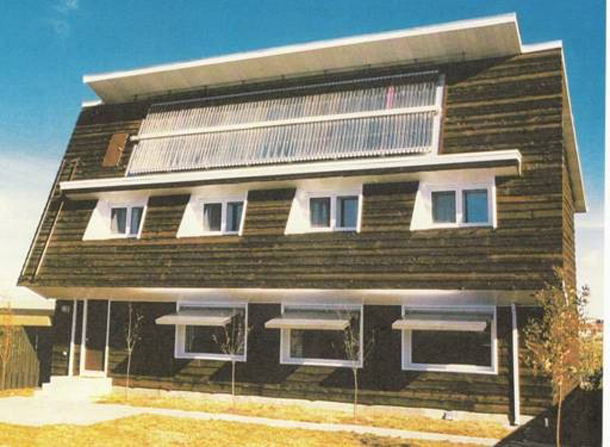
Saskatchewan Conservation House, c. 1977.
Green Buildings That Pay Off
- Five Myths About Green Building
- Green Homes For Less
- How Do They Decide a Building Is 'Green'?
- Building Jobs By Tearing Down Houses the Green Way
- Step Inside the Real Home of the Future: Passivhaus
- In Snowy Whistler, a House with No Furnace
- Low-Energy Homes Mean Thousands of New Jobs
- How Green School Buildings Help Children Grow
- How to Design a Building that Restores the Earth
- A Smarter Way to Help You Pay for Greening Your Home
- Greening Homes Can Be Big Boost to Economy
- How Many 'Miles-per-Gallon' Does Your House Get?
- Building Green from the Ground Up
The home of the future was built 34 years ago in Regina. It was called the Saskatchewan Conservation House. It used less than a fifth of the energy consumed by comparable homes. More than 30,000 people came to see it. But Canadian homebuilders ignored the ideas it offered, and the Canadian public forgot about it.
The world would have forgotten the Saskatchewan house, too, were it not for a quirky German physicist interested in energy-saving buildings. After studying the Saskatchewan house and a handful of similar buildings, Dr. Wolfgang Feist wrote a mathematically precise -- and elegantly simple -- criterion for designing buildings that require less than a tenth of the energy of average buildings. He called it the Passivhaus standard.
Feist's formula has gone viral. There are now more than 25,000 certified Passivhaus buildings in Europe, and thousands more under construction around the world.
But, here in Canada? There's just one.
Sans furnace in Saskatchewan
The Saskatchewan Conservation House was built in 1977 by the Saskatchewan Research Council, with support from partners including the University of Regina and the University of Saskatchewan.
It was built without a furnace. Instead, the northwest Regina home features a nearly airtight envelope with R-40 wall insulation and R-60 roof insulation. This enables a small hot water system to heat the house, even through the winter.
The house is cube-shaped to expose a minimum amount of exterior surface area per square foot of floor space. Dark-brown cedar siding enables the house to absorb heat from the sun. And deciduous trees on the south side of the house provide shade in summer and allow solar heat to enter the windows in the winter.
Together with the "Lo-Cal House" at the University of Illinois and the "Leger House" in Massachusetts (both of which were built about the same time) the Saskatchewan house was among the earliest conservation demonstration projects in North America. American physicist William Shurcliff summarized the common elements of these cutting-edge buildings in a 1979 paper.
"Truly superb insulation," Shurcliff observed. "Not just thick, but clever and thorough. Excellent insulation is provided even at the most difficult places: sills, headers, foundation walls, windows, electric outlet boxes, etc."
Shurcliff continued: "Envelope of house is practically airtight... No conventional furnace... No weird shape of house, no weird architecture." And he noted how these buildings were pointing the way toward affordable green homes.
"No big added expense," he wrote. "The costs of the extra insulation and extra care in construction are largely offset by the savings realized from not having huge areas of expensive [windows], not having huge well-sealed insulating shutters for huge south windows, and not having a furnace or a big heat distribution system."
After the researchers finished their monitoring and the curious departed, the Saskatchewan house was sold as a residence. A garage was later added at the back of the property, and the solar thermal collectors were removed once maintenance became untenable.
Guido Wimmers, a Passivhaus consultant who trained in Europe but now lives in Vancouver, visited the house a few years ago. Wimmers was surprised to find that the current owner knew little of the home's legacy.
"He was somewhat aware that his house is a little bit special," Wimmers said. "But he was not aware that his house is actually kind of a milestone in building history."
Airtight buildings that sip energy
A decade passed before professors Bo Adamson and Wolfgang Feist began refining the concepts pioneered in Saskatchewan, Illinois and Massachusetts into what would become the Passivhaus standard.
"[Adamson] insisted on really building one," Feist told journalist Martin Holladay in a 2007 interview. "At the time we knew about other similar buildings -- buildings made by William Shurcliff and Harold Orr -- and we relied on those ideas."
They coined the term "Passivhaus" to express the idea that these buildings would include no traditional "active" heating or cooling systems. The first building, a row of four townhouses, was built in Darmstadt, Germany in 1990.
Feist founded the Passivhaus Institute in 1996. And from 1997 to 2002 he conducted a research project called CEPHEUS (Cost-Efficient Passive Houses as European Standards), which collected data on 221 superinsulated housing units at 14 locations in five countries.
At the heart of the Passivhaus standard are two requirements:
1. Every building must pass a blower-door test demonstrating exceptional airtightness. The Passivhaus airtightness standard (0.6 AC/H @ 50 Pascals) makes the Canadian R-2000 standard (1.5 AC/H @ 50 Pa) look lax by comparison.
2. Every building must consume no more than 15 kilowatt-hours of energy per square meter of floor area. While R-2000 and most other green building standards govern only energy used for heating and cooling, the Passivhaus standard applies to all energy -- including lights, appliances, entertainment and hot water heating.
How a building meets these performance requirements is left to the discretion of its designers and builders. However, it is not possible to meet the Passivhaus airtightness standard using windows and doors manufactured to lax North American standards. They leak too much air. So triple-paned windows manufactured to the Passivhaus standard are de facto requirements. Likewise, it is virtually impossible to meet the Passivhaus energy requirement without superinsulated roofs, walls and foundations. Wood-framed buildings usually have 16-inch-thick walls.
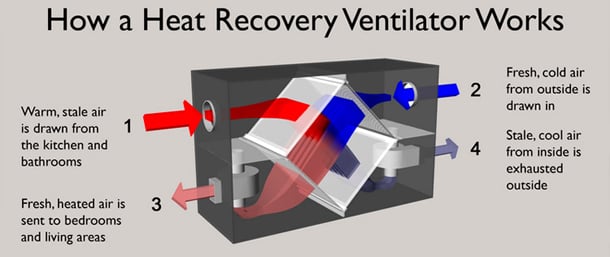
HRV is a component recommended by Passivhaus Institute.
The Passivhaus Institute therefore recommends a short list of strategies for achieving its standards. These include: high levels of insulation, reduction of thermal bridges, use of "energy-gain" windows and (shown above) a heat-recovery ventilator (HRV).
'Green building is Passivhaus'
"Forget Energy Star and LEED," the influential blog TreeHugger declared last year, "Green building is Passivhaus."
Among Europe's more than 25,000 certified Passivhaus buildings are homes, school, office buildings and a supermarket. And a growing number of local governments are incorporating variations of the Passivhaus standard into their building codes.
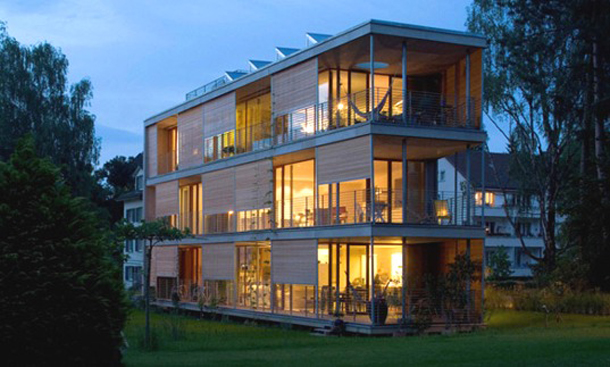
Swiss apartments, winner of 2010 Passivhaus architecture award.
The boxy first-generation Passivhaus buildings have evolved into elegant suburban apartment buildings such as the one shown above in Bern, Switzerland, and natural country homes such as this one in France.
Still on the boards is a Passivhaus tower in Austria. At 30 stories, it promises to become the tallest wooden building in the world.
The Passivhaus standard has taken root in the U.S. more recently.
Semantic confusion may partly explain the delay. Since the 1970s, the phrase "passive solar house" has been used in the U.S. and Canada to describe houses with extra thermal mass and big south-facing windows. Such homes are the antithesis of Passivhaus. Indeed, after decades of computer modeling and field monitoring, engineers at the Passivhaus Institute have concluded that passive solar design is far less significant than airtightness and insulation value. Nonetheless, aging advocates of that problematic design approach insist on using the terms interchangeably, thereby fostering confusion. The first building in the U.S. that aimed to meet Passivhaus standards was a home built by architect Katrin Klingenberg in Urbana, Illinois, in 2003. Klingenberg subsequently founded the nonprofit Passive House Institute US.
Klingenberg's houses are remarkably affordable, costing only about 10 per cent more to build than comparable code-minimum construction. "The real cost advantage occurs... when the standard HVAC system can be eliminated. It is then replaced by a smaller ventilation system, a so-called fresh-air furnace. This system's significantly reduced ductwork is used to deliver the remaining 10 per cent of heating and cooling needs."
Among the two-dozen-odd American Passivhaus projects are this Salt Lake City home, and this New York City office building.
Canada, on the other hand, has turned its back on the Saskatchewan Conservation House, in much the same way it abandoned the Avro Arrow and the TurboTrain.
There is only one certified Passivhaus in Canada. Click here to read all about it. ![]()


16
Login or register to post comments
mike eliason
1 year ago
PH in canada
there is one in whistler (the austria house)
there is one underway in toronto
there is a stunning one in planning for calgary plains.
and there are probably many more underway in BC, judging from the membership of their passivhaus group.
bfearn
1 year ago
Just goes to show...
that the average Canadian is more interested in flash than substance. While truly green homes like this have been ignored governments and citizens have built hundreds of thousands of buildings that are too big and selfish energy gluttons.
Our grandkids are going to pay for this foolishness big time.
freebear
1 year ago
Nothing new needs to be invented...
Everything needs to be rediscovered!
alive
1 year ago
Blame the architects!
So, what should we expect from architects who cannot make a watertight building?
Their problem is that they all want to create a "style" that can be identified as their trademark, instead of simply designing buildings that do the job that is required.
That again can be blamed on the laws that requires a new plan when for example we already have dozens of functional designs for schools, and no need to have some architects frills incorporated on the next one.
Originally an architects first obligation was to oversee how construction was happening, but now they never even show up at construction sites and their plans often are ambigious leaving room for mistakes.
Conductor274
1 year ago
Leadership required
Leadership is required before ideas like this will take hold and produce appreciable results. The government must provide this leadership and endorse this product and others that reduce our energy reliance and carbon footprint. Instead we have Prime Minister Harper and his far right wing agenda supporting the tar sands while ignoring environmentally friendly alternatives. At this point he's ready to climb into bed with China and sell them our dirty oil despite their human rights violations and lack of any environmental protection policies. He's a political prostitute who's trying to spin the dirty deed by calling it ethical oil.
edjahn
1 year ago
Ventilation/ air movement
Whenever I read stories like this about airtight super-insulated houses, I am left to wonder about ventilation and air movement. How can gases like radon and other problematic vapors escape? What approaches are being incorporated to balance air movement and ventilation with air-tightness and insulation value? How do builders strike a balance between these competing needs without defeating energy efficiency goals?
Snowrunner
1 year ago
Passive Houses
I think they are finally arriving.
A guy I know here in Vancouver is trying to build a "show community" in the Okanagen with pre-fab passive houses made in Austria.
The question is if most people will be willing to live in one though, there seem to be certain ideas on how a "Canadian Log Cabin" is supposed to look like and the initial investment is a bit higher than some lumber and cardboard.
bob the cat
1 year ago
promotion
Do I see socialism rearing its ugly head here?
The smell of....planning?
Wheres the two car garage? Whats with the lawn? Give that puppy some juice!
How do you promote envy with these rather sensible looking buildings?
I mean "passiv" haus?..c`mon ..passive is so
not happening now here.
I suppose the windows face south..or southeast..the old south facing schtick.
Mountain Girl
1 year ago
Whistler Passivhaus House
Indeed there was a PH built here in Whistler; built for the Austrian team during the 2010 Winter Olympics (by Austrians). It was built in Lost Lake Park with the condition that it was to be given to the resort town of Whistler after the games were all said and done. If you find yourself in our neck of the woods I implore you to take a tour. It is now home to a local cross country ski/mountain bike business and to WORCA (Whistler Off Road Cycling Association)and to a lovely cafe. It is a magnificent structure that is loved and appreciated by our community and the environment.
freebear
1 year ago
Related to Fritz the Cat, Bob?
Yeah they want to show off their 7000 square foot 'green' home and make others envious.
Funny when things are organized to make things better; you are accused of being a socialist!
Greg in Calgary
1 year ago
There were at least a couple of other super-insulated houses
built in the 70's, according to the Super-Insulated Retrofit Book, still a great guide to insulating existing homes, which most people will be living in for some time.
Bailey
1 year ago
Retrofitting
in general it seems a poor strategy to try to convert an existing dwelling to meet standards that it was never designed to meet. The process is always destructive of the synergistic flow the building was built to promote. Also, being a residence rather than a business which produces income, an expensive conversion is unlikely to ever pay for itself.
True, people will be living in existing inefficient homes for some time. But it's worth considering that people always do what they're given to do. If things like wall systems 18 inches thick were available on the market, at affordable prices, then people would use them without doubt or hesitation, in new construction.
If bathroom and kitchen equipment that actually meets high standards was not priced at a premium that amounts to multiples of the old stuff, people would use them too. Have you ever tried to buy a decent heat exchanger at Home Building supplies? Try it, and let us know how that goes.
It's treated like a novelty, no competition to the old standard materials, and priced like toys for the rich and super rich.
As long as that's true, no progress is possible. What we really lack to make this transition, or maybe transformation, is leadership.
Real, actual, not insane leadership.
Andor at Durfeld
1 year ago
Second Passive House in Whistler
The PH in Whistler was pre-fabricated in Austria and assembled by the Austrian builders assisted by Durfeld Constructors of Whistler BC. We at Durfeld are building a Passive House duplex in Whistler this spring/summer and are pre-fabricating the wall panels here in BC.
ASKBiblitz.com
1 year ago
B.C.'s marginally employable homebuilders v. Passivhaus
In a jurisdiction famous (infamous, really) for a decades-old leaky condo crisis that continues unabated, you can see why this Passivhaus business would never catch on.
In B.C., our failed housing economy works like this: Rezone everything including swamps and high-risk floodplain for multi-family housing but remove any incentive to build affordable, barrier-free social housing at a rate that reflects actual demographics. Encourage developers to partner with architects whose designs embrace the notion of planned obsolescence. Exclude anything resembling consumer protection from the legislation. Then dismantle the old building trades hierarchy that once required workers to actually learn the trades and pass hard exams. Send all that south and allow anyone who can lift a hard hat to set up with power tools and start right in interpreting blueprints, plumbing and electrical wiring. It's not that hard, right? Right? It's all good, eh? Hey, presto! Buildings that predictably leak, requiring major reconstruction about every five years. Those who bought never intending to live in the miserable places flip them to a steady supply of local suckers, who don't know what they've bought until it's too late. Hell, subsidize the repairs for awhile, anyway, with interest-free loans. Convoys of repair contractors' vans on every street create an illusion of full employment. Slap a complicated green roof or worse, a rooftop garden, on it and claim the building is 'green' and somehow sustainable.
Nothing as good as Passivhaus would ever get traction with the B.C. real estate hillbillies!
dave49
1 year ago
edjahn - Your concern about indoor air quality
Ed,
Do a little research and reading. We do not need 'new' solutions to your concern about indoor air quality.
Mechanical ventilation is now required by the BC Building Code. Energy-efficient homes use a version called a heat recovery ventilator (HRV) to ensure consistent ventilation and capture some of the heat in the air being exhausted.
Virtually every green building rating system devotes a significant part of their focus to indoor environment concerns and preventing problems.
Peter Stockdale
1 year ago
Saskatchewan insulated homes
I am convinced your article by Monte Paulson does not reflect reality. In the late 70s while living in Saskatoon I attended a short course given by Harold Orr on energy efficient (passive solar) heating. It was well attended and two friends of mine built these homes with advice from Mr Orr. After retirement I had a home built on these principles only to find to my chagrin that the low cloud typical of the Northern Okanagan didn't permit much passive solar heating. However the insulation and air tightness does mean that a house of 2000 square feet needs only just over a cord of wood for a winter. Oddly enough I have been told by recent emigrants from Germany that "passive solar" is one of their better ideas!