



 SHARE:
Tyee Interview »
Kathryn Gretsinger interviews Chris Wood about Fraser River flooding.
Subscribe: iTunes | More Tyee podcasts
There's an unseemly kind of satisfaction to saying, "I told you so." I'm hoping this week that I will be denied that satisfaction, but the odds are leaning unnervingly the other way.
Last August, I led off a series of investigative reports for The Tyee on the subject of climate change by revealing the existence of a study which had found alarming flaws in the flood defences along the lower Fraser River. The second installment of that series imagined a combination of climate-change-driven extreme weather and forest loss in the interior that unleashed a catastrophic flood on an unprepared lower mainland -- in 2011.
I may have been off by only four years.
Not every element of the scenario I painted has come true by any means, but an unusually wet winter, consistent with what climate scientists predict will become more common in our future, has piled up a near-record spring snow pack in the central interior. The water contained in that snow now threatens to submerge significant portions of the most densely populated region in B.C., the source of nearly one-tenth of Canada's gross national product.
Rush job
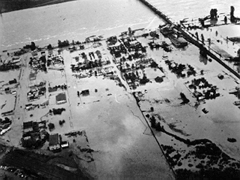
In response, and with an urgency sharpened by the discovery that many dikes along the lower Fraser River are (or were, as of the beginning of the year) as much as a metre too low to offer adequate protection against a repetition of the "flood of record," the provincial and federal governments have opened the funding tap to raise the region's defences. Round-the-clock work was targeted for completion by May 15, hopefully ensuring that the most critical low spots have been brought at least up to the height necessary to contain any recurrence of the devastating floods of 1894 and 1948.
The effort is welcome and doubtless justified in the short term. Even so, images come to mind of little Dutch boys with extended fingers. For several reasons, the expense of more than $30 million dollars is a good deal less than reassuring.
There is, first, the nature of the work that's been rushed to completion. Much of it was directed at installing "rip-rap" shielding -- broken rock or cement, often caged in wire netting -- along dike faces and stretches of riverbank that are vulnerable to erosion. This is useful to a point: it helps prevent dikes being breached by strong currents and may protect roads and pipelines that follow the river from being washed away. But by itself it doesn't raise the height of the newly shielded dikes -- or the flood protection they offer.
If the river rises high enough, it will overtop the dike regardless of how much rip-rap has been installed.
Rushed repairs, moreover, are seldom as durable or effective as well-planned construction. "It was a scramble," says hydraulic engineer Adrian Chantler, a managing partner at the Vancouver firm of HAY and Company, which has consulted for a number of First Nations with territories along the river. "When it's done in a panic, they usually just drop rock over the bank. In a couple of cases it's actually been too late to do the work: the river's already come up, for instance at Peter Island."
In other cases, the dikes have been raised using sandbags, cement lock-blocks, or large wire baskets lined with heavy fabric and filled with sand. Again, these will hopefully be effective when the river peaks this spring -- but they're temporary measures. The money that's been spent on them will simply have to be spent again to contain any future high spring freshets.
Sustainable solutions
As Adrian Chantler put it: "It's not a good way to go to react as a knee-jerk and come up with a bunch of band-aids. We really need a longer term, more sustained effort."
That could take the form of a multi-year program to bring every dike from Hope to Sea Island above the level that might be reached by future freshets (or, in the case of dikes around Richmond, storm surges in the Georgia Strait).
After years of neglecting the flood threat and pushing responsibility for dike maintenance down to municipalities and regional diking districts, the province may be forced by this year's alarm to institute just such a program. But it won't come cheaply: figure about $2,000 a linear metre to bring the Lower Mainland's dikes up to scratch, with Delta alone counting some 60 kilometres of dikes (although not every dike needs upgrading along its entire length). The price tag quickly runs into hundreds of millions of dollars.
But worth every penny, surely -- if it saves the Lower Mainland from a catastrophic flood.
Well, perhaps not. No matter how conscientiously constructed, dikes have inherent shortcomings as a strategy to contain rivers in flood.
Dike side-effects
Dikes confine floodwaters into a narrow channel. As a matter of physics that has several consequences. The confined current flows faster, for one thing, increasing its scouring effect both on the river bottom and its banks. That harms aquatic habitat along the floor of the river and increases the likelihood that the current will find and expose any weakness in the dike defences. Prevented from spreading out sideways, the water also rises higher -- requiring a corresponding height of dikes to contain it. For both reasons, if a dike does then fail, the throttled river pours through the breach with far greater force, quickly opening it wider.
Both effects were blamed for contributing to hundreds of dike failures along the upper Mississippi River that resulted in that river's worst flood on record in 1993. In that instance, once the river water had breached the levees (as they call dikes in the central U.S.), remaining stretches of intact dike prevented water from draining back into the river's natural bed—prolonging the inundation.
Then there are longer-term and less obvious consequences of relying on dikes. One is psychological: the impression of safety they provide may encourage development in the 'protected' areas behind them that will be under water should they fail. Another is ecological: such hardened river banks have nothing in common with natural riparian habitat, whose plant and animal communities are adapted to -- and often depend on -- being occasionally submerged.
Yet a third long-term consequence of a strategy of diking has again to do with physics. The Fraser River carries huge volumes of silt and gravel down from the interior. When the river reaches its natural delta in the Lower Mainland, it slows down, dropping much of that material to the riverbed (the reason why the delta exists at all). Even allowing for the acceleration of the confined current, the same thing happens between diked riverbanks. With each passing year, the riverbed rises -- pushing up the river's surface by a corresponding measure. (Along the lower stretches of China's Yellow River, this effect has actually raised the riverbed above the level of the surrounding countryside).
That in turn presents communities along the river with two almost equally unpalatable alternatives: keep on raising their dikes ever higher in an effort to keep up with the rising river bed -- or dredge out millions of tons of gravel and silt at vast cost and further devastating effect on aquatic habitat.
Cross your fingers
With luck, the next few weeks won't put the recent dike repairs to the test. Pray for summer to hold off. A long, cool and generally dry spring will give the snow still in the mountains (80-85 per cent of the winter's total accumulation is still on the slopes) time to melt gradually. The threatening alternative is for a sudden turn in the weather followed by two or three weeks of above-average heat that melts the snow quickly and sends it rushing downriver. Worse yet would be a heat-wave broken by a day or so of heavy rain in the central interior.
Regardless of what the next four weeks bring, the longer-range climate forecast tells us that we dare not let the sense of urgency that prompted the recent emergency repairs lapse once the imminent threat has passed. The record of recent years and the prediction of climate models warn us to expect more winters with heavy snow accumulation and more abrupt shifts from cool temperatures to hot, with a rising risk of heavy spring rain topping off the flood hazard.
Whether that means we also need more, higher, or stronger dikes may be another matter. Even the Dutch have recently begun to rethink that strategy. I'll take a look at some alternatives in a future report.
Related Tyee stories:
- Fraser River Will Surge over Dikes, Experts Find
Study predicts 'multiple dike failures.' But government has cut warning system. - The Coming Catastrophe
Fail to fortify Fraser dikes, and BC could wake up to a weather nightmare. - Billion-Dollar Development Planned for Flood-Prone Shore
Homework will be done says Mission mayor.
![[Tyee]](/design-article.thetyee.ca/ui/img/yellowblob.png)
Read more: Podcasts







Tyee Commenting Guidelines
Comments that violate guidelines risk being deleted, and violations may result in a temporary or permanent user ban. Maintain the spirit of good conversation to stay in the discussion.
*Please note The Tyee is not a forum for spreading misinformation about COVID-19, denying its existence or minimizing its risk to public health.
Do:
Do not: