
Island is worse off without Aristide, and Canada shares blame.
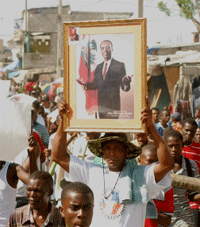
Aristide supporters in final days.
- Damming the Flood: Haiti, Aristide and the Politics of Containment
- Peter Hallward
- Verso (2008)
Four years ago this month, Canada supported a discreditable act of regime-change in Haiti -- a chain of events that ended with the removal of a legitimate head of state. It's a useful incident to remember as politicians and military men put on their most earnest faces to justify Canadians dying for freedom and democracy in Afghanistan.
Here is what's happening in that re-configured Haiti today:
- According to the United Nations, half of all the young women in the country's shantytowns have been raped or sexually assaulted. At least a third of them are under 13.
- Haiti's National Penitentiary has 3,200 inmates. It was built to hold 1,200. Many prisoners are held for months, even years, and only a tiny percentage are ever convicted. Some jails are so crowded that prisoners must sleep standing up or in shifts.
- Some Haitians, mainly pregnant women, are so hungry and under-nourished that they eat "mud pies" made mostly of clay, salt and vegetable shortening.
- Recently, mobs attacked two suspected kidnappers in Port-au-Prince, the capital, and stoned one of them to death. Vigilante justice is not unusual because authorities are powerless to prevent kidnappings. In the first 11 days of February alone, there were 15 abductions.
- Last August, a noted Haitian human rights activist, Lovinsky Pierre-Antoine, met with a U.S. delegation. After the meeting, he was kidnapped, and nothing has been heard of him since.
- Keeping the alleged "peace" are 9,000 foreign troops and policemen. In the eyes of some critics, they've become a permanent fixture. The monthly health-care bill for this UN contingent is greater than the annual health budget for Haiti's 8.7 million people!
- Meanwhile, Haiti's most popular politician by far remains in exile thousands of miles away, and Canada, along with other countries, is actively lobbying to keep him there indefinitely, a violation of Haiti's constitution.
Canada has never revealed its full role in the ousting of President Jean-Bertrand Aristide. The sins of commission (or omission) happened below the radar. Thus, Canada can argue that it is blameless in the continuing deterioration of the Haitian economy. It can point to the aid money it spends on Haiti -- more foreign aid, in fact, than any country except Afghanistan. We have police there; we're helping with the justice system; we're supporting social programs.
Setting the stage for an ouster
The truth is that Canada helped set the stage for Aristide's removal, and one can make the case that the social dislocation caused by his departure cannot be fixed until he is back on Haitian soil. Right or wrong, Aristide and the political movement he represents are still at the core of Haiti's aspirations. Twice, in 1990 and in 2000, he was elected by overwhelming margins. Twice he was removed from office, and the masses who voted for him were effectively disenfranchised.
It begs the question: How is it that our government can have "constructive engagement" with a never-elected Fidel Castro, but not with a popular leader who respects the ballot box?
The story of the last Aristide "coup" is worth retelling:
On the morning of Feb. 29, 2004, in a scenario many believe was choreographed by the U.S., France and Canada, Jean-Bertrand Aristide and his wife fled Haiti on a private jet. It was made to look like an abdication: A president running away as the country teetered on the edge of catastrophe.
But it was more than that. In fact, Aristide was told in the middle of the night if he didn't leave, and right away, Port-au-Prince would be convulsed in a bloodbath. American officials told him that he, his family, and thousands of Haitians were in imminent peril. So in the early morning hours, under armed guard, and quite probably seized by panic, Aristide signed a resignation letter, boarded a waiting jet and was flown to exile in Africa. Canadian Special Forces troops were on duty at the airport, part of what Aristide would later call "an illegal foreign occupation which was ready to drop bodies on the ground."
Cutthroats and sweatshop owners
I happened to be in Haiti in February 2004 and I met some of the people who were said to be ready to instigate this "bloodbath." They were anything but a realistic military threat. In fact, they were a pack of swaggering, well-armed cutthroats who had had some success terrorizing villages and killing policemen in the Haitian countryside, and who were slowly approaching the capital. Their leader was Guy Philippe, an ex-policeman trained in right-wing counter-insurgency. His deputy was a notorious right-wing killer, Louis-Jodel Chamblain, suddenly thrust into the international limelight. (Rumor had it that the guns and spending money for this ragtag rebel "army" came, circuitously, from the U.S. government.)
Complicating matters in the capital city, Port-au-Prince, was a growing "peaceful" opposition to Aristide led by Haiti's bourgeois elite -- the sweatshop owners like Andre Apaid. Apaid was a high-strung colorful character. When reporters came to visit, he would rattle a glass jar full of machine-gun bullet shells on his desk. "Look," he would say. "These bullets were fired just outside my office window by Aristide's hired guns." True or not, it made for great television and served the narrative of a president losing control.
Apaid and his business colleagues -- part of an organization called The Group of 184 -- hated Aristide. They called him a dangerous hypocrite and demagogue. But what they hated most was Aristide's determination to double Haiti's minimum wage, and to resist the privatization of Haitian industries. Simply put, Aristide stood between them, and unlimited plunder. And while Aristide, his back to the wall, was ready to compromise, they resisted all calls for power-sharing.
This convenient convergence of anti-Aristide rebels and robber barons gave Washington (along with Canada and France) the pretext to shoehorn the president and 7,000 other officials out of office. The three governments would have to hold their noses and make common cause with scoundrels. And that's exactly what happened.
Visit with Aristide
I visited Aristide in the National Palace 11 days before his overthrow. On the wall hung a portrait of Toussaint l'Ouverture, the father of Haitian independence. Near his desk sat a bust of Robert Kennedy. Both men had died violently. Aristide liked to surround himself with the icons of idealistic struggle. In our interview, he was clearly nervous about what might happen if the paramilitaries -- he called them "terrorists" -- tried to enter the capital. He didn't seem to be aware that much larger forces were arrayed against him. In asking for help from his "friends," including Canada, Aristide believed that a small complement of well-armed peacekeepers, even a few dozen, would be enough to keep the rebels at bay.
But Washington and Ottawa had other plans. With Aristide gone, their formula for "fixing" the Haitian economy would be much easier to implement. And his removal, they thought, would bring calm to the streets of Haiti during an uneasy time.
As we now know, the exact opposite happened. Haiti slipped deeper into chaos. According to the respected British magazine Lancet, in the 18 months that followed Aristide's expulsion, an estimated 8,000 Haitians were killed in violence -- at least half of them by the paramilitaries who leapt in to fill the political vacuum. Aristide's slum supporters, dismayed at the sudden departure of their leader, also cranked up the violence. It took 9,000 peacekeepers to bring some order to the streets. And they're still there. Four years later.
From his exile at a university in Pretoria, South Africa, Aristide told writer Naomi Klein that Canada has "blood on its hands" for its part in his overthrow.
Dangerous 'fake democracy'
Even today, the country we helped "liberate" from Aristide is listed, by Forbes magazine, as one of the most dangerous destinations in the world, along with Somalia and the Congo. Haitian journalist Wadner Pierre calls it a "fake democracy" -- a country that serves only the interests of a small bourgeois elite. "Today," Pierre writes, "we must eat dirt to let the mansions grow . . . Pregnant women eat mud cookies."
Clearly, something happened on the way to nation-building!
Why did Aristide have to go? It's simple, says Peter Hallward, the author of a dense and meticulously researched new book called Damming the Flood: Haiti, Aristide and the Politics of Containment. Aristide had to go because "the movement he led (Lavalas, the Creole word for 'flood,') posed an intolerable threat to Haiti's comfortable ruling class."
Haiti's poor have been raped, plundered, trodden underfoot, exploited, lied to and cheated almost without surcease since 1804 when they defeated Napoleon's army to become the world's first black republic. Lavalas, says Hallward, gave Haiti's poor an historic opportunity to get off their knees. After 200 years, they had finally found a political voice. But that didn't fit in with Washington's hemispheric plans.
Canada's Liberal government, still doing penance for not joining the U.S. military adventure in Iraq, was happy to lend its support. Along with many of the 80,000 Haitians living in Canada, official Ottawa was displeased with Aristide, saw him as corrupt and increasingly dictatorial, and believed he could never reconcile the various levels of Haitian society. (As Hallward points out, Aristide's so-called "dictatorial" behavior was the result in no small part of an aid embargo, again the work of Washington and Ottawa, that made it near impossible to lift Haiti from the economic trough.) Because of his massive popularity among Haiti's poor, however, the Canadian and American governments realized there was no legitimate way to remove him.
Ottawa's stony silence
Five months ago, I submitted Freedom of Information requests to both Foreign Affairs and the Department of Defense in Ottawa, asking: What, and why? What role did Canada play in the planning and the execution of Aristide's demise? And why would we dirty our hands, and risk alienating millions of Haitians who voted for Aristide time and time again? Ottawa hasn't offered any answers yet.
In Damming the Flood, Hallward, a British academic, puts Feb. 29, 2004, in stark terms: "The effort to weaken, demoralize and then overthrow Lavalas in the first years of the twenty-first century was perhaps the most successful exercise of neo-imperial sabotage since the toppling of Nicaragua's Sandinistas in 1990."
Strong language. Little wonder the Canadian government would rather the whole sorry affair be forgotten. But 8.7 million Haitians deserve better. Theirs is a history of more than 30 successive coups d'etat over two centuries. Aristide and Lavalas broke the depressing pattern, and opened the door to real representative government. They, the Haitian people's voice, deserve a chance to govern.
Claude Adams is a freelance journalist and videographer who has followed Haitian affairs since 1987. He can be reached at adams.claude@gmail.com.
40
Login or register to post comments
Canis Latrans
5 years ago
Bootlick Canada
Just one more example of this country's role as Amerika's bum-boy bootlick. And the main point to be made is, when you walk about the world with your head up someone's butt that far, a) you don't really see or understand the outside world that is taking shape too well, b) and you have to follow wherever they lead you.
And, of course, despite your best efforts to look cool, everyone really knows what your doing down there. You can maybe fool yourself there in the dank dark, but everyone else KNOWWWWS.
Time to unstuck this country, and bring it out into the real light of day.
Frank
5 years ago
Aristide
Canada's contribution in removing Aristide was shameful. I couldn't understand it at the time and I still don't.
ME2
5 years ago
Forget the Newspeak.
What the article doesn't mention is that Aristide is - oh hated word! - a Socialist.
G West
5 years ago
Just another example of why
Just another example of why those who suggest there's any difference between the Liberals and the Conservatives are whistling on the way to the graveyard.
I'd like to see some of Canada's 'journalists'
confront both Paul Martin and Stephen Harper with their involvement - then and now - with perpetuating the situation in Haiti.
I'd also like to hear Michaëlle Jean's take on what's happened (and happening) in her natal land right now....
realisticman
5 years ago
"Harper's Involvement?
then and now". Harper wasn't in government then and now The Conservatives are trying to help.
JEREMIE, Haiti–Canada will build a new road connecting this isolated town with the rest of the country, using some of the $550 million Canada has pledged in aid for the coming years, Foreign Minister Maxime Bernier said Friday.
The funds, to be paid over the next five years, were earmarked to help build roads, police precincts and implement social and economic programs in the Western Hemisphere's poorest country, Bernier told reporters.
G West
5 years ago
sorry, no cigar
Ww're still there; propping up the thugs - or hadn't you noticed?
Harper and the con men are as much a part of this shameful episode as the Libs were.
You can''t be part of this tar baby operation without getting dirty.
Canis Latrans
5 years ago
Hated???
Oh, I don't think so. It doesn't bother me in the least, and there are many "socialist" governments of various degrees and hues in the world.
Mostly it's simply a hated word amongst the ruling classes of the world-, because it suggests other class interests than just their own-, which drives them wild with fear and loathing.
Like both of us have said before, there is only one real economy interface with nature. The issue is, who owns and controls it? Whose interests is it going to be shaped to serve? The greed interests of a small capitalist class, or those broader social interests of the working class citizenry and their communities, taking into account the sustainability needs of the natural systems of the planet.
It is the small ruling class of capitalism and those who identify their interests with and slavishly serve it who whine that capitalism is the only one true path. Whereas others of us take the position, it is but one of the possible ways of managing and directing this economy. Capitalism is the historically evolved elitist's choice. Then there is as well the unimaginative and gullible of course; the followers.
As for the rest of us, whatever labels get hung on us, be we large or small in number, it is our right to challenge the limitations of this presumption, for nothing lasts forever, and to seek to create a more viable and egalitarian model-, even over the protests and whining of the fearful status quo.
asher
5 years ago
Canadian NGOs in Haiti
The overthrow of the democratic government in Haiti with the aid of CIDA makes me think that CIDA is little better than US AID - a nest of spies and covert action for perpetual war.
The NGOs that take CIDA's money are no better.
Here's a link to the a Canadian Haiti Solidarity group...
http://www.thac.ca/
Clawman
5 years ago
a little over the top
Tying CIDA to "perpetual war" is a little strong. Road-building and social programs hardly qualify as aggression, and the NGOs usually have the best intentions--even if their work does sometimes get tangled up in government policy . . .
I wrote the article, by the way, and I've come into contact with enough NGOs there to say that they are, for the most part, doing noble work under extreme conditions.
G West
5 years ago
what's over the top, in my view
is the suggestion that 'road-building' has much to do with vital development from the point of view of the majority of the Haitian people.
As a matter of fact, that kind of infrastructure is the last thing they need - it simply makes it easier for the thugs to keep the people in check.
Haiti is a Canadian embarrassment - among many others!
We have RCMP officers there training their police...I'll bet it's not in Taser usage either.
The title is apt.
Clawman
5 years ago
Roads
Haitians will disagree that good roads are the "last thing they need." In fact, they talk about it constantly. Buses, bikes and tap-taps are extremely important for commerce, and potholed, washed out roads are devastating to local economies.
Here's what one Haiti development person blogged recently:
"The lack of infrastucture has affected people's ability to do business, seek health care, visit relatives, and to travel in general. But there is good news - For the first time in a long while progress is being made on Haiti's road system.
"I remember that in 2000 I saw people wearing shirts that said "Wout se devlopman - Mesi Preval!" (roads are development, thank you Preval!) to commemorate the paving of most of the stretch from Cap Haitian down into the Artibonite."
Canis Latrans
5 years ago
It matters not a whit...
the good intentions NGOs and others in the occupying force, there playing the same essential role in Haiti as the invasion forces in Afghanistan-, however it attempts to be masked by "good works".
Aristide is gone because he did not fit in with US Empire plans for that part of the world. He was not sufficiently bent at the knee to them, and the old corrupt ruling class of Haiti wanted him gone, regardless of whether or not he was duly "democratically" elected to his office. Which he was, of course.
It is not about democracy, or really serving the lives of the average citizenry. Were that the case, starting with Saudi Arabia, there is many a right wing/monarchist dictatorship which The Empire props up in the world that would be gone. It is about making the world safe for Amerikan power.
And as part of that primary objective, of course, working to put a noble face on it through collaborative NGOs or whatever, again as in Afghanistan or Haiti. And were they truly concerned about "the rights of women", for example, Saudi Arabia would now already be under US Empire occupation. (US women suffer enough poverty and oppression, and the degradation of prostitution, even daily murder on the streets.)
Better the US Empire and this sorry ass excuse for a country turn their attention and dollars to clearing up the issues of poverty, and improving the lives of ordinary citizens here, on our own territory-, starting with a few Native reserves known to me. Not likely though, eh. Were too busy doing good, blood spilling works in other, poorer and weakers people's countries.
Amerika's imperialist ambition bloodlust has been up, and this country's toadying up to it, for as long as I've been around.
The road to Hell really is paved with phony, apologist good intentions. Check the four laner in such as Haiti and throughout the Middle East, starting out maybe in poor Iraq, another noble cause to end the world of weapons of mass destruction. (When really, what the world's people need to do, is bring under control Amerika's weapons of mass destruction-, then maybe folks could resolve their own issues without all this goddamned armed interference that is really killing them. And there ain't no doubt about whether or not Amerika is nuclear armed to the teeth, and in possession of all other manner of WMD, none of which they hesitate to use.)
Bomb, strafe , laser bomb, then bring in the New NGO Priesthood rationalize it and convert the natives with their prayers and good works.
Crap by any other name is crap just the same.
BC Mary
5 years ago
Road-builders in Haiti
Are road-builders in Haiti any different from big rich contractors in, like, Iraq? I doubt it.
So it means that a modicum of road-building gets done and a maximum of graft and corruption goes on.
Who exactly are those road-building mercenaries down there?
Frank
5 years ago
realisticman
Even those smart grade 5's know that Harper has been the PM of Canada for two years.
Fortunately for those not up on who's in power we have Wiki
http://en.wikipedia.org/wiki/Canadian_federal_election,_2006
Oh, and the definition of "now" pretty much means the guy in charge today and the last 2 years.
Let me know if you need more links to help you with any news you've missed since 2005.
G West
5 years ago
Well BC Holmes
I don't for a moment want to put down your experience in Haiti and I'm sure there are businessmen (as well as police and paras) who'd like a network of new roads.
But, given the following data, I think maybe I'll stick with my original opinion:
Haiti is an extreme case of social and economic collapse. Of the 177 countries listed in the UNDP human development index, Haiti ranks 153rd. The World Bank includes it in the list of fragile states, while the International Crisis Group expresses its concern at the social crisis which has the potential to destabilize the Caribbean region. 80% of Haiti's 8.4 million inhabitants live below the poverty line. The disparity of income and wealth, the lack of social security, the deterioration of basic services (health, education), an 80% unemployment rate, serious shortcomings in security and deficient governance are factors that explain the political instability, the vulnerability of the population and the general lack of prospects.
The health situation in Haiti is alarming. The high prevalence of tuberculosis, gastric ailments, and HIV/AIDS, among other diseases, is due to a large extent to the lack of access to clean drinking water and serious shortcomings in hygiene and prevention. The education system, largely privatized, has steadily deteriorated over the past 25 years, with only 67% of children in full-time education in 2002. The poor performance of agricultural production and the shortcomings of the water distribution system due to deforestation are compounded by the increased risk of natural disasters, which caused thousands of deaths, tremendous damage to the infrastructure and destroyed many houses in 2004.
G West
5 years ago
I should have mentioned one other thing
per capita GDP in Haiti is $450.00(US) per year; but 78% of the population subsists on less than $2/US per day while life expectancy is just over 50 years.
I'd say roads are WAYYYYYYYY up the list of things Haiti needs.
realisticman
5 years ago
Frank
As you may notice, if you check Wikipedia, Aristide was deposed on Feb. 29, 2004.
The question at hand was regarding the suggested removal of Aristide who was in fact long gone before Stephen Harper became Prime Minister of Canada and we can be fairly certain that he and Paul Martin did not confer on this issue.
As Michaelle Jean said in May 2006, three months after Stephen Harper became Prime Minister of Canada:
(Governor-General Michaelle Jean arrived in the land of her birth yesterday, bearing a message of hope and a pledge that Canada will help rebuild the troubled country.)
But that will take time, she warned.
"You cannot come out of decades of dictatorship and expect that things will change from one day to another. It takes time, and we have to support Haiti with a real will to see things change in this country.
"This country really deserves it. The people do deserve it."
(Hydro-Quebec has been providing technical assistance for electricity production, distribution and marketing in Jacmel, and Jean said she would like to see more projects like that in other parts of Haiti.)
"Do you know what it means in terms of development for a country to have that energy to make industries work, to allow hospitals to work at full capacity?"
Canada also can help Haiti develop a stable government and better justice system, Jean said."
"Canada will be a leading partner in rebuilding Haiti. We hope to foster harmony in this country, strong governance and economic recovery.
We also want to ensure that help reaches the people of Haiti, particularly in key sectors such as security, health and education, as well as respect for basic rights.
Bolstered by the unwavering friendship that binds them—and is so apparent here this evening—Haiti and Canada will continue to work together, hand in hand, in the interest of the greater good and to build a better future."
Clearly the recently announced assistance has the support of our Haiti-born Governor General and our government should be commended.
I hope this helps you understand the chronology and explains Michaelle Jean's opinion for GWest, who earlier asked a rhetorical question.
G West
5 years ago
Sorry nightbloom I don't believe a word of it
I think Frank knows the chronology quite well.
Canada's attitudes toward Haiti haven't changed. We’re every bit as compromised now as we ever were – still doing the bidding of the US and France.
If we’d wanted to, Harper could have invested the billions he’s squandered in Afghanistan to help a country of less than 9 million people overcome their problems. The 139 million he burned up shipping antique tanks to Afghanistan would have been a nice start – and no one can claim that thick-headed move came from Martin.
When a Canadian Forces Airbus arrives to return Aristide and his family to the island I'll believe that we actually give a shit about anything except cozying up to our American cousins and our French ancestors.
In the meantime, I don't believe for a minute that those words from the Governor-General were anything but tongue in cheek and pathetic dreaming. Probably written for her by the PMO.
No matter how you slice it up, Stephen Harper has proved to be just as bad and every bit as compromised as Paul Martin (who appointed Jean) ever was.
Just like our involvement in Afghanistan, which Harper pretended to criticize before he became prime minister, he adopted the dance card in Haiti without so much as a second thought. Exactly the kind of thing you’d expect from a pee wee Rambo.
And if you don’t think that’s a fact, then cast your mind back to that little drama on another Canadian Forces Airbus when the PM and his wife played host to a few dozen Lebanese-Canadians trying to return to Canada to avoid a little Israeli/Hezbollah unpleasantness. The man hasn’t an honest sincere bone in his increasingly overweight body.
As a nation we don't even TALK a good game anymore. Something happens when your chief military officer stoops to references like 'kicking some scumbag ass'...people stop taking anything you do or say seriously.
Funny that!
Frank
5 years ago
realisticman
Still having trouble with your use of the term "then and now" I see?
Here's how the word "now" is defined :
Let me know if you need any more help with that.
Frank
5 years ago
realisticman
Did you notice the reception Michelle Jean got in the land she's the head of state in from right-wingers that don't like a non-white head of state?
http://www.theglobeandmail.com/servlet/Page/document/v5/content/subscribe?user_URL=http://www.theglobeandmail.com%2Fservlet%2FArticleNews%2FTPStory%2FLAC%2F20050829%2FNATS29-1%2FTPNational%2FBriefs&ord=15186279&brand=theglobeandmail&force_login=true
Those Free Dominion guys eh?
Clawman
5 years ago
Roads, continued
Wow, there is some serious cynicism on this site! Roads in Haiti create jobs, access to health and markets, mobility, small business opportunity. . . . the list goes on. Yeah sure, there is graft, patronage, and all the rest, but when the small farmer can't get to market with his corn because of a washout, his family doesn't eat. If the tap-tap can't get his kid to the clinic, the kid may die. . . . A road is nothing more than a basic piece of infrastructure. Let's focus on the real problems in Haiti--security, AIDs, deforestation, no jobs, no judiciary . . .
Frank
5 years ago
The Roman Empire
In history, roads were built to control a region. Its harder to bend people to your will if you can reach them only by wading through bush on foot.
Roads can be great things too, but only when you're not scared of what might use it.
ME2
5 years ago
Yup, we got our history all wrong.
Well, Clawman, I guess it just boils down to choosing between being a cynic or a Pollyanna.
Please write an article soon detailing how the US-supported Duvalier was just a good guy who got bad press from us Commies.
G West
5 years ago
Apologies to nightbloom
Sorry my friend, those remarks above were meant for realisticman - I have no idea what YOU thing of this situation.
As for you realisticman, The remarks were addressed to you - obviously - I hope you take the time to read them.
And Clawman, it's not cynicism - it is actually looking at the situation on the ground and applying some critical analysis to the never-ending smorgasbord of spin that the government (and most NGOs) serve up on a regular basis.
I'd surprised you'd be so easily taken in.
G West
5 years ago
errata
That should be 'I'm surprised you'd be so easily taken in.'
I'll be checking my posts more closely from now on - unfortunately I've been extremely busy of late and I always seem to be in a rush...
Canis Latrans
5 years ago
Wow!!!
Wow, there is some serious cynicism on this site! wrote the Clawman.
Welllll, that or serious realists. Funny how each can be taken for one or the other-, especially to faith based true believers in the status quo. :-)
Clawman
5 years ago
Corrosive cynicism
You guys make me think of Mencken's cynic, who smells a flower, and immediately looks around for a coffin. And who eventually, on the eighth try, DOES find a coffin, and counts it a victory . . .
G West
5 years ago
Coffins probably aren't that hard to find in Haiti
There aren't any victories yet on this file, sorry clawman.
You might care to look at the condition of the populace on a nearby Caribbean Island that hasn't had ANY help from the US of A for half a century.....
Anyone who doesn't see the disconnect between the two – the one where the US ‘yoke’ was successfully thrown off and the other where it’s still in place and cutting very deep would be worse than cynical - in my view.
Canis Latrans
5 years ago
Deadly cut, GW
Ooooo! A really insightful and to the point observation, West. Wish I'd said that. :-)
Indeed, The Empire has done just about everything it possibly could, over these last fifty years or so, to reduce Cuba to the level and status of a Haiti. And but for a resilient and creative people and leadership, they might have succeeded.
They are the one time, to this point in time anyway, that Amerika's predilection for invading and crushing smaller and weaker countries, reducing them to rubble, hasn't succeeded.
Viva Cuba.
Had Canada half the cajones.
Clawman
5 years ago
Okay . . .
. . . how about a f'instance?
Oh, any by the way, we're still talking about the Canadians building a road here, not about a US 'yoke' even though you insist on conflating them. (I am just as critical as you of the sins of modern imperialism in Haiti and elsewhere; I just think that seeing everything in the undeveloped world through a Manichean lens--as so many on this site do-- is lazy, sour, unimaginative, effortless and ultimately unhelpful.)
Now I've used up all my adjectives and adverbs, I will retreat from this thread . . .
Joe Emersberger
5 years ago
sorry about typos [edited below]
CIDA paid the salary of Philippe Vixamar, deputy Minister of Justice under the Latortue dictatorship, where he helped fill Haiti's prisoners with political prisoners.
CIDA also financed RNDDH - a bogus human rights group that would feed allegations to the government which would then use those allegations to imprison opponents.
NGOs that received CIDA funds reliably parroted the line of the Canadian government and RNDDH, Plenty of detail about all of this in the book Canada and Haiti by Yves Engler and Anthony Fenton.
NGOs undertake some useful projects and deliver some needed services but at an exorbitant price. Aside from being very compromised politically they are horrifically inefficient. Peter Hallward points out in his book (that the Claude Adams article was about) that Haiti has more NGOs operating within its borders, per capita, than any country in the world! Amrtya Sen made similar observations about NGOs in Africa in his book "Hunger and Public Action".
With rare exceptions NGOs don't deliver the goods efficiently and, as should be common knowledge by now, can't even be relied upon to object to a murderous coup.
Canis Latrans
5 years ago
Sophistries
Plain and honest talk, striking to the heart of matters, over intellectual sophistry, is my own preference.
Appreciate your comment above, Joe Emersberger.
Clawman
5 years ago
NGOs and efficiency
You make a point, Joe, but do we really expect NGOs to operate "efficiently" in failed states, where there is little or no infrastructure to begin with? It's a cruel fact that sometimes, as in the case of Somalia, as little as 10 per cent of food aid got to the people who needed it. There was loss and corruption very step of the way. Do you stop the aid because the "tax" is too high? At what point do you decide that starvation is an option?
In Haiti, extraordinary people like Paul Farmer find a way around the roadblocks, but the price is high. And Farmer, as you know, objected to the murderous coup, along with other NGOs which were not anti-Aristide and found themselves out in the cold.
ME2
5 years ago
Is there a "black and white" in Haiti?
At the beginning of these comments Frank wondered:
"Canada's contribution in removing Aristide was shameful. I couldn't understand it at the time and I still don't."
What cannot be escaped is that the very last thing leadership in the "Free World" wants to see is a replay of what happened in Nicaragua under the Sandanistas. If that means Haitians starve, so be it.
The parallels are eerily - to some - to others, predictably - similar.
Haiti, prior to the revolution, was ruled by a tyrannical despot, Duvalier, aided by his bestial police, the Tonton Macoute for whom no excess was barred. He was an "ally" of the US.
Prior to its revolution, Nicaragua was ruled by an equally tyrranical Samosa, who employed the exact same type of policing with his National Guard. He too was an ally of the US.
The leaders of both revolutions against these men, Ortega and Aristides, are Catholic priests who have embraced a Christian version of Marxism called "Liberation Theology". Its basic premise is that Christianity is pretty diffiult to practice if adherents are forced by extreme poverty to steal, prostitute and so on in order to feed their families.
Thus the key platform of both Aristides and Ortega was Land Reform, anathema to US-backed Corporate farmers and other wealthy Haitian elites.
And you can bet that the Catholic Church, very powerful in the US, France, and Canada, having its hatred of Socialism - not to mention Marxism - has pulled lots of political strings too.
And so killing other Christians did not stop fundamentalist Catholics and Protestants from joining in the massacres US financed "Contras" waged on Nicaraguan peasant "communist sympathesisers" of Ortega. Nor did it stop the Christian Bush from rearming and financing the Tonton Macoute who bloodily overthrew the democratically elected Aristides.
Since Cuba escaped Battista's tyranny and managed to stay that way, the US was not about to see that happen again in Nicaragua or Haiti.
And if the world (and esp S America) wasn't now wise to US tricks and wasn't watching so carefully, the US would have invaded Venezuela a long time ago, though it hasn't stopped their efforts at "destabilisation", using graduates from their School of the Americas.
It is interesting to note that Venezuela's Chavez, a Catholic, is also a Liberation Theologist.
So for now, Haiti's population of desperately poor will have to wait until the NGOs et al make Haiti safe for Free Enterprise with a US-installed gov't, and be content to sell their children (yes literally) into slavery in the Dominican Republic where US-sanctioned Free Enterprise reigns, doing so partly in the hope for a "better life" for them.
If seeing things that way makes me a Manichean, then I guess I've just joined up.
James Burns
5 years ago
The joke of aid
Given the very recent example of Haiti, and the truly horrendous behavior of the American, Canadian and French governments, is there any wonder at all that Cubans in general and the Cuban government in particular are extremely wary of the economic model, and the so-called help and aid offered by developed nations, particularly the US. Cubans rightly fear their lives getting drastically worse were they simply to open up.
Aid has always been primarily a means of directing tax dollars to the corporations of the giving country who run the projects. The secondary purpose is as a means of opening the market of the target country to those corporations, by putting money into the hands of native elites who will sell the resources and labour of their nation at bargain prices, in return for their own personal enrichment. Sure aid does help the general population to a small degree, but what they lose to pay for that aid is horrifying.
Given the real goals of most "aid", simply giving money directly to the general population would be far more likely to help them. Sure there would be misuse of those funds to a certain degree, but it would be far more positive than the joke of current aid packages.
Real aid would be providing basic needs, particularly simple nourishment, in conjunction with training so that the people being helped can learn to help themselves, and build their own infrastructure. Training and education could be learned on the job. Dropping into a country, laying some blacktop at unbelievably exorbitant prices, and then vacating when the aid money runs out, will help people only for as long as the road holds out from disrepair. That money could be spent far, far more wisely.
Sadly, it sometimes seems like the primary motivation for people to participate work in under developed nations is because that work looks damn good on a resume or post-secondary application.
An example of aid that worked was the reconstruction of the Marshall Plan. It relied almost entirely on the domestic labour of Germany and Japan, and its whole trajectory was to reestablish those nations' economic self-reliance. Yes they had a large and well trained populace, but that is the foundation of any well-functioning nation. Shouldn't providing that foundation then be the focus of aid?
Joe Emersberger
5 years ago
Farmer and NGOs
Paul Farmer's group is an exception, not the rule, for NGOs in Haiti. The main way his group was an exception is that it worked with Aristide's democratic government rather than trying to undercut it.
It is worth remembering that the US, Canada and EU, during Aristide's second term, blocked loans totalling at least $500 million from a government that had a total budget of only $290 million in calendar year 2000. Haiti was not a "failed state" - it was a state under attack by very powerful groups, and, when that is taken into account, survived the assualt surprisingly well. Things derteriorated rapidly after the "intervention" (i.e. the coup).
NGOs that really want to help will follow Farmer's example - make sure their priorities are in line with the priorites of the people they are supposedly trying to help - not powerful donors in foreign countries or local elites.
For example, Hallward points out that only 5% of AID money was directed towards Haitian agriculture and riving rural incomes despite how desperately that is needed in Haiti.
84 cents of every dollar USAID put into Haiti went back to the US in the form of salaries, consultant fees etc...
No wonder Sen look at Africa's sucess stories in faiine porevention and concluded basically the same thing Hallward suggested - governments must be strengthened not undermined - because they work much better than NGOs.
zalm
5 years ago
NGOs and farmers
88% of every dollar Mennonite Central Committee collects for Haiti goes to Haiti, and gets spent in the clinics, workshop spaces, schools, cleaen water supplies are constructed or piped to villages, and the solar cooker project is present there. Human rights violations are documented, and links are built among partner organizations. The important thing for most successful NGOs (which, I would argue with Joe is most of them, especially the lesser-known ones) is the local connections with the people they are trying to help.
MCC is only one of many that work exclusively through locals already working in their communities. CIDA has had enough of megaprojects and more than a dozen years ago converted to this type of funding. You get your funding from CIDA from "dollar-for-dollar" up to "four dollars-for one-dollar-raised" depending on how locally your projects is structured and sourced.
Using USAID as an example is not a good idea - everyone knows it's strictly a propaganda/foreign-policy arm of the US government, and was set out to be so - "U.S. foreign assistance has always had the twofold purpose of furthering America's foreign policy interests in expanding democracy and free markets while improving the lives of the citizens of the developing world." in its own words. And 84% - 92% of every USAID dollar stays on the Beltway in Washington, depending on source.
But if your view of NGOs looks no further than Red Cross, USAID or OXFAM, well,I suppose you'd be as cynical as Mencken too.
Joe Emersberger
5 years ago
MCC and NCHR
Sorry Zalm,but a look at MCC's webiste (in particular a document entitled "Haiti's struiggle for justice") reveals that MCC has uncritically swallowed the line of the CIDA funded "human rights group" NCHR (since renamed to RNDDH).
RNDDH director Pierre Esperance is one of the people most responsible for the bloodbath that has taken place in Haiti since 2004.
See the HaitiAnalysis website for details - or Canada in Haiti by Yves Engler and Anthony Fenton which I mentioned above.
Even UN officials in Haiti has recognized what a bogus group Esperance leads.
Joe Emersberger
5 years ago
more about RNDDH
This piece was just put up on NARCO News about a recent report that slanderd Samba Boukman, a courageous Lavalas acitivist, based on the say so of RNDDH.
http://www.narconews.com/Issue50/article3013.html
The report was produced by Alternatives International (a Candian based NGO, and FRIDE, an NGO based in Spain)
Invariably the NGOs that backed the coup (Right and Democracy, Alternatives, Christian Aid etc..) relied on RNDDH for their information.
Hallward also discusses RNDDH in his book.
http://www.narconews.com/Issue50/article3013.html
zalm
5 years ago
Thanks Joe
I will check into this