
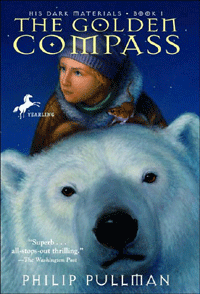
A Dangerous 'Golden Compass'?
Pullman's trilogy is a brilliant gift to the 'young adult.'
Paradise overthrown?
- His Dark Materials Omnibus
- Random House (2007)
The recent release of The Golden Compass has publicized the trilogy that the film is based on: His Dark Materials, by Philip Pullman. It's also revived the controversy over the books' anti-religious theme; Christian parents are swarming into web forums to warn one another about the movie and by extension about the books as well.
I confess I had been only dimly aware of Pullman's trilogy. He's classed as a "young adult" writer, and when the trilogy does turn up in the SF and fantasy sections of local bookstores, it looks like just more awful mass-market junk.
Shame on me for judging books by their covers (and blurbs). The controversy over the film stirred me to find a copy of The Golden Compass, and I was instantly hooked. I raced through the sequels -- The Subtle Knife and The Amber Spyglass -- and they did not disappoint.
Pullman is a brilliantly merciless storyteller. Just when you think things can't get any worse for his 12-year-old characters Lyra and Will, they get worse. They may have some special talents and tools, but they pay a high price for them. The characters are complex, plausible, and driven by understandable motives to pay that price.
He also has a wonderful imagination, shooting off ideas and images that coalesce into alternate universes full of concrete detail, from "anbaric" lights to the metallurgic skills of polar bears.
Reactionary fantasies
All fantasy is political, and here is where Pullman upsets his adversaries. Most of the fantasy epics we know and love are safely reactionary. The plots are always about restoring some dynasty to its lost throne in a picturesque country that's never experienced an election, much less a U.S.-style primary campaign. The fantasy kingdom may have evil aristocrats, wizards and priests, but the good guys will eventually win.
His Dark Materials isn't about the restoration of the old order but the creation of a new one -- the overthrow of God's Kingdom and the establishment of the Republic of Heaven. This may seem like wicked Bolshevism, but it really reflects Pullman's literary influences: a couple of radicals named John Milton and William Blake.
Pullman happily admits his debt to Paradise Lost and the poetic vision of Blake. Milton was a hell of a science-fiction author, with a story well worth stealing. His Lucifer is a spacefaring angel, flying between Heaven, Hell and Earth.
While God is the ostensible hero of Paradise Lost, Lucifer certainly gets the best lines, and he's far more interesting as a character than his mealy-mouthed and arbitrary ex-boss, who shrugs off his ultimate responsibility for Adam and Eve's fall.
'Of the Devil's party'
It's also worth remembering that John Milton was a staunch Cromwellian and anti-monarchist, who narrowly escaped punishment when Charles II took over in the Restoration.
William Blake, similarly, dreamed of a cosmos freed of mechanistic Newtonian physics and the oppressive patriarchy of "Nobodaddy," the belching, farting God of Blake's mythology. Blake saw the American Revolution as the portent of a new world, and the epigraph in The Amber Spyglass is from Blake's America: A Prophecy.
Blake also famously observed, "The reason Milton wrote in fetters when he wrote of Angels and God, and at liberty when of Devils and Hell, is because he was a true Poet, and of the Devil's party without knowing it."
So Pullman's young readers may not realize it, but they are being well prepared for their university English courses. (Whether their professors are prepared for Pullmanites is another question.)
Various universe
They are also being well prepared for some pretty sophisticated post-Newtonian physics. While many of his elements seem like straight fantasy, Pullman's tale is based on the "many worlds" theory, which argues that every time an atomic particle can go one way or the other, it goes both ways, creating a new universe in the process.
On top of this he makes dark matter -- a recent conjecture, not yet directly observed -- an active character in his story. In Pullman's cosmology, "God" is simply the first angel to form out of dark matter, and he establishes an enormous con game to maintain his supremacy.
The first angelic revolt having failed, the universes are now ruled by Metatron, a once-human angel who acts as the prime minister of a doddering and feeble deity. (Pullman's God is also reminiscent of Gabriel Garcia Marquez's "Very Old Man with Enormous Wings." Revolt against such a regime isn't easy, but it's possible -- even mandatory.
Revisiting Christianity's family quarrels
So this is what the parents are anxious about -- an ideas-based thriller that will introduce their kids to Christianity's family quarrels going back four centuries.
More sophisticated Christians have no problem with the trilogy. They may recall Milton's lines in Areopagitica, his classic defence of free speech:
"I cannot praise a fugitive and cloistered virtue, unexercised and unbreathed, that never sallies out and sees her adversary . . . that which purifies us is trial, and trial is by what is contrary."
By that token, Pullman's characters -- and readers -- must be pure indeed by trilogy's end. He follows the logic of his story wherever it leads, and we must follow whether we like it or not.
Many kids must cry by the trilogy's end, but they have also experienced a rare sensation: an intelligent author has respected them, treated them like adults capable of dealing with adult issues. (Would that more writers for adults would do the same for their readers.)
I haven't seen the movie yet, but its success or failure is beside the point. His Dark Materials is that rarity, a popular fiction (15 million copies sold) that refuses to pander to its readers. That achievement alone makes it worth reading . . . and thinking about.


12
Login or register to post comments
asp
4 years ago
"many worlds"
'the "many worlds" theory, which argues that every time an atomic particle can go one way or the other, it goes both ways, creating a new universe in the process.'
I have never understood the fascination with these theory's, it seems obvious to me that this is an error of perception. We cannot measure beyond a certain level - as we do not have a ruler fine enough - so we assume the perceived imprecision is reality?
nightbloom
4 years ago
I'm the opposite position as
I'm the opposite position as Crawford - I've seen the movie, but haven't read the book(s).
I liked the movie (I adore Kidman) and enjoyed the storyline of the Golden Compass. Any implicit symbolism is well beyond the typical adult, let alone an excited 7 year old. My only criticism is that the movie seemed to offer a short-hand version of the story in which it was easy to miss important details, and there seemed to be non-stop introduction of new characters every other scene, which was a bit of a jumble. But my money's on the 7 year old to figure it all out. There's enough excitement and visual stimulation to carry the film. The animal Daemons are a nice gimmick, bound to appeal to kids of all ages (that includes me). I haven't read the series, but I'm given to understand that the more overt "atheistic" aspects are contained in other volumes. And producers have admitted to toning down some of more overt anti-theist elements for the film.
So it's largely a media-manufactured controversy, the flip-side of the invented controversies that attended the release of Narnia and Lord of the Rings. Both were criticized for their putative Christian propaganda, in some cases quite harshly. For example, noted Sci Fi writer David Brin heaped unadultered contempt on both LOTR and its fans, apparently unaware that LOTR is actually a totally different genre - SF, Fantasy, and Mythopoesis are three different genres which happen to overlap occasionally. A good example of the manufactured controversy surrounding Golden Compass were the false MSM newsfeeds in the U.S. and Canada stating that the U.S. Catholic Bishops' Conference had condemned the Golden Compass. In reality, no such thing had occurred: quite the opposite, the Bishops' Conference endorsed it for posing worthwhile questions while spinning a good yarn. Go figure. Controversy is just another facet of marketing now. I'm sure Pullman isn't complaining.
The symbolism is certainly there, but you've gotta be pretty jumpy to take offense. "Magisterium" (the villains) has always been the word used to describe the international assembly of Catholic Bishops and the Pope, and the ubiquitous logo of the movie's villainous "Magisterium" definitely bears a striking similarity to the stylized "M" monogram of the Virgin Mary commonly found in most Catholic churches and institutions. But so what, really.
I'm glad Crawford's article takes the high road, and doesn't contribute to the mendacious nature of the controversy, by stating clearly that sophisticated Christians (a reasonable bunch) have no problem with the film or the books.
Booker
4 years ago
Bill Donohue
It is certainly an unconfident and shaky faith that feels the need to warn parents about such books. Bill Donohue of the Catholic League, the leader of the movie boycott, wrote:
We are fighting a deceitful stealth campaign on the part of the film’s producers. Our goal is to educate Christians so that they know exactly what the film’s pernicious agenda really is.
He is claiming victory now that the first weekend's box office receipts are in, and they were lower than expected. Apparently, judging from the blogosphere and the U.S mass media, people are listening to the buffoon.
nightbloom
4 years ago
There'd be something wrong
There'd be something wrong if the Catholic League didn't complain. I think the studios pay them to. It's fantastic advertising. Anything that gets "the Catholics" upset has got to be good...and it usually is :-P
Actually, the Catholic League is not representative, and certainly doesn't speak for the Bishops' Conference. There was no excuse for the misreporting of the Bishops' alleged condemnation (which never happened). Donahue might be "out there", but his critique is valid and he's simply exercising his right to free speech. He's hardly pronouncing a fatwa are calling on Pullman to be beheaded, so let's put this in perspective. I wouldn't attribute too much influence to marginal-but-vocal elements. North American Catholics are a pretty mainstream, liberal, culturally integrated demographic. Pullman's representative of a minority within a minority. Just keep that in mind and take his comments for what they are: a lobbyist's opinion.
nightbloom
4 years ago
Booker: BTW, I meant to add
Booker:
BTW, I meant to add in my post above: I don’t see Donahue’s statements as any more out of place, biased, or outlandish than, say, The Tyee’s assertion that Disney’s Narnia was Christian propaganda, or the NYT’s kvetching that Peter Jackson’s Lord of the Rings trilogy was too Christian. It goes both ways. Some people see agendas in everything. They're all entitled to their opinions.
Katisha
4 years ago
Possible alternate explanation
Possibly the film is not attracting as many viewers as hoped because of the efforts of "the buffoon". Or possibly word has already got around that it's awful.
I love the books, although I thought Pullman's anti-theist agenda rather overwhelmed them at the last (non-believer here, not a religious objection, just a literary one). But the wealth of creativity and excitement of the story are splendid.
The film is visually exquisite, and every one of the actors was terrific, but what a stupid hash they made of the story. As one of the people I saw it with said, they didn't seem to be able to decide whether they were making a kids' film or one for adults.
I can't really go into detail without spoiling it for those who haven't seen and/or read it, but anyone who has done both will know.
Bah.
nightbloom
4 years ago
Katisha - So would you agree
Katisha - So would you agree with Donahue's statement that the movie is a lure for books that peddle an overtly anti-Christian (or anti-theist) ideology to kids?
If the ideology is as overt as you say, isn't Donahue simply being a conscientious consumer watchdog for his particular constituency? I didn't read the books, so I would know (I liked the film, but agree that it was a jumble).
Booker
4 years ago
Reviews
Quite possible! I haven't seen the film, but if it's just a vanilla version of the books, then I have no interest. I guess that for a big budget movie you can't really afford to piss off the 90% of the U.S. population that's religious. On the other hand, a film as vile as The Passion of the Christ can be a big hit. Simple arithmetic.
Canis Latrans
4 years ago
Anyway....
the movie is on here next, at our lone town theatre-, and it sounds like a must see.
I am a definite fan of the movie arts, and though fantasies on screen are often a disappointment, I am also a lover of fantasy and sci-fi-, the last great one I saw that was not disappointing was Labyrinth. (I still have a soft spot for anarchist/communist sentimentality-, even though real life has turned out to be more complex.) :-)
loblollyboy
4 years ago
Oh, Please...
"Oh, please." said Deirdre wearily, motioning toward the visiting Martian anthropologist, "He still doesn't understand. Will someone please explain this whole silly thing to him again?"
si fu
4 years ago
read the books instead
I saw the movie after devouring the trilogy a while back. I came across the books by accident and I felt a little weird reading them since I am well above the target age, but they were really engaging. Okay, so the last one seemed to be a little too rant-tastic (is that a word?) but still entertaining.
The movie by necessity was a seriously Reader's Digest (TM) version. The climax of the book, which brought all the threads together, was severed from the movie like a daemon from its master. As a result it made no sense at all.
My advice is to read the books and skip the movie, notwithstanding the fact that Ms. Kidman wears some awfully slinky outfits...
nightbloom
4 years ago
From the Opinion Journal, of
From the Opinion Journal, of possible interest:
"His Dark Material: The unsubtle atheism of Philip Pullman's books"
http://opinionjournal.com/taste/?id=110010991
Although the series is a fantasy set in multiple worlds, there is no doubt that Mr. Pullman, a self-described atheist, targets Christianity--and particularly a rather thinly disguised Catholic Church--in these children's books. While the movie has excised some of the antireligious themes of the first book, the name of the most evil institution in its narrative universe remains "the Magisterium." Some moviegoers won't recognize this term, but the Magisterium is the teaching authority of the church, led by the pope. In the movie, one of the leaders in the Magisterium, the beautiful but vicious Mrs. Coulter, is played by Nicole Kidman.
Controversy began to build with the publication of the three books in 1996, 1997 and 2000. But it has taken the release of a major motion picture to bring the dispute to the attention of a wider audience. "Atheism for kids" is how the Catholic League describes the books. Mr. Pullman in turn calls his detractors "nitwits." ...
... First of all, "His Dark Materials," unlike the Harry Potter series, is real literature and, as such, deserves serious attention. Mr. Pullman, a graduate of Oxford University with a degree in English, knows his stuff. The books are loaded with allusions to Greek mythology and philosophy, Milton, Blake and the Bible, with images ranging from the obvious (the Garden of Eden) to the obscure (the bene elim, or angelic Watchers mentioned in Genesis 6:1-4). These allusions, unlike the throwaway Latinisms of Hogwarts' spells, drive the plot, characters and themes of Mr. Pullman's series. Indeed, a child who investigates them would begin to gain the rudiments of a classical education.
Moreover, again in contrast to J.K. Rowling's books (which were criticized by some Christians for their use of magic and witchcraft), Mr. Pullman's series is bluntly anti-Christian. In the third book, "The Amber Spyglass," a former nun tells the two child protagonists, Lyra and Will, that "the Christian religion is a very powerful and convincing mistake, that's all." The church and its members do nothing but evil....