
Rich as Hell
How the other one per cent lives.
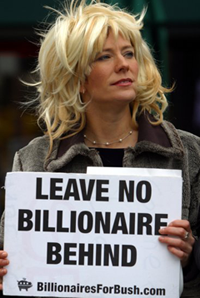
Actually, a lot of them hate Bush.
- Richistan: A Journey through the American Wealth Boom and the Lives of the New Rich
- Crown (2007)
Scott Fitzgerald was wrong: the rich are just like you and me.
No matter how much money they have, they'd feel more secure with twice as much. They tend to spend more than they make. They have trouble teaching their kids the value of a dollar. They even need support from peer groups.
So says Robert Frank, who for years has covered the "wealth beat" for the Wall Street Journal. Now he's published Richistan, about the lives and influence of America's very, very wealthy. Their lives are largely banal, but their influence is considerable -- and not always what we might think.
Frank approaches the Richistanis as a distinct nation. They aren't really living with ordinary Americans, physically or culturally. But most are émigrés from America's middle class, the wealthiest parvenus in history. They are both a recent phenomenon and a familiar one: Frank sees them as the "Third Wave" of dramatic wealth-building, after the Gilded Age (1865-1890) and the Roaring Twenties (1918-1929). In those eras, the top one percent of Americans held almost half the nation's wealth.
But after the Depression and Second World War, wealth began to reach ordinary Americans. By 1975, the top one per cent could claim only 20 per cent of all American wealth. Those were the days when a one-income working family could support a stay-at-home spouse, buy a home and send the kids to college.
Doubling the number of millionaires
Ronald Reagan changed all that. By 1989, Frank says, the top one per cent held 30 per cent of U.S. wealth, and their share is now 33 per cent.
But the Third Wave has created far more Richistanis than the earlier eras. "Half of America's total wealth has been created over the past 10 years," Frank says. North Carolina alone has as many millionaires as all of India -- about 83,000. Between 1995 and 2003, the number of American millionaire households doubled to over 8 million.
Most of this wealth is not thanks to inheritance. It's from "liquidity events," when an entrepreneur sells his company or takes it public. The resulting gusher of cash creates instant millionaires or even billionaires: the founder, the senior executives and early hires, the money movers, and some of the CEOs.
Today's Richistanis have redefined the meaning of wealth. Any West Vancouver homeowner might end up a millionaire just by selling his house, but a million bucks is chump change now. In the States, that would put you in Lower Richistan, a vulgar mob of 7 million households where the average cost of a wristwatch is $2,100.
To get away from the riffraff, you need $10 million to $100 million, which puts you in Middle Richistan. Only 2 million Americans fall into this bracket; they think $71,000 is a reasonable price for a wristwatch.
Welcome to Billionaireville
Upper Richistanis, worth $100 million to $1 billion, total just a few thousand. These folks will pay $182,000 for a wristwatch. Billionaireville, by contrast, had 13 residents in 1985 and 400 in 2006. They can hire a consulting firm to tell them what time it is.
Frank has managed to meet many Richistanis, learning how they made their money and what they do with it. The book is a series of gossipy chapters laced with statistics -- very much like supermarket tabloid papers' accounts of who's fat, who's anorexic and who's sleeping with whom.
But Robert Frank isn't interested just in unlikely success stories or heartbreaking anecdotes about those who made and lost a fortune. Like an anthropologist trying to understand the potlatch, he examines the status displays of Palm Beach "charity" balls, where the point is not to improve the life of the poor but to win status by giving more than the next Richistani.
Others gain status by building ever larger yachts: to be in the running these days, your boat needs to be over 500 feet long, cost over $200 million, and offer at least two helipads: one for your own helicopter, and the other for your guests'.
The rise of plutonomics
Richistanis compete for a relatively small number of consumer goods, so they face higher inflation rates than the rest of us. But they spend so much that billions really do trickle down. Frank calls the process "plutonomics." He suggests that Richistani consumer spending has helped keep the U.S. economy strong -- though at a literally high price:
"Despite their huge new fortunes, many of today's millionaires -- and even billionaires -- are living beyond their means. The nation's richest one per cent took on $383 billion in debt between 1995 and 2004, most of it in the form of mortgages and instalment debt. Their debt grew 235 per cent between 1989 and 2004, while their total wealth grew at half that rate."
Meanwhile, the very conspicuous consumption of the Richistanis is driving ordinary Americans to try to keep up. Maybe they can't afford $2,100 wristwatches, but they have certainly learned to live beyond their means.
Some of the very wealthy are thinking beyond mere consumption or hosting white-tie charity balls. Frank admiringly cites some "performance philanthropists" who spend millions on direct, effective aid to people who really need it.
Too rich to be right-wing
He also tells us that single-digit millionaires may be great supporters of George W. Bush, but the really rich tend to be highly liberal -- and politically active. The "super extreme self-financers" who run for office are usually Democrats. Others just pour millions into Democratic campaigns, like the "Gang of Four" who wrested Colorado from Republican control in 2004.
Are the Upper Richistanis just guilty limousine liberals? No, says Frank -- they're so rich they have to take the long view and consider how to spend their money to protect it for generations.
Richistan offers some surprises. Robert Frank describes a Butler Boot Camp whose graduates, as "household managers," will start work at $120,000 a year. He interviews a man who's made a fortune selling scarce and expensive art to instant millionaires who need to put something on the walls of their enormous new mansions. And he meets a stonemason who's served his clients so well he can go shopping for his own Ferrari.
But I wish he had devoted more time to studying the impact of the Richistanis on ordinary Americans. They're not just working harder to keep up with the Gateses and Ellisons; most middle-class households are increasingly stressed and insecure, with dangerous consequences for their health and life expectancy. However well intentioned, Richistani philanthropy can't compensate for what happens to ordinary folks because of the income gap.
Still, this is a readable, informative and insightful look at the biggest group of very rich people the world has ever seen. At some point a new war or depression may cause their government to redistribute Richistani wealth, as Teddy Roosevelt and Franklin Roosevelt did. The middle class may again see a golden age like that from V-J Day to Watergate, while the Richistanis worry about meeting their mortgage payments.
But I don't expect to live to see it.


avandoc
09-10-2007
Everyone will be rich?
Many people, notably Thomas Frank, have attempted to understand why the majority of people in the US tolerate the disparity of wealth. One theory is that everyone believes that he may be rich one day, either by selling a small business to a corporation or winning a lottery or having a kid who becomes a football star. And with that number of millionaires, it's enough to keep hope alive. But most people will remain among the working poor. And societies with great private wealth always have great poverty too. Politics in the US have become so narrow that I agree that redistribution seems unlikely.
Fiat lux
09-10-2007
What has to be remembered is
What has to be remembered is that wealth can not be created, only taken. This has nothing to do with any screwball ideology, but the unbreakable first and second laws of theormodynamics.
Much of today's billionaires are the beneficiaries of the deregulated money "creation" rights of the banks.
Large investors don't use their own capital to take over the businesses and properties of others, but borrow, because this way they can pass on the costs of the service charges on the public in the form of "tax deductible business expenses", screwing the public at both ends.
This is called the "competitive equilibrium of the global marketplace".
Now banks can "create" capital to take over the resources of any country by disposessing the property rights of the natives, accounting the resources of others for collateral. Then they can pass the service charges of that imaginary money, created from the air and represented by a few computer figures, on the already colonized and dispossessed natives and locals in the name of "wealth creating direct foreign investment", lapped up by local politicians pimping for directorships.
Foreign investment is a fraud and the biggest racket and crime wave in human history, taught in our universities as the "science of economics". In Canada's case it was the biggest fraud even in the gold standard days, but now, with imaginary capital, it has become unbelievable stupidity and crime.
What all these writers and opposition politicians never dare to mention is that the main purpose of the ongoing hysterical propaganda to become "more productive and competitive" is the collectivization and colonization of the whole world in the hands of the multinational corporate mafia, using the perceived power of imaginary capital to take control of everything and everybody.
Right now the Soviets of a few multinational corporations are controlling the oil and food, etc. supplies of the Earth, robbing blind the producers, while raising prices to the public and no politician dares to bring this out into the open, because that wouldn't be "competitive".
The now secretly planned and negotiated SPP is part of this racket as one of the major steps toward total corporate control in the hands of a few.
Ed Deak. Big Lake.
alda
09-10-2007
cowed by money
I find people in conversation --
even well educated ones -- are cowed and gobsmacked by the wealthy and the entertainment celebrities. The average Joe's sickening awe and reverence for anyone with money or fame is perplexing and disgusting and laughable at the same time. It's a common mindset I find everywhere. If Oprah were to walk down the street, women would probably curtsy, or faint.
There is no critical thinking when it comes to what a culture needs to be a good one, and there is no discussion about the misguided, revered trophy place that money holds in our lives.
In this culture, for many at least, money is God.
alda
09-10-2007
above comments
I forgot to mention that I agree totally with the two above comments - how our economic system -- as in a rigged casino game -- cleverly leaves room for a couple of ordinary Joes to be winners among all the cheaters, and thus leads all the other suckers to think they'll win, too.
And SPP/NAU as a method of continuing the colonial rigged system of resource rip-off? You bet.
snert
09-10-2007
We need the rich.
The poor certainly don't have any money to spend.
Fiat lux
09-10-2007
Obviously , the poor can not
Obviously , the poor can not spend money stolen from their pockets.
Ed Deak.
clubofrome
09-10-2007
Snert Diet
Allowing anyone to hoard and amass wealth and riches untold, is a recipe for poverty and starvation for billions of people. The Snert Diet encouarges these dreams of the criminally insane to become so obese with wealth that they think the trickle down is enough incentive to keep us in chains. Only those feeding from the left over toxicity and fat claim to think the system is all about getting ahead, following the American dream. We need a good cleansing, and we can either self administer or wait for the mother of all dieticians to put us on rations when the global economy can no longer feed the masses. The Snert Diet, encourages you to gorge your self stupid now and to hell with the future! I guess we can eat cash, bank statements and balance sheets when the real food becomes commercially unavailalbe.
snert
09-10-2007
Substtute wealth for energy and it still works
"In physics, the conservation of energy states that the total amount of energy in any closed system remains constant but can be recreated, although it may change forms, e.g. friction turns kinetic energy into thermal energy. In thermodynamics, the first law of thermodynamics is a statement of the conservation of energy for thermodynamic systems, and is the more encompassing version of the conservation of energy. In short, the law of conservation of energy states that energy can not be created or destroyed, it can only be changed from one form to another,................"
http://en.wikipedia.org/wiki/Conservation_of_energy
Clubofrome, I have a question for you. If you took the wealth away from those you feel have too much just how many people would you keep from starvation and just how long would that last before Ed Deaks Laws of thermoeconomics kicked in again. Oh sorry, that was two questions.
alda
09-10-2007
2 COMMENTS
Well said, Club of Rome.
Snert, when a full one third of all money in the States is owned by one percent,oh you bet there would be a good number of children who would no longer go hungry.
As for the "how long would that system last?" question, it's simple. Put "reasonable" limits on how much one person can own and that problem (aside from outright corruption) would be more or less solved. What we have right now is sanctioned, legalized theft.
Once those with obscene amounts of money are pilloried and reviled if they are found to have more than what society and government deem to be a fair share (say anything above the single digit millions), believe me, shame and public derision would do an awful lot to cure those big piggies' gluttoney at the public bank trough.
It can be done in socialistic communities, it has been done, it just won't be done in this society, any time in the near future. So you can rest happy in your dreams of untold riches for "those who deserve it."
Fiat lux
09-10-2007
When billions of people live
When billions of people live on $1 a day, NAFTA ruined the Mexican economy and some 50 million now live on less than $3.50/day, and we read that the Exxon chairman received an obscene $400. million golden handshake, we can guess where the money goes and what it could do.
Have you lived in Canada, or in North America, in the '50s to the '70s, when living standards were going up, and considered why they've been going down since the mid '70s, when the neoclassical market economy theory was forced on Earth by big business.
Have you ever read what Adam Smith really wrote and what he really meant with his "self interest and invisible hand" theory nd how it was distorted by crooked economists? Like Friedman and his Chicago School gang.
I grew up under fascism and have seen all economic theories at work on my own skin and can now see the same fascism under a self appointed ruling class growing here and now, using exactly the same words used by Hitler, Mussolini and Stalin, justifying the loss of human rights with ideological claptrap.
I'll be selling my calves within about 3 weeks and what I can see, the prices are in the .90 cents per pound area, which is lower than we got 20 years ago, thanks to the control of the world's food supply and markets by a handful of multinational crooks, while prices in the stores are rising every day. Is it because of oversupply? Like hell. Ranchers have been going broke for years and the numbers are way down. The crooks are causing a shortage, so they can jack up store prices even higher, while ruining the remaining producers.
Look up the control Cargill, Tyson, Monsanto etc. have on the "competitive global market" and how many millions of lives they ruin every year and how much executive salaries have increased in the past 35 years, compared to wages.
Ed Deak.
Yammer
09-10-2007
Weath is not energy
Fiat Lux applies the metaphor of conservation of energy to capital, to make the point that there is a "zero sum" framework in which the presence of wealth is, in itself, proof of theft. This makes intuitive sense -- after all, we hate the rich, or we would not be good little revolutionaries, so they must automatically be criminally culpable of something -- but cash and energy ain't similar enough for the metaphor to be useful.
On one hand, x amount of protons contain y amount of energy.
On the other hand, you have x amount of goods, which does not always contain y amount of value.
There is a humongous fluctuation in the worth of goods, due to such variables as skill, marketing, demand, and supply. One cup of, say, wheat flour could become a fabulous croissant, a stale donut, paste for my kid's papier mache cat, or just spoilage in a warehouse somewhere. The farmer who grew that wheat doesn't get paid more just because some of it became much more valuable than the rest.
According to Fiat Lux, though, the farmer was the victim of theft because the system has not kicked back the difference in ultimate price.
snert
09-10-2007
Well, the theory that Ed
Well, the theory that Ed puts forth works quite well if you accept that wealth takes many forms other than money in the bank. Ergo 'the total amount of wealth in any closed system remains constant but can be recreated, although it may change form'. In this instance power could be considered one of the forms of wealth that may take, land another. Relative value can also be factored in.
Wealth can also be redistributed but just what will that redistribution cause? Will it actually alleviate starvation or just create opportunities for others to accumulate it?
What would happen to Bill Gate's wealth if he tried to liquidate it? How many jobs would be vaporized just to produce the cash to be able to feed a few "starving" people for an indeterminate number of days. The problem here is that people look at the raw wealth and then assume that nothing is being done with it other than to buy a "$182,000" wristwatch.
I don't begrudge the rich their money. They usually wind up redistributing their wealth in one form or another. Who knows, maybe the jeweller who sold the expensive watch contributes heavily to the Red Cross. He couldn't do that if there were no wealthy hedonists around.
There are a lot of us who would not be considered wealthy but are living well within our means. Is it our duty to prevent world starvation as some feel those with significantly higher accumulations should?
Philanthropy is just one aspect of wealth accumulation. You can redistribute wealth all you want but when you reach the level where people are just eking out an existance then I think generosity will dry up in a hurry.
There is one interesting irony and that is there are people who absolutly hate the concept of globalization until they have the opportunity to dump on others for not eliminating for world hunger.
harry
09-10-2007
disclaimer: i'm not an expert, but...
snert: your logic is unclear. if you're accepting the money-energy-thermodynamics analogy, wouldn't the thermoeconomic laws not need to kick in but be at work all the time?
plus, your comment also seems to reveal that you would have a problem with the taking of money that is rightfully someone else's...wouldn't that principle apply to all forms of theft, like the theft that Ed Deak was mentioning in his post? nobody wants to rob the rich, but rather dismantle an exploitive economic system.
as for how long would it last? well cuba seems to be doing a pretty good job of it. i've looked at their stats (a year or two ago) on malnutrition and homelessness and literacy (indicators for quality of life, but not wealth) and they are the best in central america, and canada or usa certainly can't claim to have no starving kids. who knows what cuba could do if they weren't crippled by criminal economic sanctions? they might even be rich!
yammer: as far as i'm concerned the fluctuations in price are for the most part certainly a direct consequence of our contrived economy and its power structures. wasn't cash(gold?) supposed to be a stand in for goods in the first place?
Fiat lux
09-10-2007
"Wealth is the temporary
"Wealth is the temporary control of energy."
The trappings of wealth, like the 8 horse carriages, castles, forts, and huge harems of the past, now the limos, the private jets, the fashions, the palaces, the gated compounds, the yachts etc. are all symbols of energy control, similar to a dog carrying the legbone of a horse he can't possibly eat, but shows off what he has. The limos are probably the most ridiculous exhibition of human stupidity.
I'm a property owner and not against wealth, but the obscene exhibition and use of it to ruin the lives of others.
Reasonable wealth is like a glass of wine against total alcoholism. There was a lot of wealth around 40 years ago, but now, when less than 400 families control half of the world's wealth and resources, while tens of millions starve to death every year, it becomes an obscenity and crime.
What happened to the anti trust and cartel laws now in the days of the Bilderbergers, the Trilaterals the WEF, etc. etc. all criminal organizations similar to the mafia, for the sole purpose of blackmail, control and theft.
Going back to this insane "war on terrorism", get the multinationals that colonize and rob those impoverished countries blind and the main cause of terrorism will vanish. Who'd want to die for any reason when they're well off?
By the way, what can an old jerk do with $400. million, after many years multimillion salaries.
I was working as a designer and maker of custom furniture in Vancouver for 22 years, circulating among the high and mighty in their offices and homes and have seen enough of what wealth is all about.
Ed Deak.
Birch
09-10-2007
wealth creation
I don't often disagree with Ed Deak, but on the subject of wealth creation, I do. I once rode a plane alongside one of the local "millionaires" from our community, who offered the sage observation that none of us creates wealth. (HIS idea of wealth creation referred only to primary industry. He made his pile as owner of a drug store.) Oddly enough, I disagree with him for the same reason I disagree with Ed.
Anyone who does productive work creates wealth, a kind of well-being or contribution to it that would not exist had the work not been done. That's real wealth. Trouble is, we tend to measure it in dollars or their equivalents, and accumulate the dollars as if they were the same thing (and certainly sometimes they're convertible into the same thing).
I DO agree with Ed that an all too common form of wealth accumulation is, in fact, not due to much in the way of creditable action. Certainly the kinds of corporate theft in the public financial markets are legion enough to stand as evidence.
One further gets the interesting comment from active investors in the stock market that, "I made $X on a certain stock transaction that led to a capital gain." The notion that the investor MADE the money is rather laughable. He spent a few minutes paying attention to his portfolio and GOT the money when a capital gain was available. GETTING money and MAKING it are rather different, for the most part.
harry
09-10-2007
forget about the
forget about the redistribution of wealth for a minute and tackle the apparatus (ideology included) that allows entities like imf and wb to do things like conditional aid to africa (see stephen lewis' massey lectures).
forget about speculating this and forecasting that until we can figure out how to have an economy ethically.
is it a free market really? what IS the reasoning behind that claim?
Fiat lux
09-10-2007
Birch, I've been working in
Birch,
I've been working in so called "creative" fields all my adult life, say 60 years of it, as an artist, designer, tradesman in several trades etc.
I didn't "create" anything, only took raw materials and converted them into other forms, which may be very valuable, like selling $10. worth of art materials for $1000. but it is still not a "creation"
I lived through WW2 in Europe and then 3 postwar years, when we were starving, had no homes and ran around in rags, as there were no clothing or food in the stores. We had tons of money, tools, knowledge of hoe to grow and make things, but no materials, or resources to make anything from.
If we could have "created" anything, all the suffering wouldn't have happened.
Making things is not creating.
Ed Deak.
dorothy
09-10-2007
The bottom line - or the end of the line
“Who'd want to die for any reason when they're well off?”
It actually looks like it isn’t only the down-and-outers who blow themselves up and/or pick up a gun or a handgrenade, but sometimes rich people’s children, who get sucked into using that as their style of rebellion against their ‘hypocritical’ parents, who fraternize with ‘the enemy’ for material gain.
There is also the question of how long our turf is going to be our turf, if we do not draw boundaries. Do we want to leave our descendants in a state of dhimmitude?
“By the way, what can an old jerk do with $400. million, after many years multimillion salaries.”
I believe the obsessive drive to hoard is founded in fear of Death. These fools think they can beat the reaper in some fashion, by being rich enough to buy an instant place in Heaven or whatever.
I believe we were in trouble all the way back to where some people could not sustain their way of interacting with the land. When we had to start expanding, taking in new territory in order to maintain ourselves, we had already become too many. If you leave the land so that it needs six years to recover all the way after a harvest, then there should be six times that amount of land available to you. If there isn’t, someone will have to go, or not be replaced. The math of living is that implacable. We just don’t want to see it, for then we would have to grow up, and growing up hurts. We have mass starvation now, because we thought we could somehow ‘beat’ the fundamentals, and the hoarding of wealth is only secondary to the original crime: that of bullying people into ‘being fruitful and multiply’, as organized religion has unscrupulously done, to cater to the cries for expanding ‘markets’, i.e. more substrate for the parasitic machinations of greed. I have said it before, and I am saying it again: Want to cut the hamstrings of big capital? Stop producing surplus children. Don’t deliver the numbers. (Did anyone see the film ‘Big Sugar’? Beautiful illustration of what I just said.)
The problem, as I have also said, is to inspire that same understanding around the World. We should stop immigration, as it represents a deeply insulting override of people’s good sense in not over-breeding. It may give the older generation some hard years to adjust, there may not be a lot of comfortable retirement time for those of our age group, but somewhere the buck has to stop, or we condemn our children and grandchildren to a fate we cannot justify. We may thank our preceding generations for the mess, but we cannot talk about it and then refuse to act on our insight.
IAMC
09-10-2007
Spread it around?
I am too lazy right now to whip out the solar powered $7.00 calculator, but without this creation, I am sure that I can say this.
If we confiscated all the riches of this top 1% of income earners, and disperesed the througout the other 99% of income earners, we couldn't even but a coffee tomorrow.
This is not reasonable math.
Try to think of some other way of making everybody rich.
Kark Marx didn't.
He certainly figured out a way to make everyone poor.
Was that a creation?
The only problem areas on this earth, are those that do not enjoy fair market conditions, democracy and private property rights.
We should lay off the top 1%, they can't help it.
Frank
09-10-2007
Monbiot
The following is from George Monbiot, (seems to fit with this discussion)
Governments love growth because it excuses them from dealing with inequality. As Henry Wallich, a governor of the US Federal Reserve, once pointed out in defending the current economic model, “growth is a substitute for equality of income. So long as there is growth there is hope, and that makes large income differentials tolerable”(5). Growth is a political sedative, snuffing out protest, permitting governments to avoid confrontation with the rich, preventing the construction of a just and sustainable economy. Growth has permitted the social stratification which even the Daily Mail now laments.
http://www.monbiot.com/archives/2007/10/09/bring-on-the-recession/
Frank
09-10-2007
IAMC
It certainly isn't. (My solar powered calculator is still working after 21 years by the way)
You're saying that 33% of the wealth of America would only buy 99% of the population a cup of coffee? Just how poor is America in your opinion?
Because assuming a cup of coffee is $4 and the population of the US is 300 million, then America's top 1% are only worth $1.08 billion? And since they own 1/3 of the wealth of the entire country you're saying America is worth only $3.24 billion?
You may want to leave your calculator in the sun for a few weeks.
So did you. According to your figures America is a pretty poor place where the average person only has a few bucks.
Actually America (and Canada too) has a lot of problem areas. Many in fact have said America's inner cities are as bad as many places in the 3rd world. And last time I checked America was a market economy with a political system that is a reasonable facsimile of democracy.
Fiat lux
09-10-2007
Democracy and the present
Democracy and the present market economy that encourages theft by a special interest class are diametrically opposed concepts.
In a democracy no sector can claim superior and expropriation rights over others and if they do, they're struck down.
The problem with unlimited wealth is that it gives unlimited powers over the lives of others and that's not democracy, but fascism.
An economy should work like a road system, where everybody, big, or small, is permitted and protected to travel provided they follow strict rules, enforced by an independent authority and court system.
In our present so called "market economy", the large, armoured vehicles are not only permitted, but encouraged and rewarded for pushing others off the road and destroying lives and properties.
When somebody starts quoting Marx and the rest of the pathetic dead prophets, shows that they have no clue what they're talking about and have to resort to silly cliches.
How would our "market economy" faddists like to travel on a Road warrior road system, yet they're encouraging and praising the same destruction powers in economics, legalized by fraudulent statistics, like the GDP, growth and productivity figures.
Ed Deak.
alda
09-10-2007
To Dorothy
I've often said the same thing -- that accumulation of anything, especially money, but actually all consumer products (and addictions), is a feverish, childish, and misguided attempt at denying death, and of course, it never works in the long run.
If we analyzed the psychology of the Power Wolves who run things, I have a strong hunch we'd find a lot of sick competitive and frightened little puppies among that bunch of moneyed preposterously egotistical moguls.
I mean, past a certain point of earnings, how much fun can it be to be dumping more green into the bank and watching it grow - like mould? More like watching paint dry, I suspect, but probably for them it amounts to a great deal of fun, especially for a one track small mind that has never truly contemplated the ideals of compassion, altruism, intellect, humanity, the arts, kindness... or thought of making the life of one child happy by helping build a small, secure home for his parents, or other such inherently humane and decent projects.
zalm
10-10-2007
Snert and Yammer
Wealth is not fixed - it is continually expanding or shrinking, now matter which school of economics you subscribe to. The only debate is how much, in what areas and who benefits.
Here's a UN University paper from 2006 that succinctly sets forth a view that is finally is coming to the fore after years fo active suppression by the adherents of the Chicago School.
http://www.wider.unu.edu/publications/publications.htm
Of course, the new attention paid to institutions in the orthodox literature should not be seen as the result of an innocent scholastic awakening. Rather, it is better seen as an attempt to cope with the continued failures of orthodox policies in the real world. Despite the miserable failures of radical policy experiments through various structural adjustment programmes (SAPs) in developing countries and the big-bang ‘transition’ programmes in the former communist countries, the orthodox economists have refused to draw the most obvious conclusion, namely, that the orthodox policies, and the theories underlying them, are flawed.
At first, they tried to argue that the policy reforms need to be more extensive in order to succeed. When that happened and the good results still did not materialise, they started saying that policy reforms need time to work. However, after 15, 20 years of reform, even this line of defence has become difficult to maintain. So, now the orthodox economists use institutions to explain why ‘good’ economic policies based on ‘correct’ economic theories have so consistently failed. By talking about deficient institutions, they can argue that their policies and theories were never wrong, and did not work only because the countries that implemented them did not have the right institutions for the ‘right’ policies to work. In other words, the institutional argument is being mobilised as a means to protect the core tenets of orthodox economics in the face of its inability to explain what is happening in the real world.
Wealth is not fixed - it merely grows in the hands of those who have their hands on the levers of economic power, and shrinks in the hands of those who have none.
Fiat lux
10-10-2007
Typical example of "wealth
Typical example of "wealth can not be created, only taken".
If it could be created, everybody would be rich.
I just had a note on another list that the boss of some company, called Verizon, Ivan Seidenberg, gets paid $430,000/week.
This is only the tip of an iceberg of filth and corruption.
Ed Deak.
snert
10-10-2007
Did the note say what he does with all his money?
Maybe it's not quite so obscene.
Fiat lux
10-10-2007
So what ? Does this excuse,
So what ? Does this excuse, or legalize over
$20. million a year salary.
I wonder how much he's paying to his linemen and how much of the work is "outsourced" to chickencrap outfits at minimum wages ?
Ed Deak.
realisticman
10-10-2007
chickencrap outfits
Surely those workers in to chickencrap outfits need jobs too, Ed?
Did you hear that Infosys is outsourcing from India and looking for staff in the UK?
http://www.allheadlinenews.com/articles/7008781828
Everything goes around.
Wanted to ask you Ed Deak, if I take a seed and grow a plant am I not creating wealth if I sell the resulting fruit?
Fii
10-10-2007
$4 for a cup of coffee?
Geez, even I would quit drinking the stuff.
A latte, yes... but that is fancy sh**
Fiat lux
10-10-2007
rm... millions of farmers
rm... millions of farmers around Earth are planting seeds only to see the multinational middlemen buy the resulting crops for pennies and sell it for big monies and there's no other way, because the markets and prices are controlled by the corporate mafia at both ends.
Like my calves will bring me less than I have to pay for hay to feed their mothers in the winter. So, why am I, and thousands of others, doing it? Because we may be nuts, but still have enough conscience to realize that the world needs food and we're the people who must grow it, making others rich.
You may be right... we're "creating" wealth for scumbags, who "earn" millions every year on our labour and dedication.
But at least we go to bed with clear conscience every night.
I've been in independent business as a manufacturer, contractor and rancher in BC since 1957, so if you want to lecture me on how big business operates you'll have a job on your hand, because I know and have seen how some of the VIPs have "made" their billions, yachts and jets by stealing from others. Including me.
The difference is that I've left all ideologies behind long ago and know enough to run circles around all economists and politicians. Not to mention the gullible fools who follow them.
Ed Deak.
KWD
10-10-2007
Who will judge what is a
Who will judge what is a “reasonable” amount of accumulated wealth? Those who eke out an existence at a dollar a day? Those that spend $1200 on wristwatch? The alcoholic, or the wine sipper? (The shift from sipping to abuse isn’t always a function of lack of restraint.)
The problem to be dealt with is not the fact or act of so-called “obscene wealth” accumulation but the thinking that allows power (personal and corporate) to be derived from the destruction of resources. It’s the kind of thinking that allows Exxon, a company that has made billions of dollars through global resource and environmental destruction, to reward Lee Raymond (after only 12 years of doing a good job of managing destruction) with one of the most generous retirement packages in history (nearly $400 million, including pension, stock options and other perks, such as a $1 million consulting deal, two years of home security, personal security, a car and driver, and use of a corporate jet for professional purposes). It’s the kind of thinking that rewards TV and sports celebrities with millions annually.
It’s also the kind of thinking that will guarantee that if you take the “wealth” from the Richistanis and redistribute it, within a matter of a few years most of it will be back in the hands of those same few thousand folks.
Contrary to popular mythology, we don’t live in a closed system, and there is no balance in nature. So long as the sun continues to shine the earth will receive a whack of new resource “wealth” each day. The problem is that we have given some folks the power to liquidate billions of years worth of accumulated wealth at rate much higher than replacement, resulting in an ever-expanding energy budget imbalance. And then we reward them for doing it. The problem has nothing to do with economic theory.
IAMC
10-10-2007
Boogeymen
Exon Mobil controls only 3% of the world market for oil.
In fact, you are barking up the wrong tree KWD.
The vast amount of this market is controlled by despot governments.
Venezuela, Russia, Saudi Arabia, Iran, China.
Not corporations.
Why try to demonize Exon, without eqaully decrying the actions of these governments.
It would seem to me that we should encourage corporate control. At least they have to follow regulations and standards.
Frank
10-10-2007
Follow the gourd, not the shoe
I'm unclear on this point. So in your opinion Ron, despot governments are actually a good thing? Or are you being pessimistic about the Russians et al? Perhaps try to cheer up and don't think of other nations as being full of despots, look inside your heart and stop being so spiteful towards others. I really don't understand your kind of hate.
Now about that oil thingy, what about Canadian oil? Who controls it? Canada? Alberta? Oil companies? American oil?
Actually I think it was two fish and a really really big loaf of bread. Not to mention, many of the throng weren't that hungry after hearing it was bread and fish on the menu. I know I'd take a pass and wait till I got back to town.
Boogeymen
realisticman
10-10-2007
We? KWD
One easy way to solve the problems of exaggerated salaries for corporate executives is to vote for or against the board that approves them. To do this, in the case of Exxon, one can buy just one share ($93) of Exxon stock and then one is entitled to vote and speak at Annual Meetings.
Pollution and environmental issues are handled by governing jurisdictions.
Although the huge volume of money being lavished on some corporate executives is obscene, it is still, and only, money from that corporation's coffers which would otherwise either go to shareholders or investments, or sit in a bank. The money becomes taxable to the individual and reduces the shareholders dividends. Boycotting Exxon or buying a share to speak up if one is incensed is the best avenue.
Frank
10-10-2007
Politicians rejoice
Remember that the next time you hear a right-winger saying we need to get rid of government, except for the police, army, justice system, road, seaports, airports, corporate welfare and central bank parts.
Just tell him that if they don't like the way government is run they are free to vote and talk at public meetings. He won't even have to pay $93.
There you go, from now on let's hear no more complaints about government on this forum.
G West
10-10-2007
I was just reading Neil Reynolds
I was just reading Neil Reynolds latest encomium for capitalism in the Globe and Mail Frank.
He called his column today History 101: Have Capitalism, will prosper; its a collection of the usual stuff about how nice it is that total GDP in capitalist countries is growing like topsy these days - now that that nasty socialist 20th century is over.
I know Neil is R'man's favourite columnist so I always like to read what he has to say too. Helps me understand where the r'man gets his inspiration.
Y'see, both he and r'man have what I call bottom-line 'itis'. They think as long as the bottom line (total GDP) is healthy and growing that everything is hunky dory - even if all the wealth is tied up in the pockets of less than 5% of a country's population.
He, and the r'man always make the same mistake and assume that all you have to do is divide GDP by the total population to decide if things are getting better on an individual basis - always forgetting that you just can't make that kind of assumption. In fact you never have been able to: Growth means bugger all if equity isn't increasing and it sure isn't, as every measure confirms...
In fact it never was in the past either.
In 1900 Britain was No 3 in the world and Canada was No 10...and yet, Britain at the time was such a class-bound, poverty stricken and opportunity scarce place that it was sending tens of thousands of its children a year to places like Canada where they could get some training and a chance to succeed. I know all about it, one of them was my 11-year-old grandfather...he came to Ontario as a Barnardo's child (and no, he wasn't an orphan – his folks just wanted him to have a ‘chance’ he’d never have gotten if he’d stayed in England). It wasn’t just Eastern Europe exporting their people to the new world at the start of the 20th century and industrial Britain was no more a miracle than cool Britannia is today.
Now we export jobs to China and India and Burma so that business owners here can pile up the cash higher and higher for doing nothing - enabled by a criminal tax system, a compromised media and a government of sellouts: great signs of progress...and all the while more than half of the rest of the world often doesn't have enough to eat. Not all that different from that sick British system was doing to its own citizens in 1900.
Great victories for capitalism?
Not really, just more of the same immoral behavior by the same sort of kleptocrats who created the conditions for that terrible 'socialist' 20th century. Alas – nothing new under the sun and always lots of lackeys around paying obeisance to the man in the big house.
ME2
11-10-2007
Trying to define what
Trying to define what tangible wealth is these days is like trying to push your finger through a smoke-ring as it disintegrates before your eyes (I hope you all realise I'm not debasing the Tyee with a reference to errrr cigarette smoke)
The fact is that a dollar is worth only what everyone agrees it is worth, its tangible Gold base long since discarded. And so too with a Corporation, for if all the rules and privileges designed to create a "favourable economic climate" for it were taken away, and it was forced to make its own way, it would collapse like the house made of paper it is.
So, even while I agree with Mr Deak that our dollar is only fiat currency, since it isn't based upon precious metals and is worth only what people agree upon, I disagree that it cannot create wealth.
If an aid agency or something like the Bangladeshi Bank lends money to a poor farmer or shopkeeper (at reasonable interest), then that is created wealth, and it in turn will create more wealth.
If that wealth turns out to be a pile of potatoes or goods on a shelf, it still represents wealth (or stored energy as some have maintained above).
But what is a derivative, or a constantly devaluing TBill? In my view it's a gambling game, played with my money and without my consent. AND, if it matters, without my sharing in any winnings.
Fiat lux
11-10-2007
In corporations it is not
In corporations it is not people who vote, but the artificial entities of shares, which means that one person may have one vote, but the next one ten million.
This is not democracy, but outright fascism and Soviet type collectivization under an ideologically empowered ruling class.
By the way, I've been majority shareholder in one and sole owner of 2 corporations, so I do have some idea of how they work.
Now the everlasting claim of "property rights" for the legalization of crime.
Property rights must apply to everybody equally, which means that the property rights of one person can not be used to steal from and destitute others, as it is done now, legally, encouraged by governments fully owned by multinationals.
Mexico is quoted as the biggest beneficiary of NAFTA, and one of their homegrown jerks is now supposed to be the richest man on Earth, but their middleclass and agriculture have been destroyed, pushing 70% below poverty levels and 50 million existing on less than $3.50/day.
Excused, legalized and promoted by the crime wave of neoclassical market economics and the "property rights" of a corporate mafia.
Ed Deak.
realisticman
11-10-2007
Reading Reynolds
Yes, Frank, as West says Neil Reynolds is a good read. He used to be an NDP supporter. Not sure who he supports today.
Interesting to see that Indian firms are now recruiting in the UK and outsourcing to the US. Things move fast in this globalized world.
"Signalling a reverse outsourcing trend, many Indian IT firms with their operations spread across the US and Europe are now outsourcing a part of their administrative work in the US to a US-based firm Hanna Global Solutions.
A US-based full-service human resource management firm, Hanna serves over 30,000 Indian employees belonging to companies like Infosys, Satyam, Wipro and Quintegra Solutions by providing low-cost administrative services in the overall area of employee relationship covering features like payroll, healthcare benefits, retirement benefits and insurance."
The next home, or home away from home perhaps;
http://www.rgvillas.com/
Frank
11-10-2007
Reynolds
Acorrding to Wiki he was an NDP supporter in his early days but has been a Libertarian for at least 25 years (and probably longer).
Fair to say you're a fan of "globalization"?
realisticman
11-10-2007
Globalization
Too complicated to go into at length, Frank. I will say this, globalization exists. I don't believe in restricting another human from producing something for the marketplace. Ideally, humans should be able to travel all over the planet and live and work where they want. With tribal villages evolving into countries with borders this has always been a problem. Restrictions on agricultural products from the third to the first world reduce the capability of those in the third world from earning a decent living. If I shop I tend to buy in local markets, for produce and I always buy components and technology items from local retailers because I place a high value on after-sales service, even though it costs me more, and I like to support local retailers. I almost never shop in the big-box stores because of the above and also because I believe the 'village' is the most successful social structure. Aircraft and other large or other complicated items can obviously only be manufactured in a few places, not all over the place, so globalization is inevitable there.
I could go on but I have to work. Cheers,
G West
11-10-2007
SO does slavery
Slavery and globalization share more than you'd like to admit r'man. Globalization is just a more polite label for what Columbus and the British Empire exported to the far corners of the earth since 1492. Instead of importing the slaves, we leave them across the ocean and move the goods – cheaper and more efficient and when things go pear-shaped (as they have in Burma) the flak doesn’t affect the white folks in anything other than a ‘morally’ detached way.
I've no problem with travel if it doesn't harm the basic economy and the environment (stay out of airplanes if you care about the future of the planet r'man)- the last thing the globalizers of walmart are concerned about is providing a living wage for the folks who provide the edge that permits them to keep their stock prices up - the fact you don't shop there doesn't make a difference because the wage slaves globalization has created here in North America don't have a choice about buying their stuff from uncle sam's place...they can't afford any better. And they make up between 80 and 90 per cent of the custom at Walmart anyway. You’re irrelevant as a force for good unless you start really caring about what you believe in.
The fact you can take such a cavalier attitude about your own personal 'responsibility' is just your way of making yourself feel better about being at the top of the greased pole. In fact, your position there rests on the lives and misery of 90% of your fellow human beings, in my view.
If you care about the village - you'd better get out of that transcontinental jet you love so much - you're killing us all.
KWD
11-10-2007
ME2
As you’re aware there have been many attempts at defining wealth, some of which involve complex formulae. Correct me if I’m off base but from my read and attempt to deconstruct those definitions down to basics, wealth has three major components: 1.natural resources (the definition of which isn’t carved in stone, since technological change is constantly redefining the resource world) which includes all of the tangibles and the intangibles, like intellectual property; 2.some form of currency, which, in the case of barter, can include natural resources; and 3.power (individual and/or corporate).
The existence of wealth requires the presence of all three components of this equation. Currency, whether it is paper (fiat currency), precious metals, furs, art or clamshell, is useless in the absence of power and resources. Although power is a judgment, it becomes a reality when value is assigned to currency. Unfortunately, the criteria used to determine the value of currency are simply the result of judgmental thinking i.e. good, bad, right, wrong, honest, dishonest, ad nauseam. And judgmental thinking always results in a distortion of reality.
So until folks come to terms with the fact that wealth is nothing more than that and begin to question the judgments that are used to determine the value of wealth, the Richistanis will continue to amass great gobs of “wealth” and the rest will stand agape as they watch their portion of the wealth pie get smaller and smaller.
Folks are kidding themselves if they think the Richistanis are the least bit concerned about “trickle down” wealth.If they had a way to convert the rest of the world into automatons, they'd do it in a heartbeat.
Whether or not Exxon controls 3% or 30% of the market is a red herring. The point being made is that there is a huge problem with the thinking that allows folks like Lee Raymond to be given Richistanis rewards for his share in environmental destruction while folks like Stephen Lewis, who are trying to change that mindset, are being kicked in the teeth.
clubofrome
11-10-2007
Temporary Control of Energy
Ed Deaks definition of wealth. Despite other attempts, this one seems to fit what I would consider a definition that is most relative to the issue. The economic and banking system allows you to move goods around and accumulate resources without having to go out and actually do all the steps required. The more sofisticated the goods the more specialized the ecomony and workforce. That is to say far evolved from trading produce for leather goods or tools, furs for gunpowder and tea. Now the widget "A" designed in Geramny, is manufactured under license from a Japense firm, brokered by US money lenders and actually made in Mexico or Burma. So the trail is now so complex that it's no wonder no one questions the fact that paper money is wealth. It's not. Unless that's your definition, and if it is, it's not sustainable which really should be the point of these endeavours. You can ask who will be the judge or who knows better, but unless you can sustain the activity it is indeed just stealing the future from society. If we can't at least agree on a definition of wealth we should at least acknowledge that the pursuit of the "American Dream" is hazardous to our future. The fact that a few people can manipulate the control of energy so that they can surround themselves with comfort beyond a ratio of probably millions to one is obscene in itself. The fact that farmers trying to protect seeds and traditional practices to live sustainably are under attack is one of the biggest crimes besides the accounting and banking economic frauds. Imagine terminator seeds. As Dr Shivji stated, what kind of mind even contemplates this assault on nature and those trying to eek out a living growing their own food. No, those of you trying to justify this system need to dig way deeper than tweaking the tax laws and trade agreements. I'll go out on a limb and say that all of our activities should first pass the laws of nature before any human system of justice ever lays a hand on them. Then maybe we can talk about sustainability in terms that make sense. No ecology, no economy is the first law. Simple solutions for simple problems. Only greed and selfishness can twist it into a what's in it for me debate.
Last chance approaching! Vote Dolphin!