
Books

Richard Dawkins Won’t Repent

Atheist 'God Delusion' author fires back at critics.

By Terrence McNally, 23 Jan 2007, AlterNet.org

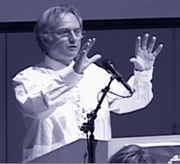
dawkins2.png

In the last few years, we have seen the dark side of religion. The events of 9-11 brought home the extremes to which some radical Muslims would go to defeat infidels and attain virgins. Americans have seen assaults on the separation of church and state and attacks on the teaching of evolution and the distribution of life-saving condoms. And now, it appears the godless are fighting back.

In recent weeks there have been prominent articles about atheism in The New York Times and the UK's Financial Times and Telegraph, as well as The Tyee. Dawkins' book, The God Delusion was a top-10 bestseller on the lists of both The New York Times and L.A. Times, number one at Amazon UK and Amazon Canada, and number two at Amazon.com. Letter to a Christian Nation by Sam Harris was recently an equally successful bestseller.

A group calling itself "The Rational Response Squad" has launched The Blasphemy Challenge, a campaign to entice young people to publicly renounce belief in the God of Christianity. Participants who videotape their blasphemy and upload it to YouTube will receive a free DVD of The God Who Wasn't There, a number one bestselling independent documentary at Amazon.com.

Richard Dawkins holds the Charles Simonyi Chair for the Public Understanding of Science at Oxford University. His 1976 book, The Selfish Gene, popularized the gene-centered view of evolution and introduced the term "meme." In January 2006, Dawkins hosted on the UK's Channel 4 a two-part documentary on the dangers of religion, entitled (against his wishes, I might add) The Root of All Evil. His newest book, The God Delusion, is an international bestseller.

Below is a shortened version of Terrence McNally's recent interview with Richard Dawkins.

Terrence McNally: When and how did you become an atheist?

Richard Dawkins: I suppose it was discovering Darwinism. I was confirmed into the Church of England at the age of 13. I then got pretty skeptical about it, but retained some respect for the argument from design -- the argument that says living things look as though they've been designed, so they probably have been. I then learned the real scientific explanation for why they look as though they've been designed, and that was enough for me. I lost my religious faith pretty much then.

TM: What do you think explains the current interest in atheism?

RD: I would love to think that there really is something moving -- a shifting in the tectonic plates, and, at last, in America, atheism is becoming respectable; that one can now come out of the closet and proclaim one's self.

I got certain indications of that on my recent tour of the United States. I got packed houses everywhere I went. Of course, I was preaching to the choir, but I was impressed by how large the choir is and how enthusiastic. Over and over again people came up to me afterwards and said how grateful they were that I and Sam Harris and others were finally speaking out and saying the things that they wanted to say, but perhaps didn't feel able to.

TM: You compare the experience of atheists to that of gays in the fairly recent past. Do you think that's an apt comparison?

RD: I think the parallel is a valid one. Until recently nobody dared admit that they were gay. Now, they're rather proud to do so. Nowadays it's impossible to get elected to public office if you're an atheist, and I think that's got to change. The gay rights movement raised consciousness. It initiated the idea of gay pride. I think we've got to have atheist pride, atheist consciousness. I think it's pretty clear that a fair number of members of Congress must be lying because not a single one of them admits to being an atheist. The probability that in a sample of over 500 well-educated members of American society, not a single one of them is an atheist, statistically, that is highly unlikely. So, some of them, at least, have got to be lying, and I think it's a tragedy that they have to.

TM: Could you address a couple of reactions that I see in the media, either to atheism, in general, or to you and your book? One, people ask why are atheists so angry?

RD: That's a very curious misperception...People have gotten so used to the idea that religion must be immune to criticism that even a very mild and gentle criticism of religion comes across as angry and intolerant. That's yet another piece of consciousness raising that we've got to undertake.

TM: You and others are accused of being arrogant, condescending. What would you say to that?

RD: Exactly the same thing. Nobody says that a Democrat who dismisses Republican ideas is arrogant. They just assume that's what politicians do. They attack each other's ideas with good, robust give and take. That's exactly what people like me and Sam Harris are doing with respect to religion. Once again, the accusation of arrogance comes about because religion has acquired this weird protection that you're not allowed to criticize.

TM: People finally say, "What's it to you? Why not be an atheist if that's what works for you, and leave the rest of us to be as religious as we wish?" This, I believe, is offered as a challenge to your open-mindedness or your respect for others. You're being called "an atheist fundamentalist."

RD: "Fundamentalist" usually means, "goes by the book." And so, a religious fundamentalist goes back to the fundamentals of The Bible or The Koran and says, "nothing can change." Of course, that's not the case with any scientist, and certainly not with me. So, I'm not a fundamentalist in that sense.

Why not live and let live? Why not just say, "Oh, well, if people want to believe that, that's fine." Of course, nobody's stopping people believing whatever they like. The problem is that there's not that much tolerance coming the other way. Things like the opposition to stem-cell research, to abortion, to contraception -- these are all religiously inspired prohibitions on what would otherwise be freedom of action, whether of scientists or individual human beings.

There are religious people who are not content to say, "Oh, well, my religion doesn't allow me to use contraceptives, but I'm quite happy for anybody else to." Instead, we have religiously-inspired prohibitions on aid programs abroad, including in areas where HIV AIDS is rife, prohibiting aid going in any form that might be used to help contraception. That is religion over-stepping the bounds and interfering in other people's freedom. So, religion does not observe this "live and let live" philosophy.

TM: In other words, if it were just a philosophical belief that had no impact on the world, fine.

RD: Exactly. I don't think you'll find many people criticizing any gentle religion, like Jainism.

The other thing is that, as a scientist and an educator, it is impossible to overlook the fact that, especially in America, there is a vigorous and virulent campaign to suppress the teaching of scientific biology. In state after state, there are court battles being fought. Scientists have to go out of the laboratory and waste their time responding to these know-nothings who are trying to stop the teaching of evolution or give equal time to creationism or intelligent design, or whatever they like to call it. They actually are trying to interfere with the freedom of children to learn science and the freedom of science teachers to teach their science properly.

TM: Why did you write The God Delusion?

RD: I care passionately about the truth. I believe that the truth about whether there is a God in the universe is possibly the most important truth there is. I happen to think it's false, but I think it's a really important question.

Also, because I felt that the world actually is drifting, parts of it anyway, towards theocracy in very dangerous ways. Education in my own field of evolutionary biology was under threat. There are all sorts of reasons why one might worry about the looming rise of religious influence, especially in the United States of America and in the Islamic world.

TM: Can you explain the distinction you offer between Einstein's God, as you put it, and supernatural God? You clarify this at the top of the book to make clear which definition of God you believe is a delusion.

RD: Sometimes when people hear that one is an atheist, they say something like, "Oh, well, surely you believe in something." Or "You believe that the universe is a wonderful place." And I say, "Yes, of course, the universe is a wonderful place." And they say, "Oh, well, then you believe in God." And they are using "God" in the Einsteinian sense of a kind of metaphor for that which is mysterious and wonderful in the universe. And the more the physicists look into the origins of the universe, the more wonderful it does seem to become. Without a doubt there is cause for something approaching worship or reverence that moves scientists such as Einstein, and Carl Sagan, and, in my humble way, myself. Einstein was very fond of using the word "God" to refer to that feeling of non-personal reverence.

TM: Beyond that feeling, didn't he also use it to refer to the awesome existence that we confront?

RD: Yes, he did. When Einstein wanted to say something like, "Could the universe have happened in any other way? Is there only one kind of universe?" The way he expressed it was, "Did God have a choice in creating the universe?" Now, to any ordinary churchgoer in the pew, that sounds as though Einstein believed that a personal God designed the universe. In fact, all Einstein was doing was wondering whether there could be more than one kind of universe, which is a perfectly respectable scientific question.

I think it's extremely unfortunate that Einstein chose to use the word "God" for that. Einstein himself was most indignant when he was taken literally and people thought that he meant a personal God, such as the Christian God or the Jewish God. But I think he was asking for trouble by using the word "God." He did it again over Heisenberg's indeterminacy principle, which he hated. He expressed his hatred for it by saying, "God does not play dice."

TM: So you're making the distinction between that use of the word "God" and the God that you believe is a delusion?

RD: A personal God. A God who is a deliberate, conscious intelligence, the sort of God who listens to your prayers, forgives your sins. A God who sits down like a master engineer or physicist and designs the Universe, works out what ought to happen, worries about sins, all that kind of thing.

TM: Could you briefly respond, as you do in the book, to some of the arguments for this supernatural, directive, personal God. The argument from beauty...?

RD: People say things like, "If you don't believe in God, how do you account for Beethoven? How do you account for a lovely sunset? How do you account for Michelangelo?" It's such a dopey thing to say. Beethoven wrote beautiful music. Michelangelo painted wonderful paintings and did wonderful sculptures. Whether or not there is a God doesn't add to the argument one bit. So that's not an argument, although an amazingly large number of people seem to think it is.

TM: The argument from scripture...?

RD: There are lots of scriptures all around the world and they contradict each other. There's really no reason to suppose that just because something's written down, it's true. You have to ask who wrote it and when and why.

If you ask somebody, "Why do you believe that your Scripture is the word of God?" the answer that comes back is, "Oh, because it says so." And you say, "Well, where does it say so?" And they say, "In my Scripture." So, the Holy Scripture, whichever it is, the Koran, or the Bible, or the Book of Mormon, says within itself that it is the word of God. This is a circular argument and not to be taken seriously.

TM: The argument from personal experience...? In late-night conversations during my high school days, my questions regarding God's existence would be answered by the challenge-defying, "You have to experience it."

RD: I think that is a difficult one, but, on the other hand, anybody who knows anything about psychology, knows what an immensely powerful simulation engine the brain is. I'm impressed by the fact that every single night of my life, my brain conjures up images and sounds of things that have never existed and never will exist. They are completely non-sensical. It's as though I go temporarily insane every night of my life and you do, too. Everybody does. We get a very life-like, full color simulation of a fantasy world inside our heads. Now, when we get that in our sleep, we call it a dream. When we get it in our waking lives -- in much less vivid form -- we might call it a vision of God or a vision of an angel, or we might say "God just talks to me."

Even when you actually see an angel or you actually hear a voice inside your head, that is an easy feat of simulation for the brain to achieve. When it's just a sort of vague feeling that God is whispering to you, it's really rather pathetic to be fooled by that, I think.

TM: My president claims God talks to him.

RD: Yes. Your president is told by God to invade Iraq. It's a pity, by the way, that God didn't tell him there were no weapons of mass destruction.

TM: I, too, wish God had been more specific. What do you make of the recent scientific conversations about certain phenomena such as a "God nodule" in the brain?

RD: There is a certain amount of evidence that specific parts of the brain do have something to do with so-called religious experience. I've had experience of the work of the Canadian neurophysiologist, Michael Persinger. He tries to mimic the effects of temporal lobe epilepsy by passing magnetic fields through the brain. In about eighty percent of subjects, when he passes magnetic fields through certain parts of the brain, he can induce religious or mystical experiences. The details of the religious experience depend upon how the person was brought up. So, if the person was Catholic, they tend to see Virgin Marys or whatever it might be. I turned out to be one of the twenty percent for whom it didn't work. If it had worked for me, I probably wouldn't have seen any gods, but I probably would have experienced some sort of mystical experience of oneness with the universe.

TM: How universal is the belief in a supernatural God?

RD: It's universal in the sense that all human cultures that anthropologists have looked at seem to have something corresponding to a belief in some sort of God.

Sometimes it's many gods. Sometimes it's one. Sometimes it's an animistic set of gods -- the God of the Waterfall, the God of the River, the God of the Mountain, the Sun God. The details vary, but it does seem to be a human universal, in the same sort of way as heterosexual lust is a human universal, even though not all individual humans have it. Like sexual lust, I suspect there's a kind of lust for God.

TM: How do you explain its prevalence?

RD: When you ask a Darwinian like me, how we explain something, we usually take that to mean, "What is the Darwinian survival value of it?"

Quite often, when you ask what is the survival value of "X", it turns out that you shouldn't be asking the question about "X" at all, but that "X" is a by-product of something else that does have survival value. In this case, the suggestion I put forward as only one of many possible suggestions, is that religious faith is a by-product of the childhood tendency to believe what your parents tell you.

It's a very good idea for children to believe what parents tell them. A child who dis-believes what his parents tell him would probably die, by not heeding the parent's advice not to get into the fire, for example. So child brains, on this theory, are born with a rule of thumb, "believe what your parents tell you." Now, the problem with that -- where the by-product idea comes in -- is that it's not possible to design a brain that believes what its parents tell it, without believing bad things along with good things. Ideally we might like the child brain to filter good advice like, "Don't jump in the fire," from bad advice like, "Worship the tribal gods." But the child-brain has no way of discriminating those two kinds of advice. So, inevitably, a child-brain that is pre-programmed to believe and obey what his parents tell it, is automatically vulnerable to bad advice like, "Worship the tribal juju."

I think that's one part of the answer, but then, you need another part of the answer: Why do some kinds of bad advice, like, "Worship the tribal juju," survive and others not?

Beliefs like "life-after-death" spread because they are appealing. A lot of people don't like the idea of dying and rather do like the idea that they'll survive their own death. So the meme, if you like, spreads like a virus because people want to believe it.

TM: Though children may tend to believe what their parents tell them, you state strongly that a child should not be called a Catholic child, a Muslim child, or a Jewish child.

RD: Yes. I'm very, very keen on the idea that children should be not labeled like that. We're back to consciousness raising. The feminists raised our consciousness about use of language in all sorts of ways -- things like saying, "his or hers," instead of just "his". In the same way, I think we need to raise consciousness about such labeling of children.

I'm not saying that parents shouldn't influence their children. That would be hopelessly unrealistic. Parents influence their children in all sorts of ways, but I think religion is more or less unique in being licensed to confer a label on a child. You never talk about a "Republican child" or a "Democratic child." You never make the assumption that because a professor of post-modernist literature has a child, that therefore it will be a post-modernist child. It would be ridiculous to do that, and yet if a Christian or a Jew or a Muslim has a child, then the whole of society goes along with the idea that you can label this child "a Jewish child," "a Christian child," "A Muslim child." I think that is a form of child abuse. I think it's a civil rights issue.

TM: Many suggest that you and other atheists, perhaps especially scientists who are atheists, neglect phenomena that you cannot explain. For example, the subjective experience of meaning or comfort of inspiration many claim to receive from their belief or their relationship with God... If millions experience such things, is this not evidence for the source to which they attribute them? If not, can you clarify why it isn't?

RD: There's no question that people do get comfort and consolation from religion. If a loved one has died, of course, it's comforting to feel that they're still somewhere out there caring for you, and you're going to see them again one day. But, what is comforting isn't necessarily true, and it is sort of intellectual cowardice to say, "We should let people wallow in their illusions, because it comforts them." I think it's rather patronizing.

TM: Do you think this is similar to when families or even doctors debate whether to tell someone their cancer is terminal? Because, after all, life is terminal...

RD: That's a really good parallel. There are people who would rather not be told the truth by a doctor and I respect that, but that doesn't make it true. That you want your doctor to tell you that you haven't got terminal cancer, and your doctor obliges by lying to you, that's fine; but the fact is he has lied to you. Similarly, you may be comforted by the thought that there's a God looking after you, but if there isn't a God looking after you, then I'm afraid there isn't one, and that's all there is to it.

I don't want to impose my beliefs on anybody else, but I do care about what's true. If you want to know what I think is true, read my book. If you'd rather not know what I think is true, don't read my book.

TM: Many criticize you on the grounds that science can't answer some of the biggest questions or that science is unwilling or unable to offer those meaningful things that we just talked about. Is it fair to respond to your book or your arguments by pointing out insufficiencies of science?

RD: There are some questions that science not only can't answer, but doesn't want to answer, things like, "What is right? And What is wrong?" or "How shall we be comforted?" Science has nothing to say about "right" or "wrong." Moral philosophy does. There's another whole category of questions that science may not be able to answer -- the really deep questions of existence, like, "Why is there something, rather than nothing?" or "Where did the laws of physics come from in the first place?" It's an open question at the moment whether science will ever be able to answer questions like that.

Physicists, in particular, are working on questions like, "Where do the laws of physics come from?" But it's a fallacy to say that because science can't answer such a question, therefore religion can. Much more realistic to say, "Well, if science can't answer that deep question, nothing can."

TM: In America, we hear that we're more provincial and religious than so many other people; that much of Europe, even the Roman Catholic countries of Spain and Italy, for instance, are far more secular...

RD: I suspect that the grip that religion is alleged to have over America has been exaggerated. If people who are not religious would only recognize that they're not a beleaguered minority, but actually are exceedingly numerous and potentially very powerful...If they would stand up and recognize each other and organize, I suspect that they would soon give the lie to this idea that America is a supremely religious country.

I think there's been a kind of hijacking of American political life by religious interests, and I think it's rather sad the way so many have gone along with that. You'll see even intelligent Democrats desperately currying favor with the religious vote because they think it's so powerful. No member of Congress will admit to being an atheist, although obviously some of them are.

TM: In polls, people are least likely to vote for an atheist for significant political office. They claim to be much more willing to vote, for instance, for a homosexual or a Muslim...

RD: It's no wonder that politicians are scared.

TM: I don't think we can expect too many politicians to move first.

RD: People have to come out of the closet and write to their congressmen and congresswomen and say, "Look, stop sucking up to the religious vote. Suck up to us, for a change. Better still, don't suck up to anybody, but speak your own convictions."

TM: I once asked a member of the Achuar -- an Amazon rainforest tribe who had its first contact with the modern world in the 1970s -- "How do you feel about the missionaries?" I assumed he would say, "Oh, bad folks," but he said, "They were the ones who stopped us from killing each other all the time."

Although several of our founding fathers were more likely Deists than conventional Christians, they believed that once you took away the monarchy or the Papacy, that the people did need religion in order to behave as a moral society. Do you agree that religion is a civilizing or moralizing force?

RD: There's something awfully patronizing and condescending about saying, "Well, of course, we don't need religion, but the common people do." I hope it's not as bad as that.

With regard to the missionaries being a civilizing influence on tribes whose habit was to kill each other -- presumably, if their first contact with Westerners had been with policemen, they would have said, "Until the policemen came, we killed each other."

Through centuries of change, we have now reduced our natural tendency to kill each other, but there have long been tribes where killing is the norm and the way to achieve worldly success. In our society we talk about making a killing on Wall Street. The equivalent in some tribes in the Amazon jungle might be to literally go and kill sexual rivals, for example.

That changes when such tribes are brought into contact with Western civilization. The fact that the people who go out of their way to bring Western civilization to such tribes usually are missionaries doesn't mean that religion fosters the "Thou salt not kill," point of view. "Thou shalt not kill" is a general moral principle, which we all have now, whether or not we're religious.

TM: Some people will claim that without religion we would not act morally; we would lack ethics...

RD: That's an appalling thing to say, isn't it? It suggests that the only reason we have morality -- the only reason we don't kill and rape and steal -- is that we're afraid of being found out by God. We're afraid that God is watching us, afraid of the great surveillance camera in the sky. Now, that's not a very noble reason for being good.

As a matter of fact, there's not the slightest evidence that religious people in a given society are any more moral than non-religious people. We are, all of us in the modern world, far more reluctant to kill, reluctant to discriminate against other people on grounds of sex. We no longer regard slavery as a good thing. All these things are universally approved of among educated people of goodwill in modern society, whether or not they are religious. You can point to abolitionists who happened to be religious, and you can point to other religious individuals who were in favor of slavery.

Modern morality is very different from the truly horrifying version of morality in the Old Testament. If we went by the Bible, we'd still be taking slaves. If we went by the Bible, we'd still be stoning people to death for the crime of picking up sticks on the Sabbath. There are all sorts of ways in which we've moved on, and nobody who claims to get their morality from religion, could seriously maintain that they get it from Scripture.

TM: You have a problem with moderate Christians, Jews, and Muslims, don't you?

RD: I take this largely from Sam Harris. In his two excellent books, Letter to a Christian Nation and The End of Faith, he points out -- and I agree with him -- that the majority of religious people are perfectly nice people who don't do horrible things. Yet moderate religion makes the world safe for extremist religion by teaching that religious faith is a virtue, and by the immunity to criticism that religion enjoys. That immunity extends to extremists like Osama Bin Laden and that dreadful man who goes around saying, "God hates fags." I've forgotten his name...

TM: Jerry Falwell, Pat Robertson, the list goes on.

RD: The world is made safe for people like them and Osama Bin Laden because we've all been brainwashed to respect religious faith and not to criticize it with the same vigor we criticize political and other sorts of opinions that we disagree with.

If you can say, "such and such a view is part of my religion," everybody tiptoes away with great respect. "Oh, it's part of your religion," then of course, you must go ahead. In a way, we've been asking for trouble by moderate people persuading us to give to all religion a respect, which it has never done anything to deserve.

TM: You quote physicist Steven Weinberg: "Religion is an insult to human dignity. Without it, you'd have good people doing good things and evil people doing evil things. For good people to do evil things, it takes religion."

You open the book marveling at the wonders of existence. You end it writing about your personal experience of awe and transcendence. You also write eloquently about this in a previous book, Unweaving the Rainbow.

RD: Unweaving the Rainbow, which I wrote in the late '90s, was my answer to those people who say that science and, in particular, my world view in The Selfish Gene was cold and bleak and loveless. Maybe I could read a few words from the opening of Unweaving the Rainbow, which I've set aside and asked to be read at my funeral.

"We are going to die and that makes us the lucky ones. Most people are never going to die because they're never going to be born. The potential people who could have been here in my place, but who will, in fact, never see the light of day, outnumber the sand grains of Sahara. ...In the face of these stupefying odds, it is you and I, in our ordinariness, that are here. Here's another respect in which we are lucky. The universe is older than a hundred million centuries. Within a comparable time, the sun will swell to a red giant and engulf the earth. Every century of hundreds of millions has been in its time, or will be when its time comes, the present century. The present moves from the past to the future like a tiny spotlight inching its way along a gigantic ruler of time. Everything behind the spotlight is in darkness, the darkness of the dead past. Everything ahead of the spotlight is in the darkness of the unknown future. The odds of your century being the one in the spotlight are the same as the odds that a penny, tossed down at random, will land on a particular ant crawling somewhere on the road from New York to San Francisco. You are lucky to be alive and so am I."

We are lucky to be alive and therefore we should value life. Life is precious. We're never going to get another one. This is it. Don't waste it. Open your eyes. Open your ears. Treasure the experiences that you have and don't waste your time fussing about a non-existent future life after you're dead. Try to do as much good as you can now to others. Try to live life as richly as possible during the time that you have left available to you.

Related Tyee stories:

 [Tyee]

121  Comments:

Login or register to post comments

  • Me3

    5 years ago

    Nobody's gonna "win" this one !

    My guess is that the notion of a god arose when someone saw the need for something which the group could unite around without any one of its members profiting more than the others.

    Good idea, but I'll bet it didn't take too long before leadership learned to manipulate THAT one too.

    If you had never heard of a god, you'd never see the need for one.

  • Booker

    5 years ago

    The Debate Continues

    If you had never heard of a god, you'd never see the need for one

    Very true. With what we now know about the natural world, there is no need to invoke a deity. Part of the problem, especially in the U.S., is that such a large proportion of the population has a very poor understanding of science. Americans ranked 34th in the world in a recent University of Michigan survey measuring the acceptance of evolution (I'm not sure where Canada would place because we weren't part of the survey).

  • nightbloom

    5 years ago

    I'm gonna sit this one out.

    I'm gonna sit this one out. The thing about the "Rational Response Squad" and UTube turned my stomach.

  • Booker

    5 years ago

    Gary Trudeau

    The latest Sunday Doonesbury has a trenchant take on this issue:

    http://www.doonesbury.com/strip/dailydose/index.html?uc_full_date=20070114

  • mephitick

    5 years ago

    nightbloom

    Your stomach must be full of special religious sauce.

  • maestro

    5 years ago

    Re Dawkins

    Problem with these Dawkins types is they often ultimately become very much like that which they oppose.

    Perhaps he should see if ol' Jim Jones Guyana compound can be leased again and see if he can get Kool Aid and Union Carbide to sponsor his religion of "non- religion".

    History has shown his "wolf -under -sheepskin " type has often lead many astray and down a road with an ugly dead end.

    Hopefully he has a lot of tenure at Oxford and kept in the IvoryTower. Isn't that why God invented universities, so these so-called Dawkins' intellectul types are separated from BOTH Church and State ?

  • dolphin

    5 years ago

    Dawkins

    I find it rather ironic that Dawkins asserts that it his passion for the truth that motivates him, and that he equates his situation with those in the gay rights movement.
    The one group which cannot stand any truth telling about their social behaviour are gays. Anyone who tries is pounced upon as a scurrilous homophobe, even if they back up what they say with evidence from peer reviewed journals.
    I intend to read Dawkins book, though. I would recommend Lee Strobel's The Case for a Creator as a good counterpoint (for those who are open-minded).

  • ubiquitous

    5 years ago

    poor Dolphin

    The real irony Dolphin is when religion is criticized, religious types get all up in arms about their perceived persecution. It’s not like we’re throwing you to the lions, but rather opening the door to debate – one based on sound logic. However, I find that children of Christ (or whomever your god may be) engage in one of two tactics: either they use ad hominem attacks on those offering criticism of religion (like Maestro), or they cry persecution (like yourself – Nightbloom uses both methods however loquacious he is). Rarely do I see any sound logic employed in the defense of religion, just pure faith in a system that’s been put through the ringer countless times over the last 2000 years (in the case of Christianity).

    On another note, since you opened up this can of worms Dolphin, you got any credible peer reviewed journal articles equating homosexuality to a social behavior? You see, your ignorance makes you a homophobe no matter how you try to sugarcoat it with so-called evidence against homosexuality. Although, I will say this, I was uncomfortable with Dawkins’ using homophobia as a comparison marker with what atheists are experiencing. Atheism is a choice, albeit one based on logic rather than faith. Plus, I’ve never heard of atheist-bashing.

  • Truman Green

    5 years ago

    hey, why no natural selection mutations etc

    Not a word in the interview about natural selection, genetic drift and mutations, the three pillars of the darwinian evolutionist hypothesis. Why not?

    These three ideas comprise the basis of the theory that biochemicals, complex molecular systems such as the genetic code and the human immune system are brought into existence by the interaction between the accidental appearance of mutations or the stochastic aggregation of alleles--genetic drift--into future generations of the same species.

    Whether such interactions will lead to speciation (macroevolution), or the developement of allele frequencies and biochemicals and complex molecular systems and complex organs microevolution) is the locus of the problem intelligent designists are having with the conventional Darwinian hypothesis, which is that accidental genetic changes which can present advantages for the organism or biochemical will be 'selected' because of the benefit offerred.

    Many scientists are now doubting that natural selection can account for the activities of complex biological systems such as the immune system, which appears to be acting proactively, and the developement of the genetic code, which appears to have come into existence as a kind of universal algorithm--a recipe which mandates how dna molecules will make copies of themselves, and how codons of nucleotides will combine to form amino acids and eventually, proteins.

    To imagine that the genetic code (or indeed any of the laws of nature, including thermodynamics and the laws of physics) arrived by natural selection is at least as dependent upon 'faith' as the assurance that Jesus died for your sins or that there are special tribes of people through which 'god' will play out the final destiny of human beings.

    It's a mystery people, and despite Dawkin' claim on his website that science has "told the true story of the origin of the world," (honest, I saved it on a floppy and downloaded to 'documents'), the origin of the world remains a mystery.

    Here's the exact, hilarious claim by Dawkins:

    "Even before science told us the true story of the origin of the world and the evolution of life, there was no reason to believe the Jewish origin myth any more than the origin myth of the Yoruba or the Kikuyu, the Yanomamo or the Maori, the Dogon or the Cherokee."

    Only problem: Science has no ideas about the origin of the world and only a few rather tired hypotheses about the evolution of life.

    So Dawkins is exaggerating, as usual.

  • jimmy_laroux

    5 years ago

    Truman: Quote:To imagine

    Truman:

    Quote:
    To imagine that the genetic code (or indeed any of the laws of nature, including thermodynamics and the laws of physics) arrived by natural selection...

    Who *on earth* is claiming that the laws of physics came about by natural selection?

  • ubiquitous

    5 years ago

    Truman's doubt

    Truman's obvious knowledge of the subject matter notwithstanding, it still seems to me that his critique of evolution is not based on any real evidence against the science, but rather on doubt - or perhaps more accurately, refusal to accept evolution as a credible theory. So, I question him again: does your refusal to accept the science mean that, by default, there exists some creator. I just don't understand such line of reasoning (if I've got it right).

  • ubiquitous

    5 years ago

    furthermore...

    On a more philosophical note, the idea of absolute knowledge, or knowing exactly how things are, is, in my opinion, is a characteristic of the creationist, or religious, side of the coin (if one wishes to reduce this argument into some kind of binary either/or scenario). Scientists, at least those who adhere to the scientific method, wouldn’t claim that a phenomenon exists in absolute terms. Instead, scientific thought revolves around the notion of evidence to explain an occurrence fully realizing that it is only the best why to explain something, not the only way to explain something. Faith based beliefs, on the other hand, do not allow for an alternative explanations for things. I’ve always liked the saying that the more you learn the less you know, and I believe that in science, this is very true. The more scientific knowledge that is collected the more questions are raised. Knowing for certain how things came into being is a ridiculous notion and scientists that adhere to strict scientific methodology, I think, understand this.

  • clubofrome

    5 years ago

    Hill of Beans

    What we know now doesn't add up to a hill of beans. Can you imagine using the technology of just 50 years ago? Advancements will surely happen in Trumans theory as with all science. Until then, there is no god, no jesus and no devil. Faith based power has had their turn driving the bus now for thousands of years, and look where we are? Lost without a road map. I say it's long overdue for a regime change. Time for governance by nature. It's just her turn. Of course she's not going to be to happy with the way she's been treated lately. For those of you already on your knee's, forget praying and start grovelling...

  • Booker

    5 years ago

    Evolution

    Ubiquitous wrote

    Quote:
    Truman's obvious knowledge of the subject matter notwithstanding

    I'm sure Truman is a great guy, but he doesn't know what he's talking about when it comes to evolution. He thows out scientific-sounding gobbledygook to promote his agenda, the promotion of Intelligent Design. I'm not going to get into another debate about it, but if you are looking for responses for his creationism, here are a few websites that are useful:

    www.talkorigins.org

    www.scienceblogs.com (see Evolutionblog; Pharyngula; Evolving Thoughts)

    www.pandasthumb.org

    www.sandwalk.blogspot.com

    Every single one of his arguments have been dealt with -- they aren't original, or based on science. They are virtually all based on the "argument from incredulity" or the "god of the gaps". Intelligent Design is just the latest flavour of creationism, and I'm sure Truman will keep pushing it until the end, stringing together new scientific phrases gleaned from the internet, all essentially meaningless.

  • Bluenose

    5 years ago

    Moderate Religion

    Richard Dawkins states: " ... moderate religion makes the world safe for extremist religion by teaching that religious faith is a virtue, and by the immunity to criticism that religion enjoys."

    It also means that religious traditionalists do not need to challenge the religious indoctrination they have received. They don't need to challenge themselves or their beliefs. For believers, everything is a given.

    In the words of Don Marquis, "If you make people think they're thinking, they'll love you; but if you really make them think, they'll hate you."

  • jimmy_laroux

    5 years ago

    Quote:I'm sure Truman is a

    Quote:
    I'm sure Truman is a great guy, but he doesn't know what he's talking about when it comes to evolution.

    Or physics. Or cosmology.

  • Truman Green

    5 years ago

    no gobbleygook, just elementary science

    I started questioning whether natural selection could construct anything twenty five years ago when I was a secure darwinian--even 'fulfilled,' as Dawkins says about himself. I've been on the internet only since 2003, but I can hardly deny that I've brushed on a few things by way of google.

    Yes, the darwinians claim to have dealt with every one of my arguments.

    I have no agenda except trying to figure out how things came into existence. The 'natural selection' mechanism is just plain ridiculous.

    Do you see any speciation in domestic dogs after 5000 years of selection?

    Of course my arguments are based on the 'argument from disbelief"--disbelief of the old natural selection paradigm.

    But what I'm basically claiming is that, although natural selection probably works with exponentially reproducing crittters such as bacteria, my studies into macroevolution always yield the conclusion that natural selection never goes beyond the creating of new variations; and so speciation does not result as the darwinins claim it does.

    I'm no creationist. Creationism is the belief that some kind of god created all forms of life with one fell swoop, (usually accompanied by a god which is personally involved with its devotees and favourite people) which is just as ridiculous as Dawkins' darwinisms--that everything's an accident.

    Evolution is a fact; the question is: how does it happen?

    And yes, complex molecular systems like the human immune system seem to act proactively, so that the derivation of its components is not accidental.

    The only message I'm pushing is that we don't really know what life is; how it originated or how it progresses; what chooses which forms will become extinct and which species will continue into the future.

    I don't have a clue about any 'first causes' or 'gods,' or what the universe was like before any projected singularities.

    We're probably thousands of years away from understanding any of these things. The darwinians are just deceiving people. The science is just not there yet to answer the big questions.

    Darwinism is nothing more than another kind of religion, posing as a science as though it's on an equal footing as chemistry, mathematics or physics.

    An excellent analogue is the use of genetic algorithms in engineering, whereby the engineers and computer programmers supply the input to chose which algorithms are superior--intelligently-designed algorithms or genetically-designed algorithms.

    The model is undoubtedly analogous because without the engineer exactly nothing would happen.

    And so, both the religionists and the evolutionists have added some genuine contributions to the knowledge of the mystery of life; life results and progress by some unknown synergy between 'purpose' and all its weird and little-understood mechanisms, such as the laws of physics, thermodynamics and the genetic code.

    Dawkins, is a preacher--a pop evolutionist-- pretending to know things that are still completely unknown by all of us--exactly like Jerry Falwell and Pat Robertson.

    Such as the "true story of the origin of life," as he claims.

  • jimmy_laroux

    5 years ago

    Truman: Quote:Darwinism is

    Truman:

    Quote:
    Darwinism is nothing more than another kind of religion, posing as a science as though it's on an equal footing as chemistry, mathematics or physics.

    'Darwinism' is not a religion. Mathematics is not a science.

  • jimmy_laroux

    5 years ago

    Truman: Quote:Darwinism is

    Truman:

    Quote:
    Darwinism is nothing more than another kind of religion, posing as a science as though it's on an equal footing as chemistry, mathematics or physics.

    'Darwinism' is not a religion. Mathematics is not a science.

  • Truman Green

    5 years ago

    Darwinism is a religion

    Sciences make predictions.

    Not even Dawkins would pretend to know what the next human species will look like, when it will appear, which current characteristics will be 'selected'--in fact evolutionists know exactly NOTHING about the future human species.

    You' d think they'd just have to do a few calculations to come up with information like this--if darwinism was actually a SCIENCE.

    Darwinism is a religion because it is based on the faith that speciation occurs because of the accumulation of millions of tiny improvements over millions of years.

    The selection mechanism for which species will become extinct and which ones will survive is still a mystery.

    Pop-evolutionists don't like to talk about it, of course, but Darwin's big book was called, "The Origin of Species."

    Species--speciation, you know the emergence of SPECIES, and how they come into existence.

    That's the big question!

    Something figured out a long time ago that you need SPECIES, so groups of organisms can increase in numbers by way of some shared reproductive mechanism, like sexual or asexual reproduction.

    As Darwin understood, (correctly) if you don't know how species evolve, you don't know squat.

    Take human evolution, then. How do you think, Laroux, natural selection is working today to alter the present human species into the next version?

    All that I'm saying is...noone on earth knows the answer to this question. There's no science which could even remotely help us begin to answer it. Only some speculation--faith, although few scientists would venture a paper on it.

    If darwinism is really science, wouldn't you suppose we'd be able to have some real knowledge by now about what the next version of humans will look like--what behaviours will be 'selected', which 'race' will be chosen, because technically speaking 'races' are 'varieties' and in darwinism, speciation comes through the selection of varieties. (not politically correct, I know, but darwinism just the same)--read his, "The Descent of Man."

    At minimum, real sciences make predictions. Not just guesses.

    Not only predictions about the future, but assessments such as: which organisms came into existence by mutations, which purely by natural adaptive selection and which by stochastic (random) genetic drift?

    When scientists have answers to these kinds of questions, I'll concede that I've totally, and unfairly underestimated the efficacy of darwinism in supplying information about the evolution of species.

    Not a single scientist in the world can supply answers to questions such as these, which would be a minimum requirement--IF darwinism was actually a SCIENCE, and not a FAITH.

  • jimmy_laroux

    5 years ago

    Truman: Quote:An excellent

    Truman:

    Quote:
    An excellent analogue is the use of genetic algorithms in engineering...

    Genetic algorithms are somehow analogous to religion?

    In addition to thermodynamics and cosmology, you don't understand genetic algorithms, though you pretend to (just like you pretended to understand thermodynamics and stellar evolution on the previous Dawkins-themed thread). Genetic algorithms do no choose "which algorithm is superior". Given a problem, possible solutions are encoded of as a binary string, a genetic algorithm uses a process analogous to natural selection to find an encoding with maximum fitness (i.e. which solution is best). The fitness function is also defined in advance.

    It has absolutely nothing to do with choice between "intelligently-designed algorithms or genetically-designed algorithms."

  • ubiquitous

    5 years ago

    Predictive qualities

    Come on Truman. Science is not about predicting the future per se. Science provides a way of explaining phenomena. It is also the collection of knowledge. It also provides the methods, through experimentation, to add to the collection of knowledge. Prediction can be a part of science if the scientist intends on predicting a future pattern based on a researched model. Evolution science is about explaining the past, not the future. No evolutionist would ever claim that they could model how evolution will work in the future because there are so many variables outside the physiological (i.e. the environment). Furthermore, faith implies a (blind) belief in something without any (statistically significant) evidence. The evidence for evolution is there, the evidence for creation is not.

  • Truman Green

    5 years ago

    now you're gettin goofy Laroux, old pal

    GA's are a big new thing in engineering. They are being employed because it is thought that in some cases they are superior to algorithms devised by engineers.

    Therefore their use has everything to do with whether they are superior--or not.

    Darwinians sometimes refer to the use of genetic algorithms in engineering as evidence that a complex system left on its own can produce algorithms which are better than intelligently designed algorithms. Beyond the question of whether the term 'genetic' is merely metaphorical (are 'mutations' the result of sequencing errors, for instance), it is totally appropriate to suggest that the global structure contains 'purpose,' because, as I said, absolutely nothing would happen without the input of the engineeer, and I am suggesting that this is exactly what happens in nature.

    For more on genetic algorithms go to the Larry Moran science blog and read my post and Jud's response. He has a friend who uses GAs exactly because of their superiority (apparently) "over intelligently designed algorithms." His words, exactly.

    Go here: https://www2.blogger.com/comment.g?blogID=37148773&postID=5223393307867024283

  • Truman Green

    5 years ago

    I know you believe, but...

    I understand that you believe, ubiquitious,--with all your heart-- but now that we've cleared up the matter of whether evolutionism can make predictions about the future (it can't), I think it is appropriate to tackle the question I posed regarding whether evolutionism can make assessments about the past--such as: which organisms progressed by means of which of the three pillars of darwinism--natural selection, stochastic allele advancement, known as genetic drift, or mutations.

    If you can't link these pillars of the so-called science up to the organisms which they alleged assembled, how then, can it be said that darwinism can offer dependable information about speciation?

    And can evolutionists present any assessments about how mutations, which are known to be primarily retrograde or degenertive, can increase the amount of information in a genome, and by doing so facilitate genetic advancement.

    I suggest darwinians can, at best speculate.

    For more on mutational information increases read the quite famous Dawkins answer to this question. I'll look for a link if you like.

  • jimmy_laroux

    5 years ago

    Truman: Quote:GA's are a

    Truman:

    Quote:
    GA's are a big new thing in engineering.

    Evolutionary computing, of which genetic algorithms are a subbranch, have been around since the late sixties. So if this is what you mean by "new" ...

    Quote:
    Darwinians sometimes refer to the use of genetic algorithms in engineering as evidence that a complex system left on its own can produce algorithms which are better than intelligently designed algorithms.

    In the field of evolutionary computing, a human comes up with an encoding, a fitness function, and a a way for to encodings to 'reproduce'. This is not a perfect analogue with nature, (it does not account for morphogenesis, for example). No one has claimed to simulate all of evolution from scratch, only some aspects of it. These algorithms show that natural selection does work for engineering problems when the problem has a good encoding and fitness function. No more, no less. Your statement about a "complex system left on its own" is a considerable extrapolation.

    Quote:
    ...absolutely nothing would happen without the input of the engineeer, and I am suggesting that this is exactly what happens in nature.

    This is a red herring. In the engineering world, the point is to find a good solution to some problem, not accurately simulate evolution.

    Quote:
    ...it is totally appropriate to suggest that the global structure contains 'purpose,'

    What do you mean by "global structure" and "purpose"?

  • Truman Green

    5 years ago

    Jimmy, did you read it?

    Jimmy, did you read my post and Jud's on the Larry Moran blog? (Remember, you sent me there last week, thinking real scientists would easily dismiss my ideas. Or was it Booker?)

    Anyway...there's an explanation of what I mean by 'purpose' and 'global structure' there.

    Btw, you seem to have done a lot of brushing up on this subject since we last clashed.

    Okay, I'll tell you. I use the word 'purpose' because there's really no doubt that without some kind of unknown 'input' containing an unknown 'purpose', nothing would happen in nature and no algorithms would be assessed for their superiority or reliability in engineering applications.

    You always need input--decision making, judgements!

    The fact that algorithms exist in nature--the genetic code, thermodynamics, physics, mathematical renderings like the equivalency of mass and energy--make it obvious that these systems did not come into existence by virtue of natural selection--otherwise they could not have predated the systems and organisms they came into existence to assemble.

    Why this isn't one of the most obvious descriptions of what happens in nature is totally mind boggling to me.

    Jimmy, keep your eye on the ball. Darwinism is about natural selection; NATURAL SELECTION is THE THEORY OF EVOLUTION. It's about genetic changes becoming heritable because they offer advantages. Do you imagine that in nature the very laws and algorithms came into existence because they offerred advantages?

    Advantages to what?

    In otherwords, there IS a meaning for life--maybe not in our individual lives, as the religionists love to believe, but in the existence of life, in general. It's just simple logic.

    Nobody knows what it is. But it's there.

    So when you think about how things came into existence keep thinking: Could natural selection have done it? Could natural selection have done it? Genetic Drift? Mutations?

    Because if these mechanism don't apply, the entire envolutionary program collapses.

    I think, eventually you will get my point.

  • Samantha

    5 years ago

    Definitions

    I think the major issue that Truman is having is with the definition of natural selection.

    The idea is that a combination of environmental and genetic factors lead to certain members of a species reproducing more frequently than others.

    It does not mean that certain species are better/stronger/faster than others, it doesn't mean that the species on the planet today have "more genetic information", and it certainly doesn't mean that anyone could comfortably predict what new species would look like (unless suffering from a God complex).

    It seems easy to say, "Evolutionists can't tell us why things are the way they are", but this doesn't mean that evolution as a premise is flawed. It means that more information needs to be gathered. (Scientists tend to be cautious about making blanket statements, after all).

    As to your question about mutations, they occur on a daily basis, in every organism. It so happens that many mutations are silent, a simple base-pair change. It is true that some are deleterious, and some have negative effects. The problem in defining a DNA change as positive or negative lies in the fact that we know so little about our genome as a whole. You are trying to personalise evolution, asking why it can't explain everything you want to know, which seems short-sighted. Evolution works on a vast scale, indifferent to the individual.

    The easiest example comes from human genes. Sickle cell anemia is a lethal and highly painful disease. When investigating the disease, researchers discovered that people who carried a single copy of the sickle-cell mutation were resistant to malaria. The malaria-resistant individuals were more likely to make it to child-bearing age, hence the mutation was passed on. Now that we have treatments for malaria, and can screen for the sickle-cell genotype, it may seem contrary to the principles of evolution that two healthy people will mate to produce a lethally affected child. However, in the grand scheme, beyond the personal or political, there was a reason for this mutation's perpetuation.

    It's not an increase in the amount of genetic information, it's simply a change that has a variable result.

    Just because we don't understand it fully, doesn't mean it's not true.

  • Booker

    5 years ago

    Paley

    Quote:
    I said, absolutely nothing would happen without the input of the engineeer, and I am suggesting that this is exactly what happens in nature

    This is nothing but Paley's Watchmaker argument. The appearance of design must mean is was designed. It was a weak argument 200 years ago, and it hasn't improved with age.

    I'm at least glad you've been reading Larry Moran. Perhaps there's hope.

    Nah.

  • GJW

    5 years ago

    A missionary

    Dawkins is an evangelist, a missionary, of his own perspective. He has all the charisma and credibility of a TV preacher. I would have more respect for the man as a thinker if he didn't spend so much time attacking the "religious fundamentalist" straw man.

    The idea that fundamentalist forces are squelching science, and that science is some noble, visionary cause that must triumph over all odds, is laughable. This is not a new idea, folks. This idea has been around since the Industrial Revolution. Dawkins and Carl Sagan have nothing new to add to the discussion, merely echoing the writings of H.G. Wells and his contemporaries, who scoffed at religion, saw it as a dangerous force and wrote against it. I quote G.K. Chesterton, who characterized their view of the world as a prison of one thought:

    "These people seemed to think it singularly inspiring to keep on saying that the prison was very large. The size of this scientific universe gave one no novelty, no relief. The cosmos went on forever, but not in its wildest constellation could there be anything really interesting; anything, for instance, such as forgiveness or free will. The grandeur or infinity of the secret of its cosmos added nothing to it. It was like telling a prisoner in jail that he would now be glad to hear that the jail covered half the county. The warder would have nothing to show the man except more and more long corridors of stone lit by ghastly lights and empty of all that is human. So these expanders of the universe had nothing to show us except more and more infinite corridors of space lit by ghastly suns and empty of all that is divine."

    Science is a tool we use to learn about the world around us. But when people turn it into a belief system, or even worse into a weapon to attack other people's beliefs, it becomes another religion.

    I have a strong, fundamentalist (going by the definition already used in the article) Christian faith. My faith comes from the glimpses of God I have had in my life. I hope that my life can have a positive influence on others, and that I can share my faith with people and have them see there is a purpose to life on this earth beyond merely existing. But I despise religion being used as a weapon, and those who love science should feel the same way about science.

    Dawkins and his followers are welcome to hold and express their opinions. But so am I, and so are the followers of the Flying Spaghetti Monster. That's the hallmark of a democratic society -- that we are able to co-exist peacefully with wildly diverse viewpoints and beliefs.

    I hope those who buy into Dawkins' perspectives agree.

  • Truman Green

    5 years ago

    You're getting close, Jimmy.

    Good point about Paley's Watchmaker argument, but
    it's not the appearance of design that I'm concerned with. Appearances can be deceiving.

    It's the arrows of time in which fully pre-assembled algorithms show up before the complex molecular structures they came into existence to construct.

    We can assess this order in time because of the fact that the components of the genetic system, triplet nucleotide assemblages (codons), together with fully-prescribed pair bonding requirements came into existence BEFORE the 20 amino acids they came into existence to construct.

    So there's a kind of rule book in place.

    Natural selection, acting by means of its 'advantages-offerred capabilities' could not apply to the emergence of the rule book--the genetic code, itself.

    Who needs a genetic code unless there's, weirdly, I admit, some 'idea' of the goals it will be in place to achieve?

    Now we can conclude that these algorithms came into existence FIRST because all living things conform to the requirements of the algorithms.

    Therefore, there was a kind of purpose in the developement of the genetic code. And its purpose was to assemble nucleotides into amino acids and amino acides into proteins.

    I'd love to be able to apply natural selection to the emergence of the genetic code. I could move on to something else for my intellectual hobby.

    But it doesn't fit.

  • tommy boy

    5 years ago

    vale of tears

    "Religion is the general theory of the world, its encyclopedic compendium, its logic in popular form, its spiritual point d'honneur, its enthusiasm, its moral sanction, its solemn complement, its general basis of consolation and justification. It is the fantastic realization of the human being inasmuch as the human being possesses no true reality. The struggle against religion is, therefore, a struggle against that world whose spiritual aroma is religion.
    Religious suffering is at the same time an expression of real suffering and a protest against real suffering. Religion is the sigh of the oppressed creature, the sentiment of a heartless world, and the soul of soulless conditions. It is the opium of the people.
    The abolition of religion as the illusory happiness of men, is a demand for their real happiness. The call to abandon their illusions about their condition is a call to abandon a condition which requires illusions. The criticism of religion is, therefore, the embryonic criticism of this vale of tears of which religion is the halo.

    Karl Marx

  • jimmy_laroux

    5 years ago

    Truman: Quote:Btw, you seem

    Truman:

    Quote:
    Btw, you seem to have done a lot of brushing up on this subject since we last clashed.

    :-) I've been familiar with evolutionary computing for a very long time.

    Quote:
    I use the word 'purpose' because there's really no doubt that without some kind of unknown 'input' containing an unknown 'purpose', nothing would happen in nature and no algorithms would be assessed for their superiority or reliability in engineering applications.

    You really haven't answered my question.

    By the way, with genetic algorithms you are typically trying to find a solution to a general problem, not comparing "algorithms" (genetic programming, a subbranch of genetic algorithms, uses GAs to write code automatically, which could, I suppose, be considered comparing "algorithms").

    Quote:
    You always need input--decision making, judgements!

    In nature or genetic algorithms? In nature, no. In genetic algorithms, yes.

    Quote:
    The fact that algorithms exist in nature--the genetic code, thermodynamics, physics...

    Good heavens. Physics is not an "algorithm".

    Quote:
    ...make it obvious that these systems did not come into existence by virtue of natural selection...

    What?! Who claims that physics came about by natural selection. This is by far the most ridiculous thing I've read in one of your posts, and that's saying something!

    Quote:
    NATURAL SELECTION is THE THEORY OF EVOLUTION.

    Natural selection and evolution are now the same thing? And just when I thought you couldn't top 'physics came about by natural selection' for outright nonsense...

    http://en.wikipedia.org/wiki/Evolution

    http://en.wikipedia.org/wiki/Natural_selection

    Quote:
    Do you imagine that in nature the very laws and algorithms came into existence because they offerred advantages?

    You are confusing "traits" with "algorithms". And again, *no one* claims that laws of nature came about by natural selection.

  • jimmy_laroux

    5 years ago

    Samantha: Quote:I think the

    Samantha:

    Quote:
    I think the major issue that Truman is having is with the definition of natural selection.

    Natural selection is only the beginning, believe me :-)

    Quote:
    Scientists tend to be cautious about making blanket statements, after all.

    I agree.

  • Booker

    5 years ago

    Outlook

    GJW wrote;

    Quote:
    He has all the charisma and credibility of a TV preacher

    Perhaps he has the charisma, but his credibility is considerably higher. Dawkins uses data.

    Quote:
    These people seemed to think it singularly inspiring to keep on saying that the prison was very large. The size of this scientific universe gave one no novelty, no relief

    What a remarkably small-minded way to look at the universe. Chesterton could be very clever, but very blind too. If I saw the world that way, I would indeed be glum; but, I don't.

    Quote:
    But when people turn it into a belief system, or even worse into a weapon to attack other people's beliefs, it becomes another religion.

    So religion is a weapon to attack other people's belief systems? Thanks for clarifying that. Except that later you say the religion shouldn't be used as a weapon. Confusing. Perhaps you should say that religion is about God. Science is not. So it's not a religion. Simple.

    Quote:
    ...and that I can share my faith with people and have them see there is a purpose to life on this earth beyond merely existing

    Yes, it's okay for you to share your beliefs, and it's okay for us to share ours. I respect your right to have whatever beliefs you want, and to proselytize, but that doesn't mean I will respect the belief itself if I think it's wrong. Do you not question people's political beliefs when you are opposed to them? Or their philosophy, or their economic ideas? Religion is no different.

  • Truman Green

    5 years ago

    Jimmy a cake mix is an algorithm

    Jimmy you should read this: "Implication of Natural Selection and the Laws of Physics."

    With R. Dawkins, Lee Smolin, Nicholas Humphrey, Brian Goodwin et al, before going off like that.

    I think you, not having any knowledge in this field, have no idea what lengths the darwinians have gone to to project natural selection into everything.

    Dawkins is even apparently devising a program whereby religions are chosen by natural selection. (I'm not 100% sure of this because somebody told me she read it somewhere. I'll look for it.)

    Natural selection is the whole ball of wax , almost, Jimmy.

    Here: http://www.edge.org/discourse/smolin-natselection.html

    And yeah, even a cake mix is an algorithm as long as its dependable to produce a cake over and over again.

    You're going to be surprised when you learn that apparently even universes themselves are assembled according to natural selection.

    Start reading.

  • Booker

    5 years ago

    Sandwalk

    Quote:
    Natural selection is the whole ball of wax , almost, Jimmy

    Truman, I thought you said you've been reading Moran? If you have, how can you say this?

    Read this article. He disagrees with some of what Dawkins says. (Hey, scientists disagree, therefore there is a Designer, right?)

    http://bioinfo.med.utoronto.ca/Evolution_by_Accident/What_Is_Evolution.html

  • Truman Green

    5 years ago

    first thing I read of Moran's Booker.

    Actually Booker that exact essay was the first thing I read of Moran's when you sent me to his site.

    Should have been enitled: "Why nobody knows what biological evolution is--except me."

    What's really going on in this field, Book, is that some of the more intelligent evolutionists are backing away from the strictly 'natural selection' paradigm, seeing that it probably is only incidental in speciation, (like I said, in bacteria, do I need to explain it again?) to other, more self-based definitions.

    Like for instance, what suits them best.

    I think, eventually, evolution will revert to its original meaning: change over time, leaving in science history's dustbin the more comedious mechanisms like mutations and genetic drift.

  • Truman Green

    5 years ago

    eventually, when they all fess up..

    So eventually when they all come clean they'll agree with me: "Evolution's a fact, but we haven't got a clue how it happens."

    They won't be selling many books with this admission, though.

  • jimmy_laroux

    5 years ago

    Truman: Thank-you for the

    Truman:

    Thank-you for the link. It's a pretty fascinating idea. I've read it descibed as "highly speculative" in several places. So it's hardly scientific theory. It applies to universes with fundamental particles having certain masses, as far as I am aware, and not different kinds of "physics'" (whatever that means).

    http://en.wikipedia.org/wiki/Cosmological_natural_selection

    Quote:
    I think you, not having any knowledge in this field...

    Oh boy. *That's* hypocrsiy.

    Quote:
    Natural selection is the whole ball of wax , almost, Jimmy.

    Yeah, I'm pretty sure it's not.

    Quote:
    And yeah, even a cake mix is an algorithm as long as its dependable to produce a cake over and over again.

    I agree, a recipe for cake is an algorithm. But so what? What does this have to do with anything?

  • Booker

    5 years ago

    There you go again

    Quote:
    So eventually when they all come clean they'll agree with me: "Evolution's a fact, but we haven't got a clue how it happens."

    As I predicted your argument would be, "Scientists disagree, therefore there's a Designer, right?" Creationists are nothing if not predictable.

  • 5keptical

    5 years ago

    Oh lord... Despite all

    Oh lord...

    Despite all his bafflegab, TG's arguments are lifted from the creationist camp and have been debunked time and time again.

    If anyone wants to survey the literature start here:

    http://www.phy.syr.edu/courses/modules/ORIGINS/origins.html

    Don't feed these trolls. TG, messtro, nightbloom... have proven themselves in the discussions on religion and now Dawkins that they believe they hold the key to Truth... they will never be swayed by fact or logic. They read stuff they really don't understand and lift out what supports their foregone conclusions.

  • GJW

    5 years ago

    Closing comments

    Booker,
    I made a grammatical error and you caught it. I don't think science, or religion, should ever be used as weapons. But they often are.

    As for your worldview, what wonders do have to show me? A brave, new universe, bent to man's will? A universe full of awesome, lifeless wonders like the moon Titan, scientific curiousities which are fascinating to discover and study, but teach us nothing about ourselves? Or maybe when man sees how infinitely small and pointless he is in the universe, maybe you can show me how we are a cause of celebration, life against all odds, and how I should be glad about that, not kill myself because there is absolutely no point to my puny little accidental life?

    Dawkins' closing statements are fascinating. He says,

    Quote:
    We are lucky to be alive and therefore we should value life. Life is precious. We're never going to get another one. This is it. Don't waste it. Open your eyes. Open your ears. Treasure the experiences that you have and don't waste your time fussing about a non-existent future life after you're dead. Try to do as much good as you can now to others. Try to live life as richly as possible during the time that you have left available to you

    You know, that is pretty close to the way Christians are supposed to live. Except that we believe there is eternal life. But everything we do matters, here and now, and we are to live accordingly. Life is precious -- not just ours, but the life of others around us, of the planet around us. Unfortunately not enough Christians take this seriously, even though it's what the Bible teaches. Otherwise, you would see a lot more Christians involved in the environmental movement. You would see a lot more Christians getting involved in politics to actually do something beneficial, not just protest against abortion or gay marriages or whatever.

    Sure, Booker, you have a right not to respect my beliefs. But I respect yours, even if I don't agree with them.

    But it's unfortunate that your position and the position of people like Dawkins seems to rely on attacking someone else's beliefs to make yours look better, instead of letting your perspectives stand on their own merits.

  • 5keptical

    5 years ago

    Pointless

    Quote:
    how I should be glad about that, not kill myself because there is absolutely no point to my puny little accidental life?

    Better that than base my beliefs on lies and that terrible hunger to "be special". Why should there be a "point" to your life?

    Do you fear insignificance so much? Or is that just your baboon brain pushing you towards alpha-male status (note: this is not an insult - we are all monkey-brained)

    Is your god just an artifact of the "every effect has a cause" mechanism of human brains that makes us good tool users?

    Is the disposition towards a religious belief in itself a result of natural selection? Groups that could be subjugated to a leader through appeal to a "higher authority" became better organized and better able to kill off those more secularly inclined?

    This may not be the case - but they are hypothesis that could be tested.


    Quote:
    I don't believe in anything that requires my belief for its continued existence

    - me

    If you stopped teaching christianity - your god, your jesus would be gone. Gravity works no-matter how you indoctrinate your children.

  • Booker

    5 years ago

    Wonders

    GJW worte:

    Quote:
    You know, that is pretty close to the way Christians are supposed to live

    That's the way humans are supposed to live.

    I have never understood how belief in a God gives one's life meaning. If it works for you though, then believe it.

    Quote:
    But it's unfortunate that your position and the position of people like Dawkins seems to rely on attacking someone else's beliefs to make yours look better, instead of letting your perspectives stand on their own merits

    If believers kept to themselves and never used their democratic right to assert their outlook on others, then there would be little conflict. I find it a little disingenuous of you to complain that we are attacking your beliefs in the same post in which you attack ours. By all means, attack our beliefs! We can handle it (and have done so for centuries), but please don't complain when we fight back -- it sounds like whining. If you want to address Dawkins' actual arguments about god-belief/supernaturalism, please do so, but I don't think you'll have much success is getting him, or anyone else, to be quiet.

    Quote:
    As for your worldview, what wonders do have to show me?

    I just find that question a little difficult to understand -- Nature; Humanity; the Earth, and the creatures on it...sorry about immortality part, and I'm sorry if those wonders are not wonderful enough for you. If you are looking for "meaning", that's up to you. Believers often treat the word "atheism" as synonymous with "meaningless", and as an atheist I know that's simply wrong. Belief in a deity that isn't there is, to me, truly "meaningless".

    Skeptical wrote:

    Quote:
    Don't feed these trolls

    Good advice, which I will take.

  • Truman Green

    5 years ago

    Skeptical, you're an idiot, calling me a troll

    Whadya mean calling me a troll? Whatever the value of my ideas, I came by them honestly by being rather obsessed with this subject for twenty-five years or so.

    And my ideas are not "lifted from the creationist camp."
    I don't read creationist literature, apart from the bible which I think is about 90% pure drivel and 10% interesting and inspiring poetry.

    As far as "reading stuff I really don't understand," and "lifting out whatever supports my foregone conclusions." How do you know this?

    This is not true. I started off believing in darwinism until I began to understand that it adds nothing of significance to our understanding of the origin or evolution of life--which I believe, remains a MYSTERY.

    You might not have noticed that I believe that evolution has occurred. It's just that darwinism--natural selection, mutations, and genetic drift--I think, are intellectual, logical fallacies--borderline hoaxes, and just unbelievably stupid. And especially regarding the existence of a genetic code, which is the primary source of my belief that there is 'purpose' in the world which predated the arrival of human beings--and which tipped me over (permanently, I think ) into the intelligent design camp.

    And I understand everything I read or I keep reading it until I get it. Except maybe physics math, for which unfortunately at my age, I've probably lost too many brain cells to understand.

    And so your little ad hominem attack is more about your childish failure to consider opposing views without attacking the people who hold them, than about me being a 'troll" or lacking the intelligence to understand the controversy.

    As far as having "...proven myself in the discussions of religion," well, skeptical, this is nothing more than a lie.

    I've never in fifty years taken a supportive stand on any religion. I don't like religions, and certainly don't view Christianity , Islam or Judaism as being remotely superior to the religion of the Mayans, whose priests felt entitled to rip the hearts out of people as a sacrifice to their God.

    Why not just try to grow up a bit, skeptical--and maybe discuss the issues without calling names?

  • nightbloom

    5 years ago

    Truman - don't sweat it.

    Truman - don't sweat it. The secular liberal fundies have just summarily inquisited and excommunicated you, that's all. Now I think I hear them stacking the wood for their own 21st century auto de fe so you might wanna check out this interesting (and still ongoing) 'blogalogue' between author Sam Harris and Andrew Sullivan on a similar topic:

    http://www.beliefnet.com/story/209/story_20904_1.html

  • 5keptical

    5 years ago

    Troll

    Quote:
    Whadya mean calling me a troll? Whatever the value of my ideas, I came by them honestly by being rather obsessed with this subject for twenty-five years or so

    25 years, and so little to show for it.

    Your arguments can be found practically verbatim in the intelligent design rants. So you've independently made the same mistakes. Congrats!

    Honest mistakes are still mistakes.

    Nor can you comprehend what you read:

    Quote:
    Don't feed these trolls. TG, messtro, nightbloom... have proven themselves in the discussions on religion and now Dawkins that they believe they hold the key to Truth...

    No-where did I say you took a supportive stand on a particular religion. Again you lift out what you need to support your world-view.

    And my apologies, troll is the wrong label for you.

    So point me to your peer-reviewed journal articles detailing your theories - make sure they include a testable hypothesis.

  • 5keptical

    5 years ago

    Nightbloom

    No, you're not excommunicated, you're just not contributing any new insights, just recycled ideas from ideologically driven sources.

    Overall, you don't seem to have any doubts, you just shout.

    And you're not in TG's intellectual league, you're not even worth excommunicating.

  • dolphin

    5 years ago

    Evidence for Ubiquitous

    Childhood family correlates of heterosexual and homosexual marriages: A national cohort study of 2 million Danes. Marten Frisch and Anders Hviid. Archives of Sexual Behaviour, Oct 13, 2006.
    Results found that those who homosexually married were much more likely to be from homes where the parental relationship was unstable, where fathers were absent, unknown or deceased, and where the relationships were of short duration.
    It's hard to argue with the data from an entire country.

  • nightbloom

    5 years ago

    LOL - nice to see you're

    LOL - nice to see you're doing your bit to elevate the tone of the discussion, 5keptical.

    Hey, I'm not the intellectual prodigy who's alternately dispensing then retracting ad hominem slurs.

    But don't let me interrupt you.

  • ubiquitous

    5 years ago

    Dolphin, you call that evidence?

    Nice “evidence” dolphin. You’ve taken a paper that reports statistical associations and applied a cause and effect relationship to it. Other indicators of gay marriage: living in the city, having parents who are further apart in age, having an older mother, having fewer siblings. Now what makes homophobes like yourself, well, homophobic, is that you’ve jumped all over this study as evidence for your ill-conceived campaign against a segment of the population. Maybe dolphin, the “traditional” family houses an air of repression where a child questioning his or her sexuality is too afraid of the repercussions for coming out of the closest. Go back to the dark ages dolphin and try again.

  • nightbloom

    5 years ago

    If it helps, I thought

    If it helps, I thought Dawkins' attempt to equate homosexuality with atheism in terms of the challenges they face in society was just...well....stupid.

    From a 'social liberal' perspective, it was hard enough to get people to swallow the notion that racism and homophobia were kinda sorta related....Now this atheist pedant wants to pile on with his big sack-o'-baggage. Great.

    For starters, homosexuality isn't a choice.

    ...Nor is it a belief system, an intellectual worldview, a fad, a scientific theory or an ideology. Nor are atheists persecuted, let alone clubbed to death or shot in their own neighbourhoods. So where does this guy get off appropriating all that so he can sell more copies of his bitchy little book--?

    Also, it would be interesting to watch this 'scientist' engage in a valid debate with a qualified historian regarding this little unscientific and counter-factual doozer of a misrepresentation:

    Quote:
    " ... moderate religion makes the world safe for extremist religion by teaching that religious faith is a virtue, and by the immunity to criticism that religion enjoys."

    Finally, no one has mentioned the fact that virtually every example Dawkins gives is drawn from Western history. It's totally Eurocentric and Christocentric. He's so damn careful not to bring Islam into the debate in any salient way, that I can almost hear his hypocritical little atheist sphincter squeak at the prospect. Could it possibly be because Christianity isn't as violent and extreme as he's saying, that Christian moderates do influence the discourse decisively, and that Christianity simply presents him with the most amenable target for his polemic precisely because it is sufficiently tolerant, non-violent, and accepting of dissent and skepticism, and secular society so firmly entrenched, that it presents him with no genuine liabilities to speak and write as he does...? Persecuted indeed.

    I don't really see any priests, pastors, or presbyters putting fatwas on Dawkins, or calling for his beheading. In fact, I don't even hear a single mainstream Christian voice calling for his book to be banned.

    Funny, that.

    I don't deny that there are wackos of all stripes out there, and I'm sure there's a few examples in the deep south (or American television) of the sort of intolerance that I think we all despise, but how does he justify the argument I quoted above?

    Questioning minds want to know.

  • 5keptical

    5 years ago

    Nightbloom

    Another one who can't read and comprehend.

    It wasn't a retraction.

  • nightbloom

    5 years ago

    5keptical

    Is that your answer, Mr. Comprehension?

    Maybe you just need to learn how to write.

    Besides, you're the one who felt compelled to invoke my name pejoratively and deliberately mischaracterize my stance on previous threads, after I clearly stated that I was going to sit this one out. If you can't even hammer out a coherent insult, then what the hell are you doing on these threads, elmer fudd--??

    Now answer my questions, you smartass copout.

    And I mean that in the nicest, most Christianesque kinda way...

  • jimmy_laroux

    5 years ago

    GJW: Quote:...not kill

    GJW:

    Quote:
    ...not kill myself because there is absolutely no point to my puny little accidental life?

    If you are truly a Christian, shouldn't you be delighted about your own death? You are going to spend eternity basking in the Goodness of The Lord (or whatever), right?

  • jimmy_laroux

    5 years ago

    Booker, I liked your last

    Booker,

    I liked your last post :-)

  • Booker

    5 years ago

    thanks, Jimmy.

    thanks, Jimmy.

  • nightbloom

    5 years ago

    Jimmy - I haven't been

    Jimmy - I haven't been following as closely as I suppose I should, but it seems pretty obvious just from the quote you cut-&-pasted that GJW was asking you to address the challenge of nihilism. It's a legitimate issue to raise. Most principled atheists and secular liberals concede that it is a signature pitfall of what they profess (though not exclusive to it).

    Unfortunately, he'll have to make due with your snide retort. You know full well what most religious creeds (not just Christian) have to say about suicide.

    And just curious: your support for Booker's post....was that the one where he seems to presuppose an inherent moral-ethical order in natural man, in his response the GJW?

    Shall we 'unpack' that assumption...? Or shall I just imitate the prevailing tactic and ask him for a bibliography of peer-reviewed journals attesting to this inborn moral order...?

    Or, if you prefer, you can apply your 'inductive reasoning' method and explain how atheists are just like gays and blacks in terms of the trials and tribulations they now face within our primeval First World civilization.

  • Booker

    5 years ago

    America

    Quote:
    I'm sure there's a few examples in the deep south (or American television)

    The umbrella Baptist group that Ted Haggard's church belongs to, alone, has 30 million members. Having lived for many years in the U.S., I can say that religious fanaticism is strong, and not just in the so-called Red states. NB doesn't seem to know the U.S. very well. Even in my own extended family (mostly Americans), there are a good dose of Fundies, all of whom dwell in Blues states. America drips with religion. Thankfully, Canada doesn't, and I hope we don't move in the wrong direction with the rise of Harper's evangelicals. What'll happen if he gets a majority? Will he release the wackos, or keep them tethered?

  • jimmy_laroux

    5 years ago

    Truman: Quote:Whadya mean

    Truman:

    Quote:
    Whadya mean calling me a troll? Whatever the value of my ideas, I came by them honestly by being rather obsessed with this subject for twenty-five years or so.

    For what it's worth, I truly don't think you are a troll, and you don't deserve to be grouped with those other two.

  • jimmy_laroux

    5 years ago

    nightbloom: Quote:I'm gonna

    nightbloom:

    Quote:
    I'm gonna sit this one out.

    I was hoping you'd keep your word. Oh well.

    Quote:
    GJW was asking you...

    Me specifically? I don't recall that.

    Quote:
    ...to address the challenge of nihilism.
    Quote:

    Before we get into this, please define "nihilism". I seem to recall having a disagreement with you over definitions on a previous thread.

    Quote:
    Unfortunately, he'll have to make due with your snide retort.

    It was a legitimate question, not a snide retort. Ad I wasn't talking about suicide in particular, but death in general.

    Quote:
    Or shall I just imitate the prevailing tactic and ask him for a bibliography of peer-reviewed journals attesting to this inborn moral order...?

    Prevailing tactic? Not sure what you mean.

    Quote:
    Or, if you prefer, you can apply your 'inductive reasoning' method and explain how atheists are just like gays and blacks in terms of the trials and tribulations they now face within our primeval First World civilization.

    Wow. This is out of left field. I didn't even mention Dawkins comparison in any of my posts.

  • jimmy_laroux

    5 years ago

    Oops...formatting

    nightbloom:

    Quote:
    I'm gonna sit this one out.

    I was hoping you'd keep your word. Oh well.

    Quote:
    GJW was asking you...

    Me specifically? I don't recall that.

    Quote:
    ...to address the challenge of nihilism.

    Before we get into this, please define "nihilism". I seem to recall having a disagreement with you over definitions on a previous thread.

    Quote:
    Unfortunately, he'll have to make due with your snide retort.

    It was a legitimate question, not a snide retort. Ad I wasn't talking about suicide in particular, but death in general.

    Quote:
    Or shall I just imitate the prevailing tactic and ask him for a bibliography of peer-reviewed journals attesting to this inborn moral order...?

    Prevailing tactic? Not sure what you mean.

    Quote:
    Or, if you prefer, you can apply your 'inductive reasoning' method and explain how atheists are just like gays and blacks in terms of the trials and tribulations they now face within our primeval First World civilization.

    Wow. This is out of left field. I didn't even mention Dawkins comparison in any of my posts.

  • GJW

    5 years ago

    Troll?

    So I'm a troll now. Thanks, nice to see the maturity level of discussions on the Tyee forums hasn't changed at all since I first joined.

    Booker, I would love to discuss this topic with you more, but if all you can do is call my posts "whining" and label me a troll, I'm not interested. You raise some great questions and I think this is a great topic, but I'm not interested in the flames that come from people secure posting from behind their anonymous internet shields. That, my friend, is the real definition of a troll. And yes I would be more than willing to drop my own shield of anonymity if that's what it takes to have an intelligent, fair-minded conversation around here.

    Quote:
    If you are truly a Christian, shouldn't you be delighted about your own death? You are going to spend eternity basking in the Goodness of The Lord (or whatever), right?

    jimmy -- no, I shouldn't be. Life is not a waiting room. Everything we do matters.

    To the topic, if Booker et al are interested in pursuing the discussion, if I wasn't a Christian I would be a nihilist. I've been to the edge and beyond of that decision. And if I was a nihilist I would laugh at Dawkins and his followers for trying to find some nobility in man that comes from nowhere, out of nothing.

  • jimmy_laroux

    5 years ago

    GJW: Quote:Everything we do

    GJW:

    Quote:
    Everything we do matters.

    I agree with that, for sure. My point, though, was that you should be happy to die, because you believe you will live in eternal bliss after.

  • Booker

    5 years ago

    Trolling

    GJW,

    I didn't call you a troll, and I don't think you are one. That reference was made about a couple of other people, not you. I sense that you and I could have a good discussion. Alas, I'm off until tomorrow.

    Adios

  • nightbloom

    5 years ago

    Jimmy - Thanks for yet

    Jimmy - Thanks for yet another snide cut-&-paste job.

    Next time, why don't spare us having to scroll thru three feet of screen, and just type an abbreviated simulacrum like "nya-nya-nyyyaaaa" which concisely captures the spirit and content of your ripostes.

    To be honest, it's unfortunate that you have chosen to (again) bait Truman in circles for the length of a thread while alternately mocking and belittling any participant that engages you on the subject matter of the article. I'm now left to wonder if you even read it.

    Feel free to respond at any time to my comments on Dawkins' material.

    Oh, and try to cut back on the cut-&-paste jobs. They're no substitute for a solid argument you developed all by yourself.

  • jimmy_laroux

    5 years ago

    nightbloom: Quote:Jimmy -

    nightbloom:

    Quote:
    Jimmy - Thanks for yet another snide cut-&-paste job.

    Ouch! I'm glad you like my posts :-) I will continue to cut-and-paste.

    Quote:
    To be honest, it's unfortunate that you have chosen to (again) bait Truman in circles for the length of a thread while alternately mocking and belittling any participant that engages you on the subject matter of the article. I'm now left to wonder if you even read it.

    I was not "baiting" Truman, or "mocking" him. I was pointing out his many misunderstandings and false statements.

  • nightbloom

    5 years ago

    Read again. Disingenuous as

    Read again.

    Disingenuous as well as snide.

    So are you going to address the Dawkins' material or not?

  • jimmy_laroux

    5 years ago

    nightbloom: Quote:Disingenuo

    nightbloom:

    Quote:
    Disingenuous as well as snide.

    Insults are your stock-in-trade. How sad.

    Quote:
    Feel free to respond at any time to my comments on Dawkins' material.

    I'm really not too interested in your "comments" after the last atheism-themed thread.

  • RickW

    5 years ago

    There are Many Gods....

    Problem is, those who tend to believe in them, also tend to fear them, a la Old Testament stuff.

    But there are many gods around us. And they walk among us. You can see them too, but just at the edge of sight and never directly (unless you wanna drop some acid, or smoke a particularly good joint).

    And they laugh at us........well, not "at us" exactly. More beside us...........

    We are a diversion. After all, when one lives forever, one needs a modicum of entertainment.

  • eight

    5 years ago

    If it helps, I thought

    nightbloom:

    Quote:
    Questioning minds want to know.

    Your questioning mind hasn't read Dawkins' latest book... has it?

  • Me3

    5 years ago

    Goddism

    Hey, you guys - lay off it. All you do in debating the "mysteries" is to give credibility to the Creationists who claim there are answers where there are none. Here is a Dawkins quote which i purloined from the EDGE site :

    Richard Dawkins. TV address in 1997 – from www.edge.org[i]

    "YOU could give Aristotle a tutorial. And you could thrill him to the core of his being. Aristotle was an encyclopedic polymath, an all time intellect. Yet not only can you know more than him about the world. You also can have a deeper understanding of how everything works. Such is the privilege of living after Newton, Darwin, Einstein, Planck, Watson, Crick and their colleagues."

    "I'm not saying you're more intelligent than Aristotle, or wiser. For all I know, Aristotle's the cleverest person who ever lived. That's not the point. The point is only that science is cumulative, and we live later. "

    "Aristotle had a lot to say about astronomy, biology and physics. But his views sound weirdly naive today. Not as soon as we move away from science, however. Aristotle could walk straight into a modern seminar on ethics, theology, political or moral philosophy, and contribute."

    "But let him walk into a modern science class and he'd be a lost soul. Not because of the jargon, but because science advances, cumulatively".

  • nightbloom

    5 years ago

    Eight - I know it's much

    Eight - I know it's much easier to write a one-liner and take off, but would you actually like to take on my critique of Dawkins arguments?

    In what way, precisely, are atheists a persecuted minority like gays and blacks in Canada and the West? In what way does moderate religion enable and empower religious radicalism and violence in the West today? Why is Dawkins' argument so Christocentric and Eurocentric, when the reality today doesn't uphold his charge of majority extremism? Why has he failed to engage other forms of Deism? Why does Deism receive a blanket condemnation for historic crimes, yet science is absolved of any and all wrongdoing (think of the 'cures' which science has peddled for homosexuality, the lobotomies and castrations; think of the immorality of nuclear weapons and other weapons of mass destruction). In short, why have the proofs been cherry-picked, pruned and re-ordered in order to suit an a priori conclusion?

    Jimmy knows he's out of his depth, which is why we've been getting a steady stream of one-liners, paste jobs, and run-arounds from him for two full threads.

    I hope you can do better. The atheist and secular humanist argument has been very poorly served on these threads.

  • nightbloom

    5 years ago

    Me3 - A short reply to the

    Me3 - A short reply to the point Dawkins made in the 1997 t.v. appearance you cite (ref. science progresses whereas the arts do not)

    Is Philosophy Progressive?
    http://www.philosophynow.org/issue59/59carey.htm

  • Booker

    5 years ago

    Nailed

    jimmy laroux wrote:

    Quote:
    I was not "baiting" Truman, or "mocking" him. I was pointing out his many misunderstandings and false statements

    I found your rebuttals effective, concise, and correct; a welcome contribution, especially when compared to the byzantine bafflegab offered up by certain hysterical religious apologists.

  • dorothy

    5 years ago

    The proof is in the pudding

    ‘Life is precious. We're never going to get another one. This is it. Don't waste it. Open your eyes. Open your ears. Treasure the experiences that you have and don't waste your time fussing about a non-existent future life after you're dead. Try to do as much good as you can now to others. Try to live life as richly as possible during the time that you have left available to you’.

    People can have their respective religions; they can practice them, display them, talk about them, etc. But when somebody presumes to try to tell me how to think, I smell a rat. There is a fine line between convincing and mobbing. The only thing that convinces me of anything is a man’s actions. I say, work on demonstrating that the value system, which ‘atheism’ will foster is better than that of any religion. Any religion, mind you. Show it by your actions, and maybe some people will be convinced. Sitting at a keyboard and spouting words into the ether does diddly for me. The proof is in the pudding.
    Show me how good your grandchildren are at managing the resources of Mother Earth and at getting along with others. Maybe I'll buy.

  • Booker

    5 years ago

    Pudding

    Quote:
    The proof is in the pudding

    Which is the whole point, I suppose, of the rejection of supernaturalism.

    Quote:
    I say, work on demonstrating that the value system, which ‘atheism’ will foster is better than that of any religion

    This would certainly be a tough one to measure, as virtually any non-theistic belief system is possible: liberal, conservative, socialist, laissez-faire capitalist (all of which exist, or have existed in theistic societies too). The debate over whether supernaturalism fosters a more "moral" society doesn't seem strong to me. Now, I don't think religion is the "root of all evil" (nor does Dawkins), but I am very, very skeptical about its claims to moral superiority. Having said that, I don't reject everything found in the religious texts: parts of the Sermon on the Mount, and much of Buddhist scripture, are very interesting and beautiful.

    Personally, I'm more interested in the question of whether the supernatural is real. That's the most important question that Dawkins asks, IMO.

  • GJW

    5 years ago

    Actions

    Dorothy, you're right. Actions speak louder than words, as my mother used to tell me =>

    As for Dawkins' book, I'm going to order a copy from Chapters and read his arguments thoroughly. (You might laugh at this, but here's a very small example of what I believe is God's influence on my life. I ordered a couple of Chesterton books for my dad for Christmas and they botched my order and shipped them to Abu Dhabi or something, so they re-shipped them just in time for Christmas -- they arrived the Friday before the weekend. They also gave me a credit on future purchases as a kind of apology for screwing up. I've had no reason to use the credit because I never buy books new -- until now.)

    And Dorothy, the difference that I believe sets Christianity apart from any other religion is that I cannot earn my way into heaven. There's no points system. And it's not about getting a free pass to heaven, either. It's about being able to draw close to the God who created everything (however he did it, I don't really care and am not going to enter that debate) and be treated like his own son or daughter. And the only way to do that is through Jesus Christ, a living paradox, God and man.

    I know it sounds offensive to hear someone say that their faith or religion is the only way to God. And I know a lot of religions say that. But I too believe the proof is in the pudding (what does that mean? Proof is raisins? Rice? Tapioca?) In my examinations of Buddhism, Islam, Hinduism, etc I have found nothing that goes beyond a general philosophy of earning your way to heaven, or earning your God's favour, or earning the right to become enlightened. Christianity turns that upside down and says we can do nothing to earn anything from God. But he offers it freely.

    Sorry if that sounded "preachy" but I felt it was on-topic.

    Booker -- thanks for the clarification. I don't like trolls -- been dodging them since the good 'ol BBS and 9600 baud modem days. You kids with your fancy Internets.

    Jimmy -- I think I'll save my thoughts to respond to your post later. Gotta go to work now.

  • Booker

    5 years ago

    Indepennce

    Quote:
    As for Dawkins' book, I'm going to order a copy from Chapters and read his arguments thoroughl

    I hope you'll support your local independent bookseller. And Daniel Dennet's book (Breaking the Spell) is possibly the better one.

  • Booker

    5 years ago

    Previous Subject should have

    Previous Subject should have read "Independents". Oops.

  • Chris H

    5 years ago

    LOL

    "Yes. Your president is told by God to invade Iraq. It's a pity, by the way, that God didn't tell him there were no weapons of mass destruction."

    That was the best part of the article.

    Dawkins gives me a compelling argument to follow my own conscience and be an atheist. If you disagree with him, shouldn't you come with a compelling argument for me to believe in god? To date no one has done this. Why not?

  • eight

    5 years ago

    I know it's much

    nightbloom

    My point is that you are critiquing his arguments without having read them, which is pretty easy stuff too, isn't it? If you want answers to the questions you raise - read his arguments - they're in the book. Whether you agree with them or not is of no consequence to me, but you should at least know what they are.

    Why do you find it necessary to hurl insults in virtually every post you make? It does nothing to bolster any of your arguments, and in fact detracts from your good ones.

  • nightbloom

    5 years ago

    What are you talking about,

    What are you talking about, eight? I've practically been quoting Dawkins' arguments verbatim.

    Remember, I was hands-off this thread until someone started naming me pejoratively. Who's a "troll" here? Who's intellect was insulted? So scroll back and see for yourself, and exercise a little less bias in your judgments. I didn't start the insults, I've simply called a spade a spade.

    As for Dawkins' arguments, which I assume you've also read, I'd still like someone to explain how atheism is the new gay (extension of the liberal Oppression Narrative); how moderate Christians today enable religious extremism and violence; why science apparently enjoys a blanket immunity for its abuses in Dawkins' account; and why Dawkins so studiously avoids Islam while focusing on a relatively safe target that has presented him with virtually none of the extemism he has imputed upon it.

    Valid critique of the arguments I've read in his book.

  • northyorker

    5 years ago

    I believe, therefore it's true?

    All I seem to be reading from the pro-god people is ''my belief in god makes me feel good, therefore it is a superior belief and must be true.'' There argument against aetheism is similar, ''believing there is no god makes me feel bad, and therefore it is an inferior belief and is untrue.'' All the self-described fundamentalists out there are out to lunch. I've read the Bible too and if you lived by everything that's written in it you'd be either dead or in jail. That's where stoning your children for back-talk will land you, whether or not they're gay. Fundamentalists like to denounce the 'moral relativism' of liberals or secular people. The actual definition of moral relativism is a moral belief system that is held not because of it's moral value or truth, but because it brings about a desired affect. Therefore, believing in god because it makes you feel good makes you a moral relativist. Pushing your moral beliefs about god onto everyone is an example of an immoral, morally relativist course of action.

  • northyorker

    5 years ago

    Christianity a 'safe' target?

    I don't think Christianity more of a safe target than Islam. I usually see more reaction against any criticism of christianity than I do islam. Usually criticism of islam is blindly accepted even though you can label every criticism of extremist islam at extremist christianity or extreme forms of every other religion. The demonization of islam is a tool in the US plan to control world oil reserves. It's easier to plunder the resources of a region if you demonize and de-humanize the people of that region and insult their religion. Where did islamic terrorism come from? US petrol dollars via Saudi friends and family to fight the Soviets, that's where. Sleep with dogs, get fleas. It's that simple..

  • Booker

    5 years ago

    The God Delusion

    The central question being asked by Dawkins, Dennett, et. al. (lest we be distracted by talking about how many angels dance on the head of a pin, or by analysing author's use of metaphor and analogy) is: "is god-belief, and belief in the supernatural generally, a delusion?"

    If god does not exist, then god-belief is a delusion. If god does exist, it is not. Dawkins says that the vast circumstantial evidence points to the non-existence of a deity or universal intelligence. He argues that that is the most parsimonious conclusion. Therefore, according to his argument (and I agree), atheism is a reasonable stance to take on the god-question, given what we now know in the year 2007.

  • jimmy_laroux

    5 years ago

    Booker: Quote:I found your

    Booker:

    Quote:
    I found your rebuttals effective, concise, and correct; a welcome contribution....

    Thank you :-) I appreciate your contributions as well.

  • jimmy_laroux

    5 years ago

    nightbloom: Quote:Jimmy

    nightbloom:

    Quote:
    Jimmy knows he's out of his depth, which is why we've been getting a steady stream of one-liners, paste jobs, and run-arounds from him for two full threads.

    I feel that it is a waste of time to argue with you. I will outline why I feel this way, based on examples from the thread "Preaching the Word of Atheism".

    You make broad generalisations, almost always false and/or derogatory. Not only that, you object when others do the same.

    You misrepresent others statements (e.g. accusing me of calling believers "delusional", which I did not do).

    You make vague and unsubstantiated statements, and object or ignore when you are asked to explain or provide an argument.

    You throw out red herrings like they're going out of style.

    You use pejorative, disingenuous, or highly subjective labels for ideas you disagree with (e.g. "dogmatic" secular humanism, calling atheism "unsweetened gruel" or "militant").

    You constantly make false statements (e.g. calling atheism "fundamentalist", "closed-minded", saying that "Atheists are essentially trashing all of human culture", etc.).

    When others point out your hypocrisy and numerous and varied errors in fact and reason, you claim to be persecuted. You then begin with new generalisations, red herrings, and lies.

    I've come to the conclusion that you are incapable of, or at least uninterested in, honest debate.

  • nightbloom

    5 years ago

    Yes and No. Dawkins is

    Yes and No. Dawkins is actually approaching two central questions.

    But first, good for you Booker. You've stated your beliefs clearly, and your beliefs are largely reflected in the social norms and laws of the land. In general terms, yours is the majority position now (in Western society). But where does that leave people of opposing views - why must the secular liberal argument now pathologize them as "delusional"? And why must Dawkins stake out a "victim status" like all the other constituencies identified and consolidated by modern liberalism (gays, blacks, etc.).

    We already reached a consensus (more or less) on an earlier thread that Dawkins' use of the word "delusion" was strictly provocative marketing on his part. He'd have to engage on a very broad front encompassing a long list of disciplines before claiming to have 'proven' that belief is actually the pathological state of mind we define as "delusional". This book attempts no such thing. His use of the word "delusion" is strictly rhetorical.

    The arguments he advances don't just revolve around the Western philosophical corpus on the existence of God. He also focuses on the secondary effects - the sub-creation undertaken by man by virtue of his belief in God. In other words, he addresses (very cursorily) the construct of God and its impact on human norms, behaviours and power structures throughout history. His argument is that this impact has been (and remains) largely a negative one, and one which we need to outgrow as a society in order to advance further.

    So Dawkins approaches two main issues: (1) God's existence; (2) the impact which man's belief in God has on human society.

    The first question doesn't actually interest me. It's his conclusions and proofs to the second question that I take issue with.

    This is why I feel it is important to resist falsification of the historical record, without ignoring the abuses which are inherent to human power structures in the absence of accountability mechanisms. This is the problem I have with reviewing 6,000 years of human socio-cultural development exclusively through the lens of 21st century bourgeois liberalism.

  • Truman Green

    5 years ago

    I think, especially in 2007, 'purpose' exists.

    I believe the contrary, Booker, that especially now, considering what we know about the complexity of the human genome and the genetic code, that it is compellingly obvious that there is some kind of unexplainable 'purpose' and 'awareness' in the world beyond that which exists in the mind of primates.

    To me it is amazingly obvious that 'something' has constructed the entire world, with its algorithms, laws of physics, thermodynamics and energy-matter equivalency in a way that would ALLOW LIFE TO BEGIN AND EVOLVE.

    And whether that 'something' is a stand-alone entity, constantly involved and tweaking biochemicals, complex molecular structures, organs and organisms to assemble new living structures (REMEMBER 96% OR SO OF ALL SPECIES THAT EVER EXISTED ARE NOW EXTINCT--or whether there is a universal kind of teleologic preparation and experimentation existing as the very essence of life itself , I think it is not only justifiable but compelling to believe that something rather 'intelligent' is present.

    And Jimmy I think you should be able to prepare an essay, using say, the porcupine cariboo herd of several hundred thousand, to develope an analogue giving examples of how the three pillars of darwinism--natural selection, genetic drift and mutations might apply to these animals evolving into a different species.

    This is a basic, elementary assignment for any evolutionary theorist.

    Jimmy, in all respect, you've given no indication that you even understand the theory of evolution. Can you do a 500 word paragraph explaining exactly what it is and how it works? Perhaps include the shifting of specific alleles, the beneficial selection of mutations and the effects of predation on the prospects for survival, and explaining how Darwin's 'sexual selection,' would apply.

    If you can't do such a simple thing, Jimmy, then I suggest you have merely accepted darwinism by FAITH, not by understanding or knowledge--which you pretend, and that you are basically merely a TRUE BELIEVER.

    And so, Jim, there's a little challenge for you. I'd love to read your essay.

    To me that fact there there's a 'rule book' in place known as the genetic code--the ultimate life algorithm--is proof enough that 'something' brought it into existence--that 'something' had 'something' in 'mind' when the code was assembled; and to believe that it was natural selection proves that the believer could not possible understand what natural selection is or how it supposely works.

    I hear the guffaws--especially Booker and Jimmy, but Dawkins, Darwin, Dennett and Gould were--and are-- just being silly (and gettting rich) pretending that natural selection could create or describe the mechanism by which life began or evolves.

  • Booker

    5 years ago

    The question

    Quote:
    So Dawkins approaches two main issues: (1) God's existence; (2) the impact which man's belief in God has on human society.

    The first question doesn't actually interest me. It's his conclusions and proofs to the second question that I take issue with.

    Fair enough. I think you are wrong on the second question (and I think Dawkins is generally right). The first question is most interesting to me, and I think that everything else flows from it.

  • Booker

    5 years ago

    The American Religion

    Nice quote from a new Michael Shermer article in The Scientist:

    Quote:
    There is no position on which people are so immovable as their religious beliefs. There is no more powerful ally one can claim in a debate than Jesus Christ, or God, or Allah, or whatever one calls this supreme being. The religious factions that are growing throughout our land are not using their religious clout with wisdom. They are trying to force government leaders into following their position 100 percent. If you disagree with these religious groups on a particular moral issue, they complain, they threaten you with a loss of money or votes or both. I'm frankly sick and tired of the political preachers across this country telling me … that if I want to be a moral person, I must believe in A, B, C, and D. Just who do they think they are?

    Senator Barry Goldwater, 1981, U.S. Congressional Record

  • GJW

    5 years ago

    Book sellers

    Booker

    Quote:
    I hope you'll support your local independent bookseller.

    I would, but the closest thing we have to a local bookstore here is Save-On Foods. There is no other local bookstore that sells anything new, other than the New Age bookstore. Well, there's also the Christian bookstore but something tells me I won't find it there =>

    That said, the book is in the mail.

    Quote:
    The central question being asked by Dawkins, Dennett, et. al. (lest we be distracted by talking about how many angels dance on the head of a pin, or by analysing author's use of metaphor and analogy) is: "is god-belief, and belief in the supernatural generally, a delusion?"

    Yes, to the point. There is certainly enough evidence that you could argue that belief in a God or anything supernatural must be an delusion. I don't buy the typical "Watchmaker" arguments either. The universe on closer examination can often appear more chaotic than ordered. I have a theory about that I'll keep to myself for the time being.

    There is more physical evidence to show the universe is doing just fine without God than there is evidence to show a universe that depends on God.

    But I'm having trouble connecting that idea with what could only be described as the biggest lie ever told, if people have had spiritual inclinations since time immemorial.

    Where did that delusion come from? I know one common argument is that early people, unwilling to accept the finality of cave-grandma's death, came up with the idea that life must carry on in a spiritual realm. They also used scary stories of supernatural bogeymen to keep little cave-Johnny from straying too far from the fire.

    But why would they do that? Where would that idea even come from? If these early people were steeped in the brutal reality of their world, wouldn't that be scary enough? Wouldn't grandma's death be seen as a blessed release? Finally, she doesn't have to justify her existence to the hunting party anymore, she's not a burden, she gets her final rest after a hard, well-fought life. Why imagine her in some afterlife when there's no reason to think of such an idea?

    As for fear-based control systems, I doubt it. Real life was scary enough. Don't go too far from the fire or a mountain lion will rip your lungs out and eat your face. That would be scarier to cave-Johnny who had actually seen a mountain lion rip someone's lungs out than some ridiculous story about some magic man in the sky who watches all the bad things he does. Real life was scarier than anything imaginable in the supernatural realm.

  • nightbloom

    5 years ago

    Hmmm....Good quote from a

    Hmmm....Good quote from a true blue libertarian conservative with forward-looking views on women's & gay rights. He knew something was going wrong with American conservatism very early on.

    As I've said on previous threads, the current hard-core evangelical vein running through American politics is a new development - it's not indigenous to true conservatism nor is it indigenous to traditional Christianity (ironically, the Democrats used to be the "Christian party"). American evangelicalism is every bit as post-modern as the New Left - it's just the flipside of the coin, sharing much of its militant fussion of ideology with neo-puritanical mindsets. This curious relationship has surfaced periodically over the strangest issues...like pornography and commercialized sex.

    I agree with what he's saying. He is accurately describing the militant minority he had to deal with in his milieu. The caveat is that what he was facing is not representative of all or even most "brands" of Christianity in the world. The fastest growing Christian denominating - Roman Catholicism - preached withdrawl from politics up until the post-war era. We can debate its advocacy on gay marriage legislation or abortion or birth control, but it does so through legitimate methods of advocacy, lobbying and civil protest. It doesn't seek to assert control over the actual mechanisms of government and politics, and quite properly so. It has internalized the lessons of the Enlightenment and the convention of the separation of the Church and State.

    That is how I see true Christianity in the political realm - legitimate non-violent civil protest and conscientious objection - perpetually on the outside of power structures. That's not always how it's played out historically at the top levels, but that's the ideal, and there's lots of examples of people living that ideal, and even dying for it. It's still important to uphold ideals, even when we are surrounded by failures. I'd apply this to virtually everything.

    So I agree with Goldwater's protest against what he could see happening around him.

  • Booker

    5 years ago

    History

    Just a quick note before logging off for the day..

    Quote:
    As I've said on previous threads, the current hard-core evangelical vein running through American politics is a new development

    You're still wrong. That's completely a-historical.

    Quote:
    neo-puritanical mindsets

    As an example -- remember the original puritans?

  • jimmy_laroux

    5 years ago

    Truman: Quote:And Jimmy I

    Truman:

    Quote:
    And Jimmy I think you should be able to prepare an essay, using say, the porcupine cariboo herd of several hundred thousand, to develope an analogue giving examples of how the three pillars of darwinism--natural selection, genetic drift and mutations might apply to these animals evolving into a different species.

    This is a basic, elementary assignment for any evolutionary theorist.

    Well, that's at least one PhD's worth of work. So no, I will not. And I'm not an "evolutionary theorist", anyway. But, of course, you know that, don't you?

    But maybe there is research out there, if you are interested. Have you looked into it?

    Quote:
    Jimmy, in all respect, you've given no indication that you even understand the theory of evolution.

    I know enough to know that the theory of evolution is not the same thing as natural selection, and that natural selection acts on organisms, not organs.

    Quote:
    If you can't do such a simple thing, Jimmy, then I suggest you have merely accepted darwinism by FAITH, not by understanding or knowledge--which you pretend, and that you are basically merely a TRUE BELIEVER.

    I think we've been over this before. First, I have never stated that I "accept darwinism". I dare you to find evidence of this in any my posts. I have remained agnostic on the issue.

    Second, I have never claimed to be an expert in the field of biology. I have repeated this many times when arguing with you. During all of these arguments, I have only stated information that I know to be true, and I have pointed out false statement you've made, and faulty reasoning you've used. The list of false statements you've made concerning evolution makes it clear that you are no expert either.

  • RickW

    5 years ago

    Some things cannot be dissected.....

    "Analysis destroys wholes. Some things, magic things, are meant to stay whole. If you look at their pieces, they go away...."
    ........Robert Kincaid, from The Bridges of Madison County
    http://www.amazon.com/Bridges-Madison-County-Robert-Waller/dp/0446364495

  • Booker

    5 years ago

    Truman

    ...got the computer back:

    Truman wrote:

    Quote:
    If you can't do such a simple thing, Jimmy, then I suggest you have merely accepted darwinism by FAITH, not by understanding or knowledge--which you pretend, and that you are basically merely a TRUE BELIEVER

    This is mere trolling. You are trying to get a rise from us. I have no respect for this.

  • eight

    5 years ago

    Hmmm....Good quote from a

    nightbloom:

    Quote:
    So I agree with Goldwater's protest against what he could see happening around him.

    Interesting that you didn't mention that this "Nice quote from a new Michael Shermer article in The Scientist:" (posted by Booker) was also included in Dawkins' The God Delusion, which you claim to have read.
    The rest of the quote is "And from where do they presume to claim the right to dictate their moral beliefs to me? And I am even more angry as a legislator who must endure the threats of every religious group who thinks it has some God-granted right to control my vote on every roll call in the Senate. I am warning them today: I will fight them every step of the way if they try to dictate their moral convictions to all Americans in the name of conservatism."

    Quote:
    As for Dawkins' arguments, which I assume you've also read, I'd still like someone to explain how atheism is the new gay (extension of the liberal Oppression Narrative); how moderate Christians today enable religious extremism and violence; why science apparently enjoys a blanket immunity for its abuses in Dawkins' account; and why Dawkins so studiously avoids Islam while focusing on a relatively safe target that has presented him with virtually none of the extemism he has imputed upon it.

    First, Dawkins refers to the atheist's status as comparable to the status of the homosexual 50 years ago when speaking of a Gallup poll taken in 1999 that revealed that Americans would vote for an otherwise well-qualified person who was a woman (95% would), Jew(92%), black(92%), Mormon(79%), homosexual(79%), or atheist(49%). He did this in the context of how he believes atheists have a "long way to go", and that there may be a certain tipping point in the numbers that "come out of the closet" (as the gays did), that would allow others to join them. He didn't mention being lobotomized or castrated - that was your thought.

    Second, take a look at Goldwater's quote that meets with your approval (including the part that is omitted in the Booker post but included in Dawkins' book). Can you imagine George W. Bush making the same statement today? Could you imagine him making that statement before either of the last two elections and getting elected? Now think of how American policy is arguably inflaming religious extremism and violence around the globe and who is directing American policy. Can you get a glimpse of how moderate Christians today enable religious extremism and violence?

    Third, I'm not sure what "abuses" you're talking about, but if you mean harm to humanity, I'll put my money on religious conflict as the root cause over science any day.

    Lastly, if you had actually read the book, you would realize that Dawkins does not "studiously avoid Islam", and in fact quite often criticizes it strongly .

  • Booker

    5 years ago

    Fear

    GJW wrote:

    Quote:
    But why would they do that? Where would that idea even come from

    I agree that those supernatural beliefs probably didn't came about primarily as control systems. I think that, as you mentioned, the fear of death was a powerful driver of religious belief. The difficulty in accepting or imagining that this is the one life that we get (could the universe be so unjust?) is a powerful reason to believe.

    I think another big factor was what Dawkins alludes to in the interview, that our brains are "simulation engines"

    Quote:
    I'm impressed by the fact that every single night of my life, my brain conjures up images and sounds of things that have never existed and never will exist

    In pre-scientific times humans didn't know that mind = brain. Images created by the brain would have been deemed "real".

    And the related point, also mentioned in this interview, is that it is a most excellent survival trait to make connections between different phenomena. A russle in the grass might be a predator, therefore animals think "predator" when they hear that russling, even though most of the time it's just the wind. (Individuals who didn't make the connection would fairly quickly be removed from the gene pool.) This trait seems to lead us to make connections to things that are not connected, to confuse cause and effect. The scientific method was gradually developed because of this problem. We can't trust our senses alone, and so we need multiple ways of verifying phenomena.

    Religion is not the only thing that arose from our ability to make connections: astrology, fortune-telling, belief that aliens roam the earth, are all related to the same brain phenomena. That's why many people use the terms religion and supernaturalism synonymously. There is obviously more to religion than supernaturalism, but it's the supernaturalism that we non-believers are objecting to (well, there's more that we are objecting to, depending on the belief in question, but supernaturalism is deemd the greatest villain).

  • nightbloom

    5 years ago

    Eight, you’re missing the

    Eight, you’re missing the point of Barry Goldwater’s statement. At the heart of his statement is a classic profession of freedom of conscience. His is expressing the post-Thirty Years’ War and post-Enlightenment status quo position on the right of every person to make moral decisions based on their own reason and conscience. He is articulating essentially the same realization that Elizabeth the First (of England) did four hundred years previously when she declared that she would not, by any act of policy, seek to “make windows into men’s souls”, following the persecutions during her sister’s reign. Goldwater’s statement also expresses the same ethic embedded in the Catechism of the Roman Catholic Church:

    Quote:
    Man has the right to act in conscience and in freedom so as personally to make moral decisions. "He must not be forced to act contrary to his conscience. Nor must he be prevented from acting according to his conscience, especially in religious matters."

    http://www.vatican.va/archive/ENG0015/__P5Z.HTM

    In other words, Barry Goldwater’s position is indistinguishable from the moderate and traditional Christian one, and is in fact Church teaching for the vast moderate majority of Christians worldwide.

    On the question of Dawkins’ attempt to graft atheism onto the liberal Race-Class-Gender ideological trinity, what he’s saying has implications far, far beyond a simple Gallup poll of American attitudes towards elected candidates.

  • Chris H

    5 years ago

    What did he say then?

    "On the question of Dawkins’ attempt to graft atheism onto the liberal Race-Class-Gender ideological trinity, what he’s saying has implications far, far beyond a simple Gallup poll of American attitudes towards elected candidates."

    What exactly did he say? After reading the book, I don't remember him comparing such things as the violence perpetrated on homosexuals with atheists. Eight's comments are exactly to my understanding of Dawkins' argument. Your making wild assumptions and making Dawkins seem more radical than he is. Hmm ... isn't that what you're complaining about Dawkins?

  • Booker

    5 years ago

    Irony?

    Goldwater's point was that the religious leaders in America (not all of them, but many) were not acting in accordance to the quote you give above. Watch what they do, not what they say. This reminds me of the old constitution of the Soviet Union which was full of paeans to the rights of humanity, which, as we know, was simply cover for an enormous dungeon.

  • Booker

    5 years ago

    Ontario

    From the National Post, Jan 25th, an article by Colby Cash (via RDF)

    Quote:
    We also still encounter controversies like the one now going on in several Ontario municipalities, where secular groups have quarrelled continually with religious conservatives over the right to commence council meetings with public prayer. If prayer works, there should be no reason elected Christians cannot ask God's blessing on their work in private. Evidently they're not fighting for the right to pray, which no one proposes to deny them, but for the right to make a collective gesture of exclusion — to seek public sanction for the supremacy of religious faith and, by implication, the supremacy of believers. What has Richard Dawkins ever said or done that is uglier or more dangerous to social peace than this?

  • eight

    5 years ago

    missing the point

    nightbloom:
    Thanks for the link. As for the quote,

    Quote:
    Man has the right to act in conscience and in freedom so as personally to make moral decisions. He must not be forced to act contrary to his conscience. Nor must he be prevented from acting according to his conscience, especially in religious matters.

    Nice words. when does the Vatican intend to put this into practice?

    I don't think I'm missing the point on the Goldwater quote at all. The reason it was in Dawkins' book was to illustrate the degree to which religion has gained undeserved respect and power. No politician seriously considering office, in the US especially, would dare make that speech today.

    Dawkins is not trying to graft atheism onto anything. It's a simple comparison about the relative status in the electorate. Atheism is a choice. Gender, race, and homosexuality are not, and he also points that out in his book. In fact, he spends considerable time examining how religions persecute homosexuals.

  • nightbloom

    5 years ago

    Quote:Nice words. when does

    Quote:
    Nice words. when does the Vatican intend to put this into practice?

    I'm not sure what you mean. The teaching seems pretty clear to me.

    The point is that mainstream religion has internalized the principle of freedom of conscience to the point of elevating it to an article of faith. I don't see any 'enabling' of extremism in that. Rather, it places faith firmly in line with modern democratic pluralism (based on tolerance of differences, not uniformity of belief and behaviour). It flies in the face of Dawkins' attempt to illustrate the most odious examples of an extremist minority-within-a-minority draw from a geographically small part of the globe (the U.S. Bible Belt) and project those examples onto all of Christrianity - indeed, all faith traditions - worldwide.

    Quote:
    The reason it was in Dawkins' book was to illustrate the degree to which religion has gained undeserved respect and power.

    Goldwater's statement was a warning of an emerging trend. Sure, evangelicals have wielded increasing political influence in U.S. politics since the 1980s. They've done it by democratic means, often imitating the highly effective tactics and organization of liberal-Left movements). Many conservatives after Goldwater (Reagan and - interestingly - Bush Sr.) were distrustful of the Religious Right's growing influence. But let's be sanguine about the reasons for this growth in influence and popular appeal. It's a backlash for which secular liberalism is partially responsible. It's also an aftershock of the urban-rural division in the U.S., as well as a host of other co-factors. But like all backlashes, it follows the swing of the pendulum. Today they're up, tomorrow they're down. Same goes for the political influence of the secular liberal Northeastern establishment.

    Quote:
    he spends considerable time examining how religions persecute homosexuals.

    All power structures and social systems have marginalized and/or persecuted homosexuals (among others), including science. Did science not once assert the intellectual inferiority of people of African origin, for example? Did it not lobotomize gays and lesbians...indeed, even lobotomizing troubled or moody adolescents on a systematic basis, not so long ago?

    Has a vital debate not been fermenting within religious communities about their response to 'new' issues like to existence of homosexual members of their faith? These are things that are slowly being worked out. Most larger university campuses now have gay Muslim and Christian groups...This bodes well for further progress in time. We don't know what changes will come with the changing generations.

    But in the meantime, secular liberals need to grasp the concept that they themselves have preached so effectively: that they cannot legislate articles of personal conscience. Some things must run their course before the pendulum can return to the centre.

  • GJW

    5 years ago

    Byproduct?

    Quote:
    This trait seems to lead us to make connections to things that are not connected, to confuse cause and effect. The scientific method was gradually developed because of this problem. We can't trust our senses alone, and so we need multiple ways of verifying phenomena.

    So... is the suggestion then that spirituality and belief in the supernatural was a by-product of a survival skill which man evolved?

    I re-read Dawkins' quote about the brain as a simulation engine. For me, our ability to imagine and create wonders in our minds supports the ancient assertion that we are made in God's image. He is creative and imaginative, and made us to be also. I know that can be turned upside down to suggest that because we are creative, we must imagine God to be like us but even on a grander scale.

    One of the hardest things for me to follow here is the idea that if our spiritual inclinations came out of something that was developed as a reaction, and our major evolutionary jumps were reactive, how did we go from being reactive to our environment to suddenly having this imaginative, pro-active approach to it? How did hunter-gatherers living in caves, reacting to the environment, following game, developing this ability to make connections as a survival skill, become farmers with villages and art and religions?

  • Truman Green

    5 years ago

    Belief by faith, Booker, is religion.

    Jimmy is totally confident that darwinism is the mechanism by which species progress and change.

    He came to this conclusion by believing others who claim natural selecdion accounts for speciation.

    He has only a vague idea what natural selection is and resists my challenge to put it into a few words, claiming that he's not an expert.

    It is perfectly reasonable to suggest that unless he understands darwinism, and exactly how its three pillars--natural selection, mutations and genetic drift actually operate, then he has just believed by faith, not understanding--the very same method employed by religionists to conclude that in the beginning, god created heaven earth.

    Darwinists believe that human beings arrived on earth merely because some atoms and elements collided with the environment; the most advantageous interactions of such collisions were progressively selected by chance, which resulted in conscious human beings a few billion years later.

    I think it takes much more faith to believe this than it does to believe in the God of the old or any testament.

    I think darwinism is nonsense and its mechanisms are much more likely to result in chaos than speciation or consciousness.

    One need not be a troll to make the observance that unless one understands the mechanism that is claimed to be responsible for evolution, then one has merely believed by faith, which is the exact mechanism by which Christians believe in god.

  • Eddy Haskel

    5 years ago

    Silly Superstitions

    So if god is not a product of man's imagination, then it must have revealed itself to man at one point in man's history. The question that then arises if it were real, why then do all the ancient deities regard the planet as a flat place with four corners? Surely the creator would understand that his creation was indeed round and that it spun around the sun, which could never stand still as depicted in the bible. Even Homer depicted Atlas as holding up the sky, and the art of the period shows him holding something horizontal, not like the post Mageallon depictions where he holds a round thing up in space.

  • Eddy Haskel

    5 years ago

    Silly Superstitions

    So if god is not a product of man's imagination, then it must have revealed itself to man at one point in man's history. The question that then arises if it were real, why then do all the ancient deities regard the planet as a flat place with four corners? Surely the creator would understand that his creation was indeed round and that it spun around the sun, which could never stand still as depicted in the bible. Even Homer depicted Atlas as holding up the sky, and the art of the period shows him holding something horizontal, not like the post Mageallon depictions where he holds a round thing up in space.

  • Truman Green

    5 years ago

    Best question in the discussion, GJW

    Fantastic thought, GJW, and analogous to my suspicion that the immune system acts 'proactively' to antigens it somehow concludes are dangerous to the well being of the organism which it protects. And this is an observation which is fundamental to my suspicion that there is some kind of creativity in the immune system, beyond our understanding. What's the source of this creativity?

    Wonderful question, GJW, and one that I think darwinians never ask themselves because they accept the 'reaction' model a priori., and, I believe,because the evolution gurus have advised that its not an important intellectual problem.

    Think about the determination animals have to survive. In fact it was undoubtedly Darwin's appraisal of this determination to survive which led him to theorize that natural selection depends upon the competition among individuals within a species.

    But, as you imply, survival is an 'idea'--the struggle to exist--probably the first existential philosophy.

    As you say, if evolutionary progress is about reacting to advantageous accidents, how did we get to be so reflective and creative?

    GWJ's question: "How did hunter-gatherers living in caves, reacting to the environment, following game, developing this ability to make connections as a survival skill, become farmers with villages and art and religion?"

    I just can't find anything in darwinism to account for this leap from reactionism to creativity and expecially proactivity, whether in the immune system, the genetic code or the imagination of human beings--all of which makes me conclude that the entire program of naturalistic evolution is nothing more than a sophisticated 'just so story,' precisely within the Stephen Jay Gould definition.

    Whether human behaviour is, in fact, modelled on that of some other entity--even in some other universe--is certainly a reasonable, even compelling observation.

    I was fortunate enough to have an email discussion with Seth Shostak (SETI's lead astronomer) a while ago, who informed me that there's as many planets in the universe as there are grains of sand on all the beaches in Canada. The exact scientific notation escapes me.

    The anwers to all of these questions could be waiting on any one of them.

  • Truman Green

    5 years ago

    Best question in the discussion, GJW

    Fantastic thought, GJW, and analogous to my suspicion that the immune system acts 'proactively' to antigens it somehow concludes are dangerous to the well being of the organism which it protects. And this is an observation which is fundamental to my suspicion that there is some kind of creativity in the immune system, beyond our understanding. What's the source of this creativity?

    Wonderful question, GJW, and one that I think darwinians never ask themselves because they accept the 'reaction' model a priori., and, I believe,because the evolution gurus have advised that its not an important intellectual problem.

    Think about the determination animals have to survive. In fact it was undoubtedly Darwin's appraisal of this determination to survive which led him to theorize that natural selection depends upon the competition among individuals within a species.

    But, as you imply, survival is an 'idea'--the struggle to exist--probably the first existential philosophy.

    As you say, if evolutionary progress is about reacting to advantageous accidents, how did we get to be so reflective and creative?

    GWJ's question: "How did hunter-gatherers living in caves, reacting to the environment, following game, developing this ability to make connections as a survival skill, become farmers with villages and art and religion?"

    I just can't find anything in darwinism to account for this leap from reactionism to creativity and expecially proactivity, whether in the immune system, the genetic code or the imagination of human beings--all of which makes me conclude that the entire program of naturalistic evolution is nothing more than a sophisticated 'just so story,' precisely within the Stephen Jay Gould definition.

    Whether human behaviour is, in fact, modelled on that of some other entity--even in some other universe--is certainly a reasonable, even compelling observation.

    I was fortunate enough to have an email discussion with Seth Shostak (SETI's lead astronomer) a while ago, who informed me that there's as many planets in the universe as there are grains of sand on all the beaches in Canada. The exact scientific notation escapes me.

    The anwers to all of these questions could be waiting on any one of them.

  • Truman Green

    5 years ago

    Best question in the discussion, GJW

    Fantastic thought, GJW, and analogous to my suspicion that the immune system acts 'proactively' to antigens it somehow concludes are dangerous to the well being of the organism which it protects. And this is an observation which is fundamental to my suspicion that there is some kind of creativity in the immune system, beyond our understanding. What's the source of this creativity?

    Wonderful question, GJW, and one that I think darwinians never ask themselves because they accept the 'reaction' model a priori., and, I believe,because the evolution gurus have advised that its not an important intellectual problem.

    Think about the determination animals have to survive. In fact it was undoubtedly Darwin's appraisal of this determination to survive which led him to theorize that natural selection depends upon the competition among individuals within a species.

    But, as you imply, survival is an 'idea'--the struggle to exist--probably the first existential philosophy.

    As you say, if evolutionary progress is about reacting to advantageous accidents, how did we get to be so reflective and creative?

    GWJ's question: "How did hunter-gatherers living in caves, reacting to the environment, following game, developing this ability to make connections as a survival skill, become farmers with villages and art and religion?"

    I just can't find anything in darwinism to account for this leap from reactionism to creativity and expecially proactivity, whether in the immune system, the genetic code or the imagination of human beings--all of which makes me conclude that the entire program of naturalistic evolution is nothing more than a sophisticated 'just so story,' precisely within the Stephen Jay Gould definition.

    Whether human behaviour is, in fact, modelled on that of some other entity--even in some other universe--is certainly a reasonable, even compelling observation.

    I was fortunate enough to have an email discussion with Seth Shostak (SETI's lead astronomer) a while ago, who informed me that there's as many planets in the universe as there are grains of sand on all the beaches in Canada. The exact scientific notation escapes me.

    The anwers to all of these questions could be waiting on any one of them.

  • Truman Green

    5 years ago

    Best question in the discussion, GJW

    Fantastic thought, GJW, and analogous to my suspicion that the immune system acts 'proactively' to antigens it somehow concludes are dangerous to the well being of the organism which it protects. And this is an observation which is fundamental to my suspicion that there is some kind of creativity in the immune system, beyond our understanding. What's the source of this creativity?

    Wonderful question, GJW, and one that I think darwinians never ask themselves because they accept the 'reaction' model a priori., and, I believe,because the evolution gurus have advised that its not an important intellectual problem.

    Think about the determination animals have to survive. In fact it was undoubtedly Darwin's appraisal of this determination to survive which led him to theorize that natural selection depends upon the competition among individuals within a species.

    But, as you imply, survival is an 'idea'--the struggle to exist--probably the first existential philosophy.

    As you say, if evolutionary progress is about reacting to advantageous accidents, how did we get to be so reflective and creative?

    GWJ's question: "How did hunter-gatherers living in caves, reacting to the environment, following game, developing this ability to make connections as a survival skill, become farmers with villages and art and religion?"

    I just can't find anything in darwinism to account for this leap from reactionism to creativity and expecially proactivity, whether in the immune system, the genetic code or the imagination of human beings--all of which makes me conclude that the entire program of naturalistic evolution is nothing more than a sophisticated 'just so story,' precisely within the Stephen Jay Gould definition.

    Whether human behaviour is, in fact, modelled on that of some other entity--even in some other universe--is certainly a reasonable, even compelling observation.

    I was fortunate enough to have an email discussion with Seth Shostak (SETI's lead astronomer) a while ago, who informed me that there's as many planets in the universe as there are grains of sand on all the beaches in Canada. The exact scientific notation escapes me.

    The anwers to all of these questions could be waiting on any one of them.

  • Booker

    5 years ago

    Correct

    Truman wrote:

    Quote:
    Belief by faith, Booker, is religion

    .

    I pretty much agree with that. Faith is belief in something, without evidence. Your dismissal of the vast empirical evidence for natural selection, sexual selection, genetic drift, as just "Faith" is a typical creationist tactic.

    Creationists (whether of the "young earth variety", or the "Intelligent Design" mutation) find themselves on the horns of a dilemma. They crave the legitimacy that science has, so they try to co-op it to defend their spiritual beliefs. On the other hand, they don't like the conclusions that science leads to, so they attack the empirical data as being just "Faith", or "just another belief-system".

    If you want to accuse us of having "faith" in 200 years of experimental and observational evidence, go ahead. You haven't offered us any evidence that this "Mind" or "Purpose" you speak of actually exists. You have only showed us your incredulity.

    Quote:
    And this is an observation which is fundamental to my suspicion that there is some kind of creativity in the immune system, beyond our understanding. What's the source of this creativity?

    How is reaction to a foreign body "creative". Why does the immune system often attack our own body, and sometimes, kill us? Again, your Designer seems to be incompetent.

    Over and out.

  • Truman Green

    5 years ago

    Book, there's no evidence, only speculation

    Book, there's no evidence and no non-controversial obvservation as whether specific organisms are truly 'transitional'-- only speculation, (and certainly no predictions, which real science is always about) and speculation which always consists of the similarities in morphology and homology among organisms.

    Nothing, except guesses (yeah, I know the strongest survived and all that) regarding how any organism morphed into another.

    NO BIOLOGICAL EVOLUTIONIST WILL EVER DISTINGUISH WHICH ORGANISM EVOLVED BY NATURAL SELECTION; WHICH BY GENETIC DRIFTS; WHICH BY MUTATIONS and which by a specific or even generalized combination of the three. Think about it. Wouldn't this have to be a minimum requirement if evolutionism were really a science? Would medical science survive as a science if it couldn't make predictions? Or Climatology? Or geology?

    Can you name another science which hasn't developed (at least statistically) dependable predictions--except alchemy?

    Evolutionism isn't science; it's more akin to philosophy.

    Why this failure hasn't appropriately precluded darwinism from being considered a science, is far beyond my comprehension.

    Maybe go look at the dspeculations regarding how land mammals morphed into whales. Or google: "The Origin of the Genetic Code." All speculation.

    All simply guesses!

    And where in any intelligent design theory, do you come across the idea that teleological purpose equals perfection--any more than classical natural selection results in perfection?

    This is a classical (read dishonest) strawman argument, by which I mean the false attribution of a claim to an opponent, then the beating down of the claim.

    The truth is that neither side, darwinians nor intelligent designists are making claims that their pet mechanisms result in perfection.

    The evidence that 'purpose' and 'awareness' exists is all, so far, a matter of opinion and arrived at merely by subjective estimation of the value of subjective logic.

    Exactly the same as the evidence that 'natural selection' has ever resulted in speciation or the coming into existence of the components of the immune system or the genetic code--or insulin, serotonin or sperm.

    I've explained my opinion that the immune system must act 'proactively' several times, and why I have come to this conclusion. Natural selection is not a 'proactive' mechanism. It is blind, except by the tautological observance that alleles and mutations are selected (for instance) by 'natural selection.'

    The immune system (weirdly I know) must have some kind of information about the antigens it has never before come into contact with, and their genetic makeup, in order to manufacture immunoglobulins with which to combat them.

    The secondary phase of immunity has to do with the 'lying in wait' of antibodies.

    It should be obvious that the cell itself is a proactive manufacturing site, but apparently that remains beyond the darwinians. These things didn't invent themselves any more the light bulb invented itself--and weren't assembled by natural selection any more than the light bulb was invented by natural selection. They're all ideas.

    The activity of the immune system is strongly suggestive of knowledge of the biochemical composition of antigens. If the immune system had to rely on its immunoglobulins merely waiting for the best immunological proteins to happen along, as with natural selection, I think we would have succumbed to the bacteria which want to kill us and eat our flesh several orders of magnitude of centuries ago.

    Not to mention the viruses and toxins.

    Go read Elizabeth's Sahtouris' account of how bacteria mend their own sequence errors. This is proactivity--intelligence.

    Now the source of this proactivity? Who the hell knows?

    Well, actually, nobody--neither popes, nor rabbis nor priests. They're all lying to get audiences.

    And the genetic code...well it's a kind of 'rule book.' How come there's a rule book in place if 'life' isn't in the plans since day one?

    I wouldn't kid you.

  • jimmy_laroux

    5 years ago

    Truman: You stated several

    Truman:

    You stated several days ago that

    Quote:
    If you can't do such a simple thing, Jimmy, then I suggest you have merely accepted darwinism by FAITH, not by understanding or knowledge--which you pretend, and that you are basically merely a TRUE BELIEVER.

    In my last post I replied that

    Quote:
    I have never stated that I "accept darwinism". I dare you to find evidence of this in any my posts. I have remained agnostic on the issue.

    In your next post, not only do you not provide evidence, you lie:

    Quote:
    Jimmy is totally confident that darwinism is the mechanism by which species progress and change.

    Wow. I take what I said about you not being a troll. You definitely are a troll.

    Truman, your many ridiculous claims (made over the last three atheism-related threads) have convinced me of one thing only. I now have absolutely no doubt now that you haven't a clue what your'e talking about, whether it's physics or evolution or genetic algorithms. I think you know that too, and that's what prompted your outburst in your last post concerning me. As much fun as it's been pointing out what nonsense your posts are, I think we're done here.

  • Truman Green

    5 years ago

    Jim, I'm proud to be a troll...

    Jim, I'm proud to be a troll if a troll is a person who studies an issue for twenty-five years or so, then when given the opportunity by the tyee forum, states his opinions about what he has learned.

    Of course, one might identify you as the troll, Jim, seeing as how you don't have any original thoughts or ideas on the subject of evolution. Your only reason for joining the discussion seems to have been to deny that there could possibly be any merit in the idea that there is intelligence in the world beyond that in the human mind, and that the concept of intelligent design is totally unworthy of serious consideration.

    I've stated in as many different ways as possible the opinion that species and biochemicals and complex molecular structures seem to be assembled by way of some kind of unknown 'awareness,' 'purpose' or knowledge of the past.

    You've taken every opportunity to tell me how stupid you think this idea is, and that I'm nothing more than a complete fool and pretender.

    If you think that makes you an agnostic, you're even more ignorant of the issues than I thought you were.

    An agnostic is one who tends to reserve judgement, and concedes that it is possible that both sides of an issue may have merit.

    Actually, though, I have been coy on this issue. The mere existence of the human immune system (not to mention the genetic code) is enough to prove that the darwinians, Dawkins included, are absolute idiots.

    The immune system is a fantastic, PROACTIVE network of defenses; a concept--an IDEA--that could never have come into existence by natural selection, genetic drift or mutations. Natural selection progresses by virtue of a sequence error leading to a phenotypical variation, or an alteration in the frequency of alleles in a future generation, accidentally offerring advantages or benefits;

    To fantasize that the immune system came into existence by this method is breathtakingly absurd--among the greatest bits of self-deception pepetrated by the pop-evolutionists.

    The immune system came into existence as a response to the KNOWLEDGE that organisms require biochemical protection from other organisms and toxins, not as a result of accidental benefits presented during the assembly of that organism. The origin of the immune system is a complete MYSTERY. It's a concept.

    And yes, the antibodies (which are themselves proteins, constructed by use of the genetic code and the double helix apparatus) could only be constructed if the immune system had some PRIOR KNOWLEDGE ABOUT THE GENETIC composition OF THE ANTIGENS against which it mounts attacks. This is really a no-brainer.

    In order to construct proteins to act as defenses against proteins you have to know how they're built because the mechanisms operate on a molecular, biochemical, genetically-based level. Of course there is one other possibily. It's called MAGIC!

    So yeah, as the programmer who did the program for the human genome project said: "The system's extremely complex. There seems to be intelligence here!" (See: "A Message to us From Our Genome by Elisabeth Sahtouris." It's online.)

    Of course, Jim, not having the foggiest what I'm talking about, it would be fairly difficult for you to decide if I'm right or wrong. Therefore your repeated announcement that I'm a fool is merely your blind faith showing.

  • eight

    5 years ago

    Nice words, when does

    nightbloom:

    Quote:
    I'm not sure what you mean. The teaching seems pretty clear to me.The point is that mainstream religion has internalized the principle of freedom of conscience to the point of elevating it to an article of faith.

    What I mean is that the words are nice, but the message from the Vatican is pretty clear; man is free to make his own moral decisions according to his conscience as long as it doesn't conflict with the party line on abortion, gay marriage, homosexuality, women ordained as priests, condom use to prevent Aids in Africa, to name a few.

    Quote:
    It flies in the face of Dawkins' attempt to illustrate the most odious examples of an extremist minority-within-a-minority draw from a geographically small part of the globe (the U.S. Bible Belt) and project those examples onto all of Christrianity - indeed, all faith traditions - worldwide.

    Simply not true. Again, read the darned book. You accuse Dawkins of something he hasn't done. There are certainly odious examples from the U.S. , but they are by no means drawn from "an extremist minority-within-a-minority", and there are many odious examples illustrated from different religions all over the globe. Some involve the Pope, who I assume you would include in your definition of "mainstream religion".

    Quote:
    But let's be sanguine about the reasons for this growth in influence and popular appeal. It's a backlash for which secular liberalism is partially responsible.

    Backlash against what?

    Quote:
    All power structures and social systems have marginalized and/or persecuted homosexuals (among others), including science.

    Agreed. But where did the idea come from that there was a problem with homosexuality, and that it was a threat to society? I think it's pretty clear that religion proscribed it. Science might have been the instrument for the atrocities you outline, but religion was the genesis. It's also my opinion that science is responsible for revealing the mistake, while religion persists in the persecution.

    Quote:
    We don't know what changes will come with the changing generations.

    True. But how has religion changed in the last few hundred years to be beneficial to society? Compare those to the beneficial changes due to science.

    Quote:
    But in the meantime, secular liberals need to grasp the concept that they themselves have preached so effectively: that they cannot legislate articles of personal conscience.

    Like stem-cell research? Teaching evolution in schools? Gay marriages?

  • jimmy_laroux

    5 years ago

    Before I go...

    Truman:

    Quote:
    Of course, one might identify you as the troll, Jim, seeing as how you don't have any original thoughts or ideas on the subject of evolution.

    No, not having any original ideas about evolution would not make me a troll. Insulting me by purposefully misrepresenting my position, as you did in your post before last, does make you a troll.

    Quote:
    You've taken every opportunity to tell me how stupid you think this idea is, and that I'm nothing more than a complete fool and pretender.

    I said that intelligent design was unfalsifiable, not 'stupid'. And I did not call you a fool. However, I did say that you pretend to understand things that you do not (including natural selection), which is clearly demonstrated in this and the previous Dawkins-related thread.

    Quote:
    If you think that makes you an agnostic, you're even more ignorant of the issues than I thought you were.

    It's really very simple, Truman. So very simple. I neither agreed with nor disagreed with the theory of evolution. That's what I meant by 'agnostic'. In other words, I was neutral on the issue. I'm not sure how much more simply I could put it.

    Quote:
    Therefore your repeated announcement that I'm a fool is merely your blind faith showing.

    More lies and misrepresentations.

    By the way, have you figured out whether natural selection acts on *organs* or *organisms* yet? Here is a link for you, in case you still don't know:

    http://en.wikipedia.org/wiki/Natural_selection

    And you might want to know what an algorithm is (and why physics is *not* an algorithm):

    http://en.wikipedia.org/wiki/Algorithm

    You might prefer:

    http://simple.wikipedia.org/wiki/Algorithm

    Brushing up on these topics might save you some embarassment in the future.

  • anne cameron

    5 years ago

    your racism is showing

    I really object to that part of the intro which read "some radical Muslims would go to defeat infidels and attain virgins".

    9-11 was horrific, no doubt about that. What I do doubt is that attaining virgins was why those guys pulled it off. If they wanted to attain virgins there are other ways, less difficult ways.

    Whether you agree with their motivation or not, agree with their manner of making their point, you really can't deny it took bravery. Fanatical bravery, yes, but however much you disagree or even abhor what happened, don't diminish and cheapen yourself by trying to pooh pooh the guys who pulled it off. No need to declare them martyrs or hold them up as icons or role models for our kids, but let's not get snarky here.

    They did what they did because of US domination of homelands in which the major and often only religion is Muslim. US foreign policy was the catalyst, not the attainment of virgins.

    I grew up in a very fundamentalist christian playpen which I fled as soon as I could. The joke among my few friends is that if ever we wind up broke they're going to start me a career as a travelling evangalist because I can quote (or seem to quote) vast sections of the Bible (or creative inventions of my own which sound to those who don't read and study the Bible as if what I'm saying comes from the Holy writ).

    I don't "believe" the Bible is the word of God, and I don't "believe" most of what is in it, and I couldn't tell you in a thousand words or less what it is I do "believe". Some of the kindest people I know DO believe, and some of the most mean-minded bigots I've met believe or claim to believe.

    I have few "friends" and many acquaintances. My friends are like family. Not all of them are Christian, some are atheist, some agnostic, some follow other religions.

    I am picky about who I choose as my friends.

    I doubt I would want as a friend the kind of person who would deliberately and stupidly misrepresent the motivation of some guys who declared their own version of a war by hitting the trade centre.

    It wasn't about attaining virgins, it was about giving a poke in the eye with a sharp stick to the American eagle which has been running amok for too many years, and always at the cost of innocent lives.

    Your comment is unworthy of this board.

    • No best comments selected by an editor for this story yet. To see all comments, click the All Comments tab, above.
    • The discussion for this story is closed. No more comments can be added.