
- Half of a Yellow Sun
- Knopf Canada (2006)
- Bookstore Finder
In one of the powerful scenes in the novel Half of a Yellow Sun, guests at a wedding party in the Republic of Biafra scatter and hurl themselves into a cassava field to avoid bombs dropped by Nigerian planes. One of the guests desperately tries to cover the bride's white dress before it catches the eye of a Nigerian gunner. The couple had known that a wedding in the midst of civil war was risky -- it was an act of hope and defiance. Those sentiments fit the times. The creation of Biafra itself, an eastern region of Nigeria that unilaterally seceded in 1967, was an act of hope and defiance. The novel explores what happens when hope is targeted with bombs and starvation.
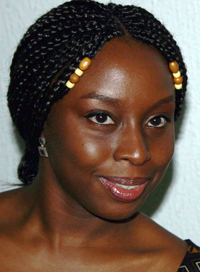
Chimamanda Ngozi Adichie, the author of Half of a Yellow Sun, always knew that she would write a book about the Biafran war, which claimed the lives of both of her grandfathers. To illustrate the conflict and the toll it took on her people, Adichie examines the war through characters whose lives are ennobled, warped and destroyed by it.
"I have heard literature called 'the soul of history,'" Adichie told me last Thursday, shortly before her appearance at the just-concluded Vancouver International Writers Festival. "For me, great historical events only make sense when we read great fiction about them."
Literature trumped science
Adichie, 29, grew up in Nigeria, in what she calls a "secure little university campus existence." Her father, a professor of statistics, assumed that his daughter would follow him into the sciences. Adichie enrolled in medical school but hated it. She fled to the United States to escape her studies. "I would have been a hopelessly unhappy doctor, and I probably would have been responsible for many deaths," she explained, drolly. "By accident, of course."
In Connecticut, Adichie studied and babysat during the day and wrote at night. In 2003 she published the novel Purple Hibiscus, which won the Commonwealth First Book prize and was shortlisted for the prestigious Orange Prize. Chinua Achebe, the great Nigerian writer, read Purple Hibiscus and Half of a Yellow Sun and was astounded by the maturity of the young writer's work. "We do not usually associate wisdom with beginners, but here is a new writer endowed with the gift of ancient storytellers," he noted.
To tell the story of the Biafran war, Adichie begins in the household of a mathematics professor in the early 1960s, several years before the war began. The professor, Odenigbo, is the central personality in a clique of political radicals. Every evening his home reverberates with fiery debate and the clinking of bottles of beer and brandy.
Into this milieu comes Ugwu, a boy who grew up in a village where refrigerators and telephones were no more than legend. Ugwu grows fiercely loyal to "the Master." He is initially nonplussed at the arrival of Odenigbo's new lover, Olanna, a beautiful, London-educated daughter of Nigerian nouveau riche. Through Olanna, Odenigbo's household becomes connected to her steely and unlovely twin, Kainene, and her hapless British lover, Richard Churchill. The early skirmishes in Half of a Yellow Sun are not military but sexual, and the plot whips along through incidents of romantic competition, deceit and reconciliation.
Right cause, wrong result
But domestic intrigues are soon swept up in national politics. In 1966, Nigerian army officers -- many of them of the Igbo ethnicity -- mounted a coup against a government that was perceived as corrupt and a puppet of the former British colonizers. In the counter-coup that followed, Igbo soldiers and civilians were massacred. The Igbo retreated to the country's Eastern Region, where they were the majority. The regional military government declared the birth of a new state, the Republic of Biafra.
In a recent interview on CBC Radio, Wole Soyinka, the Nigerian author and Nobel Prize laureate, said of the Biafran secession: "Politically it was an unwise decision, but morally I could not fault it in any way. And when the federal government of Nigeria decided to go to war with them, I deplored that war." For speaking out against the war, the writer was thrown in jail for more than two years.
The Nigerian army, with the tacit support of foreign governments, decimated the Biafran resistance and cut off food supplies. Between 1967 and 1970, when the war ended, more than two million people died, many as a result of starvation. One of the characters in Half of a Yellow Sun writes a book about the conflict, and in one of the short excerpts he notes that, "Starvation was a Nigerian weapon of war. Starvation broke Biafra and brought Biafra fame..."
Starvation as a political tool
In the West, the defining images from the Biafran war were of children with kwashiorkor -- the bloated belly, rust-coloured and patchy hair, and twig-thin limbs that accompany starvation. "Biafra was reduced to nameless starving people on TV screens and in magazines," Adichie told me. "But when I looked at the pictures, I couldn't help thinking, 'This child could be a cousin of mine. Or that man could have been one of my grandfathers who died.'"
But the war did not only bring tragedy. Biafra, during its short existence, was a source of great pride to its partisans. It was the first state created by black Africans, for black Africans. While it existed, there were inspiring examples of courage and self-sufficiency. "The people made their own alcohol, their own missiles, and they refined their own oil," said Adichie. "I wonder, where is that self-sufficiency now? Nigeria doesn't refine its own oil, and we get so much in debt because we import everything."
The title of the novel comes from the symbol at the centre of the Biafran flag -- a yellow sun, half-visible because it has just began to climb above the horizon. The tragedy, said Adichie, is that Biafra was crushed before the sun had a chance to emerge. While a fringe political group in Nigeria -- called the Movement for the Actualization of the Sovereign State of Biafra -- continues the struggle, most Nigerians have decided to lock away their memories of the brutal conflict.
With its rich, nuanced, and intimate portrait of life in Nigeria, Half of a Yellow Sun acts as an antidote to the usual accounts we read of Africa -- hard news reports of tragedy or duelling "how to fix it" opinions on the editorial pages. And Adichie's novel is, indeed, the kind of great fiction that can help us understand a dark moment in history. ![[Tyee]](/ui/img/ico_fishie.png)