Monkey Wrestles with Madness
Writers haven't done justice to BC's crazy history, but we might yet.
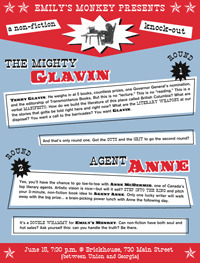
It was billed as a "non-fiction knock-out." Emily's Monkey, a loose group of Vancouver writers not content to sequester themselves in a garret, gathered for the second time at Vancouver's Brickhouse on Main Street June 15 to engage in madcap theatrics involving the written word and to drink heavily.
The star attractions were Terry Glavin, the author, editor and journalist currently stumping for his Penguin book Waiting for the Macaws, and "Agent Anne" McDermid, one of Canada's top literary agents.
Proceedings began as a man in a silver-and-blue mask (could it be...Dead Man in Paradise author JAMES MACKINNON!!!!) set the Mexican wrestling tone with his introduction of Glavin, who was billed to deliver a smack-down verbal manifesto on "how we should build the literature of a place called British Columbia."
"He might just have the clearest literary vision since Malcolm Lowry woke up without whisky in Dollarton," declared the masked man.
Glavin, however, began by retreating to his trainerless corner looking for the notes of instruction. "I haven't got the faintest idea what I'm going to say."
In fact, though, -- and unsurprisingly, for anyone familiar with The Glavin -- he said quite a bit. (Those who want to hear his exact words can obtain an audio file here.)
Sailing into madness
"The first thing we have to understand about British Columbia is that this is the Promised Land, this is the Holy Land," Glavin declared, a glass of Irish in hand. "There is no language that exists that allows us to talk about this place that comes from away."
He talked about what happens when you approach British Columbia from the sea. "You are looking for something that doesn't exist," he said. For newcomers in centuries past, that was mainly a passage to the Atlantic, a passage defined mainly in their dreams and hallucinations.
"If you look at the North American continent, it's a straight bleak line that goes all the way up to Cape Flattery and Makah, and suddenly there is this madness. It is complete insanity. There is no way to navigate it. There is no way to comprehend it. It is 26,000 linear miles of coastline, and another 30,000 to 40,000 miles of island coastline between Juan de Fuca and the Alexander archipelago, what is now Alaska."
Glavin also described those who crossed the Rockies to find a strange stew of life and myth and tales of predestination that must have confounded their weary constitutions: "When you come from the east, a similar kind of madness is involved."
He declared that the culture that resides here, that has resided here for much longer than we commonly imagine, is grounded in storytelling "that rivals epic of Gilgamesh and art that exceeds that of Michelangelo," and that many who come here become spellbound.
Our foolish imaginings
"One is unavoidably and ineluctably drawn into a kind of a magic realism. There is no other way to encounter this place...Nothing here conforms with the conventional and accepted meta-narratives of what aboriginal people are, about what colonialism was, about what multiculturalism implies. Nothing compares to this experience that we have carved out of the place, with our imagination, from the earliest moments of the human experience on this planet."
Glavin talked about Mud Bay Tom and Metlakatla, Brother XII and the Doukhobours, the Workers Republic and the Social Credit Party, the Technocracy movement and Greenpeace's better living through environmentalism. "When you look down through what we so foolishly imagine to be a new place, a young place, there's a lot of interesting things that we discover...We have consistently erupted in these utopian insanities that have produced a strange and distinctive and vibrant and multicultural and brilliant civilization in what is now known as British Columbia."
Glavin's injunction was for B.C. writers to tell the tales, because "no one has written any of these stories properly." He's a little modest, as he's told a few of them himself.
Others have as well, but not often enough, and not always well enough, although we are getting better at it. Anne McDermid, who heard 18 three-minute story pitches in a "confessional" as the evening's second act, confirmed this when she spoke to the hopeful. McDermid said a third of the writers she represents are from British Columbia. She believes that's because our writers understand there are great stories inexorably rooted in B.C. that matter enough to be told to the whole world.
In this one regard, perhaps, British Columbia is still a young place.
Charles Campbell is the editor of Tyee Books. Thanks to the Necessary Voices website for hosting the audio file of Terry Glavin's remarks. No thanks to the person who absconded with the Silver Beaver Award from the first Emily's Monkey event, which featured the First Annual First Line Contest. ![]()


91
Login or register to post comments
flyingfish
5 years ago
Comments on "Monkey Wrestles with Madness"
"There is no language that exists that allows us to talk about this place that comes from away."
This has become a popular (and by now somewhat shop-worn) theory to explain away the silence of various communities. It's been invoked over the years by feminists, lesbians, native writers and language poets claiming that since they don't "own" the language of the mainstream, (of the oppressors, of colonialism or the canon), there is no way for them to speak their own experience. That there is something so unique and presumably challenging and even threatening in their own stories that the common language actually conspires to silence them.
The success of these groups in developing a new narrative hasn't got a great track record. I suppose the language poets achieved it by simply abandoning narrative, but no one can understand them.
British Columbia is not so unique and bizarre that to confront it confounds common language. If you can write about California, you can write about BC. It's not the language, it's the comprehension, compassion and intellectual rigour the writer brings to his work. And there just isn't a lot of that out there, in BC or elsewhere. Irish-inspired post-modern flights of fancy about why we're silent might make us feel special, but far better to just sit down and write.
transmontanus
5 years ago
"There is no language that exists that allows us to talk about this place that comes from away."
Yep, that was me. It does indeed come off like some "silly postmodernist flight of fancy," Guilty guilty guilty.
My excuse is that I was, er, I think Frank magazine coined the expression "tired and emotional," which is to say the free drinks were a perk so I took advantage. But what I meant to do was to address the inadequacy of "language" from away in the sense of a vast range of ideas and terminologies, from elsewhere, that just end up so inadequate as to be useless in describing what one finds here, west of the Rockies and north of the 49th.
I could refer you to that recording of my rant, linked in Charles' piece, in the hopes that you might get a better idea what I was driving at, but I shudder to think what you'd find.
For instance: ". . .26,000 linear miles of coastline, and another 30,000 to 40,000 miles of island coastline." No no no it's not. It's 27,000 kilometers, not miles, of coastline. And I can't remember what the other number was supposed to represent.
So, flyingfish, here's the thing.
I happen to agree with everything you wrote. Especially this: "far better to just sit down and write."
You showed mercy, too. So here's to a common language:
Cheers.
TG
Right to Bear
5 years ago
Good Morning Terry,
Thanks for the explaination of your quote :-D LOL. I thought I was missing the poetic intellect necessary to get wrap my mind around this statement. I did however take the leap and eventually understood the concept... Thanks.
I am picking your book up today...but I am curious to hear your understanding and reasons why you believe as you believe, relative to the Makah whale hunt that took place, and the annual seal hunt off the coast of NFL. Hopefully you read my previous posts in the "Macaws" thread and understand where my heart lies on these issues...
Thanks for your time...
Peace
RTB
Truman Green
5 years ago
Excellent, RTB, surely Glavin's gotta tell us why he loves the baby seal killers so much sooner or later. I'm going to try to get a copy of the Fanny interview so I can quote it here, in case anybody thinks I'm misrepresenting him, as he claimed I did The Last Great Sea.
Here's uber Can-Litian, Glavin, saying absolutely nothing again, quoted from above. (pun intended):
"But what I meant to do was to address the inadequacy of "language" from away in the sense of a vast range of ideas and terminology, from elsewhere, that just end up so inadequate as to be useless in describing what one finds here, west of the Rockies and north of the 49th."
A vast range of ideas and terminology, eh.
And apparently that's an explanation for. "There is no language that exists that allows us to talk about this place that comes from away."
So now language is just useless. Maybe Glavin'll just hum or yodel about what he finds here "west of the Rockies and north of the 49th" (as if we don't where we are, I guess) seeing as how "language" is so "inadequate."
Is there an idea somewhere here? And why is "language" in quotation marks, anyway?
And so I'd like to know what this means, too: "There is no language that exists that allows us to talk about this place that comes from away."
I think there's a fairly decent chance that it's just more bs, and although it seems that I'm just being mean, this is a serious literary review. I'm currently pitching New Star for my new book on West Coast Literature, the working title of which is "Beyond the Age of BS."
transmontanus
5 years ago
Hey RTB.
Thanks for taking the leap and cutting me some slack on the weird language thing.
Tell you what.
I'm going to be writing elsewhere about whaling and so on in the next few days, and if you actually do pick up Waiting for the Macaws you'll come to a chapter set in the Lofoten Islands, off Norway's north coast, which explores the issues in some depth.
So I'll try to post back here within the next few days, by whihc time we will both be ini a better position to engage in a civil and reasonable and well-mannered donnybrook about the whole subject.
Cheers.
TG
Truman Green
5 years ago
Okay, don't edit me for gratuitous meanness, eh, Charles, but a writer who finds language "inadequate" has indeed a rough road to hoe.
Right to Bear
5 years ago
Terry,
I will be leaving to explore parts of the Central Coast in a few days, and can hardly wait. But yes, thank you, I will be doing some reading, and hopefully we can connect on these subjects before I go. Perhaps if the "gods nod" we will have the oppotunity to corespond... Thanks.
Peace
RTB
Hey Brother Truman...rtb
Skookum1
5 years ago
Well, first off, Terr, why didn't you tell me about this shindig? Hearing Glavin hold forth live is a rare treat, never mind maybe getting a bit snokked with ya afterwards, too...I think I feel jilted ;-)
But about the topic at hand, and the gaffe concerning the length of the BC Coastline aside, I do understand (even if flyingfish doesn't), I'm not quite sure where to start. I agree totally about the failings of "normal language" to cope with BC's history, geography and identity, and have run head-on into this in my edits and discussions at Wikipedia. Worth mentioning also that in one article somewhere in Wiki, someone had described our coast as "Canada's forgotten coastline" - a perspective that only somebody from Eastern Canada (aka Central and Maritime Canada) could have. Similarly, during another Tyee Comments Forum recently (on one of Rafe's columns, I think) someone was holding forth about Canada having an East-to-West perspective and history, something that is so clearly WRONG if you're from BC (from BC, not just living here) that it's not worth elaborating on; still the original poster of that comment went to great and not very accurate lengths to justify that perspective; which to me is an intrinsic problem of the "Canadian curriculum" not having a BC perspective to speak of, and the "national identity" being defined by such perspectives and biases.
So I guess that leads me to this bit of flyingfish's post:
.
Yeah true enough that last sentence (but not the first; I'll get to that in a bit); and one reason for that is because publishing and academia and media here are heavily colonized and full of value systems and priorities that are "from away"; what is genuinely a "British Columbian voice" might receive short shrift from a transplanted editor or publisher, or just not be recognized as a "Canadian voice" and so never get any attention beyond BC, if at all (since reviewers here write about writers and writing from other parts of Canada more often than not).
Even, or rather, especially the "big histories" which have been published in recent years are full of this. Barman for instance obsesses over things which interest here like demominational politics, national social policy as it affected BC, and such, but overall she spends a lot of energy (and selective evidence-gathering/misrepresenting) trying to show that BC is just like anywhere else in Canada, it was destined to be part of Canada, its identity is Canadian, and so on. She rarely examines what it is to BE a British Columbian, or what it is that makes British Columbians tick; she tries to rationalize us as eccentric Ontarians or something. And makes the usual po-mo value judgements and proonuncements on all the usual bits of BC history - but none of the neat stuff, none of the really character stuff; she visits (through Emily Carr) the Lillooet Country and doesn't even quote any Ma Murray; instead she uses Carr's depressed and out-of-place/context observations as if they were FACT - because they support the (wrong) thesis of the paragraph/chapter she's on about at the time (in this case the Dirty Thirties). (cont.)
Skookum1
5 years ago
(cont.)
And speaking of language, Barman is one of these post-modern types who feel a need to revise not just our history for us, but also our traditional language; as far as I can tell it was she who coined the abbreviated "Kanaka Ranch" for the "Kanaka Rancherie", supposedly (one assumes) because "rancherie" is a derogatory word; which it's not; this mistake has been repeated in Tom Koppel's book Kanaka (in which he mistakes a Chinook word, tamanos, for a Hawaiian one) and has been since perpetrated in print media as if it were correct. Barman's book impressed the critics in Toronto and hence the bumpf on the jacket from Quill and Quire[/I[, but that doesn't mean it's authoritative or credible, or should have; assumed the pride of place on university curriculum readings as it has come to occupy.
Maybe more to the point about a BC voice (which Barman clearly isn't), Bowering's [i]British Columbia: A Swashbuckling History, which has a bit of buckle and really no swash at all, is full of glib and trite judgements as opposed to valid history; and shares in the academic-cultural parochialsim of the educated classes ad nauseam. Only slightly more readable than Barman, and no more reliable. But again, cited as a "great work" by our overwrought reviewer-scribes because of the absence of anything else it's all there is.
But I bring up Bowering for a specific reason here; in one chapter about culture, where he extolls the questionable boredom of BC poets and composers and bemoans the fact that we don't give a fig for them (Barbara Pentland was a nice woman and has all kinds of credentials and elite composer upbringing), but her music is unlistenable; much as a lot of BC poetry, like the crud circulating on transit transoms lately, is completely out of touch with both what poetry is, and what people can or want to understand. So....somewhere in Bowering's ramblings, he singles out the widespread writing of homespun poetry in the smalltowns and rural communities and expresses thanks that it never reaches university curriculum and doesn't deserve to. Really, huh? Yet those are voices of people who live in the landscape and deal with life outside the poetry reading rooms and university lecture circuit, who tried (not successfully but sometimes admirably) to express their life and homes and nature in BC in their own, simple words. That material SHOULD be studied, and some of it evaluated, and I know there's some nuggets out there (the Okanagan Historical Quarterly is a good place to look for some of this stuff, but it's all over the place). The example is of a nose-sniffing Canada Council artist turning his nose up at popular art, and it's not a pretty picture.
I'll have to continue in a second post; but to sum up this one and citing the conservative pundit Barry Cooper (from Alberta) that "BC has yet to produce its own voice" (paraphrase) I'll venture that the reason for that is because BC hasn't been allowed to have one. And when it emerges, it either gets judged as "not worthy" or "un-Canadian" or something else; in Cooper's case, it's because despite him coming from Alberta he just doesn't know BC, and anything in BC that IS unique is simply styled in the rest of Canada "eccentric" or "quirky" (at best). In other words, painted negatively/comically and dismissed either on those grounds or as anomalous to "the Canadian experience". Gee, could that be because we're DIFFERENT? No, the shills reply, because we're constantly told we're not, we're just like other Canadians. News to me, 'cause I've met lots, and they're largely completely clueless about BC [I]except what they've learned[I] from the national media/curriculum. Point blank: we don't have our own; what history we have is maligned constantly, and the good stuff is passed over.
Skookum1
5 years ago
"What good stuff" some of you are no doubt wondering. Well, Ralph Edwards comes to mind, but that's in letters; in social/cultural history it's too lengthy to get into here, but the image of a racist, bigoted "British-dominated" British Columbia is rife, especially in Mulgrew's recent Sun/Global columns on the Head Tax Redress Train. Here's an example of the distortion of BC history that so warms the cuckolds, er cockles, of righteous Canadianist historians: the anti-Chinese riots of '85 and also the bigger anti-Oriental riots of 1907 are used as examples of how racist/bigoted BC is/was. The reality is that on both occasions the rioters were out-of-work labourites, largely from Central/Maritime Canada and only recently arrived in BC, who were outraged that Chinese contractors bid 1/3 of the labour rates of others (an interesting and rather trenchant tidbit entirely absent from all recent coverage; a tidbit that that Barman woman dismisses as a "perception", which in itself is an interesting twist on what words should mean, rather than what they do). Mulgrew's column and other po-mo accounts credit BC's "British dominated society" for being behind the racism; actually it was transplanted Canadians unused to the multiracial nature of BC (as it already was, and continues to be); more entrenched British Columbians, including those British the p-c historians like to sniff their noses at so much, were of a more pragmatic attitude and, especially in the case of 1907s, were mortified at the labour unrest because it was them who had learned to depend on the Chinese for so much (not just railway labour). Similarly, the most anti-Indian bigots in BC quite often have tended to be recent arrivals; my Dad was always firing guys on the Bridge River Power Project who'd come from the Prairies or Ontario who didn't want to work alongside natives; Dr Miyazaki, a Japanese relocatee who stayed on in Lillooet after the war, comments in his autobiog that "you couldn't be a racist and stay in Lillooet very long" (because of the multiracial nature of the place); maybe this is one reason why Lillooet is passed over by so many historians eagerly looking for things about BC to denounce.....
The image of a stuffily Briish BC crops up also in Bowering and Barman and throughout the noxious wastes of current BC historiography; but the Brits that were here more often than not were not the villains, if there were any in fact; the Brits in Gastown in '85 were not part of the riot, and helped non-whites in the community evade trouble; it was Canadianization that made early VAncouver more white, not BC policy. But oh, it's so much easier to blame BC than "immigrants" from the mainstream national culture, isn't it?
Right to Bear
5 years ago
Whoa...!!
rtb
Skookum1
5 years ago
Now, about a "common language". I do agree with Terry and I don't think that Flyingfish got the idea. For one thing, assuming that there IS a common language is a big leap; it's asuming we mean the same things with the same words, whic it being BC quite often we don't (especially politicans); all the time we hear politicians and media re-interpreting words and phrases to mean something quite opposite from what they were taken to mean ("restraint", for example, in 1983). Again, in Wiki, on the Canadian English, Canadian slang and Canadian words pages and elsewhere, the mere proposition that there was in fact a BC dialect, at least at one time if not in the homogenized, multiculturalized present, was overtly dismissed by Canadianists since "all Canadians sound the same" and there's no academic cites otherwise - but again, academia in BC is colonized, and linguists are more concerned with aborigtinal langauges and minority groups than with the alleged mainstream, despite any unique local dialects such as we know exist in the Cariboo, Chilcotin, Lillooet or UpCoast which do deserve study/documentation but aren't politically fashionable enough (or are treated as "hick", and the Kootenay and Okanagan seemed to have some particular town accents, even still back in the '0s, though we never really thought about it as such so much as character types. Finally someone on Wiki produced a linguistics paper which DID explore BC's prunonciation foibles, at least some of them; but still you'll hear in the Big Media that there's only one distinct English accent in Canada (Newfoundland's); the more you repeat something, the more it becomes true. The impact of such "consensual media" on public discourse is something that hasn't quite hit our politidcs and business and even academia yet, but is certainly on its way; certain kinds of knowledge, public information, is to be necessarily democratic in the extreme..
There's been no solid writing on the nature of so-called pre-mulcultural BC, even tghough our histories are full of all kinds of ethnicites who were promiennt in public and commercial life, or just down the street at the neighbourly level. Nobody was a foreigner, they just sounded diffferent because of where they'd come from.. I was raised in places where native-born English came in many flavours, from all the varieites of British and Prairire/BC Canadians (nearly all second generation and not old-stock Canadian, and largely from Europe originally), Europeans and second-language speakers including the other Europeans (who were many), Indians, and (where I was what few) Asians. You were used to the presence of a mix of accents from early on and picked up this and that, even if by comedy, and it was juts accepted that English. And I don't mean to dwell on the area; elsewhere John Andrew Mara, Isaac Dixon and Arthur Bunster among many others come to mind as "unique" (see below) to BC; yet none born here "distinct" and, no matter where they came from, couldn't have become what they were anywhere else, or this was at least their stage. Even the Brits were largely rogue Brits, relative to the tea-and-corset image poularized by the Island tourist trade and our own public mythology about the old days; they may have dressed well for photos, but this really was the wild frontier, adn I'm not sure how many people who haven't read up on the place can really understand that, with the way it is now. Other Brits stern but pragmatic retired military with land grants (often ranchland that survives today in one way or another, when not in a conurbation since); but obviously these were the type of Brit who'd rather live in the wild, either with an imported wife or a native one, than settle into Kent or Sussex or some cottage row in the Midlands. And they were not like the Brits who settled southern Ontario so much earlier on; they had come around the Horn, lived in California or China or India or Africa or Oz.
Truman Green
5 years ago
I rest my case.
Anyways, RTB, I really appreciate the words you chose to describe the Makah's unfortunate killing of that gray whale.
flyingfish
5 years ago
Skookum, I assumed that when Terry was speaking about language he meant it in a larger and more theoretical sense than slang, accents, dialect, and political buzzwords.
For example, some native writers have challenged the form of western narrative itself, with its beginnings and endings, its absolute moral lessons and authoritative authorial voice as being fundamentally alien to native culture. That to tell their stories, they need to write not just content but form that is so fundamentally different from anything Europeans are familiar with that we would not recognize it as a story. Yet it is.
Feminist writers, too, critique the traditional heroic, linear structure of the male canon, arguing that women's understanding of the world is more intuitive, fluid, co-operative and comparatively fragmented and women's literature needs to find a way to express that -- a form that male critics or publishers would likely dismiss as pointless, plotless and meandering.
My point was that I don't think British Columbia culture is quite that alienated!
Right to Bear
5 years ago
Good morning Terry,
I did pick up your book and admittingly I am not done reading it yet. already there are parts that I agree with and parts that I question. You clearly care a great deal for the traditional people of Norway. I understand this as I lived in the Maritines for a few years and though I openly disagreed with the seal hunt, I value my friendships from this beautiful area.
Terry, my thoughts are, as I mentioned before, if the whale hunt is for sustenence of which a peoples survival depends on, in other words, THEY eat the meat and fully use the few whales they catch, fair enough. However, if they are selling the meat to foreigners (Japen persei), this would be abuse and exploltation defined... A communty needent more than a one or two whales per year at most if it is for their own use.
The killing of a whale should only be something a community does because they are hungry NOT becouse the can...
On the concept of science... Sustainability...Not a complete look at this issue... Ethics is the other important ingredient to make educated decisions.
As I mentioned before Terry, tradition alone is NOT a reason to continue.something if includes the death of another...it has to be an ethically reasonable practise and simply has to make sense on the basis of survival... Nothing less then this "test" will do...
Do these people fall in that catagory Terry??
Never is commercial whaling acceptable, even if only on the basis of Ethics. I
I look forward to your response Terry... Got to get to work this morning but I will be back...
Peace to you...
RTB
ps
Thanks Truman, and I appreciate your imput on this subject as well my friend...Peace.
rtb
Right to Bear
5 years ago
Man oh Man...Sorry about the corrections.
"The killing of a whale should only be something a community does because they are hungry NOT because they can..."
"On the concept of science... Sustainability alone is not a complete look at an issue... Ethics is the other important ingredient to make educated decisions."
"Never is commercial whaling acceptable. It will fail on the basis of Ethics everytime."
Apologies all...RTB
Skookum1
5 years ago
Flyingfish: I wasn't meaning to discuss dialects, so much as how the "common language" of Canadian discourse has obliterated those dialects, or made short shrift of them as "not part of the Canadian experience" or whatever. As for the buzzwords, as you call them, these were meant as examples of how the language fails when faced by something ineffable; so "big" sounding words like "ancient" and "sacred" are used to sum up what might otherwise have been a flight of prose or poetry, had the writing skills and vocabulary been available. I'm sorry my ramblings of last night are hard to follow; if anythning they're incomp[leete; bu tthe idea is that there's a necessarily different language in BC - in different parts of BC, even - and that the mainstream language of academic/intellectual discourse has tended to impose judgements on BC, rather than simply observe BC and look for conclusions; but that's a whole discussion on historiographical methodology which there's no room for here.
But as for the rest of your reply.....Gee, apparently having testicles and non-aboriginal skin means I'm supposed to think a certain way, and I should make room for "non-linear" and "feminist critiques" which are supposed to be more valid/relevant? Sez who? You? And you go on to say you had no idea BC culture was so alienated, but your kind of talik is what alienates people in the outcountry, and who are otherwise outside the "chattering classes"; you've invoked two methodologies/frames of reference which EXCLUDE the experiences and opinions of (a) "linear", non-First Nations mythologically-geared people and (b) those who haven't/won't worship at the altar of feminist deconstructions of "male history".
LOL. Terry can tell you I'm the least linear guy you'll ever meet, and have a better grasp of "cyclic history/experience" than most of the ideologues who espouse the non-linear mindset. But I can also tell you that to dismiss the male experience of history, culture and identity in BC is to be wide off the mark; 4/5 of the non-aboriginal population until WWI was male, and feminist critiques of places like Yale and Lillooet in '58 just have no bearing on that contemporary reality. Sure, if you want to trash male behaviour in the goldfields it's like shooting fish in a barrel, but what's the point? No one else will read it or care except other people who ascribe to the same ideology-cum-methodology.
And what you're implying is that non-First Nations and non-feminist histories don't have any validity or relevance in BC, or that somehow there should be a priority on them and all the "male white" version of things should be ignored or set aside. But it's (the British Columbian identity, which IS heroic, over-the-top, mythic as well as linear) which has barely been documented, thanks to the domination of the national media/academia and also because hte intelligentisa/chattering classes here have elitist attitudes towards hicks, white trash, etc; and current BC histoigrophay blows pages upon pages on such important matters as "Women in the Fur Trade" (a near entirely male enterprise) by making speculations based on other parts of the country. No wonder Bill Hoffer hated the arts/academia grant system. YOU may not think BC is all that alienated; but by that it seems to me you just haven't talked to many people outside your own frame of reference (including people who think feminist critiques are worth shoving down everybody's throat, as if we didn't have enough male-bashing in our history/media already). Want to make peopole not give a shit about BC history/identity? - just shovel them more of that crap. Talk about not having a common language....
Skookum1
5 years ago
And to RTB (Charles, right?): Don't be shocked or bring the horses to buck, boyo, and shut down the dialogue. The views given of the events in question and who was responsible are throughout Maj. Matthews, Alan Morley's book, in the Akriggs and other pre-modern histories; the modern histories turn the whole affair into a comic book "white guys are racists, Chinese are victims" story, completely obfsucating the events and also the reality that it was Eastern Canadians who perpetrated these riots, and the long-time British Columbians who displayed tolerance and cooperation far more often than not. This is what I mean about history being debased by the imposition of post-modern ideologies; which is itself a form of intellectual colonialisjm - "you have to think like this now, and whatever culture you had before is no longer valid". Especially if you're male, white and not in agreement with the "new history", which doesn't examine the older material but instead concocts interpretations based on modern values and ideas completely out-of-context with the times and people whose stories are being told. Or rather, deconstructed. But isn't deconstruction the art of taking something apart, so that it won't/can't work? That's what's happened to our history, our identity, our culture; we've been deconstructed.
Even Terry's efforts to talk about the poesy and ineffability, the failings of language, in re BC's landscape and people, have been sidetracked here by flyingfish's invocation of "non-linear" ways of thinking and "feminist critiques"; the point is that we haven't really undertaken to write our own history, and funding and intellectual support systems have preordained agendas which prevent this from happening. And in cases like the Anti-Oriental Riots, the modern "official" version does not allow for discussion of background. In other words, no debate is allowed, unless it conforms to certain ideological paradigms, and certain conclusions are preordinaed ("BC has a racist history") which aren't really true. But they sure are convenient.
Right to Bear
5 years ago
Skookum 1,
Thanks for your response Skookum...
Would you mind simplifying what it is you said. Sorry, but I would appreciate understanding you post a little better...
Peace
RTB
Skookum1
5 years ago
postscript: I found myself chuckling while showering just now because of some ironies relating to flyingfish's cant about feminist/non-linear views. In the case of my own area, the histories were near-completely written by women, and I can guarantee you that Mrs. Edwards Short Portage to Lillooet is anything but inear; likewise Mrs de Hullu's Bridge River Gold and Drake-Terry's somewhat unreadable opus Time Out Of Mind; the L Green book I mentioned uses these as sources. What I'm getting at is that flyingfish made the assumption that BC history is male-driven; really much of it, especially local histories and frontier histories, was written by women, and not in a hero-driven linear fashion either; and all the books mentioned deal with native stories and the Chinese experience sympathetically.
Here's another jab at feminist history: why is it that feminist historians in this province seem to avoid studying the biographies of the notable women who helped build the place, or whose existence defines it? Other than the old canard of Emily Carr, that is. I'm thinking of course of Ma Murray and Frances Edwards and more, but also of Myrtle Philip and Delina Noel and the visit of Lady Jane Franklin. And all those kitchen poets and folk historians the Poet Laurieat'es schlock history of BC dismisses so patly, as described in my previous post, were overwhelmingly female and quite often "non-linear".
Or the "great" women politicians of the Fraser Valley (Reeve Ethel Ogle of pre-amalgamation Mission District, the aforementioned Belle Morse in MR, my own mother as dep-mayor in pot-amalgamtion Mission, and lots more; none of whom would consider themelve feminists, by the way, but all independent women who thought for themselve). Women DID play a big part in BC's history and society (often more matriarchal than latter-day historians/writers are generally aware - epecially in the company town), but to know their names you won't find that in any feminist-critique histories (which are, of course, about drubbing men and only interested in women's stories when they give something to carp at male culture/hierarchy about). And it took a male - Sage Birchwater - to profile Chiwid, another female figure archetypal in some ways of the "real BC"; certainly repreentative of the skookum tillikums, but there' one of those ineffabilities about BC that defy easy translation/rendering into ordinary language....
Point is that making sweeping generalizations about BC history/languge/identiy being "too male, too linear" is actually really inappropriate, given the number of folk historians and other sources who are women, or the marked role women played in a ociety that was numerically largely male. In other words, pronouncements are being made, based on other pronouncements, but the actual primary materials and realities concerning their authors fly in the face of these pronouncements. If the chattering classes actually read the source mterials, instead of each other's analyses of somebody else's analyses, we might get somewhere.....
Skookum1
5 years ago
Which one? ;-)
Skookum1
5 years ago
[Quot]pot-amalgamtion Mission
Oops. Meant "post-amalgamation".......
Skookum1
5 years ago
RTB: I'm not sure whether you mean my version of the anti-oriental riots, comments about deconstructed history/identity, or exactly what it is you need me to explain more clearly. Speaking of being non-linear, it's kind of in my nature; but if you point me where you need me to go I'll do my best.....
Right to Bear
5 years ago
Thanks Skookum 1, o.k. You had said the following:
" This is what I mean about history being debased by the imposition of post-modern ideologies; which is itself a form of intellectual colonialisjm - "you have to think like this now, and whatever culture you had before is no longer valid". Especially if you're male, white and not in agreement with the "new history", which doesn't examine the older material but instead concocts interpretations based on modern values and ideas completely out-of-context with the times and people whose stories are being told. Or rather, deconstructed. But isn't deconstruction the art of taking something apart, so that it won't/can't work? That's what's happened to our history, our identity, our culture; we've been deconstructed".
Could you explain, relative to FN's history< how deconstruction has affected them, if indeed in your opinion, it has...?? Is it media, political leaders, and writers who are at fault if this is the case??
Yes too, an expansion on the anti oriental riots and your understandings of them...
One more my friend, can you simplify the issue you have with "flyingfish" for my right dominated brain... Much,much appreciated Skookum 1, and thanks for your time...
Peace
RTB
Skookum1
5 years ago
my right dominated brain
Your left-dominated brain, you mean; I'm right-brained for sure....have to go meet someone for lunch; will return to obfuscte/elucidate further afterwards.
Right to Bear
5 years ago
Terry, you wrote in your book saying esentually without communities traditionaly engaging in whale hunting, "...the world would be diminished. It would be one more extinction. We'd all be that much closer to a monoculture, and Loftoteners would be pulled just one more degree back from a sustainable economy derived from the variety of ecological niches and abundances in the seas around their islands. Eventually, their old stories would die."
This truly paints a bleak pictue my friend. Essentually you are saying that if these people cannot use whaling as an economy, they will slowly dissapear. As you know Terry, many other societies that were once based on whaling have adjusted, some quite well. I believe people, though in some ways very fragile, are capable of being very strong and resilient... Economical diversity perhaps would become more important without the finacial rewards of whaling, but as a society they would heal since no longer would they be responsible for exploiting Mother Earth...
Ecotourism is fast becoming a proven economy for these once whaling societies. Loftoteners could too recieve the same financial benifits by engaging in the ET business...
My point is, these awesome magestics of the sea and humans can co-exist together. The minke whale, though numbers appear by human standards (questionable at best) to be there, will likely follow some day, the extintions of other whales who disappeared largely due to Norway's hunting of whales.
The problem with humans thinking they understand the sensitivities of the natural order, is that they actually do not know enough to know what they do not know... That is how little we know about the great beasts of the earth. Our footprints need to be much smaller and more respectful imo...
Peace
RTB
Skookum1
5 years ago
I'm just going to stay away from that whale business, except to comment that on the CHINOOK listserve long ago (as Terry may remember) got in a lot of hot water for quipping about someone's statement that she was so happy the Makah could kill their whale she wanted to dance over it - my response was "I'm sure the whale feels the same way". I was shot back/down with the "you're not from a whaling nation - you have no right to speak". She was a Klickitat or Yakima (non-whaling peoples) and I'm a Norwegian - go figure.
Now about this deconstruction stuff, RTB, by asking me to comment on deconstruction re First Nations history you've moved the goalpost. I'm not First Nation and when I said "my" history, I meant the general history of all peoples of BC, not just as defined (deconstructuralist-style) by a particular race/ethnicity, gender or class construct. The damage to culture and identity I was talking about was not concerning First Nations, and in fact I daresay if First Nations culture were subjected to the same nitpicking and often vicious detail as has been perpetrated on what is pronounced to be the "white male patriarchy" it wouldn't fare so well. What deconstructionist stuff I've seen on BC history was in the First Nations vs colonialist/white paradigm, with all whites being lumped together under "European" even though there were an easy six or seven distinct groups of them (if not more) and it doesn't serve history well to "level" those identities on behalf of a post-modern interrprtation.
Interestingly, the Chinese and other non-whites - who were every bit as colonialist and exploitive of native lands and resources as anyone else (during the gold rush, even moreso in the case of the Chinese workings in the Canyon) are spared from the same colonialist-exploiter tag, and I have yet to see a paper on the "yellow male hierarchy" of the traditional Chinese society, which is patently chauvinist and sexist in the extreme (in my own lifetime I've seen women in Vancouver with "pearl-foot" bindings, and everybody knows about some Chinese girl who wasn't allowed to date a white guy because her dad was racist about it). Similarly, a truly deconstructionist approach to the materialist and power-mongering aspects of the potlatch culture has yet to be done, and the ongoing "red male patriarchy" built into many band governments is taboo as a subject, although it rears its head every once in a while as (I seem to remember one of the female Point family chiefs having this kind of issue in Musqueam, for instance).
In terms of the frame of reference of my posts and also Terry's "no language from away" paradigm, deconstruction is one of those "languages from away" which seeks to impose its value system and means of analysis on something that it doesn't really understand and to which it's not really relevant. Its problem as a methodology is that it's intrinsically loaded with various subjective biases, including its own framework as a construct of post-existential, post-imperialist intellectual traditions; it presumse, like all social science disciplines and methods, to some kind of objectivity, without being able to grapple with its own inherent subjectivity. Kant must be laughing, and Wittgenstein; logic is not a self-sustaining system and it shouldn't be perceived as the only reality. But it and its bastard children (among them deconstructionism) are treated as proof-of-fact and have become academic doctrine. Mythological points of view, poetic history, "common sense" knowledge and folk history, are all treated as objects of study, but not taken at face value or accepted within academia as legitimate modes of thought; part of the problem here is that in modern academia it's not the discourse that constitutes the education, it's the credentials and the quantitative-measure systems that get you there.
Skookum1
5 years ago
So what is deconstruction of First Nations issues/identity/history, and who's to blame? Good question. Certainly not Terry or the publishing house he is affiliated with; High Slack comes close to deconstructionism at points but overall it's extremely non-linear and mythological in character; as is Terry's Nemiah: The Unconquered Country and [IIBirchwater's Chiwid[/i]. Even Ghost In The Water, with its biology/ichthyology undercurrent, is mythological in tone and content.
I don't have my old HIST 436 text from SFU handy; it was chock-full of deconstructionist irrelevancies, many of them concerning the apposition of First Nations culture (as if there were [I]one[/} commonality of such, which of course there wasn't) with the invading/occupying culture (you-know-who, othrewise known as the Big Bad Wolf, and which also wasn't monolothic). One essay I remember, other than the aforementioned dreck on "Women in the Fur Trade" and an overblown doctor's thesis on how big-game hunting was an expression of the white male patriarchy (duh), had to do with the supposed imposition of the Anglican-Christian landscape on the society of the Fraser Canyon, based on Col. Moody's religiosity, Bishop Hills' sermon in Yale (which was attended by all of three or four people, out of a few thousand) and the paper establishmnent of bishoprics and church allotments of land. Joke is that none of this took root, although to read the paper in question you'd think it was cultural Armageddon in the Canyon; miners and Indians alike just ignored the pious types, frankly; but this doesn't stop a latter-day academic from writing a paper to make their actions sound important, when really they were trivial. Interestingly the same author made no mention of the Revs. Lunden-Brown or Turner or the role of the "saddlebag parson"; likewise no mention of the Oblates; maybe because what they represented just didn't conform to the thesis advanced in the paper, and therefore weren't welcome as evidence.
What was another one? Lemme see - oh yeah, a paper on the imposition of the patriarchy in Burrard Inlet's milltowns (pre-railway) and how supposedlyl there was a systematic attack on native/frontier lifestyles. Actually, for anyone who's read Maj Matthews, Morley or Olga Ruskin's book and so many others, what happened on the inlet was a breakdown of Victorian values and the efforts of the white male patriarchy to assert itself; there are examples in the essay which counter-prove what the author thinks they do; but he's coming at it from wanting to find what he wants to find, and won't look at it from another angle. Not taking the events and people of the day at face value, but instead "deconstructing" them so as to "make them meaningful for modern-day readers". Which modern-day readers? Other deconstructionist intellectuals, or the general public?
So is it writers, editors, publishers? All three, well-meaning though their motives may be. What's come down the pipe is the cultivation of a variety of overworn cliches about BC history, and very little actual context of those cliches, or of other events/issues that aren't convenient to the ideological prejudices of academics or writers or publishers or whomever. Write to an agenda and you'll get published, so long as it's the right agenda.....
But again: deconstructionism is an outside judgement system, not relevant either to First Nations history or to other groups in BC; deconstructionism may work well with classes and groups of people; but for a society built by individuals and "characters" it really doesn't work. A deconstructionist history of Ma Murray? J.A. Mara? Arthur Bunster? Waiting to see it.
Skookum1
5 years ago
But rather than saddle editors, publishers and writers to blame entirely, let me single out academia for its highy-mindedness and high-fallutin' attitudes toward the great unwashed. Because it's them who've "educated" the edditors, publishers and writers and whom the latter will cite as if their ideas were facts, and not opinions...more in a bit; just a postscript ot previous.
Skookum1
5 years ago
This has become a popular (and by now somewhat shop-worn) theory to explain away the silence of various communities. It's been invoked over the years by feminists, lesbians, native writers and language poets claiming that since they don't "own" the language of the mainstream, (of the oppressors, of colonialism or the canon), there is no way for them to speak their own experience.
Short (hopefully) rejoinder to this: it's the communites in BC, self-defined or geographic, that I'm on about who the "mainstream" (here the academic/journalistic mainstream, rather than the one flyingfish means) that have silenced the histories of various communities and identities in BC by refusing to study them, or making sweeping generalizations about them (such as lumping Britons, Canadians, Kentuckians, Californians, New Yorkers, Ozzies and the heinz fifty-seven of European ethnicities, all together as "Euroipean" and blaming them ALL for EVERYTHING); silenced the history of the individuals whose stories comprise BC's history and identity, and of the non-ethnic, non-gender-analysis-interesting, non-First Nations communities. Except when dealt with as cultural objects or some kind of ghettoized identity, as with the recent books on Portuguese Joe on the Kanakas or Holt's or Woodcock's books on the Doukhobours. Not dealing with people as people, but as "communities" is part of the imported/outside language.
The general public doesn't read modern histories because they're, well, thick (and I don't mean in terms of number of pages) and because they don't speak to them. Instead, such histories hector and bait and shame people, and also don't cover non-fashionable groups who might nonetheless have some connection to the reader. That many groups, such as my own Scandinavians, have largely assimilated (wilfully) is beside the point; their identities have been leveled to being part of a "British-dominated racist and chauvinist, imperialist etc" white society. It's too cheap and simple of a way to look at something so complicated as BC's history; and I submit that "communities" is not the operative paradigm, but "individuals" are. Whether it's FN, Asians, or "Europeans" you're talking about.
Right to Bear
5 years ago
Thanks for your insight Skookum 1.
I appreciate your comments on the whaling issue... No problem, I can wait to hear from Terry... If your reading this Terry, I am leaving for the Central Coast at 4 am Sat, so no blogging except tonight for a few more hours...;-).
Skookum 1, indeed a mind stretch for me, but a good one. So academic's have largely been responsible for the deconstruction of true history. It sounds a little bit like unintentional\intentional sensoring or spreading of 'their take" through the manipulation of "language" be it written or spoken. As you say Skookum, they are the teachers or many... Are you suggesting too that the understanding from within another culture, and their ability to comunicate it perhaps through writings and stories, are not listened to or simply respected enough to be included acurately in 'our' history books, at least not to the degree of importance that actually existed within the events of history. They have been deconstructed, and replaced even... Interesting. Their story is so important and pocesses so much understanding. It would be a great loss to us all to not learn their 'story'.
Skookum you said: "...and I submit that "communities" is not the operative paradigm, but "individuals" are. Whether it's FN, Asians, or "Europeans" you're talking about".
IF you have a minute, could you expand on this a wee bit. Also feel free to correct my "take" of your comments... It would be much appreciated...
Peace to you Skookum 1 and thanks
RTB
Right to Bear
5 years ago
Skookum 1, one question I have that perhaps you can explore with me is, why is the intellectual community (profs, teachers) deconstructing this information. Is it they are just repeating their mentors? Why then would the"mentors" adjust the truths from other cultural perspective. How do "they" benifit??
Thoughts...
RTB
Truman Green
5 years ago
Hey Rtb, did Godot show up? No? This is getting absurd. Anyhows...Derrida might not be overly impressed by Skookum's particular brand of verbose deconstructionalism, and would insist, I suspect, on imagining the thoughts of that poor whale, waiting for his/her own Makahs while gliding through the fjords of this otherwise apparently unwordable province.
Right to Bear
5 years ago
Hey Truman, Who is Derrida, and Godot?
At any rate, I should stick with what I know, and that is the life of that young female whale is a life worth fighting for... It indeed breaks my heart at the same time as moves me into action...
I am tripping out to Central Coast to explore. Speaking of which, if the gods nod, maybe I will be fortunate enough to experience some whale energy...Cool. The majesty of these beasts cannot be denyed. I can hardly wait man.
Amazing how humans kill that which they fear eh Truman, instead of making an effort to understand them. They seem attracted to taking the life of the biggest and the best. It is really the same ego that you would find in people involved in Colonialism or Trophy bear hunting... pathetic really, and so lacking in understanding and harmony with Mother Earth.
Unless people are starving, these animals, should be left to be. It seems so clear to people like you and me... I am however very grateful there are brothers and sisters that feel the same...
Cheif Dan George said: "Talk to the animals, and they will talk to you. If you do not talk to them, you will not know them, and what you do not know you will fear, and what one fears one destroys...CDG
I appreciate your post Truman and I am leaving in a couple hours, so hold the fort my friend, and as I know you will, stay true to the course... Maybe I will will come back with a few good stories...
Peace my friend...
RTB
Skookum1
5 years ago
I hope you're not just humouring me and egging me on for fun (?) . . . .
I was going to first relate the untold aspects of the aforementioned riots and their circumstances, which are so easily passed over in the simplifications of history presented in the mainstream press (which is where most people get their historical knowledge, rather than from dusty and sometimes readable tomes). But I have to split (again) but shall return; before I go, though, this caught my eye just now:
One of the great tragedies I witnessed during my adult years in and around the canyon towns was the dying-off of the old frontier stock - the "white elders" of that area, as it were, whose stock of knowledge went unrecorded and largely undocumented, except by those earnest women I spoke of, all of them born or lived long in the bush, and seen modernization come and go. There has been almost totally academic disinterest in their lives and times as accordingly for First Nations, as deserved; other than Green's book, which again relied heavily on Edwards and de Hullu.
I wish I knew then how useful a tape recorder would have been taping who people talked, and what they talked about, up in that country. A few of them, a very few, are still left, that could talk about the old days, although many of their offspring still sound much like their folks, despite the impact of TV and the ability to get outside the area more easilyi than used to be the case (pre-1970s). Isolation bred one of those local dialect/attitude things, mixed up between Indian, Kentuckian, old-stock Brit/Scot/Irish and downright hoser. It's partly because of the old-timer twang in that country that I regret not having those tapes; proof that there was a regional dialect in that area, or some variation to supposedly standard Canadian English. There's still special expletives and old expressions, and of course a certain way of talking and stringing things together; a certain cadence. The English spoken historically in that area was very linguistically mixed by second language, from Germans and Italians and Japanese and Belgians and French-Canadians and Dutch and "Galicians" (Ukrainians and Poles) or those especially and notably American Southerners and those by way of the Mountain States; the cowboy twang/drawl in the Interior, in other words, is authentic, mixed in though with Anglo-Celtic and a rainbow of European, Asian and Indian ways of speaking English. Mixed with them, some of whom settled in to ranch, were retired imperial officers and an RE or two, and the native presence is and always has been so strong in that area that it influences the way white people talk quite a bit. Somewhere I saw a comment that the existence of such accents in local areas should be discounted in studies of Canadian English, since they're "not really Canadian". But they were accents spoken by born-in-Canada Canadians, developed here, and formed of the languages/dialects of people who settled here. "Not really Canadian" is something I've often heard about various aspects of BC culture/society; but doesn't that implicity indicate that whatever definition is being used is exclusive of British Columbian realities, since it can't encompass them? BC has so many exceptions to the Canadian norm that it doesn't belong in the latter, despite insistence by the Canadian norm that it, doggonit, start behaving like the rest of us or else....
Truman Green
5 years ago
Rtb, have a good trip. I thought there was a certain humour and analogy between Samuel Beckett's phantom, "Godot," (See "Waiting for Godot") and us hanging around waiting for Glavin (who's off writing about whaling, apparently). It seems funny and absurd that we're waiting for Glavin when, in the time it took for him to invent his excuse, he could have said a few words about the whales and the baby seals.
Derrida was a French philosopher, who more than one observer might have suspected, basically played a little absurdist trick on just about everybody with his philosophy of "deconstruction," an idea about which Skookum "holds forth." (I'm worried that there might not be any worthwhile escape from language--especially for a writer).
Personally, I think it's much ado about nothing, but apparently it concerns the problem of writers and thinkers being able to resist being necessarily compromised by the language they must use to present their ideas and stories. I suspect that Glavin was toying a bit with the concept in his suggestion regarding the inadequacy of words to express an apparently ineffable British Columbia, and I wanted to ask him why this problem should emerge regarding BC and not Alberta or East Timor--and whether the problem would diminish as one got closer to the Alberta border--or not.
"...waiting for his/her Makahs" was a little pun, (Macaws) but intended as a kind of minimalist parable. And I was trying to feel like the whale gliding along, before they killed it for their masculine renewal--which Derrida would have appreciated, I bet.
Skookum1
5 years ago
I picked on deconstruction, but it was just the meat on the end of the poinard as I was speaking/writing....there are other problems with the "story" of BC, and the "story" of the people/culture(s) I'm talking about, the ones that the emphasis on the "new cultures" built into multiculturalism as well as the due and proper emphasis on First Nations/aboriginal heritage; my own is for not just the frontier heritage, but for the way BC used to be. The different way of life, different from valley to valley and region to region, separated by improbable "roads" and bound by mutual isolation; modernization ended all that. Deconstruction and academia were just rhetorical targets; it's a whole mindset about past-times BC that I'm after: that it's not just all the Head Tax, the internments (including the relief camps, by the way, which were filled sometimes at gunpoint), or the Komagata Maru; it's the identity of the place as it was, and the reality that it was multicultural from day one, like it or not, and has never NOT been multicutural (unlike the rest of the country, other than you-know-where). But ask a newcomer to BC what they know of the history, and they'll know the bad stuff I just listed and not much else; and in academic papers the men and women of the early province are dissected like lab rats by historical deconstructionism - the "new history" I was on about.
And about that bit about why here and not Alberta or East Timor: because of the kind of people the remote yet stunning isolation from the world outside attracted, as per Terry's notions about the messianist elements in BC settlement and evangelization; Alberta was settled by people who were looking for farms and ranches, or services and professions in the new Prairie cities; BC's history is entirely different, and the motives and survival rate of the settlers a completely different context. As also the greater entrenchment of native populations throughout the colony-cum-province than elsewhere, a presence which had an impact and (contrary to orthodox modern history) there was an empathetic element towards them in the non-native population. Popular opinion should not be judged on what a newspaper editor was raving on about, and especially never trust reporting in an early colonial newspaper either (or sometimes in modern ones).
BC attracted visionaries, utopianists, fabianists, entrepreneurialists and arch-liberals (free enterprise was the original meaning of liberal in BC; challening Douglas, whom history paints as an autocrat but was trying to protec the interests of the peoples of BC vs that of liberalized commerce)_. And retired people and rich people in search of a comfortable retreat-resort city are both seeking an artificial paradise, a utopia; it's the same motive. Alberta attracted peopile onto a sure thing and who liked work - cattle, then oil, then all the stuff that goes with oil; but BC was boom and bust, up and down, over a thousand towns come and gone - a thousand and a half or more, in fact - including once-important centres and resource developments - Ocean Falls, Bralorne, Anyox, Sandon, Greenwood. Alberta had nothing like this; nor is the mythic and cultural world of the coastal and plateau peoples very much like those of the Plains; at least not before Confederation and the homogenization that comes with common experience. The early colonies here were nothing like anything that took place on the Atlantic and the St. Lawrence, the raison d'etre of the place entirely different ever since. What also gets me, and is often historically noted athough generally journalistically glossed over, is the great social and cultural divide between the Lower Coast and the Interior. Vancouver in particular sees itself as what it means to be in British Columbia; most new Vancouverites have almost no awareness of the Interior other than the Okanagan, and often have never been in the upper Fraser Valley; of course Vancouverites have been like this for years, iwth West Siders never going east of Cambie for generations...
Skookum1
5 years ago
on that last bit: and because Vancouver's media defines public discourse/consiousness in the rest of the province (although local papers are far more editorially/politically powerful in the Interior than they are in the Lower Mainland), it means that Vancouver's version of what it is to be British Columbian is juxtaposed on people; much like getting TO's news in Vancouver, people in Prince George and Prince Rupert get Vancouver's news. CBC North has extensive native-language programming, and there is I think an independent Inuktitut network, or shared with Dene or ?? that kind of subsidiczation of rural culture has allowed and encouraged the survival and revival of cultures. My supposition is something like a cross between Jane Jacobs' monetary decentralization hypothesis but instead of money, a breakup of the natinoal media monopolies - public and privatre - and the mandating of local control and independence. Too radical, too idealistic, I know, but my sentiments are with places like that having their own voices; whether for public affairs or in literature; rather than being assumed to be like, say, what life is like in Ladner or Lynn Valley or Guildford or the Ridge.
My main theme, that RTB asked me about (more or less) is the way we weree, who our folks were, what this place was; it's all those storeis; all those people. Not communities by label, tag or DNA or even affiliatoin, but as people. There's nowhere like it, and I think that's what Terry's trying to say; You can't understand BC without udnerstanding the stories of the people who built it, from politicians to workers; reading post-modern analyses that are out-of-context with the flavour of the place, the world that was. You can't generalize about them as communities; it was strength and energy of specific individuals, of any and all communities, however defined, all jointly forming new communities in the middle of what was then nowhere; in Lillooet's and many other cases, it was intense isolation and a sense of common spirit and identity that emerged for a number of reasons; like wise the identity of the West Kootenay-Slocan and the way the Cariboo is, and more; all commonaliies/communities distinct from "the outside". and defined by their geography, and the common experience of that locationality. Locationality; there's a post-modern geography word for ya, huh?.....
BC is like this, or was, even though there's no national awareness of our identities in the same way that Newfoundalners, Cape Bretoners, PEIers and all that "unique local colour" stuff the CBC likes to wallow in so much; go to teh Prairies an they'll find some Ukrainians, or some Reformites, and that's it, other than FN..Vancouver for all its assumption that it represents what BC is but most of its people have little contact wit hthe rest of the province (not quite as severely as Manhattan, but getting there; my friend lives in Midtown, he goes Downtown only once a month and rarely has reasonto go Uptown or to Brooklyn etc. - like never leaving the West End or South Granville for months/years on end...). And the new TV stuff - Robson Arms and Whistler - were copnceived by freshly-transplanted Torontonians, funded and cast from Toronto, and as somebody who's lived for years in both the West End and Whistler, there's no resemblance. And no Vancovuer actors, either, otehr than name cameos...so far, anyway.....
Truman Green
5 years ago
Skookum 1, I didn't claim that Alberta and East Timor have the same or even similar histories as BC. I asked, as did "flying fish": what is it about BC that renders language inadequate as a medium of expression with which to describe the place? And I only used these other places as a kind of "control" --as they have in clinical trials. And as Terry's claim of ineffability, is truly a Derridian deconstructionalist problem--in its concurrent claim of the inadequacy of language--can you let us know what, in fact, it is about BC that renders language so inappropriate?
Here's Glavin: "But what I meant to do was to address the inadequacy of "language" from away in the sense of a vast range of ideas and terminology, from elsewhere, that just end up so inadequate as to be useless in describing what one finds here, west of the Rockies and north of the 49th."
My working hypothesis is that this is just a bunch of bullshit, so I wonder if you have anything to say that would discourage this rather blunt assessment?
Skookum1
5 years ago
I'm not sure you understand how cute a question is; because I'd have to use language to reply.....
Skookum1
5 years ago
"how cute a question that is".....I better have more coffee before I make any more replies.....
Skookum1
5 years ago
Sigh. I suppose it's time to make sense, or seem to. I think the problem here is Terry's choice of the word "language" to describe what he was talking about; which I might have better put as mythology or mindset or awareness or something of that kind; the particular set of thinking/perceptions from away that are/were incapable of dealing with "this place". Ordinary English means something different in BC than it does in Calgary or TO or even Seattle; there's a particular set of personal and group agendas here that have their own internal mythologies, as well as a collective one (e.g. the utopianists in all their variety). BC is a place where even the most improbable belief or experience will not seem out-of-place (although some of the other beliefs will scream bloody murder about it, maybe). There's also no commonality that can describe the unique nature of life in places like the Chilcotin or Central Coast or Atlin, or even how the Central Fraser Valley or New Westminster was forty years ago. But again, it's not "language" per se, as the way language is used that "comes from away"; similarly with academic paradigms and values like deconstructionism, "new history", gender analysis, and all that other ivory-tower-spawned gunk that arrives in a place, sets up shop, and presumes to define the world around it based on its idealistic theories.....I know what Plato would have to say about THAT....so it's not "language"; a better word has to be found. Something perhaps ineffable, but certainly not vague.
But I do submit that Canadian historiography has NOT done British Columbia justice, national "culture" has largely ignored BC's non-native culture, even dismissed it as something worth getting rid of (I could provide a few paraquotes to that effect, in fact); that Canadian letters in its obsession with credentials and bum-patting of each other's works has produced, has produced a culture of writers who sound like each other; the "war criminals" of the Canada Council system railed at by the aforementioned Bill Hoffer, no doubt giving the Devil or Moses hell for the way Heaven/Hell is run.
I know what Terry's talking about, but it's a hard thing to put into words; which is a demonstration of the issue right there, I'd say....
Truman Green
5 years ago
Excellent, Skookum 1:
"I think the problem is Terry's choice of the word "language" to describe what he's talking about; which I might have put better as mythology or awareness or something of that kind; the particular set of thinking/perception from away that are/were incapable of dealing with the place."
And now that you have raised the discourse on "language" to something workable, and meaningful, would you not agree that in order to support your thesis regarding the uniqueness of British Columbia, you have, by necessity, committed yourself to a probitive comparison between British Columbia and all, or at least, most other places on the planet?
And perhaps, I might suggest, it is not merely sufficient for you to claim that, "Ordinary English means something different in BC than it does in Calgary or TO or even Seattle."
Or: "BC is a place where even the most improbable belief or expression will not seem out of place."
While I certainly appreciate your near breath-taking facility with the English language, Skookum 1, and I have had a great deal of fun reading your stuff (even respect) and hanging around waiting for the really Terry Glavin to stand up, I'd suggest that unless you provide the phantom missing links regarding BC's uniqueness, it is becoming difficult for me to resist placing you in the same jeopardy as I prescribed for Glavin--and that for which Charles Campbell set a precedent here on Tyee by referring to Expo lovers as "bullshitters"--you are are the brink of enjoining your friend in his methanistic production.
Truman Green
5 years ago
That being said, I do appreciate many of your comments, especially regarding such as, "...that Canadian letters in its obsession with credentials and bum-patting (Persky-Glavin reviews, for instance-- tr.gr.) of each other's works has produced a culture of writers who sound like each other."
And which, I might add, have lead to the weird and wonderful freudian slip, as reported by Campbell, of "top literary agent," Anne McDermid hearing, "18 - three-minute story pitches in a 'confessional' as the evenings second act," who then confirmed the inadequacy of B.C. writers when "she spoke to the hopeful."
I'm sure this was supposed to be a fun evening of theatrical literary promotion, but it seems that it might have been, in fact, art imitating life, and a poignant reminder that, as Skookum 1 suggests by default: the tails are indeed wagging the dogs in Canadian literature.
Truman Green
5 years ago
And also, Skookum, I take note of your story about the Chinook woman who was so happy that the Makah could kill their whale that she wanted to dance over it. To which you said, "I'm sure the whale feels the same way," and for which you were admonished.
That's a wonderful parable, and it goes a long towards expressing what RTB and I have been saying--about how mythology so often subverts the childlike human instinct towards kindness and empathy.
Thanks.
Skookum1
5 years ago
Well, actually she wasn't Chinook, she was Klickitat or Kalapuya or some other upriver people (the Chinook, once upon a time, were whalers, though not to the degree their Nootka allies were). If you'd like to read the whole series of exchanges I can dig them out of the CHINOOK-L archive for you; a place where I was admonished for discussing indigenous history "without learning it indigenously". Funny thing is, I did, but because I disagreed and wasn't FN/NA it was sufficient to dismiss me; I was shut out from the list for pointing out too many fallacies in people's arguments (especially the professional linguists who had taken over the list.....but that was long ago)
Anyway, another aside:I must be one of Charles' bullshitters, because other than the horrific back injury I got that summer, I went from being an Expo cynic to someone who thinks that's one of the best summers we ever had. Not because of the politicians or marketing nerds who put the fair on, but because we were inundated with fun-loving, happy people in search of a good time. And rather than let Vancouverites piss on their parade, all those happy people brought their own fun and forced us to, too. I was a pedicab operator and the difference in atmosphere between the Expo Gates or the hotel/tourism districts and an out-of-the-Expo zone location such as Denman and Davie was marked. Around Expo or through the downtown, you could smile at someone and they'd smile back, you could even make them a sales pitch and they didn't mind. At Denman and Davie, people walked by pretending there wasn't a 250 lb guy on a 400 lb trike trying to talk to them, cold-shouldering me as if I were a Social Credit cabinet minister or something. But then, in the real VAncouver, if you're friendly, you're "either gay, crazy or you want something", generally all three.
The bitterness and the poison in the anti-Expo crowd was noticeable, from the snotty wannabe hippies of the Drive snitting their noses at the nightly fireworks (which I got bored of myself, night after night at East Gate waiting for the crowds that surged from the gates after the show ended) to the arrogant "I couldn't be bothered" mood in the farther West End. But to hell with the local public; the travelling public turned out to be a great good thing, and their absence was noticeable the next year and ever since. People actually having fun and not getting looked at sideways (well, not too much anyway). It was a time when the police didn't look at you shiftily for the small crime of having a smile on your face....
More on your mythology issue or ?? after breakfast; I should really try and account for what I said about the 1885 and 1907 riots, though, since Charles asked that first.....and your questions make me feel like I'm in front of a Master of the Order of Meaningless Debates, otherwise known as the Church of the Red Herring. But I'll be back.
ratfish
5 years ago
Oh yeah, we're so wild and crazy it's almost impossible to describe us, right? This is what every one of those self-published tank-town histories Friesens puts out starts off by saying. Every community and region from Chedabucto to Jedway thinks it was the most unique little community on the face of the earth, and I recently read a piece on Dominica where they were making the same case for that place. Marquez made a pretty good case that Colombia is the really craziest place on earth. I guess every region is at some point convinced its just the most uniquest corner of the globe, where everything runs counter to the rest of creation--every inch of which they invariably view as boringly conventional in comparison to their own twist coastline. I think of this self image as a juvenile stage in cultural self awareness, like the 14 year old who goes around saying, "me, I'm crazy, you know." Fact is BC has a fairly placid history compared to the US west and a pretty short one to boot. The people who have done the best job on it are ones who have got over this romantic whisky-quaffing, swashbuckling "we are the most uniquest and crazy bunch of rascals" approach and just tried to pay attention to what actually has gone on and continues to go on out here. It's only when you get over trying to see what is unique about a people's experience and start finding what is universal that you start creating worthwhile history and art. Barman a post modernist? In what sense? I think her valuie is that she's just a good straight-ahead scholar who eschews all isms and has done a ton of useful spadework in BC's back yard, especially in tarcing the histories of these humble mixed-race families nobody else could be bothered with, but who have so much to tell us about the the real sinews of modern BC experience. Skookum, you should quit wastingl your time blatting away on blogs and do something as useful!
Skookum1
5 years ago
Before it gets lost in the dialectical shuffle, here's my reasons for saying what I said about BCers being unfairly blamed for the Anti-Oriental Riots of 1907 and the anti-Chinese Gastown riot of the winter of '85-'86.....sources for all this are in many accounts, from Skit Matthews' Early Vancouver, Alan Morley's Vancouver: From Milltown to MetropolisI/i], Olga Ruskin's story of Gassy Jack (title forgotten at the moment) and Joseph Morton's [i]In The Sea Of Sterile Mountains[/I/ (which anyone interested in the politics of the Head Tax and the railway workers should read, and read more than once). The contexts I am about to describe are consistently left out of Vancouver Sun/CanWest Global coverage of the whole business, and are also at odds with what the Chinese-Canadian National Congress would like us all to believe/accept. Why there is such a difference is not my fault; I'm not the one who finds it necessary to revise/edit history so as to omit contemporary contexts for my own ethnic group's political advantage...which is what I think has been going on, far too much, in recent years concerning BC history overall.
I should add to the above that Matthews is widely dismissed in current historiographical circles on the basis of one critical paper condemning his interviews with hobos during the 1930s as classist and anti-labour. Yeah, OK, whatever, but the reality is [I]Early Vancouver is a unique set of first-person reports of "elders" in Vancouver who remembered pre-railway Gastown, the fire, the way life was and what people thought. The same historian who crapped all over life in Burrard Inlet as a tool of the British male patriarchy waded through Matthews; only to conclude the opposite of what the truth so obviously was. So much for having alphabet-soup after your name.....Skit Matthews is a historical source, whether the politically-correct like it or not....and Morton's account of the motivations and ideals of the anti-Chinese politicians in BC back then isn't entirely unsympathetic; but in modern accounts they're all white demons with pointy tails and pitchforks, with "racist" being equivalent in its tone to "white dog" or, um, "foreign devil"....I do always get a kick out of anyone pretending that only white people were racist back then; everybody was but for some reason this is a taboo topic of discussion; apparently the whipping-post isn't bloodied enough yet or something.
What I do notice in re this, is that carping on the racism, so-called, of a hundred and some-odd years ago is a great way to avoid having to confront modern racism, such as the implicit exclusion of non-Chinese from Yaohan and Aberdeen shoipping centres, or the common attitude in the new Chinese that white people are lazy, shiftless, and don't deserve what they've got (I've heard the same from South Asians and many others). And the refusal to actually take contemporary accounts at face value (since they were by white men, they can't be trusted, apparently) has resulted in some outrageous gaffes. One that comes to mind is in a book a few years ago on the sociology of transit in Vancouver; the earnest authoress speculated that because of the endemic racism in BC, Chinese were "probably" relegated to the back of the streetcar. Actually, if she'd read Matthews or Morley (clearly off-the-list of her research materials), she'd have learned that the Chinese sat at the front of the streetcars; mostly because they were carrying vegetables, chickens, whatever, and so it was better for them to be nearer the door, rather than dragging all that past the non-chicken carrying passengers to the back. But it's easier to condemn white people because "probably" they were like this "because they were racist"; yet the paradigm transposed in that little story is from the Deep South (sitting at the back) and has nothing to do with BC; but it sure sounds nasty, doesn't it?
Gee, looks like the story's in the next post (character limit reached, again...)
Skookum1
5 years ago
Now down to business......re 1885 riots first
First thing you have to understand is that from the beginnings of Granville, B.I. (Gastown) in 1867 (when Gassy Jack landed with his barrel of whiskey at what is now Maple Tree Square) to 1885 (when the town began to grow, like crazy, on the heels of the CPR's designation of it as the railhead), Gastown was entirely multi-racial and "multi-cultural" (as was all of BC at the time, in fact, despite the lace-and-doily image of British paternalism the museums as well as the propagandists have given us). Merchants on Water Street included Chinese, Portuguese Joe Silvey/da Silva), the bartender at the Sunnyside was West Indian (Joe Fortes) and the first church services were held by another West Indian (Mrs. Sullivan, whose talented singer of a son Arthur went on to be the generic M.C. in Vancouver for many years...no, not that Arthur Sullivan...). The workers from Hastings Mill were also multi-ethnic, including four or five different kinds of First Nations (few Squamish, though) as well as the usual mix of Scandinavians and others. The lingua franca of old Gastown was Chinook, such that (as observed by Maj. Matthews later on) old Vancouver families were so accustomed to it that they spoke it to each other at home; this included Britons.
So...leaving aside the intricacies of railway politics vis a vis the Chinese (cf. J. Morton), when the fall of 1885 hit, Gastown had become the focus for a lot of the disemployed railway workers, Chinese and otherwise (worth remember that "otherwise" here includes Hawaiians, First Nations, Americans, Eastern Canadians, then simply called Canadians, Irish and European-Europeans). Discontent among these hundreds of men - a couple of thousand more like - over the lack of work was pronounced already when "Chinese McDougall" was contracted to clear the Brickmaker's Claim (the West End) and hired only Chinese workers (as was his usual calling, per his nickname) at the usual one-third rate that anyone else (including First Nations and Kanakas) expected to get. It was these unemployed workers, nearly all of them new to British Columbia (other than living in railway camps for the previous few years), who went on the rampage that winter, much to the horror of long-time Gastown residents and merchants. Either Matthews or Morley note that it was in the wake of these riots that Gastown was purged of its non-white residents in order to accommodate the prejudices of the new arrivals from the East, with the Hawaiians relocating to the Cherry Orchard on Lost Lagoon, where two Kanaka families had already made residence; it was afterwards known as the Kanaka Rancherie; and Joe Fortes was quietly retired from the Sunnyside and given his cottage at English Bay. Not sure what happened to Mrs. Sullivan, if anything; the Chinese, who hitherto had run various small businesses or otherwise lived on Gastown's back streets (Cordova and Hastings) were run out of the settlement and regrouped at the southeast end of False Creek in a defile known ever since as China Creek. It was not until the eary 1890s that they began to re-establish themselves in the heart of what was becoming the city in what was then the red-light district on Dupont Street (East Pender).
The Head Tax was finally brought in (after years of the BC government lobbying for one; see Morton again) in order to mollify white/Canadian opinion so as [I]to protect the Chinese already in the country from further violence[/]; the same is true of the successive raises to the tax, and also ultimately re the Exclusion Act. Yet in the CCNC account, and in Mulgrew's parroting of same, the stylebook goes "racist Head Tax", as if a Head Tax were by definition "racist".
Skookum1
5 years ago
[Another bit of context re 1885 that shouldn't be passed over: the murder of a white foreman by a mob of Chinese using pickaxes and shovels at Camp 23, near Lytton, was not forgotten by other railway workers....]
In reality there was an existing distinction between British Subjects and all others, and while the Chinese accounts persistently describe their forebears as "immigrants" they were not such under imperial law and remained subjects of the Chinese Emperor (some few swore allegiance to the Crown, generally better-off merchants). They were brought in, as per agreeements with the CPR and Onderdonk but afterwards not enforced, as temporary workers, not as "immigrants". Apparenetly the latter-day think on this is that Canada had the same mythology of opening her doors to everyone, as the United States like to see itself (while not delivering on it), but these are latter-day suppositions which have no bearing on how things were seen at the time. And the Chinese, themselves, wanted to be buried in China; it was the railway who wouldn't pay to send them home; nor the "snakeheads" who had contracted their services to Onderdonk from hiring halls in Taiwan and Canton.
Fast-forward two decades. China had encouraged a racist, yes racist, extermination/expulsion campaign against non-Chinese known of course as the Boxer Rebellion (1900-01); this was followed by the launch of the Chinese Nationalist revolution, which as I recall was 1902-03 (?). Many exiles and refugees from the suppression of both these events found their way to Vancouver, despite the Head Tax (human smuggling was a big business back then, too), and were hired in the construction of the Grand Trunk Pacific, which was to become the Canadian National; when that was done, like other railway workers, they headed for the big city in search of livelihood and their own kind.
Further to this, In 1904-05, Imperial Japan had taken on Imperial Russia and beaten the crap out of them, with the US weighing in on Japan's side; and not un-incidentally the US had also been threatening war if they didn't get their way on the Alaska Boundary Dispute, a war for annexation of British Columbia in toto; while this wasn't directly in the equation, its relation to the growing US alliance with emergent Japan made everybody just a little jumpy about why there were so many Japanese suddenly immigrating to BC (since the late 1890s).
So, along comes 1907, and the impending visit of the Japanese Crown Prince. Rumours circulated that the Japanese in town had enlisted the Chinese to join them in killing off all the non-Asians in Vancouver and declaring a Prefecture of Japan. How that would have sat with the U.S. is anybody's guess, if it were true, but mobs don't need truth. They need fear and resentment. Morton's book gives further contexts as to why the suspicion and hostility other than the visit of the Crown Prince, but of the same kind of cross-Pacific politics/realities confronting the insecurities of the unemployed. And again, other than the few years' residence in railway camps, most of these men were either straight from Eastern Canada, Britain/empire or the United States (there hadn't been enough British Columbians to build the railway, not in the 1880s, not in the 1900s either).
Anyone who reads any of the accounts knows full well that a lot of Vancouverites were horrified; the wealthy ones especially when all their house and kitchen and garden staff went on strike. And while long-standing British Columbians had reason to resent and suspect the Chinese, there was a general living arrangement that accommodated their presence, begrudgingly or not. But newcomers from Eastern Canada, as Matthews especially notes, had no experience with Asians or with First Nations people and were heavily prejudiced against both of them. But becaus the riots happened here it's supposedly British Columbians who were racist; in particular, if you listen to the CCNC version, the British.
Skookum1
5 years ago
(cont.)
Nope, it was the Canadians and the labour agitators from the US; the British element in BC, remember, had long worked out a compromise with itself over the use of Chinese labour vs. more expensive non-Chinese labour.
Here's a question to ponder, which stymied the earnestly p.c. junior prof in that aforementioned history course at SFU; what's more racist? - Resenting someone who is willing to work for a third of what you need to work for? Or the person who's willing to hire that person for a third of what you would work for because that person was Chinese. In other words, the racism in the equation was on the part of Onderdonk and the CPR for being willing to cater to snakehead contractors, in other words to willingly pay people less because of their ethnic origin; and also, in fact, of the Chinese, for being willing to undercut other people's incomes to benefit their own ethnic group.
Hard stuff to swallow, and the kind of stuff that even to mention/discuss in modern BC gets vitriolic denuncations of racism, bigotry etc. All I'm doing, however, is delivering the context of the times, telling it like it was, what people thought. Not what some latter-day politico has decided was the case.
Closing item: re the Exclusion Acts. The final chapter of Morton is an eye-opener. Despite the propaganda concerning the Exclusion Acts and the Head Tax, one always-passed-over truth about either of them is they only applied to individuals; corporate individuals were exempt, i.e. merchants and company owners, and they didn't pay the Head Tax, nor were their comings and goings from China, or their ability to open a business here, thwarted by either the Tax or the Acts. This is in Morton and I'm not making it up; but obviously it's an inconvenient fact that the ethnic agenda-beaters don't want to bring up because it would cloud their issue.
I support, on the basis of shutting down the whining alone, the Head Tax Redress agenda in general. What I don't like is the newcomer Chinese pretending that it has anything to do with them (as one "old Chinese" offspring I know commented, it's really none of their business) and that it's become an ethnic-politics football, and something to make non-Chinese all guilty and apologetic about.
Well, how about some apologies for the treatment of non-Chinese in hiring at Chinese-only malls? The exclusion of non-Chinese from entire property developments marketed entirely "offshore"? The plethora of Chinese-only workplaces in the city, owned by Chinese? And, while we're at it, an apology for the Boxer Rebellions and the expulsions of whites from Shanghai, etc. Property reparations? Yeah, right.
Thing is, fifty years down the line, some revisionist politico is going to claim the "investor immigrant" category was a racist policy "because it was targeted at Chinese" and demand reparations for it.....
Skookum1
5 years ago
What I was trying to get at in that last bit is "let he who throws the first stone" etc; and to me, modern-day racism is a lot more relevant than century-old racism. Espcially when the century-old racism is a blanket (and untrue) judgement/condemnation, and there's little to no discussion of the "new colonialism", by whatever group, never mind the obvious facts of the new racism which is so apparent almost every day in Vancouver, despite the boasting in the press and by polilticians that multiculturalism is such a great thing and Canadians have just sucked it up and "changed" fomr whatever it is we used to be.
Funny thing is, we were never given a fair chance to discuss "whatever it was we used to be" before it was ripped from underneath us and downgraded to the status of an "obsolete way of thinking", or alternatively told that we were just like Americans, only we had medicare and didn't like handguns; room for discussions of differences between provinces and their internal regions is levelled with the "all Canadians other than Newfies and Quebecois and FN are the same".
I fielded some of this past my First Nations friends and their immediate reaction to my comments about being told we don't have a culture, that we don't have as much history or civilization as the newcomers, or that we're lazy and can't be trusted and a bunch of whiners, and so on, is "uh-huh, we know where you're coming from". And although some FN politicos like to say that it's sauce for the gander and all immigrants are just "smelly boat people" (a comment that should have gotten whomever raked over the coals every bit as much as Ahenakew), the non-official FN people I talk to are very sympathetic to the being-pushed-aside thing that "old Canadians" are now finding in their daily lives, and out of the mouths of their politicians and pundits. But what is interesting is the degree to which the latter two groups will look the other way when confronted by non-white racism, and Chinese racism in particular, and excuse it (if ever) as "multiculturalism at work". Yeah, uh-huh. And people take degrees to learn how to talk like that, you know what I'm saying?
It's not just racism; it's the bending-over backwards that's such a part of colonialism and so distinct in our polity right now. Sullivan trying to ditch the Falun Gong protest so as to clear the city streets before whichever high ranking Politburo member shows up, or before the 100 million-tourist-per-year tourism deal is sign, or the rest of the Tar Sands is auctioned off. It's all for business and diplomacy, i.e. anything the Chinese business community and/or the Chinese government want; including the right to discriminate against non-Chinese here in Canada, and to persecute "enemies of the state" in China itself. Our pollticians are bunch of whores when it comes to stuff like this, we all know that; it's just getting really obvious......
flyingfish
5 years ago
Whew.
Well, Skookum, is it? Yes, well, I think I see someone on the other side of the room that I really, really need to run and talk to, but it's been really nice chatting with you.
Skookum1
5 years ago
Yeah, well, figured that would be the response. Typical. Uncomfortable facts generally make the politically self-righteous run the other way. Be sure to tighten up whatever it is you need tightening up while you go, though. It's so much easier to listen to the simplified history than the actual one, isn't it? I bet you feel all nice and squishily Canadian for backing away, huh?
Skookum1
5 years ago
Here's an example of the half-baked history flyingfish is apparently comfortable with:
"Some say that for every foot of the (hell gate) Fraser Canyon, one Chinese worker died." (from the CCNC's website)
Hmm. Even from just Spuzzum to Boston Bar (the "hell gate" section), that would be on the order of over 50,000 dead. Yet this statement is not only subjected to repetition as if it were factual, it is extended into hyperbole, with one TV account saying that the whole of the CPR in BC had been built at the cost of one Chinese per foot of track. Yet this publication of "false history" is never questioned, and in fact is repeated by government-funded sites (including the CCNC's) without question.
Similarly the CCNC history of the gold rush is also grossly distorted. But Flyingfish is over on the other side of the room talking to someone (I hope about me) so I just won't bother trying to show him how wrong they are. This is my basic point - the new Canadians are only interested in national history as it pertains to their own group, and also how they can benefit from exploiting its injustices. Actually knowing the facts, and studying any version other than their own, is just NOT ON.
As a side note, because of my interest in the Chinese history of Lillooet (http://www.cayoosh.net/chinatown.html) I've tried to contact the new Asian-Canadian heritage resources centre at UBC to see if any of the store, mine, ranch or family documents from Lillooet (once the Interior's largest Chinatown, and lasting from 1860 through to the re-routing of the PGE, which was run through what was left of the adobe buildings and joss houses of old Chinatown).
Now, that I've gotten no response at all migth be just a bureaucratic shuffle. I could at least expect, from anyone else, a note saying "we don't have a clue what you're talking about" (even though prominent pioneer families were based in Lillooet, including if I'm not mistaken the Yicks, who are associated with the early history of the Hat Creek Ranch). For the period from the end of the Golden Cache gold rush in 1898 (Lillooet's fourth or fifth gold rush, in fact) to the onset of PGE construction c. 1912, "Lillooet was left to the Chinese and the Indians" and other than Oblate and Government Agent records, and what trifles are in the St. Mary's parish register, the history of that period in non-native Lillooet is Chinese. Many stayed on until WWII, including major merchants who were wealthy enough to raise $20,000 for Chinese war relief after being enlisted by Ma Murray (whose editorials against the Japanese, while racist-sounding, were rooted in her sympathies for the Chinese, as she had been in Shanghai when that city was under Japanese attack, and barely escaped).
I'd really like to read these materials, and also see if the Chinese merchants kept any notes on their use of Chinook Jargon with the local First Nations people and others ("others" in Lillooet being a whole rainbow of ethnicities, right from 1858 onwards). And on life in Lillooet and the story of the Cayoosh Gold Rush (1884-87) which is known mostly only from the Govt Agent's belated observation that gold extracted from the creek was about 5 times as high ( 7mil) as the declared gold revenues for the province for that decade (1.4 mil). The prosperity of Chinese ranches and Chinese market gardens, which helped feed both PGE construction and the Bridge River mines, are a largely untapped part of Chinese history in BC.
Skookum1
5 years ago
But I get no response; presumably either because my surname isn't Chinese, or I didn't ask in Chinese. And maybe because Lillooet doesn't offer a lot of examples of Chinese-bashing as other places in the province do. One of those ill-thought-out history essays I was forced to read in that course blathered a complaint about the 1886 expulsion of Chinese from the Tulameen placer field. Yeah, uh-huh, and it just happens that in the previous two years thet Chinese around Liloooet had shut non-Chinese off of the incredibly rich banks of Cayoosh Creek. The upsetting of that streambed by gold mining, by the way, is NOT cited in Drake-Terry's ongoing list of complaints about white abuse of First Nations resources (I've sold my copy, but I think she paints it as an example of white negligence); and flies in the face of the CCNC website's claim that the Chinese were excluded from the goldfields and never made any money. Yeah, uh-huh, whatever - go join flyingfish on the other side of the room where the self-righteous hang out.
Not that my nose is in a snit. But I do know that in order to get a response from this publicly-supported archive, I'm going to have to get a Chinese person to ask, preferably in Chinese. And then I might get an answer.
I really didn't mean to get into all of this in the spin off Terry's speech; but Charles asked, or rather "whoa-ed". But overall it's typical of the filtered, controlled debate in Canada where things people don't want to hear about are just shut down, and the conversation broken off rather than explored. Rather like Vancouver's social life, in fact....(which is to say "not very sophisticated", or brave either).
Skookum1
5 years ago
Here's the CCNC's history site. If you can read it and not squirm - you haven't read enough of the source materials.
http://www.ccnc.ca/toronto/history/pgallery.html
Here's a further example of historical fudging, from that site:
The term "A china man’s chance" was originated from the white workers who often harassed the Chinese Miners. It describes the slim chance a Chinese miner has of finding gold, because most of the Chinese miners lacked mining experience and they could only mine on areas left behind by the white miners.
Actually, if they'd done their research, Chinaman's Chance is a card game with roots in Chinese gambling, adopted into the goldfields through Chinatown gaming houses....
And as for that last sentence, it's just so completely wrong it's laughable. The Chinese were skilled at extraction methods that bewildered white miners, and also dug up native potato patches and graveyards with even more eagerness than non-Chinese miners (I use "non-Chinese" because of the many black, Metis, Hawaiians and others in the goldfields, esp. on the Fraser). And as in t he previous post, around Lillooet they were the MOST successful of all until the Bridge River mines were financed enough to get into the deep hard rock. The second-most successful gold miner in that area, by the way, was a St'at'imc man, Chief Hunter Jack. "Areas behind by the white miners" also fails to observe that a good number of non-Chinese miners were not white, and in fact many were native (particularly around Lillooet).
But what can I do about it? Their site gets government funding, mine doesn't. Not that I want it; they just have more clout and more resources to put forward their revisionist history. And this is what I mean about having my own "language" (culture/mythology/history) taken away from me; I'm not allowed to have a voice. If I try to use it, the "educated" get their noses out of joint and find someone else across the room to talk to.....
Skookum1
5 years ago
Having it both ways, given the claim in the previous quote that the Chinese lacked placer mining skills:
Despite the hard times the Chinese miners faced, they never gave up and some managed to strike gold. It was the Chinese miners who invented the gold separating machine shown here
Pictured is a rocker, a kind of sluice, also known as a cradle. So on the one page, they don't know how to mine, on the next they're credited with inventing a mining technique. They invented more than that one, in fact, but I'll leave off here except to show that even their own site's revisionism isn't even consistent......except when trashing everyone else, that is....
bigbear
5 years ago
Hey flying fish...
I'm over here, in the corner, sampling sockeye. I'll listen to you.
Skookum1
5 years ago
Look, I didn't mean to rant/blog on an anti-Chinese agenda so much as answer to Charles' query about what I meant about 1885 and 1907 being blamed on the way British Columbians are, but actually the perpetrators tended to be relatively new arrivals in both cases - spare as the population had been hitherto. And you have to consider the culture of the labour camps of the era, which fostered the Wobblies and other union groups, all of which joined the rest of the spectrum in denouncing cut-rate labour until the Socialist Party (as Terry told me) broke ranks and supported Chinese working and immigration rights, the first party in BC to do so. Not that I'm a Socialist or anything, but it's an example of how broad the spectrum of let's call it "British imperial communitarian interests", that is to say, the drive to create a British Columbia was very strong, in keeping out Americanizatoin - even in what was then free-wheeling Vancouver, whose commerce resembled San Francisco's - and also suspect of German and other Powers intriguing in what was, briefly, a very strategic port. Among those railway workers, by the way, were those who had tried, or dreamed, of the Klondike; they had come to the Northwest seeking their due, possessed by their own vision of finding a good life just as it is always so exalted that that's what the Chinese came here for. Gum Shan is El Dorado. Almost literally, in fact (the gilded one/thing)
That's the point about Utopianism as a factor in the way people become in this place - the way their personal and community mythologies develoop - is based around the pursuit of the better life. Current historiography vilfies "Europeans" for messing with First Nations peoples and abusing Chinese "slave" workers, and more; yet those "Europeans" - a whole rainbow in itself - does not also acknowledge that it was in defense of their own people and their interests that events such as the riots took place; and again, seriously, if you read the debates, the Head Tax was brought in to stabilize the situation, which was growing increasingly heated. And it would not do for a major new imperial port to be shut down or its trade endangered by any risk of further violence. It was not simply "racist", and Ottawa actually invoked it very reluctantly; though not on racist grounds so much as diplomatic ones.
I'm just trying to say "no one's clean". Pre-Contact native history isn't a pertty sight, either, no more than anywhere else on the planet, given human behaviour as a whole and all that I'd rather just know my dog stuff. But I'm not a white-supremacist, anti-Asian, anti-native; I'm just anti-untruth, and despite the accepted and obvious validity of the Head Tax Redress (who's to object to someone getting a tax refund, especially if you can get it accrued?) it still doesn't validate the oversimplification of our common history in the way that hs been occurring, at least in the popular press and certainly in the Chinese press. As with native peoples, what doesn't get reported are the many instances and communities and relationships and individuals who represent those lives who were tolerant and accepting of the Chinese, sa well as natives; they weren't newsworthy. This is what I was saying about don't trust newspapers as the primary record; as with historic photographs, as a certain photobook from the Vancouver Archives has it, you have to consider why the photo was being taken and who paid to have it taken. This was in the age before easy-to-use "Kodacs", rememeber, so most photos from that time are profressional, or at least trained. You can['t really work an 8x10 without knowing quite a bit, in fact. But it's the same way with journalism as historical document; you have to be wary of the publisher's agenda and also be aware that good deeds are, as said, not newsworthy. (cont>
Skookum1
5 years ago
This was partly the point of my long digressions about specifics of history in Lillooet (as elsewhere) that go against the prevailing paradigms and judgments.of academia, journalism and poiltical and ethnic groups; that either good things aren't looked for and/or understood as having went on (if you're not knowing what it is you're looking for, you'll never find it...), or they're uncomfortable to the established ideologies and interests which run and populate those carriers of their own various versions of history (as is their wont and also right, but that should not exempt them from criticism as with anyone else).
I gotta go; you guys take offense too easy. I'm just the messenger and not being racist, just fielding both sides of the story; if there's a "both" (and there really shouldn't be, there should be just one story, but the right one, trying to point up an instance where "official culture/history" has failed the cause of truth in the interest, apparently, of politics. Or simple oversight, or inbuilt prejudices resulting from their own various mythologies and worldviews, all happily arrived in this rainy place and colliding and mixing like crazy. But you can't build a future on a false past.
Intead of shooting the messenger, you can go shoot crows if you want to, I was going to move on to the thing about language/mythology (was that you flyingfish or ?? that asked that?) but I gotta go to the gym. Kilapi chako alki.
Truman Green
5 years ago
Good, Skookum, but what's your name, eh? You gotta be proud of writing all this stuff.
Skookum1
5 years ago
Tsst. Tpical British Columbian: accuse someone of suspect motives for using a pseudonym. All you have to do is follow my links to my site to figure out who I am; I have a different pseudonym for music, and others elsewhere. In the absence of anything rational to come back with you have resorted to insult and allegation, as if I were a coward. I am not, sir, buit it is also not for you to question the reasons that I may have for not using my ordinary name in blogs or on stage or whatever else; that's my business and has nothing to do with my politics.
What I see here is that, failing any ability to accept the blunt truths confronted upon you earlier, you now join the ranks of snooty-nosed intellectuals sniffing their noses at people who don't hold politically-correct views. Here come the Thought Police.
Consider this: if you never though British Coluimbians were all that alienated, I'll tell you right now you weren't talking to the right British Columbians. Sure, you can always find people who agree with your own vision of light and goodygoody twoshoes politics, but that you're not talking with people who don't agree with you doesn't mean they're not there. Or that they're not talking to each other.
I'm only bearing the message that the discontent is out there, in a big way. And, from my end, serving notice that cheap simplifications of common history in order to serve current political expediences are no way to build a national identity or culture. My name's Mike Cleven and no doubt you can find dirt on me if you try; whether or not that dirt has any relation to the FACTS I've transmitted from published, valid accounts would appear to be beside the point. Since now, armed with my name, you will no doubt rally off somewhere to find all kinds of reasons why I "don't have the right to speak" or, at best, am "bigoted white trash" (itself a headily racist epithet redolent of the usual stereotypes that piss people off).
But as Terry can tell you I'm anything but. Rational, well-read, tolerant - but not of intolerance, not of irrationality, not of people who only read one account of something and then extrapolate universes of prejudice off it (as the CCNC have, for example, done).
I'm done for the night; you guys can go be all smug and self-righteous and go tsk-tsk into your aperitifs; but remember this: What you shut your ears and eyes to you don't have to admit exists. Handy, huh?
And Truman Green and big bear and flying fish are YOUR real names? Truman Green, really? I thought that was a Jim Carrey meets Adrienne Carr thing....
Skookum1
5 years ago
Hey Truman, just as I was shutting off the lights just now it hit me: your challenge for me to provide my real name was really a vague threat to shame me for daring to speak un-p.c.; how very un-Canadian, huh? But silencing people rather than listening them is the Canadian way; that you would essentially threaten me with trouble, that I couldn't dare say what I say without a mask on, is just cheap allegation, but it's also a "I'm gonna make trouble for you now" kind of passive-aggressive thing.
Why is it that you have to seek to attack my reputation, instead of deal with the factual elements I've raised from Morton, Matthews, Morley (and many others, if you bothered to read up on it)? Or is reputation-baiting, passing judgment on others, your own chosen form of personal self-expression? Because earlier you were demanding I answer your particularist questions or be consigned to the same dustbin you've slagged Terry into; that I talk your talk, instead of my own; that I don't talk in my language, I talk in yours. And if I want to talk in my own language, and from my "own culture" (actually my own family only moved to BC in '46, so there you go; but I'm a British Columbian by birth and spirit) you'll insult me, impugn me, and basically suggest that you're going to smear my name for daring to upset your personal ideological applecart.
Any personal information I can provide for you, so you don't have to dig it up to slag me with? Credit? Heartbreak? Unemployment? Misadventure? Peccadilloes? It's all there, along with an active mind and skookum tumtum (solid-heart). I mean, you don't have to go to efforts to find stuff to moralize against me and call me names; I'll provide you the fodder if you really need to feel better by doing that kind of thing. And any press is good press (I'm half-assed in certain aspects of showbiz but the right scandal could tip that over the top....)
/pparently I'm one of those people thgat aren't acceptable in the "new Canada", all intellectually controlled and culturally engineered as it is becoming, and purged of unacceptable ways of thinking. Fine, I'll go back to my own planet, wherever that is and as soon as I can find a way out of this burg; Too many people asking questions of you in order to denounce you for your answers, whether it's in society or the so-called intelligentsia.
Think about it again: for lack of sound responses to the points I raised, you threatened to defame me if you could. Who, exactly, is the one who should be ashamed of what they're posting?
Truman Green
5 years ago
Don't be silly, Skookum. I was asking your name because I might ask the name of anyone with whom I was having a conversation.
I admit that I think all of this blogging anonymity is pathetic and cowardly and childish, and I certainly wouldn't write anything on tyee that I wouldn't take full and transparent responsibility for. So when I blow it, make spelling and grammatical mistakes, do incorrect attributions of content, or just plain get goofy, as I have once or twice, I'm still out in the open, not hiding like a little bad kid throwing rocks and then dashing into his mom's kitchen--like you are.
As far as "Truman Green" being my real name, google me, or look it up in the telephone directory. My address is 13-8190 King George Highway. Or read my story on Tyee. Nice name, eh. I was named after Truman Bradley, who was a war correspondent. I don't know where my dad got the name "Green," though but probably from some slave master who bought his grandparents in West Africa and kidnapped them to work for free in the land of the free and the home of the brave.
As far as slagging Terry Glavin into a dustbin...well he can come on here anytime he wants and give his point of view regarding killing whales and baby seals and explain to us why BC is just so darn impossible to write about that even words are inadequate. For which I claim he's full of bullshit. What's wrong with that? It was inspired by Persky's "wonderfully intelligent" comment about him, which I think is a bit of an exaggeration.
So what's your name, eh?
As far as me being "ashamed" of what I've written. Not! I'm tickled pink about everything I've written on this thread.
And that's just one reason I'm proud to give my name.
Don't worry about being unacceptable, Skookum. I personally relish my own unacceptability. Your unacceptability is part of your charm. Be proud. Tell us your name, eh. You're a brilliant, hilarious and original character, and a fantastic writer. I'm not trying to do you any harm or ruin your reputation.
As if I could!
Skookum1
5 years ago
Skookum1
5 years ago
Hadn't noticed catfish's post before:
The US West's is shorter....but it's not a question of comparing BC history to that of the US (despite many similarities, and including the overlaps which mystify Eastern Canadian historians, who are largely ignorant of same).
And that would be who? McLennan? Barman? Woodcock? Bowering? Hutchison? Or any of the recent-history writers, none of whom can be trusted but who are all entertaining (Paddy Sherman's book on Bennett, or anything about the Fantasy Gardens era) more because of their subject matter than their writing skills. "Uniquest and crazy bunch of rascals" is, to me, an urban/Lower Mainland image; people in the real bush KNOW that they're sane, it's the rest of the world that's crazy. And please note it's not my issues with popular-history writers like Terry or Hume or Delgado that get me going, but the treatment of BC by the rest of Canada as a series of useless cliches and stereotypes; stereotypes which academics and publishers and media wallow in, then pass on to their students/readers/viewers without any second thought.
Hence all the stuff about, as in the CCNC's news releases, aped by Mulgrew, that "white people wanted Chinese to work as slaves, then told them they wern't welcome when the job was done". In real history, the first part of that statement involves the one group of white people - the wealthy, namely the CPR and its contractor Onderdonk - who hired the Chinese to the express opposition of BCers, who wanted work for themselves and increased immigration from Scotland and Ireland to get the rails built. The second half of the sentence includes the OTHER white people who didn't want the Chinese to work on the railway in the first place, and who as discussed elsewhere (especially in Morton) had a whole roster of rational grievances/concerns, but all of that is now waste-basketed as "vicious racism". Point is that the CCNC's history makes it sound like "all" white people wanted the Chinese to work as slaves, and "all" white people turned on them afterwards. No, there was no unanimity in the white community, and there were pro and anti-elements in this matter as elsewhere; it was a complicated scenario. But complicated scenarios don't sell news show advertising, or government policy either; so it's easier to pander to a simplified, bigoted version and pronounce it to be correct, even though it's not. And THAT's why I'm so hostile to Barman; her equivocation on this issue alone is enough for me to trash her whole book (Bowering's even worse).
Skookum1
5 years ago
I'm not looking for universalities, and I don't think there can be anything in BC that's universal to the whole place; my thesis about this is about the uniqueness, the internal uniqueness and frame of reference, of specific "geocultural" areas, such as the Lillooet Country, the Chilcotin, Queen Charlotte Strait, the West Kootenay, the Gulf Islands, the Lower Mainland etc. There are no universalities in BC; there is instead something more like a galaxy or a constellation than any kind of unity as is expected and more or less the case in most other provinces. "Worthwhile history and art" cannot be created self-consciously in any case; it either happens or it doesn't; and no amount of cultural engineering can "cause" it to happen (the presumption that this is possible through government programs and policies is one of the hobbles Canadian letters/academia/art has placed on itself).
"Worthwhile history and art" comes from personal experience of the world, from individual perspectives, not from sweeping generalizations based on class, colour, gender or ethnicity. You can't concoct it; you have to know it, express it, live it. But in face of a colonized publishing and media structure, ideas and individuals indigenous to the BC experience are shunted aside, or simply not understood or accepted by the deans and doyennes of Canadian publishing and media. Even our accents - hell, our way of saying placenames - have been shoved aside by transplanted broadcasters from other parts of Canada; and we're shoved the Canadian paradigm over and over again, even though we don't have sugar maples or frozen ponds for the kids to work out their dreams of being goons for the NFL on or give much of a hoot about whether or not Quebec stays or goes. We're told we're just like otehr Canadians; and having to be told that, over and over, should be a clue that we're not....
Ethnic, class and gender analysis, and the whole string of anti-white, anti-British invective that comes with that. She's a sociologist, more concerned with stats and policies and large numbers, and largely dismissive of a lot of sentiments held by the subjects of her study; post-modernism, or whatever it is in her work I'm alluding to (I'm bad with definitions) is the least of her problems. Maybe it would have helped if she'd spent all those years studying BC histor and lived somewhere else in BC than the Endowment Lands; she studied instead denominational schools policies, educational policy and child-welfare stats, and Emily Carr's diaries; she uses all that to demonstrate how Canadian we were, rather than discuss what it was that made us British Columbians; she has an agenda, and it's a nationalist one that doesn't serve a British Columbian perspective. Or rather, any mention of a British Columbian perspective is invariably put into the pejorative, or downplayed as one of those quirky and kinda nasty things about us. And her work is full of "probably", "most likely" and "we can speculate that" and other fuzzy language which normally isn't acceptable in historiography, and in almost all cases involves a gaffe or bad value judgment based on imported prejudices about BC and BCers. She's one of those people who can look at a camel and call it a horse....
Skookum1
5 years ago
Yeah, huh? Funny thing, I already knew about Portuguese Joe, and the Kananaks, and Maria Mahoy. In those books she's dug into family histories in a way that is only rivalled by some of the kitchen histories of settler families, and in the case of mine and other areas there was no effort to zero in on "mixed-race families", who were just regarded as families, period. Barman's obsession with separating Portuguese Joe and Maria Mahoy from the general BC commonality, if anything tying them into aboriginal-fringe society, creates a fictional past where there was some kind of clear line with mixed-race people in BC, which there wasn't. Why doesn't she try to trace other "minority" ethnic groups that are prominent in BC history, such as Norwegians or Dutch? Is it because they're white and supposedly assimilated easier that she doesn't bother? And her general history of BC is a load of crap, with page after page of largely irrelevant detail and on every other page, sometimes every page, an incredible gaffe or misjudgement of the facts in front of her. Fine, let her write family histories; but take that overblown "West Beyond The West" off the exalted shelves of the curriculum; it's loaded with baggage, inconsistencies, bad geography, silly assumptions and suppositions, and not a small whiff of self-righteousness and moral high-grounding. And, in fact, it's not very readable, not in the way Glavin, Hume, Pethick or Delgado or any number of other BC historians are, including un-p.c. ones like Rothenburger and Basque. Who at least talk to the people they're writing about, and give both sides of the story instead of just the politically-acceptable one.
Barman has not been part of the "modern BC experience", unless thirty years residence teaching at UBC qualifies her as such. But if she can't spell Central Interior with capital letters, or thinks the PGE rail line to Fort St. John had something to do with Prairie in-migration, then she shouldn't have been given a history-book deal, period. Let her write on social policies and families supposedly marginalized by supposedly mainstream society; it's all, to me, nothing more than ideological fiction based on a smattering of facts, and ignoring facts and sources which are inconvenient. Or calling black white, as she does in regard to the Anti-Oriental Riots, where the white view is a "perception" and the Chinese one is a "reality".
Jean Barman and Terry G have the creds and the contacts to get book-publishing and book-distrubution deals. I don't. I've fielded even a general history of the Lillooet Country, among other topics, by various publishers, and there's no interest. As for teaching a BC history course, which I'd like to do and as Terry and others would endorse me as more than capable of, but I don't have the alphabet soup after my name and I never will, partly because I refuse to kowtow to the nostrums of current BC historiography. i.e. "agree with us or you're not going to pass the course/ get a degree". Write a column? Hey, Charles, David, sure, love to; I really do need to pay rent. But you just try and find a living as a writer, unless you're prepared to be a hack for CanWestGlobal or Black Newspapers.
)ALL OF YOU: It's Skookum1, as in skookum-one, like a CB handle.)
Skookum1
5 years ago
catfish and flying fish, what is it with the fish thing anyway?
Here's what else I do with my time:
http://www.isound.com/tamanassman
http://www.isound.comstonetamanass (and follow the "tamanass" links in the friends section for more)
http://www.cayoosh.net/music/ the quasi-orchestral stuff ended a few years ago and I sold the keyboard(s) involved during the last couple of years, getting a cheap Fender copy in return that all that twangy out-of-tune stuff is on. Raw recording, straight from my Rockman to my soundcard, no vocals, lyrics, mixing, just as it was. What I do when I'm not "blatting on the blogs". It was Terry who encouraged me to blog, actually, though I habitually do it in Wiki and used to be a UseNetter (ironmtn@bigfoot.com if you want to hunt around ancient groups)
I gave up on words long ago and largely turned to music as the only possible expression of some of my experiences; and of the flavour of the country - the place - I'm from. Language fails, in terms of the ordinary meaning of language. You're left with poetry, and music. And as yet, nobody in CanLit has come close. Lowry's evocation of a bus trip up the island in the '40s, with its coterie of Canadian-raised private schoolboys sparring Latin grammar with Lowry's expat antihero, reeks of old BC, and especially of the Island post-Brit world, which anyone has to admit IS a distinct culture, just as much as the Brit-transplant culture in the Okanagan was entirely different from that in Kerisdale or West Van. There were no "communities", not in ethnic terms; only in local ones, even among the Britons. And here I'm meaning first-generation Britons, of any era, as opposed to Britons who have lived here, with or without staying entirely British over generations, since colonial or railway or post-war times; not just of British descent, but actually British in character/dialect. They're still around, and they're still as much Canadian as anyone else; Webster is the famous example but there's hundreds of others in almost any field; yet somehow we're supposed to be ashamed of our British legacy and, for those of us have it, descent. We were all bad guys, y'see, the nasty imperialists, and we're guilty as a group and that's that. There's to be no dispute of this permitted, as "history has rendered its verdict" and there is to be no questioning the academy's official tenets; perhaps catechism might be a better word. But it's interesting how the verdict is maintained in the public eye, though the contextual evidence is so manipulated as to be unseen; not just the Tax redress stuff and the discussion about "concentration camps" vs relocation/internment centres and all that jazz, but even stuff like the Storyeum script, which is a-historical and bred to entertain, but has little bearing on actual history, and also to foster the national myths for the purposes of increasing the tourist trade.
Skookum1
5 years ago
"Fake history" like that, for commercial or community purposes, and "fuzzy history", where the facts are massaged and edited so as to favour one agenda and judgment, that's what I'm out against; and fake history includes bad methods of analysis, such as the current trend to posit a conclusion and then go look for evidence to support it (and none that would challenge it), publish it and let everyone treat it as fact, and other citations are made for similarly-written papers, and it all feeds on itself. Rather like Canadian poetry, although given the importance of the subject matter it feels a lot ickier when I'm faced with it.
Example: I was speaking to a here-nameless senior prof at SFU about my desires to do graduate work, one day, on the Lillooet Country, and he was doing his best to fit me into their programs. Since SFU has a Scottish Studies Program and that kilt-obsession thing they developed off Simon Fraser's name (and not a decent course on the history of the fur trade or early BC at all, in fact) was "well, why don't you write on the Scots in Lillooet", which would presumably get me support within the department. Huh? People "from away", deciding how and in what way and about what I was to write about my own area. Who knew nothing about the kind of place it was I was talking about, and why those kinds of ethnic delineations just don't work; the identity in that country, until recently at least, was entirely local. You may have been native or white or ir immigrant white or Chinese or Japanese or whatever, and many people of your daily life were mixed anyway; and one commonality about that district, and its twin the Bridge River Country, is that anyone who's ever lived there or spent a small amount of time there hasn't seen anywhere else like it, and will always remember it.
I went away scratching my head at what the prof said; the first Scot who came to mind, other than Scots by way of Americans such as Jonathan Scott, the tobacco farmer (he sold chaw and smoking tobacco to all the many Americans in the goldfields) and various others (lots of Welsh and Cornish in there, but nobody noticed things like that in last names; I've only thought about it in t he post-multiculturalism hyphenated-identity era). Because the first Scot I came up with was John Currie, who was the only white man to settle in the Pemberton Valley after the Fraser Gold Rush and the heyday of the Douglas Road, which ran thorugh present-day Mount Currie. It's not accidental the (in)famous reserve is named after the mountain facint it, which is named for him and his ranch, the Currie Farm.
Currie married the daughter of the Lil'wat chief and in his ranch and farm operations, and in contracts to maintain and use (disastrously, as ever) the Lillooet Cattle Trail, aka the Pemberton Trail (to Howe Sound). I can't remember which families on both sides up there are descended from him. But darned if any of them sported kilts or bagpipes, except maybe through military training/culture. "Being Scottish" wasn't part of the life; so why do we have to study their lives through the lens of them being Scottish? Why can't we just study their lives through them being themselves?? But this is the "new history", "academic history" and not the :"romantic history" of straightforward narrative I was supposedly posing. I'm from the area, and my ideas on discussing it were dismissed out-of-hand by someone who, despite their academic pedigrees, might want to learn about the subject someone coming to him his own expertise obviously has before dictating the modes in which it will have to be analyzed (and no other).
Skookum1
5 years ago
ThereIS something ineffable here, and I submit that it's something "bigger" (in a qualitative sense) than reason-based analytical/critical writing can ever evoke; to deny the existence of that ineffability is to deny the senses and what is obvious, as almost with the famous denial of common sense by Pentheus in the Bacchae. There are special landscapes everywhere, and sometimes sacred landscapes such as Delphi, Delos, Karnak and others which surmount description and can only be effectively experienced in situ. But it's not just scenery and locations that are involved here; that short but shattered history had left its flavour everywhere, if you'd been around the various districts of the Interior before the modernization and homogenization that came with the roads were much improved.
I'm a bit young to have seen much of it, but I remember it - partly because the Bridge River-Lillooet, and even much of Ruskin Dam (the Mission end of Ruskin) where I spent my later childhood years were not yet drawn into suburbanization and even with media we were somewhat cut-off even at Ruskin (at Bridge River there was only radio, very bad radio, at night; hence a lot of community life, dinners, beach/boat life, concerts, kids' stuff and so on; as well as woods to roam in....sigh. Hydro wants to bulldoze it for a works yard; I think http://www.cayoosh.net/townsite.html works).
That's a side issue; my point is that residence in these areas imprinted people, made them somehow different than they'd been before, and in cases like Lillooet the specialness of the place (their slogan, "Only in Lillooet" is only the tip of an iceberg); that that identity suprsedes any ethnic origin or ethnic identity in town (ethnic accents are common and always having been, including among whites, and of course the local hick accent is pretty down-home, too). The Indians recognize it in long-time and new Lillooeters alike; a point where you've become "from town" and, whatever your status, you're part of the local identity. Every place does this, and in frontier towns especially where mutual reliance and daily co-existence is big player in daily life, but the further idea is that this becomes more important than the usual gender/class/ethnic analyses that, while maybe relevant in modern urban and suburban societies, don't work well in the resource/frontier town-meets-Indian Reserve town meets cowboy town environment. And add on top a unique climate and landscape (oh yeah: http://www.cayoosh.net/canyonlands.html or just http://www.cayoosh.net) and historical background, and yeah, I can actually claim Lillooet is unique, and has many reasons for that claim. But is Lillooet BC? i.e. representative of BC? No, there's no such place. Vancouver sees itself as such a place, but Vancouver as we know is extremely myopic and well as googly-eyed about iself (all that hybris has to add up to something some day, is my estimation....)
Alberta has oil. Here in BC we've got "God's Country" or various paraphrases of it including the increasingly banal "The Best Place On Earth" (why do we have to see those commercials? Shouldn't they be for other places, or is it just a government sell-job, not incidentally launched during the last election campaign) .
Oil's a lot easier to sell than God's Country, although make no mistake that's exactly the sell, especially offshore, whether it's Vancouver or BC property/condos; the whole place is pitch, pitch, pitch, and since all t he trees are gone or dying, the only thing the money crowd can think of here is build more condos, jack more real estate, import more buyers/ capital, and keep the circus rolling. An actual productive economy??? Producing WHAT? Now THAT'ss a rant; and dangerously the start of another topic....
Skookum1
5 years ago
But if we could ever tap into the ineffable and make it material, i.e. marketable, then we have something inexhaustible. We're too busy banalizing everything, though, to see the wonder that is still before us, or to learn how to convey it or show it to other people. I'm not sure what I'm talking here; doesn't mean to sound like tourism a la Sedona or Taos or Marin (though there's big $$$ in that game for sure, as well as no small amount of trippiness BC could use some more of); but really I'm just talking as a general cultural motive; that there is something inexpressible here; and that it's inexpressible means that it's rich ground for people trying to express it.
But first they have to know what it is, and they won't learn that from simplified histories, outside viewpoints which only look for what it they want to find (it's been observed that Boas, Barbeau, Levi-Strauss et al all made those mistakes in anthropology of native peoples; you'd think they'd watched out when considering analysis of non-native society; but methodologists aren't often known for critiquing their own methodologies, only those of others....
BTW anyone here familiar with Franz Kafka's parable The City Coat Of Arms ??
Skookum1
5 years ago
Canyonlands was the wrong name for that link; the URL is http://www.cayoosh.net/canyons_index.html
ratfish
5 years ago
Skookum, you Are kinda scary, but not because of your 265 lbs, because of your volcanic volubility. Anybody with this many words to vent into the cybersphere has at the least an outsized oral fixation and at the worst a dangerous case of cabin fever. I suggest you offer yourself as a food bank volunteer or helpline hand where you can ventilate your excess energies on something constructive or you're gonna wear out your keyboard. Your rants are engaging up to a point but this seems to be some kind of a substitute for life for you, what with your Wikipedia and other web wonkings. This is not real life out here, you know. This is all just vapour. You should put your imagination into some kind of situation where you would have to prove your opinions and serve some kind of purpose. Going on and on like some kind of posessed hot line caller with no kill button can't be lead to any good.
Skookum1
5 years ago
See? Disagree with someone and they engage in invective to the point of alleging insanity; sure I gave you guys a good rave in those last posts; I type faster than you can speak so don/'t think this takes up TOO much of my time; there's reasons I don't have ordinary work in the day-to-day sense and have lots of time, other tham music and keeping my body in one piece (trianing), and being an earnest sort, I apply myself where I can be helpful; and mass volumes of information are indeed historically a forte for me, both in employment and in volunteer work. My Wikipedia work is about facts, and in several Wikiprojects involving BC I'm in there to build infrastructure in geography, politics, history, on a completely impartial basis. Sure, I'd like to be paid for it, same as for my long-built Lillooet site, or an expansion of it, but I do it anyway "because it's there".
I'm still "on" here because I was asked to continue on certain issues/questions (still unfinished, although I tire of defending myself instead of hearing responses to the facts raised/submitted); and ultimately I was challenged to my identity - though I took that mistakenly, as Truman wasn't trying to spike me over it; but it was the shot about me having better things to do than "blatting" on the blogs,. So I took off my mask - "how my time is better spent", and I gave y'all a taste of the other stuff I'm into.
Cabin fever? Yes, in a way, though from city life and it's too long and personal story to tell here, but I've a right to it - especially since I did my time more than once in cabins and squats in the bush, long ago when BC was less of a controlled space than it is now; when it was some of the space it still had been, out there, since the days of the fur trade and gold rush, and in places it was, yeah, downright First Nations and couldn't be anything else, other than the non-native landholders adjoining the reserve.
And simply I'm here because I found the subjects engaging and had/have the time to hold forth (well, OK, I could have been playing tunes or eaten my meal when I should have...), not because I don't have a life; saying I don't have one is, in fact, a standard British Columbia putdown and you get more than used to it.
And again, don't be deceived by the amount of my writing; it doesn't take me long. Yeah, sometimes it takes up too much of my time, but some things need defending or clarifying or answering to, and I do enjoy discussions. And occasionally polemics, perhaps...as for my mental condition, all I can do is suggest your penchant for analysis others should first be turned upon yourself first; yeah, sure, I'd like to have the resources to work on my historical projects (the site hasn't been worked on in over five years, and was built slowly from about 1994 onwards as a hobby page, but my abilities with large volumes of data and formatting - useful at work, when employed, though dulling - lent it towards becoming a big site, with the skeleton of a still-larger site built in. But I never had the reosurces to spend time on the site properly, or do the time at the archives and museums; and life has taken me along still-other paths. You think I"m complicated HERE? Sheessh....
OK, whatever. Terry asked for some crazy history, I came up with some, I guess.....
Skookum1
5 years ago
http://www.isound.comstonetamanass should have been
http://www.myspace.com/stonetamanass
Skookum1
5 years ago
Prove my opinions? Opinions? No, I'm just offering omitted facts, omitted in present-day accounts that is. All the material I've discussed is in the standard source material, including the locally-written histories and even the newspapers (tragically inaccurate and manipulative then as now). Alleging cabin fever against me for giving a shit and spending time in doors on such a gorgeous day (actually I've been stuffing my face while I've been writing this, mantural multi-tasker that I am...).
Wahtever; I don't mean to blog on the Tyee, but was asked about a lot of stuff that had involved answers; and I always have interesting tangents - of information, not opinion. Sure, I have my own biases, but at least I know what they are. And you'd be surprised, but then that's not my purpose here, to talk about all that. I don't have an oral fixation; I have an information fixation; what I see or hear I remember forever, and sometimes even exactly where it was seen or heard. And I write because I have the time, and inclination. Suggesting I need to uncheck myself, as if living in a fantasy world, are a furthjer example of the downgrading of opposition of different ideas and ways of thinking that have come to permeate the way things are now/here. Yeah, I write volubly, it's my nature, partly from a desire to be precise but also because I can't quite not be voluble; in other parts of the world this is OK. In BC it's suspect, a pathology, something you need a change of life or community work to atone for, as if you were a criminal or sinner. And so opposition is silence, and being silenced through being turned away, by however insulting and degrading means. Sticks and stones and all that. Doesn't work on me anymore, though; I've heard it all before. Silence is submission, and I just can't be silent anymore if called to defend myself or my ideas; I know what I know, and I know a lot of what is taught and published is quite [I[wrong[/I] in context and substance/conclusions and it's kinda scary, but silence is acceptance, and if you know something is wrong and you can debate/fix it, why shouldn't you? Sure, that's the Wiki addiction; and feeds my interests in BC history, where all sorts of bios and episode accounts have yet to be written or expanded, and it's a consensual effort- rather than one by committee, if you get my drift.
Whatever. Gonna finish my meal and split.
Truman Green
5 years ago
Skookum and Ratfish, you guys are the best, honest. I've never enjoyed any writing like I have your stuff. And Skookum, properly packaged, I'd definitely buy your stuff. All it would take is browsing and chuckling in a book store.
Maybe lose the Glavin surrogacy, though. You know...that "inexpressible, ineffability" schtick. The whole planet's fairly mysterious, eh--like I think it was Ratfish who pointed out, although it's a bit hard locating any one specific idea in this mass.
Skookum1
5 years ago
Point is about the planet's mysterious places, or places with mystique, is there's been lots of time to write about them. In BC, there's whole countries as yet unrecounted in good text or bad, whether it's native history or post-Contact we're talking about. Also, one odd advantage, is that the history [I[IS[/I] so immediate and quite a bit of personal records are available, which they wouldn't be for the first century-and-a-half of almost anywhere else, other than one of our neighbouring jurisdictions.
Ineffability is a common problem with existence, never mind the world; it's why poetry and metaphysics remains subjects of human endeavour, and for those who can't endeavour, then study and debate. Not that talking about poetry has ever had much point; likewise music. Better just to do.
It's not Glavin surrogacy; Terry and I just happen to feel along the same lines about certain things. And the magic of place is one of them, although for me it's particular places in BC, not the abstraction drawn on the map "as such". The "national voice" of CanLit has largely passed over life in BC, except as seen through CanLit's own perceptions of what BC supposedly is about. This is why Barry Cooper's comment, which I think I mentioned above somewhere, that "British Columbia has yet to produce a voice" struck me so hard; that because other Canadians can't recognize what's authentically British Columbian as being that, and therefore part of what it is to be Canadian; instead of being an exception to the latter, as with the whole schtick about hockey and the CN Tower and all that other stuff we're supposed to give a shit about because we've got a maple leaf on our passports.
Ineffability? Yeah, so's Delphi and Bangkok. But I can show you lots of writing about those places, or [I[because[/I} of them; finding that in the wastes of CanLit or BC historiography you're not going to find it. In popular history and journalistic writing, yes, for some reason, but no strong, distinct capital-V voices that represent the whole place; because no one single voice can't. Ma Murray and the various back-country bios of the Bridge River-Lillooet are voices for taht area; Paul St. Pierre and Chilco Choate and others for their area, and so on. But a single BC voice? I don't think it's possible, or even relevant to try and create. Preserving and encouraging the the regional voices- the regional mythologies, histories, identities and so on - is where the vitaliy, t he reality is going to come from. Trying to get us to abandon who we used to be and embrace the "newcomer cultures" as somehow more valid than our own, whatever that was; or aboriginal culture, of course, which smacks of a cooptation as much as it does of necessary pride of place.
What's missing in a lot of BC lit, in fact, is mystique, mystery, atmosphere, magic, as well as life as it is really lived in places like Clinton and Keremeos and Powell River. Ethnic-oriented histories and fiction don't serve those identities; they cloud it, imposing urban/modern-culture values and judgements on a different way of life and different worldview.
I don't know, Truman, how to explain it to you except to get you to drive to the Bridge River Canyon, park the car, get out and listen to the wind howl and the rocks fall from the bluffs. Stay their all day, and wonder. If you don't feel something there, you can't be reached; same with Lillooet as the sunset lights hit the crags of Seton Canyon and Fountain Ridge, or when the wind whips up on otherwise-glassy Seton Lake every day about 3:15 (like clockwork, or used to be); take in the view from Crane Hall at South Shalalth (my old Bridge River) and you'll know what ineffable is. And you'll be stuck for words, too.
Skookum1
5 years ago
And Truman, I get the feeling you might really like that Morton book; [I]In The Sea Of Sterile Mountains[I]; check it out....
Skookum1
5 years ago
Just attacking your "size-ism", fatfish. I dont' supposed it's occurred to you in your lack of self-criticism that such a comment implies that big people are dangerous/scary based on size/weight alone? One of the most annoying things about being huge is having people fear you, or make dumb/rough judgments on you, because you're bigger than they are. And I'm not just talking about Short Man Syndrome, which I'm sure you've heard of. I'm talking about people judging others based on comic-book values and "gee you look scary so you must be". Not that you're aware of these subtleties, but it is rather like being told "you're a bit too dark-skinned so I find you scary". Honestly; my big black/East Indian friends get it even worse - non-white AND huge. Be kind to big people; they're probably nicer than most of the shorter people you know, OK??
Skookum1
5 years ago
This hoipefully will be my last post (?!) in this forum (depending on responses, and further questions) but this one comment of Charles' I wanted to come back with some hearsay that illustrates it quite well.
The "hearsay" is some reportage given to me by SFU students of my recent acquaintance with whom the various discussions about overly-politically-correct thinking/language and the general ideological drift of modern academia against dissent of any kind (unless it's ideologically-approved dissent).
Goes something like this: in a sociology or women's studies or English lit course, students were told that "these" were the terms and frames of reference and language they were to use, and that other modes of thought/language were not acceptable in an academic environment. The professor in question said outright that (paraphrase) "we've managed to take over academia, although there's still a few holdouts. Once they've died off, only our way of thinking/talking will survive and the language/academia will be purged of XXXX". Yeah, uh-huh, OK. These are types who, remember, espouse free speech - but rarely practice it.
transmontanus
5 years ago
Hey, Right to Bear:
As promised:
My piece on whaling is in the Globe and Mail today, here:
http://tinyurl.com/jgp2b
And there's more here:
http://tinyurl.com/foorf
Cheers,
TG
Truman Green
5 years ago
So Terry, exactly why do you have so much espect for the baby seal killers and how come a conservationist couldn't make a decent argument against the Makahs killing that whale? And exactly what is it about BC that renders you speechless?
Truman Green
5 years ago
And oh yeah, Ter, contrary to your claim that you're living up to your promise to RTB, here's your orginal promise:
"So I'll try to post back here within the next few days, by which time we will both be in better position to engage in a civil and reasonable and well-mannered donnybrook about the whole subject."
So in the name of oncomouse, the Makah's whale and all those baby seals that have been murdered by our awful species, I hereby invite you to participate in that promised "donnybrook" now, for which I will humbly offer myself as surrogate debater for the absent Right To Bear.
You can even bring along your "pesky" friend (our very own Socrates), who will be, I'm sure, more than happy to get your "wonderfully intelligent" back should you find words mysteriously inadequate to express your, so far, ineffable respect for the seal killers and whale shooters.
transmontanus
5 years ago
Sorry it's taken me so long to notice your post, Truman. I've been riding around in my pickup truck running over fawns.
RTB can take care of himself, and doesn't need your help, He's welcome to find me anytime for a chat.
Now I'm off to shoot kittens.
Cheerio,
tg
Truman Green
5 years ago
Well, Ter, if you're too busy running over fawns and shooting kittens, maybe I can get you started and save you some of your valuable time.
Just finish this sentence: I believe that it was a good idea for the Makah's to kill that gray whale because________________________________________
And maybe: I spoke up for the Newfoundlander seal hunters (not killers, as Truman claims) and proclaim my admiration and respect for them on the Fanny show because._____________________________________________
Truman Green
5 years ago
And without harping too long on the fact that RTB did, in fact, recommend me as his stand in during his vacation, ("so hold the fort, my friend") I would point out to you that it is rather obvious that you have concurred with me in my condemnation of killing little baby animals such as the seals, by referring, in jest, (one would hope) to your inability to debate with me due to your baby fawn and baby kitten killing responsibilities.
But perhaps you should seek the advice of the moral philosopher and enthusiastic reviewer, Stanley Persky, to catch you up on on the polemic requirements of moral equivalency.
In the unfortunate event of Persky being similarly pre-occupied, I would cherish running the entire course by you, should you acquiese into filling in the blanks and requesting my assistance in bringing you up to a reasonable facility with common sense and common decency as suggested by your little kitten and fawn irony.
Truman Green
5 years ago
But thanks, anyway for signing off, "Cheers, tg." I appreciate the goodwill.
Truman Green
5 years ago
And to take advantage of the precedent in verbosity set by the talented and hilarious Skookum 1, I'd suggest also that it might be instuctive for you to contemplate the potential "freudian slippage" inherent in your choice of satirical excuses (kittens and fawns), and by so doing, diminish the liklihood of my reviewing (again) the wisdom of your reviewer's kind words, "wonderfully intelligent."