
- Mary Carlisle is a Tyee Builder. You can be, too.
- Prem Gill is a Tyee Builder. You can be, too.
- Nancy Flight is a Tyee Builder. You can be, too.
- Justin Everett is a Tyee Builder. You can be, too.
- John Westover is a Tyee Builder. You can be, too.
- Nora Etches is a Tyee Builder. You can be, too.
- Edward Henderson is a Tyee Builder. You can be, too.
- Bharadwaj Chandramouli is a Tyee Builder. You can be, too.
- Dean Chatterson is a Tyee Builder. You can be, too.
- Marius Scurtescu is a Tyee Builder. You can be, too.
- Robert Parkes is a Tyee Builder. You can be, too.
- James Murton is a Tyee Builder. You can be, too.
- Susan Doyle is a Tyee Builder. You can be, too.
- Vincent Strgar is a Tyee Builder. You can be, too.
- Helen Spiegelman is a Tyee Builder. You can be, too.
- Subir Guin is a Tyee Builder. You can be, too.
- Kimball Finigan is a Tyee Builder. You can be, too.
- Joanne Manley is a Tyee Builder. You can be, too.
- David Leach is a Tyee Builder. You can be, too.
- Joel Berger is a Tyee Builder. You can be, too.
The Web of Disappearances
We must start connecting our astonishing losses of both culture and nature, argues Terry Glavin.
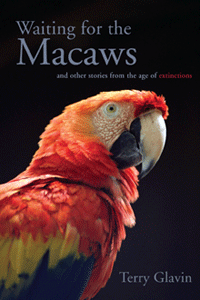
- Waiting for the Macaws
- Viking Canada (2005)
- Buy this Book
As I was re-reading the title chapter of Terry Glavin's Waiting for the Macaws, an episode that takes place in the forests of Costa Rica, a blackbird landed in the feed box on the balcony of my apartment and began poking around for the last crumbs of yesterday's bread. The feed box, an unused planter hanging from the balcony railing, is also periodically visited by neighbourhood sparrows, fat greedy pigeons, and the occasional starling or magpie. The blackbirds wake up just before dawn and carry on a chattering conversation through much of the day that sounds at least as intelligent as people talking on cell phones. They're my favourites. The balcony, which faces onto a narrow, closed courtyard with two maples and one ash tree, is about as close as I get (or want to get) to the Great Outdoors.
Whereas my ventures into nature are decidedly timid, in Terry Glavin's important, wonderfully intelligent, and beautifully written book of "stories from the age of extinctions," the adventures are spectacular. The intrepid Glavin (who, in the interest of full disclosure, has said embarrassingly kind things about me lately) is not only found half-snoozing in a Costa Rican wildlife refuge, awaiting the always-startling arrival of the big scarlet macaws of the book's title.
He's also up in the almost impenetrable Nagaland Himalayan mountains along the Indian-Burmese border, where the locals in a longhouse are shyly displaying a cache of the skulls of former enemies from the next tribe over and wondering if the sight of them will help or harm the possibilities of tourism. Or he's aboard a Norwegian whaling boat drifting at the edge of the mythic but also real Maelstrom, the swirling ocean pool that drags sailors to the depths. And sometimes Glavin is just in an abandoned apple orchard on Mayne Island, B.C., his home base, where his kids are engaged in the honourable art of stealing apples, apples whose taste is otherwise unknown on the planet.
Walking, at home and to home
The commanding image of Glavin's book is that of taking a "long walk." The walk begins quite a ways from Glavin's Mayne Island, but nonetheless close to "home" of another sort. It's an actual, rather than metaphoric, walk through the local "rolling hills, bogs and woods" around his mother's ancestral family farm in Coolreagh, Clare County, Ireland. He'd just begun working on the book we now have before us, going over some of his notes before starting out on "a long walk."
There are two items of interest in his notebooks, he reports. One is an Old Testament passage from the prophet Hosea that the land will mourn, and everyone that dwelleth therein shall languish...yea, the fishes of the sea also shall be taken away. The other is a recent newspaper article about the not-so-distant future in which 1100 scientists forecast the destruction of two-thirds of the natural world within decades, along with the "mass extinction of species, and the collapse of human society."
With those bleak thoughts in mind, Glavin sets off on his walk in the countryside around Coolreagh. Immediately, he makes the first crucial move in how he's going to position himself in fashioning this account. In Glavin's view, the landscape is not just rolling hills, Irish bogs, woods, fields, and mountains in the near distance, it's also a veritable storybook.
For example, Glavin finds himself "beside a field called the Castle Field, which takes its name from a craggy and vine-covered rock in the middle of it, the remnant of a stone fort built by local tribesmen loyal to Brian Boru, the great warrior-chief who defeated the Vikings at Clontarf in 1014. In the Castle Field you will notice the ground beginning to rise gently, and if you walk that way, up Blackguard's Hill, you'll find yourself heading through Ballyvaughan into the Slieve Bernagh mountains."
But "if you walk in the other direction, northward, you will eventually find yourself in the townland of Fossamore, and the ground begins to rise there, too, into the Slieve Aughty mountains. It's wilder up that way. Above Fossamore is Powlagower, the Goat's Hole, and Tabernagat, the Well of the Cats. There is the Struthanalunacht, the Stream of New Milk, which once ran white with milk but long ago it turned to water, they say, when a woman washed her feet in it. There are people who live at Cloonusker who say that at the end of the world, the final battle of the last war will be fought up there, above Gortaderra, in a place called the Valley of the Black Pig, and on that last day of battle the Stream of New Milk will turn to blood." And it's not just the old people at Cloonusker who brood on that prophecy. William Butler Yeats, Glavin notes, "was haunted by these things, and just as the world was carrying the great weight of dread and foreboding in his apocalyptic poem, 'The Valley of the Black Pig'" -- with its clash of fallen horsemen and cries of unknown perishing armies -- "so it was when I began writing this book."
Finding the story in history
Along with the recognition that we, too, are living in strangely apocalyptic times, what especially interests me in the extended passage I've quoted above, and throughout his book, is Glavin's strategy in approaching his subject. It's something he's done consistently ever since his first book, A Death Feast in Dimlahamid (1991), about aboriginal people, landscapes, and stories in northwestern British Columbia, and the perspective has been maintained in subsequent work, A Ghost in the Water (1994), about the disappearance of ancient sturgeon from our rivers, Dead Reckoning (1996), on the crisis in the Pacific fisheries, This Ragged Place (1996), and The Last Great Sea (2000). Once you get the point of his narrative "strategy," what Glavin is broadly up to becomes quite clear.
Wherever he goes, Glavin takes in not only the mundane features of the world, but also its place names and their histories, and the stories that people tell ("long ago it turned to water, they say, when a woman washed her feet in it") about how the world got to be the way it is and how it might become ("there are people…who say that at the end of the world, the final battle of the last war will be fought up there…in a place called the Valley of the Black Pig").
Glavin gives a kind of equal, almost impartial, weight to all this information and telling. He doesn't bog us down by asking, Now, was there actually a woman who washed her feet in the Stream of New Milk, and if so, when exactly, and what are the chemical transformations required to establish the fact of that story, if, indeed, it is a fact? Nor does he worry about the relation of myth to the mundane. Rather, he simply passes on the tale, requiring no more than that casual, elegant folk attribution of they say. The effect is a kind of magical naturalism which insists that all of the material -- names, etymologies, the sounds of various languages, historical events, myths, poems, stories resting on the authority of they say -- must be vividly co-present if we're to have a sense of reality sufficient to focus our attention. Otherwise, the world will be mere "scenery."
Glavin's remarkable art as a writer is founded in that highly charged way of seeing, to recall John Berger's phrase, and it informs just about every passage, argument, claim and meditative reflection in Waiting for the Macaws.
Figures are crudest barometer
"This is a book about extinctions," Glavin declares at the outset, pointing out that "roughly 34,000 plants, or 12.5 per cent of all the plants known to science, are threatened with extinction." Ditto for one in eight bird species (maybe including those poking around in my balcony feed box), one in four mammals, four of every 10 turtles, and half of all the surveyed fish species in the world's waters. Facts and figures of this sort punctuate the text, even if they "constitute only the most crude sort of barometer of the great unravelling of the living world." But equally distressing, extinction is taking place outside the categories of animals and plants. "It is happening down where the true measure of life's diversity is found. Extinction is taking away the subspecies, the local population, the particular, the neighbourhood, the singular, and the specific. And it is not confining itself to the 'wild' things of the world."
Glavin is talking not just about "nature," and I put that word in quotes, because what is natural and cultural, what is "inside" and "outside," is one of the things that this book puts in question. "Humanity's diversity," says Glavin, "is similarly withering. Though the world population has surpassed six billion, it is as though some savage ethnic cleansing is underway. The world is losing an entire language every two weeks. Fully half of the world's 5,000 languages are expected to be gone, with all their songs and sagas, by the middle of this century. We are losing religious and intellectual traditions, entire bodies of literature, taxonomies, pharmacopias, and all those ways of seeing, knowing and being that have made humanity so resilient and successful a species for so long…We are not gaining knowledge with every human generation -- we are losing it."
My first serious apprehension of that loss of memory, imagination and investigation that Glavin's book is about was awakened some two decades ago when I read Brian Fawcett's Cambodia: Stories for People Who Find Television Too Slow. So, Glavin's message here is not a new one, but it is powerfully and effectively delivered. One of Glavin's several concerns is how to express that message. And here, he makes another important move.
He says, "A dark and gathering sameness is descending upon the world, and the language of environmentalism is wholly inadequate to the task of describing the thing. It can't even come close. It isn't that environmentalism exaggerates the phenomenon," an accusation frequently levelled against it, say, in the debates about global warming. Rather, it's that environmentalist discourse "just doesn't have the words for it."
Blurring line between nature and culture
Ever since his journalistic days as a reporter for the Vancouver Sun, when he was reporting on and arguing with his editors about getting adequate space for stories about the political struggles of Haida native people in the Queen Charlotte Islands, Glavin has been regarded as an environmentalist writer, so his declaration of its inadequacy as a vocabulary may be taken by some as a betrayal of commitments, though of course it's not. He charges that the environmentalist discourse is burdened with "language that draws arbitrary distinctions between 'wilderness' and everything else and that places 'nature' outside of culture." And that will no longer do.
The method Glavin adopts in Waiting for the Macaws is a culturally more traditional one, but one that is also more risky than discourse that rests on scientific authority. As he says, "To make sense of the world, people tell stories. This is a book of stories, not only because as novelist Doris Lessing says, 'our brains are patterned for storytelling.' It is also because at a time when the world is filled with dread and foreboding, and when the great master narratives we've relied on to understand things are collapsing all around us, there should be some virtue in going for a walk through the hills and coming back at the end of the day with an account -- a story -- of what's out there."
As much as "nature" in its conventional sense is imperilled, so too are our stories. "For all its splendid, flourishing, and elaborately interconnected profusions of life, the earth is also a tomb, and the dead breathe their stories out of the ground," Glavin observes. "But those very stories, all over the world, are vanishing just as certainly as all those birds, languages, turtles, songs and apples. They are also vanishing just as quickly." So, this is a book about the extinction of vital cultural practices as much as it is about the extinction of nature, both in and out of quote-marks.
This act of repositioning in terms of how to deliver a message may seem rather modest, but if one of the cultural practices threatened with diminishment if not extinction is narrative itself, Glavin's commitment to story is more significant than it may appear at first. In terms of modes of language adequate to the situation being described, I'd be tempted to go even further and suggest that perhaps we need poetry to get an understanding of what needs to be understood, but I'm realist enough to recognize that poetry in our time has been relegated to very specialized laboratories of language-users. I'll settle for good storytellers, and Glavin is definitely one of them.
Not all roads lead to oblivion
Finally, in terms of the strategies, methods and repositionings of this book, one of the interesting things about Macaws is that it's not a doom-and-gloom environmentalist jeremiad, though it provides the full complement of apocalyptic prospects without flinching. "After a fairly thorough reconnaissance of the extinctions at work in the world," Glavin declares, "I found absolutely no evidence that any of this is what humanity really wants. That is good news. I can also confidently report that the roads and boreens that wind their way through the East Clare hills do not lead inevitably northward beyond Fossamore into the Valley of the Black Pig."
Indeed, even the recent newspaper article about portending extinctions doesn't "describe one inescapable fate." The article is based on a United Nations Environment Programme report that actually outlines "four roads through the hills," only two of which head toward the Black Pig. The "security first" and "markets first" approaches offer dire prospects in which "the powerful and wealthy end up gating themselves into enclaves leaving the masses of poor to survive as best they can in the collapsing environment outside the walls," and the state loses its capacity to regulate human affairs and is subsumed to faith in market forces, further globalization and greater trade liberalization. Margaret Atwood's recent dystopian novel, Oryx and Crake (2004) imagines the more extreme outcomes likely to result from travelling such roads.
The "policy first" and "sustainability first" approaches, by contrast, "lead to a different sort of countryside altogether," one that focuses on local and coordinated responses to environmental disruption and poverty, and in which "new institutions make room for radical changes in the way people interact with one another and with the living, breathing world." Along these latter roads, "we all muddle through."
Glavin concedes that the present extinctions, unlike previous ages of extinction, can all "be reliably attributed, in one way or another, to a single species: Homo sapiens." He adds, "But it is not a simple story, with human beings as the cruel villain of the piece. In the case against humanity, this book is offered as evidence for the defence." What Glavin relies on is a sense that "deep within the human consciousness is an ancient and abiding desire to be in the presence of flourishing, abundant, and diverse forms of life. Like the desire for narrative, enchantment with the beauty, utility and diversity of living things is an inescapable aspect of human nature."
Glavin's concept of "humanity" is of course to be distinguished from particular human regimes, social classes, corporate cabals and the rest. Still, humanity presents a puzzling dynamic. Perhaps the best we can claim is that there's "the wisdom of the people," which really does exist, and there's popular ignorance, even wilful human stupidity. The important term in the dynamic is "and."
Everything I've reprised is found in the opening chapter of Waiting for the Macaws, which provides a framework for understanding Glavin's subsequent experiences as well as a brief demonstration of his magical naturalist method while walking in the hills of East Clare. After that, in a sense it's all downhill, or downhill, uphill, over hill and dale, onto the ocean's bounteous blue, and from home to the middle of nowhere and back to the apple orchards of Mayne Island.
The 'exotic' lives at home
In each of the stories to follow, which I leave to the reader -- stories about tigers and the simulacra of safaris in Singapore, to cougar attacks on Vancouver Island, to the shrine of Kali in Calcutta which shimmers at story's end -- the narrative is sustained by Glavin's cosmopolitan intelligence, a sense of curiosity that is at once precisely local, but that simultaneously measures the local in terms of the worldly. In Glavin's case, intelligence is motivated by passion (the heated charm of an Irish temperament) and unrestrained by ideological prejudice or pre-judgement. That is, he approaches experience without over-determined preconceptions, though of course he comes to each scene, like all of us, with ideas. But the ideas do not feel imposed on the landscape. Rather, the adventure (and this is a book of adventures) is refracted through the prism of the reality Glavin encounters, and that reality is permitted to test, shape and rewrite whatever notions he brings to the scene.
While Glavin's locations seem exotic to me, given my natural habitats, what you learn from reading his stories is that the locales he arrives at are not really exotic, they're simply other places where people have ways of living and ways of telling that are ultimately recognizable to us. My "natural habitats" tend to be classrooms, urban streets, libraries (public and personal), cafes, and the occasional balcony where blackbirds make social calls. What Waiting for the Macaws does for a reader like me is to sharpen my attention toward the disappearances, losses and extinctions of cultural practices taking place in my own backyard: letter-writing has been replaced by qualitatively diminished electronic messages, teaching is becoming an almost lost art in the face of overcrowded university lecture theatres, and sometimes I wonder if conversation and books themselves are not also disappearing. Glavin's book not only awakens memory and inspires investigation, but it's that rare thing, a narrative that stays in mind. It's time for all of us to take "a long walk."
Stan Persky is a regular contributor to Tyee Books, and recent winner of the Hubert Evans Non-fiction Prize for The Short Version.


22
Login or register to post comments
mjscox
5 years ago
Comments on "The Web of Disappearances"
I have to admit I read Glavin's book in fits and spurts, mostly because it was so damn depressing. I came to it after reading two other environment-related books, The Weather Makers by Tim Flannery and Field Notes from a Catastrophe by Elisabeth Kolbert. So I was either primed for more disaster, or I had had my fill, but I found it a tough slog. That said, what he's saying is just as important as the issues around global warming that the other two are writing about. Taken together it forms a grim prognosis. And I look about me and see no end to our love affair with large vehicles; I see fewer and fewer songbirds because their winter nesting grounds are gone or the in-between migratory path has been denuded of sufficient forest by suburbia; there's Kevin Falcon, an ironic name if ever there was one, about to commit the biggest blunder of the decade with his mega-highways projects, and I have to say: we're going down the toilet, big time. It will take disasters of such magnitude as the collapse of the fisheries to make us wake up, and of course it will be too late. I wish I wasn't feeling so pessimistic. I wish I could go over to Victoria and Ottawa with copies of these books and MAKE the leaders sit down and read them, cover to cover. I fear they have other agendas which don't include saving our planet.
jesterjogger
5 years ago
curse them all
loblollyboy
5 years ago
What Glavin relies on is a sense that "deep within the human consciousness is an ancient and abiding desire to be in the presence of flourishing, abundant, and diverse forms of life. Like the desire for narrative, enchantment with the beauty, utility and diversity of living things is an inescapable aspect of human nature."
A full stomach first, peace in the valley second, then there`s time for developing such an esthetic.
Truman Green
5 years ago
Hey mjscox don't forget to take a copy of "The Last Great Sea" with you when you go to Victoria and Ottawa, eh--wherein Glavin basically says the other environmentalists are crying wolf and just thinking too simplistically.
And also take along a copy of the Fanny (Shaw tv) interview wherein Glavin says he has tremendous respect for the baby seal killers cause they gotta make a living, eh--presumably, who knows? (It made me commiserate with Elvis Presley for wanting to take a shot at his tv when Robert Goulet came on.)
Don't go around believing everything you read you guys. These guys all have their schtick.
Right to Bear
5 years ago
Hey Truman,
You said: "...wherein Glavin says he has tremendous respect for the baby seal killers cause they gotta make a living, eh--presumably, who knows?" (man, I can't get this "quote box" thing...duh".
This "seals it" for me. I may read this book, but as usural, one has to be discerning with ones reading material... Good point.
mjscox: The obvious thing to me, is if your overwelmed with "dark" reading material and information, get out more, and get away from this sh**. Spend time in the natural world to heal for a while. Just a suggestion on an observation dude...
Peace all...
RTB
mjscox
5 years ago
Oh, I do get out, every day, in particular on summer evenings, a nice long walk, listen to the birds (those that are left), smell the flowers, etc. I also joined the Green Party.
I don't know about seals and Mr.Glavin's agenda, but even if that quote were true, it doesn't take away the science underpinning his arguments, and the urgent need for action.
Terry, if you are reading any of these, comments?
Inaction: in the 70's I stood by while others protested the Vietnam War, nuclear testing; in the 80's I let Greenpeace and the Sea Shepherd Society take on whalers (who, it seems, are about to come back into the news, thanks to the Japanese); in the 90's I don't know what I was doing but other than separating my garbage into recyclable, compost and garbage, not much. So now, finally, I am being shaken out of my complacent stupor by these authors, by the documentary films An Inconvenient Truth and, shortly, Who Killed the Electric Car, among others. Hope you are, too.
Truman Green
5 years ago
Yeah, Terry, are you reading this? Maybe you could run that by us again--regarding your total support for the baby seal killers as you reported on Fanny's show. I'd like to debate it with you, eh.
Not to mention, of course, how it converges with your big new book about waiting for birds and having respect for living creatures, and everything.
Enzo di Mateo claims that you referred to your competing environmentalists as "cosmologists" and "SUV environmentalists." (Enzo de Matteo, Now Toronto, Jan. 4-10, 2001).
Is this true? And if it is, what did you mean by it?
electric_bicyclist
5 years ago
Coincidentally, food (e.g. hazelnuts) was made to disappear when the "smog gun" is fired at the food during a Sustainability Magic Show during Energy Fair at Lougheed Mall.
Here's a link to photos:
http://sustainabilitymagic.blogspot.com/
The "smog gun" (a.k.a. Hydrocarbon Gun) also made kids/adults in the audience so weak that they couldn't tear paper, at this Sustainability Magic Show on the fair's main stage.
You can see more about this at the interview on Channel M (German Today show) to air at 3PM, 23rd June, and on 2PM (not sure about time) on 24th June.
Charles Campbell
5 years ago
I can't speak for Terry exactly, but seeing as he hasn't weighed in and Truman would like someone to, and I know Truman will come back to read this, I'll simply say this on my own behalf. I think we need to be wary of the levelling moralism of anyone who thinks another culture should behave as theirs does.
I was in Nunavut a few years ago, where hunters couldn't buy bullets before they went out for a few months on the land because of the perverse application of gun control legislation. I think whaling in particular can be a very complicated issue, when you have a culture that does it and continues to do it as they have always done as a source of sustenance. I'm not talking about Japan's "scientific" hunts here.
I am concerned about "SUV environmentalists". There are a lot of people, some with particularly high opinions of their own morals, who decry the culture of people who live close to and lightly on the land, while they themselves leave a pretty huge footprint in their travels. Is there irony, as writer Andrew Struthers has noted, in someone driving a VW 1968 microbus to Tofino for a weekend to protest environmental degradation? You bet there is.
I have enormous respect for most environmentalists. I also have seen more than my share of overbearing puritans. I'm glad, at least, for the species diversity. But I do share Terry's opinion that a lot of environmentalists would do a much greater service to the world if they stopped building an insurmountable wall between our culture and the natural world.
IAMC
5 years ago
They just discovered eight new species in a cave in Israel. They were buried in their own lives for hundreds of millions of years, deep in a dark cave, undiscovered until recently.
The world is bigger than humans ego wants to accept.
Right to Bear
5 years ago
IAMC said: "They just discovered eight new species in a cave in Israel".
Very cool IMAC. That is why we have to be so careful when in consideration of the Earth... We know so little. Not only "how" things got here, "why" things are here, but we do not even know "what" is here. Here in Alberta, when discussing the "reclaimation" of the land by the Oil Sands projects "IM" we do not even know what "was" there. Sure we can make it green, but there will be NO balanced and harmonious ecosystems living withing this artifical habitat...
Charles Campbell said:"Terry's opinion that a lot of environmentalists would do a much greater service to the world if they stopped building an insurmountable wall between our culture and the natural world".
I am sure Mr. Green will respond. I thought I too would get my two cents in.
Charles, the only only seemingly insurmountable "wall" between our culture and the "natural world" is made up of the money and ego of human beings... We are of the opinion we are better than the natural world...and this attitude will be our demise...
The FN people in consideration to the seal hunt use the animal for their survival, culturally they do not exploit these animals for money. They are the best we have for "management" of lands and it's animals. Traditional Mangament imo works.
The problem is when the government subsidises a cruel industry as in the seal hunt, in a disrespectful effort to give people something to do to earn their EI. What part of "this" is right??
Armchair enviromentalist, SUV enviormentalist, and so on...Who cares bro. None of us including the enviros will ever have a "clean house" perse, this should NOT be the prerequisite to helping Mother Earth. for if it was, there would be no one able to help her... All hands on deck I say.
Peace
RTB
transmontanus
5 years ago
This is my very first post on Tyee.
Congrats to everyone here, and especially to Charles. I'm very, very enouraged by the new book section he's piloting here. Congrats!
Now.
To mjscox, who says, among other things, that he found my book depressing, and is otherwise "feeling so pessimistic," the first thing I can say is, cheer up, I have great sympathy for ye, though. But do bear in mind that my book isn't at all pessimistic, and while it has been received quite generously and favourably reviewed, I've noticed some very sensible criticism here and there along the lines that I'm being too optimistic. That may well be true, but I would observe that pessimism doesn't result in change. You actually have to be optimistic if you're going to hope for anything really transformative.
As for debating with Truman Green: No.
Anyone who claims that my book The Last Great Sea asserts that "other environmentalists are crying wolf" obviously hasn't read it and is deliberately mispresenting it. And anyone who refers to Newfoundland's sealers as "baby seal killers' and who says he felt like shooting his televison set when he saw me in some interview is clearly not someone interested in anything I would consider a debate.
To RTB: Peace back at ye.
tg
Truman Green
5 years ago
Terry Glavin, if it is not appropriate to refer to someone who kills baby seals for a living as a "baby seal killer," then our language has no use at all, and words have no meanings--as you well know.
Yes, your declaration of respect and admiration for the seal hunters did enrage me. To me, the minimum requirement for a so-called environmentalist is that he does not wish to see animals slaughtered in this fashion, especially if the only purpose is to supply unneeded clothing for a fashion industry.
This is, to many, simply a matter of human decency. The image of this kind of brutality remains in my psyche and causes me pain, and in the memories of millions of others who have protested this kind of unnecessary slaughter. It's the same sentiment that inspires those who protest the killing of whales and I think your ability to converge a supposed reverence for living creatures and the methods used in the seal slaughter would enrage many if they became aware of it.
As for a debate I invite you to join me in a philosophical discussion regarding the idea of "morality," and my assertion that the killing of baby seals in this dusgusting manner is in obvious contradiction to "morality" as I define it-- as being not what humans are big enough to do to the other species, nor what we can gain by so doing, but rather, what we OUGHT to do in order to be distinquished from most of the other species whose behaviour seems to be coded in their genes.
While watching the show on which you declared your respect and admiration for the baby seal killers, I felt that your reputation as an environmentalist was indeed entirely unearned, and weird-- and yes it did piss me off, although I would never shoot my tv.
So come on, let's talk. What's your definition of a human being? I will also explain to you that your enchantment with the slaughter on the grounds that these animals are not, after all, on the "endangered species list," is perhaps as pernicious a rationalization as one can conjure, and equal to your pretense that baby seal killers should not be called baby seal killers--which is, after all, exactly what they are.
Truman Green
5 years ago
Charles Campbell wrote, "I think we need to be wary of the levelling moralism of anyone who thinks another culture should behave as theirs does."
And I would agree, but my dislike of the seal hunt is not due to any cultural chauvinism, but rather to the fact that it abuses my personal sense of common decency. And I think Glavin would agree (regarding a personal sense of common decency) with me for the very reason that on that same television show, he also said that he would have no trouble with the extinction of what he considered as cultures that practised cruel and brutal traditions.
I think he brought up female circumcision, but I'm not absolutely sure of that. Perhaps I only envisioned this example as he spoke, but I am certain of the jist of his comment. In this regard I applaud the demise of the Mayans and Aztecs because they believed that there was no greater good than that a citizen should report for duty to have his/her heart manually ripped out of his chest, as an appeasement and sacrifice to the gods.
Yes, Mr. Campbell, I condemn this cultural tradition, not because it's different than my own culture, but because it's stupid and cruel.
And such a comment (Glavin"s) begged the question, at least in my mind: How can Glavin condemn one kind of brutality and admire and rationalize another? It struck me as a kind of small "p" political posturing. And yes, of course the assessment of "brutality," is merely a personal construct, but one to which I think "environmentalists" should pay particular attention. After all, the protection of life is supposedly their defining ethic.
I think Glavin should be opposed in his admiration of the seal killers because his belief is a common divergence: the idea that it is only the extinction of species with which we should be primarilty concerned--not the treatment of individual members of such species. Concern with species extinction is merely pragmatic, and most who profess such concerns do so only in the light of a truism that our survival is necessarily tied to the survival of other species.
My proposal is that the treatment of individual members of species should be at least as important, because failure in this regard would render our "environmentalism" as based no less upon utilitarianism than the slaughter of baby seals for profit.
And utilitarianism affords a poor refuge for an environmentalist, I think.
Mr. Campbell refers to cultures which use animals as "a source of sustenance."
For me to condemn those cultures which must use animals or perish, as the Inuit, for example, would be an exercise in futility, if not banality. I think those who oppose the seal killers understand this.
Right to Bear
5 years ago
Truman Green said: "My proposal is that the treatment of individual members of species should be at least as important, because failure in this regard would render our "environmentalism" as based no less upon utilitarianism than the slaughter of baby seals for profit".
Hi Truman, well said on the above post. Good words brother.
Ethics and Morality are are as important as science and numbers. Good decisions require the representation of both imo.
Terry thanks for your response. I think that I need to mention that imo golfer, martial artist, surfer, baby seal killer. This is simply an easy way to discribe a persons interstest or activities, be it good or not...imo friend.
In consideration of the men who are struggling to raise their families in a harsh and economically starved enviroment, I feel they have been disrespected to the fullest. The governent, because of their EI qualifying rules, found something for these men to do for "work" for a few weeks in order they can recieve EI the rest of the year. The govern't subsidize and therfore artificially enhance an economy with taxpayers money...and it is as cruel as the cruelest form of animal deaths in the world...the Canadian Seal Hunt.
These family men, in an effort to care for their familys, are "forced" to look in the eyes of a baby seal pup, strike its head with a pathetic blow, and watch it suffer alive as they skin them and take their penises for the asian market so someone can "get it up". Everything happens fast because they have to move on to another target in an effort to get their quota. Does anyone consider the phycological effect on these poor desparate young men. Would anyone want THEIR sons to witness this horror. How about the political leaders who support this heinious initiative, would they volunteer their kids??
That is why I say it is cruel and disrespectful to not only the seals but the young men involved. The govern't doesn't care and would sacrifise the seals and the men who live on the coast, then go home to eat their dinner, put their kids in private schools and be thankful they do note live in the life of a Maritine sealer...
Just some thoughts...
Peace.
RTB
Right to Bear
5 years ago
Sorry for the typos in the above post all...RTB
Truman Green
5 years ago
On page 211 and 212 of Glavin's "The Last Great Sea," he describes the 1999 killing of a gray whale by the Makah Indians:
"The harpoon thrust was followed by a blast from a .50 calibre rifle, then another harpoon thrust, then another shot from the rifle. By 7:05 A.M., the whale was dead, and from Sequim to San Francisco, people in tie-dyed shirts wept for the cameras. Seattle editorial writers clucked their tongues and clacked away at their keyboards, and Portland radio phone-in shows lit up with every conceivable reason that the Makah were wrong to kill the whale: It was wrong because the harpoon was unnecessarily cruel, it was wrong because the rifle wasn't a traditional weapon, it was just wrong."
And.."Whatever one might say in opposition to the Makah whale kill, a conservationist argument could not be raised against it."
Hey, Persky, you're apparently our very own Socrates, according to Glavin. What do you think? Might a conservationist raise an argument against needlessly blowing up a gray whale?
Right to Bear
5 years ago
The killing of this whale should never have been allowed, not just by us, but the Makah themselves. Very sad when traditions that were meant for survival at one time, are used falsely to define the healing and health of a culture. This kind of abuse does the opposite.
If a tradition no longer makes sense, then people need to let it go...
In this case it was sad for the life of the whale, and a bruise on the Makah peoples relationship towards Mother Earth...
I would like to know what Persky says too...
Peace
RTB
Truman Green
5 years ago
RTB writes: "Very sad when traditions that were meant for survival at one time, are used falsely to define the healing and health of a culture. This kind of abuse does the opposite."
Exactly! And that would have been one of my issues with Glavin--and his mocking of those of us who hated to see a gray whale killed like that for no good reason. (See above quote from The Last Great Sea).
Truman Green
5 years ago
Come on, eh. Am I the only one who thought Persky's review was just hilarious? In his disclosure statement he admits that Glavin has been saying some "embarrassingly kind things about me." Not to be outdone, Persky comes up with "wonderfully intelligent," for Glavin, as a weirdly unashamed, get-a-roomable 'right back at ya."
Glavin on Persky: "...so I never had the chance to say congratulations to our brilliant Stan Persky, our beloved Stan Persky, our Socrates."
Which makes me wonder, of course: Is there ever a point at which this kind of affection becomes recusable as far as serious, arm's length literary view is concerned?
Just asking.
Mink
5 years ago
Why do we always need to think we are right? There is no truth, merely interpretation and personal choice. There is no universal code of ethics, nor is there one "right" way to live a life. So Glavin has said some things in the past that he may or may not believe in now. Who here is above that? What is important is that he is engaging us in a exploration of important ideas. He doesn't have to be aligned with all my opinions in order for me to respect his efforts.
Truman Green
5 years ago
Mink, you suggest that Glavin has said some things that he may or not believe in now. He supported both the seal hunt and the killing of the gray whale. (At least the seal hunt up to his Shaw tv book promotion interview with Fanny a few weeks ago). These are two very controversial things,I maintain, especially for a conservationist. I suggest that he has an obligation to come on and discuss them both. He's conveniently said that my silly joke about Elvis' disenchantment with Robert Goulet has disqualified me from being a suitable debating opponent--and that I misrepresented his book, The Great Last Sea. I maintain that I actually went easy on that book! (Google Gary Magee Terry Glavin The Last Great Sea Ubyssey), then go back to the book and see what you can make of Glavin's "regimes." (heaven knows, I tried)--not to mention his mere suggestion that there is a possibility that global warming due to human activity MIGHT be a real thing. Then go to his Dooney's Cafe article where he apparently thinks we're all going to drown from melting ice and rising sea levels in about fifteen minutes.
I think writers have an obligation to discuss their books, not only in book promotions like the Shaw tv, Fanny interview, but in forums where their friends have done "reviews."
You claim: "There is no truth, only interpretation and personal choice." Also: "There is no universal code of ethics, nor is there one right way to live a life." Well Mr. Mink, if it befits you to live your life in perpetual moral and ethical relativism, go for it, (and this lifestyle seems to be coming more into vogue these days), but I would like to suggest that there might be merit in another view. And, Mink, as it so happens, these are exactly the ideas I wanted to challenge Glavin and Persky about--especially concerning the seal hunt.
And, as I agreed with Charles Campbell, when he made a similar suggestion, I wrote that there might be some universally accepted truisms to which human beings should try to aspire--and that my disagreement with the seal hunt and the killing of that gray whale was not due to any cultural chauvinism. RTB pointed out that being human might mean more than doing only what benefits us as a species--thus my reference to utilitarianism. Glavin's new book is apparently about extinctions, and one might think that he would be interested in this subject.
And one might imagine that Glavin, conservationist, environmentalist--and Persky, Socratic philosopher and teacher of philosophy, would have something to say about these ideas.