


 SHARE:
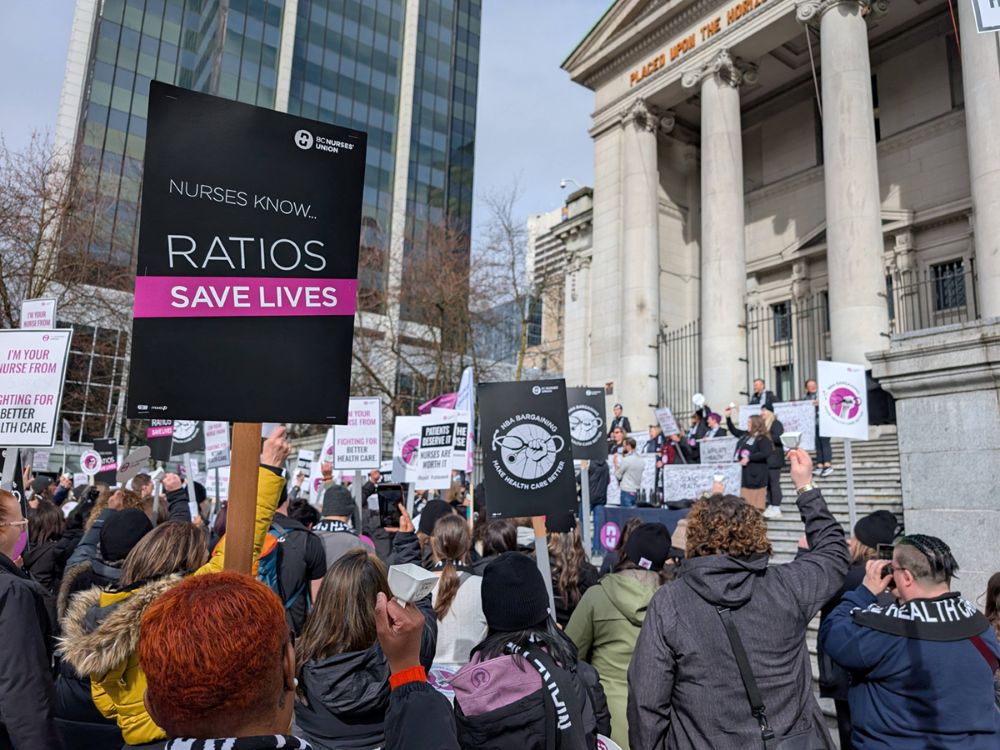
Members of the BC Nurses’ Union have overwhelmingly voted in support of a strike vote, meaning they can now legally take job action.
But there are several steps the union will take before nurses don’t show up to work, said BCNU president Adriane Gear.
“The last thing that we want to do is to withdraw labour,” Gear told The Tyee. “We do not want to impact patient care… ultimately, we’re trying to improve the system.”
The Nurses’ Bargaining Association and Health Employers Association of BC have agreed to return to the bargaining table and “will resume negotiations starting today [Tuesday] to address the issues that both parties believe are important,” the HEABC said in an emailed statement.
The employers’ association declined an interview but added a strike vote is a “normal” part of the collective bargaining process.
The BCNU has been trying to negotiate a new collective bargaining agreement with its employer, the HEABC, after the previous agreement expired in March 2025.
But after six months of bargaining there hasn’t been much progress and nurses are fed up, Gear said.
From May 8 to 11 the union’s 53,000 members voted on whether or not to take strike action, with 98.2 per cent of nurses voting in favour. That’s “tremendous engagement, which clearly shows how frustrated nurses are,” Gear said.
Job action from the BCNU could include “working to rule,” where nurses start and end their shift on time and take their scheduled breaks, which is a big shake up from showing up early, staying late and never taking breaks, Gear said.
A next step could include banning non-nursing duties like answering phones, cleaning, delivering meal trays or running to the blood bank or pharmacy, she said. These extra duties would have to be taken on by managers.
The union could also restrict overtime and set up information picket lines, she said.
“Withdrawing labour would be a last resort,” Gear said. If it got to that point rules around essential service staffing levels kick in.
“Ironically,” those staffing levels are “in some instances actually higher than what happens now,” Gear said.
Crushing workloads, unsafe staffing levels
She said nurses are upset about crushing workloads, unsafe staffing levels, workplace violence and occupational health and safety concerns, as well as systemic risks that undermine nurses’ ability to provide quality care.
Gear said during bargaining the union made 104 proposals and counter-proposals to address working conditions.
“We’ve only heard back from the employer on 65 of them and they’ve rejected 61 and agreed to four — one of which is literally correcting a spelling mistake in our collective agreement,” Gear said.
One proposal was about using AI weapons detection in areas where weapons are a “problem,” she said.
Gear said the union also wants to be able to negotiate benefits at the bargaining table, but said their employer has resisted that.
“Nurses need eyeglasses so they can read the tiny printing on medication vials that we’re drawing up. We need hearing aids so we can communicate effectively with our patients and we need paramedicals to keep us fit for practice,” Gear said.
Paramedicals can refer to physiotherapy, massage therapy, speech therapy and naturopaths.
The third thing the union and the employer are at an “impasse” over is extra money that Gear said other union workers have access to. Nurses are being excluded.
Government workers get an annual three per cent raise if their union has a four-year deal, with additional money from “enhanced mandate money” which is about two per cent over four years, Gear said.
But nurses are only being offered 0.4 per cent of that enhanced mandate money, rather than the two per cent. “They’re saying, ‘we don’t know that you’re entitled to that.’ But why not? Other bargaining associations have had that offer,” Gear said.
“Why should we be expected to take less? That equates to over $100 million a year for my members,” she added.
Some progress
In general, the provincial implementation of minimum nurse-to-patient ratios is going “really well,” Gear said.
“Where we’ve been able to implement ratios nurses are saying ‘it’s good to be a nurse again.’ Nurses are reporting increased time to spend with their patients, less care that is missed, better outcome for patients and certainly a better workload for nurses,” Gear said.
However, not all nursing teams across the province are fully staffed. The province varies between 6,000 to 4,500 nursing vacancies, Gear said.
A great way to fill those vacancies is to have a contract that is competitive, has good benefits and an employer that is taking meaningful steps to address violence and make sure nurses are safe, she added.
Gear says B.C.’s use of agency nurses is still “very problematic,” as are workplace injury rates.
Agency nurses work for for-profit companies and are contracted out to work for health authorities. Public nurses work directly for health authorities.
According to reporting by CTV, a BCNU nurse earns $45 an hour, a temp nurse $53 an hour and an agency nurse $76 an hour.
Workplace injury rates have increased by 25 per cent since 2019, which translates to one nurse leaving on a WorkSafeBC claim every 16 hours, Gear said.
She said the main cause of injury is musculoskeletal injuries, from hurting shoulders or backs — often while trying to provide care for patients in hallways without lifts — followed by workplace violence.
Psychological injury rates have gone up threefold since 2019 too, she said.
“Nursing is dangerous work and we need to make it less dangerous,” Gear said. ![[Tyee]](/design-article.thetyee.ca/ui/img/yellowblob.png)
Read more: Health, Labour + Industry










Tyee Commenting Guidelines
Please note that email notifications for replies are not currently working due to a software issue which may be resolved in a future update.
Comments that violate guidelines risk being deleted, and violations may result in a temporary or permanent user ban. Maintain the spirit of good conversation to stay in the discussion and be patient with moderators. Comments are reviewed regularly but not in real time.
Do:
Do not: