

 SHARE:
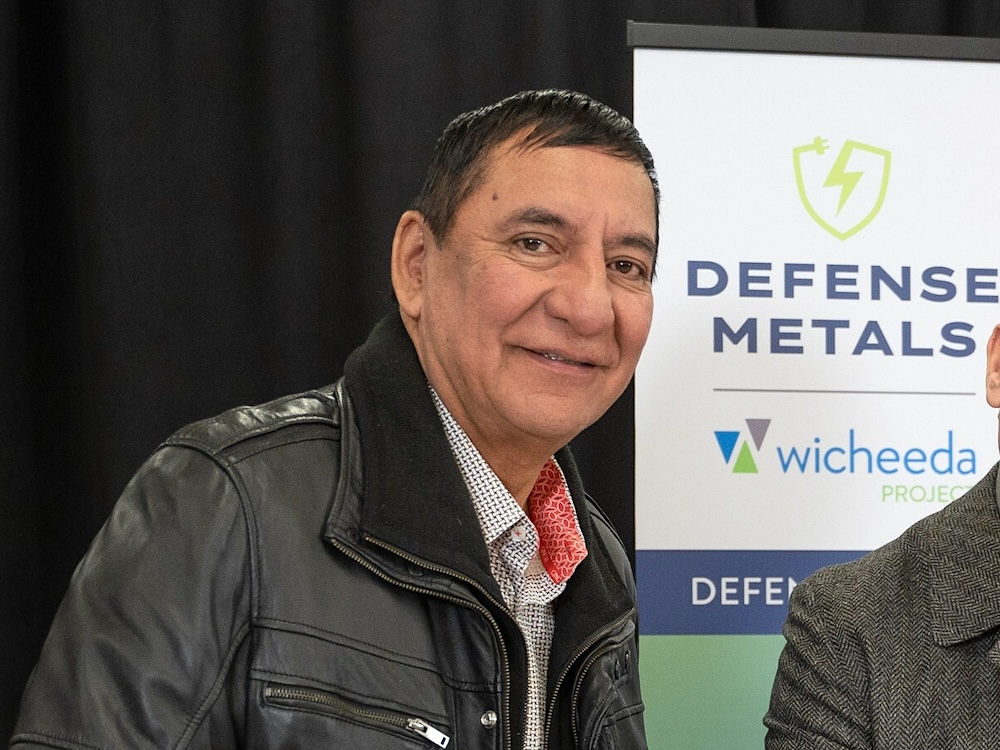
When it comes to spending by First Nations leaders, Chief Harley Chingee of the McLeod Lake Indian Band is unrivalled.
Over the last three years, the 590-member band’s top elected official claimed more than $370,000 in expenses, a tally far exceeding all other British Columbia First Nations leaders for whom records are available.
During one six-month period, Chingee’s band-issued Visa card was used for tens of thousands of dollars of purchases at high-end hotels and restaurants, upscale retailers and Rogers Arena, according to statements obtained by The Tyee. The statements were provided by a source The Tyee isn’t naming because they requested anonymity.
Chingee is serving his third consecutive term as Chief and has occupied the post for the past nine years. He has been embroiled in a dispute with the band’s elected councillors since at least June 2024 when councillors notified band members of an “investigation regarding allegations of serious misconduct and potential misappropriation of funds.”
“We understand the gravity of the situation and the importance of transparency and accountability in our organization,” the six councillors wrote in the letter, which was obtained and reported on by the Prince George Citizen. The councillors wrote that they would no longer be meeting with Chingee.
Neither the councillors’ statement nor the Citizen story detailed who or what was being investigated, and more than a year and a half later band members remain in the dark about what led to the extraordinary, public action by the band’s elected councillors.
Band member Kandy Stout said that there has been no communication to band members since the letter was circulated and that it is wrong for members to be left in the dark.
“I just feel it’s unfair that our membership is not being notified on band business or band updates regarding the relationship within the council,” Stout told The Tyee.
The Tyee tried repeatedly to reach Chingee and the band’s elected council members for comment on the investigation but received no responses.
Top documented spender
In each of the last three fiscal years, Chingee claimed more expenses than all other B.C. Chiefs for whom records are available, according to documents posted on a federal government website.
The Tyee used the website, which was created following passage of the First Nations Financial Transparency Act in 2013, to review hundreds of records filed by First Nations and band governments in B.C.
A total of 105 B.C. First Nations posted financial records in 2024-25, the most recent complete fiscal year, and 92 posted financial statements in each of the past three years.
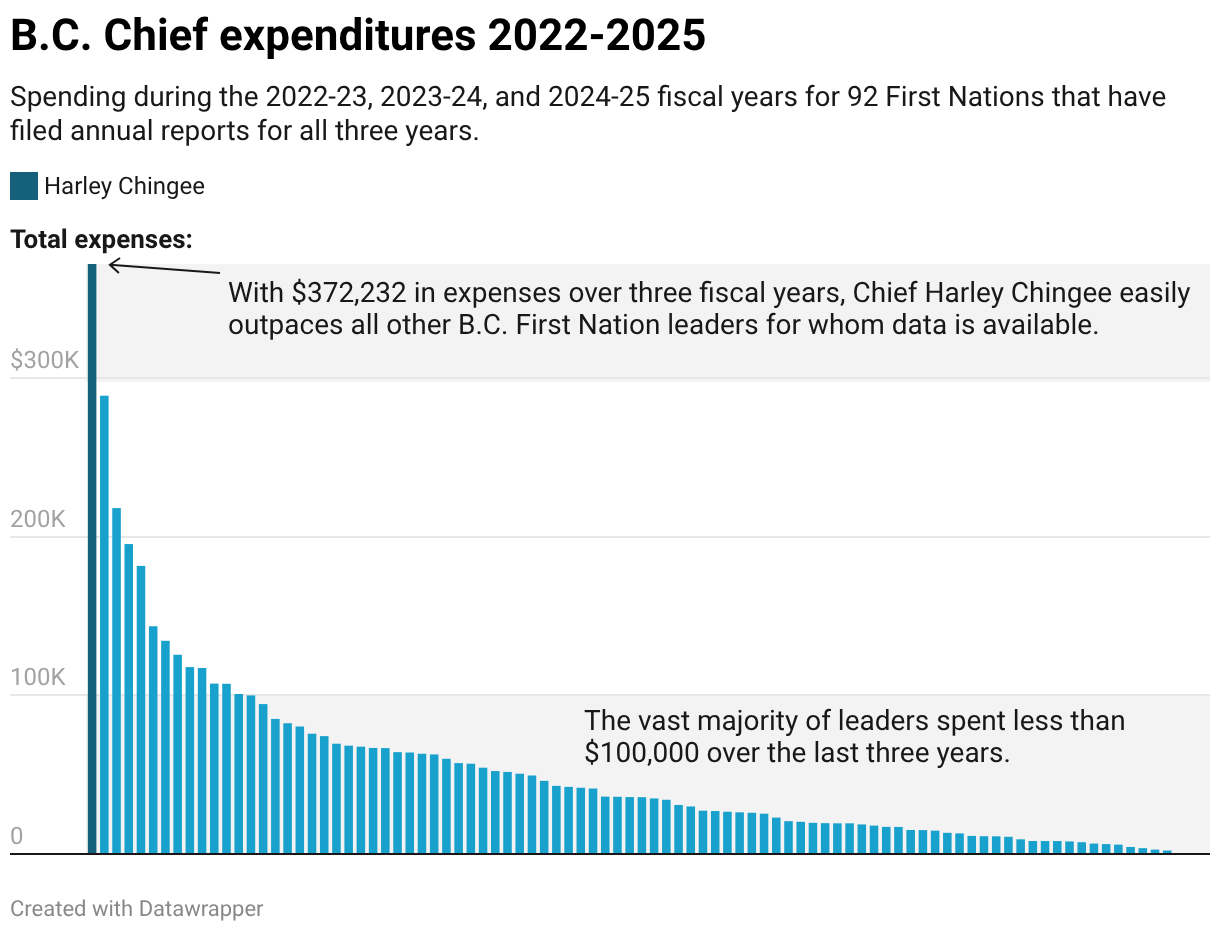
In the documents reviewed by The Tyee, Chingee was the only Chief in B.C. to claim more than $100,000 in expenses in 2024-25. Four out of every five Chiefs had expenses totalling less than $30,000, and only nine registered more than $50,000 in expenses.
In each of the two previous years, Chingee’s expenses exceeded $130,000. Over the three years, his total spending was $372,232. No other elected First Nations leaders in B.C. came close. Only the Chiefs of Lake Babine Nation and Kitasoo Xai'xais Nation registered more than $200,000 in expenses over those three years.
The spending has been noticed by Chingee’s constituents.
“The Chief does not talk about spending with council,” Stout told The Tyee.
“Nobody has his itinerary. His budget is not approved. To me, it’s shocking that the whole organization does not come down on this,” added Stout, who once served as economic development manager for the band-owned Tse’khene Development Limited Partnership.
Purchases at Nordstrom, Aritzia and more
The federal government website provides only expense totals for Chiefs and elected councillors. It does not provide details about how the money was spent, or how it is distributed between typical expense claim items such as meals, accommodation and travel.
The monthly Visa statements obtained by The Tyee show spending on a wide range of items, with some large purchases appearing to fall outside the scope of gas, food and lodging.
The charges include more than $5,000 spent between June 2 and 14 at the Hudson’s Bay and Nordstrom department stores, shoe store Geox and women’s clothing outlets Aritzia, Sephora, Kate Spade and Dynamite. The stores are located at the Vancouver Centre and Burnaby Metrotown malls.
The statements also show two payments to Vancouver’s Rogers Arena totalling $6,760, and additional payments to Ticketmaster totalling $1,068.
Much of the spending is on meals. Many of the expenses are incurred at Prince George’s White Spot. But there are also purchases at more-upscale eateries incurred during trips to Vancouver and Ottawa. They include meal claims of $425.79 at Ottawa’s Shore Club on March 20, $213.12 at Ottawa’s Keg steak house on March 21 and $321.59 at Ottawa’s Grand Pizzeria on March 22, the same day that another $506.76 was charged to the card at the Shore Club. The statements also show a $1,000 payment made at Black + Blue restaurant, a high-end steak house with locations in Vancouver and Toronto.
In June 2022, a combined $10,838 was charged to the card to cover expenses at higher-end hotels in Vancouver, Calgary, Winnipeg, Montreal and Ottawa. The charges came during a month in which more than $21,296 was charged to the credit card.
The Visa statements also show two payments to the Liberal Party of Canada totalling $2,475 and one payment to B.C.’s New Democratic Party totalling $1,309. Both payments would contravene Elections BC rules if the band, rather than Chingee himself, footed the bills.
In an emailed response to questions from The Tyee, Elections BC communication adviser Melanie Hull said that under B.C.’s Election Act, “eligible individuals can only make political contributions with their own money, property or services. This means that an individual or organization must not give money, other property or services to an eligible individual to make a contribution.”
Hull added that provincial parties are then “responsible for ensuring contributions are only received from eligible individuals.”
BC NDP provincial director Tania Jarzebiak told The Tyee that if the party becomes aware that a contribution has been made “that contravenes the rules, usually as a result of an honest mistake by the donor, we return it immediately and adjust our public reporting accordingly.”
“We can't comment on a specific case without knowing the details,” Jarzebiak added in an email. “If it comes to our attention that an improper contribution has been made in this instance, we will contact the donor and issue a full refund.”
The Tyee attempted to discuss details of the Visa statements with the Chief and council members, but neither phone calls nor emails elicited responses. Chingee did not respond to a detailed list of questions provided by The Tyee.
The Tyee has not confirmed whether specific charges on the Chief’s band-issued Visa card were later reimbursed by Chingee.
The statements provided to The Tyee show $73,599 in spending on Chingee’s band-issued RBC Visa card in the first six months of 2022. A total of $28,632 was charged to the card from January to March. Those three months are included in the 2021-22 fiscal year when Chingee’s total expenses for the year were listed at $79,075. A total of $44,967 was charged to the card from April to June — a three-month period covered by the 2022-23 fiscal year. Chingee’s stated expenses for that year were $130,756.
The outliers and most everyone else
The spending detailed on Chingee’s band-issued Visa card occurred partially during a year in which he was paid $154,205 as McLeod Lake’s top elected official. His pay in the most recent fiscal year was $177,583, making him the eighth-highest-paid Chief for which records are available for fiscal year 2025.
Topping the list that year was Kwiakah First Nation Chief Steven Dick, who was paid $281,625, more than double the $132,250 he was paid the year before. Dick presides over the self-described smallest First Nation in B.C. It has 21 registered members and its territory is on the mainland coast near the southern reaches of the Great Bear Rainforest. Takla Nation Chief John French received the second-most pay at $278,029, followed by Chief Clarence Louie of the 606-member Osoyoos Indian Band at $230,495.
To provide context on what other First Nations leaders received in pay or claimed in expenses relative to outliers, The Tyee examined the expenses of the leaders of all 105 First Nations to file financial reports in fiscal year 2025. High Bar First Nation Chief Jamie Fletcher posted the median expense claim of $9,821, meaning half of all listed Chiefs registered more expenses and half registered less. Four Chiefs claimed no expenses at all. Fletcher’s expenses last year were just nine per cent of Chingee’s.
Tŝideldel First Nation Chief Otis Guichon received the median salary of $100,519. Fifty-two other First Nations leaders received less, with 10 Chiefs paid less than $43,000. Guichon’s 2025 salary was 36 per cent of that of the highest-paid Chief.
Only about half of British Columbia’s First Nations governments in the province have posted financial records on the federal government website.
The fallout of forced accountability
In 2013, when the Conservative government led by Prime Minister Stephen Harper passed the First Nations Financial Transparency Act, the new legislation required all First Nations in the country to file annual financial statements as well as publish remunerations for elected Chiefs and councillors.
It was immediately condemned by some First Nations leaders.
The following year, the federal government imposed sanctions on First Nations that failed to comply with the act’s disclosure requirements, including withholding funds from some of those nations.
It also launched a legal proceeding in Federal Court to compel the First Nations to make those financial disclosures, prompting some First Nations to then launch their own lawsuit, saying that the act violated Aboriginal and treaty rights.
With tensions running high between some First Nations and the Harper government and a federal election in the offing, Liberal Leader Justin Trudeau promised to scrap the law if his party formed government.
“I wouldn’t keep the legislation in place,” Trudeau vowed, adding that if he became prime minister, he would work with First Nations to ensure “that a proper accountability act” was in place but one that was “done in a way that is respectful of the First Nation communities.”
After coming to power, the Trudeau Liberals halted all discretionary compliance measures related to the act.
That has led to significant gaps in readily available financial information on numerous First Nations.
In 2018, for example, the 67-member Tlatlasikwala First Nation reported that its then-Chief Tom Wallace was paid $222,694 and claimed more than $47,000 in expenses. No information has been posted since.
In an emailed response to questions filed by The Tyee, Indigenous Services Canada said that despite halting compliance and enforcement measures, “most First Nations governments complete their annual audited financial statements,” which include information on what elected leaders are paid and what they claim in expenses and other related documents.
“First Nations governments are leading the way on accountability and transparency in their communities with significant growth in the adoption of financial administration laws,” the Indigenous Services Canada email continued, adding that those laws often exceed what is spelled out in the First Nations Financial Transparency Act.
Currently, 304 First Nations across Canada have financial transparency laws in effect. Indigenous Services Canada said that number has more than doubled since 2018.
Despite the government having dropped its compliance and enforcement provisions, many B.C. First Nations, including the McLeod Lake Indian Band, continue to post their financial documents under the federal legislation.
Surging surpluses and administration costs
Chingee is currently serving his third consecutive term as Chief. During his time as the McLeod Lake Indian Band’s top elected official, he has presided over a rapid increase in the band’s revenues and accumulated surpluses, as detailed in consolidated financial statements submitted by the band to the federal government and posted on the First Nations Financial Transparency Act website.
The band owns a number of businesses that have worked on natural resource projects including logging, road building, pipelines and the Site C hydroelectric dam project.
Nearly three years ago, the band signed a revenue-sharing agreement with the provincial government that resulted in tens of millions of dollars flowing to the band. In recent years the provincial government has become the band’s most important source of funds.
The result is that the band’s reported accumulated surpluses surged from $48 million in 2016 to $281 million in 2025, a nearly sixfold increase.
Those surpluses coincided with a huge increase in the band’s administration or governance costs. Those costs have varied significantly from year to year.
The band’s 2024-25 revenues were $63 million. That includes money from the provincial and federal governments as well as earnings from investments in band-owned businesses.
Publicly available financial reports show the band spent about $14.5 million on administration in 2024-25, a fivefold increase from eight years prior. Those administration costs amount to one-quarter of the band’s total revenue. Administration costs rose from $2.7 million in 2019-21 to $8.9 million the following year. They shot up again from $9.3 million in 2022-23 to $16.6 million in 2023-24. The reports do not provide a reason for the increase, and McLeod Lake officials did not respond to The Tyee’s questions. (The lack of detail is common in consolidated statements for companies and local governments such as municipalities.)
Last year, the band’s reported administration costs were $14.5 million, a figure three times higher than the band’s combined spending on education, housing and health programs.
Tens of millions in log sales
Increasing surpluses are generally regarded as a sign of financial health. But they can also be a sign that a government is not spending enough on existing programs or assets.
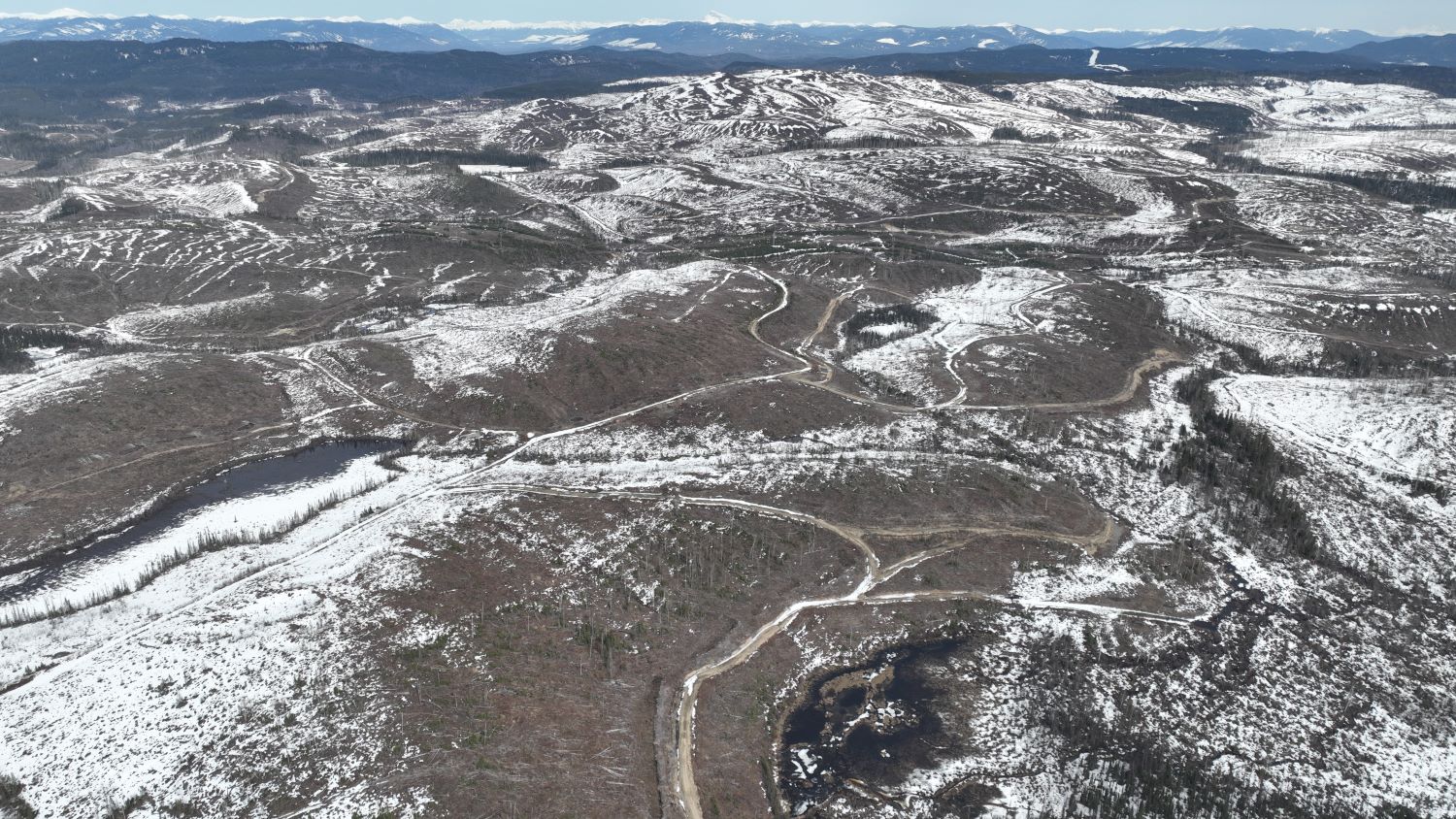
McLeod Lake’s increasing surplus is partly due to band-owned companies that do logging, mining and land-clearing work. Band-owned companies have been involved in major infrastructure projects such as the Coastal GasLink pipeline and the Site C hydroelectric dam.
The provincial government’s approval of the dam opened up business opportunities for band-owned Duz Cho Construction. The company was directly awarded more than $78.5 million in contracts during the 10-year construction of the dam by BC Hydro. Those contracts were awarded while the West Moberly First Nations were fighting BC Hydro and the provincial government in court trying to halt the hydroelectric project that would flood their lands.
McLeod Lake’s revenues were also boosted by intensive logging. In the 2018-19 fiscal year, the band recorded $82.4 million in log sales. Those sales marked the culmination of logging that consumed almost all of the forest across the band’s treaty settlement lands. The widespread logging suggests future logging-related revenues from those lands are likely to be minimal and remain so for decades to come.
After the logging activity drew significant media attention, Chingee said the logging was necessary because beetles had attacked the forests’ spruce trees.
“Tse’khene people have lived on these lands in a sustainable way for thousands of years and understand that sometimes we need to take action when the environment becomes hostile,” he said. “In this case, an insect infestation was destroying our resource. Rather than remain idle, we took action. We could move quickly and harvest this timber while it had value for [McLeod Lake Indian Band] or we could stand still and watch it decay, lose value, and become a giant tinder box for future wildfire. We chose to act.”
Promises of cash
In his 2023 band election campaign brochure, Chingee pledged to pay all eligible band members a bonus of $15,000 within 45 days of his re-election. He also said that a second payment of $10,000 would follow in December of that year if he was elected.
Stout believes those promises were pivotal to securing a new term for Chingee.
“It is huge,” Stout said. “Every time he gets in, he does that. It’s an expectation among the band members. ‘Well, this guy’s bringing in the money.’”
The band’s financial disclosures show that large disbursements to band members have tended to immediately follow elections.
More than $11 million was disbursed to band members in 2014, the year that Chingee’s predecessor Frank Orr was elected Chief. The disbursements the next year amounted to just $2.3 million.
In 2017, the year Chingee succeeded Orr as Chief, a disbursement of $11.9 million was sent to members. Following the 2023 election, disbursements totalled $12.9 million, their highest level yet.
Other than those three election years, disbursements only once exceeded $6 million.
Chingee beat five rivals in the 2023 election, receiving a total of 110 votes, 40 per cent of all ballots cast. His two closest rivals — Eureka Carty and Tania Solonas — received 77 and 65 votes, respectively.
Few allies on council
During the 2023 McLeod Lake Indian Band election campaign, Chingee not only urged band members to elect him but endorsed a slate of candidates running for positions on council.
A month before members were slated to go to the polls, Chingee held a press conference in Victoria in the legislature’s rose gardens.
The press conference, whose focus was a new revenue-sharing and land management agreement with the provincial government, was attended by three cabinet ministers. The only McLeod Lake councillor to attend was Jayde Chingee, one of the Chief’s preferred candidates for the upcoming election.
But when the band’s election occurred less than a month later, just one of Chingee’s personally endorsed candidates was elected, leaving the Chief with few allies on council.
In June 2024, a year after the election, the councillors issued their letter and said they had ceased meetings with the Chief.
In June of this year, McLeod Lake Indian Band members will once again go to the polls to elect a slate of councillors and a Chief for a new three-year term. ![[Tyee]](/design-article.thetyee.ca/ui/img/yellowblob.png)
Read more: Indigenous, Politics









Tyee Commenting Guidelines
Please note that email notifications for replies are not currently working due to a software issue which may be resolved in a future update.
Comments that violate guidelines risk being deleted, and violations may result in a temporary or permanent user ban. Maintain the spirit of good conversation to stay in the discussion and be patient with moderators. Comments are reviewed regularly but not in real time.
Do:
Do not: