


 SHARE:
"Architecture, especially its Manhattan mutation, has been a pursuit strictly for men. For those aiming at the sky, away from the earth's surface and the natural, there has been no female company."
Thus wrote starchitect Rem Koolhaas in Delirious New York, way back in 1978 before his own building ambitions had risen very high off the ground. But his historical premise was true, as it was with female representation in most of the professions. The difference with architecture is that this truth has carried extra ideological weight. A whole slew of alpha-males has been shaping our city skylines for centuries now, and the dearth of female company has more public repercussions than a paucity of, say, female dentists.
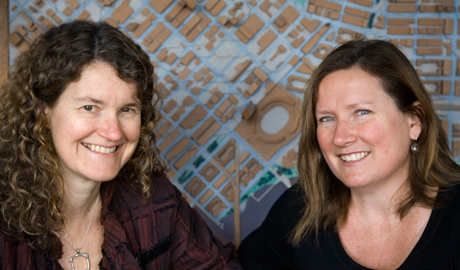
Now, 30 years after the publication of Koolhaas's sexually charged, career-launching manifesto, architecture has been steady progressing towards more female representation. In Vancouver's design community, emblematic of this new female ascent is Urban Arts Architecture. Founded by principals Jennifer Marshall and Shelley Craig, the firm is overtly and unapologetically female-dominated. "I would have partnered with her even if she had been a man," says Marshall, "but Shelley happens to be a woman."
To this day, architectural practices without a man in the house remain an oddity around here, so the two architects had to sit down and calculate if Vancouver could accept an all-female firm. "Jennifer and I talked about it for a long time beforehand," says Craig. "There was always that question: is the world ready for this? We decided that it was." They launched earlier this year with just the two of them and a male intern; since then they've hired two associate architects (one male and one female, as it turns out) and are embarking on projects like the addition to UBC's presentation centre and the visioning package of an ambitious museum of art, design and architecture for West Vancouver.
Starting as 'office boy'
Marshall notes on her website that she "began her architectural career as the 'office boy' at Thompson Berwick & Pratt." From the 1940s through the 1960s, that firm was the biggest game in town, an old-boy enclave of mid-century manners. There were no women architects, recalls now-retired TBP associate Barry Downs, although there was an excellent draughtsperson named Rosa Willcocks. If Rosa Willcocks were starting her career today, assumes Downs, she'd rise to become an alpha architect at the top of her field.
"On Friday after work," recalls Downs, "we'd all go to the tavern or the hurly-burly bars," that generation's version of Hooter's, you might say. Defying the precious conventions of the day, Willcocks regularly joined the guys at the tavern, but not the hurly-burlies. That tavern-fuelled camaraderie helped accrue what respect and success she did achieve at TBP, although who knows what critical power-mongering she missed by skipping the burlesequerie.
Be chuffed, though, that B.C. is where Marjorie Hill, the first female architectural graduate in Canada, developed her career. Hill was relegated to decorating the furniture displays at Eaton's before finally making a viable architectural career in Victoria, as the newly published book For the Record: The First Women in Canadian Architecture tells us.
There's no international male conspiracy to keep women out, says Marshall; it's just the way things developed during all those decades when there were few women in any of the professions. "People work with whom they're comfortable," she says. "That's what the buddy-buddy system is all about." Once women are around in sufficient numbers, the power-mongers get to know them and become gender-blind"in theory.
"We also saw a particular niche for clients that may deliberately seek an all-female firm," she adds, citing daycare facilities, battered women's shelters, and even libraries with female chief librarians and female-dominated boards -- "projects that are by women, for women. Sounds suspiciously like the makings of an old-girl network. "New-girl network!" they simultaneously correct me. "I think women are much more inclined to be fair and to work extra-hard at being fair," says Craig. "For the first time in my life, I've felt like I've been working in a really collaborative manner."
What's different?
This is the kind of conversation that makes me happy and cringey at the same time. First reaction: Yeah! I know from decades of swimming laps in public pools that men at any speed are almost always the least collaborative lane-sharers. That's my observation, at any rate. But how about at work?
In my own field (architectural journalism, as opposed to architectural practice), I see no difference; in fact, the most collaborative colleague and the least collaborative colleague have been a male and a female, respectively. Probably a coincidence, that. Or is it a statistical anomaly? Or does womankind's currently strong representation in that particular sector simply mean that more of us can afford to be self-oriented lone rangers? Maybe working in a really collaborative manner means that the non-collaborative, fang-baring alpha dogs will always have an advantage.
Architect Veronica Gillies rolls her eyes at any attempt to codify the male and female architectural psyches. "If you're intelligent, it doesn't matter." says Gillies, the director of the Vancouver arm of HOK Architecture. In fact, Gillies spent years as the associate in charge of hiring other architects at the office of Peter Busby, himself renowned as an alpha architect.
The only distinction Gillies noticed was not in talent or approach, but in personal goals: "Men would ask about what kind of career opportunities they would have; women would more often ask what it's like to work there," recalls Gillies. "If you have family, it can take you out of the picture." (To be sure, one prominent Vancouver architect is renowned for her longtime edict to younger colleagues that they must choose, as she did, between architecture and motherhood.) Gillies estimates that during her time at the firm, about 20 per cent of architects at Busby Perkins & Will were female, even though about 35 percent of job offers were made to females -- "Because you know what? Sometimes they don't accept the job."
To Marie-Odile Marceau, a long-established and highly successful Vancouver architect, it's ridiculous to pretend to be gender-blind. "We assign to women a better understanding of management," says Marceau. "We assign to men a better understanding of construction."
Beyond the 'warrior mentality'
Which leads to the prickly question: is the mind of a female architect different from the mind of a male architect?
"Absolutely," replies Marceau. "Men have developed from the warrior mentality." And would the city look different if more female architects had held sway? Has the gender imbalance manifested itself in the slender towers that define the Vancouver skyline? "What, you mean all the penises? Of course!" retorts Marceau, visibly perplexed by the naïveté of the question.
Back to Koolhaas in Delirious New York: "The Metropolis strives to reach a mythical point where the world is completely fabricated by man, so that it absolutely coincides with his desires," he concluded. (And yup, if you read the book it's pretty clear that by "man" he means "men.") Thirty years after its publication, Shelley Craig just laughs at that brand of rhetoric. "It's ideological, for sure. It's trying to state a really obvious thing in an aggressive manner."
And totally unlike the kind of architectural approach they take at Urban Arts Architecture. "We always start with a question," says Marshall. How does something work, what do people need? "That's the big difference" when more women are involved, argues Marshall. "It's all about team. I know that's a stereotype," she laughs, "but I probably am sexist at some level."
Related Tyee stories:
- Women's Pharmacy Designed by Students
To fill void on tough street, funding needed. - Arthur Erickson, the Brand
His new condo tower is more ritzy than timeless. - Back into the Kitchen, Girls
Why are females increasingly portrayed as twits who fall down? Call it Attack of the 50 Foot Hollywood Wiener Women.
![[Tyee]](/design-article.thetyee.ca/ui/img/yellowblob.png)










Tyee Commenting Guidelines
Comments that violate guidelines risk being deleted, and violations may result in a temporary or permanent user ban. Maintain the spirit of good conversation to stay in the discussion.
*Please note The Tyee is not a forum for spreading misinformation about COVID-19, denying its existence or minimizing its risk to public health.
Do:
Do not: