Opinion

A Tyee Series

The $18 Million Condo

Vancouver's new architectural paradigm: the insanely priced pied-á-terre.

By Adele Weder, 25 Oct 2007, TheTyee.ca

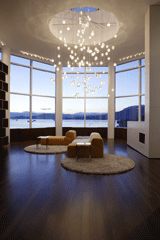
The 'Great Room' at 1000 Beach.

The 'Great Room' at 1000 Beach. Photo Michael Boland.

The modest old post-and-beam bungalow is swiftly being usurped by a new west-coast signifier: the insanely priced penthouse.

The latest newsmaker is a 48th-floor unit at the Hotel Georgia's "Private Residences" planned condo-tower annex, pre-sold for $18-million, even though it won't even be finished until 2011. No matter, it's in good company, joining the future penthouse of the Shangri-La tower (on the market for $17.6 million) and Unit #2601 at Beach Avenue (listed at $18.2 million). As their sales agents aver, buyers for these kinds of condos form a market unto itself. But they still enter our collective consciousness through media coverage, trickle-down influence, and, let's face it, subterraneous veins of jealousy. Welcome to the new architectural flagship of 21st-century Vancouver.

With interior architecture by Omer Arbel, the 6,900-square-foot unit at 1000 Beach Avenue is the only one in the $18 million club that's actually finished, and it is spectacular -- in a very literal and public sense of the term. Rising out of the crotch of the Burrard St. Bridge, the building itself reads like our city's version of the Statue of Liberty, except that the lantern that tops it off is not a spiked beret but a double-storey penthouse, aglow with a thousand points of halogen light. And its implicit slogan is definitely not: Give me your tired, your poor, your huddled masses yearning to breathe free. It's something more along the lines of: Give me your whiz-kids, your rich, your global expats yearning to park their money somewhere so that they can breathe free.

The Beach Avenue penthouse has been the talk of the town this year. The eye-popping price tag is fuelling the buzz, to be sure, but more unusual is the affiliation of mega-budget with radical design. Hyper-expensive penthouses are more typically decorated in fusty faux-classical, or the TV-informed tastes of the resident mistresses. But the Beach Avenue project is different. It's rad. The Market Unto Itself is starting to hone in on our more innovative young design talent, and it's hard to say if that's a good or bad harbinger. Both, probably.

'Low man on scrotum pole'

Inside, Arbel's phantasmagoria is defined by a series of backlit onyx pods that illuminate spare but rarified art and custom furniture. A Graham Gilmore painting bears the saucy text: "low man on the scrotum pole/takes the cake." This kind of irreverence pervades the whole space, from the fanciful "office" -- which acts like a highly sophisticated tree house suspended over the dining room -- to the long, slim walnut dining table with tiny bowls recessed right into the tabletop. For ketchup? "Olives," replies Arbel, tersely.

Every zone boasts elements that are so glamorously dangerous you could put an eye out on one of them (as I almost did, literally, when I walked distractedly smack into the floating metal staircase that descends from the overhead office). But the space reaches its theatrical zenith in the living room, with Arbel's huge Bocci chandelier, a stupendous cluster of tiny halogen-lit glass spheres that you can see across downtown. That makes 1000 Beach Avenue the city's most expensive lighting showroom. This isn't the tree hugging post-and-beam bungalow of Western Homes & Living; this, my friend, is Wallpaper.

It's wholly impractical for a "home." But that's beside the point. It's not a home. (Arbel himself speculates that the eventual buyer would likely be someone who spends just a few weeks a year in Vancouver.) And it's definitely not "west coast" -- at least, not in the humble, nature-inspired and inclusive mode we've come to expect from the term.

Expensive intimacy

Arbel, for his part, seems weary of the focus on wow and is more eager to show off the subtleties: his dining room table, deliberately crafted as a more narrow elongation, to imbue intimacy among the diners; the floor-to-ceiling window that unfurls the downtown vista like a flag as you walk out of the epoxy-floored kitchen; the decorative elements on the doors and elevator panels. And the materials: not dumpy local wood and stone, but onyx and walnut and steel and epoxy.

So what's so unsettling about 1000 Beach Avenue, other than the churlish fact that the rest of us can't afford it? In part, it's because it defies the British Columbia ethos of woodsy naturalness. It rubs our noses in the fact the cedar, hemlock and fir have been pretty much used up, or at least are no longer cheap and plentiful regional materials; and that our new core culture is swiftly evolving into the kind of slick cosmopolitana for which 1000 Beach Avenue serves as such a heady backdrop. Like the old west-coast-modern approach, it boasts views that have been strategically designed to look out onto the landscape -- but in this case, the most vaunted views are the towers to the north and, to the south, the condo's own boat slip in the marina below (admired from the bathroom window "as you're brushing your teeth," notes Arbel).

Arbel's argument is that we have to rethink the concept of "local" in our architecture. Why is concrete now the definitive West Coast material? Because years ago, as our wood supply dwindled and post-and-beam structures started to rot, designers and builders turned to concrete as a logical, sustainable substitute, training a generation of designers and builders in its use. Within a decade or too, the industry boasted an entire citywide crew of concrete artisans. So, it's the particular skill, rather than the material itself, which is local.

What's $18 million anymore?

To some critics, though, 1000 Beach Avenue uses architecture to bring conspicuous consumption to new heights, both financial and literal. It smells like what Rhodri Windsor Liscombe, head of the Visual Arts department at the University of British Columbia, has dubbed "architizing," the condo-marketing phenomenon wherein "the architect and architecture operate as incidental justification for the mobilization of civic space as the marriage of elitist profit with singular desire." You could reformat that Proustian dictum into a simple, crude question: is radical new architecture turning into a lap dance for itinerant billionaires?

On the other hand, should architects be content to remain low-key, low-budget and virginal when corporate lawyers and botox doctors haul in all that elitist profit for shamelessly exploiting all those singular desires? Affordable domiciles crafted from local materials -- that tradition has been scorched by soaring land values and construction costs. And that outrageous-sounding price tag isn't as comical as it first seems when $30 million faux villas are cropping up near Jericho Beach and Whytecliff Park.

"Eighteen million dollars is not exactly unheard of anymore for a Vancouver property," says Arbel, and he's right, although that's small comfort for the huddled masses.

No matter; 1000 Beach Avenue is more radical experiment than rational living. "For better or worse," says Arbel, "some of the most innovative projects in architecture have come at the highest end." Like Mies van der Rohe's 1949 almost-all-glass Farnsworth House, which is drop-dead-gorgeous to look at in books, but was impossible for the infuriated client to live in.

"You're constructing fantasy," says Arbel of 1000 Beach (which on his own website is dryly called Project 15.2). And there's no denying that the city's recent architecture is, by comparison, overwhelmingly banal. "It's time that Vancouver wakes up from the sleep we've been in," says Arbel. For all the men worrying about their place on the scrotum pole, 1000 Beach Avenue is just the right kind of wake-up call.

Related Tyee stories:

 [Tyee]

67  Comments:

  • kl

    25-10-2007

    Resort City

    Yesterday I read the condo king Rennie called Vancity a resort city. Gag.

    Our Governments do not care about those of us that have lived here their whole lives yet can't afford to buy a place to live. And no, moving somewhere else is not an option for those that suggest it. Instead it cares only about catering to rich millionaires.

  • NicS

    25-10-2007

    "Artisan Concrete" & Leaky Condos

    "Why is concrete now the definitive West Coast material?"

    Because at the height of the leaky condo crisis in Vancouver developers were worried sick about the state of their industry. Then they came up with "concrete" as the answer to all their problems. Because it doesn't rot. Unfortunately concrete still doesn't solve drainage problems, leaks and proper interior & exterior ventilation.

    Potential buyers see the "artisan concrete" in condo sale ads and think: "Gee honey, we'll never have to worry about the 'leaky condo boondoggle' problems of the 90's". Guess again sucker!
    Reports of deteriorating concrete with rusting rebar in highrises hit the news a couple of years here in Vancouver. So much for "concrete artisans". "Concrete Houdini's" might have been more appropriate.

    No doubt, the construction industry in Vancouver has matured since the leaky condo fiasco, but we still live in the wettest climate in the western world. Pretending that concrete construction is the answer to our leaky condo questions is an idea that attempts to solve the problem of the public having confidence in the product thats now available. Tryed and tested methods of construction will work regardless of the materials being used. Better building codes, stricter inspections, and more knowledgable designers are still lacking in Vancouver.

    So how about an article on the "true" state of where this industry was and now is.

  • realisticman

    25-10-2007

    kl

    Our Governments do not care about those of us that have lived here their whole lives ... it (sic) cares only about catering to rich millionaires.

    I thought these buildings were built by private developers. Is it the governments that are building them, kl?

  • southdeltawalker

    25-10-2007

    views from the ground...

    gee maybe the homeless lying on the sidewalks will be able to look up and see the Bocci chandelier.

    guess i'll go out and look at the birds...

  • charlesdemers

    25-10-2007

    "Suggest as offensive"

    I know the option refers to the comments section, but is there any button I can press to "suggest" an $18 dollar apartment "as offensive"?

  • G West

    25-10-2007

    Not 30% saleable kl

    This is the breakdown:
    500 condominium units and 200 units of 'social housing' plus all the other stuff like an SFU campus etc.

    The condos went on the market last April, and they sold out in two days - about $200 million in sales with at least 30% of the sales, maybe more, going to speculators and investors.

    In building two the one on Abbott Street, there are condos and 75 low-income units to be managed by Affordable Housing, which will be for low-income families. The remainder of the space goes to offices and retail.

    There are also (in the building on West Hastings) 125 low-income housing units administered by the PHS will be here. These units are designed to replace single-room occupancy units. The budget price for rent was set at the welfare rate for singles at the time the buildin was planned - $325.00/mnth.

    So, leaving out the rental units (which are just a partial replacement of lost SRO stock) the ratio is 75:700 or 11%.

    At least that's the way I understand it. Of course, Peter Ladner and the NPA would say it's 200:700 or nearly 30%.

    Take your pick.

  • kl

    26-10-2007

    Exactly

    G West breaks it down nicely. Yes, the rental units do nothing more than replace some of the lost SRO's. We are no further ahead.

    G West do you happen to know if BC keeps a database, like Nova Scotia does, of foreign property owners? I'm guessing we don't. I'd really like to see some hard numbers on the number of foreigners in the real estate market in BC.

  • G West

    26-10-2007

    kl

    Likely not...at least not for public use; I might just know someone who could find out though.

    There is likely a way to get at the information - although it might be of questionable reliability and not all that easy to assemble.

    The BC Assessment Authority has records of all property owners for tax purposes and it is accessible online - or was the last time I checked.

    If the database is searchable for more than name and address (I doubt it is from home computers) it might be feasible to set up specific search criteria to ferret out which owners are not based in BC.

    There would be lots of problems with any information obtained that way because of corporate (numbered companies) holdings and the fact that many offshore investors use a local proxy to manage their investments.

    Such a registry - similar to the one in Nova Scotia - would certainly open the public's eyes to how problematic this situation has become for local affordability.

    In a way it's the flip side of what western businesses do in terms of setting up sweat shops to exploit labour resources in Mexico and the Far East.

    I’ll bet Gordon Campbell could tell us.

  • realisticman

    26-10-2007

    kl

    Quote:
    I would like to see 30% saleable condos at a subsidized price.

    How would this work?
    Government uses taxpayers money to pay developers to sell cheaply?
    Would developers be the sellers or government?
    If it's government, would they buy from developers at market cost and sell cheaper?
    Sells to whom, anyone?
    What happens at re-sale?
    Would owners have equity? If so, would they pay back government, plus interest, for their received subsidy?
    Would properties be forever 'subsidized' for market valuation and tax assessments?

  • kl

    26-10-2007

    Just like Whistler

    It would be similar to the Whistler Housing Authority housing purchase program. I won't regurgitate it here but you can read about it at http://www.whistlerhousing.ca/?NmID=42

    The massive profits developers make off of higher end units can subsidize the non market sales.

    In Whistler, an 1100sf non market condo sold for $227 900 in September, amongst other sales. Granted, as a buyer you have to be prepared to live within the set formula for appreciation but at least it allows you to get into ownership without having to be a millionaire.

    As well, purchasers would have to demonstrate they have lived and worked in the city for at least a year to be eligible.

    One more thing I'd like to see implemented: a special tax on sales of homes and condos if you sell it within a year of purchasing it. That would take out some speculation buying.

  • realisticman

    26-10-2007

    kl

    Interesting program. As I understand it, correct me if I'm wrong, the program is for employed workers and financed by a tax, "The tax is collected from businesses that rent out their property in the Village area as well as the hotels, and is used towards the cost of building employee housing." Rather than from developers profits. On this basis it makes sense.

  • realisticman

    26-10-2007

    One other thing

    You ask for,

    Quote:
    a special tax on sales of homes and condos if you sell it within a year of purchasing it. That would take out some speculation buying.

    As things stand now, one is supposed to be liable for capital gains tax if one's principal residence is sold within a year, I believe. Also a property is subject to capital gains tax if one doesn't live in it.

  • kl

    26-10-2007

    What about a development tax

    What about a development tax of some sort, imposed on developers that is then put into a fund, to fund such housing as the WHA provides? Plus, a non resident owner tax could help fund some housing.

    Seeing as I am not a home owner, or speculator I am unsure of how capital gains taxes work. However, whatever tax, if any, that is in place clearly is not enough to end speculative buying. I live in So. Granville and a recent development was completed. The sod hadn't even been laid yet on the grounds and there were a about 6 for sale signs up out front. As it stands now I'd say judging by looking into the building only about 1/4 of the units are occupied. Pre-sale prices were $675K and up.

  • G West

    26-10-2007

    kl

    I think the simplest and most effective brake on runaway house prices is to change the tax system. Capital gains should be taxed as regular income - and on all real property including principle residences.

    Houses make much better homes than speculative instruments.

    Coop housing should be encouraged and promoted and Real Estate commission sales should be replaced by a small fee - say expenses plus $1500.00.

    Foreign ownership should be outlawed and current non-residence owners given 5 years to liquidate their holdings.

    If people want to invest in real property they should live here - otherwise - invest in their own countries - they're only making things worse here in Canada.

  • realisticman

    27-10-2007

    kl - it exists

    Quote:
    As of November 29, 2008, there will be a new rate for the Downtown South DCL area. The new rate
    will be $13.00 per square foot for most uses.
    Introduction
    Development Cost Levies (DCLs) collected from development help pay for facilities made necessary by
    growth. These facilities include: parks, child care facilities, replacement housing (social/non-profit
    housing), and sewerage, water, drainage and transportation projects.

    http://www.city.vancouver.bc.ca/commsvcs/planning/infobul1.pdf.

    Ad to that permit costs of thousands.

    http://www.cityofvancouver.us/buildpermits.asp?menuID=10463&submenuID=10522&itemID=17516

    It's complicated. The Globe reported that land costs on the west side have just reached $1 million a 4,000sq' lot. That's around $250sq'. On the east side it's perhaps $150sq'. Building costs are around $250sq' if you're lucky. So, if you have a small lot in the back of an East Van lot that's 2,000sq' to build on, the land will cost around $300,000 and if you're building a modest 2 story structure for two families of around 1,200sq' each, that adds $480,000 for materials, trades and finishings. So each dwellings costs $390,000, plus DCC and Permits fees.

    If you could go up 6 stories the cost to each would be $290,000. $100,000 less because the land cost is the same. There would also be less in DCC and permit fees.

    Vancouver has plenty of room to grow up to six or eight floors, much like most of Europe, without being covered with skyscrapers. There are also thousands of opportunities to build coach-style homes along the alleys of Vancouver. These would be be much less likely to attract foreign investors who tend to buy more prominent properties.

  • realisticman

    27-10-2007

    Correction

    That should be; "Building costs are around $200sq' if you're lucky." Accent on the lucky.

  • kl

    27-10-2007

    Levies

    Real, I was aware of the levies, which I think are a good thing. However this still does not help out with making purchasing home affordable. We need both non market rental and non market homes for purchase.

    G, I am torn on foreign ownership. I don't know if I would go so far as arguing no foreign ownership. However, looking at what has happened in some areas of Central America where it can cost as much as here to buy a home (Roatan, Honduras; San Juan del Sur Nicaragua to name a few places), maybe restricting foreign ownership isn't such a bad thing.

  • G West

    27-10-2007

    kl - I tend to be very welcoming to immigrants

    Moreover, I'm pleased to have them come and bring their traditions (most of them at least) their energy, resources, initiative and talents to Canada as new Canadians. I'd never tell a landed immigrant they couldn't buy property either...but, to practically salivate at the prospect (as our current governments mostly do) of folks from away buying residential properties as speculative investments while they live somewhere else - well it has to stop.

    I suppose there could be an argument for grandfathering certain kinds of property - say a cottage on the lake that passes through inheritance to a son or daughter who once was Canadian but now lives somewhere else - but only for their lifetime.

    There are also many other ways to provide affordable housing through cooperatives which should be explored and encouraged. The high cost of concrete construction is another serious problem – an expedient which has become the one-size-fits-all solution to address building envelope failure. Something which was much more related to incompetent design and sloppy building practices that to the nature of wood frame and composite construction anyway.

  • G West

    28-10-2007

    And, by the way

    I understand there's an equally messed-up Convention Centre a-borning in downtown Nanaimo too - to which 'senior' levels of government had promised funding which has now - to the mayor's chagrin - apparently gone walkabout.

    In Victoria too there is another messed up civic/private enterprise ‘built’ and now run by a certain developer from the mainland - Kelowna I believe - which white elephant the good burghers of this burg will still be paying for 27-odd years from now when the so-called private partner has long since flown the coop.

    Perhaps they'll all retire to flashy condominiums in Maui...sensitively placed within easy walking distance of their favourite watering holes.

    Why there should be so much emphasis upon building facilities for tourists, travellers and conventioneers, not to say obscenely expensive condominiums, at a time when everyone responsible is cutting back (personally and corporately and even bureaucratically) on wasteful and irresponsible international air travel is a huge mystery to me.

  • The discussion for this story is closed. No more comments can be added.