
They pay less than BC's post-secondary crowd, yet the revolt is unlikely to spread west. Here's why.
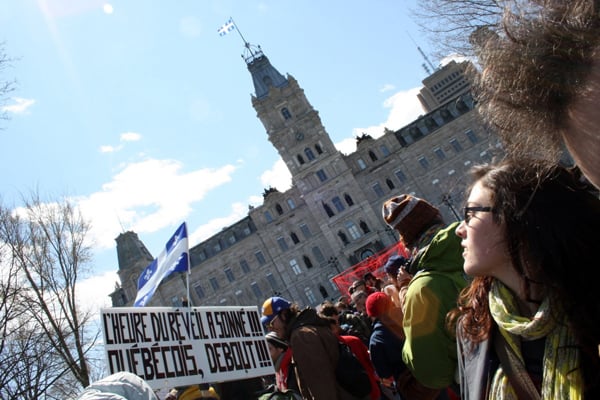
Students demonstrate April 29 in front of Quebec's National Assembly. Sign reads: "THE WAKEUP BELL HAS RUNG!!! QUEBECERS, ON YOUR FEET!!!" Photo by Kai Nagata.
Quebec and British Columbia could well be described as sister provinces. Both siblings are photogenic and outdoorsy, with more than a hint of estrangement from the ROC ("Rest Of Canada").
Politically, both provinces feature socially progressive urban centres, routinely mocked by those outside the big cities. Both are governed by unpopular Liberal premiers: Jean Charest, an ex-Tory, and Christy Clark, who has started recruiting federal Conservative staffers at an impressive rate.
Charest and Clark are each caught between a resurgent, traditional social-democratic opposition and an upstart right-of-centre party. With elections looming, both premiers appear to be tacking to the right, trying to squeeze out their business-friendly opponents -- John Cummins in B.C. and François Legault in Quebec.
In Quebec, this shift has crystallized in the decision to hike tuition fees by 75 per cent over the next seven years. At an average of $1,625 per student, the savings for government would be modest, but symbolic.
Backed by roughly half the population, the government has faced down 175,000 striking post-secondary students, refusing to reinstate a tuition freeze. Electorally, the Liberals' tough stance appears to be working. Last week the Quebec Liberal Party squeezed out a first-place finish in a CROP poll conducted for La Presse, leading to speculation that Charest is polishing his campaign buses with little red felt squares.
That ubiquitous red square, by the way, is a play on the phrase "carrément dans le rouge," or "squarely in the red." I've pinned one to my jacket to show my philosophical support for the students, even if I think some groups' tactics are counterproductive. My involvement is not totally abstract: I am one of many young people from B.C. to have been lured away at one time by Quebec's excellent and affordable universities.
During my undergrad, B.C. had the fastest-growing tuition fees in the country. According to Statistics Canada, in 2011/2012 undergrads in B.C. paid an average of $4,852 a year, up from $2,527 a decade earlier. That's a 92 per cent increase. (Inflation over the same period was 23 per cent.) In comparison, Quebec looks rather attractive: $2,519 this year versus $1,843 ten years earlier, for a hike of 37 per cent.
The cost of living in Vancouver is also ridiculous. In The Economist's 2012 worldwide cost of living survey, Vancouver is listed as the most expensive city in North America. In Demographia's 2012 housing affordability survey, Vancouver ranked second from the bottom. Montreal ranked 70th.
These numbers raise two interesting questions. If B.C. and Quebec are otherwise comparable, but Quebec students pay half the tuition (and less for rent) -- why have they been protesting for 12 straight weeks? And if Montreal students can get 200,000 marchers to hit the streets (double Vancouver's estimated Game 7 crowd last year), why can't progressives in B.C. muster anything close?
Québécois debout
The answers are likely to be discouraging for anyone hoping for a student-led B.C. "spring" (itself a problematic term). Certain broad strategic lessons do emerge, but first, here's why it won't happen the same way out west.
One could certainly say that Quebecers embody a more robust culture of public protest. Normal middle-class families consider it healthy to take the kids out and hoist placards denouncing things they disagree with. Quebec unions have lent financial and logistical support to the student associations from the beginning. Low tuition fees are a distinct point of "national pride." Quebec progressives recognize a slippery slope when they see one. While the rest of us have been lulled by neoliberal think tanks, Quebecers are awake and pounding the pavement on our behalf. These arguments are all part of the truth.
But like practically every other issue in Quebec, the tuition debate must also be considered through the lens of the National Question.
At the top of this article is a photo of a sign saying "QUEBECERS, ON YOUR FEET!!!" The other side was marked with the words "LA SOUVERAINETÉ! ÇA PRESSE!!! (DEPUIS 1760!!!)" Roughly translated: "Sovereignty, it's urgent, and has been since the Brits conquered Montreal." The woman carrying the sign was also wearing a red felt square on her jacket.
There are signs all over of this blending of nationalist sentiment with support for the student strike. My anglo friend, pointing at one of many Patriotes flags: "What's that, an Irish thing?" No, it's a symbol of armed rebellion against the English. Hence the guy holding a rifle.
It gets uglier. At one protest in March, a group of young people in blackface hauled an effigy of the premier through the streets bearing the name "Sir John James Charest." This is a reference to the book Nègres blancs d'Amérique, published in translation as White Niggers of America. Written in prison by FLQ leader Pierre Vallières, the book calls on French Quebecers to throw off their colonial shackles and unleash revolution.
Were these groups invited to the protests? Do they hold a stake within the various student associations? Probably not. But there they are, padding out the crowd numbers, protesting for a complex blend of reasons.
Everything is political
Like me, Pauline Marois has been sporting the little red square on her lapel -- though I daresay for slightly different reasons. The PQ leader has condemned Charest's tuition hikes and promises to cancel them if she is elected. She can hardly do otherwise. In 1996, Marois was education minister under Premier Lucien Bouchard. Her musings about a fee hike at that time prompted another giant walkout and weeks of demonstrations before she backed down and instituted a tuition freeze.
This time, the protests appeared to play in the PQ's favour. They catalysed a sense of public frustration with the incumbent Liberals: nine years of alleged corruption, arrogance, influence-peddling, gerrymandering, regressive tax hikes, environmental callousness, and sundry other wicked deeds. (Sound familiar, British Columbians?) So the PQ threw its support behind the students. Now it appears that might backfire.
Still, despite the unique situation of the left in Quebec, here's some general tactical advice from the streets of La Belle Province.
Step one: If you're going to protest, don't just abstain from property damage. Prevent it. Sure, we can debate the semantics of "violence." Sure, nobody's been hurt, mostly, except several police officers. Yes, people are angry, although Yoda would have something to say about that. Think of the street like an airplane fuselage: broken windows just suck out all your oxygen. Indignant national columnists are drawn to flames like moths. If you care about step two, stop your friends from picking up rocks. Pull them away from the line of riot shields. That takes infinitely more courage than fighting cops.
Step two is to build coalitions. This is where Quebec students have done well, most notably in the recent Earth Day rally. Subsequent media reports tried to characterize the student movement as having hijacked or co-opted the quarter-million person manif. Rather, all the students did was create a Venn diagram of people who oppose the hikes and people who are concerned about the environment. (The sovereignists, Charest-haters, and federal opposition MPs showed up too.) The overlap between all those groups is considerable, and that's okay.
Occupy was accused early on of not having a single focus. There is strength to be found in broadening the conversation. Making the tent bigger. Speaking to the middle. All these issues are, in fact, related -- Charest made that clear when he joked about sending student protesters to work in the new mines up north.
From sister to sister
Last Friday I followed a feminist demonstration in Quebec City, where marchers made the point that tuition hikes disproportionately affect women. It was a smart angle on a well-worn issue. As protestors marched and chanted behind a purple banner, police boxed them in, wrapped a line of police tape around the whole group, and arrested them one by one for blocking traffic. Each received a $494 ticket.
One older woman was sight-impaired, walking with a white cane. The image of police leading her off to a borrowed city bus provoked a certain cognitive dissonance. It pointed to a larger dysfunction. It led one angry person on Twitter to accuse me of making it up. I thought it made the whole demonstration worthwhile.
As long as Charest is in power, any challenge to his government will be bolstered by those who see him as a federalist imposter. Barring the emergence of a B.C. sovereignty movement, Quebec's crowds will continue to be larger, noisier, and more complicated. But the two provinces still have lots of other things in common -- including a broken economic system and a natural environment under threat. Plus nice older folks who are willing to risk arrest on behalf of younger generations.
Tuition is unlikely to be the Alamo for British Columbia progressives. For the movement to capture broader appeal in Quebec, the issue will have to morph and evolve. All this as Quebec's election deadline draws closer. Whatever happens next, there's still much to learn from our francophone sister. ![[Tyee]](http://thetyee.cachefly.net/ui/img/ico_fishie.png)
Former CTV News Quebec City bureau chief Kai Nagata is The Tyee's current writer-in-residence. Read his previous Tyee articles here. His blog is here.
31
Login or register to post comments
mikemowbz
1 year ago
The pragmatism of 'Step One'
The pragmatism of 'Step One' is obvious.
Still, Marc-Andre Cyr has an interesting counter-perspective:
http://voir.ca/marc-andre-cyr/2012/04/30/des-casseurs-sans-histoire/
Jeffrey J.
1 year ago
Quebec an Inspritation for Democracy
The 1960's Quiet Revolution in Quebec was a singular event in Canada's democracy. It remains an outstanding period,while the Mainstream Media does everything in its power to pretend it didn't occur.
One of the best accounts of Quebec's fiery history and independence is Dickinson & Young's brilliant Short History of Quebec.
http://www2.education.ualberta.ca/css/css_35_3/BRshort_history_quebec.htm
Years of Anglo corporate exploitation and domination finally led to a powerful independence movement. This ultimately saw Quebec citizens basically evict them from Quebec. English Canada's elite NEVER forgave Quebec for this audacious act of independence.
I salute every Quebec student on strike for reminding us what citizen power is all about.
Great coverage!
jimmmmy
1 year ago
A neat little article some
A neat little article some interesting ironies/ hypocricies, and the usual homage to christo- capitalism to cover himself. Fees for for university and health care were once thought dispicable in this country, but thanks to 50 years of right wing social engineering they are now the norm as the writer intimates.
ptudge
1 year ago
Learning from Quebec
This is really good commentary, being from BC and currently living downtown Montreal, and working at one of Quebec's university's this student strike is an eye opener. The article really touches on connections back home, but also the complexities that underpin this issue. It is really hard to talk about the student strikes without situating it within Quebec's history, as jeffrey above points too.
As a BCer in Quebec, I wear my red solidarity flag, live with the nightly helicopter buzzes over my home and when I can, walk with the students. We all can learn from Quebecers ability to say NO, mobilize and voice themselves.
btrain
1 year ago
Tuition
When Kai points out the increases in tuition fees in BC over the past years, he does play with the numbers a little bit - as is the privilege of anyone with access to statistics.
If you click on the StatsCan link he gives above, you see that in 1990/91 the BC provincial average tuition was $1808, and eleven years later in 2001/02 it was $2527. That's a 40% increase over 11 years, or about 3% per year compounded.
What Kai does not mention is that from 1996 to 2001, tuition in BC did not change at all - the then NDP government froze it for five years, then when the Liberal government came in it removed the cap in 2002. Because the NDP government, over the period of the tuition freeze, did not make up the full difference in foregone tuition revenue by increasing funding to colleges and universities, there was a considerable amount of ground to be made up when the freeze came off - hence the very quick rise, and now BC tuition rates are soundly in the middle of the national pack (excluding Quebec, of course).
The point is that these were conscious decisions made by successive governments. It was a decision by the government of the day to freeze tuition, then not to make up the difference - governments of all stripes are only too willing to kick cans down the road when they may.
It was another decision by the Liberals to remove the freeze, they made another decision to slightly increase funding to post-secondary education from 2006 to 2009, and yet another (since about 2006) to limit tuition increases to a maximum of 2% per year - about equal to CPI inflation (however, this has not kept pace with other cost pressures with higher inflation rates and post-secondary institutions are starting to run deficits they can't make up).
At any rate, it seems that the value of post-secondary education is signified by the extent to which a given province's government is willing to subsidize it. Canada, or rather individual provinces, could go the Nordic route and make post-secondary education completely free to its residents (I don't undetrstand why Alberta, with its Heritage Fund, never did this, or maybe I do). But the surprising thing about countries that have done this - Norway, Ireland and Scotland are examples - is that attendance at colleges and universities did go up, but it did not explode: it appears that the strongest among many factors influencing someone's decision to go to post-secondary is whether their parents did.
crypticvalentine
1 year ago
Montreal Spring
http://vimeo.com/41274541
Tahsis Tattler
1 year ago
Does current education do the job?
If you can't get a job with grade twelve education because employers are requiring a higher standard, then basic education is not up to standard. Does this mean that the governments are sloughing off their responsibility and cost onto the individual?
G West
1 year ago
btrain - Lies, damn lies and statistics
In fact, the story is even more fraught than your somewhat interesting post reveals.
Per-student funding in BC, adjusted for inflation, declined for both colleges and universities since the early 1990s - in fact, real per-student funding for universities fell by 21 per cent between 1990/91 and 2003/04.
During more or less the same period real per student funding for colleges fell by only 10 per cent between 1991/92 and 2004/05.
The majority of the real per-student funding decline (to take issue with what you've written) actually dates to the period before the tuition freeze. In fact, during the tuition freeze, real per-student funding was essentially flat for universities while it increased for colleges.
In fact - and this is the REAL problem for universities in the province - since the tuition freeze was lifted in 2002/03, tuition fees have increased by 76 per cent in inflation-adjusted terms. This means that student paid fees are now the primary means by which post-secondary institutions are meeting cost pressures...And that's the problem!
MonicaC
1 year ago
It is easy to say that we have different history Part 1
I am a new Vancouverite who moved here one year ago after living for several years in Montreal. First, I would like to thank Kai for taking up this important topic - 12 weeks into the strike but better late than never. Second, I appreciate the historical angle that he took, as it explains some of Quebecers' motivation to go out to the streets. While Kai correctly mentioned that 175,000 students remain on strike at this point, the large manifestation of March 22 saw a quarter million students and supporters march across the streets on Montreal. Since then, the city has been tormented with almost daily demonstrations and actions of economy disruption, night and day.
However, saying that Quebec and BC are sisters who share similar values and problems but have different historical predispositions to disobey is a simplification even for a newcomer to BC without excessive knowledge of this province. I have close family members who grew up in BC and they always presented this province to me as leftist, environmentally-minded and willing to engage in alternative economic choices to build sustainable, supportive communities. Yet, upon my move here, I have mostly seen incredible economically-based segregation, much more poverty than in Quebec, hyper-individualistic values, NIMBism, and apathy. The so-called "laid-back" nature of people in BC seems to boil down to the last three characteristics for me and is not appealing at all. People in Quebec are nothing like that. They are open and emotional. They have a sense of community (nation) and shared identity. They have socialist values and are not afraid to say that. They believe that the English North American world is predatory and exploitative, and they are right. They disobey this world. Of course, Quebecers were shaped by their history but they are just different in their values and life choices. They are willing to be involved, willing to get out of their backyards into the streets, willing to handle the discomfort and consequences of disobedience. People in BC talk big values but they stay in their backyards, drive their SUVs everywhere so that they do not have to interact with one another, seem terrified of another human being and, consequently, need numerous laws that regulate social behaviours, and in my opinion, buy into capitalist values.
MonicaC
1 year ago
It is easy to say that we have different history Part 2
Some of them do not admit it because it is not cool but they eventually do buy in. The hipsters who claim to have alternative views are kids from West Van or Van West side who are rebelling against their parents while having them pay their tuition and rent. The hippies are often older counterparts of today's hipsters: they used to be privileged kids back in the day. Of course, this is a huge overgeneralization but I am disappointed with the people in BC. I agree with Kai that students here will not rebel against tuitions. It is not because they did not grow up in a province that fought for sovereignty - it is because they do not care. Half of them have well-off parents who take care of their tuition and another half have bought into the loan system and the capitalist promise of a better tomorrow. For these students, education is a product that you buy. They believe that it has a high monetary value and, hence, are willing to pay it. In Quebec, education is a value (period). And a right. This point was made by several amazing McGill professors in their letter to Montreal Gazette a few days ago http://www.montrealgazette.com/news/Tuition+hikes+solve+what+ails+system/6501275/story.html
I think people in BC need to stop making excuses and figure out what they stand for. A change will not be made by building isolated communities based on love, respect, and politeness that works only when everyone is doing well but fails when there is a crisis. It will not be build by moving to the suburbs, sitting in your backyard, and complaining about the predatory people from Yaletown. A change has to be emotional and angry. It is a commitment. It is uncomfortable. It has a price. This city is too nice, people are to physically and emotionally isolated to rebel. Again, this is a huge generalization. But so far I have not found evidence against it. If there is something that we can learn from out Quebec "sister", it is how to be passionate individually and as a society, how to embrace our emotions and use them as motivators for actions. Then, we will be able to call ourselves a sibling of La Belle Province.
PS. I do not want to glorify Quebec. It has its own issues, such as (institutionalized) discrimination and very bad medical system. But this is a separate topic.
Kreditanstalt
1 year ago
I won't pay...they SHOULD.
I have no idea why taxpayers should be forced to subsidize other people's education costs at all.
You can bet the REAL cost of a year of post-secondary education is a lot more than $2,519.
After all, teachers, professors and support staff have to be paid "living wages", don't they? :)
crypticvalentine
1 year ago
Montreal Rising!
https://vimeo.com/41387746
Dan the socialist
1 year ago
Both are governed by
Both are governed by unpopular Liberal premiers
=====
Your obviously not from BC as you would know we have not had a Liberal government since the 40's. Just because conservatives call themselves Liberals does not make it so.
I have close family members who grew up in BC and they always presented this province to me as leftist,
============
BC never has been 'leftist' sure the NDP has won only 3 times ever and that is due to vote splitting on the right, when it is a two party race the NDP does not win nor will ever win.
Were not much different than Alberta as we elect right wing governments all the time whether they call themselves Social Credit or BC Liberal..Rural BC is just like rural Alberta full of 'red necks'.
BC is a nice place if you are rich. So expensive, so much poverty here, people do not realize they come in second to corporations. They get brainwashed by the BC media from radio to tv to newspapers which are all very pro right wing.
BC used to protest like in the 80's when Bill Bennett was in charge but not anymore and anyone that does is branded a 'welfare bum', 'communist', 'socialist', unemployed', 'NDP supporter' 'crazy environmentalist' and other shaming language I can not print here.
BC is fast becoming a place where one can not afford to raise a family unless you are rich, Rents, food so expensive, taxed to death, msp premiums keep going up.... The so called Liberals are giving away and mis managing our assets.
Myself I plan of leaving before it collapses here and it will. Probably be a good idea to leave the country as our national debt itself is 2.5 times that of Greece's. Then all the provincial debts and if interest rates ever go up things will get worse...
What changed BC for the worse was Expo 86.
Frank
1 year ago
Re : I won't pay...they SHOULD.
Pretty hypocritcal response from someone who didn't contribute to the Cdn economy but has no qualms collecting old age pension and supplement and using the Cdn education system for their kid.
RickW
1 year ago
Kreditanstalt
Because civilization as we know it isn't possible without an educated population. Now if and when you could find a way to guarantee who is worth educating and who is a waste of space, let me know and we will be able to carry on with this conversation. But in the meantime, smarts are not restricted to the so-called "monied class", and in a democracy, everyone is entitled to a chance to be educated.
anarcho
1 year ago
Always the same problem - the greedy guts!
The reason for the rise in fees is greed, pure and simple. If the rich minority and the corporations paid the same amount of tax as back in WAC Bennett's day - a conservative, by the way, there would be no need to have such high tuition fees. Indeed, our Quebecois friends are not radical enough- the fees should be abolished and everyone who qualifies should be able to go to university as they do in France and other European countries.
Fritz
1 year ago
One 4 All, All 4 One, Everyman 4 Himself
Kreditanstalt: "I have no idea why taxpayers should be forced to subsidize other people's education costs at all."
Kred even though you're not complaining about things such as taxpayers paying $114 billion to bail out the CDN banksters.
Or about huge subsidies to the oil corporations and all the other corporate tax perks which "individual persons" can not claim; I am still with you --ALL THE SKIN FLINTING WAY!
Lets also cancel ALL the subsidies from daycare right through to grade 12. Who cares if well educated people can pay more taxes to support us in our old rAGE?
And if we get sick of each other's Tyee rants Kred...we'll show them and pay our OWN medical bills too!
Why should I help you or you me or anyone else?
It's too bad we weren't born 1 per centers to rationalize our attitude against the 99 per cent. ~_~
Kreditanstalt
1 year ago
Fritz,
Tell me one good reason why anyone should be FORCED to pay for the education of others. (Or to prop up banks).
Is that - "coercive redistribution" - stealing, whatever - ETHICAL? Does it encourage social harmony? Does it make anyone want to work harder, do more business, earn more or save more?
Does anyone actually own the product of their labor anymore? Or can it be seized if 50%+1 want it? Power is what counts.
Face it: these students have it pretty damn good now, considering that everyone else's standard of living and discretionary income has been cut to pay for THEIR education.
While I'm at it, it's not just free money for education: stop using taxpayers' money to subsidize inefficient industries and companies. To bail out banks. To expand the police and military. To pension off politicians. To stage pageants, Olympics and spectacles. To provide "cheap" of "free" public housing. To pay Cadillac wages to public employees. To subsidize low interest rates. And on and on...
Name goes here
1 year ago
A piece of Europe in North America
Quebec is more European than anywhere else in North America, and just look at the images of protests in Europe - quite violent. It makes for some damn good TV. I don't expect to see anything like that here in BC.
I think higher education should be cheap or free and based on merit, not money. I don't think Quebec's tuition fees are too low, I think our tuition fees are too high.
If businesses want well educated and healthy workers they need to pay for it by paying their share of taxes. As it is, the tax paying public and students are subsidizing these businesses.
If we continue on this path of lowering taxes for businesses and raising tuition fees, we will have only wealthy students in university. It will revert back to the 19th Century and before.
I can see the need for universities to keep up with inflation by raising tuition fees. But it seems insane that there is a tuition freeze for decades, but then in a few years universities are allowed to raise their tuition quickly to "catch up"
Fritz
1 year ago
Kred if you don't Get what RickW said:
"Because civilization as we know it isn't possible without an educated population." ...then I just don't have the smarts to bring you up to snuff on such an abstract concept as "civilization". It's as basic as an axe how we
all benefit by other's education ...EXCEPT for a-hem-m.
Sometimes Kred others are more capable than we are and the others pitch in and vice versa, but in a society as large as ours it isn't quite as simple as just asking the neighbour for a loan of some wampum to put junior through spear chucking class.
I am no advocate for the status quo of this plutocratic and corrupt society, but your ideals as you express here in the Tyee and on TRNN are turning off people not unlike the ideals of the inverted Marxists Gwyn Morgan, Stephen Harper, the Frazer Institute and the Koch Brothers.
The thing is in Ontario at one time a "junior matric" (grade 10 honours) would get you a caliber of employment where a BA in general arts NOW won't. The taxpayers paid for my grade 13 and then I only had to take 3 years at York instead of as in BC where it takes four years. If I had dropped out of grade six I would have paid a boxcar less in taxes. But this is real tricky stuff for a misanthrope to come to grips with. When grade 12 doesn't cut it we may now look at it as a kind of educational inflation.
You seem to understand about "cost" of education Kred, but you are lacking about the "value" of education is not only for the individual it is a benefit for ALL OF US. Archie Bunker had a problem with that sort of concept.
I understand, but with little empathy you have some deep seated resentments about "...students have it pretty damn good now...", my parents were real churls too: "Wipe that smile off your face young man" :)
Eduard Hiebert
1 year ago
To MonicaC
Bonne Jour MonicaC!
While I too compliment Kai for finally picking up on the relevancy of the Quebec student lead protest, a real pleasure in reading your more substantive compare and contrast of BC and PQ. Hats off to you for putting in the effort!
I personally had the occasion to live in Montreal for a few years just after Rene Levesque formed the elected government and the subsequent referendum and came to see values as you reference that are supported in Quebec not understood or valued in much of the rest of mainstream Canada. While Quebec has a fairly palpably strong anti-church sentiment quite out of step with the church-types who support our current “Canadian” government (in quotes as over 70% of Canadians who voted did not vote for one of Harper’s side-kicks presently “serving” as MPs), however as you point out in spades, the Quebec people not only believe in something but actually assert their voice, including through active protest.
Perhaps one further way to underline this difference is that in Quebec, if you ask someone to lend a hand they will actually help you however as even evidenced by the Tyee community, some really great progressive articles but where is the response other than perhaps like it was said of the beatniks, in a “joke” I heard many years ago, instead of lifting a finger to help, they would clap their hands.
Monica,and others interested in effectively moving more of our talk into effective walk so that as Suu Kyi the newly elected in Myanmar stated her aim was to actually achieve the “the rule of the people in everyday politics in our country” I would invite you to review the following link on taking back our democracy and from there make contact.
http://www.eduardhiebert.com/ereform/v123p.htm
Kreditanstalt
1 year ago
Fritz,
Just one question:
You believe "...the "value" of education is not only for the individual it is a benefit for ALL OF US..."
If not each individual, then WHO has the authority to decide whether that is indeed true and to decide who should pay for its implementation?
Noahr
1 year ago
Interesting article Kai. I
Interesting article Kai. I would have appreciated more spent more time detailing how BC and Quebec are being gutted by neoliberal governments rather than joining the broad choruses of people who criticize those who vandalize corporate property. To me this is an issue between the people who engage in those actions, store owners and police - as you intimate the main reason smashed windows get dragged into the spotlight and become an issue is because of the mainstream media. With this in mind, why also raise your voice - I think you would agree that the broader issue at hand is the neoliberal agenda and the governments advancing it. In order to have real solidarity among progressives we need to stop letting the mainstream media lens distort our own focus - the purpose of the alternative media is to represent a progressive focus not to fret over what the mainstream writes about, no? It seems like so much fretting is partly what hinders the growth of strong progressive movements in places like BC...
Cool Hand
1 year ago
Time For Quebec to Separate
2012 QC Deficit - $4.2 billion
2011 QC Equalization $8 billion (mostly from AB and BC)
Quebec's National Debt% Financing: ~$10 billion
Add it all up and Quebec would have a current budget deficit of ~$22.2 billion.
Quebec also has the highest tax rates in Canada.
No upward movement in tax rates without future corporate/employment moves outta Quebec - CN Rail/ Bank of Montreal/ etc. out. It causes a boomerang effect.
Quebec then becomes North America's version of Greece. Ergo, today's college/uni students are still in living in tuition heaven.
And from yesterday's CROP poll from Quebec - the NDP actually beats the BQ 38-35% as the party best able to defend the financial interests of Quebec!
Yup. That's gonna politically fly in the rest of Canada.
Time to say good-night to Quebec. A political and financial basket case.
anarcho
1 year ago
Separate the right wingers!
Rather than Quebec separating how about all those pseudo-Canadian right wingers separating - let them go to where their hard little hearts really are - the USA!
Frank
1 year ago
Luke
Remember how you've been predicting the demise of the NDP even before last year's federal election? And after Jack died you were submitting an obituary?
Well, from Eric Grenier at 308 :
"A weighted average of all public polls puts Conservative support at 34 per cent nationwide and narrowly ahead of the New Democrats, who trail with 32.9 per cent support. This represents a gain of 2.3 points over the last year for the NDP but a loss of 5.6 points for the Conservatives since the election."
Geez, he didn't even mention the Grits. That's gotta hurt.
RickW
1 year ago
Cool Hand
Hardly. Just need to remove that 3rd world proclivity to
sell offgive away raw resources, and lo! - Canada becomes a "political and financial basket case"......RickW
1 year ago
Kreditanstalt
Why, the government(s) of course! That's what they are elected to do. It's why we pay taxes.
VivianLea Doubt
1 year ago
to expand on the last comment...
"If not each individual, then WHO has the authority to decide whether that is indeed true and to decide who should pay for its implementation?"
What part of democracy is not understood here? Democracy, is, in fact collective decision-making about what we value, what we wish to support and to pay for. Government, of course, is elected to carry out the collective will of the people, although one could be forgiven for believing it doesn't much work like that. Never the less, the entire focus and aims of democracy are citizens who decide together. The value of an education can surely be evident in having people who understand how the sytem they live within operates.
Trish
1 year ago
Lessons From Quebec's Student Protests
The fact that “Quebecers embody a more robust culture of public protest” can be traced more to a robust class struggle than to the "National Question". In 1972, a Common Front was formed by the Quebec teachers, public sector workers and Confederation of National Trade Union (CNTU) members working in the civil service, health care and education fields. Leaders of the 3 Common Front unions went to jail for the actions of their members. The Common Front won many advantages for the members, including minimum salaries and pensions. At one point it even demanded the right to allocate the wage increases among its members, a very radical concept even today. The CNTU was so radical that some of its members quit and formed a separate organization.
It is this history that is the background to radical activity in Quebec, including the successes of the PQ. While forming coalitions is important, it's also important to have class actors in your coalition. BC'ers who were around in the early 80's may recall a similar struggle that saw unions and community organizations confronting the Social Credit government at its cutback schemes. Unfortunately that struggle was sold out by labor leader Jack Munro - I guess he didn't want to go to jail for his movement's principles.
RickW
1 year ago
VivianLea Doubt
You shouldn't use the word "collective" around the likes of Kred, Cool, etc. It makes their eyes go crossed and their brains steam......