
Cut greenhouse gas emissions dramatically? UBC students envision building this into Vancouver's future.
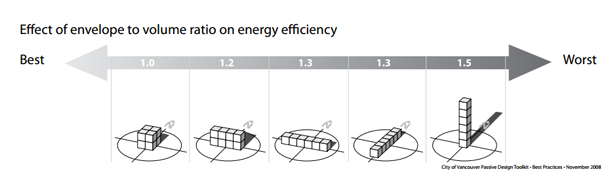
Passive Design Toolkit: Image from City of Vancouver indicating that compact low rise structures are inherently more energy-efficient than high-rise towers.

-
Green doesn't have to mean expensive, exotic or uncomfortable. First in a series.
-
-
Brent Toderian on the city's mid-rise future, thinking in corridors, Goldilocks, and more.
What happens when you ask 14 landscape architecture and three planning students to cut the energy use and consequent greenhouse gas production in the city by at least 80 per cent -- by 2050? How is this to be done?
We started by looking at the city as it is now, finding the places where energy use was high and where it was low, and trying to understand why.
It turns out that energy use is lowest in the downtown. Not on a per hectare basis, though. On a per hectare basis, the production of GHG was higher downtown than anywhere else in the city. But on a per person basis, people living downtown produced only a quarter as much GHG per person as those living in the southern half of the city. Why? Two reasons. For one thing, most people living in the southern half of the city live in detached homes that, because they are exposed to cold air on all sides, take a lot of energy to heat. For another thing, because services are more spread out in the southern half of the city, residents are more inclined to drive than to walk, bike or take transit.
This led to a question that we debated in class. Would it be better to simply repeat the urban form of the downtown as much as possible, expanding the footprint of the downtown towers into Chinatown and beyond? Or simply take every block within a 10 minute walk of a Skytrain station and zone it for 30-storey towers like they are successfully doing at the Gilmore Skytrain station area in Burnaby? After all, the data says that is the most efficient density to use, and people sure seem to like high-rises.
Towering drawbacks
But after a bit of study, a few problems emerged.
First, if you follow that approach you end up with two cities. A city of gleaming glass towers spread like beads on the string of the Skytrain line, disconnected with the surrounding areas they overshadow.
Second, it sentences neighbourhoods between stations to a future of slowly aging residents, gradually shrinking populations, more empty classrooms, restricted access for young families, fewer commercial services, and an increased dependence on the car to get around.
Third, while it is true that high-rises, when combined in large numbers, create GHG-efficient districts, the buildings themselves are not as efficient as mid-rise buildings. While it is possible to build a very energy-efficient high-rise and indeed possible to build one that even produces energy, that type of building is not the norm in our city. High-rise buildings are subject to the effects of too much sun and too much wind on their all-glass skins. And all-glass skins are, despite many improvements to the technology, inherently inefficient. Glass is simply not very good at keeping excessive heat out, or desirable heat in. Our high-rises, according to BC Hydro data, use almost twice as much energy per square metre as mid-rise structures.
Fourth, we worried that while high-rises are an attractive option now, how will they age? Vancouver is full of examples where single family homes have been adapted to house two or three or four families, with dormers added here and garage suites there, and basement suites inserted. But try as we may, we couldn't think of an example where a high-rise had been adapted to a different circumstance. It seems a high-rise is forever.
Fifth, high-rise buildings built largely of steel and concrete are less sustainable than low rise and mid-rise buildings built largely of wood; steel and concrete produce a lot of GHG. Wood traps it. Concrete is 10 times more GHG-intensive than wood.
Sixth and last, our guest lecturers made us painfully aware that people living in single family homes do not appreciate high-rises as neighbours. Politically, it is a nonstarter. So the prospect of supplying the tens of thousands of housing units that our young families and elderly need in high-rise structures seemed naive at best.
Instead we explored a different strategy, one that our situation as students and teachers made possible in a way not always easy for elected officials and city staff. We decided to see what might happen if we doubled the population of the city and placed all of these residents in areas outside of the downtown, avoiding wherever possible the problematic high-rise.
Many parts of Vancouver, like this spot at West 4th Ave. and Waterloo Street, have gentle infill density in the form of four-storey wood frame structures lining former street car arterials. More people in the same area create added customers for stores and buses. Seniors are given more affordable choices when seeking to downsize their housing.
Would it be possible to provide all those housing options but retain existing neighbourhood quality? Might we even improve those neighbourhoods as they grow? Could we supply enough units to house the burgeoning wave of elderly, who we know are coming, and the young families with children, who we fear won't be able to afford to stay? And if we did all this, would this reduce our energy use enough?
Our answer was yes.
We discovered that there are three major ways to dramatically cut our per capita energy use, and to meet our housing equity and neighbourhood preservation objectives at the same time.
1. Gently infill all existing residential streets.
The recent change to City of Vancouver bylaws, whereby each single family home site (in R-1 zones) can now legally include two rental units (one in the principle residence, the other in a lane house) provides enough legal capacity for tens of thousands of additional units, units with access to yards, neighbourhood parks, and neighbourhood schools. An overlooked element of this strategy is that a typical Vancouver bungalow, now being sold at the jaw-dropping price of over $1 million, is wildly unaffordable for a typical young couple making a combined income of $90,000 year; but, it is affordable (albeit barely) if they can count on the additional $2,000-$3,000 in extra monthly income that the rents could bring in. Not only does this rent make the house affordable for them, but the owners provide a crucial social service in the process. They supply two affordable rental units in attractive neighbourhood settings for families or individuals who need them.
2. Build tens of thousands of primarily mid-rise wood frame mixed use commercial/residential buildings on arterial streets.
Vancouver has unused capacity for tens of thousand of additional residential units on most of its arterial streets. The market for this type of unit is robust, (albeit held back during the past few years by the troubling increase in the cost of land). In some places, such as West 4th Avenue between Vine and Alma Streets, entire streetscapes have been slowly changed, and hundreds of units added, without engendering hostility from abutting residents.
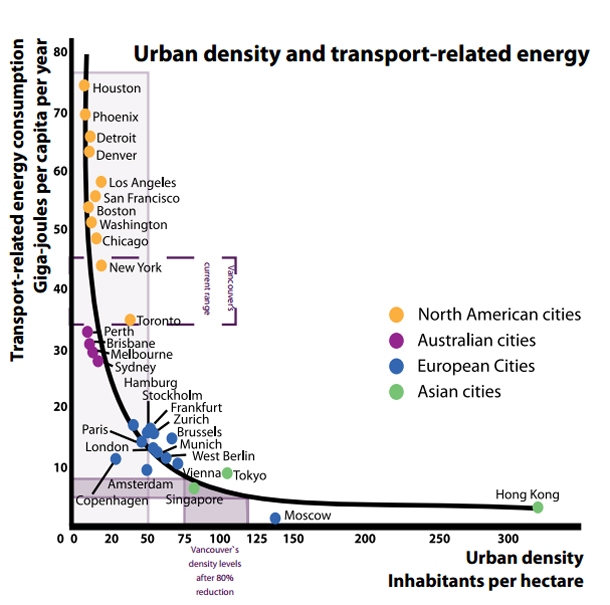
Research by Jeff Kenworthy demonstrates the direct correlation between urban density and reduced need for GHG-emitting cars. Vancouver occupies the zone close to Toronto and Sydney where major gains can be made with relatively minor increases in density. Beyond the density of Vienna, conversely, increases in density provide proportionately less benefit.
Typically, these four-storey structures replace rudimentary one-storey commercial buildings. When completed, the same or similar commercial enterprises re-occupy the ground floor commercial space. As units are gradually added, neighbourhood commercial services and transit become more viable, as thousands of new potential customers live above bus stops and commercial services. Our studio also discussed the benefits of this housing type for elderly residents, who would have the advantage of walking distance access to neighbourhood clinics, inexpensive cafes, and social support facilities.
As we discussed the burgeoning proportion of the population that will be elderly, we became more concerned about where these seniors would live and more importantly how they would live. We emerged cautiously optimistic that development along corridors was, given the options, the best location in our city to accommodate what might be the most compelling housing (and health services) need of the 21st century.
3. Expand the city's district heating system up Cambie, then laterally from there.
While we could use zero-GHG hydroelectric energy as the way to eliminate GHG from heating, using a high-grade energy like electricity for a low-grade use like heat is a waste. There are better options. The new system at the Olympic village uses "free" heat that would otherwise quite literally go down the drain: waste heat from sewage. Every street in the city has sewer pipes that waste a staggering amount of heat. The demonstration project at the Olympic village proves that it is technically possible to recapture it. The problem is the cost of installing all those district heating pipes in existing streets.
That's a lot of streets to dig up, and a lot of money to spend. If expanding this system at all is even possible, it would require an affordable, long-term plan.
As it happens, the City of Vancouver is already developing such a plan.
The jumping off point is the existing system at the Olympic village. The next step is to tie the Olympic village system into one that serves the Vancouver General Hospital area, and places in between. From there, the system could extend up Cambie, financed by development fees on new Cambie Street development projects. Such a financing strategy is commonplace. The City of North Vancouver already uses this strategy along Lonsdale Street, where new developments tap into and help finance the expansion of the Lonsdale Energy Corporation's district heating system. Through this self-financing mechanism, a more extensive City of Vancouver system could eventually tie into new plants at Oakridge/41st and Marine Gateway. With this main spine in place, the system could follow the many east-west transit arterials to serve districts to the east and the west. Somewhere between 2050 and 2070, assuming a steady and incremental addition of new dwelling units along the city's many arterials, a city-wide nearly zero-GHG heating system, one that is almost energy free to operate, would be in place.
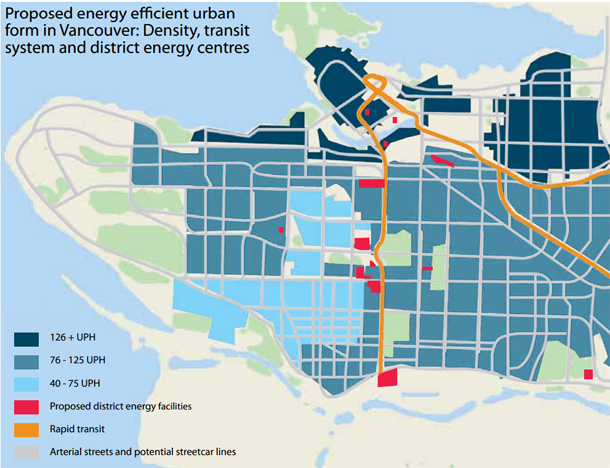
A plan for Vancouver that would provide district heating for the city while reducing transportation demand. Density is increased through gentle infill in all existing neighbourhoods, resulting in an energy use profile similar to that of Copenhagen by 2050.
These three rules then, infill the neighbourhoods, line the arterials, and extend the district heating system, provide a possible energy element for a more sustainable Vancouver.
Interestingly, the gains arrive mostly from spreading the new dwelling units throughout the city, and in this way create the financial and practical conditions necessary to dramatically lower the amount of energy we use for heating our homes, shops and workshops. Spreading this density throughout the city also changes its density profile to one more akin to Oslo or Copenhagen, places with climates not unlike our own and where walking, biking, and taking transit predominate. They predominate not because the Danes and Norwegians are more hardy than us, but rather because when a city's density and services are in balance, it becomes easier to access the things you need on a daily basis by means other than a car.
Next week: 100,000 elderly, 100,000 kids. Where to put the one group. How to keep the other. ![[Tyee]](http://thetyee.cachefly.net/ui/img/ico_fishie.png)
Patrick Condon is a professor at the University of British Columbia and holds the James Taylor Chair in Landscape and Liveable Environments. Student authors for this report were UBC candidates for Masters in Landscape Architecture: Niall MacRae, Peqi Wang, Rebecca Coulter, Jingling Sun, James Goodwyn, Lisa Lang, Margaret Soulstein, Jia Cheng, Cindy Hung, Neda Roohina, Paula Livingstone, Mary Wong, Nicci Theroux, and Sara Orchard, and UBC candidates for Masters in Planning: Tate White, Patrick Chan, and Sam Mohamad-Khany.
15
Login or register to post comments
carfreecity
1 year ago
garages
garages and parkades shouuld be converted to housing
Ruben
1 year ago
Really great work, and....
...I would like to offer a few thoughts.
I agree that the three-story walk-up is the best density and towers are a dead-end--I think they will be the slums of the future.
However, I think this proposal is excessively GHG focused, at the expense of systems thinking. There are two factors worth looking at. The first, of course, is resource constraints--peak oil, political instability and unpredictable volatility of fuel costs. The mayor of Seattle, in 2008, said if fuel prices stayed high they would have to cut community centres and police officers in order to keep the garbage trucks running.
The second factor is infrastructure. The operating costs of our infrastructure is coming home to roost--old pipes, old roads, old bridges, old sewage and filtration plants, old electrical systems. Canada's infrastructure gap is estimated to be between $50 billion and $125 billion, which is 6-10 times the level of all current annual government infrastructure budgets combined.
Now, any non-delusional person can see Vancouver has a real estate bubble, and bubbles always break. The last time real estate ticked down, municipalities had a huge revenue crunch because they got less tax, which is only going to amplify the infrastructure problem.
The response to the problems of volatility and decrepitude is to continue to expand the strategy of localization. Everybody knows eating locally is a good idea, for many more reasons than food miles, but that hasn't quite emerged as a robust urban agriculture (and spare me the postage stamp community gardens). But we have not even started to consider what energy generation and waste management might look like on a much smaller scale--neighbourhood recycling collection and repair, sewage treatment, greywater collection and reuse, composting, agriculture, and energy harvesting.
These things will all need space, and infill kills space. We need to start thinking about other kinds of density than people/hectare. We need to think about density of energy generation, food production and garbage management, rather than just monocropping people.
I believe there is a sweet spot of urban density. Too many people reduces your flexibility and makes the city brittle, not resilient.
Ruben
1 year ago
Really great work, and...continued.
Now, as for densifying arterials...
Arterials are crappy places to live. I laughed out loud at a City charrette for Norgate when the planners started talking about activating street life and cafés on Kingsway. Kingsway is a six lane truck route. Who wants to sit and "enjoy" their coffee with ten diesel trucks per minute passing in front of them?
All the talk about arterials is just because nobody cares about them. The NIMBYs don't live on them--because they are crappy places to live--so they don't care what you do to them. Arterials are easy to build on, but crappy to live on. Do we really want our city-building to increase crappy housing?
I think the model should look much more at 10th between Granville and Cambie, and all the lovely old streets like that. Fantastic walk-ups, lovely streets, one block away from the arterial. It will take more courage and more public process to densify near arterials, but the quality of life will be much better.
My last point--infill providing affordability is a canard. The real estate market will price in that approach and the prices will rise accordingly. Find me a hard-working young first-time buyer who has not bought or built a house with a suite--the assumption is that to make prices work you must have a suite--and that causes the asking price to rise.
There is no way to build enough supply to cut prices, there is no way infill can maintain affordability. Seattle's laneway cottages were affordable for a couple of years, then prices rose to market. The only way to maintain affordability is through market covenants, land leases, ownership co-ops and directed housing like Whistler has.
edoherty
1 year ago
Density graph data weak
Some great work here, but Jeff Kenworthy's work on density as illustrated in the graph - using average densities across whole regions and cities - is weak and controversial. Paul Mees, while advocating exactly the kind of low-rise development on transit corridors envisioned here, asserts that analysis based on average densities is worse than useless. e.g. http://www.worldtransitresearch.info/research/3273/
The fact is that average densities take a very long time to change, and are only weakly correlated with transportation energy use. So if you only aim to increase average densities across a metropolitan region, you are looking at 50 years plus for any big changes - and it might not work.
The good thing is that this series is taking a much more systematic approach.
What is very clear is that improving transit service, with micro-scale increases in density along transit corridors, does quickly reduce transportation energy use. The density (and jobs, and retail, and entertainment) needs to be convenient to transit, not just somewhere in the city or region.
pwlg
1 year ago
affordability
It is interesting that the author(s) of this piece found rents of $2000-$3000 a month affordable.
I do like the mention of medium density rather than the awful high density towers that have sterilized Vancouver. The Pearl District in Portland, despite the odd 14+ story buildings feels human. There is space for human interaction, outside of consumerism, not all the space is filled with bland geometric shapes, and the open space is refreshing.
The neighbourhoods in Portland have not suffered the same fate as Vancouver where homes have been demolished wholesale. Smaller older homes are renovated keeping the character intact.
Modernist engineering has ruled the day so far and in many ways has failed (leaky condos) and it is good to see that other values are being discussed and hopefully put into play.
Given the expense of housing oneself in Vancouver and the level of constant upheaval and demolition perhaps the focus on that city by younger people is misplaced.
"The very great challenge of the future, however, will be the urbanization of suburbia, the redevelopment of sprawl."
Leon Krier
pwlg
1 year ago
a challenge
How could one design and redevelop King George Blvd in Surrey to incorporate a livable streetscape, human neighbourhoods that are complex, streetfront shops and a narrowing of the roadway surface for cars leaving a corridor for trolley buses and eventually a modest light rail system?
Lewis N. Villegas
1 year ago
Game Changers
Balancing inputs & outputs gets us to Sustainability. Patrick & the Group have done a wonderful job of tackling the thorniest questions:
1. Built Form
2. Dig up the arterials to implement District Energy Systems (including… add transit; correct for livability; clean the air up; plant street trees; add density; etc.)
3. Implement District Energy from waste
[Rule #2 does the heavy lifting].
The most refreshing part of the presentation by far is its reliance on concrete and verifiable facts. Our findings are that this approach focuses the discussion; it rules out personal ruminative fantasies; and builds consensus.
The Group reaches the same distinction in measuring energy use that we get when measuring density.
On a tower by tower basis, we find the tower wins the density contest hands down. However, measured at the scale of the neighbourhood as a whole, the 3.5 storey urban house yields equivalent density to the tower district.
On a tower by tower basis, they find the tower is an energy monster. On a district wide basis—especially if that district is Vancouver's West End, with the walkability of the Robson-Denman-Davie horse shoe spine—other factors intervene to lower the GHG count, and keep the tower zone in the mix.
Of course Patrick and the Group don't have a human-scaled, high-density, walkable neighbourhood to measure anywhere around here. They are restricted to the two models we've built.
It is central to the presentation to keep in mind that if they are retrofitting BRT/LRT on the arterials, then laying down GHG-0 district heating is simpler and cheaper.
The Group is envisioning an arterial with far fewer average daily trips than we have now. “Livability on the arterial" is built into their model. Important to note in this regard that the plan of "Energy efficient urban form in Vancouver" is not a zoning map. It is a take on “built form & density." It depicts only the existing transit corridors. At this scale the shape of the intensification, the new transit, etc., don’t show. What looks like average densities, I take as a diagram of the demand side of the District Energy Grid.
If the Group were zoning by building type, for example, the map would make stand out the footprint of their street car neighbourhoods, for example.
It's a similar problem to mistaking the presentation to deem all intensification as future payers of strata fees & special levies.
My reading of this work is that they are flexible on specific issues. They are game-changers that can stop and pivot, this way or that, in response to any one specific, and local condition.
anarchynow
1 year ago
Focus on GHG's...
Thank you for the thought-provoking work on urban planning...
I thought it should be pointed out that a focus on GHG's sometimes is used as a justification for almost any kind of solution.
In this case the solution that struck me as under-considered was the emphasis on wood for construction; it is stated that wood is a carbon "trap". However, wood comes from forests - these are not just places to get wood to build urban structures - forests are ecosystems that are integral to the biodiversity of the land.
British Columbia's forest ecosystems are a wealth of biodiversity, and are valuable for more than nice postcards. Healthy ecosystems provide clean air, clean water, resistance to disease outbreaks, and a series of literally an infinite number of checks and balances for maintaining life systems. Sure climate change is reducing biodiversity, but so is logging the forests and planting monoculture tree plantations.
Thanks again for the great work, you have provided us with excellent ideas on a critical problem.
Lewis N. Villegas
1 year ago
King George Blvd.
@pwlg
The first issue is that there are so many KG-Blvds that the design challenge would look different along successive districts.
The second is that you would probably start with LRT implementation first, not last, because that would take space back from the cars.
Beyond that, the principles don't change much from one place to another. Although, because they inflect to local conditions, what you get will feel tailor-made to each place.
The journey you describe has been completed in western North America. There are two new boulevards in San Francisco since the last earthquakes. And, I have just discovered, that Seattle is gridded by boulevards designed by the firm of Frederick Law Olmsted, in the years it was run by the son and nephew.
However, like the KG I expect that the boulevards in Seattle will be shadows of their intended self.
Your question really is about cultural change, not a design challenge. Here, history will not lend a hand. There are examples of communities that make the change; and examples of communities that enter decades and centuries long periods of urban decline.
edoherty
1 year ago
BRT's no-dig advantage
"keep in mind that if they are retrofitting BRT/LRT on the arterials, then laying down GHG-0 district heating is simpler and cheaper."
This actually points out a major advantage of electric Bus Rapid Transit (BRT), it is not necessary to dig up the street to move existing pipes around to create a fully functional BRT line. The pipes can be moved out of the transit right of way over a decades as utilities are replaced. Buses can easily re-route around road work. (You can lay track on top of parallel pipes, but you have to be prepared to shut sections of the LRT line down for emergency repairs to the sewer or water main).
Similarly, district heating systems have advantages in some locations, where a huge amount of new construction or major retrofits is planned. This makes it worthwhile to dig up the streets and install a new system of pipes. In other locations, individual air, ground or sewer source heat pumps for each building may be a better solution.
Our streets are actually complex systems with much of the complexity hidden underground, and every one is different. Sometimes the 'no dig' path is the better one to choose.
Lewis N. Villegas
1 year ago
Dig It!
E. Murphy
1 year ago
A few comments...on district energy
Further to the good points raised in the article, I have a few comments as to how these principles could be implemented.
Reducing GHGs for heating and cooling is important.
District energy has many possibilities but I understand from City engineering staff that the sewer system only has capabilities in a few locations near sewer collection points where the volume of sewage is large enough. They suggested that only False Creek South and the Frazer Lands have the adequate volume, but not much outside of those areas.
Another option for district energy is geothermal which can be located anywhere on the road/lane system or under parks and does not require the reconstruction of the sewer pipe system. Because this would be a pressurized system, it would not need to be as low as the sewer system and could be located down lanes rather than streets where there are less potential conflicts with existing services.
E. Murphy
1 year ago
A few more comments...on transit and development
I agree with the comments about electric trolley bus system that would not require road reconstruction and could be implemented quickly in a city-wide grid at a very low cost compared to any other electric transit system.
Much of the required low-rise development could already be accommodated within C2 zones which allows 3 storeys of apartments above 1 storey of commercial. There could be design guidelines to improve the quality of these developments.
The RS zones that now allow 3 units on every "single-family" lot have potential. But we need to do more adaptive reuse of existing buildings rather than demolition and construction of new monster houses. Existing houses are more affordable than new construction.
Regarding affordability, the $2000 to $3000 potential income on each lot as mentioned above would be assuming two units are rented and only one is owner occupied. The advantage to having secondary suites and infill laneway houses is that it provides flexibility to the family with options to occupy various parts of the house through the life cycles and as needed.
Laneway houses should be used as an incentive to retain existing houses rather than for new construction. This was recommended by the City of Vancouver Heritage commission but ignored by staff and Council.
E. Murphy
1 year ago
Capital Gains Tax Incentives
Also, as an incentive to build secondary suites and infill, the capital gains tax rules should be changed. The tax laws should allow an owner to claim a whole property of up to 3 units as the principle residence for exemption from capital gains as long as the owner lives in one of the 3 units and property is not stratified. This would provide incentives to add new secondary suites and infill, while protecting existing rental units rather than converting existing multi-unit conversions back to single family to avoid capital gains taxes.
E. Murphy
1 year ago
A summary...
So I would suggest the following changes to the summary of rules for the city that reduces GHGs.
1. Expand the existing electric trolley system to the entire city network. Add electric rail where appropriate (like Arbutus Line) and pace rail construction as it is affordable.
2. Protect existing heritage, character buildings and amenity assets through adaptive reuse and restoration of existing buildings rather than demolition. Wherever possible add infill that is in scale and character with the existing buildings.
3. Build-out the residential/commercial on arterials in C2 zones and build-out some of the transit arterials with low-rise where appropriate while avoiding #2 above. Use energy efficient forms of development such as 3-4 storey apartments, row houses and townhouses, while avoiding towers which are the least energy efficient form of development.
3. Consider adding district energy based on geothermal along the lanes and streets to use broadly across the city.
4. Protect the urban forest (on public and private lands) and keep buildings below the tree canopies as much as possible, to avoid the heat island effect.