
Opinion

A Tyee Series

Vancouver in 2050: Transit City

Team of UBC landscape architecture and planning students envision getting around easily, sustainably. Second in a series.

By Patrick M. Condon, 22 Feb 2012, TheTyee.ca

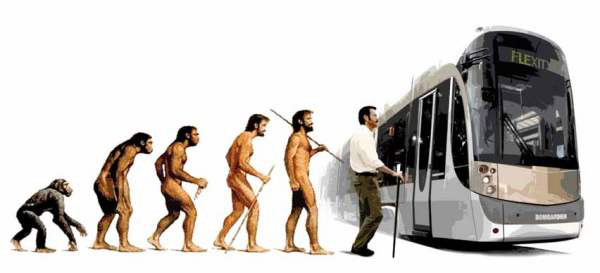
Streetcar evolution

Vancouver's future lies in the streetcar grid of its past. Illustration source: Streetcars, the Missing Link? Gordon Price.

Related

What happens when you give a team of 14 UBC landscape and architecture students and three UBC planning students the challenge of imagining how people will get around when Vancouver becomes a truly sustainable city in the year 2050?

We started by acknowledging that lately Vancouver has adopted an ambitious goal: by 2020, over 50 per cent of all trips in the city will be by biking, walking, or transit. This will put Vancouver in the same league as Copenhagen and Oslo, lofty competitors for this achievement. It's not impossible. Right now more than 40 per cent of Vancouverites' daily trips are via biking, walking and transit.

But in order to raise that figure to more than half of all trips, it seems judicious to examine how we move in this city, how our movement patterns got the way they are, and how we might use what is already working as the launching pad for something that works even better in the future. 

So, next we studied the weave of the city's existing neighbourhoods and roads.

Most of Vancouver is oriented around its arterial streets -- Hastings Street, Commercial Drive, 41st Avenue, Cambie Street, Dunbar Street, Main Street, and many more. These key byways are the legacy of a time when moving around the city was impossible if you couldn't pick up a streetcar near home. Stimulated by the outward extension of streetcar lines, our neighbourhoods grew laterally from the tracks, with neighbourhoods gradually assuming an identity based on their service area. Thus the area we now know as "Point Grey" is composed of the blocks lying no more than a five-minute walk from the 10th Avenue streetcar. The area served by the Dunbar Street streetcar became know as "Dunbar," the area known as "Kerrisdale" includes blocks no more than a five-minute walk distance from the 41st Avenue streetcar, and in the "Hastings Sunrise" area the homes lie within a five-minute walk of the Hastings Street streetcar line. 

Cafes, social clubs, clothing stores and pubs eventually lined each of these streets, forming the common centre for everyday life. To this day, if you ask a Vancouver resident where the heart of their neighbourhood is, they will likely name the former streetcar street at the center of their district. However, if you ask them where the edge of their neighbourhood is, their answer is likely to be more hazy. 

Some of the city's streetcar arterials were so long that it would be ridiculous to name your neighbourhood after them. So the Broadway streetcar line became the center of civic life for what eventually became neighborhoods named "Kitsilano," "Mt. Pleasant" and "Fairview," while the Main Street streetcar arterial got divided between neighbourhoods named "Riley Park" and "Sunset."

Over time these main arteries became taken for granted, and in some cases abused. Widened many times to accommodate the increasing demands of the car, and hollowed out along many sad stretches to make room for parking lots, portions of these streetcar focused centres often became little more than auto sewers -- places no longer suitable for meeting friends, but engineered pipe systems designed to speed you and your car somewhere presumably better. 

Fortunately, Vancouver's original streetcar grid left such a strong imprint that many arterial streets survived this auto-centric onslaught. The West End "U" of former streetcar streets, a U shaped by Davie, Denman, and Robson Streets, still combine to form one of North America's most vibrant civic realms and provide the West End with much of its defining character. Dunbar Street in Dunbar still accommodates serendipitous chats on a bright Sunday morning, and Hastings Street in Grandview-Woodland still throbs with the same vibrancy that it must have in 1920. In fact, our experience of the city echoes our earliest modern way of getting around, the streetcar.

Rise and fall of the streetcar

What does this history mean for us today?

Consider that until the advent of the electric powered streetcar, Vancouver was pretty much isolated to an area within a 15-minute walk of Victory Square. Things changed quickly after 1883 when Ernest Wiener von Siemens perfected a system of overhead wires capable of delivering electrical power to a moving vehicle: a streetcar. By 1890 the Vancouver Electric Railway and Light Company was formed, and just a few short years later the developed area of the city increased by over 1,000 per cent. Previously remote forests and farm fields, which covered the city south of downtown, could now be developed for housing. And they were. So much cheap land was made suddenly accessible that average city workers could, for the first time in history, live in their own houses on their own land.
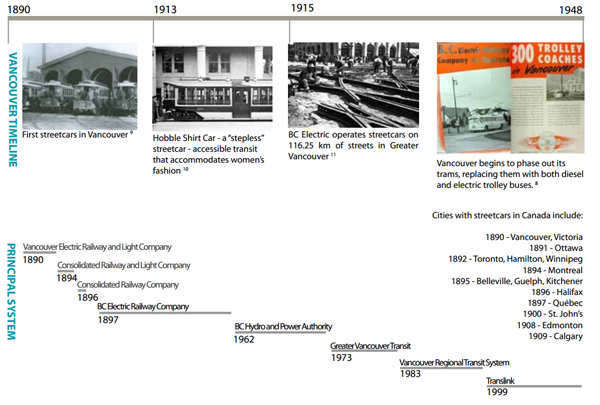
Transit history in Vancouver

Short reign of the streetcar in the City of Vancouver. Its presence defined and still defines our city. Graph produced by Niall MacRae and Nicci Theroux.

Like most early streetcar companies, the Vancouver Electric Railway and Light Company was both enormously profitable and vertically integrated. They were in the business of everything from building hydroelectric generation plants on Indian Arm (our area's first hydro plant and still in operation), to supplying street lights, to developing and selling housing within the service areas of their streetcars. This corporate behemoth rivaled the power of the Vancouver city government, which might help explain why no tears were shed when streetcar companies ran into financial difficulties. Their troubles occurred when residents finally had an alternative way to get around: the car. Introduced in large numbers by the 1920s, the car proved so powerful that in a matter of only two decades Vancouver streets were jammed with them, making the smooth movement of streetcars no longer possible.

Vancouver, like most North American areas, faced with the cost of maintaining and extending a rail system that was already in financial trouble, opted for the car over the streetcar, and tried to make transit vehicles operate more like automobiles. Steel-wheeled vehicles gave way to rubber-tired buses capable of riding on the newly-paved streets without the need to further extend and maintain a system of steel tracks. 

The enormous influence of the auto industry played a part as well. Vancouver officials, not unlike officials in most other North American cities, were offered favorable deals by the makers of rubber-tired vehicles in exchange for a guarantee that at the end of their last run the city's streetcars would be burned. What to us seems like a shocking waste was justified by companies who did not want secondhand streetcars being shipped to other markets where they might compete with rubber-tired buses. Thus the burning of streetcars was an explicit requirement of the contract. Photos of burning streetcars from many cities litter the Internet. The image below is a record of our own version of this once commonplace ritual. 
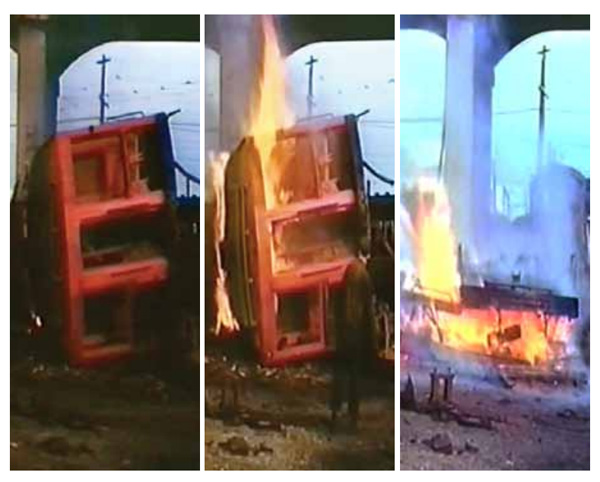
Burning streetcars

Streetcars burning below the Burrard Street Bridge after their last run, in the late 1950s. Destruction of streetcars was a condition of contracts.  Images from video: BC Electric Railway: Then and Now. Photo capture and composition by Sara Orchard and Tate White.

While the demise of the streetcar is, for many, heartbreaking for romantic reasons, their loss produced other unintended consequences. In recent years, B.C. citizens have been struggling to decrease the amount of carbon dioxide we put into the air. Every city in the province is required by law to come up with a plan that will, by 2050, reduce our greenhouse gas (GHG) production by 80 per cent. For us in B.C., transportation produces more GHG than any other sector, and the bulk of that comes from the ordinary activity of citizens just going to and fro each day.

Interestingly, during the period when our transportation needs were met by the streetcar, our GHG production for transportation was essentially zero. All the energy for the system came from GHG zero hydroelectric sources. With the advent of the petroleum fueled  private automobile, our per capita production of GHG skyrocketed. But the shift from streetcars to diesel powered buses also contributed.  A diesel powered bus produces more GHG per rider (assuming average loads) than does a Toyota Prius (assuming 4 passengers, details here).

Unfortunately this means that even if we could move the bulk of our car trips over to buses, we may not solve the GHG problem. We would certainly slow our per capita rate of GHG production, but not nearly by the 80 per cent required by law.

If we are serious about meeting our targets, it seems that the GHG produced by transit vehicles will need to be addressed. And since most of our transit trips in the region are by bus, and likely to remain so, the GHG profile of the humble bus must rightly be part of the discussion.

How to get to a sustainable Vancouver

With all this in mind, our UBC studio of students and instructors concluded that there were a few obvious rules to follow when thinking about sustainable transportation for Vancouver.

First, back to the streetcar future. Whatever is done must accept that the city is still, and likely always will be, organized around its streetcar arterials. Every neighbourhood depends on them, almost all of our merchants run businesses on them, and most of our job sites are near them.

Second, streak for zero greenhouse gas emissions. Our transit system must eventually be GHG zero, or nearly so. Moving all trips from cars to diesel fired buses only slows, but does not stop, our over-dependence on fossil fuels and the toxic exhaust they generate. It is logical, given our regions abundance of hydroelectric power, to start a process of switching to electrically-powered transit.  

Third, make more destinations close by. To minimize unnecessary movement, each neighbourhood should become more diverse over time. Neighbourhoods with good-paying jobs, ample services, and a variety of affordable house types, reduce the necessity for traveling long distances from home: to get to the store, to work, to play. This transformation is already happening in areas like Kitsilano, where population has been increasing for decades, where many new apartment/condo units have been supplied, where every bungalow can be converted into a three-family strata unit if the owner desires, where virtually every single family home contains a reasonably affordable rental unit, and where, as a result, commercial enterprises and neighbourhood services have steadily grown. As a consequence, with so many things they need near at hand, Kitsilano residents use the car less than they once did, walk more than they once did, use transit more than they once did, and travel much shorter distances for what they need than before.

These three rules: use what you have, make it GHG zero, and put things close, provide the jumping off points for the design work that follows, and a logical public realm framework for a more sustainable city.

Next Wednesday: Energy use and the city of Vancouver. What's form got to do with it?

[Tags: Transportation.]  [Tyee]

34  Comments:

Login or register to post comments

  • Grumpy

    1 year ago

    Streetcars - LRT - it's all the same

    Raw cost for streetcars, including track and overhead, but not including cars - $6 million/km to $16 million/km.

    Here is something TransLink doesn't tell us, most of the vertical supports and span wires are in situ, with some being used by trolley buses, which would make the cost of LRT/streetcar even cheaper.

    As most of the proposed streetcar routes would be a reinstatement of old streetcar service, the foundations for the track are already there, meaning the cost to reinstate streetcars would be very cheap.

    Real cost for implementing streetcars in Vancouver, track and overhead only - well under $10 million/km.

    Cost of a streetcar or LRV - $2 million to $5 million. Most modern streetcars are modular (with some companies offering up to 8 different modules) in design, so various motor, saloon, driver modules can be mixed in matched to meet the demands of the city. Car capacity can be increased cheaply by adding another module.

    The same is true with motors, as the cars are able to accommodate various motor sizes to enable the streetcar to be a Light Rail Vehicle or a TramTrain (a streetcar which can operate on the mainline railways).

    Capacity of a modern streetcar - 225 persons to 350 persons (Budapest Caterpillars).

    Streetcar line capacity, nominally 2,000 persons per hour per direction to 20,000+ pphpd.

    Last year it was announced in the railway press that the city of Karlsruhe Germany, was locating its main streetcar or tram line in a subway, because of the success of the regional TramTrain network, this line was seeing 45 second headways in peak hours. This equates to a capacity in excess of 40,000 pphpd.

    For you skeptics, 45 second headways = 90 trips an hour; the 3 section articulates trams and TramTrain used have a capacity of 250 persons, with many operating in coupled sets in peak hours. Thus 90 (trips per hour) X's 500 (capacity of a coupled set) = 45,000 pphpd!

    It seems our 21st century simple streetcars have a higher capacity than our multi-billion dollar SkyTrain!

    Who would have thought!

  • Grumpy

    1 year ago

    The burning photo............

    .......in this article is not a streetcar, rather it is of an interurban, as you can notice the gangway in front of the car.

    Interurbans, like modern LRT today, can operate as streetcars, on streetcar routes, but also be able to operate on a railway line, such as the old BC Electric Richmond and Chilliwack interurbans.

  • Grumpy

    1 year ago

    The longest tram/TramTrain route is............

    is the Karlsruhe, Achern–Öhringen-Cappel, route S4 which is 210 km long and serves 86 stations or stops.

    This route operates as a streetcar/tram. LRT and a local commuter train.

    It would be like boarding a streetcar in Hope, having it act like a passenger train to Abbotsford, LRT/train to Vancouver and a streetcar to UBC, all with the same vehicle.
    The cost of TramTrain under $5 million/km to $10 million/km.

  • alive

    1 year ago

    Who funded this?

    "What happens when you give a team of 14 UBC landscape and architecture students and three UBC planning students the challenge of imagining how people will get around when Vancouver becomes a truly sustainable city in the year 2050?"

    The answer is easy: BS happens!
    Boxes of reports and stats will be stored for ages, and nothing will ever happen!

    Vancouver screwed itself ages ago with its "traffic plan", where city councillors were up in arms when someone proved that on a few streets, it actually was possible to travel 15 blocks without a stopsign!

    Heaven forbid that people should get from point A to point B without inconvenience!

    We need more signs, so that people do not have to teach their youngsters to stay off the road and to pay attention when they really have to step out on it.

    So obviously it is better to pack every citizen into a bus and let them be pedestrians for the last several blocks!

    If green is the motto then stop the glaring commercial signage all over, it might even save us from people getting distracted from driving and prevent accidents?

  • David Beers

    1 year ago

    Administrator

    alive

    The project was done by a class at UBC. No one funded it other than it was done in the context of a class project. Not sure I understand why you are upset that planning and architecture students would examine how to make the city sustainable by 2050. that's exactly what I'd hope they'd be studying. Better signs would be a good thing, yes, but I think they aimed a bit higher here and we at The Tyee are pleased to be able to share their insights and welcome thoughtful responses.

  • Okanagan Orchardist

    1 year ago

    Just an idea...

    On a recent trip to Wollongong, Australia, a coastal tourist/industrial city about an hour south of Sydney, we were pleased to be able to use a free bus for transportation and sight-seeing. The route took us along the seashore, where most of the tourist hotels as well as locally-owned condos are located, to the university and back through the central business district. Thousands of tourists used it quite regularly. Other bus routes requiring payment were also in regular use. As a tourist city, there would probably be some advantage for Vancouver starting such a program.

  • edoherty

    1 year ago

    Unfortunate disrespect for trolley buses

    This is valuable contribution. Unfortunately in one key respect it muddies the water, by associating diesel with buses and electric drive with streetcars. The article states that "since most of our transit trips in the region are by bus, and likely to remain so, the GHG profile of the humble bus must rightly be part of the discussion." But the article basically ignores the potential of the trolley bus - the quietest form of public transit.

    Trolley buses have an extremely important role to play in reducing GHG emissions. Trolley bus rapid transit in particular has great potential to help meet Metro Vancouver's aggressive GHG reduction targets.

  • patrickC

    1 year ago

    Trolley buses

    Hmm....i was hoping that would get through Eric.

    I agree that trolley buses are part of the solution, and that electrifying as much of the system as possible should be the plan. Use trolley bus or tram. Those are the options.

    Patrick.

  • Grumpy

    1 year ago

    Trolley buses, nostalgia at work

    Trolleybuses are a dying breed as the scope for development is very poor.

    To compete against trams, trolleys must be guided, which drives up the cost to almost 70% of a tram to install. For a little more money, one gets a whole lot better bang for ones buck, Euro, etc.

    Vancouver's trolleybus system is ill used expensive to operate, so expensive that diesels replace most trolley services at weekends.

    But what has condemned trolleybuses to a limited market is that they do not attract new ridership as the transit customer perceive them as a bus and a bus, is a bus, is a bus.

    There have been many comprehensive studies done in Europe, especially France, on various transit modes including bus, trolleybus, guided bus, tram/LRT and light-metro and tram/LRT is seen as the best value for money spent, except for major metropolitan transit routes catering to traffic loads greater than 20,000 pphpd.

    In Vancouver, there is much happy nostalgia with the trolleybuses, which is akin to the happy nostalgia with monorail in Anaheim (land of Disney), but if one wants to provide an attractive alternative to the car, one must embrace 21st century tram (streetcar)/LRT philosophy.

    With no real transit experts being trained in BC, or Canada for that matter, nostalgia and questionable transit planning will trump sensible and affordable transit planning.

    Patrick, its time for UBC to have a faculty of Urban Transportation, to study the science of urban transportation, just like the UK and Europe.

  • Bill McCreery

    1 year ago

    trolley buses

    @edoherty. You make a good point. Trolley buses can continue to serve, and expanded into, in lower demand areas and they can be used in the transition process to higher capacity systems. But the capacity of a trolley bus is limited to the articulated (bent) bus. Others will be more knowledgeable than I, but I suspect the multi-unit trolley with a single driver has labour efficiencies also.

  • patrickC

    1 year ago

    Trolleys Trams and Trams and Trolleys

    Eric and Grumpy.

    As you both know i have, for many years, been a proponent of trams for vancouver. But my main motivation for this has come more from the belief that we need to get to a zero GHG transit system fast. Having studied cost and comfort issues I generally align with what Grumpy says, vis the relative merits and demerits of tram vs. trolley. But I am increasingly feeling that the debate about what transit vehicle to choose gets in the way of the big picture. People around here are passionate about either skytrain, or trolleys, or, increasingly, trams. But this passion for the value of one or the other type of vehicle seems to often obscure the more fundamental point: the need to get to GHG zero, or nearly so.

    So more and more i am agnostic in the Trolley vs Tram debate. Let our regions officials duke that one out when they go to spend the money on one or the other.

    As for skytrain, as Mayor Watts has stated publicly, there isnt enough money in the world to get skytrain close to everyone, or something to that effect. I am with her on that one.

    Patrick.

  • edoherty

    1 year ago

    Trolleys big enough for most rapid transit routes

    @Bill McCreery

    Double articulated trolley buses are now very common in Europe, they are about 80 feet long - twice the size and capacity of a standard 40 foot bus. Many have dual drive units for improved snow performance. For many rapid transit routes this is an ideal size as it has adequate capacity with frequent service. Big transit vehicles on moderately busy routes are not so great - a 240 foot long vehicle every 12 minutes does not provide the same service quality as an 80 foot one every four minutes.

    On very busy routes, big rail vehicles are great, and save a lot of labour costs. But 'labour costs' are local green jobs, so there is a lot to balance.

    Like Patrick, I think there is a role for both electric bus and electric rail in our region, the main thing is to get off the tar sands diesel and gasoline that now powers our cars, trucks, diesel buses, and diesel trains including the West Coast Express.

  • Grumpy

    1 year ago

    Nope, not, nada

    Quote: "Double articulated trolley buses are now very common in Europe........"

    This is not quite true, as bi-articulated buses are used on special routes, which because of topography, or local restrictions, can not operate a tram. Trolley buses are being phased out in many cities, in favour of trams which is the opposite with transit agencies until the mid 1980's, where tram routes were being phased out in favour of electric buses.

    Extensive studies have shown that for a bus to be competitive to a tram, it must be guided and starting in the early 80's there have been several proprietary guided buses on the market including O-Bahn, TVR and GLT, as well many other wire or line of sight guided buses. Yet, the all suffer from the same thing, they fail to attract ridership.

    This disappointment continues today, where in Caen France, their ten year old GLT/TVR guided bus, due to poor performance, is now being rebuilt as a tramway.

    There is a role for electric buses, such as hilly routes like SFU or on transit routes with sharp grades and/or curvatures, but these are few and far between.

    The following also shows why the electric trolleybus has grown out of favour.

    Modern LRT/streetcar can operate economically on routes with traffic flows between 2,000 pphpd to 20,000+ pphpd. Trolley buses economic range is from about 1,500 pphpd to 5,000 pphpd. With a great overlap with LRT/streetcar, it is easy to see why transit planners opt for a tram.

    The nonsense that; "Big transit vehicles on moderately busy routes are not so great - a 240 foot long vehicle every 12 minutes does not provide the same service quality as an 80 foot one every four minutes.", is just that, nonsense as transit to be efficiently run must deal economically with traffic flows. Many people will take that "big" tram or streetcar, but would never consider taking a bus.

  • Grumpy

    1 year ago

    And if you think Grumpy is anti trolleybus..........

    ......think again.

    In the early 1990's, Grumpy proposed to BC Transit an express trolleybus route along #3 road in Richmond, across the Oak Street bridge, along Oak Street to Broadway, then over the Granville St. Bridge to the downtown.

    The route would have priority signaling and operated with articulated trolleybuses with stops every 400 metres to 500 metres apart.

    The only reply I got from BC Transit was that the trolley wires would block the view of auto drivers crossing the Oak St. Bridge.

  • alive

    1 year ago

    David Beers

    Sorry if I fail to get excited by yet another study.
    Basically I post to various articles, in order to present my views as inspired by what I read here;
    When transportation is the subject I feel it is appropriate to remark that Vancouver deliberately has stifled traffic for years.
    As an aside to traffic obstruction, we have succumbed to the lowest common denominator, by catering to the idea that traffic should be slowed because some kids are not thought to obey simple instructions --- like: stay off the street!

    I am sure that the study was not intended to solve such practical things: I am well aware of the mentality in such circles, having had to put up with a lot of recent graduates who had no practical experience but a lot of funky ideas!

  • RickW

    1 year ago

    grumpy

    Quote:
    Most modern streetcars are modular (with some companies offering up to 8 different modules) in design, so various motor, saloon, driver modules can be mixed in matched to meet the demands of the city

    And this system sounds like it makes it entirely feasible to run track instead of pavement to single family dwellings, etc., which can eventually eliminate the need for the automobile (as we know it) entirely.

  • patrickC

    1 year ago

    Rick W

    I would agree with you in that the streetcar grew during the same period that the single family home emerged in Canada. The one begot the other. The system is balanced when there are 10 dwelling units per acre over the service area. This provides enough customers to keep such a low cost system solvent, while this zero GHG transit mode makes the homes accessible.

  • marcerickson

    1 year ago

    Arterial streets

    The paragraph starting, "Most of Vancouver is oriented around its arterial streets -- Hastings Street, Commercial Drive, 41st Avenue, Cambie Street, Dunbar Street, Main Street, and many more...." ignores the major east - west arterials. I'd mention Kingsway and Broadway before 41st - if I mentioned 41st at all.

  • E. Murphy

    1 year ago

    Trolley buses will get us to GHG zero the fastest...

    I agree that the objective is to reduce GHGs to zero. However to do that we need a broad network of electric transit. Providing only a few transit corridors using expensive technology that depletes the resources for the rest of the system is not the answer. Cambie is an example where after the Canada Line was built, the previous trolley lines were replaced by diesel buses, with the service reduced on a number of lines including Granville St.

    The most cost effective system is to expand the trolley bus network to replace diesel and increase service on high capacity lines. Trolley infrastructure costs only $1 million per km. New trolley double articulated buses are $1 million each. For a fraction of the $3 billion Broadway skytrain we could expand trolley buses to the entire City of Vancouver and much of the suburbs. Trams and rail technology can be added as we can afford it to routs that make the most sense like Arbutus where we have the existing rail right of way.

    Trolley bus network expansion could happen much quicker than any other technology because of the costs and existing infrastructure already in place. Very little changes to the road system would be required. We could get to GHG zero the fastest with trolley buses.

  • KD Brown

    1 year ago

    Hydro GHG free?

    I wish if folks would stop blindly supposing this.

    The Department of Fisheries and Oceans (DFO) Small Lakes Research Program worked in small basins in Ontario (on the Shield, so not incredibly rich biomass) and did broad spectrum (very multi-disciplinary) research on aquatic ecosystems. A very successful program, they did ground-breaking Canadian research on acid rain, and confirmed the bad news about phosphates in detergents. So, now nobody with any scientific knowledge denies the fact that acid rain is an issue, and phosphates area no longer found in detergents.

    Just before their program was cancelled and funding pulled, they were just completing preliminary research on the GHG impacts of hydro dams.

    Turns out that hydro dams are just slightly cleaner than natural gas fired generating plants, due to the huge amount of carbon released as methane due to rotting vegetation.

    Mega-projects are mega-projects. There are impacts. Nothing is without cost.

    That being said, I would much prefer seeing electric vehicles providing transportation in Vancouver and other cities that have even modest electricity supply. It is a far more efficient power train than any form of internal combustion.

    Just quit thinking that electricity is GHG free. Roderick Haig-Brown, author and conservationist from Campbell River, was writing a paper on hydro when he died suddenly in 1976. He wrote (paraphrased):

    "Hydro electricity is not cheap. It is said to be cheap and is sold cheaply only because the downstream costs, of flooded farmland, ruined forests, the loss of homes, are not paid by those who earn the money selling hydro electricity."

    As we know watching the government of BC trying to develop yet more dams through independent power producer agreements, there is a long-standing controversy existing about power production in BC.

    Not to say that there are not solutions to this, and one would be to place more windmills and solar panels in our urban fabric. There are millions of square feet of blank roof space and acres of under-utilized land that could be used for this.

    Just don't suppose that these moves are GHG free either - producing tram cars, windmills and solar panels requires energy as well, just much less than huge dams and internal combustion autos...

  • Lewis N. Villegas

    1 year ago

    Transit is Fundamental

    My wicked mind sees the diagram at the top of the story extended to the left to reveal the chimp descending a Toyota Prius.

    There is something remarkably un-Modern about this presentation—it starts with a historical analysis! In so doing it provides us with a remarkable insight about the shape of our urbanism: Vancouver is a Garden City platted out of cottage lots set in a matrix of arterial streets spaced one half miles apart.

    Why a half mile? It guarantees that every resident will be within a 5 minute walking distance from an arterial, and a transit stop.

    Yet, there is something unsatisfying about the extruded nature of the long arterial as the heart of a neighbourhood. It glosses over too many of the important details of any given site. For example, Main street between Broadway and 14th (5 blocks long) is a generally flat area with a rise as we move to 16th, and a precipitous drop as we descend towards False Creek. The clock tower on the Beaux Art Post Office building at 15th Avenue is set to take advantage of its elevated siting providing a counterpoint to what it imagines as a human-scaled urbanism of streets and blocks. The contours shaped the experience of place to such an extent that the Main Streetcar was free to ride down-hill, but charged the full fare to carry passengers to the top at Broadway.

    Like the 1884 CPR plan for Vancouver, a lexicon of arterials, blocks, and parks, leaves out the public square. In my calculus, it leaves out too much. There is something mean-spirited about not setting aside a block of land at the centre of each district or subdivision as an urban room—different from a park—but crucial for supporting social mixing.

    Yet, these are properly details at a finer grain, or scale, reserved for discussions down stream. The hi-level presentation here not only whisks us through a century of transportation in our city and region, but touches on power generation, vehicle technology, and the key role played by transportation in shaping a sustainable urbanism.

    So, it is important to understand that fine-grain detail is not excluded by this analysis. It argues for putting the pieces in place, then freeing up local planning to look at the uniqueness of each place in later stages of planning and urban design.

    A city has many, many moving parts. For sustainability—transit is fundamental.

  • gcross

    1 year ago

    Vancouver: Trolley City (Part 1)

    Thanks to Patrick Condon for offering a timely perspective on the sustainability of public transit in Vancouver. I strongly agree with the view that Vancouver needs to roll back the tide of diesel buses in favour of hydro-powered public transportation. Fortunately, due to enduring public support from a wise public, Vancouver's electric trolleys have survived and should once again become the dominant feature of a truly sustainable transit future.

    The sustainability advantage of electric trolleys is more than significant; it is dramatic. On the basis of a recent analysis of energy demand and greenhouse gas emissions from urban passenger transportation in the Lower Mainland, UBC researchers (Poudenx and Merida in Energy 32 1–9, 2007) concluded that electric trolleys are 80 times better than single occupant vehicles (SUVs) on reducing per-passenger greenhouse gas (GHG) emissions (roughly equivalent to SkyTrain), while diesel buses are only twice as good as SUVs. Consequently, given the uniquely toxic nature of diesel emissions and related noise pollution, the net advantage of moving commuters from SUVs to diesel buses would appear to be rather slim compared with the enormous benefit of low-noise and nominally zero-emission trolleys.

    Frankly, am not aware of any factual basis for Grumpy’s assertions that “Vancouver's trolleybus system is ill used, expensive to operate, so expensive that diesels replace most trolley services at weekends”. In fact, on average Vancouver’s trolleys carry 50-100% more passengers than diesels and still provide a longer service life and reduced lifecycle cost. Moreover, while the cost of diesel operations continues to rise with the price of fossil fuels, electric trolleys benefit from the relatively stable cost of publicly-generated hydro-electricity. Similarly, in contrast with the claim that trolleybuses “do not attract new ridership”, estimates from jurisdictions around the globe suggest that trolleybuses attract10-20% greater ridership compared with diesel buses offering the same service.

    While it is too often true that “diesels replace most trolley services at weekends”, it is certainly not because trolleys “are expensive to operate”. In the majority of instances it is due to route closures associated with roadwork, construction or public events. And the real problem is that transportation authorities are too willing to substitute diesel buses, rather than to re-route trolleys or to return them to service when the route is reopened. The net result is that a temporary street closure for a parade on Saturday morning means diesel buses on one or more trolley routes for the entire duration of daily service, with related increased operational cost and environmental impact.

  • gcross

    1 year ago

    Vancouver: Trolley City (Part 2)

    The standard response is that it is impossible to re-route trolleys due to their inability to operate off-wire. However, with renewal of Vancouver’s trolley fleet in 2007, Translink had the option of adding auxiliary diesel power to permit unlimited off-wire operation at no extra cost and, instead, opted for battery-based auxillary power units (APU) that would knowingly limit the range of off-wire operation. Unbelievably, Translink’s explanation is that by adding auxiliary diesel power, the new trolleys would not be “zero emission” and that this was the priority. Great! As a consequence of promoting “green” transportation, we are substituting diesel buses for thousands of operating hours per year. Not surprisingly, I was informed by New Flyer (manufacturer of Vancouver’s new trolley fleet) that the company was surprised by Translink’s decision and noted that Philadelphia simultaneously made the more sensible one.

    Short of retrofitting the current fleet to include the diesel APU, battery-based APCs should be exploited wherever possible to keep trolleys on the road. Moreover, additional switches and related connectivity should be strategically implemented throughout the existing network to enable greater flexibility for rerouting of electric trolleys and to limit unnecessary diesel substitution. And, finally, where diesel substitution is unavoidable, policy should be revised to ensure that trolleys are returned to service ASAP, following temporary route closures.

    As for the relative merits of electric trams or streetcars, it is indeed true that these alternatives offer greater capacity. Related efficiencies, however, are only realized through parallel implementation of strict lane and signal priorities that could also be provided for electric trolleys, including higher capacity bi-articulated (i.e. triple-length) trolleys. Moreover, the capital cost of trams/streetcars is several times that of electric trolleys, noise emissions are higher and of course there is no flexibility whatsoever for re-routing around obstructions or other temporary route closures. Another factor that should not be overlooked or underestimated is the advantage of established trolley infrastructure, maintenance facilities and know-how already in place.

  • gcross

    1 year ago

    Vancouver: Trolley City (Part 3)

    The inconvenient truth is that diesel buses are not a sustainable technology for
    high-frequency transit services on densely populated urban corridors.
    Another reality, given finite transportation funding and regional priorities, is that rapid transit on the Broadway corridor is an unlikely expectation for the foreseeable future. In the meantime, the objective should be to implement a truly sustainable “best bus” alternative for Broadway and UBC, and there should be no question that this means a major expansion of Vancouver’s electric trolley network to replace B-Line and other limited-stop diesel services on Broadway and collateral corridors.

    High-capacity electric trolley services (with lane and signal priorities) could be established on multiple corridors for a mere fraction of the projected cost of mass rapid transit and without significant construction impact on local business. By yielding to competing regional rapid transit initiatives (with arguably greater potential to attract new ridership), significant relief for Broadway/UBC commuters could be realized sooner rather than later while simultaneously yielding a major reduction in GHGs, urban noise and significant health risks associated with diesel emissions.

  • patrickC

    1 year ago

    Elevated conversation

    g cross et al.

    Its gratifying to see the level of comment provoked by this article. After the comments that followed hard on the first article I was beginning to despair. These comments constitute a complete 180.

    Please stay with the debate over the course of the next six weeks. Perhaps at the end the comments will be as informative as the articles, or even more so!

    Patrick.

  • Grumpy

    1 year ago

    The trolleybus lobby.............

    ..........certainly live in their own little world and one wonders if they have read anything in the transportation press about the subject.

    The unpleasant fact is, there is limited scope for trolleybuses and is the reason why they are not favoured by transit planners except in extraordinary situations.

    Broadway is a perfect example of ill-use of trolleybuses. Instead having an electric trolleybus service with stops every 400 to 500 metres and some signal priority at intersections, the trolleybuses languish as a second rate bus service, while the express B-Line buses take the heavy loads.

    By operating both electric and diesel buses on Broadway only drives up the cost of bus service and most transit customers lose the benefit of electric service.

    The anti tram crowd reject decades of study after study that shows streetcars/LRT/tram offer the lowest operating costs and are the best in attracting customers.

    By the way, has anyone read the series of internationally acclaimed studies by Professor Carmen Hass_Klau, starting with Bus or Light Rail, Making The Right Choice? If not, would suggest you do as there is a lot interesting information contained within and it would certainly ramp up the transit debate with hard facts and not fairytale.

    Oh by the way, has anyone researched if bi-articulated buses are legal to operate on BC roads? I believe they are not.

  • pwlg

    1 year ago

    boys and their toys

    Perhaps this idea should receive the recycling award of the year, once again the streetcar enthusiasts roll out their bi-annual child from the past.

    It wouldn't by any chance have something to do with Bombardier financing a position at UBC's School of Planning in something called "sustainability"? Hmmmm?

    Perhaps it would be best for transplanted Vancouverites to think about Ferris Wheels and Carousels which I believe would have greater "ridership" than streetcars.

    Despite the current bus bashing by these "experts" there is one fact those who always propose the most expensive options always neglect. Up until 1972 the bus system was fully funded by fares. Vancouver was late in embracing the car as most of those living in working class neighbourhoods couldn't afford the four wheeled beasts.

    If those in planning's ivory towers had kept UBC downtown and SFU at ground level near an already existing transit hub, which is now called Metrotown, we wouldn't always have to expend valuable public dollars on ferrying students to the end of the line rather than into the middle.

    Give this a thought...most workers lived near where they worked until street cars came along and allowed them to move further from their workplace.

    Both my parents were born in Vancouver and rode the streetcars. They were not sad to see them go. There was a reason why the trolley bus was embraced by residents of the outlying neighbourhoods, they were faster, more comfortable and warmer and drier during the many rainy and cold days of Vancouver.

    If Vancouverites want streetcars then they should finance them through their own means and not dip into the pockets of the majority metro residents.

    There is a crying need for conventional transit in the second largest city in the region, Surrey. Before Surrey receives any expensive rail they need to develop a conventional transit system with electric buses ($500,000/km). A bargain.

  • Story

    1 year ago

    Emmissons free trams for Vancouver.

    Thanqu Patrick for yours, and your student team’s, look at Vancouver’s TX future. We mostly agree.

    I have been working on the same topic concurrently: here is my take . . .
    http://www.theyorkshirelad.ca/1yorkshirelad/vancouver.re-boot/Vancouver.re-boot.html
    . . . and, may I, include a few observations?

    I am not as definitively wedded to AGW as you and your students seem to be. The earth warms and the earth cools for many reasons, I am told, not the least being, because of Sun’s activity. And given the controversy and recent anecdotal evidence not as conclusive as you indicate.

    Since neither you or are climate scientists we should not be too quick to jump to conclusions. Therefore, may I suggest a switch to a more secular approach?

    1. In Vancouver.reboot once I had laid out the main thoroughfares the close correlation between the TX system and neighbourhoods became evident. Mount Pleasant stood out as the epicenter. Given the clustering of so many facilities there I should not have been surprised: but I was!

    Ergo, should we not consider rebooting neighborhood’s functions in order to take full advantage before we propose new TX?

    2. Air quality, one of the main reasons for the switch. I don’t believe we need resort to apocalyptic scare mongering to put the case . . .
    http://www.calidadaire.df.gob.mx/calidadaire/index.php
    . . . Mexico city has been working on it for two decades that I know of without going AGW etc. Maybe we should try looking into its IMECA scale.

    Oh, and as an aside, your students must have applied an inordinate amount of time building their models. Would their time no have been better spent looking into the reasons modern architecture and modern urban design is so unsatisfying? Professional legend takes us to Le Corbusier and Frank Lloyd Wright. But it goes much farther back.

    In fact modernism, once we venture beyond the prosaic conversation of architecture schools, goes back to the late 1600’s and the Glorious Revolution. William of Orange became William lll, King of England, set up the bank of England, fractional reserve banking and usury as we know it today.

    The outcome is the bland austere architecture we must live with today because all our, otherwise wealth, goes to paying off interest on loans to build our cities.

    This we have yet to tumble to and we will continue to have live with bland austere concrete until we change the rules of the game.

    Thanqu Patrick we seem to be on the same page nevertheless.

  • Lewis N. Villegas

    1 year ago

    BRT/LRT & 'good' urban design (1)

    Using Translink reports for implementing transit on Broadway and South of Fraser I've indexed the costs of constructing the three alternatives as follows:

    - Skytrain (8.5)
    - LRT (3.0)
    - BRT (1.0)

    I used the Translink's reported cost to build BRT as the index value = 1.0. Of course, I come at this debate with the perspective of an urban design specialist, not a transit engineer.

    However, the numbers make clear that we can build 8.5x more BRT than Skytrain, and 3x more BRT than LRT. Since the cost of operation between Skytrain and LRT are about the same according to Translink, the only other issue is trip capacity.

    With long blocks on Broadway, I've read commentary that two LRT trains can deliver equivalent capacity to Skytrain.

    Thus, given that analysis, the question I pose is whether or not our transit strategies can be presented as a BRT/LRT menu of choices? We would begin by building BRT (with lane & signal priority) and upgrade to LRT when and if demand for more capacity manifested.

    Where I can contribute to the conversation is from the point of view of urban design. Next post.

  • Lewis N. Villegas

    1 year ago

    BRT/LRT & 'good' urban design (2)

    Putting a train in the sky blights the street and neighbourhood it crosses.

    Skytrain technology on the ground—as on the Greenline—is even worse. Just look at Begbie Square in New West, or the portion of the Expo Line that touches ground to go under the viaducts near Rogers Arena. That's urban blight writ L-A-R-G-E.

    Even the grade separation between the Skytrain station and the street is problematic from a point of view of making memorable places.

    Finally, there is a hidden problem with Skytrain on Broadway. If we assume that Skytrain on Broadway would do away with the need for the B-Line, then additional road capacity would be freed by Skytrain. And, we all knows what comes after that: more cars.

  • Lewis N. Villegas

    1 year ago

    BRT/LRT & 'good' urban design (3)

    BRT/LRT implementation can—to use an inexact metaphor—pave the way for LRT.

    Assuming transit will use the centre of the street, there is the desire to provide some separation between BRT/LRT and other moving lanes. Medians as narrow as 5-feet (1.5 m) can be used to plant urban trees at close spacings.

    The prospect of two continuous rows of trees along Broadway has the potential of transforming the human experience of place.

    When station platforms are required in the centre of the street, the two side medians can be joined in the centre of the R.O.W. in a re-configured road section that is only one block long (i.e. at the transit stop). Since station platforms will need to be 15-feet (5 m) wide at a minimum, it really means the medians on the non-station blocks can be much wider and serve as pedestrian islands of safety (7.5-feet or 2 m wide).

    This begins to present what I believe to be the real BRT/LRT advantage to the resulting quality of the public realm. Not only can it deliver continuous rows of trees, and double the trip capacity of the 6-lane arterial, but it will remove SUV trips at a rate of up to 10,000 trips per day per lane.

    GHG-0 BRT/LRT along with their attendant medians and platforms occupy right-of-way. And, by extension, take R.O.W. away from the private car. This carries the great promise of improving the "livability" of our streets, which is typically measured in average daily traffic counts (ADT).

    Our arterials carry between 40,000 and 60,000 ADT. Studies show that at about 16,000 ADT residents on fronting residential begin to report that the "livability" of their street as becoming compromised. By 40,000 ADT "livability" is lost, the street fails to support social mixing, and is seen as presenting threats to life and health (This is not new, the classic study for this was completed by Donald Appleyard in 1982).

    Because it is a surface implementation, BRT/LRT promises to revitalize our streets with rows of continuous trees, and return the "livability" of our streets with GHG-0 transit, and a reduced number of average daily trips by single use vehicles.

    Broadway is only 99-feet or 30 m wide, building to building. Is there enough room to fit BRT/LRT, 4 lanes of cars, and sidewalks ample enough to create a truly great street?

    One answer is to require redevelopment to set back from the street 10.5-feet, for a new R.O.W. of 120', or 15.5-feet for a new R.O.W. of 130 feet. Developing properties could still use the set-back area to build underground parking, for example.

    A final requirement from the urban design playbook is to set the street aspect ratio at 1 : 3 to allow for good solar penetration, and fast dispersion of pollutants. At 120-feet we would be contemplating a 40-foot streetwall; at 130-feet a streetwall 43 feet high.

    We've measured the density of this build form at 2.42 FSR.

  • Lewis N. Villegas

    1 year ago

    Correction

    BRT 'can pave the way' for LRT.

  • Grumpy

    1 year ago

    Through the past darkly

    The bus/LRT debate lacks merit, because buses are used on routes with ridership from the 0 to 5,000 pphpd range, LRT/Streetcar on routes with the ridership in the 2,000 to 20,000+ pphpd range, metro on routes with ridership in the 15,000 pphpd range, and subways on routes with ridership exceeding 25,000 pphpd range.

    There is overlap and with modern technology and operating philosophy, LRT affordably carry very low ridership (TramTrain) or very high ridership in peak hours.

    Buses are hamstrung with wage and maintenance costs, thus on heavier used routes, electric and articulated buses are used to eke out a little more ridership, but in the end suffer the same problems as buses.

    Curitiba, the holy grail of BRT is now building with LRT on a route which saw bi-articulated buses, because, in part, they were tearing up the streets and expensive street maintenance was a big problem.

    Most LRT/bus/metro studies used as a basis for planning in Vancouver are based on mid 1970's PCC cars and early Duewag U-2's and have no relevance today. Any mention of modern studies, creates all sorts of accusations of bias, trolley-jolly, etc.

    In the early 90's, during the Broadway/Lougheed transit debate (which the NDP forced into the Millennium Line, a REAL transit expert from ABB Switzerland spoke to me on the phone.

    First, he was p*****-off that no one from BC Transit or the GVRD would speak to him or give him time and fobbed him off on me. What he had to say was very interesting.

    According to the ABB chap, "we could build an European style LRT/tramway from BCIT to UBC, using Broadway and 10th Ave. and a second line from Broadway from Cambie St. to Stanley Park", for about one half the cost of the Millennium Line, which would double present transit ridership on the present routes in just two or three years."

    With that type of ridership, "You could not only pay your operating costs, but your capital costs as well, in short, you could build a modern LRT/tram line AT NO COST TO THE TAXPAYER!"

    Gets one thinking doesn't.

  • Grumpy

    1 year ago

    SkyTrain cost more to operate than LRT

    Comparing the operating costs (2008) for the Calgary C-Train and just the SkyTrain Expo Line saw SkyTrain's operating costs about 60% higher than LRT's!

    That is just one of the many reasons that light metro (SkyTrain) is on a dead branch of the tree of public transit evolution.

    As well, another reason I have absolutely no faith in TransLink's transit planning.

    • The discussion for this story is closed. No more comments can be added.