


 SHARE:
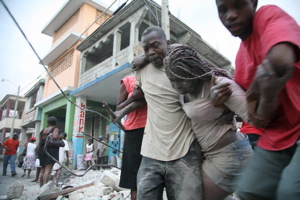
Haiti's "friends" now talk about re-building. But their colonial history in Haiti, and their failure at Copenhagen, should give us pause.
Their default position is to rebuild the country to be competitive in the neo-liberal economy. Its advantage is cheap labour and access to a big regional market. So, retool the country and offer good terms and security, and that should attract capital and investment. This is the growth model that sunk Copenhagen.
After we have sent our money to Haiti relief, and the pictures recede, what then? Do we just leave it to the same folks to rebuild the same old economy-as-usual? Is there a better way forward?
This is the challenge of eco-conversion. It is a new vision for Haiti, and beyond. But it confronts a trajectory of globalizing state and corporate power, and it will require new historical forces to make it real and give it momentum.
Port-au-Prince Vert
Many such forces exist on the margins of power -- in local and regional governments, small businesses and rural communities, farmers and workers, and the world’s diverse social movements. Although in an inchoate form, this is where one finds the new social movement for a globalization from below.
Its project of re-grounding power may seem unrealistic. But it is backed by a new protagonist -- the planet itself. As in Serres' metaphor of the unnoticed quicksand on which the combatants are fighting, and in which all are sinking, the planet is increasingly assertive, relentless, unconquerable and unforgiving.
The entry of this protagonist is a game changer, and we must learn its rules. This is the commonality of Copenhagen and Port-au-Prince.
Haiti is notoriously undemocratic. But so too is a global treaty process where elite state bureaucrats and lobbyists in backrooms carve out a deal between states, not peoples. When important economic issues are at stake, negotiators must be shielded from the people by fences, barbed wire, and phalanxes of truncheon-wielding troops. (Haitians know these troops well.) When politicians emerge into the daylight, their job is to mute broad democratic hopes, and satisfy powerful economic demands.
This is globalization from above. But where democracy is marginalized, so too is economic and social innovation. Haitians and climate activists contend with the same linear model : Exploit from afar and as cheaply as possible to fuel growth at home. There is, we are assured, no other model.
This is the top-down model that the Scottish philosopher, Adam Smith, rebelled against over 200 years ago. The targets of his criticism were big state-chartered trading companies that squelched the potential of small businesses. Smith sought to liberate them with his "free" market. British policies to secure external trade reinforced this corporatist control -- and provoked America’s revolution. Smith’s small market triumphed, but as it evolved, it became today’s big one.
Local matters
An eco-conversion revolution shares similarities with Smith's and America's revolutions. It demands a new way of thinking, an economy of, by and for the people, and a re-definition of the state. That's a tall order, but it is also the nature of history. People only appreciate revolutions in hindsight.
So how might one start to implement a new model? Well, in Haiti, those who invest their time and money and expertise would not seek to withdraw big profits or exploit cheap labour, not extract cheap resources or acquire new resort properties for a song. Instead, beyond a fair return, investments would be re-invested in the place and people themselves.
This is the core of eco-conversion as a global strategy—developing a process that can redirect the wealth that has been built up in our extractive linear growth systems into the creation of new circular economic systems. In linear systems, wealth comes from unequal trade, from distant resources and cheap products, and the disposal of wastes somewhere away. In circular systems, wealth is generated and recycled locally, with resources provided and benefits returned from where they came. Only one of these systems is sustainable.
In this transition, we can give humanity an escape route into a workable future. Indeed, the world can extract one thing from Port-au-Prince -- lessons in how to do it.
Local practice
Let me give some specific examples. Consider health, probably the key component of real wealth. One of the conditions to create health is good food. In Haiti, eco-conversion would dramatically promote the ability of local communities to produce fresh foods and markets for their own consumption. But Northerners also need such good local foods to combat the growing epidemic of the illnesses of affluence, from strokes to diabetes. Inadequate, poor or bad foods erode the physical wealth (the health) in both places.
In Haiti, the need is obvious. But in the North, our dependence on fast foods and agri-business industries allows them to extract both profits and health. We then make huge payments to medical providers and big Pharma that drain massive health care budgets.
In both places, investing in healthy communities also means displacing unhealthy industries. And there is a big lesson here. Contrary to conventional wisdom, redirecting investments can create healthier and wealthier communities by reducing economic activity. Now that's a Smithian revolution appropriate to our times.
So take another example in, say, transit, and the need to move from private to public infrastructure by creating high-quality and energy-efficient public systems, car-freed cities, and livable neighbourhoods. Places where healthy residents can safely walk or bike or tram to work; like Copenhagen, a very livable place.
Such an urban vision would certainly suit any poor, traffic-congested Southern city from Jakarta to Port-au-Prince. It would save global resources big time. But Northerners, people like you and me, would also benefit by saving on average $10,000 per year -- the cost to buy, maintain, insure and park a single private vehicle. That's paying less money for a better place to live.
Wildly idealistic? Not
In 1999, Enrique Penalosa was elected mayor of the murder-ridden, traffic-choked, impoverished city of Bogota, Colombia. As he took office, international development agencies demanded that he spend a billion dollars on new freeways. He refused. Instead, he put restrictions on car use, built a state-of-the-art bus system, the Trans Milenio, plus 70 miles of bike routes, 1,200 parks, the largest pedestrian-only street in the world, restrictions on car use, and more.
The eco-conversion of Bogota has seen the murder rate plummet, and the city's sociability skyrocket. It works for the poor, and it works for the rich. And it was driven not by the constraints of climate targets, though undoubtedly Bogota achieved many.
And it all cost less.
Just conversion
Copenhagen was a downbeat spectacle for those of us watching from afar. But two images repeatedly showed up on the news that made me smile. They were two placards that read: "Change the system, not the climate" and "Climate justice".
These phrases are not about the industrializing nations who demand that "you rich countries had your turn; now it's our". That's the old model, and it's an impossible vision. Instead, they point to a system rooted in natural limits and social justice. Today, inequity is actually needed because it drives growth. Remember the mantra of globalization where "a rising tide lifts all boats", luxury liner and broken skiff alike? Only if we're all on the way up, can inequity be ignored.
To get past this contradiction, climate justice means giving all citizens meaningful access to land, to capital, to education and economic opportunity, and to the democratic accountability to see that it works.
Thus would Haitians, not foreigners, do the rebuilding, learning the skills that will benefit those who live there. This entails an emphasis on small-scale production for local use and enjoyment, on land that is available to be widely and fairly owned. Wealth creation would increasingly come from the recirculation of capital locally. This is a model of balance, circular exchange systems providing the foundation upon which new forms of export could be carefully built.
This approach runs counter to decades of growth-driven globalization. But it works. Several years ago the Nobel Peace Prize was bestowed on the highly successful micro-lending innovator, the Grameen Bank in India. This year, the Nobel Prize in Economics went to Elinor Ostrom for her work in showing just how such a commons economy operates.
Revitalizing the commons (and it is a basic part of eco-conversion) would draw on a plethora of global initiatives, from local currencies to worker co-operatives. Liberating such techniques would, unlike Copenhagen, generate real global dialogue and learning from all directions -- North to South, South to North, South to South. This is Port-au-Prince not as a victim but as a participant.
Wealth costs
In today's numbers-oriented, GDP-obsessed world, Westerners have come to equate wealth with money. Wealth comes from a rising stock market; forget what those listed companies actually do. Rising incomes depend on increasing productivity; never mind that a productive (mechanized) factory is also a high-energy one.
But in reality, wealth has real costs. There is indeed no free lunch. But we think there is when we let the real world drop out of sight. As we should have learned from the recent bubble, watch out when financial wealth gets detached from the real economy of land and labour, physical infrastructure and technology.
But what do we think when we see a cheap flight to London? It's only $349! Do we consider the real costs, that we will use the same amount of fuel, and generate the same impacts? No, to cut carbon emissions, you have to cut flights, and certainly not increase them by making them "cheap."
The 2008-09 recession saw the first drop in CO2 emissions in decades for a good reason -- there was less financial economic activity going on, generating fewer real costs. Now in 2010, the fallacy of costless wealth pervades the stimulus spending on highways and bridges and airports that keeps today's economy afloat. Building this infrastructure and keeping it going will demand continuous new flows of energy, minerals, labour and money.
The free money fallacy becomes outright delusional with the dream of green growth powered by "clean" energy. Some energy is certainly cleaner than others, but there is no clean way to harness energy. A green economy is a low energy economy. The truth is that we are running out of space for unreal wealth.
Haitians' impoverished history has taught them to know the real value of things. If someone pulls a nail out to salvage an old board, chances are that they will recycle the nail as well. Our grandparents better appreciated real costs, and they had a level of respect that has almost disappeared from our big money culture. As limited as our recycling systems may be, and as incipient as may be the bike to work week, their successes come from the vestigial remains of this cultural knowledge, and a subtle impulse to get it back.
In short, eco-conversion is about creating a new steady state economy that marries reduced resource flows with increased social benefits. Now what's an economy for?
The 100-mile economy
Everybody now knows about the 100 Mile Diet that the Tyee series brought to popular attention. This diet is an example of what geographers have long identified as the tension between space and place. Wealth in the north today comes from across such vast space that our dinner that travels 2,000 kilometres from "gate to plate" is essentially placeless. We don't see the sprawling factory farm at the far end, and have become numbed to the brute urbanism of the supermarket strip mall at our end. And never mind all the truck stops in between.
This triumph of space over place has created what urbanist James Kunstler calls the "geography of nowhere." To conquer the momentum of growth we must reclaim our somewheres. And to do so we must come full circle by revitalizing place against space, the 100-mile economy over the 1,000-mile, small markets over big, the community over the corporation, democracy over statism.
Such a project was most definitely not on the agenda of Copenhagen. And we will never be able to put it there. We must do it ourselves. When do we start? Where? Why not a green Haiti? Why not a Port-au-Prince Vert? Why not here, there and everywhere? We cannot afford to wait.
Already, practical lessons are everywhere -- in the people-centered transportation networks in Curitiba, Brazil and Bogota, Colombia, in the fair trade regimes in Mexico and the co-operative businesses in Bologna, in the permaculture and slow food movements in Australia and Italy and the urban farming experiences in the cities of Cuba. The list is endless.
But to escape from the one-sided, de facto constitution of globalization-from-above, eco-conversion points to a new constitution, one rooted in a diversity of local places, connected across global space but not dominated by it. This is the balanced constitution of what might be called networked localism.
To bring power down to earth will take a vigorous global movement for planet justice. What better place in which to begin to heal a ravaged earth than at the site of its most open and festering sore? ![[Tyee]](/design-article.thetyee.ca/ui/img/yellowblob.png)
Read more: Rights + Justice, Politics, Environment







Tyee Commenting Guidelines
Comments that violate guidelines risk being deleted, and violations may result in a temporary or permanent user ban. Maintain the spirit of good conversation to stay in the discussion.
*Please note The Tyee is not a forum for spreading misinformation about COVID-19, denying its existence or minimizing its risk to public health.
Do:
Do not: