



 SHARE:
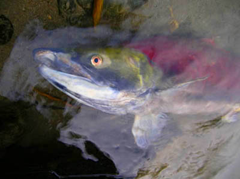
The scene at Bridge River rapids on an August afternoon during the late summer sockeye run is timeless.
Dozens of men stand on the rocky outcrops at the river's edge, holding nets on long poles over the churning water.
The salmon, silver bullets of pure muscle, ascend these class five rapids in leaps. It's a matter of timing and location to land a fish as it springs out of the froth and, hopefully, into the dip-net.
People who aren't fishing are working and relaxing in the shade of blue tarpaulins; at least two dozen of these temporary shelters line each side of the riverbank.
Between them are wooden racks on which thin pieces of filleted salmon flesh hang, drying in the convection-oven heat of the Fraser Canyon. Preserved this way, the meat will last for months.
This place is called Xwisten, which means smiling place, so named for the abundance of fish here. A thousand years ago, Xwisten people would have spent summers on these same rocks, going through the same rituals.
If predictions hold true about the decline of salmon stocks in the Fraser, this tradition will end. For some of the people who depend on salmon in their culture and diet, that's simply unthinkable. But others fear their grandchildren will never see the wild salmon migration at all.
Ask 10 people how it came to be this way and you will get 10 different answers. Sea lice, pollution, loss of habitat, rising water temperatures -- some of these are clearly linked to human behaviours and some might be beyond our control. "Salmon are dying a death of a thousand cuts," said one DFO officer.
Increasingly evident, however, is the need for a new system of managing this precarious resource.
Time for a moratorium?
For some people, the solution to recover fish stocks is simple: stop fishing, at least for a little while. That's the view of Chico Williams, the ferry operator at Big Bar crossing, about 60 kilometres north of Lillooet in the Fraser Canyon.
Williams is a short, stocky man with slicked-back hair and tattoos up both muscled forearms. He worked on commercial trawlers in the North Pacific in the '70s, at a time when the oceans' fisheries seemed inexhaustible.
In those days, says Williams, migrating sockeye would be so thick on the Fraser you could walk across the river without getting your feet wet.
Now he sees so few he's given up fishing at all.
"It's just common sense. I want my grandkids to be able to fish."
Sharolise Baker shares this view. She is the fisheries manager for the Stellat'en First Nation near Fraser Lake, where last year, a total of 21 sockeye were caught in the community fish weir, or fish fence, which forces fish to one side of the river where they are harvested or allowed through.
In May, amid predictions of the lowest ever Fraser sockeye return, Baker says she raised the possibility of a total moratorium on sockeye at a meeting with DFO officers and various First Nations fisheries managers.
"The room got pretty darn quiet," she says. Yet, in her opinion, drastic conservation measures have to be taken. "We should be saying no to everybody. Commercial, sport and First Nations."
'Last in line' to catch salmon
She describes the Stallat'en as being "last in line" to have access to the fish. Until there is a moratorium on all sockeye fishing in the entire migration corridor, Baker says she isn't going to ask her own people to let them swim by.
"First Nations particularly further upstream in the natal areas rely on very few stocks because they fish close to home," says Neil Todd, operations manager of the Fraser River Aboriginal Fisheries Secretariat.
"So they have access to far fewer stocks than people who fish in the main stem. This has been an issue for 50, 100 years."
But this year the DFO asked the 94 First Nations in the Fraser watershed to devise a catch-sharing program so sockeye could be more equally distributed.
"It's not as though the DFO saw the light," says Todd. In 1996, "through a huge number of meetings," First Nations on the Fraser collaborated on a one-year management plan for the early sockeye run.
This year, the stakeholders who met didn't come up with such a plan that could be fully implemented in season.
"And, as it turned out, the sockeye did come back at a rate that was quite a bit higher than expected pre-season, at least in some stocks," he says.
Still, the total run size of all Fraser sockeye was 30 per cent lower than the pre-season forecast, slightly more than 1.7 million fish compared to the approximately 2.9 million that were expected.
'Can't be an exact science'
Although fish managers within and outside of the DFO "understand and accept it can't be an exact science," says Todd, the uncertainty of run estimates, and the allocation of commercial and recreational rights based on those estimates, are a point of contention for many First Nations.
The underlying issue, he says, is the fact that B.C.'s commercial fishery is a mixed-stock fishery. It happens in the marine areas, where stocks strong and weak in numbers co-mingle before heading up the river to their respective spawning grounds.
There's no way to tell if a salmon is from a stock with very weak, or fairly healthy, numbers. So certain stocks, Cultus Lake sockeye for example, face a very real risk of complete extinction.
In October 2008, the International Union for the Conservation of Nature reported that one-quarter of the world's sockeye salmon face extinction, and some of the most critically endangered runs are in British Columbia.
Among the report's recommendations were to fund and implement the DFO's Wild Salmon Policy. This policy does address mixed-stock fishing by limiting the catch available for commercial boats in the marine areas.
"The government is basically acting as a broker to exchange fishing opportunities from marine areas to upriver," says Mike Griswold, vice president of the Gulf Trollers Association. He says the government should compensate commercial fishermen for taking their boats off the water.
"There has been a massive reduction in harvest but the fleet has stayed the same so what's left for us to harvest has been minimal," he says. "Quite a few of us are going bankrupt."
'They're taking so many'
Portaging through the Bridge River fishing grounds, we pause briefly to chat with a young man coming up from the water. He's bent over from the weight of a big backpack lined with a garbage bag.
Fishing's been good, he tells us. He's caught 15 today and will come back for more later. Fifty-three is the most any one person has caught this season, he says, and the "springers" are landing in dip-nets two and three at a time.
Is he worried about taking too many, I ask. "No," he says. "There's lots."
One of our participants from Fraser Lake, who signed up for the program at Baker's urging, is taken aback by the number of people here and the volume of red flesh strung up to dry.
"They're taking so many," she says. To someone from a community where salmon are scarce, this seems excessive. But six different bands from the area come here to fish, someone points out.
It's always been a gathering place. Lytton, just downriver at the confluence of the Fraser and Thompson Rivers, is the oldest continuously inhabited place in North America.
Driving through Soda Creek in the pouring rain one evening, we stumble across Xats'ull heritage village. Owned and operated by Soda Creek First Nation, the site is a grassy plateau on a tall cliff overlooking the river (Xats'ull means "on the cliff").
Like children, we run for a semi-circle of teepees that will be our shelter tonight and start exploring the site. I meet Jordell Sellars and Fallon Williams, two Soda Creek band members who are here to monitor the catch.
The salmon mean everything to her people, Fallon, 22, tells me. When her grandmother is sick, she eats nothing but salmon-head soup.
I ask how they pick the fishing spots and Fallon pauses a moment, thinking. They've just always been there, she says. Since forever.
Related Tyee stories:
- 'Race Based' Fishery on the Fraser?
Court ruling puts that loaded language to rest. - Salmon Kills and the Politics of Mining the Fraser
BC's hunger for gravel is voracious. - BC Salmon Future in Hot Water
Climate change + pine beetle = trouble for Fraser sockeye.
![[Tyee]](/design-article.thetyee.ca/ui/img/yellowblob.png)
Read more: Rights + Justice, Environment







Tyee Commenting Guidelines
Comments that violate guidelines risk being deleted, and violations may result in a temporary or permanent user ban. Maintain the spirit of good conversation to stay in the discussion.
*Please note The Tyee is not a forum for spreading misinformation about COVID-19, denying its existence or minimizing its risk to public health.
Do:
Do not: