
News

A Tyee Series

The Fraser's Fragile Forests

Near the headwaters of BC's vast watershed, how to place a value on ancient trees? Second in a series.

By Colleen Kimmett, 26 Nov 2008, TheTyee.ca

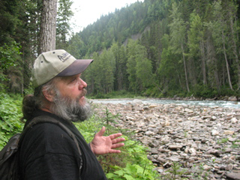
Roy Howard

Roy Howard at the cable car site in Upper Goat. Photo by Colleen Kimmett.

It's called the dirty Fraser in some parts of the province. But in the Rocky Mountains, before sand and silt colour it muddy brown, the Fraser River is a milky steel-blue and clean enough to drink.

At least so says Shawn Burleigh, our young rafting guide. He steers the raft with two long paddles, strong and steady, and patiently answers all our questions.

We've got many of them. Our group has been camped on the banks of the Fraser River not far from the town of Valemount, and within sight of the Mt. Robson glaciers that feed the huge river's source. We've been here two nights but this is our first time on the water. Today we'll spend a couple of leisurely hours on the raft with Burleigh.

Tomorrow we climb aboard our 34-foot canoe, the Cedar Spirit, and begin the first leg of our journey north down the Fraser River, from Tete Jaune through Dunster, McBride and Crescent Spur.

Rock flour, tiny particles from the rocks, give the river the colour of cartoon ice cubes, says Burleigh. In fact, he adds, people say the high mineral content can actually relieve constipation.

"Of course, you never do know what's upstream."

He's right in more ways than one. In terms of climate change, we don't know exactly what's coming down the chute at us.

Follow the Fraser further downstream and you'll find people along its route already feeling the foreshocks of climate change. This is especially true of those who make a living from the forests.

Warmer winters have allowed the mountain pine beetle to flourish in B.C. Like locusts making their way from field to field, from 1993 to 2006, beetles ate through 9.2 million hectares of B.C.'s pine forests -- an area as large as England.

Then the U.S. housing market crashed. Lumber giants Canfor and Weyerhauser started cutting shifts, then shutting down and closing their mills for good.

Last year alone an estimated 10,000 workers lost their jobs -- and communities are asking themselves, now what?

For middle-aged mill and forestry workers, early retirement or job training is an option, but for Burleigh's friends, guys in their early 20s, the dream is a well-paying job in the Alberta oilfields.

But in the fall, Burleigh will return to the College of New Caledonia's outdoor recreation and ecotourism program. His goal is to design a mountain-biking tour for people in wheelchairs so a paraplegic friend of his "will have something to do."

Tourism the next big thing?

For now, Burleigh says, he's having the time of his life rafting on the Fraser River. Floating in the shadow of Mount Robson, we look up at the glaciers from which this river springs, dazzling white against a blue sky. It's hard to imagine a better job than this. I understand why he wouldn't want to leave.

"So tourism might have to be the next big thing," says Burleigh. "If people out here rafting on the river are caring and not just trying to make money, then it would be pretty sustainable, I think. We could all be happy."

Roy Howard knows better than anyone how difficult it can be to reach that kind of happy, or at least friendly, compromise.

Howard has lived in Dunster for 33 years. In the late 1990s, as president of the Fraser Headwaters Alliance, he sat on the Robson Valley land use management committee. When yelling matches would break out between loggers and environmentalists, friends say Roy was the peacemaker to whom both sides would listen.

One of the most heated arguments was over logging near the Upper Goat River, a tributary of the Fraser about 35 kilometres northwest of McBride. Despite being identified as important habitat for the endangered bull trout and mountain caribou, as well as wolves, grizzlies, lynx and wolverines, the area received no special zoning under the region's land use management plan.

Where the Fraser Begins

The headwaters of the Fraser River spring from four glaciers on Mount Robson. From here, it flows northeast through the Rocky Mountain Trench, a major migration corridor for wildlife. The Robson Valley lies in this trench, and this is where the Fraser begins to pick up silt and sediment it will carry all the way to the delta. Only a handful of towns exist in this region and the total population is about 3500 people. Clustered around these communities are farms whose acreage stretches down the river, but for the most part the riparian zone along the banks -- cottonwood trees and low vegetation -- remains intact. The ecosystems in the Upper and Fraser Headwaters regions range from wet, valley-bottom interior rainforests to mountain tundra, and are home to grizzlies, mountain caribou, wolverines, black bears and cougars. -- C.K.

Intent on raising the profile of the Goat as one of the last pristine valleys in the region, Howard spearheaded the task of promoting it as a premier hiking destination in the province.

The Goat River Trail is a historic route from Barkerville to McBride via a pass in the Caribou Mountains. It was first cleared in 1886 by a crew of men under orders from Gold Commissioner John Bowron, though First Nations likely traveled this way long before they arrived.

We meet Howard at the confluence of the Goat and Milk Rivers, on an old forest service site northeast of West Twin Provincial Park. The Cedar Spirit is parked in a cutblock -- the only one so far in this valley -- where we've set up camp for the night. After three days paddling north, we will travel by van from here to Prince George, where the river curves like the top of an 'S' and heads south.

While we're here, Howard has agreed to lead our group down a 5-kilometre section of the Goat River trail to the first ford, where he and his son installed a cable car back in 2001.

"We got all kinds of shit from the Forest Service for building the cable car," he says, as we file along the narrow path that follows the river, flanked on either side by blueberry bushes and prickly devil's club.

Some of the locals weren't too happy about the trail promotion either, says Howard as he hacks at some overgrowth.

"Log it! There's no money in tourism, only logging. Tourism only pays eight dollars an hour for jobs, and there's not very many of them," Howard recalls hearing.

"It seems to me that's the minor part of it. It's the ecosystem protection you should be worried about."

How much is a forest worth?

Jobs in tourism will never replace those in the forestry industry. But in recent years, researchers in British Columbia have tried to put a dollar value on forests, not just trees.

We meet one of these researchers, Kyle Hillman, in a parking lot off Highway 16, about a hundred kilometres west of Prince George.

A plain and forgettable sign on the side of the road indicates the Ancient Cedar Forest is one kilometer ahead; what it should say is, "See a tree that's older than Christ!"

Hillman is counting the number of visitors that do pull off the highway to visit the Ancient Cedar Forest interpretive trail, and requesting they fill in a survey asking where they are from and why they have come.

"As you're coming along this road, you don't expect to see trees that magnificent a couple of hundred metres off the highway," says Hillman.

They are magnificent. We speak in hushed voices and walk on to the trail as though we're tourists in a cathedral. It feels like a holy place; it's dim and silent but for the occasional creaking of the treetops, some 50 meters high. The sweet musty smell of moist earth and cedar bark fills my nostrils.

The tallest cedar, Big Tree, is five metres in diameter. It's been growing in this spot for at least 1,500 years.

In 2005, University of Northern B.C. graduate student David Radies was doing random sampling for a lichen diversity study in the area when he saw logging tape tied around a red cedar that he estimated to be at least two thousand years old.

His hunch was correct. Radies had inadvertently discovered an ancient forest that was about to be logged. Such pockets of biodiversity comprise only about one per cent of the land base in the Robson Valley. Characterized by giant cedars and forms of lichen that have evolved together over thousands of years, they exist within the ordinary spruce and fir that cover the mountainous slopes of the valley.

Although this particular forest has been removed from the timber license, Radies fears that as logging operations move away from now-worthless pine stands and into sub-alpine regions, the ancient trees will be axed along with everything else and likely turned into fence posts, shingles or garden mulch.

"It's almost like a litmus test for how poor forestry is," says Radies. "With all of our fancy biodiversity literature that we have out there, we still continue to log these forests when there is such a low economic value."

"We do need to subsidize and diversify the forest economy. But we need to do it within the parameters of what can be supplied ecologically."

Researchers at the University of Victoria found that the value of forests is often greater than the value of clear-cut logging. Forests also serve as recreation sites, carbon storehouses and sources of products other than timber.

'Raise the level of discussion'

David Connell is an assistant professor at UNBC who is leading the study at the Ancient Cedar Forest. He says this work is part of a growing body of research that could be used for land management and planning purposes.

"It's an attempt to actually play the same game with the same rules," says Connell.

"Let's at least try to place a value on the things we can easily value, and raise the level of discussion. Then we can talk about global significance of conservation in ecological terms."

We leave the Ancient Forest Trail and hit the highway. Next stop is Prince George and then Soda Creek, where we will begin week two of the trip in a raft. The theme for this leg is salmon and riversheds.

In the Goat River, Howard told us how bears carry the salmon carcasses in to the forest where they rot, providing valuable nitrogen for the soil.

Salmon feed humans, too. We've all heard the gloomy stories of how stocks are declining. How is it affecting people who fish on the river? We're about to find out.

Next Wednesday: Following the embattled young salmon's journey down BC's mightiest river.

Related Tyee stories:

 [Tyee]

21  Comments:

Login or register to post comments

  • Sam Salmon

    3 years ago

    Drink It?

    Drinking freshwater anywhere in BC is a poor idea-giardiasis lurks everywhere.

  • snert

    3 years ago

    Wow

    Big headline.

    "Global warming is altering BC's vast watershed, forcing nature and humans to adapt. Second in a series."

    The article only makes mention of the "mountain pine beetle."

    Kind of hard to adapt if there's not much to adapt to the beetle aside. Seems there's more need to adapt to the economy.

    YOU'RE RIGHT, SNERT, I COULD HAVE DONE BETTER WITH A SUBHED THAT MORE CLEARLY REFLECTED COLLEEN'S ARTICLE. I'LL REDO IT. -- DAVID BEERS, EDITOR

  • ME2

    3 years ago

    Sam Salmon

    Before you make any more such alarmist statements, Sam, you should read this - carefully.

    http://www.yosemite.org/naturenotes/Giardia.htm#_ednref7

  • murdock

    3 years ago

    Tangle in the woods

    Interesting to think of the argument and discussion within the NDP about this sort of item.

    Do they support the desperate Unionized forestry workers?

    Do they support the protectionist and NO LOGGING attitude of the green movement?

    Are they stuck in a place they cannot negotiate out of since their policies cannot untangle this pair of planks?

  • North of Hope

    3 years ago

    Pine beetle epidemic

    I would like to see a story about the pine beetle devastation, the lack of clearing out of the rotting wood and the lack of replanting the forests that have been cut. It seems that the provinical government has reduced the amount of trees that have to replanted. Is that possible to have such a story?

  • David Beers

    3 years ago

    Administrator

    North of Hope, some reporting we've done

    Series on 'Battling the Pine Beetle'
    http://thetyee.ca/Series/2005/08/17/BeetleBattle/

    Series on restructuring BC's timber industry, including waste wood
    http://thetyee.ca/Series/2006/11/29/Timber/

    Article on declining rate of tree replanting in BC
    http://thetyee.ca/News/2008/04/28/ReviveForest/

    You can use the search engine on the top left of every Tyee page to find out what we've published about other issues.

  • monty

    3 years ago

    Just wait 'till Big Oil overtakes the Headwaters

    To learn about the utter devastation of the Fraser, check out what Gordo and friends plan with Big Oil. Contact:

  • ME2

    3 years ago

    It's a tangle, alright.

    it is sad, Murdock, that the three groups which the NDP is ideologically committed to support - the unions, environmentalists and FNs - in turn support the NDP only when it suits them. Indeed, even though they should be natural allies, when it suits them those allegiances are similarly inconstant in supporting each other, too.

    But even so, the only ten years of those imperfect quasi-alliances under the NDP have been better for our forests than the 44 years of ruinous "free enterprise" management which has reduced our forests and their productivity to the ruinous state we see today.

  • North of Hope

    3 years ago

    David

    Thanks for telling me about these articles. "Who Will Revive BC's Forests?" is a great article and I will have to put it in my own files and distribute it to some friends who, I believe, have also missed it. Again Thanks.

  • Whiskey Jack

    3 years ago

    Fraser River headwaters

    I suggest the author of the Fraser River series consults a map of BC and determine just exactly where the headwaters of the Fraser River actually are. While the Robson River drains into the Fraser, it is incorrect to say that this drainage is the headwaters. Further east, past Moose Lake and Lucerne Lake, through which the Fraser runs, the author will see that the headwaters are actually very close to Jasper National Park.

  • michael maser

    3 years ago

    Rose-coloured Orange glasses

    That's an interesting fantasy you spin Me2. You need to do some reading beyond the Funny pages from which you are getting your sense of political history. It was under an NDP watch that mounties rounded up more than 800 Clayoquot protesters in the largest mass-arrest in the province's history in the early 90s, and it was Glen Clark who tarred environmental advocates as "enemies of BC". Then we have the NDP's record of doubling raw log exports in the 90s, and its sleepwalking through this session of the legislature and the numerous enviro-issues that have arisen under the (non) leadership of Fraulein James. There is no love lost, and very little trust, between knowledgeable environmental advocates and the NDP for good reason. And I so no reason that this will be changing any time soon.

  • Spirit of the West

    3 years ago

    Salmon, Forests, and Climate Change

    Colleen closes this part of her series on the topic of salmon, and the role of our symbolic fish in providing nitrogen to the soil of our forests with the aid of bears and other predators. Years ago, UVIC Professor Tom Reimchen showed that up to 50% of this important nutrient in forests around salmon bearing rivers comes from the ocean by way of the salmon and bears.

    Fast forward to 2008 and the reality of climate change. Researchers at UBC are only now discovering the direct link between nitrogen levels in the soil and the ability of forests to absorb carbon dioxide from the atmosphere. While researchers themselves often aren’t aware of the implications of their studies with those of other researchers, those who care to look will see that our ailing salmon have a direct role in thwarting global warming as a catalyst for trees in absorbing our carbon dioxide.

    It’s now evident that as salmon returns and the nitrogen they bring decline each year, our stocks beaten down by open-net-pen aquaculture, over fishing, and general mismanagement by provincial and federal authorities, our forests will gradually transition from carbon sinks to carbon sources. As I’m sure Colleen will point out in her next article, salmon play a profound role throughout the province and are of unfathomable importance to our forests, land and people.

  • ME2

    3 years ago

    michael maser

    It appears that it's YOU who's been reading comic books instead of the Tyee, Michael, for I've slammed the NDP many times for its anti-environment stance during its days in power.

    But I've been careful to distinguish between Harcourt's days of genuinely accommodating enviro wishes - remember the remarkable CORE process? - and his ground-breaking Forest Practices Code?, and between those later days of Clark's anti-enviro cabal. That active opposition within the Party came from Jack Munro's IWA, the same bunch who sewered Dave Barret's gov't and whose lack of support handed Campbell his victory in 2001.

    While I support today's opposition to log exports, in particular Cedar, I favoured them in the early days of Harcourt's gov't. Though boneheaded enviros and unionists opposed them, capitalising on the appearance of it being an export of jobs, the reality was far different.

    At that time, BC had subsidised logging with allowing clandestine Cartels through the Howe Sound Log Market, along with low resource rental taxation of many kinds, This allowed the Corporations to mill logs that cost them well below 1/2 their actual value on the world log market.

    The export of logs in those days concerned only High Grades, with the exception of logs on the North Coast which met Scribner Scale rules. (Cedar w not allowded) At its highest extent, those exports never exceeded 2.75% of Coastal production, yet they resulted in the doubling and more in the overall pricing of logs, approaching their real value.

    At the same time, the Province extracted super-royalties in the form of export taxes which in many instances quadrupled the going resource rent due to the Province.

    Besides this bonanza, huge numbers of new jobs were created by the extra handling needed to process these logs for export, the towing and assembling of them prior to shipping, and the creation of new Canadian longshoring jobs in the loading of ships.

    On top of all that, the lessening of the perfect high-grade logs necessary to subsidise their butchering in BC's dinosaur mills, (and the diversion of sawable logs and the profitable waste from the sawmills to the Coastal pulp mills) resulted in the acceptance of lower grades by the sawmills, including those formerly considered only for pulp. As someone charged with the scaling and grading of logs at the time, I can confidently state that logs formerly left in the bush were brought out, and much less waste went to the burn piles, more than replacing volumes going offshore.

    From what I've heard from others, those practices of adapting to the market, were, with the exception of exporting, ignored by the Majors, who opposed their losing control of their formerly captive log market.

    Continued

  • ME2

    3 years ago

    Continued.......

    I've recounted that story in the Tyee before, Michael, and it, among many other similar instances of where unthinking environmentalists, with their heads lodged firmly where the sun don't shine, will believe and follow false leaders, along with others such as the late unlamented IWA Munro-ites, all of which have led to my comments above.

    Reserve your ill-informed, sneering comments for things you might know something about.

    Incidentally, there's something really phoney - and smelly- about your choice of nom-de-plume.

  • weasel

    3 years ago

    East not west!

    "We meet one of these researchers, Kyle Hillman, in a parking lot off Highway 16, about a hundred kilometres west of Prince George."

    Trust me. This would put you past Vanderhoof. Check your map of northern B.C. and change your article to 100 kilometres EAST of Prince George, where the trees grow large and lovely. There used to be cabins at 8-Mile, Grizzly Den and Raven Lake in the 1970s maintained by Northwood Pulp and Paper. Maybe there still are. The area needs preserving.

  • snert

    3 years ago

    Bear poop

    "Colleen closes this part of her series on the topic of salmon, and the role of our symbolic fish in providing nitrogen to the soil of our forests with the aid of bears and other predators. Years ago, UVIC Professor Tom Reimchen showed that up to 50% of this important nutrient in forests around salmon bearing rivers comes from the ocean by way of the salmon and bears."

    I find it fascinating that so much is made of the nitrogen enhancement along salmon streams. The last time I looked the forests grew quite well miles away from any salmon streams.

  • ME2

    3 years ago

    snert

    In a sense, you are quite right, Snert. While the tremendous productivity in the riparian zones alongside rivers and streams has historically been due to salmon biomass, Reimchen has used the tracing of N isotopes to show that insects and birds can distribute these nutrients many kilometers into inland forests.

    But any improvement in the health of these forests as a result of this further distribution of such a tiny amount of nutrients would be hard to prove.

    Hard to prove, that is, if one hews to the standard forest industry belief that a forest is a crude system that can be broken up into its component parts and mixed and matched at will, eliminating those parts thought to be "unproductive". The truly crude forest, snert, is a tree farm, supportable only through the Professional Forester's hubris.

    In an earlier series of posts, I demonstrated how monocultural Pine forests were unable to cope with lack of winter-kill of the Mountain Pine Beetle, normally a relatively harmless endemic species in those forests. A healthy forest is a MIXED forest, trash trees, shrubbery, and all.

    We are seeing in our Oceans how the elimination or overharvest of one species of fish cascades throughout the ocean food chain, a syndrome Peter Larkin described 30 years ago, which today is unquestioned in fisheries science, but which remains ignored with the politicising of our fisheries.

    Similarly, a forest is not a collection of discrete, unrelated parts, with riparian zones here, alpine zones there, Drybelt and Coastal forests in another, but is instead a series of unique ecosystems with transition zones between each, creating undeniable interdepenencies.

    Who knows whether Reichen's flies, adapted to fish-carrion, in turn provide a major food source at that time for a species - bird or insect - which in turn is beneficial to inland forests?

    Sure, I've just concocted that story, but it is far from implausible since similar ones keep turning up all the time as we grope our way toward understanding how a forest works.

    That said, snert, while I share your impatience with enviro hyperbole, may I suggest that there's sound science behind most of it.

  • North of Hope

    3 years ago

    Sound science

    ME2 said, "That said, snert, while I share your impatience with enviro hyperbole, may I suggest that there's sound science behind most of it."
    Here is an example of enviro hyperbole.
    Some economists say that a gas tax will solve global warming. But they present NO plan to show how it will occur.
    What we need is a scientific model to work with rather than an economic plan that is not sustainable.
    Both Ed Deck or the Jan, Feb issue of "Adbusters" point this out.

  • snert

    3 years ago

    ME2

    Quote:
    In an earlier series of posts, I demonstrated how monocultural Pine forests were unable to cope with lack of winter-kill of the Mountain Pine Beetle, normally a relatively harmless endemic species in those forests. A healthy forest is a MIXED forest, trash trees, shrubbery, and all.

    A significant portion of infested pine forests are not subject to "winter kill" conditions. The temperatures are just not extreme enough for that in those areas. The most likely cause of this major out break is simply man's interference in the natural order of things by not allowing forest fires to run their course thus reducing the number of over mature infestation prone trees. This may meet your requirement for a "healthy" forest, I don't know.

    You use of the term monoculture implies the hand of man in the cultivation of these forests and I don't believe this is the case either as large tracts of infested pine have never been logged then replanted.

    http://www.for.gov.bc.ca/hre/bcmpb/BCMPB.v3.2012Kill.pdf

    As to the importance of salmon to overall forest health, I think it is negligible.

    That should not reduce the significance of salmon in the environment as a whole. I just think it's a non issue in this respect. The trees would most likely survive in any event as they do elsewhere when no salmon are present.

  • ME2

    3 years ago

    snert

    I wrote in much earlier comments concerning the MPB, that the creation of Pl (Jackpine) monocultures was indeed anthropogenic in origin.

    I noted that this began in the late 1800s when, because of the breakdown in FN cultural traditions, they discontinued their practice of lighting low-intensity ground fires which burnt off underbrush and fuels. At that time the forest was dominated by old-growth trees of all species, with the exception of Pl, which is only incidental in a normal Interior forest.

    The result was that because of this new, abnormal build-up of fuels, a fire could now generate enough heat to initiate the destructive "crowning" fires we see today, which clear large areas of standing timber.

    Since in the Interior PL is the natural first forest coloniser of such burnt-over areas, the result became the huge areas of unnatural, monocultural Pl stands which our generation inherited.

    Though many of these now very destructive fires were induced by lightning, the by far larger cause was human.

    In the late 1800s - very early 1900s, many huge fires were deliberately set by mining prospectors looking to clear ground to enhance prospecting.

    By the 30s the Forest Service had their Fire Suppression policies in place, and many fires were set during the Depression by people seeking work fighting them, and thus more areas of Pl monocultures.

    This scenario has been verified by a CFS forester, but feel free to dispute it if you want, and by all means support your totally honest Industrial Forester who seeks to replant with more "natural" Pl monocultures. .....Sucker

    And re the Salmon, please don't deliberately misinterpret what I wrote. Its intent was clear enough.

  • ME2

    3 years ago

    Snert

    And BTW, since you haven't yet understood WHY a mixed forest, with its wide variety of plant and animal species is a healthier and more productive forest, it's long past time you did some reading.

    This is not just a bunch of touchie-feelie aesthetics, but instead concerns economics which involve the Limits To Growth issue.

    In the case at hand - Pl monocultures and Tree Farming - it is entirely concerned with short rotations and seeking the quickest return on investment, with all other issues becoming distantly secondary - if accounted for at all.

    • The discussion for this story is closed. No more comments can be added.