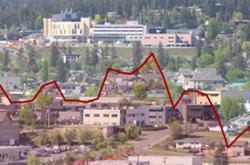
Rush of Homes on Vancouver Market: Prices to Slide?
Milestone of 20,000 homes for sale has realty blogs abuzz.
Hopeful home buyers: at the top?
Does the number 20,000 represent the apocalypse, nirvana or nothing at all? Well, that all depends on how much or little money you have invested in Vancouver's real estate market.
The number of homes for sale tipped 20,000 on Friday and is still climbing. Paul Boenisch, a popular blogger who runs the North Vancouver Homes blog was the first to announce the turn of the dial: "20,000 listings. Is this the top???"
This time last year, there were around 12,000 listings for sale, and it was, to use the blogger lingo, a bullish seller's market. But when there are more listings, and the sellers outnumber the buyers, the theory goes that it becomes a buyer's market -- the law of supply and demand.
The tide may now be turning, and not just in the minds of those wishful-thinking real estate bears. Boenisch, a realtor, predicts even more homes will be listed by fall. "We saw prices decline last month and many feel prices are destined to continue moving downward," he blogs.
"Is this a good thing or a bad thing? Does cheering a price correction make you a pessimist? I guess it depends entirely on your current position."
The benchmark price of a detached house in Greater Vancouver was $771,250 in May 2008, but $765,654 in June 2008, according to the Real Estate Board of Greater Vancouver. Not a huge decrease, but significant because it's the first one in years.
"One thing is for certain," blogs Boenisch, "home prices were growing at a rate that could not be sustained. Now our market is re balancing. I personally would not want to be holding a bunch of pre-sales right now."
Rob Chipman is another popular blogger and realtor whose commenters started posting about "20K" as soon as it happened, then he joined in. Chipman consistently predicts a price correction on his blog, but doesn't think that 20,000 is "some sort of magic number causing sellers to capitulate."
In response to the hundreds of comments about the milestone, he blogged, "Apparently it's common knowledge that we're on the verge of another Great Depression. Mark me down as doubtful. Real estate prices rise, and real estate prices fall. We don't require a cataclysm for that to happen. The fact that the market is changing doesn't mean we're in for a Great Depression either. Just as we said three years ago when prices were rising -- real estate prices rise and fall, and that's normal. (I'm sure that should get the bears burning! :-)"
Dozens of commenters wished each other "Happy 20K!!" on both blogs. Here is a sampling of what else they said:
Reactions
"I cheer for a world where housing is affordable not just for those that already own it. Is that pessimistic?"
-Jesse.
"YEEEEEEEEEHAAAAAAAAW! Didn't think we would get there this fast!"
-Damien.
"I'm sorry that I don't share all of your enthusiasm, but I just don't see the significance of 20,000 listings. Sure, it's a big round number, and this may very well prove to be the peak of the current market cycle. But the reality is, I still can't afford to buy a house, and prices have barely come off their highs. What I've learned from this blog (and others) is that: 1) Prices are sticky on the way down and 2) Prices usually bottom about 2 years after a market peak. I'll get excited when prices drop 30% to 40% and I can actually afford to buy. That may take a while."
-Missed the Boat
Observations
"Times are certainly changing. My phone didn't ring at all today. I currently have 6 active listings on MLS, another 1 that should get processed by tomorrow, and possibly another three listings to hit within a week.
"I was chatting with one of my colleagues today who has 26 active listings and she told me that she was doing a lot more showings last year while carrying 8-10 at a time.
"From a realtor's perspective, this is bleak. I had to laugh earlier this week when a prospective client thought it was 'bleak' that I suggested $449k on his property that he bought for $138k in 1999, and it traded in 1992 for $131k. Greedy pig!"
-Jeff
"GUYS, the place I'm bidding on is 25% less Market…. and the realtor says there is a shot… as NO else is calling or coming to view…… so it can happen…"
-romeojordan
"Check out job growth in San Diego in 2007. Unemployment was not significantly increasing in 2007 even as house prices declined at double-digit annual rates. In San Diego, job losses indeed exacerbated the housing bust but price declines started before major job losses happened -- the job losses were an inevitable fallout of overbuilding."
-jesse
Predictions
"If past trends are an indicator, we'll probably stay around this level (+/- 1,500) until September or November with a decline towards December (expiries)."
-Vansanity
"I have to disagree with you there. With tighter lending (no $0 down, or 40 yr mortgages) coming in the fall, we will continue to see listings increase until the winter, especially in the next 2-3 months. Another reasoning is the fact that the [mainstream media] hasn't really focused on the story yet and many people still aren't aware of the current state of the market."
-Anonymous
"30,000 -- it is possible -- we could have one of the largest crashes on the planet in the [Real Estate Board of Greater Vancouver]… seriously, why not? Our listings to population is going off the charts… sales coming to a halt (and the great unwashed are still buying a bit -- when the fools wise up -- then watch the fun unfold… good times…"
-WoW
"Well, there's mighty stiff competition for that. I'm sure we'll have the biggest tank ($s and %) in the Pacific Northwest. Definitely the biggest $ drop in Canada. Maybe the biggest % drop in Canada, but Edmonton/Calgary will be tough to beat. For overall % drop there's no way Van could beat San Bernardino or Stockton CA. They'll be in the 50-75% range, we'll be lucky to hit 50% in sales price #s. I suppose it's conceivable, though, that the city of Van could have the biggest $ drop in SFHs anywhere in North America… Average SFH from $750 (or wherever it peaked in May) to $400, that's a $350K drop, tough to beat. But London will probably beat our pants off in % and $."
-Whybuywhenucanrent?
"Easy to beat. Edmonton/Calgary never got nearly as expensive as Vancouver, they have higher incomes, and have an economy that produces something the world needs (oil) as opposed to one based on [real estate], tourism, and drugs. No contest."
-patriotz
"It really is amazing how everyone is so happy to see 20,000. I must admit it is mind blowing. But, this is gonna have to affect us all. We all know what is going on in the US and how their entire financial system is blowing up. Foreclosures are rampant. Banks are failing. Employment is awful. This is all having a major impact on us in Canada. And now our own real estate meltdown. Our own concerns about banking failures. And employment opportunities aren't that great, especially in this small city. And it's gonna get a lot worse.
"US foreclosures up 121% in q2, this market is in big trouble as the worst of the mortgage crisis hasn't hit. I don't see a bottom in this market for 3-5 years, people have no idea how cheap housing is going to get."
-Anonymous
"Walking away from deposits on pre sales will become a common theme if things keep going the way they are. That doesn't surprise me :)
"I, personally, do not hope to see things become as horrible as they are projected here but I can entertain the idea that it may…My prediction is a two year downward trend back to 2004 prices at the bottom and a two year climb from there back up to 2006/7 prices."
-Lurker
"We are looking at 1998 prices. Prices will drop back to [what] it was a decade ago. Very scary. It's not going to be just a 30% drop."
-Anonymous
"Just did an open house. What a waste of time. No one. I had to listen to the concierge tell me how no one comes to the open houses anymore… and how last year they were so busy. He chatted with all the residents coming into the building and laughing how everyone needs to sell because prices are falling. He went on about how many of his friends and family sold their houses and moved back to China. And how a few remaining friends can't sell their Westside houses.
"How possible do you guys think it is that we shave 80% off current values? I'm talking pre 1990 prices."
-Jeff
"I'm predicting a 50% drop in Van area RE by from April 2008 to April 2012… Low end properties in LA are already down 37% (and only halfway through the expected foreclosure cycle).
"Based on other NA markets that are well into the tumble, 40% in 20 months is about par. It's a pretty conservative guess, really. Maybe it will take 30 months, but 40% on par with other cities.
"After all, why wouldn't Van's markets tank 40% if every other bubbly city but San Francisco tanks 40%?"
-Whybuywhenucanrent?
“I would tend to agree that 40-60% is most likely given our rational thinking… after all, that is where prices make sense to us today."
-Jeff
What do you think the current state of the market is? Where do you think it's going? Do you agree with any of the bloggers or their commenters? Why not write your thoughts and predictions below.
Related Tyee stories:
- Evicted and Shuffled into SROs
Hot real estate market uprooting working class tenants in Vancouver. - Vancouver Housing Bubble to Pop?
Interest rates could change tomorrow. Then what? - Pop Goes Real Estate Bubble Blogger
'Don't go!' say fans of Vancouver Housing Blog.


Grumpy
28-07-2008
Dive - dive - dive!
My house is assessed at $950,000.00 yet two houses withing 400 metres of mine have been on the market for at least 10% less than assessed value, for over 5 months and have not sold.
One may sell for 25% less than appraised value (estate sale) and here is the crunch.
I will, the Jan., ask for a reassessment of my house and property based on the fact that retail sales level is 20% to 25% below 2008 assessed value. Municipal coffers will suffer from declining property taxes from reassessed value.
Hold on to your hats, the region is just not gong through a roller coaster of house sales, but a massive general decline in house values.
Be prepared for a vast reduction of social services!
RickW
28-07-2008
Everyting's OK!
Campbell told us not to worry at all, as the market and economy would be nothing but sunshine and roses right through to 2010 (and beyond)............
Budd Campbell
28-07-2008
WHAT WILL THE OFFICIAL PUNDITS SAY?
For the sake of argument, suppose any one of these major correction scenarios materializes, with prices dropping well over 10%, and count me among those who think a 50% drop is highly indicated.
What are all the official (READ: positive) pundits going to say? You know, people like the economists at CMHC and CUCBC, or the housing writers at CanWest? For years these housing market experts have assured everyone that Vancouver prices will never, ever go down, and will all but certainly keep on rising at a rate well above inflation and/or average incomes, at least 5% per year. How on earth would they explain themselves to investors who bought additional micro-condos based on these ironclad sounding assurances, or to first time buyers who stretched their borrowing power with both family and lending institutions to the absolute limit to "get into the market"?
I just don't think there are enough shucks and shrugs and mumbles to gloss over that kind of advice which will result in personal bankruptcy for tens of thousands, perhaps over 100,000 people in Greater Vancouver.
To me the acid-test indicator is the gap between capitalized rents and prices, and until that relationship returns to some kind of rational level there's downside risk in the housing market.
Luke Skywalker
28-07-2008
Another Run Comes To An End...
Some earier housing run-ups:
'79 - '81
'86 - '89
'91 - '93
However the 7- year run-up from 2001 is the longest that I've ever witnessed. Thought that it would lose steam by late 2003. Boy was I wrong.
One problem is the loosening of credit restrictions from the conservative 25% down from years back to 0% down until recently, which caused a lot of greed in the market.
Too many people buying pre-sales on spec and attempting to flip 'em prior to closing a few years later on Craig's List, etc.
Market went tooooo far skyward.
The market in Calgary and Edmonton already turned one year ago.
Grumpy:
Nope. The BC Assessment Authority assesses real estate as at July 1 of every calendar year and, based upon that assessment, municipalities set their mill rate for their budget requirements.
Budd:
Remember the large run-up to May, 1981? And the bottom falling out of the market in the late fall of 1981?
Back then... 20% prime rate for a period and double-digit unemployment in BC's mini-depression to ~1985.
Even back then, most prices did not tumble 50% as far as I can recall.
Today's market fundamentals are waaaaay different from back then. Neverthless, look for a slight downward trend and flattening of the market for the next 5+ years.
It's gonna take time for seller's perceptions of the market to also readjust to current realities.
C'est la vie.
ME2
28-07-2008
Home "equity"
Like most of us here, if the crunch comes and a few real estate speculators get burnt, I won't feel a bit of pity for them. And I'll feel more than some disgust for the rest of them who will retreat to their mansions to await the opportunity to begin the cycle all over again.
I will, however, feel considerable sympathy for those who as a result of simply seeking a place to live will be paying for equity that no longer exists in the home they've bought.
I've just been told tonight that due to fairly recent BC legislation, buyers can no longer just walk away from a mortgage they cannot handle, as they can in the US and other Canadian provinces. This seems unreasonable to me.
Budd Campbell
28-07-2008
REMEMBERING REAGAN AND VOLCKER
Luke Skywalker:
Budd:
Remember the large run-up to May, 1981? And the bottom falling out of the market in the late fall of 1981?
Back then... 20% prime rate for a period and double-digit unemployment in BC's mini-depression to ~1985.
Even back then, most prices did not tumble 50% as far as I can recall.
You're god-damned right I remember it. Sometime during the summer of 1981 I was renewed at a rate of 18%! It's not something I am ever likely to forget, for Chrissakes!
Prices in suburbs such as Ridge-Meadows did fall by 50%, or close to it. The house I bought in 1979 for $62,000 could have been sold in early 1981 for about $120,000. And by 1982 or 1983 it could have been bought for about $60 or $70 thousand. If only I had known that at the time!
President Ronald Reagan backed Fed Chairman Paul Volcker to the hilt in doing a serious deflation, that many had thought would extract too high a price in terms of lost output and high unemployment. And the 1980s recession was the worst since the Great Depression. But, as articles in the Fall 2007 issue of the Journal of Economic Perspectives point out, Volcker remains a hero to central bankers and monetarists because his hardass, take no prisoners, ignore the screams of the victims approach did succeed in killing off the major inflationary pressures that had been building since the Vietnam War. And while the unemployment and lost output costs were high, they weren't as high as some Keynesian economists had predicted.
And incidentally, the New York Times reports today that President, ... er, ... I mean, ... presumptive Democratic Presidential nominee, Senator Barack Obama of Illinios, met today with his panel of economic advisers, including Paul Volcker.
Today's market fundamentals are waaaaay different from back then.
Maybe so. But the investment portfolio realities won't go away just because it snows less in Vancouver than in Winnipeg. In long run equilibrium prices of real estate assets should be equal to capitalized rents. Otherwise, investors are paying too much to buy properties they have no intention of living in. One only buys a property if one intends to live in it for the longer term, and wants to be mortgage free during one's retirement years, and to put a permanent asset into the estate.
Whybuywhenucanrent
29-07-2008
Prepare for The Big Drop
Hi readers in TheTyeeLand,
Just to elaborate on my quotes above:
I'm forecasting a 50% drop in Vancouver-area Real Estate prices, from April 2008 to April 2012. This is corrected for inflation, so with inflation in the 2-4% range it will be a drop in pricetags from 35-40%.
For example, a Yaletown condo now selling for $500K would go for $300K, and a westside bungalow now selling for $1M would sell for $600K.
Why? The biggest reason is simply that housing is unaffordable here--it's unaffordable to *own* as well as to buy. Vancouver will have a rash of foreclosures like the US is having now. There's many more reasons, search for my handle in Rob's blog and you'll find my reasoning, or I'd be happy to respond to any queries here.
Long story short is that lots of folks that bought in the last year or three will be biting the dust financially. The good news, of course, is that houses will become genuinely affordable for ordinary folks in Vancouver. It's quite the silver lining when you think about it...
So, what to do?
* If you don't own property, don't buy until after the Olympics.
* If you need to see the evidence for yourself, run the buy vs rent calculator at
www.ic.gc.ca/epic/site/oca-bc.nsf/en/ca01821e.html Try plugging in zero% annual appreciation on property and see how much Mr. Renter saves. Then imagine a 10-40% drop in property values.
* If you bought recently, seriously consider selling. Take a day or two and read the arguments for both sides. Look at charts like this http://calculatedrisk.blogspot.com/2008/06/oceanside-reo-back-to-2002-2003-prices.html and ask if you're ready to weather this kind of price drop in your condo. (Basically, SoCal prices are headed back to 2001 levels, that'd be a 60% drop for Vancouver... )
* If you are staying in your house, you can offset your losses by shorting Canadian financial stocks, like CIBC, the Royal Bank, Genworth Financial, the Canadian Real Estate Investment Trust, or the Horizon Real Estate ETF. As properties drop in value, so will these stocks. If you're not familiar with the stock market, take a little time to research, it could easily mean the difference between keeping your house or not.
* In any case, prepare for a massive recession to hit Vancouver from late 2009 until the mid teens. Save your pennies, pay off debt now, and be ready to be very frugal.
* If you do find yourself bankrupt and homeless in a couple years, keep your head on straight, don't despair. Just rent a nice little pad, cut back on expenses, and bankruptcy will be off your credit history in seven short years.
Whybuywhenucanrent'til'13?
and does anyone recognize this quote:
"Vancouver! Vancouver! This is it!!!"
Jeffrey J.
29-07-2008
Massive Bubble to Burst
Canada's elites have gleefully aped the US financial sector. Should we be surprised if the we suffer the same results? Hardly. However, it is important to realize that it is financial conglomerates who prosper in a bubble, but regular homeowners who suffer afterwards. By shifting most of the risk to the citizenry, the banks, real estate industry and developers are simply "maximizing profits". Way to go Gordon Campbell and Jack Poole!
A US financial website operated by Mike "Mish" Shedlock has been accurately describing the US meltdown for months. http://globaleconomicanalysis.blogspot.com/
For those of us who live in rural BC, housing sales virtually stopped in late fall and haven't budged since. It is very, very likely we will follow the US directly into a depression. Remember, Canada didn't have a stock market collapse in 1929. But it got to experience all of the results.
Great article of a very important issue facing Vancouver.
realisticman
29-07-2008
ME2 - quoting
I'm not sure this is true but are you saying, ME2, that you and your financial institution are quite prepared to pick up the tab for speculators or others that have bitten off more than they can chew? You don't mind if I pick up a nice penthouse, then go on a spending binge and just walk away? You and yours will cover it?
gglave
29-07-2008
Why should I be able to walk away?
@ME2 Wrote:
--------------------
I've just been told tonight that due
to fairly recent BC legislation, buyers
can no longer just walk away from a
mortgage they cannot handle, as they
can in the US and other Canadian
provinces. This seems unreasonable to me.
--------------------
I never understand posts like this - If people 'walk away' from mortgages the banks lose money. If the banks lose money then their share prices drop, and your parent or grandparent's pension goes down (because it's invested in banks), your interac fees go up, your mutual fund drops in value, or your bank-teller neighbour gets laid off.
Why is the economy suffering in the USA? Because the banks are suffering.
In a year or two I may very well have a mortgage that is bigger than the equity in my house. I knew what I was getting into. Why should the nanny-state 'coddle' me by letting me walk away from my responsibilities?
- Geoff in East Vancouver
Budd Campbell
29-07-2008
CAN'T WALK AWAY NO MATTER WHAT?
realisticman:
"I'm not sure this is true but are you saying, ME2, that you and your financial institution are quite prepared to pick up the tab for speculators or others that have bitten off more than they can chew? You don't mind if I pick up a nice penthouse, then go on a spending binge and just walk away? You and yours will cover it?"
gglave:
"... If people 'walk away' from mortgages the banks lose money. If the banks lose money then their share prices drop, and your parent or grandparent's pension goes down (because it's invested in banks), your interac fees go up, your mutual fund drops in value, or your bank-teller neighbour gets laid off.
Why is the economy suffering in the USA? Because the banks are suffering.
In a year or two I may very well have a mortgage that is bigger than the equity in my house. I knew what I was getting into. Why should the nanny-state 'coddle' me by letting me walk away from my responsibilities?"
Here are two posts that, depending on mood, can provoke either anger or laughter. The picture of the low-wage bank teller (Geoff naturally didn't mention the low wage part) being laid off if the mortgagee defaults is one of those crocodile tears arguments that a rational person learns to ignore.
There's a suggestion here that perhaps individuals should never be able to revoke bad debts no matter what. It's a suggestion I personally find very ominous, but one that's not out of keeping in a British Columbia where public policy is dictated by business lobbies to an administration of smug yuppies.
In the 1970s when the AHOP homes were built and sold as cheaply as possible, many people who couldn't pay simply dropped the keys on the bankers desk and walked away. If the banks and credit unions now have some new legislation preventing people from doing this without declaring general consumer bankruptcy, perhaps that's just as well, since it will further discourage frivilous buying in response to media and salesperson's hype.
Umslopogaas
29-07-2008
Inflation Zim and the USA
Back when I started working, and was making a princely sum, I could buy 30,000 gallons of gasoline with my annual wage. Now I earn over 7 times as much as I did then and my annual salary will not buy even half that amount of gasoline. It also applies to other commodities, a can of coke for example used to cost 10 cents compared to $1.50 now.
It is not that houses have increased in price, you could probably still by a nice Vancouver home for about $14000 if you paid for it in $20 gold coins.
The point being that governments can print all the paper they want and it is just paper. We are a long way from Zimbabwe but not that far from Zimusa.
Moat
29-07-2008
Empathy for the banks?
gglave:
Why is the economy suffering in the USA? Because the banks are suffering.
Hmmmm, I remember applying for my first mortgage at the Royal Bank for my condo a few years back. Across the street at the TD, the rate was a little lower.
I asked the Royal if they would match their rate for convenience, because my girlfriend and I had been customers since we were young children. The loans officer told me that she would not match their rate because it was too much trouble, and that they don't make that much money on residential mortgages anyhow. That was in 2000. I ended up walking across the street and presently deal with 4 financial institutions.
It blew my mind, especially when I calculated how much interest I would be paying over 25 years.
You make it sound that people want to walk away from their homes.
Don't take responsibility away from the banks - they knew better, and they were getting greedy.
Yeah, we are going to take some hits, and individuals should take responsibility. But I am also going to blame the banks who encourage the careless spending habits of our society.
realisticman
29-07-2008
Budd
Not necessarily. I don't want to put words into ME2's mouth but it could be said that there's also a suggestion here that banks and credit unions should bail out, without any ramifications, those that have overbought and overspent irresponsibly including any overextended or greedy speculators.
alive
29-07-2008
bad policy
At one time there was a "debtors jail" where they put away people who could not meet their financial obligations!
We have countries where children are indebted for their parents obligations!
Is this what some posters are asking for?
The onus is on financial institutions to ensure that they do not take stupid risks!
They are the one that changed the rule where a person had to have one third cash as downpayment on a vehicle as an example, and as a result they now repossess cars constantly.
The only reason they get away with that practice is because they are allowed to pass on losses to the rest of us!
If the loans officer was docked for bad loans issued things would be totally different!
no1important
29-07-2008
Big Banks give people loans,
Big Banks give people loans, they should be held responsible.
I also think banks (along with big oil, some mining and forest outfits) need to be reigned in and even a couple of them nationalized.
Capitalism is a scourge on Society. We need socialism ala Chavez style if we are to succeed as a country in the 21st century....
Frank
29-07-2008
Indentured servitude
Geez, Canada and America were built by people who "walked away" from their previous lives. Often leaving behind debts and a lot more.
The ability to start over with a clean slate is the opposite of "nanny state".
You might want to look up what you get when you decide the health of banks, corporations and feudal lords should trump the ability of people to start over.
Budd Campbell
29-07-2008
ME2: BANKRUPTCY LAW IS FEDERAL
ME2:
"I've just been told tonight that due to fairly recent BC legislation, buyers can no longer just walk away from a mortgage they cannot handle, as they can in the US and other Canadian provinces. This seems unreasonable to me."
ME2, I am getting more and more curious about this assertion since bankruptcy law is federal. What BC legislation are you refering to?
Dave2
29-07-2008
grumpy, that's your 2007
grumpy, that's your 2007 assessed value, not 2008. Also, the assessed value you receive in January is actually calculated the previous July, so in Jan 2009 you'll see what the asssessed value is as of right now.
ME2
29-07-2008
Budd Campbell
I was told that the legislation arose as a result of the leaky condo situation when people were walking away from units which were costing more to repair than what they were worth. As I noted, my post recounted hearsay.
Re it being only fair to cover the bank's risk in mortgage loans, it seems to me that in times past the mortgagor always had the home assessed to make certain that with the down payment and a few month's payments they could recover their investment by selling the defaulted-on mortgage / home.
I recall reading AT LEAST five years ago commentary pointing out that people in the US who were remortgaging their homes, spending the capital gain, and then expecting to recover same in an ever-inflating house market were more than just foolish.
And so too were the bankers who willingly promoted this easy money scam. For them the illusion of good practice arose as bankers and remortgagers hid their risk in the falsities of the sub-prime derivatives market. In the process, they were showing record profits.
And so while we've read about Bear Stearns et al, what we have not read is that our financial institutions - notably CIBC - are in the same soup too, and also requesting gov't bailouts.
I would suggest that it has been the too easy access to mortgages that has driven the price of homes out of sight, demonstrating that removing the risk to the banks only exacerbates the problem by creating a "nanny state" for the money-lender - aka Fascism.
Budd Campbell
29-07-2008
ME2: ANY MORE DETAILS WOULD BE GREAT!
ME2
"I was told that the legislation arose as a result of the leaky condo situation when people were walking away from units which were costing more to repair than what they were worth. As I noted, my post recounted hearsay."
It would be nice to know more about what kind of statute this might be. I really don't understand how you can practically hold a person to debts when they have no means to pay, and how you can force them to honour debts for a devalued asset is an intriguing question.
There is one exception I can think of, and that's student loans. It's no longer possible to get out of your Canada Student Loans by declaring personal bankruptcy. Those obligations will kick right back in once you start earning money again.
realisticman
29-07-2008
ME2
Sure, you'd better clarify that hearsay because that would be a big deal.
On the other point, you say Canadian financial institutions are requesting federal government bailouts - and CIBC in particular. Can you please provide more information on this too. I see that CIBC is up almost 5% today. We've heard about their exposure and that more is still to come but news that they've gone, with others to the federal government would be big news. Is this hearsay too?
JIm
29-07-2008
Since when did fear
Since when did fear mongering by bloggers and anonymous posters become leading story material?
Frank
29-07-2008
realisticman
Are you saying the federal gov't would stand aside and let CIBC go bust? No chance. If things get that bad the Bank of Canada and the feds will keep CIBC going.
Frank
29-07-2008
JIm
There's a really cool new thing called the internet. You've probably read in the paper how its killing newspapers. Apparently people prefer bloggers to reading the premier's brother.
As for fear-mongering, you sound like a guy with very little equity.
realisticman
29-07-2008
Frank
There's some talk of CIBC being swallowed by Manulife but ME2 made a few comments about a new BC law and federal bailouts for financial institutions and says that some of his/her comments are hearsay. ME2 has not substantiated anything but has made some strong hints. ME2 also said that he/she would shed no tears over speculators loosing out and then said that he/she considers it unreasonable if mortgage holders can't just walk away if they want to. No suggestion as how to define 'speculators'. Maybe it's all just rambling abstract thoughts.
Canadian financial institutions, unlike US brokers, have not given out mortgages without verifying debt to earnings ratios. Some people here might want to give up on their homes if there's no equity but there's been no talk here, that I know of, suggesting a wholesale crash. Yet.
ME2
29-07-2008
Budd Campbell
My only defense re the mortgage question is that my informant is usually very trustworthy, and holds to his statements. My search tonight yielded only the following :
Mortgage Enforcement in British Columbia[i]
www.manning-trustee.com/docs/Andrew%20Bury%20Mortgages5reformatted.pdf -
And the following is the only statement in it I could find relating to a sale loss by the mortgagor:
Following foreclosure proceedings.... "If the real property sells for a sufficiently high price, the lender will have its principal and mortgage interest completely repaid. If the real property does not sell for a sufficiently high price, the lender will apply all of the net sale proceeds to the judgement and retain the right to pursue the covenantors for any balance under the judgement plus legal costs. Because of the interest difference between mortgage debts and judgements described above, situations arise in which the net sale proceeds are sufficient to pay off judgements (leaving the lender with no remedy) but insufficient to pay off the mortgage debt (leaving the lender with an unrecoverable loss)"
I'm no lawyer, but it appears me and my informant were wrong. However, the two statements I've hilited appear to contradict each other.
ME2
30-07-2008
This site might give a clearer picture
Google : Canlan investment corporation et al vs Gibbons
Choose second listing of "BCLRC report on prsonal liability under a mortgage or agreement"
realisticman
30-07-2008
Apples & Oranges ME2
www.bloomberg.com/apps/news?pid=newsarchive&a
I suggest you do some research before you shoot your mouth off.
ME2, this is a story about the US based asset-backed commercial paper, the sub-prime loans and CIBC's exposure. It has nothing whatsoever to do with Canadian mortgages!
Where have you been? This is story which some Canadian financial institutions have been involved with.
I suggest you Google 'ABCP' if you missed it and before you suggest, again, that CIBC or any Canadian financial institution has been giving out these types of loans for Canadian properties.
If you're a federal employee it might be of interest since the Public Sector Pension Investment Board is currently taking an almost $2 billion bath.
realisticman
30-07-2008
A Clearer Picture
A partner at Gowlings refers to the case you cite, ME2.
"...the lender will apply all of the net sale proceeds to the judgment and retain
its right to pursue the covenantors for any balance owing under the judgment plus legal costs."
(convenators: a party bound by a covenant)
Not only can they not just walk away, they will be pursued for legal fees too.
Budd Campbell
30-07-2008
ME2 "I'm no lawyer, but it
ME2
"I'm no lawyer, but it appears me and my informant were wrong. ... "
Thanks for doing all that digging.
I don't think it's anything new that a lender could pursue the owner of the property for the unpaid balance of the mortage. It's the person who owes the money, not the house, it's just the collateral. However, back in the 1970s with cheaper AHOP homes bankers probably didn't bother persuing that angle because the departing owners were young and mobile and were probably between jobs at that time, so it just wasn't worth it.
ME2
30-07-2008
RMan
From what I can glean, Canadian banks didn't push the subprime remortgaging scheme to their customers, and if you review what I wrote, you'll see I didn't say they did. My observation re CIBC was this:
"And so while we've read about Bear Stearns et al, what we have not read is that our financial institutions - notably CIBC - are in the same soup too, and also requesting gov't bailouts."
Banks, etc, are required to invest their base money in very low risk debentures, bonds etc, since this money backs their somewhat risky loans.
At the time, the subprime derivatives market was considered among the safest of "blue-chip" investments, and their very high returns attracted managers of every form of fund.
And so CIBC, along with other CDN banks, Credit Unions, Trust funds, etc, invested heavily in them - CIBC so much so it wound up "in the soup" when the scam unravelled.
Others have noted, and I'll repeat for your benefit, RMan, the Canadian fallout from our subprime investments has only begun.
Try again RMan, so far you're batting .000. :-)
realisticman
31-07-2008
ME2
Here's some info to support another of your comments:
Canada Mortgage and Housing Corporation is going to expand the Canada Mortgage Bond program to include a bond with a 10-year maturity, a move that will please the country's major banks, which use the program as a cheap source of mortgage financing.
Chief executives of Canada's big six banks had been pressing Finance Minister Jim Flaherty to expand the program because ongoing financial turmoil has increased the amount banks must pay to raise funds to lend to borrowers.
“In the past year, when mortgage lending institutions across many countries have faced liquidity and funding challenges, Canada's CMB program has provided cost-effective funding to Canadian mortgage lenders and a high-quality investment for investors,” stated CMHC president Karen Kinsley.
The Canada Mortgage Bond program was created by the federal government in 2001, with the goal of decreasing mortgage costs for Canadian borrowers and boosting liquidity in the mortgage market.
It's carried out by Canada Housing Trust, which issues the bonds. With the proceeds, it essentially buys swaths of mortgages off the books of Canadian financial institutions. The bonds are guaranteed by the federal government.
A large number of Canadian mortgage lenders are eligible to use the program, and they have increasingly wanted to access it in the wake of the financial crisis that erupted late last summer.
HSBC Bank Canada this week reported a $12-million increase in securitization income in its second quarter as it sold more mortgages into the program.
CMHC said that the expansion announced Thursday is in addition to a record $12.5-billion Canada Mortgage Bond issue in June, which provided funding for 25 different financial institutions and about 64,000 Canadian mortgages.
The program has about $136-billion in total bonds outstanding.
ME2
31-07-2008
RMan
Thanks for that, RMan. The problem with digging out that info is that in trying to disassociate itself from the financial panic caused by the US subprime scam lest it infect public confidence in our own market, the Canadian Gov't / financial community has been VERY wary re how and how much info re bailouts is released.
That of course, explains why some posters above accused me - without explaining themselves - of "fear mongering".
The little analysis I've read suggests that if we escape being sucked down with the Yanks into a full-scale depression / recession, we'll be very lucky, since the US situation is far from being fully played out.
I guess we'll all have to wait and see if Obama conjures up some magic bullets.
Stump
02-08-2008
Repeated for emphasis
Damn straight. These are the folks who want to charge me $0.75 every time I want an automated printout from an ATM of my account status. Information they already have and will cost them nothing to pass along to me other than the fraction of a cent of worth represented by the electricity, paper and ink of the printout. Nice money if you can get it.
Screw the lawyers. When the revolution comes, let's start with the bankers.