
- Mary Carlisle is a Tyee Builder. You can be, too.
- Prem Gill is a Tyee Builder. You can be, too.
- Nancy Flight is a Tyee Builder. You can be, too.
- Justin Everett is a Tyee Builder. You can be, too.
- John Westover is a Tyee Builder. You can be, too.
- Nora Etches is a Tyee Builder. You can be, too.
- Edward Henderson is a Tyee Builder. You can be, too.
- Bharadwaj Chandramouli is a Tyee Builder. You can be, too.
- Dean Chatterson is a Tyee Builder. You can be, too.
- Marius Scurtescu is a Tyee Builder. You can be, too.
- Robert Parkes is a Tyee Builder. You can be, too.
- James Murton is a Tyee Builder. You can be, too.
- Susan Doyle is a Tyee Builder. You can be, too.
- Vincent Strgar is a Tyee Builder. You can be, too.
- Helen Spiegelman is a Tyee Builder. You can be, too.
- Subir Guin is a Tyee Builder. You can be, too.
- Kimball Finigan is a Tyee Builder. You can be, too.
- Joanne Manley is a Tyee Builder. You can be, too.
- David Leach is a Tyee Builder. You can be, too.
- Joel Berger is a Tyee Builder. You can be, too.
Cold War Cult
Inside RAND, Robert McNamara's favourite think tank.
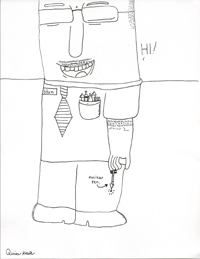
RAND: Heyday of war nerds. Illustration by Quinn Kelly.
- Soldiers of Reason: The RAND Corporation and the Rise of the American Empire
- Houghton Mifflin Harcourt Brace (2008)
You probably never heard of the RAND Corporation, but it's indirectly influenced your life more than any government or institution in North America.
And during a week when U.S. President Barack Obama is summit-meeting with the leadership of a resurgent Russia, and the ultimate Cold War "soldier of reason" Robert McNamara has died, Alex Abella's history of the think tank makes fascinating and cautionary reading.
Early in its 60 years, this Santa Monica-based nonprofit corporation taught the U.S. Air Force how to fight a nuclear war while assuring the rest of us that such a war would be kind of OK. But it's done much more.
Early on, RAND economist Kenneth Arrow argued mathematically that individuals always act rationally in their own interest, not in the interest of groups. This philosophy developed into Reaganism (government is the problem) and Thatcherism (society doesn't exist). It has guided the policies of George W. Bush.
RAND developed "systems analysis," a logical, mathematical approach to problems. Its analysts argued, for example, that fallout shelters and evacuation into deep mines could save millions of American lives. That would make a nuclear war not just fightable, but winnable. Herman Kahn, an advocate of such wars, became the model for Stanley Kubrick's Dr. Strangelove.
Paul Baran, another RAND analyst, thinking about surviving a Soviet nuclear attack, invented a way to use digital communications. His information packets are the foundation of the modern internet.
Irrational patriotism
Systems analysis had an eager ally in Robert McNamara, who died Monday. When McNamara was U.S. defence secretary, he told his boss, President Lyndon Johnson, that Vietnam was a winnable war. Then RAND analysts interviewed Vietcong prisoners and found them alarmingly irrational and unconcerned about their individual interests. Instead, they were patriots determined to unify their country at any cost. The analysts decided the U.S. had put itself on the losing side of the war, but by then it was too late.
It was a RAND analyst, Daniel Ellsberg, who secretly photocopied the top-secret history of the Vietnam War and released it to the U.S. media. As The Pentagon Papers, that leak discredited a generation of America's best and brightest.
Alex Abella's Soldiers of Reason is a disturbing history of very smart people putting their brains at the service of very stupid ideas. He managed to interview many of the key persons in the organizations, as well as friends and relatives of those who launched RAND after World War II. The result is a book rich in ironies.
Perhaps the richest irony is that RAND owes much of its success to an ex-communist who kept his radical youth a secret. Albert Wohlstetter had been part of a 1930s generation -- the brightest and poorest. They attended City College of New York [CCNY] because Columbia, a few blocks downtown, was too expensive. It also had a quota on Jews.
Stalinists versus Trotskyites
Wohlstetter, a brilliant young mathematician, knew the CCNY Reds who sat at separate cafeteria tables -- the Stalinists at one, the Trotskyites at another.
Some of the names of the CCNY Trots still resonate today: Irving Howe, Irving Kristol, Daniel Bell. They soon migrated from the left to the anti-Soviet right, and flourished in Cold War America. Kristol's son William is a neo-conservative who edits the right-wing Weekly Standard magazine, and he remains Sarah Palin's promoter within the Republicans even at this strange stage in her public evolution.
Not yet political, Wohlstetter left CCNY in 1934 and managed to study law at Columbia. There he applied his math skills to politics and philosophy. His mathematics and logic led him to join a neo-Trotskyite splinter group called the League for a Revolutionary Workers Party.
Fortunately for him, his party records were lost in a traffic accident. While he left the League, he never abandoned his view of the Soviet Union as a system determined to conquer the world. His mission in life was to thwart that system.
Wohlstetter spent World War II as a government bureaucrat, and then, in postwar Los Angeles, bumped into an old colleague who invited him to apply for a job with the new RAND Corporation. With his communist past well concealed, he got the job -- and, Abella suggests, prevented the possibility of a Soviet first strike on American air bases.
Wohlstetter's analysis of the vulnerability of the Strategic Air Command didn't just teach the Air Force to disperse its bases. It also made him a major force in U.S. strategic thinking. RAND's systems analysis approach has dominated American policy-making ever since.
The sorcerer's apprentices
Wohlstetter strongly influenced John F. Kennedy, Lyndon Johnson, and Richard Nixon. He eventually left RAND, but his impact endured. By the time he died in 1996, at the age of 86, he had inspired and advanced a new generation of apprentices who would become the neocons: Richard Perle, Paul Wolfowitz, Donald Rumsfeld, Dick Cheney, Zalmay Khalilzad.
As soldiers of reason, the neocons believed in numbers and systems and individualism. Trotsky's bastards, they imagined themselves "scientific" just as the Bolsheviks had. Like the Bolsheviks, they believed in reason yet never examined their basic premises. Their patriotism was as irrational as that of the Vietcong, but far more destructive.
It didn't matter. As long as they had access to the billions in the US defence budget, and they could invoke a Soviet or terrorist threat, they flourished.
Abella, a fine writer, does a beautiful job of evoking both the culture of RAND and the personalities of its major figures. We can really believe they were as smart as he says they were. Many, including Wohlstetter and Kahn, emerge as genuinely likable men with charm and wit. That makes them all the more disturbing.
RAND's greatest triumphs were the war in Iraq and the economic policies of the Bush administration. Now both are in ruins. But for the foreseeable future we will live with the consequences of RAND’s thinking, just as we have for the past 60 years.
Related Tyee stories:
- Canada and the Big Powers
We should strive to play broker to China, Russia and the US. - Nuclear Arms Ban Is Hot Again
Interest grows among world leaders, 'Global Zero' campaign builds steam. - America, Bad to the Bone?
Reviewed: The Perils of Empire: America and its Imperial Predecessors by James Laxer and What is America? A Short History of the New World Order by Ronald Wright.


7
Login or register to post comments
Fiat lux
2 years ago
The cold war was a stupid,
The cold war was a stupid, irrational propaganda effort ob both sides and anybody who supported it was nuts. Especially when it came to nuclear bomb shelters in backyards and the building of armies.
However......
Let's not forget that immediately after WW2 the Soviets started rearming the countries under their occupation and were building up their own forces. There were large military parades under red flags by armies who only a year before fought against them. Conscription was mandatory in all occupied countries.
Their propaganda machine was working full blast with anti American propaganda and they toppled all elected, non communist governments one by one, killing and jailing leaders, ministers and politicians by the thousands.
At the same time, he Americans did nothing in Germany or Austria. Their tanks stood rusting on open fields, there were no exercises, or maneuvers, no satellite armies until years later and communist parties were free to organize. By then I was working for the US Army in Wels, Austria and could see what was going on.
I was working with Germans who have been former Soviet POWs, and spent years of their captivity repairing and mothballing thousands of German tanks in Russia and Siberia, parking them under tarps, with Soviet markings, on huge fields, starting even before the war ended and for years afterward.
I've seen it all at both sides and technically, have been a deserter from the Red Army, because I escaped my call up.
So, let's have a bit of realism in these articles, because both sides have been equally guilty.
Ed Deak.
ME2
2 years ago
Good point
So thanks for that, Ed. But tell me this. How do I escape this unwelcome feeling that I am just one of the many millions of helpless and easily sacrificed pawns being moved around as these jerks test their "brilliant" theories?
Fiat lux
2 years ago
ME Having lived under
ME Having lived under every known ideological idiocy, I've long given up on all of them.
I'd say the only way out is a major public demand for real democracy, not this sorry state of phony baloney we have now. People will have to learn to force themselves to think, instead of getting buried in "fun", while being led into slavery.
Then, in our present case, a strong public demand for the examination of the criminal economic theory being taught in all our universities, which is nothing less than the promotion of corporate dictatorship, killing the Earth and humanity. In the name of "wealth creating global competition" of course, with a world government by the biggest thieves and crooks.
At this time, everybody is screaming about the growing power of corporations and the loss of incomes, etc. but not even politicians dare to question the crap students are brainwashed with as economics.
After all politics are nothing more, or less than the enforcement and legalization of often criminal economic theories, as we have it now, stealing us blind and enslaving the world.
Ed Deak.
North of Hope
2 years ago
Dr. Strangelove
The article states, "That would make a nuclear war not just fightable, but winnable. Herman Kahn, an advocate of such wars, became the model for Stanley Kubrick's Dr. Strangelove."
I thought that this character was based on Dr. Edward Teller, who was involved in the making of the hydrogen bomb and he supported and pushed the plan to drop the atomic bomb on Japan.
Robert Oppenheimer, who was the head of the project disagreed with him. Teller slandered Oppenheimer, and drove him out of his position.
There is an excellent movie about this called "The Making of the Atomic Bomb" that was shown on the KNOWledge network last year.
ME2
2 years ago
Ed Deak
So, as I understand you, Ed, you feel that the expansion of the money supply through the creation of paper wealth - a good example being speculation on currencies, which produces NO goods whatever - is wrong.
But it is undeniable that if one buys a factory which has the potential to create far more value in goods than its cost of purchase, how does one account for that increase in wealth other than printing more currency?
Or if that incease is eaten up in debt payments, to whom is this paid, since all countries seem to have massive debt loads?
If the missing money is held by the ultra-wealthy, how is it held, since there is nowhere near enough Gold to cover it?
I've asked many university graduates who've taken economics courses to esplain to me how value is attributed to a dollar, and the consensus reply seems to be "Whatever people can agree upon."
Perhaps I've asked the wrong question, but then perhaps this might be a starting point for discussion.
I've no axe to grind here, Ed, so I'm not looking for a chance to argue.
oeanda
2 years ago
Think Tanks
This might be a good place to discuss, in general, the dangerous reliance of governments upon think tanks of all kinds, be they social (the Family Reasearch Council) or economic (The Fraser Institute).
Think tanks do one thing, no matter who they are or what position they espouse: they make shit up and publish it as research. They are instruments of ideological self-justification.
The extent to which the Liberal party and Canadian media rely on Fraser for direction is shocking.
dorothy
2 years ago
I'm not Ed, but...
"If the missing money is held by the ultra-wealthy, how is it held, since there is nowhere near enough Gold to cover it? "
I imagine that the money is 'held' largely as accounts payable, i.e. other people's debt to them. Wealthy people, and a few poor ones, know that the dumbest place you can put your money is in the bank. It should be spent on real assets that can improve your life situation, i.e. your ability to handle what life may throw at you. Only when you can think of nothing further to add in that department would it make sense to 'stash' anything. How you stash wuld depend on your storage and your idea of what will be negotiable should you wish to negotiate it. But let me tell you right now: beyond a certain point it will stand you in better stead to throw it back, to redistribute it, and do so with gusto. For, as the High one says:
40
Once he has won wealth enough,
A man should not crave for more:
What he saves for friends, foes may take;
Hopes are often liars.
(Havamal)
"But it is undeniable that if one buys a factory which has the potential to create far more value in goods than its cost of purchase, how does one account for that increase in wealth other than printing more currency?"
First, the potential is just that - potential. To count it as a real asset is exactly what has sent us into the quagmire. Also, on deeper examination, the potetial increase in wealth, if counted according to now traditional methods, is likely vastly overrated, because far too many non-monetary costs are not included. Until we sytart using Ed's principles, i.e. applying the laws of thermodynamics, we are kidding ourselves mightily as to the value we add to anything.
There. I have done the groundwork. Now Ed has an easier job. He can just fix my inadequacies. Always at your service. No kidding, it actually used to be the motto of my professional organization. Now it says something mealymouthed about upholding quality. As if that was a mission and not a given.
I am also not trying to grind anything. I view this public square as I do traffic, a place where everyone ideally co-operates to make thing go easier and better for us all.