

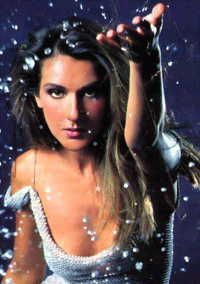
- Let's Talk About Love: A Journey to the End of Taste
- Continuum Books (2007)
I don't know much, but I know a lot about Celine Dion. Her power ballads colour my childhood and adolescence, her voice soundtracking mornings before school, car rides to swimming lessons, and family meals. This year, I arrived home for Christmas to the sound of Dion's 1996 album Falling Into You playing at full volume, my mother listening in the kitchen over a cup of tea.
My brother and I keep the Dion fires burning at home by giving albums to our mom as gifts. If the ultimate gift is giving something you personally despise with full knowledge that the recipient will like it, Mike and I have won, year after year. This past Christmas, I came bearing a wrapped copy of Taking Chances to put under the tree.
I remain bewildered at Dion's popularity with my mother, and even more confused at how I have come to know her work so well -- without even trying. Dion once said in an interview that she tries to be part of people's everyday lives through her music, but she doesn't want to interrupt. And I think she's succeeded, especially with me. No other artist has infiltrated my young life or reminded me of my mom more than Celine Dion. How? Why? Carl Wilson, a Toronto-based culture critic, explores the phenomenon in his new book, Let's Talk About Love: A Journey to the End of Taste.
"Unlike you," Wilson said, "I hadn't knowingly ever even met anybody who liked Celine Dion. Insulting her just seemed such a taken-for-granted part of my social world that I found perplexing in and of itself."
Wilson talked to The Tyee about guilty pleasures, old-fashioned femininity, music criticism, and the mystery of Celine Dion. What follows are excerpts from the conversation.
On Celine Dion as a book subject:
"I really had two reasons for picking Celine. One was that I wanted to do a sort of case study about the gap between popular success and critical acclaim, that gap that's familiar to everybody who's ever read movie reviews or looked at best-of-the-year lists from critics about any mass-cultural medium.
"Celine seemed like a very good example to use because she's very, very commonly mocked and insulted by the 'tastemakers' while having this enormous global audience, millions and millions of people who love her. I wanted to understand what was setting these two groups of listeners at odds with each other and whether that conflict had any bigger social meanings.
"The other reason was that I'd decided the way to do this would be to use myself as a guinea pig: I'd pick something popular whose appeal I personally did not get at all, and try to see if immersing myself in it and studying it from other angles could produce some kind of shift in my own tastes.
"I wanted to know if taste is really innate or if it's maybe a bit more subconsciously chosen. I wanted to understand viscerally as well as intellectually what's at stake in taste.
"Because I'm Canadian and lived in Montreal for many years, I've always taken Celine's success a bit more personally than a lot of Top 40 music -- I've found her a bit more specifically embarrassing and hard to take than most pop stars. So that personal edge seemed to me to give the whole enterprise a bit more grounding than if I'd chosen someone else at random."
On empathic pop tunes:
"Before I wrote the book I really thought of Celine as part of a self-help, Dr. Phil kind of culture that I thought was making people dumber.
"Having listened to her I don't think so, that much. First, I came to think that self-help is kind of layperson's philosophy -- I don't like the guru side of it, the prescriptive side, but for people who don't have access to other stuff, it's a way of living a more examined life.
"Second, Celine's stuff actually isn't very prescriptive, it's much more about empathy and catharsis, and I don't particularly think those things are bad for people. In fact, a lot of today's music, on the charts or off, could spare more space for empathy.
"I think we perhaps don't exercise those feelings as much as would be healthy -- and that might have to do with the kind of culture we're living in, on many, many levels."
On Celine Dion vs. indie love-crooners Wilco and Ryan Adams:
"Even though [Wilco and Ryan Adams] might be testifying emotionally for or against love in their songs, as Celine does on all her albums, they couch it in personae that seem somewhat cynical, pessimistic, weary. It protects them from seeming naive. And it's because a more elite audience will accept an emotional display from someone who seems knowing.
"Someone who seems too open and sincere, I think, is assumed to be unsophisticated. Celine and her songwriters and producers are reaching for a model of sophistication that's a much more pre-1960s show-biz model, out of the days of supper clubs -- although pumped up with modern production techniques. These are matters of taste but they're also matters of social position. Not necessarily the performer's social position -- because art is such an all-encompassing concern for most artists, it's completely possible for a self-taught creator to appropriate all the available techniques and tones -- but that of the listener.
"The Ryan/Wilco model is coded sensitive-guy masculine and the Celine model is feminine in an old-fashioned sense, not sassy in the post-feminist way. It makes me wonder whether there's something valid in the more maternal, old-style 'women's culture' that's been repressed lately."
On what's missing in music criticism:
"I think the credibility of the 'objective,' authoritative critical voice is just about drained. It's tempting to write that way because it has persuasive power -- and because when you speak more personally you'll be accused of self-indulgence -- but aside from a few elder statesmen, who've maybe earned the right to feel that way, I don't think many of us believe you can make black-and-white statements about quality.
"Lots of critics already speak more candidly and intimately, but I'd like to see that become more widespread and legitimated."
On broadening musical horizons:
"No one should be 'told to' do anything with their tastes or their leisure or their aesthetics, except perhaps students in a class. Broadening your tastes is perhaps a way to understand the culture and the humans around you more fully -- that it's really and truly an enriching and humbling experience to grapple with 'other' people's music.
"But that's just one way to get outside your own social boundaries, you know. It was important to me to do because music plays such a big role in my life and because the side my 'taste cluster' leans towards one that typically does a lot more sneering -- I'm not sure how many Celine fans are going around sneering at the stuff I'm into and the people who listen to it. I suspect they haven't got as much to answer for."
On how to consume Britney Spears:
"I'm overall pretty dubious at the idea that any music is harmful to the people who embrace it. Music is more complex than celebrity gossip, by nature: if you're thinking about Britney Spears, you're better off listening to her music than reading Internet stories about her -- something more is going to happen there, if you listen to whole songs, not just sound bites.
"Music has many, many functions, from the workout-soundtrack level to the very personal and reflective, and they all go at once, and people will seek and get what they need."
On guilty music pleasures:
"The only time you might productively feel guilty about enjoying music is if there's some actual moral weight involved. You should feel guilty maybe if your favourite album this year was The Best of Moans and Screams of Burmese Political Prisoners 2007. (Maybe. I wouldn't want to say that 'bad' content always means bad music, because that would sure wipe out a lot of great music). Otherwise your shame just reflects that you're being intimidated by snobs who've convinced you your ears shouldn't like what your ears like.
"Why don't we feel equally guilty for listening to music we're not sure we honestly like because we want to impress people, for instance? By the way, I think this is also fine -- it's a way to expand your aesthetics -- but it's certainly more dubious than just finding 'dumb' music fun.
"The book's about the 'guilty displeasure' -- I want to suggest that we save our guilt for the times we find ourselves dismissing music because something about it suggests to us that it's meant for people we look down on.
"But pleasure and displeasure are always worth questioning, looking into more deeply, for what secrets they might tell us about ourselves."
![[Tyee]](/ui/img/ico_fishie.png)