
Books

The Fall and Rise of an American Empire

Just not the one you think.

By Crawford Kilian, 17 Aug 2007, TheTyee.ca

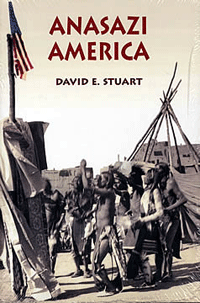
Anasazi America book cover

A collapsing power culture.

  • Anasazi America
  • David E. Stuart
  • University of New Mexico Press

In the Americans' current age of anxiety, comparisons with Rome are easy and numerous: Chalmers Johnson's Nemesis, recently reviewed here, is only one of many. Some writers, like Jared Diamond, consider ecological downfall a consequence of political failure. Like the Greenland Norse and the Easter Islanders, they argue, we in the industrial nations may be too locked into our culture to adapt to changes we ourselves create.

But another lost civilization, right here in North America, offers not just examples of failure to avoid but also of success to imitate. Anasazi America, by David E. Stuart, an archaeologist specializing in the Southwest, offers an excellent introduction to this oh-so-relevant history.

The Anasazi were a cluster of related tribes in New Mexico who began to adopt agriculture at about the time that Rome was falling. I had always thought of them as a mysterious people who built cities and then vanished. But as Stuart makes clear, archaeologists have amassed a great deal of forensic evidence about the Anasazi -- and we know even more about their descendants, the Pueblo Indians.

History in their bones

The history of the Anasazi is written in the tree rings of their roof beams and the bones of their dead. The roof beams record the wet and dry years since their earliest settlements. Similarly, their bones and teeth record years of plenty and years of famine.

Between 700 and 1000 AD, small farming communities grew and expanded across northwest New Mexico and the adjacent areas of Arizona, Utah, and Colorado. By the end of the 10th century, an estimated 10,000 farmsteads were operating across an area the size of Scotland. Then, starting around 1020, something remarkable happened in the Chaco Canyon area of New Mexico. The "Chaco phenomenon" saw the sudden evolution of "great houses," urban centres that drew on the food and goods produced by their nearby small farms.

The great houses created trade links for both essentials and luxuries, including macaws imported from Mexico and abalone shells from California. Four hundred miles of roads linked the burgeoning communities. But surprisingly, the society had no warrior class.

Ritual rule

Stuart argues that the great-house elites sustained themselves not by force but by religion and ritual. The Anasazi were good farmers, ready to experiment with different food plants and different farmlands. But they were at the mercy of the climate, and the great houses supplied two key services.

First, their rituals purported to ensure that rain would fall in July, when the cornfields most needed it most. And, for almost a century, the water generally came when it was needed. Second, if the crops did fail in some places, the great houses were able to supply food and seed from more successful spots. In return, for these services, the farmers gave their scanty surpluses to the great houses.

But in 1090, when the Normans were consolidating their hold on Saxon England, the rains failed in New Mexico. The long drought cost the elites much of their prestige, which they answered with more and bigger rituals. When, by 1100 the rains returned, more great houses appeared in more far-flung regions, and more roads, and still more wealth went into the rituals.

The income gap

Wealth also went into supporting the great-house elites. Anasazi life, even at its best, was a harsh one. Almost half the ordinary farmers' children died in infancy, and most farmers themselves were dead by 45. Their teeth reveal bouts of childhood malnutrition, and the osteoporosis in their bones shows the lack of other nutrients in a life of brutally hard work.

But the great-house families lost fewer children. They were on average 5 cm taller than the farmers, and they lived longer. That gap in income and health persisted until the system broke down for good.

The rains failed again in the early 12th century. As a result, farmers moved away from the great houses to the upland, searching for rain. The first to leave did well for a time; then a dark age fell.

Settlements became fortified, but still succumbed to attack. Evidence suggests that between 1120 and 1140, 60 per cent of all adults and 40 per cent of all children died violently. Stuart estimates that by the end of the 13th century, the Anasazi population was only a quarter of what it had been 200 years before.

From power to efficiency

Out of this dark age emerged the "Pueblo IV," a culture strikingly different from that of its Chacoan ancestors. The Chacoans had been what Stuart calls a "power" culture, relying on extensive farming and trade to cover the losses when a crop failed.

By 1400, power had yielded to efficiency. While trade continued, it was minor compared to the old days. Each community was now self-sufficient, and drew on resources from diverse ecosystems within its control. It was unified and egalitarian, and produced necessities rather than luxuries. Life was still hard and short, but the Pueblos now at least were able to deal with the vagaries of weather.

Significantly, most of the Pueblo IV communities were unfortified. While they suffered occasional raids from Plains tribes, Pueblo communities were no longer threats to one another. In fact they even worked in concert when necessary, as when they arose and expelled the Spanish in 1680. (The Spanish returned in 1692 only because the Pueblos were weakened by European disease.)

A portent of the future

Writing in the late 1990s, Stuart drew some persuasive analogies between the Chacoans and modern America's power culture, with its aggressively expansionist trade, exuberant economy, and growing gap between rich and poor.

Stuart also points out that today's Pueblos keep their rituals and language alive not to entertain tourists but to sustain the values of their efficient culture. They know what happens to power cultures, and they see America as dangerously fragile.

Comparing America's empire with those of Rome and Britain is easy and often helpful. But Anasazi America is more compelling. The Anasazi showed that imperial collapse and a dark age really can happen here. Their descendants have proved that a lost civilization can find itself again and endure for centuries. And that is a very encouraging thought.

 [Tyee]

19  Comments:

Login or register to post comments

  • Fiat lux

    4 years ago

    After a lifetime spent

    After a lifetime spent studying the rise and fall of empires I came to the conclusion that all empires self destruct, as must all so called "competitive systems", because of the ever increasing demands for energy bringing lesser and lesser benefits, until the system wears out, implodes and collapses. Newton's law on speed and reactions.

    The present American empire is one of the best, ongoing, easily seen and recorded, self destructive examples, but history is full of them and always for the same reasons: increasing and inefficient energy demands to stay on top, a worn out and disillusioned population and a ruling class making bigger and bigger mistakes to stay in power.

    The real problem is that the insatiable energy demands of empires always destroy efficient economic systems on their way up, while in power and as they collapse, so nobody wins on the long run.

    Ed Deak

  • dorothy

    4 years ago

    putting the question

    So, how do we eliminate the dumb and detrimental effects of competition without getting so comfy that we slough off on the job and lose our sharpness in the face of natural changes as opposed to those we engineer ourselves only in order to rig the competitive game?

    If we can ask the question, we can find the answer. Next twist on our evolutionary path. I mean, enough is enough. Do we need to go on doing the same dumb thing? isn't that supposed to be the hallmark of insanity?

  • Fiat lux

    4 years ago

    When we look at the history

    When we look at the history of cooperative societies, we can see that they've always been the most prosperous.

    What we have to remember is that the energy wasted on economic competition and wars would more than ensure the well being, health and real prosperity of everybody on Earth.

    Look up the work and words of W.Edwardes Deming on cooperation. He was the guy sent out by the US govt. to rebuild Japan's industries and a dead enemy of wasteful economic competition, which, in any case is based on the presently used fraudulent definition of economic efficiency, ruining the ecology and humanity. Therefore it is not efficiency, but the encouragement of stupidity and waste.

    I was an employer for 22 years in Vancouver and my guys were the best producers without any threats, or rank pulling, but treated as friends and free to express their thoughts and ideas.

    Ed Deak.

  • dorothy

    4 years ago

    But, But...

    Oh,I believe you. My problem is not, what's right to do, but how do we make people 'get' the rightness of it? I have participated in many creations, in a community context, of little islands of solidarity and cooperation, and, as you say, they are extremely productive, but sooner or later, one crashes into the vagaries of human nature, somebody or somebodies, who only understand the paradigm of either pounding others into the ground or being pounded. If you're an employer, you can enforce the better pattern, but wherever the buying in is voluntary, it may not happen. How do we effect the shift in the tectonic plates of our surrounding culture? - I am willing to do the 'one person at a time' thing, if it is the only way, but then we must certainly organize, because this will take more than one generation and could easily get lost in the shuffle.
    I hope to get to know your thoughts on this.

  • Fiat lux

    4 years ago

    The only way any progress

    The only way any progress can be made is through the elimination of the teachings of the neoclassical market economy theory that distorts all real values with phoney and fraudulent monetary games.

    This garbage science is the cause of most of the world's problems today, forcing it into permanent war, already killing millions every year, and as long as students are brainwashed with it and politicians enforce it, there's no hope for any improvement.

    The world can no longer afford to follow faith based ideologies, regardless whether they're called "right", or "left, and we must turn to economic systems based on physical laws: the most work done with the lowest energy/resource inputs.

    This is the only system that can not be distorted into wealth creating crime rackets for the benefit of ruling classes, with the use of fraudulent mathematics.

    Ed Deak.

  • snert

    4 years ago

    This may apply as well.

    An article in the NYTimes entitled:

    In Dusty Archives, a Theory of Affluence

    The article is a couple of weeks old so may disappear soon.

  • dorothy

    4 years ago

    thank you

    Thanks for the reply and references.

    I am really trying to understand this to the extent that I will know what to stick to as the lyrics of my broken record; what do you see as the driving force behind this compulsive, militant need a certain class of people have for hoarding 'wealth', much much more than they could possible use in one lifetime? Is it an underlying fear of death, or of being insignificant, or what? It is alien to me. It is good to have enough to stretch to do what we need in life, without having to raid garbage bins, but to the question 'can you imagine a million dollars?', or two, or more, I invariably must observe, that such an amount of money would not aid me much in any of the tasks I see as part of my mission in life. I stick to the view of my cultural heritage, which has it that 'gold makes men mad' and:

    "oft is saved for a foe what was meant for a friend,
    and much goes worse than one weens."

    (Havamal, 40)

    Ergo, I am interested in knowing why other people do not see it that way...

  • Fiat lux

    4 years ago

    I would say the present and

    I would say the present and historical reasons for grabbing are artificially created, caused and instilled by a predator ruling sector, to legalize their own criminal activities with religious, or pseudo religious theories.

    Crime always existed and always will, only the scale changes within certain societies.

    Having been born in 1927 in a country and economy already destroyed by WW1, I've lived through the Great Depression, served and was wounded in WW2 at 17, lived through the postwar years of destitution and starvation in refugee camps and barracks with a dozen nationalities, yet, I've never seen any evidence that humanity would have any natural criminal instincts to rob others.

    But, having studied history and economics for a lifetime, I have seen enough evidence and thousands of years of precedents, that criminal activities, wars, etc. are always the planned actions, instilled into the populations with religious theories as the "will of God", or " the human instinct to compete". It is never nations that go to wars against others, but governments and rulers. Ordinary, normal people don't want to kill others, or steal their properties.

    When we were starving and running around in rags, our few possessions were perfectly safe in our open barracks, whereas now, even out here in the boondocks, we have to lock our doors in the midst of plenty.

    E.g. When profitable businesses fire people to direct their wages into the pockets of the "investors", they're engaged in outright theft. But have you ever heard a politician, clergyman, lawyer, or economist ever admit this obvious fact?

    It wouldn't be "competitive" to admit that theft is theft no matter how it is done.

    Ed Deak.

  • dorothy

    4 years ago

    thank you

    Ed Deak:

    Thank you so much. This really great insight! It gives me just a little hope for the future.

    I have always perceived revolutions as simply events in ongoing wars between interest groups. But if your observations are included in the picture, we can perceive these occurrences as the majority of decent human beings finally throwing off the yoke, which the top ten percent sociopaths have managed to lay on them.

    Now the problem we are faced with is possible to state: How do we prevent them from laying it on us in the first place. I know we are starting from a bad position, the balance having been pushed heavily in their favour already. But it seems to me it all centers around consumerism and how we are all-too-willing players at that end of the game.

    So, the new paradigm we must go along with is that of ‘denying profit’ as part of our daily life. A lot of the consumerism has to do with the public schooling having beaten the stuffing out of the young ones, to the extent they will spend the remainder of their life trying to fill up the vacuum with mass-produced junk. We should consequently endeavour to bring up our kids self-reliant, resourceful, able to exercise critical thinking and sound judgment.

    I know one organization, which is working hard to promote that, swimming hard upstream as it is, namely the Canadian Society for prevention of Cruelty to Children, web site address:

    http://www.empathicparenting.org/

    One piece from there is so strong that I cannot help quoting it:

    Snug Like Alcoholics in a Brewery

    Physical violence against little children is easy. A small skull crushes like a cardboard box.
    Psychological violence, the perversion of small minds, is easier still and much safer for the criminal. The damage is not seen until years later, when the victim cannot remember what hit him, even if he knew in the first place.
    A perverted mind, either in a child or an adult, does not mean a peculiar mind. Perverted means what most of us become. Perverted means lacking in trust, empathy and affection. We daily suffer and inflict common-place inhumanities, most importantly upon our children.
    For the first time in history, we have certain knowledge of the means whereby the capacity for trust, empathy and affection can be shattered in the first three years of life. This knowledge is timely because the means to destroy each other is at hand as never before. Quite apart from the question

    to be cont'd

  • dorothy

    4 years ago

    continuation of previous post

    of whether or not trust, empathy and affection are better than mistrust, indifference and hate, the world will not survive many more generations of suspicious, hardened, affectionless individuals. If we are not to die, we are to change. Our survival depends upon the care of our children. They will drop the bombs, release the germs, use the poisons or not.
    Nothing can be more urgent. It cannot be postponed.
    Even if this means abandoning most of the institutions, habits and beliefs we now cherish, snug like alcoholics in a brewery.

    Michael Mason, Founding Member of the CSPCC, April 1975

    If it is hard to believe that we are mostly perverted, consider this: One of my children volunteered in a well-known youth organization, one which used to operate by principles of cooperation, integrity, and truth-seeking. One of the leaders recently told the kids: Nice guys finish last.

    Wonder how this all lines up the perpectives for those small children, who survived the recent events in Sinjar. You are right about organized religion being bad news.

    But at least it gives us a direction: Straight up the cliff. Maybe, if we try hard, we can get to where the Pueblo IV people were around 1400.

    Interesting to hear that the modern pueblo dwellers stick to their culture. Some of us westerners are finding our own roots again, no doubt for the same reasons...

    Thanks again

  • G West

    4 years ago

    Snert

    Clark's thesis is simply a more sophisticated re-stating of the same kind of capitalistic and extremely offensive social Darwinism that started off as the 'big idea' of the first third of the 20th century.

    After having been taken to its logical and evil conclusion by eugenicist fascist theoreticians and political practitioners in many parts of the west (and in Japan), the inevitable scourging effects of the Second World War and the Holocaust and its aftermath should have ended such ideas forever.

    Dr Philippe Rushton appears to have a new ally at the University of California.

  • dorothy

    4 years ago

    And another thing...

    - Quite aside from the fact that it's really no great mystery, why economic 'growth' took off in Europe around 1800. Perchance it had a lot to do with the steam engine being made truly workable from the 1770's; duh!

    It is easy to read the events from a completely different angle: How about it's not a hallmark of 'better human quality' to end up on top, and the downwards seepage is simply a result of surplus numbers, whereas the displacement of the original poor in favour of the dropouts from the upper crust may very well show that ruthlessness is a genetic trait, and it doesn't get lost on the way down...

    I wouldn't give such self-serving 'theories' the time of day, other than it's good to know the enemy. That's also my reason for reading Vancouver Magazine, even though it gets more and more dumb and braggadocio-loaded.

  • RickW

    4 years ago

    The more that humans moved

    The more that humans moved away from their "natural" environment, the more dependent they became on energy for their survival. This dependency created opportunities for control and manipulation.

    A question to be explored might well be: why was it encumbent on those first humans who did, to move away from their "natural" environment in the first place?

  • snert

    4 years ago

    We're doomed.

    People do what they must to survive but when they get good at what they do to the extent that surpluses start to rear their ugly head then populations start to grow and an economy develops. Start mixing in alpha personalities and tribalism will rear it's ugly head.

    The civilization that flourished and died on Easter Island is a prime example of just how this works. I think all societies behave in that manor and the only thing that makes EI unique is that society effectively vaporized at the final collapse instead of blending into the background and reforming again as the next group of peoples.

    This may be an over simplification but it just keeps happening over and over again. The only way to stop it is to kill all alphas......oh shit, that won't work, two more will take their place and have to fight it out to see who wins.

    Oh rats! We're doomed.

  • G West

    4 years ago

    I think all societies behave in that "manor"

    I think I believe in Meerkat Manor. Is that the manor you're talking about snert?

  • snert

    4 years ago

    Interesting correction.

    Meerkat societies carry on much the same as human ones do in a manner of speaking.

  • G West

    4 years ago

    damned pernicious lazuli

    It's a surprisingly good show.

  • dorothy

    4 years ago

    there is a way, but is there a will?

    "The only way to stop it is to kill all alphas"

    Well, I got curious and did a survey of the next generation in an attempt to find out how they saw things. My very small sample of three were in complete agreement with each other: it's about the attitude. Attitude is everything. That's what we need to work on.

    So, question: can the Aplhas get rid of the attitude? Robert Fuller (Breaking ranks) thinks they can, he has written a couple of books about 'rank-ism', the mother of all 'isms'. The rank-ist thinking would place the Alphas on the spot and read them the riot act. Mr. Fuller admits that rank-ist thinking people cannot likely reform, but you can browbeat them into at least paying lip service to the code, and then the next generation will have heard only those tones, and maybe....

    In short, rank-ism is doing with impunity unto others, what we would hate to have them do to us, simply because we can. Sound familiar? This can be described as acting out the sense of entitlement, no doubt. WHen I was a girl scout, this 'elitist' organization taught, that one should take a given action only after it had passed two filters: one, does it comply with the Golden Rule, and two, would things work out, if everybody did the same thing? I have not seen a good reason to discard this simple wisdom as I went thorugh life.

    Now you can make the sad observation, that there are no real girl scouts any more, and, more importantly, what the Hel happened to 'noblesse oblige'??

  • G West

    4 years ago

    Hope

    Nice points dorothy. I think there are still a few of us left...and funnily enough, my experience with the younger generation indicates that many of them aren't so difficult to persuade either.

    Keep on keepin' on! The alternatives are even more unattractive.

    • The discussion for this story is closed. No more comments can be added.