
- Mary Carlisle is a Tyee Builder. You can be, too.
- Prem Gill is a Tyee Builder. You can be, too.
- Nancy Flight is a Tyee Builder. You can be, too.
- Justin Everett is a Tyee Builder. You can be, too.
- John Westover is a Tyee Builder. You can be, too.
- Nora Etches is a Tyee Builder. You can be, too.
- Edward Henderson is a Tyee Builder. You can be, too.
- Bharadwaj Chandramouli is a Tyee Builder. You can be, too.
- Dean Chatterson is a Tyee Builder. You can be, too.
- Marius Scurtescu is a Tyee Builder. You can be, too.
- Robert Parkes is a Tyee Builder. You can be, too.
- James Murton is a Tyee Builder. You can be, too.
- Susan Doyle is a Tyee Builder. You can be, too.
- Vincent Strgar is a Tyee Builder. You can be, too.
- Helen Spiegelman is a Tyee Builder. You can be, too.
- Subir Guin is a Tyee Builder. You can be, too.
- Kimball Finigan is a Tyee Builder. You can be, too.
- Joanne Manley is a Tyee Builder. You can be, too.
- David Leach is a Tyee Builder. You can be, too.
- Joel Berger is a Tyee Builder. You can be, too.
Summoning Galbraith's Spirit
The amusing economist is looking smarter every day.
- John Kenneth Galbraith: His Life, His Politics, His Economics
- Farrar, Straus and Giroux
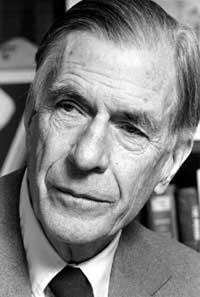
John Kenneth Galbraith died almost exactly a year ago, at the age of 97.
Galbraith had been a presence in North American politics since the 1930s, but seemingly a fading one. He had been dismissed as a "Keynesian liberal," a relic of the Depression and war years and no longer relevant. Younger economists had passed him by, promoting newer, more scientific ways of applying economics to create and maintain prosperity.
This was an opinion Galbraith did not share, and for the last 30 years of his life he maintained a cheerful guerrilla war against his younger colleagues and the politicians who listened to them. Economist Richard Parker has now published John Kenneth Galbraith: His Life, His Politics, His Economics. He argues that while Galbraith lost some skirmishes, his war was more successful than most realize. He was also one of the most influential Canadians of the 20th century.
Born in rural Ontario in 1908, Ken Galbraith seemed headed for, at best, a modest career in agricultural economics and teaching. But having graduated from Ontario Agricultural College (now the University of Guelph), he applied for a fellowship at Berkeley, got it, and launched himself into a career as an academic, writer, bureaucrat, diplomat and political adviser to presidents.
He was a hard person to ignore during much of his early career. At six foot eight, he loomed over everyone. As a convert to the economic ideas of John Maynard Keynes, he influenced his colleagues in New Deal Washington. Then, running the Office of Price Administration during the Second World War, Galbraith helped to keep the revived U.S. economy from running into crippling inflation.
Casualty of a civil war
But he finally had to leave that job after constant attacks from the corporations he was trying to control. As Parker makes clear, the present battle between conservatives and liberals is nothing new. The conservatives fought FDR every step of the way through the Depression, and they fought him through the war as well. More than once, Galbraith was a casualty of that fight.
The economic civil war would go on for decades, and the conservatives began to win in 1973 when Nixon dismantled the Bretton Woods agreement and set the world on a dangerous new course -- masked as "Keynesian."
Later Republicans like Ford and Reagan would stick to that course, and by the time Clinton arrived, the U.S. was locked into a deeply unbalanced economic system: enormous government spending on the military had not been factored into the American economy since Ike left office warning about the military-industrial complex.
Economics as messy politics
As a postwar academic at Harvard, Galbraith argued that the concept of the ideal free market was a delusion. Instead of free individuals with perfect knowledge, exercising free choice, the market was the outcome of "countervailing power": government, corporations and labour were a form of checks and balances.
His ideas were unwelcome not only to the corporate conservatives but to economists who wanted their discipline to be a science based on mathematics. An economy run by messy political processes was very unattractive.
Galbraith further annoyed his colleagues by making his points in books and articles that any reasonably educated person could read and understand. He sold millions of copies of books like American Capitalism, The Affluent Society, and The New Industrial State. The expressions he coined, like "conventional wisdom," entered the language as useful concepts.
He didn't confine his ideas to print. In the 1970s he starred in a BBC TV series, The Age of Uncertainty, explaining the history of economics to millions who would never pick up a book.
The funniest Canadian since Leacock
Even more infuriatingly, Galbraith was funny -- probably the funniest Canadian-born writer since Stephen Leacock (also an economist).
He was funny on every level from the throwaway line (he once described a very young Chinese girl as being "of negligible age") to the satirical novel (an economics professor who becomes incredibly rich by investing against every economic fad). He ridiculed the great men of his age, and included himself among both the great and the ridiculous.
The cap on Galbraith's annoying traits was that he repudiated Disraeli's consoling promise: "While there is death, there is hope." Retirement from Harvard at 67, in 1975, scarcely slowed him down. He published five books and countless articles in his '80s, and his last book, a memoir called Name-Dropping, appeared when he was 90. In his last decade he continued to write and speak as a committed public intellectual.
Parker's biography is also an economic and political history of the United States, and an intellectual history of economics itself. Too often that history resembles the theological conflicts of Protestants and Catholics or Shias and Sunnis. We are all collateral damage in those religious wars, survivors (barely) of Nixon's corruption of Keynesian ideas, Milton Friedman's monetarism, and a host of other sectarian solutions to the problems the last sectarians created.
Galbraith lived to see them all discredited, and his own views gradually regaining respect. This book shows why Galbraith won in the end. He wasn't just too tall, too smart, too clear, too irreverent and too funny. He was also too right.
Related stories:


28
Login or register to post comments
anarcho
5 years ago
the ideal free market was a
the ideal free market was a delusion. Instead of free individuals with perfect knowledge, exercising free choice, the market was the outcome of "countervailing power": government, corporations and labour
Very true. Corporate capitalism is a creation of the state, and grew and developed through the assistance of the state. Corporate capitalism is thus a form of state capitalism and our present "free market economy" is a myth. If we actually had a "free market" ie, no corporate law and other state granted privileges, corporate capitalism would wither like Dracula with a stake driven through his heart.
danneau
5 years ago
Isn't It Ever So True
My favourite quote from Galbraith:
“The modern conservative is engaged in one of man's oldest exercises in moral philosophy; that is, the search for a superior moral justification for selfishness.”
It sums up Mulroney, Reagan, the Bush clan and particularly Harper, along with, of course, Chrétien and the Clinton interregnum. Per the above, the state has ceased to be a mediator between the worlds of corporations and citizens and has become a tool of the corporations who, incidentally, own the principal organs of information (for those who can't take the time to suss out conduits like this). Our future doesn't look too rosy, notwithstanding John Baird's and Gordon Campbell's bleatings to the contrary.
gkam
5 years ago
economics
In 1980, the National Debt of the US was less than a trillion dollars, and was primarily one we owed to ourselves.
Now, since the Reagan Revolution, the debt is about at TEN trillion dollars, despite Ronnie's promise to pay it off - and we owe most of it to Asia!
Yessiree, that's real economic progress.
We are worse off in every possible way since the foundation of our economic policy became personal greed and corporate looting.
Hey, Capitalism, are you proud yet?
Fiat lux
5 years ago
It is a long known fact that
It is a long known fact that neoclassical, globalized market capitalism is a fraud, and the biggest crime wave in history, forced on the Earth by big business and bought politicians, yet, it is still being taught in our universities and its purveyors are still getting away with the murder of millions every year.
This has to be about the most remarkable and incomprehensible historical event.
Of course, they control the media, all information and religions, but this is supposed to be the information age and people have never received more information and "education", yet this crime is still going on unabated?????????
I have realized long ago, with the help of the books of Galbraith and Daly, among others, that all ideology based economic systems can be turned into dictatorships and the only way out is the adaptation of strictly physical law based economic laws.
Without this, humanity can kiss its tail end goodbye, because the crooks will never stop until they destroy the Earth in the name of "wealth creation".
Ed Deak.
Bluenose
5 years ago
JKG
“The modern conservative is engaged in one of man's oldest exercises in moral philosophy; that is, the search for a superior moral justification for selfishness.”
Perfectly phrased.
I met JKG eons ago. He was a model of moral integrity. Which is more than can be said for ... oh, it's too depressing to dwell on those, er, people.
Question: "What alternative do you see in the future to the market capitalist system?"
Galbraith: "Oh, I don’t see any great change. I’ve never felt that there were plausible alternatives. The only economic system that is successful is a pragmatic combination of market effects and public intervention, determined not by theology, not by theory, but by the practical exigencies of the case."
"Nobody, for example, would want pure capitalism any more. And we’ve already seen the breakdown of comprehensive socialism. What remains? A mixed system. What is the nature of the mixed system? It is one that decides in the particular case. I’m very much for government intervention in social insurance, social security. And nobody in this room is against that. At least I don’t think so. It would be a position of extreme eccentricity. But I would not be in favour of government intervention in retail enterprise. That’s something that works extraordinarily well in and of itself – with the assistance of Mr. Campeau, properly restrained. So I go back to what I said before. These are matters that have to be decided in the individual case, by thought and not by overall theory. Overall theory is an escape from thought."
Fiat lux
5 years ago
Wise words and right
Wise words and right on....
Now, if somebody could explain this to our politicians, who still believe that 2+2 = anything the "market" offers.
Dismissing that the "market" is now controlled by a few multinationals, which is even worse than markets controlled by local thugs, as under communism.
Ed Deak.
clubofrome
5 years ago
Military intelligence
If ever there was a case for impeachment it's George W Bush. If ever there was a US leader who needed to be hung for war crimes...
The wealth for future generations is being used up for guns and ammo. Nice legacy.
We Canadians used to be worried about the collateral damage from the cold war, mushroom clouds and radiation. Now it's economic ruin on the horizon. Time to cut back on the corporate bonuses, dontcha think?
flattax
5 years ago
Galbraith is an ignoramus
The only economist that matters is Milton Friedman. Read about him here:
http://en.wikipedia.org/wiki/Milton_Friedman
clubofrome
5 years ago
Trolling for Dollars!
A new game show starring Ron Erwin, I mean flattax... Contestants use the most insane statements in order to attract attention. Everytime someone responds the troll wins valuable prizes!! You'll laugh, you'll cry you'll hurl yourself off the cliff in this uproariously funny new version of an old comedy show! Special guest host this week, maestro!!
G West
5 years ago
flattax
Coming from you, flattax, that is high praise.
Friedman went to his grave scratching his head about why his treasured theories never got much traction in Scandinavia. By the end of his life, he was slowly coming to the realization that much of what he'd devoted his life to had come out very badly.
Galbraith was criticized roundly during his life, but by the time of his death, he was already being recognized as a much greater intellect than Friedman and a far more elegant writer and a true public intellectual.
The effects of Friedman's larceny (and the greedy haste with which his ideas were adopted my the Reagan White House) have definitely been greater and the sub-standard of living of 4/5ths of the world's population shows it: As does a very sizeable proportion of the current population of the United States.
For folks who live in million dollar houses in West Vancouver I suppose Friedman's bust is an appropriate mantel decoration. For the rest of the world, Galbraith will always be a hero - not least among his one-time countrymen here in Canada.
You'll be pleased to know that his son Ken is continuing to take the high road in ways Friedman almost never dreamed of doing.
So, flattax, you're welcome to Friedman. In 20 years, almost no one else will want him.
Fiat lux
5 years ago
Yep, Friedman's "seigneurs'
Yep, Friedman's "seigneurs' rights to free to chose whom to XXXX.." will be remembered in human history on the scale of the Trojan Horse.
If there's any human history left by the time his idiocies are finally kicked out.
Ed Deak.
anarcho
5 years ago
Friedman's experiment
The families of victims of Pinochet will always have a special place for Friedman, and it isn't in their hearts.
zalm
5 years ago
My favourite Galbraith quote
God, there are so many.....
"The greater the wealth, the thicker will be the dirt." (The Affluent Society)
"Trickle-down theory: the less-than-elegant metaphor that that if one feeds the horse enough oats, some will some will pass through to the road for the sparrows." (Culture of Contentment)
"The salary of the chief executive of the large corporation is not a market reward for achievement. It is frequently in the nature of a warm personal gesture by the individual to himself." (Annals of an Abiding Liberal)
This man represents the original American founding spirit - honourable, pragmatic, intelligent, humorous, egalitarian. Now we berate him because he was not more "American", never mind that most of us are products of his economic justification for the just society that arose since the Second World War.
Those who fail to learn from their mistakes are doomed to repeat them.
Vancouverite
5 years ago
Canadian nonsense
Nonsense. He was born in Canada, but renounced his citizenship in 1937 and repeatedly made it clear that he was American, not Canadian. Much as we love to lay claim to him - and to his success - he was successful as an American, not a Canadian.
zalm
5 years ago
flattax
Friedman was a great man, but as with so many who are unable to see their crowning achievement given lie, he failed to keep up with the times. Since 1991, it was readily apparent to all that control of the money supply through inflation, and consequently unemployment, (as opposed to demand management through fiscal policy) that Friedman was so famous for, was rapidly becoming discredited as a tool for management, only applicable to exceedingly large enterprise such as government, and not at all to the underground economy, small business or foreign exchange. Its fall is so complete that the US Fed no longer reports M3, and hence has no idea what M0 really is. The vast sums of M1 and M3 held overseas by other countries in US dollar denominated accounts for everything from oil to trade balances makes this even more difficult to calculate, and consequently, underreporting is the norm. The US Fed has no idea whether Friedmanism even works any more, and the near-constant devaluing of its human capital over the last twenty years leaves me, at least, in no doubt.
Canada only escapes disaster by dint of repurchasing as much debt as possible to be held within the country and hedging outside the country to achieve balance in M0.
One of the best profs I ever had, Richard Lipsey, had us read both Friedman and Galbraith, among others. Lipsey's shit-kicking by Friedman was one of the great tragedies of modern economics. Friedman in essence said that there is no link between inflation and unemployment, thereby removing any responsibility for unemployment from the central bank, and hence from the federal government. This paved the way for the amendments to our current over-funded, under-serving UI system.
I regret to say that I was among his worst students. You can judge for yourselves if you were any better.
G West
5 years ago
Vancouverite
I think Galbraith was always very proud of his Canadian heritage and birthright. I'm quite certain that, had such a thing as dual citizenship been possible in 1937 that he would still have been a Canadian (as well as an American) when he died.
One never knows of course. He did testify before the Gordon Commission on Canada's Economic Prospects in 1956 at Queen's Park and had a long term relationship with the CPR and the Guelph Agricultural College (where he got his first degree) as well. Of Walter Gordon he wrote in his autobiography, A Life in Our Times, that he was a lifelong ally in varied liberal enterprises.
There's another nice line about Friedman in the book cited above.
When asked by an Indian intellectual about the Eisenhower Administration's suggestion of Milton Friedman as a consultant for one of India's post war 5 year plans, Galbraith said that asking Friedman to consult on economic planning was "like asking the Holy Father to counsel on the operations of a birth control clinic." The Indian consultant decided to have Galbraith come to India instead.
G West
5 years ago
Lipsey
Was it at Queens where you studied under Lipsey Zalm?
Nice memory I'd say. We all grow too soon old and too late wise, eh?
Fiat lux
5 years ago
A professorial type from the
A professorial type from the U of Waterloo wrote to me, off list, about 10 years ago, when we were on the ecol-econ list of the U of Colorado, that at his/her university the teaching staff was forced at the threat of dismissal to teach, and students had to prove that they were willing and able to absorb the Friedmanite/Chicago School, neoclassical theory, before they were accepted.
There was also a witchhunt in the USA, where scores of teaching staff were dismissed for questioning, or not teaching the theory and a student revolt in France, Belgium and to a certain extent in Britain, against it.
This was widely discussed at the time on the lists I was on. Of course, John Crispo and Sylvia Crystal of the U of Toronto were prime examples, not to forget some at SFU, like Herb Grubel, who was on TV once declaring that "no country can afford universal health care"
Ed Deak.
G West
5 years ago
Excellent point Ed
You don't hear David Horowitz complaining about 'that' aspect of political correctness in US academia do you?
zalm
5 years ago
That's "Doctor" Lipsey to mortals like us
Nope - his all-too-short tenure at UBC in the early 70s. And he failed me. So did his successor the next year. A year later I got kicked out.
Bytesmiths
5 years ago
My favorite Galbraith:
When asked by a student to explain the difference between Communism and Capitalism, he said, "It's simple: Communism is man exploiting his fellow man, whereas Capitalism is exactly the opposite."
zalm
5 years ago
Huh...
Still waiting for the right-wing-free-market-neocon-capitalist bunch to weigh in here. Apart from flattax, I doubt any of them have even read this thread.
C'mon guys! Targets of opportunity! Defend your all-important principles! To the barricades to defend your wealth and privilege! Here's your chance - show these lefties that Galbraith was wrong, and show them exactly how!
If you know, that is. Or hasn't Canwest Goebbels told you what to think about this article yet?
Cynic
5 years ago
My favourite Galbraith
My favourite Galbraith quote, from memory: "The process by which money is created is so simple the mind is repelled." From "Money, Whence It Came, Where It Went".
So true. Whenever I explain money creation to a first timer, I watch the eyes glaze over, as did mine the first time. Some people refuse to get it, preferring denial and intellectual dishonesty. It's not possible to understand what's going on politically and economically on this planet without understanding where money comes from.
jimmy_laroux
5 years ago
Economics as science ...
Ha! Just as calling politics a science does not make it one, the same goes for economics. Ask a physicist if economics is a science and I'm sure you will get a hearty laugh.
doggone
5 years ago
legal tender
just checked the dollar bills in my wallet. These last few years they print (in ever decreasing font):
"This bill is legal tender"
Older Canadian currency actually says:
"The Bank of Canada "Promises to pay""
I'm feeling much better now
Vancouverite
5 years ago
G West
G West: True enough about dual citizenship. It wasn't permitted in 1937. But technically (and to correct what I said in my first post), Galbraith was not born a Canadian citizen: he was born a British subject. Canadian citizenship was only created in 1947, with that year's Citizenship Act. Galbraith's renunciation was likely more of a protest against Britain than Canada, but it still doesn't allow us (as Canadians) to lay too much of a claim to him or to his success. It would be more correct to refer to him as a "British-American" economist, but this would clearly be ridiculous. He was American, full stop.
G West
5 years ago
Vancouverite
The business about being British subjects notwithstanding - it's a technical point after all - (my Grandfather was born in England and, as I understand the current UK immigration laws, if I were to go back to England to live, I'd have no trouble getting a British citizenship to add to the completely Canadian one I have now) - I think we have all kinds of dibs on Galbraith as a “Canadian”.
He was certainly naturalized a citizen of the US, but, I'd remind you of one other - probably little known fact - about Galbraith. It'll take me a minute to find the details, which I think will make the point quite clearly about Ken's ambivalence over the Canadian/American dichotomy so I'll post it in a few minutes after transcribing the evidence.
I'd just add here that I'm all for more and firmer distinctions between the US and my native land by the way. I think that some of the instincts of the Pearson generation of public intellectuals about the permeability of the border were a bad start in what has turned out to be a very bad development for the continued pride and independence of this country and its international voice - not to mention its economic self-sufficiency. However, that's another story.
I'll be back.
G West
5 years ago
As promised
Vancouverite:
This is taken from Galbraith’s A Life in Our Times (1981)
He starts out with this:
“I never understood why one’s affections must be confined, as once with women, to a single country.”
And then he goes on:
“There is advantage otherwise.” [He doesn’t say whether this is both as to countries & women…but I digress.]
And then he goes on to describe the problem at the time (May 1963) about the possibility of permitting Canadian air flights into the United States and the difficulty of providing reciprocal arrangements in useful Canadian cities for US commercial carriers. That’s the way thing were (or to be more accurate, were not) done in those days. In an attempt to clear up a stalemate over reasonable reciprocal arrangements – the problem being, as it usually is, the narrow vastness of Canada and its string of cities along the border as compared with the more dense and agglomerated situation in the United States. – Kennedy and Pearson agreed to appoint a two-man committee to investigate the problem and suggest a solution.
Kennedy, recalling Galbraith’s frequent identification of himself as a ‘Canadian’ decided to appoint Ken to the American representative. Pearson, and here I’ll quote Galbraith himself, “…a friend of many years, said I would do as the Canadian representative. Both agreed that so efficient an arrangement called for a measure of reticence. I held meetings, first in Washington, then in Ottawa, with carriers and regulatory officials and found that the long-range jet had made everyone dissatisfied with the current transshipment arrangements. Also, I contrast with most international disputes, nothing was involved but money –prospective earnings – and those could be divided equally. After I negotiated with myself on the few serious points of difference, I rendered a judgment satisfactory to the carriers of both countries. While thus engaged, I was treated with marked courtesy by all the airlines. My recommendations then went back for more orthodox bargaining between national representatives, which, needless to say, took much more time. Clearly my dual allegiance had been advantageous.” [pp 6-7]
Anyway, I think it makes the point about Galbraith quite nicely, from my perspective at least and, given the length of time and effort expended in the recently (but not so satisfactorily) resolved softwood lumber dispute with the United States, for me to wish that Ken Galbraith – instead of David Emerson – had been handling THAT file as well.
Enjoy.