- Ms Kaye is a Tyee Builder. You can be, too.
- Mary Carlisle is a Tyee Builder. You can be, too.
- Prem Gill is a Tyee Builder. You can be, too.
- Nancy Flight is a Tyee Builder. You can be, too.
- Justin Everett is a Tyee Builder. You can be, too.
- John Westover is a Tyee Builder. You can be, too.
- Nora Etches is a Tyee Builder. You can be, too.
- Edward Henderson is a Tyee Builder. You can be, too.
- Bharadwaj Chandramouli is a Tyee Builder. You can be, too.
- Dean Chatterson is a Tyee Builder. You can be, too.
- Marius Scurtescu is a Tyee Builder. You can be, too.
- Robert Parkes is a Tyee Builder. You can be, too.
- James Murton is a Tyee Builder. You can be, too.
- Susan Doyle is a Tyee Builder. You can be, too.
- Vincent Strgar is a Tyee Builder. You can be, too.
- Helen Spiegelman is a Tyee Builder. You can be, too.
- Subir Guin is a Tyee Builder. You can be, too.
- Kimball Finigan is a Tyee Builder. You can be, too.
- Joanne Manley is a Tyee Builder. You can be, too.
- David Leach is a Tyee Builder. You can be, too.
BC's Gardens of Eden
Why were aboriginal clam farms so far out of our sight?
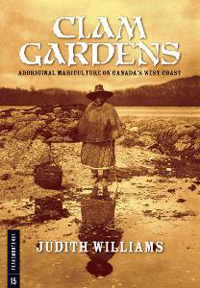
- Clam Gardens
- New Star/Transmontanus (2006)
- Bookstore Finder
Years ago, an old maple toppled in an Indian Arm waterfront park near where I live. Its fall exposed a large midden of oyster and clam shells -- a reminder that what is now just a pretty view was once a source of food for a whole community.
Our present-day fish farms pollute the waters and kill off the wild salmon. Judith Williams's new book Clam Gardens: Aboriginal Mariculture on Canada's West Coast shows us how the First Nations did it first and did it better. The clam gardens are a centuries-old sustainable industry that still helps to feed coastal communities.
Williams tells the story as a quest for something hidden in plain sight. While doing research for another project in the early 1990s, she'd learned about rock walls erected in Waiatt Bay on Quadra Island. Her sources were modern Sliammon who still harvest the butter clams grown inside those walls.
Having seen the walls, Williams began a years-long investigation. Similar walls can be found in bays and coves all over the central coast -- more than 350 clam gardens in the Broughton Archipelago alone. Many are still in use, and kept in repair. Others simply mark long-abandoned village sites.
Gardens of 'imagination'
Williams tried to interest the archeologists at the B.C. Heritage Conservation Department. They told her no evidence existed for an aboriginal mariculture; the Waiatt Bay wall didn't exist -- and if it did, it was a salmon trap.
Persisting, Williams explored the central coast and found supporters as well as more walls. People who live on the central coast know about the clam gardens. The trouble is that hardly anyone lives on the central coast nowadays. To most British Columbians, the coast between Powell River and Prince Rupert is just so much empty scenery, a tourist attraction for the boaters and cruise ships.
But the neglect of this aboriginal industry goes all the way back to the days of anthropologist Franz Boas, who studied coastal culture a century ago. Williams speculates, with some reason, that Boas was simply more interested in the male-dominated aspects of that culture. What the women did wasn't as important as the ceremonies and arts of the men.
Yet the more she learned, the more Williams came to believe that the clam gardens reflected a larger, older and more sophisticated culture than Boas had recognized.
The basic structure of a clam garden is simple but elegant: a wall of stones and boulders set at the extreme low-tide contour of a bay. Sediment gathers within the wall, creating "fluffy" sand that butter clams flourish in. The tides carry nutrients over the wall. Clams and other shellfish multiply. At extreme low tides in summer and winter, the gardens are exposed. All you have to do to harvest the clams is walk out with a digging stick and a container -- preferably in winter, in the middle of the night, when the danger of red-tide poisoning is least. The clams can be easily dried and strung together for storage.
Williams points out that clam digging may have been women's and children's work, but building the walls required plenty of brute strength. Organized teams of men had to carry or roll the boulders out to the low-tide line at precise times of year. They had to maintain the walls, and ensure that gaps would permit canoe access even at very low tides.
So the coastal populations in those pre-European times must have been far larger than they are today, simply to provide the manpower. And the size of the population also created a good reason for building the clam gardens in the first place: a lot of mouths to feed.
Evidence challenges assumptions
"What population densities might provoke and accomplish such labour?" Williams asks. "Recently anthropologists have suggested that early estimates of 100,000 people on the Northwest Coast had been gross underestimates."
What happened to them? While Williams doesn't explore that question, we know that a smallpox pandemic swept the coast from 1862 to 1865. An estimated 60,000 aboriginals lived on the coast, and 20,000 of them are believed to have died. It was B.C.'s greatest single documented catastrophe.
Some historians think smallpox had reached B.C. before, perhaps in the decades just before Captain Cook and then Captain Vancouver explored the coast in the late 18th century. The disease could well have followed aboriginal trade routes north from Mexico, just as the 1862 outbreak originated with a traveller from San Francisco.
If so, then a population of far more than 100,000 had been living on a now-empty shore. They had sustained their numbers by a highly sophisticated mariculture, using techniques that may have been thousands of years old. Even after suffering hideous losses, the coastal peoples had held on to their technology. Over generations, that technology helped them begin to recover.
Clam Gardens is therefore a special book. Like the midden under the maple tree, it makes us look at our own landscape and history in a different light. The boaters and cruise-ship passengers roving this coast are gazing not just at scenery, but at the sites of a great, lost civilization. ![]()


13
Login or register to post comments
BC Mary
5 years ago
A wonderful, sad, beautiful story
Thanks very much for introducing this book.
I hate to say this, but it's true: "I had no idea."
Thanks again, to Judith Williams and to Crawford Kilian.
Such a history makes us question what else was lost.
anarcho
5 years ago
Thank you Crawford
Thanbk you for reviewing this book which gives us insight into the lives of the FN peoples. We are also learning that far from being mere "gatherers" of fruit and plants they also engaged in permaculture. The distinguished ethnobotanist Nancy Turner's writings are good to read on this.
doggone
5 years ago
Broken Group, Barclay Sound
We thought these were salmon traps too: stone walls built long ago beneath high tide.
little bits of information add to the complex: possible village sites drowned off our coast by the rising ocean levels and subsidence of islands and plains offshore as interior BC ice masses melted at the end of the last ice age.
I have seen middens in BC inlets at least 40' above normal high tide. I doubt that people climbed up there and deposited shells.
Canadian Geographic has an article a few months ago about this specific to the Queen Charlottes: the greatest rate of sea level rise that can be measured.
As the ice sheets receeded the continental crust "rebounded" while the off shore islands and plains (very likely inhabited) subsided since they had been displaced upward by the depression of the mainland.
Though I have yet to find it some researchers are using "side scan" sonar imaging on this coast and claim to see evidence of village sites off the Charlottes under many fathoms of ocean water.
dolphin
5 years ago
Ingenuity
This story is a good example of the food gathering ingenuity of the first peoples. What really impresses me is whale hunting from a dugout canoe, though. One thing many don't know about the inukshuk rock sculptures (the 2010 symbol), is that they were more than just landmarks in a treeless landscape. Hunters would arrange them in an open ended V, and lie in wait at the narrow end. They would attach strips of cariboo hide to the "arms", which would flap in the wind. Other members would drive a cariboo herd in the direction of the inukshuks, and the naturally skittish cariboo would shy away from the flapping inukshuks, in effect funnelling them towards the waiting hunters, who would dispatch them with arrow and lance. Pretty smart, eh?
Another factor not often talked about is the large slave culture practiced by many north coast tribes (John Jewitt's two years as a slave of Chief Maquinna is a fascinating account). The fact that much of the grunt work was done by slaves probably contributed to the amount of leisure time devoted to carving and artwork which the West Coast is so famous for.
skeptikool
5 years ago
The temptation is great to
The temptation is great to jump into a boat and do a little gunk-holling in the area mentioned. Is there any reason that the clams would leave merely because the people did.
On a trip to Quadra Island, just a few years ago, totally ignorant of red tide, I collected a whole bunch of clams on a beach very quickly and easily. Washed and micro-waved for a few minutes, they were most delicious - juice and all.
Sadly, perhaps through harvesting undersized clams some areas where they were previously abundant are, reportedly, almost empty of them.
Drying of them is news to me. Clam jerky? They should smoke well, too, I would think. Well, be smoked, You know what I mean - as in, oysters.
Skookum1
5 years ago
Quote:What happened to them?
Some historians think smallpox had reached B.C. before, perhaps in the decades just before Captain Cook and then Captain Vancouver explored the coast in the late 18th century. The disease could well have followed aboriginal trade routes north from Mexico, just as the 1862 outbreak originated with a traveller from San Francisco.
I'm surprised Kilian or Williams don't cross-reference with Cole Harris' smallpox/disease histories The Resettlement of British Columbia; I think there's a few other papers/authors out there in recent years on the same subject, and on the scale of possible projected pre-disaster/disease populations.
To this day mainstream histories continue to way there were only 60,000 aboriginals in the whole of BC, never mind the Coast alone, despite revised estimates. That there might have been up to half a million or more in the Pacific Northwest, or half a million on the Coast alone (i.e. from Oregon up to Skagway), is a politically volatile bit of history if ever demonstrated to be true...
But as to Cole Harris' estimate and the quote above, it's important to note that 1862-65 was only the largest documented virulence. Others were known to have been probably larger. One that's maybe connected to Captain Gray's voyage, or Lieut. Broughton's a few months later, is the story of "the mortality" which swept the lower Columbia, and also the lower Fraser, in the 1810s and/or '20s - not smallpox, some kind of hemorraghic fever, probably/possibly tropical in origin (lots of ships were in the area, not just Gray's or Vancouver/s/Broughton's). There were other rounds in the 1830s and '40s, of smallpox that is, and the first known to have ravaged the region swept overland from Missouri in something like 1690, with several more in between.
Then there's that tsunami which is known to have wiped out various villages off the west coast of the Island, I think in the 1790s or was it the 1690s?
Even earlier, somewherre I saw an anthro estimate for 100,000 inhabitants on the Fraser-Whatcom Lowland, or was it 500,000, in the period of the Julian dynasty in Rome (BC-AD turn-of-the-centuries) which apparently was devastated by flooding and/or volcanic activitiy (e.g. the Meager-Bridge River activity, not necessarily Baker which may be closer but isn't upstream....). Similarly so many centuries ago (500AD? 1500BC?) there was a pottery culture on the Lower Columbia which has since vanished; again because of ash deposits it's believed to have been destroyed by volcanic activity. Similarly Dimlahamid indicates a large "city" was destroyed, and there are volcano-related legends of destruction throughout the region. We might wonder how such an abundant land could not have had more popuplations; we haven't been around here long enough, maybe, to understand why - by suffering a similar fate mayhap.
Makes you wonder if, had there been on the one hand no smallpox and on the other exactly how far along native civilization around here might have been; rather than roughly tribal kingdoms emerging from a clan system, very similar to pre-Conversion Scandinavia and the Celtic world and elsewhere, that might have been something a lot more resembling statehood. Maquinna and Wickanninish and many of the other coastal leaders were arguably kings, and ruled large populations. But for "a few" geological and epidemiological variables they might have well ruled cities, and navies, by the time Cook, Martinez, Meares et al. showed up on the scene. Had some earnest priest gotten here first with variola inoculations (which saved the life of many Thompsons and Shuswaps, thanks to the Oblates - Lejeune I think, or Pandosy), the colony when formed might have had no choice by to reckon with native govenrment in the same way that was done in India and Malaysia; rather than pretend to override and eradicate it as not having existed, which was the colony's/province's position (post-Douglas/Seymour anyway). Another factor - inter-native war, whether in the Interior or on the Coast - was often as genocidal as the diseases or anything a volcano or earthquake could wipe out, and much of that was going on in the historical period, as well as before.
The scale and distribution of the clam gardens are an innovative bit of demographic evidence. Numbers of quiggly holes in the Interior (which have never been adequately counted or dated) indicate equally larger estimates than the usual less-than-100,000-for-the-whole-province/colony. Local tradition at Lillooet and Mt Currie says there were tens of thousands of people living there in the old days of prosperity, likewise at Seton Portage where the lights from the smokeholes of the quigglies, seen from the pass above the valley, was "many like the stars in the sky". If you've ever seen the number of stars in the sky in the Bridge River Country, you'll undertsand that wasn't meant innocently.....apocryphal legend says that the giant quiggly village of the Lakes Lillooet which once spanned the Portage (rhymes with "porridge" btw) had 15,000 or more residents (one elder said 25,000....). If you could comprehend the size of the old Seton salmon run, and the incredible abundance of game in that country pre-industrialization (pre-1950s...), that number is all too believable....
village
5 years ago
THE Territory we now call B.C. ...
Skookum , would you have a source or any indication of what the chronology was as per ... the various names that existed through time for the territory we in this day call BRITISH COLUMBIA..*
Would the First Nations have had a series of names in their various languages which attempted to LANGUAGE this particular territory ? , by naming it whatever... or alluding to it as... this or that .., in various tribal territorial communications imperatives ? Do you have any knowledge of this ?
If anyone else has any knowledge of the cumulative name changes of this territory , it would be greatly appreciated..
Thanks ,
VILLAGE
Skookum1
5 years ago
What's in a name?
There was no one First Nations language for the whole region, so by default there could be no name in any First Nations language for such a region - which is by default a somewhat externally-imposed definition/concept, even though a certain geographic unity does exist.
Even within language groups - the Coast Salishan or Interior Salishan groups - there was no concept of a "whole country", except by way of "the land", "the earth". Even within a particular people, their territory is just referred to as such - "land of the people" - and other than basin/inlet names or area names, there is no contiguous nomenclature available. e.g. you'd think there'd be a native name for the Queen Charlotte Strait, Georgia Strait or Fraser Lowland, but there's not; someone stateside has tried to advance the Lushootseed name for central Puget Sound - "the Whulge" in the anglicization - as if it applied to the whole Georgia-Puget Depression, but it doesn't; it doesn't even pan over into Straits Salish, never mind Halqemeylem or Skwxwu7mesh, which are related also to Lushootseed.
The only names for whole regions existed - roughly - in Chinook Jargon, and these were "King George Illahee" for the lands remaining under the British Crown after 1846, and "Boston Illahee" for those that weren't. Various names existed for different parts of BC prior to the creation of the Mainland Colony in 1858 - New Hanover, New Braunschweig (aka New Brunswick), New Georgia for certain parts of the Coast, the Columbia District, New Caledonia, Stikine Territory and a handful of others inland. But a term for the whole of the post-colonial geopolitical construct of British Columbia, or even for the "whole of the Oregon Country" (up to 54-40 but no farther), simply did not exist, at least not without political baggage (as in the case of Oregon Country where it's clearly American-expansionist agenda in flavour).
The only term I've come up with myself is "Skookum Illahee" but it has no documentation nor any kind of historical currency. The sense of that phrase is not just "the Skookum Land", with all the connotations that has for those of us who know/use that word, but also/more like "the country where 'Skookum' is known/used", i.e. the territory of the word "skookum", which encompasses the region from Eureka to Anchorage and inland to the Rockies, plus a bit. Nice name/concept, but no history to it to validate it....
Skookum1
5 years ago
Wakish Nation
Just to note that on older maps Vancouver Island is sometimes shown as "Wakish Nation", which would almost be appropriate in the sense of 3/4 of the Island being Wakashan by culture/language (Nuu-chah-nulth-aht and Kwak'wala) but it still misfires because of the southeastern 1/4, which is entirely Salishan; and there was no one "Wakish Nation", but several; even if "nation" is used in an ethnographic sense, there's still at least two such (Nuu-chah-nulth-aht and Kwakwaka'wakw) and even those are really assemblages of "nations" rather than a "Nation" in the European sense of the word.
Given another hundred years, even another fifty years, without smallpox and colonialization, it's possible that a unified state might have emerged in some region, and it might have come to have a recognizable name; chances are it would have been a state with subject peoples, e.g. the Euclataws lording it over the Straits Salish, or one of the Nuu-chah-nulth chieftaincies consolidating that region under one ruler with subject Sookes and Clallams and Quinalts; i.e. still an imperial state, just not an imperial state run by non-First Nations......
The sense of a named territory spanning an area the size of Western Europe just doesn't pan out in BC history/ethnography; names may have existed for specific areas, although usually associated with chieftaincies, not people, e.g. Chief Nicola, whose name came to apply to the whole Nicola region (the river was named after him, or rather after "Nicola's Country", rather than the area being named for the river as is usually the case) or in the case of the hereditary territories of the chieftaincies of Gitxsan-Wet'se-we'ten Confederacy.
village
5 years ago
and of TURTLE ISLAND ?
From earliest of First Nations mythology we hear of the above name for explaining away human settlements origins ..., any way of tracing how the earliest of arrivals..., be they from the furthest reaches of the earth or what have you, explain away their origins? ( from a point of view of what eventually became their HOMELAND ) .
What I'm getting at is prior to the earliest of the First Nations arriving on the shores of these lands , perhaps existed and exist still in deep MEMORY archives of ASIAN MYTHOLOGY and CULTURE certain references to a new world , to a new land , to a new beginning* ?
Being EXPLORERS and DISCOVERERS in their own right , would it not be reasonable to think that their ancestors ( First Nations ) who arrived in these undiscovered and unchartered lands.., had a name for, or thought up a name ..., which preceded the EUROPEANS venture forth ?
Of course the very origins of language itself comes into play when asking a very related question of ; WHAT'S IN A NAME?
( nothing and everything )... as in the great observation made by a fascinating writer when stating the following ... in the titled prose called THE DOOR*...
IT WENT SOMETHING LIKE THIS...
by beginning with..
'' Everything is something it isn't..''
eventually ending with ..
'' and every time I put my foot to the earth it comes up and meets me ''.
VILLAGE ,
Skookum1
5 years ago
fabulism
Sorry; can't live with the Turtle Island thing; that's as much an external imposition as it's from Cherokee or Hopi mythology or whatever; just as alien to the Northwest Coast as Yggdrasil or the World-Egg. And looking for "Asian mythology" among First Nations beliefs is a disservice to the latter, and panders to the modern-day obsession with finding links between BC and Asia by way of justifying the new round of Asian-based colonialism here. There might be some similarities between shamanic peoples in Siberia and some of the peoples of this region, and there are similarities with the Ainu in some respects; but largely superficial and anything else is not only unproven it is highly speculative; that "Asian" now generally isn't used to include non-Mongoloid peoples like the Ainu and the Altaic peoples of eastern Siberia adds another rider to the use of that particular term.
And to have a grasp of the name for a whole territory, first you have to have a grasp of its existence; seeing it from the Coast doesn't tell you anything about what's inland, and those inland - even FN peoples - often never saw the sea; never mind how difficult it was to get from the Prairies to the Coast, and how many peoples lay in between. In native nomenclature, also, names are given for specific locations, not in the same way we name things, i.e. peaks, rivers, bays, etc; they'd more likely name a shoreline, or a meadow where roots could be gathered; even peaks often didn't have names, though spots on their slopes did.....
village
5 years ago
What do you think of this explanation?
H. The First Settlement of the Americas (c. 15,000 Years Ago)
Dental morphology, genetics, and archaeology show that the biological and cultural roots of the Native Americans lie in northern China and extreme northeast Asia. 1
We do not know when modern humans first settled in China. Although Chinese archaeologists claim that Homo sapiens sapiens evolved independently in the Far East, they have yet to put forward convincing evidence for such a hypothesis. Anatomically modern people were hunting and foraging in the Ordos area of Mongolia by 35,000 years ago. Ten thousand years later, a vast area between Mongolia in the west and the Pacific coast in the east supported a highly varied population of hunter-gatherers exploiting game and plant foods as well as coastal resources. As time went on, their tool kits became progressively smaller and more refined. They produced tiny stone blades used as lethal spear barbs and small scrapers; they also relied on artifacts made of wood and bone. This so-called microblade technology spread widely in northeast Asia, offshore to Japan, and north into Siberia. 2
The earliest human settlement of extreme northeast Siberia, from Lake Baikal eastward, took place late in the Ice Age. This was after the last glacial climax 18,000 years ago, when warmer conditions opened up hitherto uninhabited steppe-tundra. The first settlers were few in number, living off big game, plant foods, and perhaps fish and sea mammals. The middle Aldan River Valley began to support bands of late Ice Age people using microblade technology 15,000 years ago, perhaps earlier. These same people settled as far northeast as the Bering Strait. 3
A low-lying land bridge joined Siberia to Alaska during the entire Würm glaciation, from about 100,000 to 15,000 years ago. During glacial maxima, the land bridge was a wide, poorly drained plain, swept by arctic winds. The climate was dry and intensely cold, with only a two-month summer. Low scrub covered the landscape, except in shallow river valleys where some trees and lush grasses grew in spring and summer. During warmer intervals, sea levels rose, flooding much of the plain, leaving but an isthmus between Old World and New. This was the route by which humans settled the Americas. 4
Great controversy surrounds the first settlement of the New World. While everyone agrees that the first settlers crossed the Bering land bridge, some archaeologists believe the crossing dates to at least 40,000 years ago. Others favor a much later date, at the very end of the Ice Age, or soon afterward. 5
Claims of very early settlement are based on a series of cave and rock shelter finds in South America. There are affirmations of humans occupying Boqueirao de Pedra Furada in northeastern Brazil at least 40,000 years ago. Only a few scholars accept this claim or other much heralded occupations said to have occurred between 40,000 and 25,000 years ago. 6
The most widely accepted scenario has small numbers of hunter-gatherers from northeast Asia crossing into Alaska as the land bridge began to flood at the end of the Ice Age some 15,000 years ago. This was not a journey of exploration but rather part of an age-old hunter-gatherer lifeway that had people following migrating game and searching for new clumps of scarce plant foods. 7
The earliest archaeological evidence for human settlement in Alaska—nothing more than small scatters of stones and bones—dates to about 11,500 years ago. From that date onward, there has been continuous human occupation in the Arctic into modern times. 8
During the height of the Würm glaciation (called the Wisconsin in the New World), northern North America was mantled by two vast ice sheets that extended from Greenland to British Columbia. There may have been a narrow, ice-free corridor between them, but it would not have supported animal or plant life. Most likely, people from Alaska hunted and foraged their way south onto the Great Plains as the ice sheets receded rapidly after 13,000 years ago. 9
Despite occasional occurrences of 12,000-year-old artifacts in North America, the first widespread settlement of the Americas as a whole dates with great consistency to about 11,000 years ago (9000 B.C.E.). Within a few centuries, perhaps no more than 500 years, hunter-gatherer groups had colonized the entire Americas, from ice-free Nova Scotia in the north to Patagonia in the south. 10
The Clovis people (named after a site near Clovis, New Mexico) are best known for their characteristic stone projectile points, fluted at the base for mounting in a wooden shaft. These people preyed on game of every size and also foraged plant foods. They hunted large Ice Age animals like the mammoth, mastodon, and large steppe bison, sometimes camping close to a kill while they butchered the carcass. Clovis artifacts have been found throughout North America and deep into Central America, with variants on this culture farther south. 11
It appears that humans literally exploded into the New World, living off a fauna that was unused to such formidable predators. As a result, the human population rose rapidly, then stabilized, as people adapted to a great variety of natural environments, everything from rocky coasts to desert and dense rainforest. 12
By 8800 B.C.E., most large late Ice Age animals except for the bison were extinct, probably as a result of rapid climate change and drought. Some experts believe that human predators helped in the process of extinction by exploiting slow-breeding mammals like the mammoth and mastodon. Whatever the cause of extinction, the disappearance of big game fostered greater cultural diversity among Paleo-Indian groups. They adapted to a rapidly changing world that was not to stabilize to near-modern conditions until about 4000 B.C.E. 13
village
5 years ago
Quest for Fire !
I revisited recently the great film , as named above.
I highly recommend it to anyone who wishes to delve into the origins of the homo sapiens and to in effect think through the origins of our earliest of settlements and how as the '' thinking evolving animal '' we gradually overtook each and every territory we've ever settled.* BUT FOR THE ONE'S THAT NATURE GRADUALLY REMOVED FROM OUR GRASP OR UNDERSTANDING.
Thus we are today , faced with an ever overpowering presence within the environments that we claim as ours.., and through a poor understanding of our origins do we at our peril continue our journey *..
This is the reasons for my questions , and for my search and quest.
To simply find a '' story '' , as in becoming part of the great tradition of STORY TELLERS.., so that we can find a narrative that will unite us rather then keep us apart.
LAND OF THE LIGHT ... indeed, was another suggestion of this territory , we all live in... ( or so it is claimed by some ).
Village ,