- Mary Carlisle is a Tyee Builder. You can be, too.
- Prem Gill is a Tyee Builder. You can be, too.
- Nancy Flight is a Tyee Builder. You can be, too.
- Justin Everett is a Tyee Builder. You can be, too.
- John Westover is a Tyee Builder. You can be, too.
- Nora Etches is a Tyee Builder. You can be, too.
- Edward Henderson is a Tyee Builder. You can be, too.
- Bharadwaj Chandramouli is a Tyee Builder. You can be, too.
- Dean Chatterson is a Tyee Builder. You can be, too.
- Marius Scurtescu is a Tyee Builder. You can be, too.
- Robert Parkes is a Tyee Builder. You can be, too.
- James Murton is a Tyee Builder. You can be, too.
- Susan Doyle is a Tyee Builder. You can be, too.
- Vincent Strgar is a Tyee Builder. You can be, too.
- Helen Spiegelman is a Tyee Builder. You can be, too.
- Subir Guin is a Tyee Builder. You can be, too.
- Kimball Finigan is a Tyee Builder. You can be, too.
- Joanne Manley is a Tyee Builder. You can be, too.
- David Leach is a Tyee Builder. You can be, too.
- Joel Berger is a Tyee Builder. You can be, too.
Working-Class Dignity
Ivan E. Coyote's novel 'Bow Grip' busts stereotypes with a cello-playing mechanic.
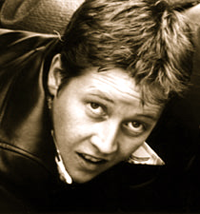
Ivan Coyote explores ordinary humanity.
- Bow Grip
- Arsenal Pulp Press (2006)
- Bookstore Finder
Novelist, storyteller and trickster Ivan E. Coyote is on the phone from her East Vancouver home and we are talking about book reviews. Coyote wrote reviews for more than eight years for the Georgia Straight. "I must have done 100 reviews and panned a grand total of three books, and they all came back to bite me on the ass."
These days Coyote is too busy for the book-reviewing gig. Her new novel Bow Grip has been enjoying great non-ass biting reviews, and she has hooked up with live-wire literary agent Anne McDermid. Coyote was preparing two book outlines for McDermid when I spoke with her.
Coyote is the author of three story collections, including the warm and plainspoken short tales found in Loose End (Arsenal Pulp Press, 2005), which are collected from a column she wrote for the Vancouver newspaper Xtra West. At the conclusion of that collection, Coyote writes of a fire that destroyed the home she lived in for 12 years. In Bow Grip, Coyote credits her cousin, who pried the hard drive out of her melted computer after her house burned down, with saving the manuscript that is her first novel.
Does Coyote have the staying power for a longer work? The answer is a definite yes; Bow Grip is a heartfelt, amusing page-turner with characters recognizable from the working-class walk of life.
Joey Cooper is a good-hearted, 40-something mechanic from Drumheller, Alberta, until recently happily married to Alison. His buddy Mitch Sawyer runs an Esso in town and his wife Kathleen is a quiet kindergarten teacher. Joey and Mitch played hockey together and share the occasional beer. Now they share some news; their wives ran off with each other. And, as is the case in a small town, everybody knows. Mitch now spends his nights in the bar of the local hotel, lamenting to anyone who will listen about his wife running off with another woman to their "one-bedroom artist's loft in Calgary."
As Joey Cooper sees it: "Mitch Sawyer seems to feel that the fact that Kathleen left him for another woman is more binge-and-sympathy worthy than if she'd just run off with his brother or the postman, but I guess I don't really see it that way. My wife of five years has left me, and I pretty much don't care who she went with, all I know is that she's gone, and it's been about twelve and a half months now of looking like she isn't coming back. Drinking doesn't seem to help much either, so mostly I try and just avoid running into Mitch Sawyer. I like the Mohawk gas better anyways; higher octane, plus they got the video rental counter right there in the gas station. I've been watching a lot of movies lately."
When privacy becomes secrecy
Coyote has a great ear for conversation and a keen understanding for those small moments -- punctuated by her dry, observant sense of humour -- that define who we are and offer glimpses of our humanity.
When James, a stranger who lives in a bus on the edge of town, approaches Joey at the garage he works at, they come to a Robert Johnson crossroads deal. Joey agrees to sell his beater Volvo in exchange for a beautiful handmade cello. Joey sees the cello as an opportunity to make some overdue changes in his life, considering his mother keeps insisting he needs a new hobby to get over his break up -- and it is hard to argue with your mother.
The car breaks down shortly after Joey sells it to James. He takes a trip out to the bus where James lives and makes a dark discovery about the reasons for its purchase. Then, moping about at home one evening, Joey makes another startling finding -- his wife had graduated from college while they were together without his knowledge. How could such a thing take place in a relationship?
"I had never sat down at Ally's desk since I gave it to her, just like she would never have touched anything on my workbench in the garage, or opened mail with only my name on it. It was one of the things about Ally and me that I had always appreciated, that we still had private spaces and lives. No rules or hassles about it, we just fell into things that way. We were both just naturally private people. Not like some couples get. Until she popped the news to me about her and Kathleen Sawyer, of course. That was the first time that her privacy turned itself into a secret."
With his suspicions now aroused, and with a strong desire to close the door on his failed marriage and return some furniture, Joey hits the road and travels to Calgary where he lands at a rundown hotel, populated with mysterious drifters offering sage advice, straight out of a Sam Shephard novel.
Joey's eventual meeting with his ex and her new beau produces one more surprise for him, but not before he finds a cello teacher, a sympathetic shrink, insight into the furtive James and a new path for his life. The cello it seems is a conduit -- the sound and the shape of the mystical musical note of life passing through us.
Coyote sat down at her keyboard recently and e-mailed some answers to questions I sent her.
The novel is dedicated to the men in your family. Why is that? What influence have they -- and particularly your father -- had on you?
I wanted to honour the men in my family, as in the past a lot of my hero characters have been women, and I thought it was time the male influences I have had got their proper credit. My dad taught me the love of building stuff, of working with my hands, and to not be intimidated by technical things. He can fix or build anything, and I was always impressed by that, and have tried to make myself as capable as I can in my own life. I can fix my own car, wire my own house, build my own shelves, stuff like that, because he taught me to be capable, and to learn by doing.
Joey, an infertile divorcee whose wife has left him for another woman, seems a remarkably sympathetic/empathetic character. Do you believe his character is idealistic? Or some sort of instruction manual for being a man?
I don't think Joey is ideal, or that he is an instruction manual for anything. I certainly didn't write him to be any of those things. I just imagined and created a decent human being, one who was raised to respect people. I feel like that was how I was raised, and I am a bit surprised at how many readers are shocked that Joey is a working-class man from a small town, but he isn't a total redneck. To me this is very telling, and it shows how much urban middle-class folks lean heavy on their stereotypes, which is ironic, when you think of it. I know lots of decent small town blue-collar men. My family is full of them. Joey is not pure fiction, he comes from a place and a family that are very real, in my experience.
Regarding Joey's discovery that his wife had graduated from college while they were together without his knowledge, how could such a thing take place in a relationship?
To me, this was a symptom of one of Joey's faults: he is private to a fault, and he assumes that other people are the same way. He doesn't ever ask his wife how she is, or what she is up to; he assumes she will just tell him everything she wants him to know. His lesson is that real communication is not just a passive activity, it's not always only about listening, it is sometimes about asking the right questions. I was writing about a relationship that failed because of things that were not said or done, where silence was the culprit.
You seem to have real insight into the human heart and those small moments that reveal us to others and ourselves. Where did you get that talent/ability? Have you ever considered writing a lonely hearts column?
I have always liked eavesdropping. I like to watch humans be human. I notice little things, I take notes on the details, and I'm always looking for a story, hidden anywhere. I love stories that are about everyday, mundane things that could have happened to anyone, and finding the magic little seed of humanity buried in them. Anyone can tell a story about a great event, or breaking news, or a disaster or a miracle. I call them headline stories. It's a lot harder to capture the beauty or the insight hidden in the everyday. But it is something that everyone can recognize, and relate to.
This is your first full-length novel. How difficult was the transition from short-story writing to a full-length novel?
Writing a novel was the hardest thing I have ever done, at least in my creative life. Everyday I had to slay a couple of demons: would anybody be interested, did I have it in me, could I finish it? It was terrifying, and torturous. I can't wait to do it again.
This novel is set in Drumheller as opposed to your regular writing haunts of Van East. Was that a conscious choice or just where the muse led you? Why Drumheller? What kind of research did that require?
Drumheller. I needed a small town that was close to a big city. I needed dinosaur bones. I needed working-class folks. Alberta seemed to make sense to me, and I have a sister there, and a buddy, who I could call for details. The rest of the research I did online, and during one short day trip to Drumheller when I was first crafting the idea of the book in my head.
Trading a cello for a Volvo seems like a strange and symbolically laden choice. How did you arrive at these as your exchange choices? A cello seems a very feminine and slightly sexual choice and a Volvo very lefty. Anything to that?
The cello seemed like the farthest thing away from anything that Joey would come across by accident in his life. I wanted him to find something by himself for himself, something that nobody he knew played, something he'd never thought about before. I was also dating a cello player at the time, so that was handy. I never thought of the cello as lefty or feminine. Actually to me it is a rich person's instrument, one that only spoiled private school kids would have access to. It is a sexy instrument, for sure, and it does have sweet curves, but the feminine thing? Must have been subconscious. I'm a very subconscious writer. I don't over think things, or create with metaphor or symbolism in mind. It's more visceral for me. I think with my guts.
What makes for a good storyteller?
A good storyteller knows how to pick the right tale for the right crowd at the right time. A good storyteller knows how to listen while they are talking. A good storyteller remembers everything, especially the stuff everybody else would think is irrelevant. A good storyteller knows that every one of us has at least one thousand amazing tales to tell.
What was the toughest crowd you ever performed for?
Kids are the hardest audience of all time. Especially in packs. You have about three seconds leeway before you lose them, and they never come back. They haven't yet learned to be polite and just pretend they are listening, either.
The whole scenario at the hotel reminded me of Sam Shephard and his work. Are you a fan? Can you relate to that comment at all?
I love Sam Shephard. I didn't have him in mind when I wrote Bow Grip, but I do love his work.
Many of your characters and settings come from the working-class walk of life. In a world that has gone all Doug Coupland modern-reference buzzy, is that a risk? Why make that choice?
I can't read Douglas Coupland, so I can't really give you much of an educated answer on that one. I just write what I know, about people who I can relate to and live inside long enough to write about them. Then I hope people like my book. What's in, or what the buzz is about, I don't really think of that stuff when I sit down to write. That's for the marketing folks to decide. Me, I'm just the writer. I just love to write, and tell stories. I love that I can go to work without putting any pants on. To me, that is success.
For an excerpt from Ivan E. Coyote's Loose End, visit Geist. ![]()


27
Login or register to post comments
G West
5 years ago
Good Idea
Good idea: that one just above about NOT reading Dougie Coupland.
The Tyee's about the only place still promoting that guy and his throw away pastiche of forgettable modernity.
I will read Coyote though; and - like her, I CAN'T read Coupland....
After that last pathetic shill-fest in the New York Times last summer I almost cancelled my subscription to Times Select as well.
G West
5 years ago
Check out her website and the piece from Geist
Not only is she worth reading, she's gonna end up, ( I think) if all goes well, being far better know as a WRITER , though probably not as a phenomenon, that Dougie Coupland could ever dream of being.
Check this one out bob the cat.
Michelle Hoar
5 years ago
A wonderful writer
Can't wait to pick up Bow Grip. Loved Loose Ends - it really brought east Van alive, in a humorous, compassionate, vibrant and down-to-earth way. Reading it almost felt like being lead by the hand down the streets, into people's homes...
flyingfish
5 years ago
Trickster? Oh, please.
Where did this Trickster reference for Ivan Coyote start, anyway? In the last few years, every cozy local reviewer has begun referring to this perfectly ordinary white girl writing perfectly ordinary, somewhat pedestrian short fiction, as a trickster.
Can anyone illuminate?
G West
5 years ago
Trickster does seem superfluous
But she does dialogue very believably and well - reminds me a bit of Bobbie-Ann Mason in fact.
Grant Shilling
5 years ago
Trickster/Chickster
Trickster for me comes from her play with gender.
Grant, Cozy, local reviewer.
flyingfish
5 years ago
So every Queer writer is a trickster?
It just strikes me as a term that reviewers are copying from each other, from previous reviews and interviews with Ivan, or something that the writer herself is promoting as a self image that is just adopted by journalists without much thought.
It's the kind of thing that makes it hard to take a lot of local lit criticism/review seriously -- the sense that they are not looking at the writer's work in light of a larger body of work, or what else is being done in the world in that vein, or holding it against a set of aesthetic judgements, but just kind of having a pleasant cup of tea in the writer's kitchen and enjoying the fact that someone is writing about "us" and telling "our" stories, in a straightforward narrative that everyone can understand.
I suppose this article wasn't intended as a review, but I wish there were a few more critical challenges to local writers, somewhere.... and yes, I know, the term "aesthetic judgement" is going to get me flamed on this site!!
G West
5 years ago
You can't expect much from Tyee
Well, every time Doug Coupland burps someone from Tyee runs out to cover it three ways from Sunday.
They haven't set a very high standard for aesthetic evaluation.
It's an interview of course, so I suppose that lets them off the hook.
At least Coyote is producing decent prose and not playing silly games with her own persona – whatever one thinks of it.
I do agree that the 'Trickster' label is pretty shopworn in these parts.
You should see what some local 'professional' historians have written for the Canadian Encyclopedia on BC gold rush history.
Skookum1
5 years ago
You can't expect much from "professional" historians
I'll leave aside my thoughts on Coupland; all I've looked at is City of Glass and I don't see what all the fuss is about, let's just say that....
As for professional historians at the Canadian Encyclopedia, I hesitate to drop names but one that was shot back at me, in the context of who do I think I am contesting the oh-so-credentialed contributions of a doctorate of history at UBC, the head no less....
here's one of the pages on the British Columbia gold rushes:
http://www.thecanadianencyclopedia.com/index.cfm?PgNm=TCE&Params=A1SEC821353
Well, she may be the head of history at UBC, but hell, I can't help it if she thinks the Big Bend Gold Rush was in the Thompson Country (it was in the Big Bend of the upper Columbia, between/north of Revelstoke and Golden....) or the Wild Horse Creek rush was in the Similkameen (it was in the East Kootenay). Gaffe after gaffe, and irrelevancy after irrelevancy, in such terse form there's barely any content, much less correct content.
She also writes it as though the gold rushes were all only about the First Nations, anyone else is barely mentioned; and she has it that the Chilcotin and Coastal Salish were affected by it - wot? No Nlaka'pamux or Lil'wat or Stl'atl'imx or Okanagan or Nicolas or Kamloops/Bonaparte Shuswap (all Interior Salish, and all directly affected by the rush since it either happened on their turf or people going to it tromped all over their turf....the Coast Salish were comparatively spared, other than around Victoria and a bit of mayhem on the way up the Fraser to Yale and Port Douglas); the Chilcotin had no part in the Fraser rush, and were only incidentally involved in the later Cariboo rush by way of the Chilcotin War/Waddington's Road.
But who am I to argue? SHE has a doctorate, and is [I]at UBC{/i}. I'm just some unqualified amateur historian who doesn't stand for bullshit, especially pedigreed, highly-paid bullshit. That this stuff is circulated into curriculum online and in print is all the more alarming....has this "doctor at UBC" even studied BC history? Because it's clear that she doesn't know how to read maps....and must not know her way around BC except maybe the area west of 10th and Sasamat....
Skookum1
5 years ago
CanEncyclopedia on Fraser Gold Rush
Had a look at the Fraser Gold Rush article, which thankfully was by Dan Marshall who knows what he's talking about...more or less. His ending leaves a lot to be desired:
http://www.thecanadianencyclopedia.com/index.cfm?PgNm=TCE&Params=A1ARTA0010032
Because he makes a mistake in his thesis Claiming the Land (UBC, interlibrary loan photocopy/fiche only, yr 2000 or '01 I think) that American miners were too lazy or scaredy-cat to go above Yale, and that the supposedly harder diggings up the Canyon were where the coloured folks had to go to mine; which was garbage as analysis for ttwo reasons: Chinese, blacks, natives, and Latin Americans were all over the Yale-Spuzzum area, and in the Canyon above Spuzzum there were German/Austrian, French, Belgian, and tons of Americans and other whites...how do you think Boston Bar got its name ("Boston man" means "American" in Chinook (and in the Canyon you'll still hear it as native slang - just "Hey, Boston!" meaning "hey, white man!")?? He points to Kanaka Bar as evidence that the Kanakas (Hawaiians), too, could'nt work the supposedly richer lower river; but all the bars of the Fraser were rich, not just Hill's Bar and on Yale's doorstep; the richer diggings were in fact upstream, and there were no shortage of white guys, American or otherwise, who headed for the upper Fraser and beyond, either right through the turf of the Canyon War and the hostile Hakamaugh (Nlaka'pamux in the old spelling) and also around via the Douglas-Lillooet route; and the multi-ethnic bars of the Lillooet-Fountain area were just as rich as the lower Canyon's and "everybody was there".
He makes another gaffe in the course of his thesis in regard to this specific topic, and it's one which got him to arrive at a false conclusion which of course becomes citable in his own later writings, or in anybody else's; he saw "Nicaragua Bar" on the map and thought it meant that Latin Americans were working that site, from Nicaragua no less. Well, it's true that there were lots of Central Americans in the rush - the first registered marriage in Lilllooet was between an El Salvadoran and a Costa Rican or Guatemalan, and Mexican packers were a mainstay of the Douglas Road as well as the River Trail (most travel above Lillooet was not via the toll road that got built over Pavilion Mountain via Fountain, but along the river to Sixty Mile - Big Bar, more or less....but as for Nicaragua Bar....
Well, y'see, there were all kinds of ex-mercs in the goldfields, both American filibusters and French and German irregulars (the "Austrian Company" in the Canyon War was composed of these, and led by Centras, apparently French or Belgian...or Magyar even perhaps by the look of the name...), and where they'd been mercs in was...wait for it....Nicaragua. THAT is who was on Nicaragua Bar, not Nicaraguans.
But seeing Nicaragua Bar, China Bar, Kanaka Bar, etc. Marshall, needing to find reasons to be critical of supposed white domination of the goldfields, and misled into thinking the central canyon bars were any less rich, or any more hard to work, than those below Yale, pronounces that "apparently" whites were disinclined for the tough stuff and pushed aside the Chinese and other non-whites into the harder turf upstream (which were few in fact, and below Hill's Bar not rich at all....and Hill's Bar was partly worked by the Spuzzum people right through the thick of it - they were among the first on the site...)
Well, it's true PERHAPS that the Thompsons were maybe not as inclined to cut the throats of non-white miners (their preferred mode of killing, hence the nickname "Knife" or Couteau Indians), but to the First Naitons versions that I know of, personally and sometimes in print, ALL outsiders were outsiders and all of them were invaders, not just the whites....and it's true that the story goes it was two French guys (ex-Nicaragua mercs) who raped a Thompson girl near Siska or Kanaka Bar and triggered off the Fraser Canyon War. But it's also true that, gee, those French guys were all the way that far up the canyon and THEY hadn't been pushed there by the Yankees; and Siska used to be Cisco, and guess why....
So meanwhile, up the canyon, there's hordes of Americans and Chinese and via-California Europeans and ex-HBC French Canadians working the bars alongside each other, and Chinese merchants successfully established themselves in freighting and drygoods and more, as well as getting rich off mining, rich enough to buy land, and to invest in huge, expensive flumes that cost the equivalent of millions today....but Marshall doesn't touch on this, and builds his thesis around the idea that the Canyon above Yale was off-limits to whites, or was where non-whites were "forced" to work by the Yanks.
Yet there's this whole story, ignored by Marshall (though not by Hauka in McGowan's War), that Governor Douglas, on his visit to Yale to dress down the Yanks after the Fraser Canyon War, and also to many of them during their passage through Victoria (where 7 of the top 10 tax assessments were Chinese businessmen, the other two being the HBC, de Cosmos and Dunsmuir...) lectured the Yanks (well, most were from Dixie) that the Chinese and blacks and others had equal rights, and the treatment given the Chinese in California would not be tolerated here; and it wasn't; yes, there must have been some going on at Yale for him to weigh in about it, but the Chinese were right around Yale and had been from the start - though they, like everyone else working the Spuzzum-Lytton stretch when the war broke out, took refuge in Spuzzum and abandoned their workings too (headless bodies floating down the river tend to have that effect on people...no matter what their skin colour....). Yes, and at Rock Creek and Wild Horse Creek, restive American miners got hostile to the Gold Commissioners-cum-Magistrates that Douglas appointed who were just trying to enforce British colonial taxes as well as policy, including tolerance of the Chinese and their equal rights to stake the workings; and the Chinese stayed on at Rock Creek, and at Wild Horse Creek, despite the troubles, even before Douglas dressed down the Americans; and they were willing to mine places that no one else would think to, and were so efficient at ore extraction that their working over gwailo tailings was often a richer take than what the Americans or others had managed to get out of the same claim......
There's too much to pick on in nearly any academic paper I read, even a fairly good one like Marshall's. But even he will take A plus B to make X, and then say that Y is true because he's come to the conclusion that X is (even though it was only speculation...and wrongly-founded speculation at that...), and other people will also cite his misinterpretation of something as tangible fact; but the Newell bit (that's the UBC history head/prof who wrote the first link I posted tonight) and much of other stuff I've read, from Barman to Bowering and countless dry, didactic papers, is so far from being right, despite lengthy and very selective footnotes/references, that it would be a whole lifetime spent deconstrucing and dissembling on the catalogue of errors and knee-jerk prejudices built in to the line of thinking and false/fictionalized history that's portrayed.
"Probably" this, "we can assume" that, and "it seems likely" that such-and so, and endless speculations based in modern p.c. prejudices and doctrines.....yet when I pick up something by Garnet Basque or Bill Barlee or the various homemade histories on my home area (the Bridge River-Lillooet Country, for those who don't know that arleady, even though I'm not redneck enough to actually live there anymore...), whose books are NOT in the curriculum, certainly not at the post-secondary level, I find out things that none of these "professional" historians have any clue about, or - as is perhaps sometimes the case - don't want to admit to.
BTW as a parting comment, for now, the editor of the Canadian Encyclopedia asked me to please note quote them on Wikipedia, as they've had "lots of problems" with people lifting information from their website wholesale (you can't copy-paste from it, for one thing; must be image files beneath the HTML but I haven't looked at their source code)....my response was a LOL, though I didn't put that in my email (I was much less polite, in fact...), that quoting form them was the last thing I was thinking of, as their site was so clearly wrong and out of its depth on so many accounts (this isn't my first run-in with issues with their content....) that I couldn't take it seriously; I'd only come to their site because it had been linked in an external links or references bit on a page I was looking at. I was hoping to find a certain piece of information - dates on a certain rush (which weren't there) - and wound up being confronted with some of the worst writing on the BC gold rushes I've ever seen.
Dan Marshall, as said, has a bit of worthwhile content in his bit in the "CanEncyc" but even he's hamstrung by wrong conclusions based in the prevailing mythologies and biases of "professional" historiography. Not an expert on the rush [/I]as a rush[/I], either - no analysis of the gold take, who made what etc (if he'd dug a bit farther he would have found out that those who made money weren't all white, not even dominantly white....especially as the goldfields continued on after the rush, and most of the Yanks had mofved on to Colville or Colorado or the Black Hills, and/or bounced back from there to the Big Bend, Wild Horse Creek or the Omineca or Cariboo.....or went home and started shooting at each other for that fun Civil War thing they had just after the Cariboo rush began....
The interconnection of the Colville and Colorado and Nevada and Idaho rushes with BC's is made in Marshall's thesis, by the way, but not in Newell's mention of the other spin-off rushes from the Fraser one, which she confines to BC in typically Canadian blinkers-on fashion over the interconnectedness of Pacific Northwest history and the close relationship between California and BC in those times - which also got completely bypassed and mis-stated on Mark Forsythe's radio bit on "the gold rush"....which was wildly off-topic, even fielding questions and comments on the Klondike Gold Rush (and not very well, either, whoever the "expert" was he had on taking the questions.....).
Frustrating, and maddening, when I know that the better-written histories are going ignored, even snubbed and often criticized as not being p.c. enough, while the trashy stuff is backed up by "alphabet soup" (as a late friend of mine would always describe the little strings of letters following someone's name, as if they meant something, instead of being a symbol of intellectual and moral castration, which for all I can see is the end-product of academic training nowadays...especially in historiography, and especially in BC historiography.....
Skookum1
5 years ago
continued tangent on gold rush from previous
So meanwhile, up the canyon, there's hordes of Americans and Chinese and via-California Europeans and ex-HBC French Canadians working the bars alongside each other, and Chinese merchants successfully established themselves in freighting and drygoods and more, as well as getting rich off mining, rich enough to buy land, and to invest in huge, expensive flumes that cost the equivalent of millions today....I'd meant to say "very good land, lots of it" including prime ranchland and very good farmland (once lots were for sale); yet gold rush history is portrayed by latter-day Chinese historians as being yet another example of them being hard-done-by and whties mistreating them and more; but as with the "professional historians", the propagandists of the CCNC and the SUCCESS and Benevolent Assn "historians" journalists like Ian Mulgrew turned to during the lead up to the Head Tax politicking/repayment/refund, it's clear from what comes out of their mouths and put up on their websites (all uncited, and in fact often uncitable because it just ain't true, or is at least only half-true, or quarter-true or less...) that they haven't actually read up on the era or its realities either; except when looking for something to complain about, perhaps. In Saltwater City, which is a very nicely-produced book in fact, there's ONE mention of Lillooet, concerning a Chinese or two being beaten by other miners; yet in local histories you hear that some of the Chinese claim-jumped while other miners were in town, and would pull up claim stakes and such; and that there were conflicts with natives over the tearing-up of streambeds (the Chinese excelled in hydraulic diversion techniques....) as well as potato patches and other food resoruces and other benchland; and in the most celebrated case up there, the chief of the Lakes Lillooet, Hunter Jack, drove 300 Chinese off of Tyaughton Creek in the upper Bridge River basin (where Tyax Resort is...), as well as a party of Italians. And no wonder - somewhere around there was his own famous placer-nugget mine, and that particular region his people had just fought a decades-long war of homicidal proportions with the Tsilhqot'in over; the Chinese were just as unwelcome as the Italians or anybody else (by the 1870s and '80s he'd softened and would hand-pick miners to come in and prospect the territory, but under his control....).
You don't hear about any of that kind of stuff from academia. What you hear is what a bunch of bastards the whites were, how the coloured people were so hard done by, how what few women there were here had to put up with the men (focussing on women's issue concerning a time when 80%-90% of the immigrant population here was male....and who are dispensed with broad, untrue generalizations....)
It's late and this stuff is aggravating. My advice, if you want to read BC history, is to ignore the "professional" historians and read the sources for yourself, and the "old white men" histories by Bancroft and the Akriggs, and all of Pethick's stuff on the Coast, and all of James Teit (especially for pre-colonization warfare between native peoples....), and make a point of finding all the Ghost Towns books by Heritage House, from Basque through many others. That's the real history, written by us. Not a bunch of imported academics whose only interest in the place and its history is, on the one hand, political, and on the other.....well, purely academic. And totally out of their depth or field of knowledge. Don't be misled just because somebody has a Ph.D or teaches at a BC university; look at what their specialty was in, and 19 times out of 20 it won't be BC history, even if that's what they've been contracted to write on by our publishing establishment.....
Skookum1
5 years ago
small emendation/correction to first post
r was where non-whites were "forced" to work above Yale by the Yanks.
And again "Yanks" is a Canadianism that's my own fault; as stated before the Southerners were in large number; but essentially, as Marshall points out in his thesis, all the whites had a common culture - "Californian", whether they were from Nova Scotia like de Cosmos, Yorkshire like Gassy Jack, Pennsylvania like Ned McGowan, or the Deep South or Germany or wherever...ten years in California, then the end of the world, and this the end of the world beyond that end of the world, and you have more in common than differences..from-Canada Canadians finally showed up, but after the Fraser rush was over, but even in the Cariboo there were no usable overland connections to and from Canada; you still had to come via San Francisco to get here, either by sea or by rail across the States.
Skookum1
5 years ago
as for the interview...
Gee. I decided to actually read the article/interview. Do we really need to know that the Calgary motel is "straight out of a Sam Shepherd novel" (besides I thought Sam Shepherd wrote plays....)?? Are we so Canadian that we have to look to American examples to explain what "our" writing is about. The plotline seems utterly boring - why should I want to read something about interpersonal whatever-isms and a lesbian writer "honoring the men in her family" (in American spelling, no less)?
But it's the interviewer that's most cloying here:
Oh, geez, c'mon on. Who are you interviewing? Milosz? Lorca? Brodsky? I might even be able to ask Tom Wolfe that question with a straight face on, or the late Truman Capote or nearly any other non-Canadian author you could care to name, preferably someone like Goytisolo who actally has something to say about the human heart etc. But kissing up to a local small-fry author (sorry, Ivan) with "friendly" and flattering questions like this is nauseating. No wonder the interviewers' name is "Shilling" (from "shill").
flyingfish
5 years ago
No kidding?
Say no more.
G West
5 years ago
Shill/ Shilling?
Nice point Skookum1...Did you notice the interviewer has also chimed in on the 'trickster' label? Is he telling us his name is actually Cozy? Or did you get something else from his contribution to the debate...maybe ‘shilling’ isn't far from the truth. And the Lesbian/gay thing is way too tired, as you point out flyingfish.
I still think Ivan is a decent, young, short story writer who handles dialogue well....but then, I already said that. Enough encouragement to the tyro - there aren't many working class heroes in Canadian letters (pace Doug Coupland) - or is that just me? If only we'd produce someone of the stature of Eric Hoffer, for instance.
I found your observations about the state of history writing and education in academia a lot more interesting that the interview anyway, so thanks for that.
Skookum1
5 years ago
response to flyingfish
Actually, fish-person, in general the forums at the Tyee are generally more interesting than the articles. This is even more true of the forums in Tyee Books vs the reviews...or the books reviewed....
flyingfish
5 years ago
I imagine you do believe that...
Skookum says:
>Actually, fish-person, in general the forums at the Tyee are generally more interesting than the articles<
Sometimes that's true, when the threads stay more or less related to the subject at hand, and a wider number of readers are moved to participate.
A tangent is one thing, but screen after screen of cut-and-paste text from some utterly unrelated hobbyhorse topic that is one of a few subjects that seem to interest a poster who admits he posts without even reading the original Tyee article -- trust me, that is not interesting.
Why don't you start our own blog and give us a link. If we're interested, we'll click.
Skookum1
5 years ago
that's not cut-and-paste, dearie
It's spew, not cut-and-paste; I know my stuff, and it was meant as a response to G West's comment about the Canadian Encyclopedia and "professional historians". So I obliged....
So fine, G West found it interesting, I couldnt care abot you. You're the epitome of the Canadian cold-water shut-that-guy down thing, the communally repressive nature of this oh-so-supposedly open and liberated society. Why not grapple with the notion that CanCon in lit or history or anything isn't what it pretends to be; whether it's out-of-line bad history from a senior academic historians, or a set of short stories being over-sold with maundering tripe?
alive
5 years ago
waste of space
Skookum1
it might interest you to konw thas many of simply scroll past your ravings?
G West
5 years ago
Some do, some don't
Personally, I find Skookum1's knowledge of BC history and his comparisons between the way things actually were in the 19th century in this place and the way academic historians would like us to think things were are very much more valuable to me than the majority of stuff here at Tyee.
I think if he had a regular paid gig here that he'd encourage a lot more interest and conversation than many of the 'cultural' threads at Tyee, which frequently don't generate spit.
What exactly are you objecting to? Unless you’re a member of the academy itself, I can’t quite fathom the reason behind your reaction.
G West
5 years ago
Academic objections
But of course, if you are a member of the Faculty at one of our 'great' institutions of higher learning, I can appreciate why you wouldn't want someone checking up on your slopply mistakes.
Skookum1
5 years ago
reply to the supposedly alive
Your short attention span and narrow mind are your problems. People raised by television and other modern media are trained to want to read and think in point-form; a sign of the decay of the intelligentsia so many of them presume to....
Styling something "ravings" because you're too thin-headed to be able to spend some attention trying to understand what's being said is just more passive-aggressive crap that's so typical of Canadians; more of the "whack-a-mole" thing that flying fish has - find something flip to say about someone who intimidates you so you can pretend to be superior to them, and to mask your own inability to having anything useful to say....
Skookum1
5 years ago
by the way, flying fish
Were you a hall monitor in high school, or a study hall monitor? You must have been one of the two, I'm sure....the kind of person who enjoys other people to shut up, and/or to behave themselves, and would rather pretend to authority than acquire it legitimately......
Skookum1
5 years ago
and just to repeat myself...
since I made some word-omissions in rapid-type:
Were you a hallway monitor in high school, or a study hall monitor? You must have been one of the two, I'm sure....the kind of person who enjoys telling other people to shut up, and/or to behave themselves, and would rather pretend to authority than acquire it legitimately......
Or maybe you were just the kid in the library who was always going "shush!".....
alive
5 years ago
Quote:Your short attention
Or not?
Maybe I select what is worth my while to read/study?
My post was to make you realize that you are speaking to a select few, and a damn nuisiance to others
Skookum1
5 years ago
which others?
As you and flying fish have said, you types usually just scroll past my stuff; is it such a nuisance to have to do so? Does your mouse not have a wheel? And no doubt you only want to read things that agree with your prejudices and narrow mind - why should you read anything that might contain truths to upset your particular "intellectual" apple-cart? Keep you nose in the academic gutter where it belongs then, and you can keep on snooting it people when you need to; especially those who confront you with things that you don't want to know......
And readers of the Tyee ARE a select few, FYI; this site doesn't have great numbers ratings anyway; even Maestro, whom I disagree with politically on whole slews of issues, appreciates my historical tangents, as do G West and quite a few - an open-minded "select few" - make a point of encouraging me, and if they want to hear it, you're welcome to go read the Canadian Encyclopedia for their half-baked version of Canadian history instead. Nobody's forcing you to read my posts.
"A damn nuisance" is no doubt what my icon-smashin historical writings are considered in academia, where whole careers have been built on highly-footnoted nonsense. I think G West is right - perhaps the only apparent reason for you or flying fish to have to dump on me is because you are members of "the academy", the cloistered halls of professional academia where credentials mean everything, and knowledge nothing.
islandcat
5 years ago
trickster illuminated?
Wow, I feel as though I am back in school listening to squabbling children.
As for the query that Flying Fish had regarding references to Ivan E. Coyote as a "trickster," I think this is coming from her surname. In First Nations lore, the coyote is a known as the trickster.