Opinion

A Tyee Series

Inside the World Urban Forum

DAY THREE: Poorer nations suffer for our excesses.

By Charles Montgomery, 21 Jun 2006, TheTyee.ca

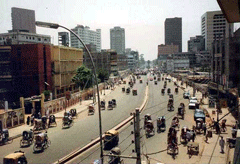
Bangladesh

Downtown Dhaka.

[Editor's note: Watch this space daily as noted author Charles Montgomery adds updates to the top of this article.]

WEDNESDAY AFTERNOON, June 21

It is a very bad time to live in the rich lowlands between the Ganges and Brahmaputra rivers. This is where Dhaka, the capital of Bangladesh, has grown into a megacity of 12 million people. The city has suffered three hundred-year floods in the last 18 years. Each time, most of Dhaka disappeared under the chocolate waters of the Buriganga River. With the rising waters come the usual flotsam of disease, hunger and chaos.

"These floods are supposed to be hundred-year events. You tell me if these are the result of climate change," Mozaharul Arum told a packed room at the World Urban Forum on Tuesday. In fact nobody can pin distinct weather events on climate change. But what climate scientists are certain about is that it is too late to stop rapid change from happening, and that as the earth warms, extreme weather will become more common.

And it will be the world's poor, particularly the urban poor, who will suffer the most.

‘A profound unfairness’

The irony of this was not lost on the crowd of researchers and community activists who had gathered to discuss ways to help the developing world's cities plan for climate change.

"There is a profound unfairness, globally, in terms of who has generated this problem and who is most at risk," said David Satterthwaite, Senior Fellow with the International Institute for Environment and Development (IIED). "The poor residents of cities in Africa, Asia and Latin America are not the ones emitting greenhouse gasses. We didn't make this problem. The developed world did," he said, adding that people in the developed world -- that's you and I -- are responsible for hundreds of times more greenhouse gas emissions per capita than the urban poor in the developing world.

"So why should we in the developing world bother with climate change? Because what is done or not done in the next decade will affect hundreds of millions of lives."

The exploding cities of the global south will experience most of the world's population growth in coming decades. This presents not just huge risk for slum dwellers, but monstrous potential for greenhouse gas emissions. The key, Satterthwaite said, is getting climate change issues onto local government agendas. Cities with good transit, where people can live close to work, will pollute less. They will also happen to be more livable.

China gets off its bike

Victor Orindi, a researcher with the African Centre for Technical Studies in Nairobi, said cities could follow the example of the Kenyan town of Kisumu, which has built bike paths for its local fleet of thousands of pedicabs.

A young delegate from China got a big kick out of that one. "Thirty years ago in Beijing, almost everyone rode a bike. But then we adapted capitalism and got cars, so we could catch up on growth. Now you want us to go back to riding bikes?"

This is, of course, the conundrum that has stymied the Kyoto Accord. The U.S. and Australia refused to agree to emissions cuts in part because developing countries weren't required to make cuts in Kyoto's first phase. But China has a hell of a way to go before it manages to belch out as much CO2 as the U.S., which currently accounts for a quarter of the world's emissions.

Incidentally, if you look at per capita emissions, Canadians are among the world's top 10, at 16.5 metric tons per head. That puts us just ahead of the oil-rich Saudis.

A Canadian agenda

So while it is noble for folks in the developing world to do their bit, it is clear that everyday actions by average Canadians are much more likely to have an effect. The most urgent task, agreed delegates, is to scream for action from the countries that have prospered by pumping out CO2.

For Canadians, that means investment in green technology. It means pushing our government to legislate emissions reductions here in Canada, and demanding public investment in decent transit rather than highways. And it means considering the floodwaters of Dhaka every time we make personal decisions about where to travel, how to get around, what to buy and how to vote.

TUESDAY EVENING, June 20

Barely a day into the World Urban Forum, the naysayers have declared the event irrelevant. Many Tyee readers responded to my first WUF blog disparagingly. Too many politicians, too much hot air, you say. Well, you've got a friend in Vancouver Sun columnist Pete McMartin who, apparently grumpy from his morning commute in from White Rock, took a wander through Canada Place and concluded that the WUF was a "wonk-fest."

McMartin, a proponent of the rights of minivan drivers, declared the forum pointless, given that cities are inevitably shaped by market forces, not the efforts of idealistic planners and Jane Jacobs-istas. Further down I'll explain why this notion is utter hogwash. But I should first admit that I actually felt similarly about the WUF until I dug a little deeper.

A few weeks ago I quoted local architecture critic Trevor Boddy, who pined for fewer bureaucrats and more architects at the UN Habitat event. That, of course, was before organizers actually told us exactly who was coming. In the past couple of days I have discovered that the real action of the forum occurs far away from spotlights and sound-bite central. It happens in the networking and training sessions put on by more than 160 participating groups. Folks at these sessions are not talking about cutting-edge architecture. That's because they are too busy working on the rather more pressing issues of how to feed and house the billions -- yes, billions -- of people who will be moving to urban slums in the coming decades.

The Woodwards lesson

"It's so easy to dismiss the UN as a bunch of people who get together for conferences and waste taxpayers' money," Tilo Driessen, a planner with the Vancouver Park Board told me. "In fact, UN Habitat is providing training and tools to people who are making change happen in their communities. These training and networking sessions give people the sense that they do have rights and allies, and that they are part of a global movement for sustainable development."

Example: Today, hundreds of WUFers participated in workshops focusing on tools to get citizens and experts working together on urban design, civic budgeting and governance. What's so important about this work? Well, take a look at the Lower Mainland, where we have, at times, done these things quite well.

Take the Woodwards development, which will transform Vancouver's Downtown Eastside with a mix of social housing, upscale condos and public amenities. There were many plans for Woodwards over the years, and most would have been disastrous for the community who now call the area home. The current plan got support from developers, planners and residents specifically because residents were included in the decision making process, and so their wishes were part of the final plan.

A decade ago, thousands of citizens from all of Vancouver's neighbourhoods came together to figure out what we wanted this city to look like in the future. We called this effort CityPlan, and the vision that came out of it has guided the development of many neighbourhoods. Take Kensington-Cedar Cottage. Folks in that hood put together their vision plan in 1998. City hall now makes area decisions based on that plan. It's why residents around Knight and Kingsway are now getting a bit of density, with shops and services, around their key intersection.

'Eco-density'

Contrast this approach to Vancouver Mayor Sam Sullivan's latest out-of-the-blue proclamation. Sullivan announced, on the eve of the forum, that he would be working to implement what he called 'eco-density' in neighbourhoods across Vancouver. It was an undoubtedly useful idea, given the benefits of walkable neighbourhoods and the rising cost of gas.

Yes. Great idea. Problem was, the mayor apparently never bothered to discuss it with the rest of council, nor did he get communities on board before he set sail with his new eco-brand. So the past few days have seen an outcry from the crème de la crème, daring Mayor Sam to just try to build a forest of condo towers in their neck of the woods. Never mind the fact that Vancouver's co-director of planning, Anne McAfee, has been trying to spearhead such densification strategies -- and community involvement -- for more than a decade.

Cities work better when the people who actually live in them are involved in planning. But citizens are never included by accident. They are either invited by enlightened governments, or they have to claw their way into the clubhouse.

People in the developing world are envious of the kinds of consultation and inclusiveness that Vancouver has developed in the past decades. "Between us and democracy there is bureaucracy," complained Jean-Pierre Mbassi, of United Cities & Local Governments Africa, at one crowded dialogue session. "Our elected representatives keep people out of the loop. They are afraid of giving up power to the people. We won't really have democracy until we can engage them."

That comment stung, particularly because in January, our own mayor tried to suspend the city's own network of citizens' advisory boards. (The boards' fates will be decided by council sometime this summer. Until then they will continue to meet and advise the city on everything from bikeways to theatres.)

Government's role

I began this blog with a reference to the Vancouver Sun columnist who suggested that the WUF's well-meaning eggheads have little effect on the cities they love. One look at Vancouver proves this is not true. The city boasts higher residential density than any mid-sized city in the USA, thereby making it easier to serve with transit and amenities.

This feat of sustainable planning is no accident. It is a result of citizen engagement -- the anti-freeway fight of the 1960s -- and sound planning policy. Vancouver's dense, walkable downtown is no accident. It was the brainchild of planners who were profoundly influenced by Jane Jacobs and her tribe. The neighbourhood centres popping up around SkyTrain stations are no accident either. Nor is the fact that fewer commuters in Vancouver are using their cars. These things are the result of government policy informed by boring conferences like the WUF, and they benefit even the citizens who deride activist civic governments.

We may quibble about traffic and smog in Vancouver, but, as Mbassi told his fellow WUFers today, it is reckless to argue against informed government intervention in the developing world, where slums are growing exponentially: "If we leave all people moving to cities to the forces of free market, they will all be homeless," he warned. "They will all be brutalized."

MONDAY EVENING, June 19

We were all late for the opening ceremony of the World Urban Forum this morning. Thousands of us, in pinstripes, chadors, tie-dies and bureaucrat-grade Dockers, all lined up on the promenade at Canada Place while event security checked our bags for machetes. Stephen Harper was in the building.

We gawked at Vancouver's signature views like Inside Passage cruisers and we talked, of course, about the host city. A Swiss urban planner named Ewa turned to me and asked me why half the streets in Vancouver had no names. "All your big streets have names," she said, " but the ones in between have none."

"Those are alleys," I told her.

"OK. Alley streets," she said. "Well why do they not have names? And why are they so filthy? It's so strange that you would leave garbage on half your streets."

She was gone before I had a chance to explain that alleys were for service, for dumpsters and trucks and graffiti. Not for living. Then it struck me: we in Vancouver have become so accustomed to congratulating ourselves on what a fabulous town we've built that we've forgotten to imagine that there are other ways to see things; other ways to see our own city, and perhaps other ways to imagine making it better.

Indeed, why should alleys not be considered streets?

Backs well patted

More than 6,000 politicians, planners, activists and eggheads from around the world will spend this week talking about how to make all cities more sustainable. But they'll also be wandering around -- and wondering about -- Vancouver. Much pre-forum buzz has focused on what Vancouver, with its dense, livable downtown, can teach the world's cities. I learned on the forum's first day that we may learn a heck of a lot more from these fresh eyes.

Of course, to do that requires one first to wade through a slurry of self-congratulation. The WUF's opening ceremony was awash with it. Vancouver Mayor Sam Sullivan cheered the city's three-decade-old decision to keep out freeways -- while neglecting to mention his own council's inertia on the urgent question of affordable housing for the people who actually work in and around downtown. Premier Gordon Campbell, whose government is spending $2 billion to wrap Greater Vancouver in new highways, declared without a hint of irony that, "we need to move people, not cars."

Affordable housing. Accessible, low-emissions transportation. These are the trumpeting elephants in the corner of the sustainability chat room. And they could not be heard this morning above the roar of back-slapping.

Scratching heads at SkyTrain

In the afternoon, the folks from TransLink (Greater Vancouver's Transportation Authority) put on a plush PowerPoint show describing their integrated approach to transit. Visitors from Sweden and Nigeria were wowed by images of the SkyTrain and SeaBus, of wheelchair elevators and HandyDarts. Yet TransLink board chair Malcolm Brodie made no mention of the fact that TransLink is currently hundreds of busses short of meeting its modest service targets, largely because the province has chosen instead to pour money into the Canada Line rapid transit route to Richmond and the airport.

"How do you see transit?" asked a woman from Nigeria after that presentation. "I think it's a human rights issue. It gives us access to health. To education. To employment. Everyone has the right to transit."

This prompted William Batt, a sustainable transportation expert from Albany, New York, to recall the ride he took on a fancy new elevated commuter railway in Chennai, India. "They put the rail where the politicians wanted it to go, not where people needed it. So at rush hour, it was empty." Batt also spent a lonely Sunday afternoon on Vancouver's Millennium SkyTrain Line. What shocked him most were the vast parking lots along the way, like that at Brentwood Mall. "Parking lots! That land is begging to be used."

Batt suggested that such land would be better utilized -- and cities could pay for fancy transit projects -- if we simply re-thought how we taxed the land.

"Right now you guys tax both the land and improvements. It's a double-whammy that punishes the developers who actually build anything. It encourages them to sit on property for years. You should cut the tax on improvements, and heavily tax the land around transit stops. This is called capturing the land value. The more you tax the land, the more the developer is going to invest in that land to recoup his tax expenses."

In one study, Batt found that if such tax strategies were used along one road project in New York State, the government could have recouped the cost of that highway eleven-fold. Just an idea, he said.

Urban poverty, there and here

Vancouver has never experienced the scale of wrenching poverty, homelessness and violence faced by the members of Slum Dwellers International who bring their stories this week. We are awash with cash to deal with our problems. And yet we still have problems housing people. We still haven't figured out how to get people around the region. The poorest of our poor still face the spectre of forced evictions.

In one networking meeting (of the more than 160 to be held this week), delegates from Africa discussed their frustrations that, despite the ongoing tide of urbanization, and the painful knowledge that slums are growing faster than cities, federal governments around the world are doing next to nothing to deal specifically with urban poverty.

It was hard not to immediately think locally. Despite a brief photo-op and chinwag at the opening ceremony of the forum, Canada's own prime minister has yet to announce a significant investment to deal with urban poverty here at home. Then again, his predecessor was the guy who cut federal funding for such projects in the first place. The city of Vancouver has acquired dozens of parcels of land for social housing. Some of that land has been waiting more than a decade for provincial and federal dollars to make such housing happen.

With Vancouver now boasting the least affordable housing in Canada, I'll be looking for inspiration from the debate set for Thursday, where some Members of Slum Dwellers International will argue that the poor can no longer afford to wait for action from higher levels of government.

It would be a mistake to confuse our problems with those of the developing world. But there are lessons to be learned from people who are tackling the greatest problems of our age without our financial wherewithal. In the coming days, I'll be looking to them, and to visiting sustainability experts from all over the world, for inspiration.

Charles Montgomery will continue to blog the World Urban Forum daily for The Tyee. He is author of The Last Heathen, and is at work on a book about mega-cities.  [Tyee]

50  Comments:

Login or register to post comments

  • RickW

    5 years ago

    Comments on "Inside the World Urban Forum"

    Large cities are unsustainable. The city-state is inevitable, yet historically, the city state cannot survive. Ergo...........

  • Fiat lux

    5 years ago

    This affair should be renamed Idiocy United.

    All over the world miseducated and brainwashed economists are pushing corporate hack politicians to depopulate the countryside, destroy family farms and jam more people into unsustainable, disgusting human sardine cans, called cities, wasting huge amounts of energy and resources in the process.

    To keep people in rural environments, all over the world, would cost a fraction of the energy and resource inputs, which translate into monetary costs, than forcing them into cities. These convening phonies should work on plans to keep people on the land, instead of yammering and making stupid academic statements and speeches about nonsense, like "affordable housing".

    When will humanity, once again, start realizing that forced urbanization has one single purpose: To destroy any degree of self sufficiency, make people incompetent, so they have to pay through the nose for everything, which then raises the phoney GDP figures and makes a few jerks rich.

    But then, this is what goes for "economic efficiency" these days. The more resources and humanity we waste, the more efficienct we become, according to our pathetic economists and politicians.

    Just watch what will happen, when the pine beetle epidemic destroys, deindustrializes and depopulates the BC Interior.

    What will these poor fools suggest then? To fill up False Creek and build more "affordable housing, where the jobs are"?

    Ed Deak, Big Lake.

  • freebear

    5 years ago

    Remember in the 70's when there actually was a federal department of Urban Affairs? It was axed!

    Now 30 years later, the focus on cities!

    Are they sustainable? Is Vancouver a shining light of informed planning and design? As noted by Mayor Sullivan, if the rest of the world lived, planned, designed and built like Vancouver it would require 5 Planet Earths!

    Yesterday the CBC Radio story on the the WUF (yes I think its a dog!) lead with cities becoming more sustainable!

    More sustainable? Is that like more highest; more tallest; more full?

    What you do and where you live is either sustainable, or it is not! Period!

    It seems to most governments in Canada (all parties and at all levels); the chamber of commerces; the think tanks; and the general public that sustaibale development is more of the same!

    Quite the vision!

    Is there any discussion at WUF about where the energy is going to comne from in order to continue the farce of so-called sustainable development?

    Or is it like Star Trek and other science fiction (remember flying cars), where the energy source is some fantastic dilinium (sp) crystal, or some other scientific/technical saviour/miracle.

    I think sustainability is possible, but it is not the vision of more of the same!

  • Ryu

    5 years ago

    sustainabullshit

  • The brain

    5 years ago

    Rest easy Ed, in knowing that as our dumbassed economists and corporate hack politicians herd us all into the cities for "fiscal efficiency", so too, does the chances of bubbling a new pandemic which normally follows such dirty cities of grossly populated filth. It all just speeds up the "great cleansing" so many of us are due for... :-)

  • jesterjogger

    5 years ago

    Anyone hear that bizarre keynote speech given by gruppenfueher harper at the forum yesterday? What the fcuk was he talking about? All he did was spout a bunch of lame, hateful, ignorant bushisms to a largely befuddled crowd.
    As for the real issues for which this forum is attended to address he hardly said a f'n thing of relevance!!
    What a waste of time. What a goof.
    I guess we know where bush's speech-writer has gone.

  • realist2

    5 years ago

    If these guys voted Vancouver as one of the best cities in the world, does that mean that the trafic congestion, strife of the homeless, those living on the eastside and housing that is unaffordable for the average joe are acceptable situations in their minds? This alone has shown me that they really do not know what is going on and that their opinions are just as confused as our politicians. Vancouver is a great place to live if you are moderately wealthy but, for the majority it is a struggle just to survive. As for Harpo his message is as corporate driven as all our politician and further provides proof that he is for big money and all else is a waste of space.

  • freebear

    5 years ago

    Rememeber the PM was referring to the journal The Economist!

    The ranking is all about money!

    The term sustainable has been co-opted by the "more of the same" visionaries!

  • jesterjogger

    5 years ago

    You're right-unless your loaded you've got no place in the new vancouver.
    I hate that f'n city and feel sick every time I go there.
    A bunch of sleazy, well oiled thieves parading their ill-gotten gains in a vulgar display of narcissistic greed and conspicuous consumption.
    If this is the ideal model then we truly are doomed.
    p.s.-fu sullivan

  • Fiat lux

    5 years ago

    We have to remember that people go to conventions to have a tax deductible, or paid for, travel holiday, not to make any worthwhile and rational decisions. The more they yak, they more conventions they can attend.

    As far Harpo is concerned, he's a neoclassically brainwashed economist. Need we say more ?

    Ed Deak.

  • grapeman

    5 years ago

    ... neglecting to mention his own council's inertia on the urgent question of affordable housing for the people who actually work in and around downtown.

    I pleased to see somebody taking on Vancouver's self-congratulatory nonsense about Vancouver's "livability". Perhaps a single or professional couple might still be able to afford a home within walking distance of work. But where does an average family with 2 to 4 kids and an income of $50,000 actually live in Vancouver? Having been forced out years ago, I now view Vancouver as a slightly surreal destination, largely cut off from the rest of BC. I haven't seen any innovative tax and/or zoning proposals by any level of government; the condo monoculture and twisted demography - increasingly devoid of school aged children - will only get worse.

  • Left-Right-Left

    5 years ago

    This may be the most uninformed collection of impotent pessimism I've seen on the Tyee yet. First of all, great article to Charles Montgomery. Now, if everyone in Vancouver moved to the countryside and lived in a "sustainable" manner, the net ecological footprint would be a lot higher than with people living in compact urban centres with things like rapid transit and geothermal district energy systems. Second, these types of conferences don't always solve all the problems that we face, but they sure as hell throw down a lot more interesting ideas than I've seen on this list of complaints about the "corpo-fascist-military-industrial-Harper-Bush complex that is in league with the religious illuminati to devastate humanity. Third, I make $50K a year, and it takes me 9 minutes to go from my apt. in East Van to my office downtown, via rapid transit. Geo-exchange and solar energy power much of my building. Vancouver's air and water quality, and access to pristine areas are almost without peer in the world - if you don't know this you haven't seen many other cities out there. Quit bitching and DO SOMETHING!!

  • Gloomy

    5 years ago

    Quote:
    Left-Right-Left

    I am sure that we all are happy for you and how everything works out so well for you and your (how many kids?)
    The last time i priced rental accomodation and the restrictions on them, i concluded that not only can i not afford to own, but also not afford to rent there.
    The posts here suggests viable alternatives, and living in the boonies or the "heartland" sure beats living in slumdistricts we see around many large cities in this world!
    Let us not forget it was Gordo as Mayor who invited the developers to come in and plunder Vancouver, just like he now invites them to plunder the rest of BC
    It bothers you that the posts here are pessimistic?
    Well about the only thing "we" can do is to go and vote the next time!

  • Fiat lux

    5 years ago

    The ecological footprint of city dwellers is much higher than that of rural people, in energy, resource, water use on a per capita basis. Then there's the pollution, especially from needless and worthless communting to needless and worthless jobs.

    This came first home to me in 1968, when I was flying from Winnipeg to Vancouver in a Bristol Britannia at 16,000 ft. as opposed to the 30,000 ft. by jets.

    As we approached the Valley, we could see
    a big blob of smog on the horizon, covering the city. In 38 years this has doubled.

    Large cities, like cattle feedyards, and chicken farms with millions of birds are
    ecological disasters in the making.

    Check out the facts. Like the estimated 1,400 US gals of water estimated per person per day, very similar to the 1,500 gals of water needed per cattle in a feedyard. These figures were quoted to me by the BC Dept. of Environment.

    Ed Deak.

  • shmendrick

    5 years ago

    mercy.

    I live in vancouver, in a house with 5 people (i rent, which i guess some people don't consider sensible) we have a workshop in the back garage, all of us ride bikes to far places like work, and get 90% of our groceries and other things on foot. none of us have cars nor do we need them.

    Granted, it might not be many years before all the good shops in my neighbourhood are pushed out by kits-style coffee joints, but i happen to think livin' where and how I do makes a bit of sense. I can't say I feel too vulgur or filthy...And i sure as hell ain't filthy with lucre either...

  • jesterjogger

    5 years ago

    DELETED FOR POSSIBLE LIBEL. -- Tyee editor

  • jesterjogger

    5 years ago

    shmendrick

    If your post is in reference to wait I said you may have misunderstood me.
    I

  • jesterjogger

    5 years ago

    also lived that lifestyle and I agree it's good.
    I'm refering to a city thats changed since I lived there 12 years ago.
    A city where ordinary people are being squeezed out and replaced with a burgeoning esl, corrupt, merchant class who have no regard for anyone but themselves.
    Why do you think that a$$whole sullivan just made that disgraceful decision re the falun gong?
    In the new age vancouver theres only one rule: money talks and bullsh!t walks.
    Unfortuneately what "they" consider bullsh!t are all the things I thought made a city a good place to live.

  • Left-Right-Left

    5 years ago

    Ed - you're smarter than that. You know as well as I do that compact living results in a lower ecological footprint if done right, especially if the city dwellers don't have big houses and manicured lawns, and don't have to commute from the end of the spoke to the hub. Ecological footprint has a direct correlation with income levels, which are generally higher in urban centres, which is why your figures are right but still wrong. And I believe Vancouver's air quality is actually better now than it was ten years ago, no...? Aha there it is - the BC Lung Association measurements show that Vancouver's particulate count is lower than Victoria's, Prince George's and Kelowna's, and has been decreasing steadily for more than two decades.

    Great discussion on promoting civic engagement for participatory urban development at the WUF meeting this morning - too bad you guys missed it. But you'd have probably heckled the rep from the African Union for insisting that local hire contracts are included in new foreign investment deals...

  • jwstewart

    5 years ago

    If a person in the city uses 1400 gallons/day per capita and a cow in the country uses 1500 gallons/day, maybe we should move the cows to the city and the people to the country.

    That's about the only conclusion I can make from that overly simplistic statistic.

    Canada has 13 million cows, and over 22 million hogs. I think they got us humans outnumbered. If they use a 100 gallons more water per day per capita, that's more water useage than what occurs in cities.

    Also, considering the fact that cities have sewage treatment, and the ratio of human doodoo to cow/hog doodoo, the pollution being created in rural Canada just boggles the mind. I'm sure it's comparable to urban hydrocarbon polution in scale.

    It's time to get over the us .vs. them argument, it is a symbiotic relationship where neither living arrangement is sustainable.

    http://www.themeatrix.com/
    http://www.themeatrix2.com/

  • Steve P

    5 years ago

    All large mammals trash their environment, period. This is why larger mammals tend to be nomadic. For humans to do anything different would be a dramatic, however necessary, evolutionary step. So it isn't always about the money -- it is about being a mammal, and money is required to pay for innovative green infrastructure.

    Cities are large consumption zones for resources that are gathered from other places (local hinterlands and distant areas accessed by trade). Human societies have generally not been self-sufficient because no one region has everything humans desire for a good life. Since we need to draw things from other locales, trade is required, as trade is better than tribute or warfare. Our task, then, is to make the ecological impacts of our trade explicit (included in price, if possible), and the social impacts of our trade both fair and progressive.

    Exploitation of distant resources is with us to stay.

    Fiscal efficiency remains an important component of sustainability. Providing basic human needs to a growing urban population in an affordable manner is vitally important to a sustainable future. Social justice, environmental stewardship, and economic prosperity and three, interlinked pre-requisites for sustainability -- without any one of them, the other two go down the tubes. We have erred in the past for focusing too much on economic development, but this is no argument against fiscal responsibility.

  • The brain

    5 years ago

    Funny how the big bad acid rain filled sulpher carbon monoxide and O3 clouds with all the breathing diseases never quite seem to get factored into the GDP, eh, Ed? Little things like Chyrnobyl (spellings off today) never seem to make the large picture of it.

    We humans seem to believe that the "powers that be" have it all figured out elite or otherwise, or a last minute hail mary will come along and save us from ourselves, but... what we all definitely know is that we pollute every day our cars are started, every day the furnace kicks in, heck, all we have to do is throw a switch and we become polluters.

    Christ, all we do is come home with a chunk of copper and plastic and we've become a problem to the solution. So the big question is, well, to what scale can we polute, and on what timelines?

    And if our populations continue to increase in cities and towns and we continue to polute on the scales we are polluting... and especially if the numbers seen not to care about the very environments that support their lives continues to do so...

    not much be to happy about.

    Quote:
    a lot more interesting ideas than I've seen on this list of complaints about the "corpo-fascist-military-industrial-Harper-Bush complex that is in league with the religious illuminati to devastate humanity. -Left-Right-Left

    Such as? You're fast track lifestyle isn't shared by most. Thats the problem. In a world that demands speed, room is required for it (including, I might add, good government) and for as many integrated, high tech systems that there are to allow humans to evolve at high density populations per square mile... cause thats where its going, how many poorly integrated, low tech systems are still in operation? And the thresholds and limits of waste over scale and long timelines until sustainable energy (along with its conductors) is actually used is cause for optimism?

    When waste becomes valuable... we'll start to see change. but until then, waste is a nag and a drag on the whole of entire ecological systems that are also integrated, linked. The problem is that we can't or won't acknowledge the waste that comes from our personal use on a daily basis.

    Hard to be optimistic.

    Our future is sometimes as obvious as estimating the average human lifespan with a diet of dead food, or estimating what the causal effects of population growth that can't be substained by the scale of what we call "economical growth", will be.

    In a future so obvious with what a timeless historian would refer to as "a series of large waves of life breaking apart as they crash off a coast, followed by a dead calm"... every now and then we're allowed one of those more fatalistic "bad" days where we get to describe and call it what it really is... and get wasted :-)

  • Working Man

    5 years ago

    Quote:
    You're right-unless your loaded you've got no place in the new vancouver.

    Vancouver is now facing the results of what happened 25 years ago when the white majority that ran the place did not allow a reasonable amount of multi-dwelling zoning, particularly in Dunbar and Point Grey. At the time the city planning office was proposing more density throughout the city. IT has really only happened in a few areas like Fariview.

    Here are some facts that lefties rather like to dismiss: the world's population is not going down. The demand to live in cities like Vancouver is rising. The available land and density are remaining mostly the same. Hence, prices are going through the roof.

    We have the selfishness of white elites who cast their lot in the status quo a generation ago. These people are now in their twilight years and the only people who can afford their houses when they head to the old folk's home are wealthy foreigners. On my street in Fairview there is a modest 1920's house that has a price of ONE POINT EIGHT MILLION on it. That is insane but I have no doubt it will be sold at very close to that.

  • Left-Right-Left

    5 years ago

    We're all saved!! The Brain claims that once we can devise a way for waste to become valuable, we'll be on the path to sustainability valhalla. Well the GVRD won the 2003 sustainability award for burning solid waste, neutralizing the emissions, selling the excess energy, and using the leftovers as asphalt filler. HALLELUJAH!

  • Gloomy

    5 years ago

    The problems arise from the fact that the population increases!
    Only China has done anything to keep a lid on the expanding population.
    The solution can be found in any drugstore in the isle that features contraceptives!
    Humankind has no difficulties deciding that some species are too numerous and a cull is needed, but fail to realize that we are causing our own downfall by procreating as we do!

  • Fiat lux

    5 years ago

    JWstewart,

    I did NOT say a cow in the country uses 1,500 gallons per day. Please read before starting to make statements. That figure has been quoted for cattle in US feedyards, which would be the same for Canada and includes the water used for the infrastructure. The same as for city dwellers. Can you imagine the long term environmental destruction caused by 50,000 cattle jammed year after year into small areas ?

    Cattle out in the country use only a few gallons per day and cause no environmental damage to speak of. I have a small herd, so I do now.

    I also know that when I sell my organic cattle at the auction sales, as there's no market for organic cattle in BC to keep the prices ridiculously high, they will be pumped full of antibiotics, hormones, stroids and grain to make them fat quick, because that's what stupid people want. Then they complain about getting fat.

    The ecological footprint of a city also includes the huge amount of deliveries etc. etc. and the problem it causes is the concentration the ecology can not cope with and balance. It is like 100 pinprics vs, a stab with a knife, or a glass of wine vs. a bottle. That's the main problem.

    In any case, the culprits are not city dwellers, but the criminal economic system that forces people into mega cities the environment can not absorb. But it is profitable for some jerks and governments jump onto the bandwagon.

    I'm in daily contact with world class environmental scientists on this subject and have a pretty good idea what I'm talking about.

    E.g. China is planning to jam 100 million rural, farm people into incredible skyscraper communities and Mexico has thrown 1.5 million farm families off their lands with NAFTA, so that multinationals can take over their lands. The situation in Africa is even worse.

    Has anybody on this blog ever seen the photos of the Chinese skyscraper slums ?
    Until you do, you have no idea what horror they are.

    Ed Deak.

  • RickW

    5 years ago

    Fiat lux:

    Quote:
    The ecological footprint of city dwellers is much higher than that of rural people, in energy, resource, water use on a per capita basis. Then there's the pollution, especially from needless and worthless communting to needless and worthless jobs.

    Paul Watson (Sea Shephard Society) is against immigration from "developing" countries, because he says that an immigrant to our fair shores automatically begins consuming some 50 times the energy and resources he did back home. He was villified by Elizabeth May as being too simplistic. But I notice that no one denies his assertion.

    As for all you "urbophiles", try living in your city with the resources brought in from the countryside no longer available to you.....and your wastes needing to be processed "in house", instead of offered up back to the countryside.

  • RickW

    5 years ago

    PS Likewise, a rural dweller forced to "relocate" to the city (because the city is usurpiing the resources of the countryside without just recompense - where else does the money for skyscrapers come from?) uses considerably more resources than while living in the country.

    If the money from the oil stayed in Fort McMurray, they might perhaps have enough to combat the spreading sickness that is happening in that part of Alberta because of the oil extraction -- and Calgary would be a ghost town.

  • Fiat lux

    5 years ago

    The neoclassical theory robs people of their livelihood and homes and this is the result.

    Ed Deak

    Britain and Europe face being overrun by mass migration from the Third World within 30 years, a senior Royal Navy strategist claimed yesterday.

    In an apocalyptic vision of security dangers, Rear Admiral Chris Parry forecast 'reverse colonisation', where migrants become more dominant than their hosts.

    He said the seeds of the problem were spiralling population growth and environmental destruction.

    In the competition for resources, many would flee their homelands and head en masse for better places such as Britain.

    The Internet, cheap foreign travel and free international phone calls would hasten the demise, he said, because new migrants would stay connected with their homelands rather than assimilate into the host country's culture.

    His prognosis is that Western civilisation faces a threat on a par with the collapse of the Roman Empire after the 5th century invasion of Rome by the Goths, the East Germanic tribe.

    And he said the process could start within ten years with African pirates attacking yachts and beaches in the Mediterranean.

    Admiral Parry is head of the Ministry of Defence unit tasked with identifying future threats to Britain's security.

    He said: 'Globalisation makes assimilation seem redundant and old-fashioned.

    'The process acts as a sort of reverse colonisation, where groups of people are self-contained, going back and forth between their countries, exploiting sophisticated networks and using instant communication on phones and the Internet.'

    Admiral Parry, 52, an Oxford graduate who was mentioned in dispatches in the Falklands War, warned in a presentation last week that the world was heading for a cataclysmic security breakdown.

    Although it would start in the Third World, the instability would seep into the West via the Mediterranean.

    'At some time in the next ten years it may not be safe to sail a yacht between Gibraltar and Malta,' he warned.

    He predicted that as flood, water shortages, agricultural decline or starvation strike, the most dangerous zones would be Africa, especially the northern half, and the Middle East and central Asia.

    The flashpoints would also be regions affected by radical Islam.

    With rural areas of Third World countries falling into ruin, millions would be forced into towns and cities, with the result that large metropolises such as Mexico City face becoming ungovernable.

    In an effort to control population growth, some countries might be tempted to copy China's 'one child' policy, but with the widespread preference for male children this would produce a ratio of boys to girls as much as 150 to 100.

    'When you combine the lower prospects for communal life with macho youth and economic deprivation you tend to get trouble, typified by gangs and organised criminal activity,' he said.

    He pinpointed 2012 to 2018 as the period when the current global power structure was likely to crumble, with the United States's superpower status challenged by the rise of nations such as China, India, Brazil and Iran.

    Admiral Parry, whose slogan was 'old dog, new tricks' when he commanded the attack ship HMS Fearless, delivered his vision in the presentation to senior officers at the Royal United Services Institute in London.

    He did not claim all the threats would come true, but warned what was likely to happen if problems were not addressed by politicians.

    Lord Boyce, a former Chief of Defence Staff, said of the analysis: 'Bringing it together in this way shows we have some very serious challenges ahead.

    'The real problem is getting them taken seriously at the top of the Government.'

    http://www.dailymail.co.uk/pages/live/articles/news/news.html?in_article_id=390230&in_page_id=1770

    *

  • moodyguy

    5 years ago

    Wow Pessisimism!
    Wether it is skyscraper slums or any other type of slums, it is scary. Montgomery is right, liveability comes through solid long term planning, the market in itself will not produce it and has not in any country. The scary thing is that although we have a relatively very liveable region, it is the result of decision made 30, 40 or more years ago such as the ALR, skytrain and the reluctance to build freeways. None of these were aimed at enhancing liveability but both ALR and lack of freeways are the major drivers for the development of the region as it is today. Our challenge is to look 20, 30 40 years down the road. Are the decisionjs that we make today leading to liveable cities then. Looking at the present push to build more roads and highways, I think not.

    To see what can go wrong versus, I urge people to do a little travelling, see cities that work versus the squallor of what does not & it is not directly correlated with the wealth of the country in question

  • kris

    5 years ago

    Fiat Lux: Where did you see the pictures of the Chinese skyscraper slums? Could you post a link? Thanks.

  • James Burns

    5 years ago

    Cows on 15000 gallons/day? Screw that, now they're going to grow it all in a vat. Puts a whole new meaning to "Where's the beef?"

    http://www.commondreams.org/headlines06/0621-03.htm

  • Coyote

    5 years ago

    Sorry I'm so busy today. This has the potential to be an extremely useful thread.

    I basically agree with Fait and many other posters here. This is just another attempt to avoid dealing with the two headed dragon ; one capitalism's greed driven over-development, with its attendant centralization of wealth, power and poverty, and the great head of over-population. Both of which with their attendant consequences co-exist together and feed into each other perfectly, as these apologists for the socio-economic system with their heads in the ideological clouds understand it at least.

    And there is no viable or apparent St George the dragon slayer upon the socio-political landscape as yet, so these guys yet manage to maintain some public degree of credibility by default-, and with the aid of media manipulation.

    There really is a need for a more radicalized, as in cutting straight to the central core of the matter, alternative view of social, economic and political development to emerge, that can begin to seriously and successfully challenge these advocates of "More of the same"-, that better meets the needs of the mass of the human species over time. It is the great shortcoming of the current period.

    That said, a storm front of socio-economic and environmental consequences is gathering within global capitalism, growing out of the current neoconservative ruling class period, that is either going to drive us to it anyway, sooner more likely than later, or extirpate us.

    Catch ya's later.

  • Coyote

    5 years ago

    Kris,

    Check this out:

    http://india_resource.tripod.com/china.html

    Also a simple google of "China skyscraper slums" brings up a raft of material.

  • jwstewart

    5 years ago

    Fiat;

    No, you did not say a cow in the country uses 1500 gallons per day, I did.

    Those feed lots you spoke, in which the majority of cattle are "grown", since nobody wants well cared for beef like yours, are not located in the city, they are in the country.

    And if these CAFO's are located in the country, doesn't that atribute the water usage to the country?

    My point is that the economic system has driven the sustainability out of agriculture in the name of profits. The polution and environmental degradation caused by unbridled economic growth are not limited to the cities, they apply to all locations without discrimination.

  • Steve P

    5 years ago

    Quote:
    Vancouver is now facing the results of what happened 25 years ago when the white majority that ran the place did not allow a reasonable amount of multi-dwelling zoning, particularly in Dunbar and Point Grey. At the time the city planning office was proposing more density throughout the city. IT has really only happened in a few areas like Fariview.

    This concerns me greatly because many talking heads for sustainable development claim that democratization of the planning process will bring about greater social justice and green development. I'm not convinced this is always the case. It has grown so such a big problem that many Canadian planners do not believe they have a professional opinion, but hide behind process to dodge a hostile public. Many planners are fearful of sharing their professional opinion when it is counter to public pressure due to nervous councils who worry about re-election prospects.

    How do we build affordable housing when current neighbourhood residents don't want it nearby? Why privilege the voice of reactionary residents in the name of democracy?

    I think we need leadership to get out of this problem, as most people agree affordable housing is necessary until an application appears on their block. So how do we reconcile the need for leadership with participatory planning and democracy?

  • Left-Right-Left

    5 years ago

    Like casting pearls before swine engaging this crew. Again a good update by Charles goes completely ignored. You know folks, they have these things called blogs out there. Does nobody want to engage this article's contents and merits? Citizen engagement in major development decisions isn't a worthy cause? The Woodward's development plan isn't better as a result of it? We haven't achieved any gains in the Lower Mainland through citizen-based neighbourhood planning? We don't need to find ways to have more public involvement in decisions? Ways to iron-out the blatant contradictions between the Gateway Strategy and Livable Region Strategy...? All worthy topics.

  • Left-Right-Left

    5 years ago

    Apologies - Steve P just posted something relevant. Thank you!!

  • BC Mary

    5 years ago

    Quote:
    "... You should cut the tax on improvements, and heavily tax the land around transit stops. This is called capturing the land value. The more you tax the land, the more the developer is going to invest in that land to recoup his tax expenses."

    What a great idea ... give this guy the Cement Shoes award.

  • RickW

    5 years ago

    Fiat Lux:

    Quote:
    He said the seeds of the problem were spiralling population growth and environmental destruction.
    Quote:
    The flashpoints would also be regions affected by radical Islam.

    The Middle East is unsustainable: http://www.mideastweb.org/water.htm
    And here is what happens with a (relatively) benign deterioration of infrastructure:
    http://www.time.com/time/nation/article/0,8599,1175489,00.html
    Imagine (if you will) major and all-encompassing breakdown...........

  • Capitalism

    5 years ago

    Quote:
    "... You should cut the tax on improvements, and heavily tax the land around transit stops. This is called capturing the land value. The more you tax the land, the more the developer is going to invest in that land to recoup his tax expenses."

    This has to be one of the most foolish things I have ever read.

    When are you lefties going to figure it out??? Taxes put a hault on investment.

  • freebear

    5 years ago

    Here is a radical idea:

    Do away with property taxes based on assessed value.

    Choose instead to base the taxes you pay for city services (transport of water and people for example) on the dwellings impact and cost of the city to service; as well as its situational context:

    A scorecard per se:

    How far from the city centre; the neighborhood centre; the school; the seniors home; the water treatment plant; the sewage treatment plant; the landfill; the recycling plant; the homeless shelter, the bus stop; the subway/lrt/skytrain station; and so on.

    The farther away your dwelling; the less mixed/diverse your neighborhood, or community is; the more you pay. In other words a "Sustainability Tax"!

    Another idea is to do away with private property (you'll seethe over this one Capitalism!) and replace with leases.

    You own the dwelling privately but the land you place it on is leased. This shopuld also reduce the price of a dwelling (not buying land though lease prices may be higher for more desired land; but would likely taxed higher based on the "Sustainability Tax" noted earlier).

    Chew on these ideas!

  • freebear

    5 years ago

    "How do we build affordable housing when current neighbourhood residents don't want it nearby? Why privilege the voice of reactionary residents in the name of democracy?"

    See my earlier post "Sustainability Tax"

  • Growlhisss

    5 years ago

    "green technology"!!!! pfff. Technology will solve our problems, horray!!!! ooh, ooohh, look at the pretty rainbows!
    Seriously though, technology isnt the barrier here... it would be nice though, if it were.

  • rob

    5 years ago

    Freebear, I like your thinking on some of these issues - taxes increase as the resources the building uses increase. Even though I am a Green party member, it seems to me that keeping property rights intact is a better idea because it has built in motivation. What about putting societal conditions on the use of that property instead e.g. you cannot turn farmland into condos for the ultra rich.

    In North America we may end up having to learn from developing countries because many of them, through sheer necessity, seem to be coming up with good ideas on how to make cities more livable. They have people that recycle garbage from the dump and use every bit of it. They have ultra dense living arrangements and are experimenting with more rooftop gardens. The CBC is doing a great series called CitySpace that is outlining all these issues.

    SteveP brought up a good point - how do you plan when every little group wants to preserve their piece of high value property paradise? In Kelowna the city planners and Interior Health decided to put a drug rehab residence in the downtown on a city owned lot. The local business group went ballistic and challenged the program, the model, the decisions. The town had a series of meetings and city council voted on it. The project was passed by council at the original location, now the business group is seeking legal action. The point is that a decision was made but the business people did a good thing, they got everyone to really start talking about this issue. I think public discussion and more involvement by citizens is energizing for democracy. City hall will continue to emerge as the most important level of government along with regional districts.

    In the past this decision would have been made in Victoria by Health bureaucrats and there would have been no discussion at all. By trying to download services and avoid the difficult decisions, provincial governments have actually given people an opportunity. Kelowna is the most development prone city in Canada with the fastest rate of real estate sales. At the same time the crime and homelessness issues have become so bad that it has forced major changes at city halls throughout the valley and created massive public interest in discussing sustainable development.

    Green party definitions of sustainable development are:
    Good For The Economy - Good For Workers - Good For The Environment. That is Right AND Left PLUS the Environment.

    It is hard not to be pessimistic when we see present trends and look at the Provincial and Federal governments. All the more reason to work hard to develop fact based solutions that help breed optimism. People on this web site could help. The article is full of optimism and cities, within rural bioregions could again emerge as centres of enlightenment and solutions to pressing world problems.

  • kirk

    5 years ago

    I'll never forget this old article about David Suzuki opposing SE False Creek:
    http://www.shawnblore.com/Pieces/VanSun/Suzuki/Suzuki1.htm

    I wonder if he still thinks that way.

  • malithgow

    5 years ago

    I am also attending the WUF as delegate and presenter. On Wednesday afternoon, I did a demonstration pirate radio broadcast by turning our session into a radio show with a micro-transmitter, 89.3 WUFm. I have been having mixed feelings about the event, especially after the incident on Wednesday . WUF security physically and agressively removed three youth delegates from the conference because they had anti-US t-shirts in their backpacks. It's bizarre. Equally disturbing is WUF organizer's unwillingness to answer questions about the incident. I encourage readers and Tyee reporters to raise this issue and not let it pass unchallenged.

  • malithgow

    5 years ago

    A good news update on the roughing up of the youth delegates story -- apparently the WUF organizers have apologized to the delegates and later today there will be some kind of reconciliation meeting.

  • Stuart

    5 years ago

    malithgow says

    apparently the WUF organizers have apologized to the delegates and later today there will be some kind of reconciliation meeting.

    Quote:

    Its not good news at all, to little to late, the conference is over and their democratic rights to free speech was taken in a brutal way, now its over they can toke their shallow apology and stick it you know where.

    Well gee, we're sorry your right to make a statement via a t-shirt was taken away and you got slapped around a bit, but we are so sorry. How about a free blue box.

    I don't want an apology , I want an explanation of why and how it happened.

  • van-island

    5 years ago

    Let's put aside the fact that major changes to the tax code are highly unlikely given that most politicians these days are only into getting themselves elected again, and as such will do nothing which threaten that in any way. So don't hope for any progressive taxes any time soon. We should be so lucky as to have someone like Enrique Peñalosa at the helm.

    For Canadians, that means investment in green technology. It means pushing our government to legislate emissions reductions here in Canada, and demanding public investment in decent transit rather than highways.

    Why invest in green technology when there is so much we could do without a single research dollar spent? Peñalosa showed that huge investment isn't necessary to make real change happen in our cities; instead we need to build up critical mass to bring about a perception shift. Like a previous poster said, a can of paint is all that's necessary, the question is how can we build up the will? Major changes don't take billions, but they do require less selfishness than is currently present in our society. Unfortunately, with the PTB either too weak-willed or happy with the status-quo to change things from what they are, I fear it won't be until things get really bad that we look at our situation through the eyes of the likes of Peñalosa. We in the first world need to recognize that not only do we shit on those in the third, we are actually no different - when push comes to shove, we either change or suffer the same fate so many in third-world countries are presently not enjoying.

    This problem will be solved from the grassroots - the society we find ourselves in won't voluntarily fix itself, nor will the WUF create fundamental changes to the way we function. Only as things progressively get worse and worse will visionaries like Peñalosa appear in our midst.

    • No best comments selected by an editor for this story yet. To see all comments, click the All Comments tab, above.
    • The discussion for this story is closed. No more comments can be added.