'If One Meets an Architect, Slap Him'
Cities, slums and 'The Sketches of Frank Gehry.'
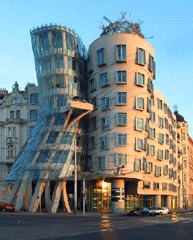
Gehry’s ‘Dancing Building’ in Prague.
If cities are the future, then now is the moment to ask some important questions about the future of cities.
The World Urban Forum runs June 19 - 23, in the fair city of Vancouver. The thinkers and the talkers will be hard at work, posing questions about sustainability and design and envisioning new urbanities. Particularly relevant to those discussions will be contributions from architects, who have the responsibility for shaping those cities.
But, as Bob Geldof says in the new documentary, The Sketches of Frank Gehry, architects have a lot to answer for. No wonder architects all seem to be in long-term therapy. To paraphrase Geldof paraphrasing Evelyn Waugh, "If one meets an architect at a party, one's first duty should be to slap them."
And indeed, a slap in the face of straight edges everywhere is the work of Gehry, who does to steel and aluminum what someone else might do to a crumpled piece of paper. There is beauty in chaos, but there is also ugliness, and as some of the people interviewed in the film note, many of Gehry's designs are extraordinarily ugly.
Concrete risks
But artists take risks; that is their job. And Gehry is both architect and artist with both job descriptions bringing the weight of insecurity. Despite the fact that Gehry is, by most accounts, an architectural superstar, he is prone to agonizing bouts of self-doubt. Upon visiting the Guggenheim Museum in Bilbao, a structure that is perhaps one of the most celebrated contemporary buildings in the world, Gehry claims to be horrified. "How could they let me do this?" he asks. Whether he is in fact being disingenuous, is difficult to say.
The man is a bit of a paradoxical creature, both an “aw shucks” everyman and a superstar, lauded and loathed in equal measure. The film lets Gehry tell his own life story, from his childhood in Toronto, to his move to L.A., art classes, a failed first marriage, a couple of bankruptcies, a name change from Goldberg to Gehry and, finally, the glories of fame and fortune. Of course, in the film, as in life, things are not nearly so linear.
The film is made by his friend Sydney Pollack and features the usual talking heads yakking away, although the cast of characters is a curious combination of chairmen of the board (Michael Eisner, Barry Diller) and freaky artists. (Julian Schnabel, get some clothes on for God's sake!) Details of Gehry's life are casually discussed, and much of the film's charm comes out of his exchanges with Pollack. It's like listening in to a conversation between two friends looking back over the course of their lives.
Plans of infinity
Pollack is not a particularly introspective documentary maker; he is content to let his subject merely expound and ramble at length. However, in Gehry's case, this actually works. He is a good raconteur: witty and amiable. And as he drives and talks, and caresses the skins of his own buildings, he is never less than easy to listen to. The fact that larger issues related to architecture are only cursorily addressed is not the fault of the film.
Whether or not Gehry has any insights about the larger issues of designing buildings and cities themselves, his work is interesting in light of urban planning: not simply because it elevates the notion of architecture to something beyond mere service, but in that it reworks the rules themselves. If his work offers any type of lesson, it's that in rethinking the idea of cities we need to entertain infinite and hitherto never considered possibilities, all grounded by practicality -- transit, sewage, schools and a good grocery store. Urban Fare begone!
We are living the results of some of these conversations in Vancouver. If you visit it regularly, you might not recognize the Vancouver downtown core from one week to the next; the pace of change is so rapid as to outstrip human comprehension or, more importantly, understanding. And yet the nature of making art (or architecture) requires an act of trying to understand what you are doing in mid-leap. But of course, a painting won't fall down on your head and kill you if it doesn't work (with the possible exception of Schnabel's work that is). Only the long view of history will enable us to clearly ascertain what worked and what did not; we are all forced to let time be the judge.
Tenuous certainties
The larger questions of architecture, cityscapes and the politics of city-building are deserving of a film all of their own. Luckily for us in little old Vancouver, the World Urban Forum will examine in depth the issues surrounding modern cities, and they are multiple. Not the least of which is that, in the next 50 years, most of the world's population will be living in cities. How then to house this influx? If you want an example of what not to do, look only to City Limits: Slums of the World, a series of films offered next week at the Vancity Theatre. As for what happens when there are too many poor people all in one place: you end up with every possible variation of human suffering, and quite possibly some that haven't even been invented yet. These films -- Pixote, Tsotsi, The Cool World, In Vanda's Room, Ali Zaoua, Salaam Bombay -- often focus on the poorest and the most vulnerable, especially small children living lives of desperation, poverty, and often unremitting horror. But despite the dark side of urban living, people love their cities with a remarkable passion. They are home after all to billions of souls worldwide.
Vancouver has been hailed recently in such magazines as Canadian Geographic as something of an urban planning success story (the downtown core in particular with its mixture of live/work space and density). It offers a direct contrast to many U.S. cities, with their dead city centres and urban sprawl everywhere else. Despite the good press, things are far from perfect here. If Vancouver is to learn anything from such films and from the Urban Forum, it has to look to the examples (good and bad) of other major centres, which are all similarly grappling with issues of sustainability, transportation, housing and social issues so complex that they might necessitate some mass slapping of architects everywhere.
But the vexatious problems of huge numbers of people in an increasingly tenuous world won't be solved by any abstract combination of glass and steel, no matter how artful. How exactly, or if, they will be solved at all, is the much bigger question. Having recently visited two of the world's most remarkable cities (Paris and London), I discovered one can learn a lot from the simplest things, like that living and working close together is a good idea, or that underground subways work better than buses to transport the masses hither and thither. The parks of Paris continue to be a revelation, utterly beautiful, and somehow wonderfully democratic, with attractions for every age -- puppet shows, carousels, sculpture, and grass that no one is allowed to sit on. Despite the curious last fact, Parisian parks live in my brain as the truest embodiment of a truly world class city. Vancouver has a ways to go.
Dorothy Woodend reviews films for The Tyee every Friday.
Related stories: David Beers talks with Dream City author and urban planner Lance Berelowitz; James Glave interviews Dr. Sustainability, UBC’s John Robinson; and Charles Montgomery writes about the 'Dialogue of Cities.' ![]()


22
Login or register to post comments
Steve P
5 years ago
Comments on "'If One Meets an Architect, Slap Him'"
Architects and planners get slapped regularly in this region at public meetings. I don't think it matters now nice the building is -- people rarely like construction projects to occur near them. Public hearings in this region are astoundingly vicous.
The final form of our buildings often has little to do with the desire of the architect, and much to do with the regulations of planning departments, which have much influence over why so many buildings and urban centres look the same.
Skip Tracer
5 years ago
People forget one important fact about Vancouver's wonderous and mostly accidental status as most livable city: the majority of people don't live in its nicest parts (the ones written about in the international press) This will continue to be the case even more as horrific developments creep up the mountains in an eastward direction with no architechtural or planning vision whatsoever.
Steve P
5 years ago
Skip:
Which developments have no planning vision?
TheObserver
5 years ago
Ironically enough, Vancouver is the world's most liveable city for those who don't live here (ie, Coal Harbour, where most condos are owned by non-Vancouverites). On the flipside, the places where Vancouverites do live (the rest of Vancouver proper, East Vancouver, the suburbs) are mostly unliveable.
Davey-boy
5 years ago
I grew up in North Van, and I lived for many years in Kerrisdale, Kits, Oakridge, and Fairview. Vancouver has some splendid features, but tops my list of "most over-rated cities".
I still like the North Shore, where the ravines are your friends when biking, and the Upper Levels Highway is your buddy when you're driving. And the Seabus is a drunken pedestrian's dream come true.
Living in Kits was great, for all of the obvious reasons.
But none of those places measure up to life in Victoria, London, Barcelona, and a few other places I've spent time in. Hell, I liked living in Inuvik, NWT better than Kerrisdale or Oakridge.
World's most livable city? What a crock.
And if you live way out in the 'burbs, you live in a place no different from any suburb of Toronto, Detroit or Atlanta.
Moving to Langley? Might as well make it Mississauga and be done with it.
Small towns beat the big city any day of the week. But few city dwellers know that.
Bailey
5 years ago
I think Frank Lloyd Wright taught a lesson that seems to have been forgotten; that each building exists in it's environment. It should be designed so that when it's there, the environment it lives in is not only not offended, it's enhanced.
Why have architects abandoned this obvious truth? I'm currently watching a 9 story shredded crackerbox being dropped into an exquisite site on Parksville beach.
This building steals the view (and property value) of hundreds of people and clashes so vehemently with this setting, worthy of a Cartier ruby, that I think it ruins it.
It's probably not ugly per se,it might look good in a city neighbourhood someplace without much visual value to affect, but it ignores completely the world-class wonders all around it.
Why would anybody do that? A site to rival Wright's hillside with creek. Do architects also ignore the lessons of the engineers and physicists who tell them about structural properties of materials? Obviously not, so why do they insist on ignoring this other important principle?
Forget slapping these people, what they deserve is to be spanked.
BC Mary
5 years ago
Wha-a-at?? A 9-storey building on Parksville Beach?? That's where my place is ... !! and although it already had far too many people living at the water's edge when I was last there (Sept. '05), it surely wasn't being assaulted by an ugly high-rise.
But then, there seems to be a certain weakness on the town council, or there wouldn't be 250 units on the Englishman River estuary, either. The thought of tax revenues seems irresistible. Guess it's the same with an ugly high-rise.
I'll be there for the summer, as of June 28, Bailey. Would I recognize you if we both were at the little round veggie shop at the same time?
Or hey, coffee at Tigh-na-mara? We can plan a spanking ... or preferably a drop-kicking.
Bailey
5 years ago
My goodness Miss Mary. That might be the most interesting offer I've had all week. I'd be honoured to sample a veggie with you, and I'm also quite fond of coffee.
Any old time.
BC Mary
5 years ago
Great!
I'd love it if you would pencil me into your busy schedule for coffee on a day after the busy Firsta July weekend? At Tigh-na-mara?
And much as I'd like to sweep you off your clever feet, please, dear soul, fear not: I am a very old lady with a tired heart ... with much I'd like to talk to you about.
Hooeee ... isn't this the first-ever on-line Tyee date?!! <>
trophycase
5 years ago
I've been living in Vancouver for over two years now, and I ain't dead yet. There's some proof that you can live here.
I was at Garden Park for Britannia's soccer league this morning, and it struck me then, how nice the space felt. A couple years back I was in a very similar situation in Windsor, Ontario. There the kids were playing soccer inside the old Ford test track. There's not a tree in sight. Suburban development edges the industrial park, and while the kids there were having fun, the space didn't inspire it.
You can't blame architects for the good in Vancouver's neighbourhoods, and you can't blame them for higher density buildings going up in areas closest to the core, and definitely not urban poverty. Architects are no more than over-educated decorators. It's not like they're given a site and told to make the city a better place. They're hired to do a developer's drawings. Like Steve P was saying most buildings are not an architect's expression. Gehry is a superstar because he's doing something different. To conclude that Gehry's design freedom means architects have the freedom to design better cities, is a complete misunderstanding of Gehry's freedom, and wishful thinking at best.
Fiat lux
5 years ago
Having worked in the trades and with architecs for many years, I've long been of the opinion that architects and economists are the most dangerous people on Earth, filling our lives with ugliness, lies and misery.
On construction sites architecs are usually greeted with: "What the hell does that goddamn idiot want now ?
Ed Deak, Big Lake.
Moat
5 years ago
We can blame the architecs as much as we like, however, they only respond to what the market wants or what they think the market wants. People in Vancouver have a fear of anything tall, whether it be trees or buildings.
Give archtecs the freedom from unnecessary restrictive zoning and subsidize residents $50 (to a maximun of $100) per tree, and you will see a different region in a few years. Pocket neighborhoods will develop, and the city will remain green at ground level. Developers will help build parks, if the price is right.
Fii
5 years ago
Hope downtown Vancouver never feels the effects of an earthquake... all that glass- ouch!
Aimless
5 years ago
For a different take on architecture, on public space, and on Frank Gehry, one would do well to visit a Canadian site, the Project for Public Spaces, at
http://www.pps.org/
An essay it its Hall of Shame calls the Gugg and other such inhuman-scale buildings "monuments to architectural ego," in part because:
The site makes very good points about liveability, and is dedicated to making public spaces that people won't just goggle at but will actually use in their daily lives.
Steve P
5 years ago
Real environmentalists live in apartment buildings because fewer resources per capita are required to sustain their existence.
trophycase
5 years ago
Steve P's right. And if those apartment buildings are close to where the occupants work, shop and play, that kind of development is even more sustainable.
I saw a documentary the other day, it was called Super or Regular. It was about Mies, or Meis, von something or other. He made these floating buildings of steel and glass that hovered over plazas and walking space. They looked out of human scale, but were quite livable.
Earlier when Bailey talks of Wright and his truth, I don't know if that applies here. Wright's building wasn't in an urban setting. It is beautiful, and I'd love to live in it or something like it, but that isn't going to solve the problem of poverty in the urban environment.
The urban environment is built up and separate from the natural environment. Buildings separate and define the environment. It's a bit decadent to want to live in an urban environment and maintain a view. Vancouver's 3 story limit has created a bit of a sprawling mess. It's good to hear of higer density buildings going up. You can feel good knowing the view, while you can't see it anymore, may be preserved on the other side of this type of development.
Skookum1
5 years ago
In case I missed it in the article proper and there's something underway I haven't heard about: the one architect whose work I haven't seen in Vancouver yet, and which could only add to the place isntead of detract from it as so much of the new crap on Coal Harbour and False Creek North has done, is Frank Gehry, the 21st Century's answer to Gaudi. All the rest in town is dull, dull, dull - Safdie's library might have been more interesting if its budget hadn't been cut, and we all know the fiddling that uglified the otherwise pristine Wall Centre. The rest of the new junk downtown is a travesty, especially in comparison to the classics of the Marine and Dominion buildings, and the result is an inhuman city with sterile public spaces (but really nifty modern-looking shots for the tourism brochures).
I would love to have seen a Gehry proposal for Woodward's, for example...
But you can blame them for unusable spaces, cold seas of concrete and glass, and rainswept plazas without decent cover or seating.
That some of the problem with such spaces has to do with zoning bylaws or how things are managed, e.g. no music or vendors on BC Place's empty plazas, because theoretically it's "private property" despite being publicly-owned); unused patio space such as next to FedEx on Burrard, where both and Don Francesco and Martini After Six - if this were Europe - would be able to expand their seating into the nice plaza offset from the main sidewalk, but which here is federal property and so not for use by the general public or by commerce; but it sure looked nice in the drawings.
Then there's Robson Square, another monument to Arthur Erickson's ego, er, career, which is devoid of public-space utility despite rave reviews and being smack-dab in the centre of things. Sure, the main atrium outside the courts gets used for salsa/ballroom dancing, but what the hell is such a space doing attached to a ''law court'' instead of a social/entertainment space in the first place? And why load down the street-level spaces with 9-5 government offices like Motor Vehicle services, which leave the place sterile after hours, or the bland, waxed-floor lobby of the downtown UBC campus; which is nearly every bit as lifeless as any other administration building. And a fake hockey rink - a salute to our Canadian-ness, I suppose, in an otherwise rain-drenched city - that kids are kicked off of for having fun on, and which is isolated from the street and public view. Rockefeller Centre it ain't, and why the ice rink in the first place? Might as well put a stuffed beaver there, too....
OK, OK, it's not the architects; it's the planners and politicians who hire and direct them who insist on such civic absurdities. But don't the architects have any balls to tell the planners that what they're doing is wrong, or are they all in the same camp? Of course they are; and it's a camp where "imagination" isn't taught, nor is any actual sense of civilization and socialization. Architects, like "classical composers", are party to an ideology which has set itself up to push people's perceptions, to "lead" them, as if they knew what they were doing simply on the basis of some overworked theories and the occasional obsessions (like Erickson's passion for "the marble of the future", otherwise known as pitted grey concrete in big slabs and no decoration).
The next major civic building in Vancouver - say the Whitecaps Stadium, once a better site for it is found (and I nominate the eastern end of the False Creek flats, near Terminal and Main) - should be built by someone like Frank Gehry; something to look at, that enhances the city instead of making it look like a cheap Christmas tree like that atrocious glo-ball at Science World.
BC Mary
5 years ago
Skookum 1 ... agreed, B.C. needs a Frank Gehry building but Gehry also needed a Ken Thomson. Fact o'life.
It was Thomson (an unusual billionaire who cared more about art than money, they say) who made possible the spectacular new glass addition to the Ontario Art Gallery ... to house the art which was something else Thomson gave to the AGO.
There's money in Vancouver but not enough appreciation of art. They ... they say everybody's out skiing or something.
Pssstt ... Jimmy, have you thought about this? Li Ka Shing ain't gonna care. B.C. problem.
Steve P
5 years ago
Although there is some dialogue, the architect/developer/planning consultant who burns bridges with City hall will never get their project approved.
Bailey
5 years ago
Dear trophycase; I know what you mean about the urban environment that must be the setting of all these buildings. Clearly, if you think the 'view' can only be mountains or gardens or other volunteer elements you would be right.
But I think Wright's principle can still apply. The environment for these buildings is other buildings. They are the view for one another. Why should they not enhance their own environment in exactly the same way?
For an example look at Kitsilano's sad attempt to redevelop in the 70's. Lovely, elegant, if elderly houses with real flavour replaced by stucco lowrise cubes. Ugly as hell and no net gain in residency over the houses.
Then later, under protest, developers began to design new buildings along the lines of the neighbourhood's original sweet lines, and even rescue some of the pretty Victorians not too far gone.
Take a wander through that neighbourhood sometime. From Burrard to Alma, between Beach and West 12th or 16th. You can still see examples of all these. Look at the old and you see what was, at the stuccoboxes and see what might have been, at the new residences and I think you'll agree Wright's point is made. Even in a city, context is everything.
Skookum1
5 years ago
Well, you'd hope Victor Li would care even if his old man wouldn't. One thing to buy fancy houses and fine furniture and sports cars and a few stylish companies for your portfolio, another to philanthropize on the order of the Diamonds or Adaskins David Lams and other philanthro-culture mavens. I'm sure Concord Pacific (by the corporate name/tax writeoff) contributes to, for example, the VSO and VAG. But does Victor or his old man, or many of the new ex-China wealth here, give a fig for anything here but the property value? Surely not our culture, much less whether or not our city looks human; because Shanghai, Shenzhen and other new-city developments in China surely DON'T (as with Seoul and other Asian cities, where monumental has replace human as the preferred scale for architecture).
As for Jimmy Pattison......uh, methinks he was one of the poohbahs who helped pick out the design for BC Place et al; Socred futurism is what you'll get from him, that is, and what you've already gotten. Consider the architecture of your average new Save-On and you'll get where I'm coming from on that one.
I can only help Paul Allen takes an interest in laying on the pizazz - but getting it past the cinched-up constipations of city council and the NIMBYs, whatever it is, will be rough; a Frank Gehry-designed Whitecaps Stadium I'd go for (but I still think it's best located in eastern False Creek flats, near Glen/China Creek, or out in the Still Creek/Bridge Studios area.
Actually, mentioning Paul Allen, it might take an American or European developer/moneyboy to throw us a truly spectactular design since Canadian developers don't seem to have the vision, despite the Reichman's Canary Wharf (if Canary Wharf was a good thing, I couldn't say); the new crystal-tower hotel to be built behind/over the Georgia and the Wall Centre are a taste of greatness not seen in a very long time around here (not sure exactly when there was greatness, except maybe in the the days of the 2nd Hotel Van and the Marine Bldg).
IMO it's time for a Second Renaissance. A return to human and natural forms, actual decoration (instead of just modernist designs evoking architectural ornaments of ages past, as has been in vogue since the '80s).
darcy.mcgee
5 years ago
Safdie's library is appaling. I can't stand that place.
I just saw Sketches of Frank Gehry and that library typifies Gehry's comments about reaching back to Greek styles for inspiriation in buidlings. We've been there and done that.
The Library has a huge amount of wasted space, a horrible interior "courtyard"
The only good thing about it is the staircase out front, which acts as a gathering place.
Except it's such a weird spot, who would want to gather there? It exists only because Robson Square fails so utterly miserably.